Solving Quadratic Equations by Factoring and Graphing  By: Megan Littlewood
Equations of Quadratics  There are two basic forms of quadratic equations: General form: y= ax 2 +bx+c Standard form: y=a(x-h) 2 +c (or k) Example of standard form: Y=(x+6) 2 +2 x- coordinate but with the opposite sign y-coordinate of the vertex Vertex = (-6,2)
Writing Equations in Standard Form  We’ll start with an example: Find the equation when the vertex is (3,-1) and x-intercepts of 2 and 4 Y= a(x+h) 2 +k Y=a(x-3) 2 -1 0=a(2-3) 2 -1 0=a(-1) 2 -1 1=a(-1) 2 a=1  So the equation of the line is y= (x-3) 2 -1 Plug the vertex coordinates in for h and k, remember to flip the sign for the h value! Let y=0 and x=2 to solve for a Next we’ll learn some other ways to solve quadratic equations!
Completing the Square (Going from general form to standard form)   Example: Put y=x 2 +10x+23 into standard form Section off the ‘x’ terms Y=(x 2 +10x)+23 Add a blank at the end of the bracket Y=(x 2 +10x+___)+23 Subtract this number from the ‘c’ value  23-25 Y=(x 2 +10x+25)+23-25 Factor the brackets and simplify  Y=(x+5) 2 -2 Hooray! You have now completed the square! 10/2=5 5 2 =25 Plug this number into the blank
Vertex Formula  From the general formula we can conclude that  Y=-b/2a X=4ac-b 2 /4a Therefore the vertex formula is: (-b/2a, 4ac-b 2 /4a) Example: y=-4x 2  +12x +5 a=-4 v=  -12 b=12   2(-4) c=5 , 4(-4)(5)-(12) 2 4(-4) V= (3/2, 14)
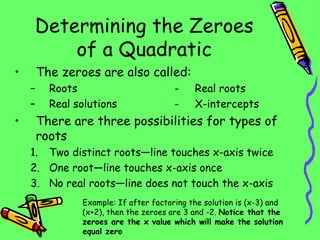
Determining the Zeroes of a Quadratic The zeroes are also called: Roots  -  Real roots Real solutions -  X-intercepts There are three possibilities for types of roots Two distinct roots—line touches x-axis twice One root—line touches x-axis once No real roots—line does not touch the x-axis Example: If after factoring the solution is (x-3) and (x+2), then the zeroes are 3 and -2.  Notice that the zeroes are the x value which will make the solution equal zero
The Quadratic Formula First of all, the equation must be in the form: y=ax 2 +bx+c Also make sure that the quadratic is in descending powers of x  Note that there will probably be two answers The Formula: x=-b+-  b 2 -4ac 2a Example:2x 2 -5x+2=0 X=-(-5)+-  (-5) 2 -4(2)(2) 2(2) X=5+-  9 4 x=2 and x=1/2 These are the zeroes of the equation **For the discriminant remember that no value of x can ever make something in the denominator equal zero
The Square Root Principle  You can use the square root principle when a number in the equation has a perfect square Example: Solve: x 2 -14=155 x 2 =  169 x=+-13 **Note: Make sure you account for both the positive and negative answer Example 2: x 2 -21=-3 x 2 -18=0 x 2 =  18 x=+-3  2
The Discriminant The radicand from the quadratic formula is called the discriminant b 2 -4ac We can use the discriminant to determine the nature of the roots There are three options: b 2 -4ac>0 b 2 -4ac=0 b 2 -4ac<0 There are two real and distinct roots There are two equal roots There are no real roots **Note: The equation must be in the general form, in descending powers of x
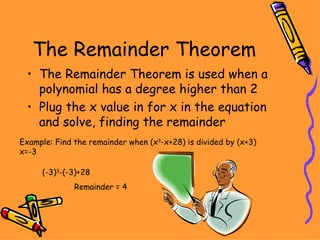
The Remainder Theorem The Remainder Theorem is used when a polynomial has a degree higher than 2 Plug the x value in for x in the equation and solve, finding the remainder Example: Find the remainder when (x 3 -x+28) is divided by (x+3) x=-3 (-3) 3 -(-3)+28 Remainder = 4
The Factor Theorem The Integral Zero Theorem- A factor is a value that divides another evenly, the remainder will always be zero Use the value of the constant to find the factor(s) that will equal zero Example: Find the factors of x 3 +2x 2 -5x-6 -6 +- 1,2,3,6—Guess and check with calculator, continue until you reach zero F(-1)=0—Now to find the other factors, divide the original equation by (x+1) Since the remainder is zero after the division, there are no more factors
Rational Zero Theorem Use this Theorem when the leading coefficient is not 1 x= b/a b is a factor of the constant a is a factor of the first term Example: Find the factors of 6x 3 +13x 2 +x-2 -2 6 +- 1,2 +- 1,2,3,6 F(-1/2)=0 (Therefore (2x+1) is a factor) (2x+1)(6x 2 +10x-4) (2x+1)(3x-1)(x+2) Factor by sum and product:
Synthetic Division Is used as a quicker way to divide, easier than using long division Example: Divide 2x 3 -4x 2 +3x-6 by x+2 2 - Note: Always subtract on the bottom For the top, use the opposite sign of what x equals  2  -4  3  -6 2  -8  19  -44 The factors are: (x+2)(2x 2 -8x+19)-44 (x+2)2(x-2) 2 +11-44 2(x+2)(x-2) 2 -33 x=-2 and x=2 and x=2 The zeroes are:
Solving by Graphing On your graphing calculator, follow these steps to answer quadratic related questions (in a way that does not involve a pencil!) Example: Y=-x 2 +3 Y=-x+2 Hit: CALC INTERSECT  (Do twice) Scroll the curser to the point of intersection (as close as you can get). Hit guess and record the answer, repeat a second time on the second point of intersection
Review There are several methods to finding the roots: Graphing (doesn’t always give exact values of real roots Factoring by sum and product (not all can be factored) Completing the Square  Quadratic Formula Integral/Rational Zero Theorem If polynomial has a degree higher than 2: Remainder/Factor Theorem Synthetic Division
THE END Math 20 Pure January 2011

Bonus math project

  • 1.
    Solving Quadratic Equationsby Factoring and Graphing By: Megan Littlewood
  • 2.
    Equations of Quadratics There are two basic forms of quadratic equations: General form: y= ax 2 +bx+c Standard form: y=a(x-h) 2 +c (or k) Example of standard form: Y=(x+6) 2 +2 x- coordinate but with the opposite sign y-coordinate of the vertex Vertex = (-6,2)
  • 3.
    Writing Equations inStandard Form We’ll start with an example: Find the equation when the vertex is (3,-1) and x-intercepts of 2 and 4 Y= a(x+h) 2 +k Y=a(x-3) 2 -1 0=a(2-3) 2 -1 0=a(-1) 2 -1 1=a(-1) 2 a=1 So the equation of the line is y= (x-3) 2 -1 Plug the vertex coordinates in for h and k, remember to flip the sign for the h value! Let y=0 and x=2 to solve for a Next we’ll learn some other ways to solve quadratic equations!
  • 4.
    Completing the Square(Going from general form to standard form) Example: Put y=x 2 +10x+23 into standard form Section off the ‘x’ terms Y=(x 2 +10x)+23 Add a blank at the end of the bracket Y=(x 2 +10x+___)+23 Subtract this number from the ‘c’ value 23-25 Y=(x 2 +10x+25)+23-25 Factor the brackets and simplify Y=(x+5) 2 -2 Hooray! You have now completed the square! 10/2=5 5 2 =25 Plug this number into the blank
  • 5.
    Vertex Formula From the general formula we can conclude that Y=-b/2a X=4ac-b 2 /4a Therefore the vertex formula is: (-b/2a, 4ac-b 2 /4a) Example: y=-4x 2 +12x +5 a=-4 v= -12 b=12 2(-4) c=5 , 4(-4)(5)-(12) 2 4(-4) V= (3/2, 14)
  • 6.
    Determining the Zeroesof a Quadratic The zeroes are also called: Roots - Real roots Real solutions - X-intercepts There are three possibilities for types of roots Two distinct roots—line touches x-axis twice One root—line touches x-axis once No real roots—line does not touch the x-axis Example: If after factoring the solution is (x-3) and (x+2), then the zeroes are 3 and -2. Notice that the zeroes are the x value which will make the solution equal zero
  • 7.
    The Quadratic FormulaFirst of all, the equation must be in the form: y=ax 2 +bx+c Also make sure that the quadratic is in descending powers of x Note that there will probably be two answers The Formula: x=-b+- b 2 -4ac 2a Example:2x 2 -5x+2=0 X=-(-5)+- (-5) 2 -4(2)(2) 2(2) X=5+- 9 4 x=2 and x=1/2 These are the zeroes of the equation **For the discriminant remember that no value of x can ever make something in the denominator equal zero
  • 8.
    The Square RootPrinciple You can use the square root principle when a number in the equation has a perfect square Example: Solve: x 2 -14=155 x 2 = 169 x=+-13 **Note: Make sure you account for both the positive and negative answer Example 2: x 2 -21=-3 x 2 -18=0 x 2 = 18 x=+-3 2
  • 9.
    The Discriminant Theradicand from the quadratic formula is called the discriminant b 2 -4ac We can use the discriminant to determine the nature of the roots There are three options: b 2 -4ac>0 b 2 -4ac=0 b 2 -4ac<0 There are two real and distinct roots There are two equal roots There are no real roots **Note: The equation must be in the general form, in descending powers of x
  • 10.
    The Remainder TheoremThe Remainder Theorem is used when a polynomial has a degree higher than 2 Plug the x value in for x in the equation and solve, finding the remainder Example: Find the remainder when (x 3 -x+28) is divided by (x+3) x=-3 (-3) 3 -(-3)+28 Remainder = 4
  • 11.
    The Factor TheoremThe Integral Zero Theorem- A factor is a value that divides another evenly, the remainder will always be zero Use the value of the constant to find the factor(s) that will equal zero Example: Find the factors of x 3 +2x 2 -5x-6 -6 +- 1,2,3,6—Guess and check with calculator, continue until you reach zero F(-1)=0—Now to find the other factors, divide the original equation by (x+1) Since the remainder is zero after the division, there are no more factors
  • 12.
    Rational Zero TheoremUse this Theorem when the leading coefficient is not 1 x= b/a b is a factor of the constant a is a factor of the first term Example: Find the factors of 6x 3 +13x 2 +x-2 -2 6 +- 1,2 +- 1,2,3,6 F(-1/2)=0 (Therefore (2x+1) is a factor) (2x+1)(6x 2 +10x-4) (2x+1)(3x-1)(x+2) Factor by sum and product:
  • 13.
    Synthetic Division Isused as a quicker way to divide, easier than using long division Example: Divide 2x 3 -4x 2 +3x-6 by x+2 2 - Note: Always subtract on the bottom For the top, use the opposite sign of what x equals 2 -4 3 -6 2 -8 19 -44 The factors are: (x+2)(2x 2 -8x+19)-44 (x+2)2(x-2) 2 +11-44 2(x+2)(x-2) 2 -33 x=-2 and x=2 and x=2 The zeroes are:
  • 14.
    Solving by GraphingOn your graphing calculator, follow these steps to answer quadratic related questions (in a way that does not involve a pencil!) Example: Y=-x 2 +3 Y=-x+2 Hit: CALC INTERSECT (Do twice) Scroll the curser to the point of intersection (as close as you can get). Hit guess and record the answer, repeat a second time on the second point of intersection
  • 15.
    Review There areseveral methods to finding the roots: Graphing (doesn’t always give exact values of real roots Factoring by sum and product (not all can be factored) Completing the Square Quadratic Formula Integral/Rational Zero Theorem If polynomial has a degree higher than 2: Remainder/Factor Theorem Synthetic Division
  • 16.
    THE END Math20 Pure January 2011