Arnulfo Peña
Herma Araujo
What is a quadratic equation?
 The name quadratic zome from “squad” meaning
square, the variable get squared (over 2)
 The standard form of a quadratic equation is:
ax´2 + bx + c
 The assumptions are:
 a, b and c are known values. a can't be 0.
 "x" is the variable or unknown (you don't know it
yet).
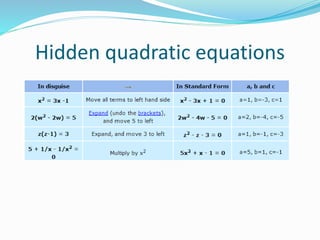
Hidden quadratic equations
How to solve quadratic equations
 There are 3 ways to find the solutions:
 1. You can Factor the Quadratic (find what to multiply
to make the Quadratic Equation)
 2. You can Complete the Square
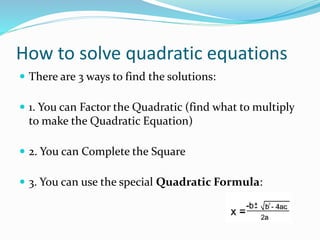
 3. You can use the special Quadratic Formula:
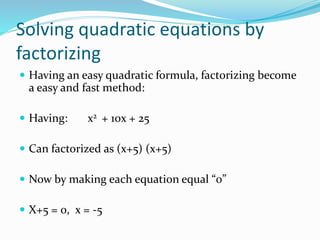
Solving quadratic equations by
factorizing
 Having an easy quadratic formula, factorizing become
a easy and fast method:
 Having: x2 + 10x + 25
 Can factorized as (x+5) (x+5)
 Now by making each equation equal “0”
 X+5 = 0, x = -5
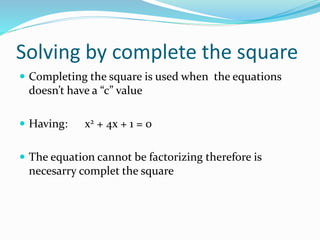
Solving by complete the square
 Completing the square is used when the equations
doesn’t have a “c” value
 Having: x2 + 4x + 1 = 0
 The equation cannot be factorizing therefore is
necesarry complet the square
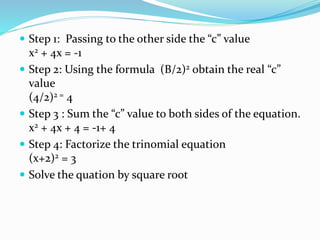
 Step 1: Passing to the other side the “c” value
x2 + 4x = -1
 Step 2: Using the formula (B/2)2 obtain the real “c”
value
(4/2)2 = 4
 Step 3 : Sum the “c” value to both sides of the equation.
x2 + 4x + 4 = -1+ 4
 Step 4: Factorize the trinomial equation
(x+2)2 = 3
 Solve the quation by square root
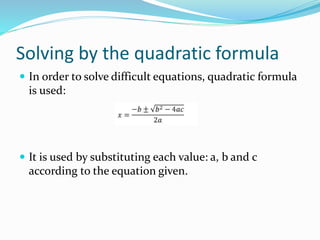
Solving by the quadratic formula
 In order to solve difficult equations, quadratic formula
is used:
 It is used by substituting each value: a, b and c
according to the equation given.
*Completing the Square (Completing the Square)
http://www.mathsisfun.com/algebra/completing-square.html
*Quadratic equations. (2000, January 1). . Retrieved May 29, 2014,
from http://mathworld.wolfram.com/QuadraticEquation.html

Solving quadratic equations

  • 1.
  • 2.
    What is aquadratic equation?  The name quadratic zome from “squad” meaning square, the variable get squared (over 2)  The standard form of a quadratic equation is: ax´2 + bx + c  The assumptions are:  a, b and c are known values. a can't be 0.  "x" is the variable or unknown (you don't know it yet).
  • 3.
  • 4.
    How to solvequadratic equations  There are 3 ways to find the solutions:  1. You can Factor the Quadratic (find what to multiply to make the Quadratic Equation)  2. You can Complete the Square  3. You can use the special Quadratic Formula:
  • 5.
    Solving quadratic equationsby factorizing  Having an easy quadratic formula, factorizing become a easy and fast method:  Having: x2 + 10x + 25  Can factorized as (x+5) (x+5)  Now by making each equation equal “0”  X+5 = 0, x = -5
  • 6.
    Solving by completethe square  Completing the square is used when the equations doesn’t have a “c” value  Having: x2 + 4x + 1 = 0  The equation cannot be factorizing therefore is necesarry complet the square
  • 7.
     Step 1:Passing to the other side the “c” value x2 + 4x = -1  Step 2: Using the formula (B/2)2 obtain the real “c” value (4/2)2 = 4  Step 3 : Sum the “c” value to both sides of the equation. x2 + 4x + 4 = -1+ 4  Step 4: Factorize the trinomial equation (x+2)2 = 3  Solve the quation by square root
  • 8.
    Solving by thequadratic formula  In order to solve difficult equations, quadratic formula is used:  It is used by substituting each value: a, b and c according to the equation given.
  • 9.
    *Completing the Square(Completing the Square) http://www.mathsisfun.com/algebra/completing-square.html *Quadratic equations. (2000, January 1). . Retrieved May 29, 2014, from http://mathworld.wolfram.com/QuadraticEquation.html