Module one
What is Organisation Behaviour? Some Definitions Why study organisational behaviour? Elements of Organisational behaviour Contributing factors Evolution of  OB  Role of a Manager Models of Organisational Behaviour Learning Organisations
The study and application of how employees behave within organizations Known as people skills  Field of study that investigates the  impact that individuals, groups and structure have on behavior within organizations for the purpose of applying such knowledge toward improving an organization.
O.B. is a field of study that investigates the impact that individuals , groups and structures have on behaviour within organizations for the purpose of applying such knowledge towards improving an organization’s effectiveness. O.B. can be defined as the systematic study of the actions and reactions of individuals, groups and sub-systems. O.B. is the study and understanding of individual and group behaviour, patterns of structure in order to to help improve organizational performance and effectiveness. O.B. is one of the most complex and perhaps least understood academic elements of modern general management, but since it concerns the behaviour of people within organizations it is also one of the most central- its concern with individual and group patterns of behaviour makes it an essential element in dealing with the complex behavioural issues thrown up in the modern business world. O.B. is an inter-disciplinary behaviour science studying phenomena and dynamics(processes) of organizations and their various units. Some definitions of OB
Definition: The study of human behavior, attitudes, and performance in organizations. Value of OB: Helps people attain the competencies needed to become effective employees, team leaders/members, or managers Competency = an interrelated set of abilities, behaviors, attitudes, and knowledge needed by an individual to be effective in most professional and managerial positions
Chart the evolution of management thought on the nature of the organization Understanding of the organizational factors that influence work Understanding of how the work environment shapes organizational performance
consideration of the interaction among the formal structure (organisational context in which the process of management takes place) the tasks to be undertaken the technology employed and the methods of carrying out work the behaviour of people the process of management the external environment
Interrelated dimensions influencing behaviour: The Individual - working environment should satisfy individual needs as well as attainment of organisational goals. The Group - formal and informal.  Understanding of groups complements a knowledge of individual behaviour. The Organisation - impact of organisation structure and design, and patterns of management, on behaviour. The Environment - technological and scientific development, economic activity, governmental actions.
 
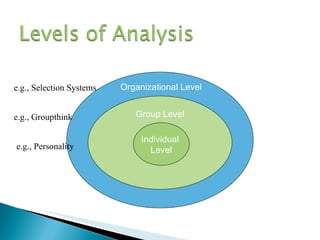
e.g., Selection Systems e.g., Groupthink e.g., Personality Group Level Individual  Level Organizational Level
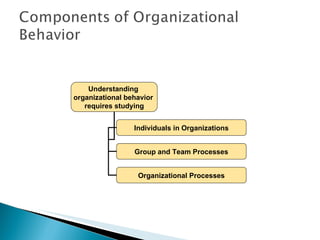
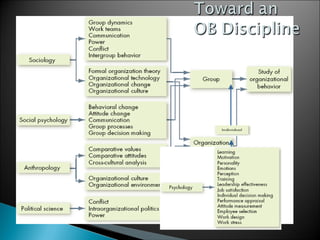
Understanding  organizational behavior  requires studying Individuals in Organizations Group and Team Processes Organizational Processes
Note that organizations are “ open systems , ” such that their long term effectiveness is determined by their ability to anticipate, manage, and respond to changes in their environment, with such changes resulting from external forces and/or stakeholders External forces   include the labor force, the natural environment, the economy, and different cultures, while   stakeholders  include shareholders, customers, competitors, suppliers, creditors, governmental agencies and their regulations  Note the impact of these environmental influences on individual, interpersonal, team, and organizational processes; organizations that do not effectively adapt to environmental change will fail Organisations as Open systems
Consciously coordinated social unit   Composed of two or more people   Functions on a continuous basis to achieve a common goal   Characterized by formal roles that define the behavior of its members
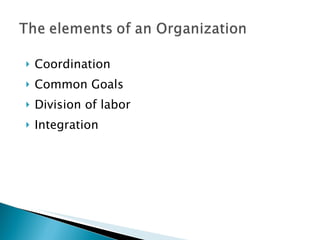
Organization :  An organization has four essential elements (a) Group of people (b) Interacting with each other (c )In a structured manner (d) Towards a common objective Management: Implies getting things done through and with people Manager: He is the dynamic, life-giving element in every organization. And it is the quality and performance of its managers which is the only effective advantage an enterprise in a competitive economy can have and particularly in a business enterprise. Basic Definitions related to OB
To provide an understanding of what goes on at the workplace. Four aspects need to be explained viz. Definition, goals, forces and O. B. ’s major characteristics O.B.  is the systematic study and careful application of knowledge about how people- as individuals and as members of groups –act within organizations. It strives to identify ways in which people can act more effectively. O.B. provides managers with the tools to: (a) to understand the behavior of individuals (b) to understand the complexities of inter-personal relations (c )to examine the dynamics of relationships within small groups –both formal teams and informal groups (d) organizations can be viewed as whole systems that have inter-organizational relationships  What is organisational Behaviour?
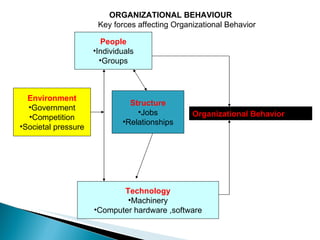
3 GOALS: Most sciences share four goals-to describe, understand, predict and control some phenomena.  The field of OB seeks to replace intuitive explanations with systematic study  O.B. has the following goals, 1. Describe , systematically, how people behave under a variety of circumstances 2. Understand  why people behave as they do. 3. Predicting  future employee behavior. 4. Control  at least partially, and develop some human activity at work Managers can utilize the tool of O.B.to influence human behavior , skill development, team effort and productivity. 4 FORCES: There are a wide array of issues and trends that affect the nature of organizations today.  They can be classified under four areas PEOPLE, STRUCTURE, TECHNOLOGY and the ENVIRONMENT
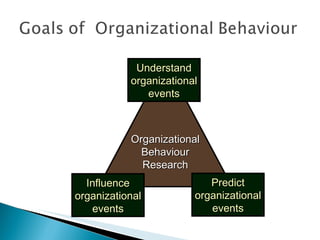
Organizational Behaviour Research Understand organizational events Predict organizational events Influence organizational events
ORGANIZATIONAL BEHAVIOUR Key forces affecting Organizational Behavior People Individuals Groups Environment Government Competition Societal pressure Organizational Behavior Technology Machinery Computer hardware ,software Structure Jobs Relationships
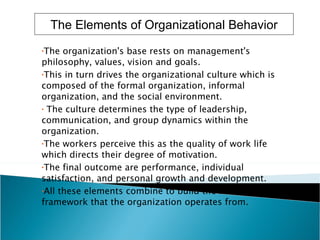
The organization's base rests on management's philosophy, values, vision and goals.  This in turn drives the organizational culture which is composed of the formal organization, informal organization, and the social environment. The culture determines the type of leadership, communication, and group dynamics within the organization.  The workers perceive this as the quality of work life which directs their degree of motivation.  The final outcome are performance, individual satisfaction, and personal growth and development.  All these elements combine to build the model or framework that the organization operates from.   The Elements of Organizational Behavior
Coordination  Common Goals  Division of labor Integration
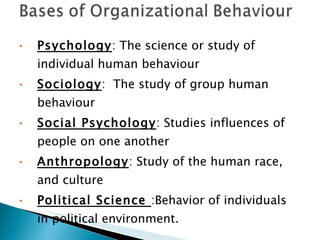
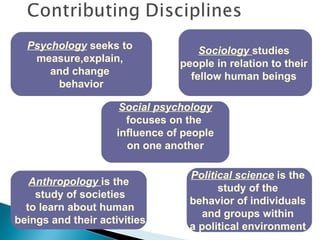
Psychology : The science or study of individual human behaviour Sociology :  The study of group human behaviour Social Psychology : Studies influences of people on one another Anthropology : Study of the human race, and culture Political Science  :Behavior of individuals in political environment.
Psychology   seeks to  measure,explain,  and change  behavior Sociology  studies  people in relation to their  fellow human beings   Social psychology focuses on the  influence of people on one another Anthropology   is the  study of societies to learn about human  beings and their activities Political science  is the  study of the  behavior of individuals  and groups within  a political environment
 
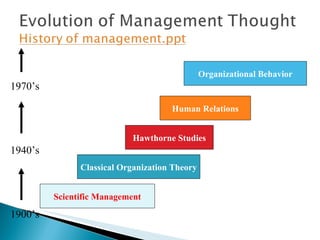
Organizational Behavior Human Relations Hawthorne Studies Scientific Management 1900’s 1940’s 1970’s Classical Organization Theory
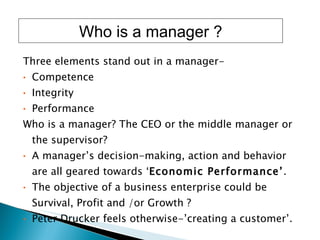
Three elements stand out in a manager-  Competence  Integrity  Performance Who is a manager? The CEO or the middle manager or the supervisor? A manager’s decision-making, action and behavior are all geared towards ‘ Economic Performance’ . The objective of a business enterprise could be Survival, Profit and /or Growth ?  Peter Drucker feels otherwise-’creating a customer’. Who is a manager ?
Managing Managers Managing Worker and Work Managing a Business Managing Time A Manager has to manage Resources- 5 Ms- Money, Materials, Machines, Methods and Man. One of these resources is different from the others. Which one and why? What about Time as a resource? A manager also performs the following functions: Planning, Organizing. Staffing, Directing and Controlling or Leading, Planning, Organizing and Controlling Planning  –determines what results the organization will achieve Organizing-  specifies how it will achieve the results Controlling  –determines whether the results will be achieved Leading-  through planning, organizing and controlling managers exercise  leadership
The three vital determinants of team work are the l eader ”  subordinates  and the  environment .  These factors are interdependent. It is the leader’s responsibility to make the environment conducive to work. He studies the employees individually and insists interest in them. By encouraging the inquisitive employees and by prohibiting insidious elements, he creates hygienic environment. He inculcates the sense of collectivism in employees to work as a team. The resultant output will then be efficiency. A person who manages, conducts, trains, manipulates, directs, deals, supervises, organizes and controls resources, expenditures, an organization, an institution, a team, a household, etc.  Roles and Responsibilities of a manager
Supervise  and manage the overall performance of staff in his department. Analyzing , reporting, giving recommendations and developing strategies on how to improve quality and quantity. Achieve business and organization  goals ,  visions  and  objectives .   Involved in employee  selection , career development, succession planning and periodic  training .   Working out compensations and  rewards .  Responsible for the growth and increase in the organizations'  finances  and earnings.   Identifying  problems, creating choices and providing alternatives courses of actions.  What are the roles and responsibilities of  managerial positions?
Interpersonal relationship skill. Communication skill. A good planner. Decision Maker. Leadership skill. Appraiser. Provide satisfaction  Become an exemplary role model. A good Listener
A representative of subordinates  An appropriate counselor Uses power properly Manages time well Strives for effectiveness Manages and leads   Maintains relationships Source of influence Sanctions
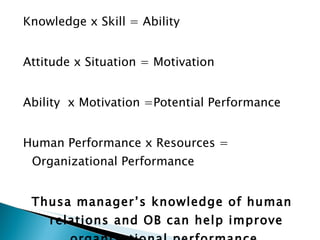
Knowledge x Skill = Ability Attitude x Situation = Motivation Ability  x Motivation =Potential Performance Human Performance x Resources = Organizational Performance Thusa manager’s knowledge of human relations and OB can help improve organizational performance.
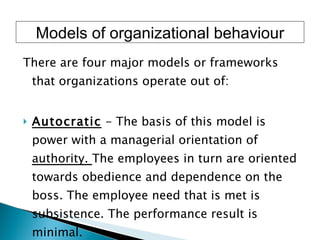
There are four major models or frameworks that organizations operate out of:  Autocratic  - The basis of this model is power with a managerial orientation of  authority.  The employees in turn are oriented towards obedience and dependence on the boss. The employee need that is met is subsistence. The performance result is minimal.  Models of organizational behaviour
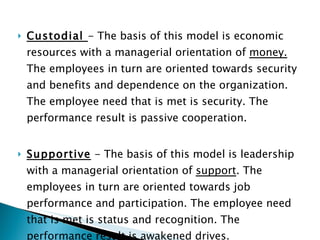
Custodial  - The basis of this model is economic resources with a managerial orientation of  money.  The employees in turn are oriented towards security and benefits and dependence on the organization. The employee need that is met is security. The performance result is passive cooperation.  Supportive  - The basis of this model is leadership with a managerial orientation of  support . The employees in turn are oriented towards job performance and participation. The employee need that is met is status and recognition. The performance result is awakened drives.
Collegial  - The basis of this model is partnership with a managerial orientation of  teamwork . The employees in turn are oriented towards responsible behavior and self-discipline. The employee need that is met is self-actualization. The performance result is moderate enthusiasm.  Although there are four separate models, almost no organization operates exclusively in one.  There will usually be a predominate one, with one or more areas over-lapping in the other models.
The first model, autocratic, has its roots in the industrial revolution. The managers of this type of organization operate out of McGregor's Theory X.  The next three models begin to build on McGregor's Theory Y.  They have each evolved over a period of time and there is no one "best" model.  The collegial model should not be thought as the last or best model, but the beginning of a new model or paradigm.
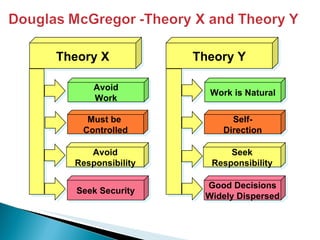
Theory Y Theory X Work is Natural Self- Direction Seek Responsibility Good Decisions Widely Dispersed Avoid Work Must be  Controlled Avoid Responsibility Seek Security
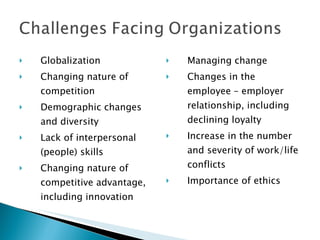
Globalization Changing nature of competition Demographic changes and diversity Lack of interpersonal (people) skills Changing nature of competitive advantage, including innovation Managing change Changes in the employee – employer relationship, including declining loyalty Increase in the number and severity of work/life conflicts Importance of ethics
Four types of organization designs have emerged in response to certain deficiencies in conventional designs and to rapid advances in technology. They are Matrix Network Virtual Learning
Only Learning Organizations will survive in present competitive market It ability is to learn ,create, codify and utilize knowledge faster. It has the capacity to adapt and change. Learning Organizations like individuals constantly learn. Old shibboleth is demolished and a new order created Teaches managers to look at the world afresh
Leader in this field is Senge –’The Fifth Discipline’, He  says  Old methods of TQM, learning from mistakes etc are insufficient  He  put forward 5 compact technologies Systems Thinking  Personal Mastery Mental Models Building shared visions Team learning
" The essence of organisational learning is the organisation's ability to use the amazing mental capacity of all its members to create the kind of processes that will improve its own"  Nancy Dixon, 1994 "Organisations where people continually expand their capacity to create the results they truly desire, where new and expansive patterns of thinking are nurtured, where collective aspiration is set free, and where people are continually learning to learn together"
“ A learning organization is an organization skilled at  creating,  Acquiring Transferring knowledge Modifying its behavior to reflect new knowledge and insights” New ideas are essential if learning is to occur Ideas cannot change an organization, it can only trigger organizational improvement Requires both  generation  and  distribution
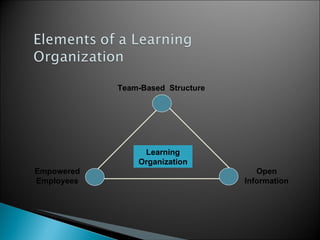
Learning Organization Open Information Empowered Employees Team-Based  Structure
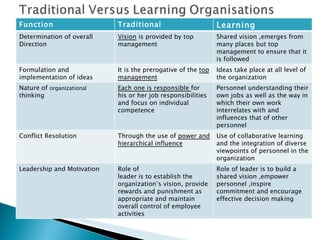
Learning organizations are skilled at five main activities Systematic problem solving Experimentation with new approaches Learning from their own experience Transferring knowledge quickly & efficiently throughout the organization Each is accompanied by its own distinctiveness
Function Traditional  Organization Learning Organization Determination of overall Direction Vision  is provided by top management Shared vision ,emerges from many places but top management to ensure that it is followed  Formulation and implementation of ideas It is the prerogative of the  top   management Ideas take place at all level of the organization Nature of  organizational  thinking Each one is responsible  for his or her job responsibilities and focus on individual competence Personnel understanding their own jobs as well as the way in which their own work interrelates with and influences that of other personnel Conflict Resolution Through the use of  power and hierarchical influence Use of collaborative learning and the integration of diverse viewpoints of personnel in the organization Leadership and Motivation Role of leader is to establish the organization’s vision, provide rewards and punishment as appropriate and maintain overall control of employee activities  Role of leader is to build a shared vision ,empower personnel ,inspire commitment and encourage effective decision making
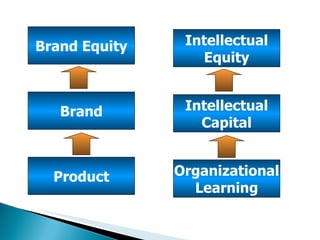
Product Brand Brand Equity Organizational Learning Intellectual Capital Intellectual Equity
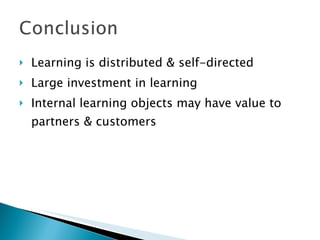
Learning is distributed & self-directed Large investment in learning Internal learning objects may have value to partners & customers
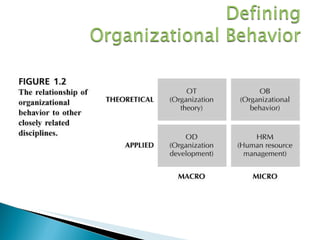
Insert Figure 1.1 here
Any Questions

Module 1

  • 1.
  • 2.
    What is OrganisationBehaviour? Some Definitions Why study organisational behaviour? Elements of Organisational behaviour Contributing factors Evolution of OB Role of a Manager Models of Organisational Behaviour Learning Organisations
  • 3.
    The study andapplication of how employees behave within organizations Known as people skills Field of study that investigates the impact that individuals, groups and structure have on behavior within organizations for the purpose of applying such knowledge toward improving an organization.
  • 4.
    O.B. is afield of study that investigates the impact that individuals , groups and structures have on behaviour within organizations for the purpose of applying such knowledge towards improving an organization’s effectiveness. O.B. can be defined as the systematic study of the actions and reactions of individuals, groups and sub-systems. O.B. is the study and understanding of individual and group behaviour, patterns of structure in order to to help improve organizational performance and effectiveness. O.B. is one of the most complex and perhaps least understood academic elements of modern general management, but since it concerns the behaviour of people within organizations it is also one of the most central- its concern with individual and group patterns of behaviour makes it an essential element in dealing with the complex behavioural issues thrown up in the modern business world. O.B. is an inter-disciplinary behaviour science studying phenomena and dynamics(processes) of organizations and their various units. Some definitions of OB
  • 5.
    Definition: The studyof human behavior, attitudes, and performance in organizations. Value of OB: Helps people attain the competencies needed to become effective employees, team leaders/members, or managers Competency = an interrelated set of abilities, behaviors, attitudes, and knowledge needed by an individual to be effective in most professional and managerial positions
  • 6.
    Chart the evolutionof management thought on the nature of the organization Understanding of the organizational factors that influence work Understanding of how the work environment shapes organizational performance
  • 7.
    consideration of theinteraction among the formal structure (organisational context in which the process of management takes place) the tasks to be undertaken the technology employed and the methods of carrying out work the behaviour of people the process of management the external environment
  • 8.
    Interrelated dimensions influencingbehaviour: The Individual - working environment should satisfy individual needs as well as attainment of organisational goals. The Group - formal and informal. Understanding of groups complements a knowledge of individual behaviour. The Organisation - impact of organisation structure and design, and patterns of management, on behaviour. The Environment - technological and scientific development, economic activity, governmental actions.
  • 9.
  • 10.
    e.g., Selection Systemse.g., Groupthink e.g., Personality Group Level Individual Level Organizational Level
  • 11.
    Understanding organizationalbehavior requires studying Individuals in Organizations Group and Team Processes Organizational Processes
  • 12.
    Note that organizationsare “ open systems , ” such that their long term effectiveness is determined by their ability to anticipate, manage, and respond to changes in their environment, with such changes resulting from external forces and/or stakeholders External forces include the labor force, the natural environment, the economy, and different cultures, while stakeholders include shareholders, customers, competitors, suppliers, creditors, governmental agencies and their regulations Note the impact of these environmental influences on individual, interpersonal, team, and organizational processes; organizations that do not effectively adapt to environmental change will fail Organisations as Open systems
  • 13.
    Consciously coordinated socialunit Composed of two or more people Functions on a continuous basis to achieve a common goal Characterized by formal roles that define the behavior of its members
  • 14.
    Organization : An organization has four essential elements (a) Group of people (b) Interacting with each other (c )In a structured manner (d) Towards a common objective Management: Implies getting things done through and with people Manager: He is the dynamic, life-giving element in every organization. And it is the quality and performance of its managers which is the only effective advantage an enterprise in a competitive economy can have and particularly in a business enterprise. Basic Definitions related to OB
  • 15.
    To provide anunderstanding of what goes on at the workplace. Four aspects need to be explained viz. Definition, goals, forces and O. B. ’s major characteristics O.B. is the systematic study and careful application of knowledge about how people- as individuals and as members of groups –act within organizations. It strives to identify ways in which people can act more effectively. O.B. provides managers with the tools to: (a) to understand the behavior of individuals (b) to understand the complexities of inter-personal relations (c )to examine the dynamics of relationships within small groups –both formal teams and informal groups (d) organizations can be viewed as whole systems that have inter-organizational relationships What is organisational Behaviour?
  • 16.
    3 GOALS: Mostsciences share four goals-to describe, understand, predict and control some phenomena. The field of OB seeks to replace intuitive explanations with systematic study O.B. has the following goals, 1. Describe , systematically, how people behave under a variety of circumstances 2. Understand why people behave as they do. 3. Predicting future employee behavior. 4. Control at least partially, and develop some human activity at work Managers can utilize the tool of O.B.to influence human behavior , skill development, team effort and productivity. 4 FORCES: There are a wide array of issues and trends that affect the nature of organizations today. They can be classified under four areas PEOPLE, STRUCTURE, TECHNOLOGY and the ENVIRONMENT
  • 17.
    Organizational Behaviour ResearchUnderstand organizational events Predict organizational events Influence organizational events
  • 18.
    ORGANIZATIONAL BEHAVIOUR Keyforces affecting Organizational Behavior People Individuals Groups Environment Government Competition Societal pressure Organizational Behavior Technology Machinery Computer hardware ,software Structure Jobs Relationships
  • 19.
    The organization's baserests on management's philosophy, values, vision and goals. This in turn drives the organizational culture which is composed of the formal organization, informal organization, and the social environment. The culture determines the type of leadership, communication, and group dynamics within the organization. The workers perceive this as the quality of work life which directs their degree of motivation. The final outcome are performance, individual satisfaction, and personal growth and development. All these elements combine to build the model or framework that the organization operates from. The Elements of Organizational Behavior
  • 20.
    Coordination CommonGoals Division of labor Integration
  • 21.
    Psychology : Thescience or study of individual human behaviour Sociology : The study of group human behaviour Social Psychology : Studies influences of people on one another Anthropology : Study of the human race, and culture Political Science :Behavior of individuals in political environment.
  • 22.
    Psychology seeks to measure,explain, and change behavior Sociology studies people in relation to their fellow human beings Social psychology focuses on the influence of people on one another Anthropology is the study of societies to learn about human beings and their activities Political science is the study of the behavior of individuals and groups within a political environment
  • 23.
  • 24.
    Organizational Behavior HumanRelations Hawthorne Studies Scientific Management 1900’s 1940’s 1970’s Classical Organization Theory
  • 25.
    Three elements standout in a manager- Competence Integrity Performance Who is a manager? The CEO or the middle manager or the supervisor? A manager’s decision-making, action and behavior are all geared towards ‘ Economic Performance’ . The objective of a business enterprise could be Survival, Profit and /or Growth ? Peter Drucker feels otherwise-’creating a customer’. Who is a manager ?
  • 26.
    Managing Managers ManagingWorker and Work Managing a Business Managing Time A Manager has to manage Resources- 5 Ms- Money, Materials, Machines, Methods and Man. One of these resources is different from the others. Which one and why? What about Time as a resource? A manager also performs the following functions: Planning, Organizing. Staffing, Directing and Controlling or Leading, Planning, Organizing and Controlling Planning –determines what results the organization will achieve Organizing- specifies how it will achieve the results Controlling –determines whether the results will be achieved Leading- through planning, organizing and controlling managers exercise leadership
  • 27.
    The three vitaldeterminants of team work are the l eader ” subordinates and the environment . These factors are interdependent. It is the leader’s responsibility to make the environment conducive to work. He studies the employees individually and insists interest in them. By encouraging the inquisitive employees and by prohibiting insidious elements, he creates hygienic environment. He inculcates the sense of collectivism in employees to work as a team. The resultant output will then be efficiency. A person who manages, conducts, trains, manipulates, directs, deals, supervises, organizes and controls resources, expenditures, an organization, an institution, a team, a household, etc. Roles and Responsibilities of a manager
  • 28.
    Supervise andmanage the overall performance of staff in his department. Analyzing , reporting, giving recommendations and developing strategies on how to improve quality and quantity. Achieve business and organization goals , visions and objectives .   Involved in employee selection , career development, succession planning and periodic training .   Working out compensations and rewards .  Responsible for the growth and increase in the organizations' finances and earnings.   Identifying problems, creating choices and providing alternatives courses of actions. What are the roles and responsibilities of managerial positions?
  • 29.
    Interpersonal relationship skill.Communication skill. A good planner. Decision Maker. Leadership skill. Appraiser. Provide satisfaction Become an exemplary role model. A good Listener
  • 30.
    A representative ofsubordinates An appropriate counselor Uses power properly Manages time well Strives for effectiveness Manages and leads   Maintains relationships Source of influence Sanctions
  • 31.
    Knowledge x Skill= Ability Attitude x Situation = Motivation Ability x Motivation =Potential Performance Human Performance x Resources = Organizational Performance Thusa manager’s knowledge of human relations and OB can help improve organizational performance.
  • 32.
    There are fourmajor models or frameworks that organizations operate out of: Autocratic - The basis of this model is power with a managerial orientation of authority. The employees in turn are oriented towards obedience and dependence on the boss. The employee need that is met is subsistence. The performance result is minimal. Models of organizational behaviour
  • 33.
    Custodial -The basis of this model is economic resources with a managerial orientation of money. The employees in turn are oriented towards security and benefits and dependence on the organization. The employee need that is met is security. The performance result is passive cooperation. Supportive - The basis of this model is leadership with a managerial orientation of support . The employees in turn are oriented towards job performance and participation. The employee need that is met is status and recognition. The performance result is awakened drives.
  • 34.
    Collegial -The basis of this model is partnership with a managerial orientation of teamwork . The employees in turn are oriented towards responsible behavior and self-discipline. The employee need that is met is self-actualization. The performance result is moderate enthusiasm. Although there are four separate models, almost no organization operates exclusively in one. There will usually be a predominate one, with one or more areas over-lapping in the other models.
  • 35.
    The first model,autocratic, has its roots in the industrial revolution. The managers of this type of organization operate out of McGregor's Theory X. The next three models begin to build on McGregor's Theory Y. They have each evolved over a period of time and there is no one "best" model. The collegial model should not be thought as the last or best model, but the beginning of a new model or paradigm.
  • 36.
    Theory Y TheoryX Work is Natural Self- Direction Seek Responsibility Good Decisions Widely Dispersed Avoid Work Must be Controlled Avoid Responsibility Seek Security
  • 37.
    Globalization Changing natureof competition Demographic changes and diversity Lack of interpersonal (people) skills Changing nature of competitive advantage, including innovation Managing change Changes in the employee – employer relationship, including declining loyalty Increase in the number and severity of work/life conflicts Importance of ethics
  • 38.
    Four types oforganization designs have emerged in response to certain deficiencies in conventional designs and to rapid advances in technology. They are Matrix Network Virtual Learning
  • 39.
    Only Learning Organizationswill survive in present competitive market It ability is to learn ,create, codify and utilize knowledge faster. It has the capacity to adapt and change. Learning Organizations like individuals constantly learn. Old shibboleth is demolished and a new order created Teaches managers to look at the world afresh
  • 40.
    Leader in thisfield is Senge –’The Fifth Discipline’, He says Old methods of TQM, learning from mistakes etc are insufficient He put forward 5 compact technologies Systems Thinking Personal Mastery Mental Models Building shared visions Team learning
  • 41.
    " The essenceof organisational learning is the organisation's ability to use the amazing mental capacity of all its members to create the kind of processes that will improve its own" Nancy Dixon, 1994 "Organisations where people continually expand their capacity to create the results they truly desire, where new and expansive patterns of thinking are nurtured, where collective aspiration is set free, and where people are continually learning to learn together"
  • 42.
    “ A learningorganization is an organization skilled at creating, Acquiring Transferring knowledge Modifying its behavior to reflect new knowledge and insights” New ideas are essential if learning is to occur Ideas cannot change an organization, it can only trigger organizational improvement Requires both generation and distribution
  • 43.
    Learning Organization OpenInformation Empowered Employees Team-Based Structure
  • 44.
    Learning organizations areskilled at five main activities Systematic problem solving Experimentation with new approaches Learning from their own experience Transferring knowledge quickly & efficiently throughout the organization Each is accompanied by its own distinctiveness
  • 45.
    Function Traditional Organization Learning Organization Determination of overall Direction Vision is provided by top management Shared vision ,emerges from many places but top management to ensure that it is followed Formulation and implementation of ideas It is the prerogative of the top management Ideas take place at all level of the organization Nature of organizational thinking Each one is responsible for his or her job responsibilities and focus on individual competence Personnel understanding their own jobs as well as the way in which their own work interrelates with and influences that of other personnel Conflict Resolution Through the use of power and hierarchical influence Use of collaborative learning and the integration of diverse viewpoints of personnel in the organization Leadership and Motivation Role of leader is to establish the organization’s vision, provide rewards and punishment as appropriate and maintain overall control of employee activities Role of leader is to build a shared vision ,empower personnel ,inspire commitment and encourage effective decision making
  • 46.
    Product Brand BrandEquity Organizational Learning Intellectual Capital Intellectual Equity
  • 47.
    Learning is distributed& self-directed Large investment in learning Internal learning objects may have value to partners & customers
  • 48.
  • 49.

Editor's Notes

  • #11 Organizational behavior can be examined at 3 levels: organizational, group, and individual. OB is particularly important to managers.
  • #12 Figure 1.3 illustrates how the text covers the three levels of organizational behavior. Part I includes chapters 2-9. Part 2 includes chapters 10-15. Part 3 includes chapters 16-18.
  • #37 Theory X and Theory Y This CTR relates to the material on p. 273. McGregor’s Theory X and Theory Y Douglas McGregor proposed two theories of how human beings view themselves. After studying the way managers treated their employees, McGregor concluded that managers based their decisions on group of assumptions about what motivates individuals and then shapes her or his behavior toward employees to align with those assumptions. He labeled each hypothetical set of assumptions Theory X and Theory Y. Theory X. Under Theory X, managers take an essentially negative view of human nature. Four assumptions of this perspective are: (1) Employees inherently dislike work and whenever possible will attempt to avoid it. (2). Because employees inherently dislike work they must be coerced, controlled, or threatened with punishment to achieve desired goals. (3) Employees will shirk responsibilities and seek form direction whenever possible. (4) Most workers place security above all other factors associated with work and will display little ambition. Theory Y. Under Theory Y, managers take an essentially positive view of human nature. Four assumptions of this perspective are: (1) Employees can view work as being as natural as rest or play. (2) Men and women will exercise self-direction and self-control if they are committed to the objectives. (3) The average person can learn to accept, even seek, responsibility. (4) The ability to make good decisions is widely dispersed throughout the population and is not necessarily the sole province of managers. Discussion note: The text notes that McGregor believed in Theory Y as a more adaptive managerial philosophy. From the standpoint of Maslow’s Hierarchy, Theory X focuses on lower level needs while Theory Y emphasizes higher level needs. Given that managers of both styles can be successful, you might wish to discuss the demand characteristics or self-fulfilling prophecy effects of managerial styles: people behave the way you expect/treat them.
  • #42 2
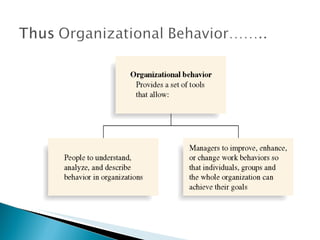
  • #49 4 Figure 1.1 illustrates how organizational behavior concepts and theories allow people to correctly understand, describe, and analyze the characteristics of individuals, groups, work situations, and the organization itself.