Dr. Sonali Sandipta Sahoo
Alliance University
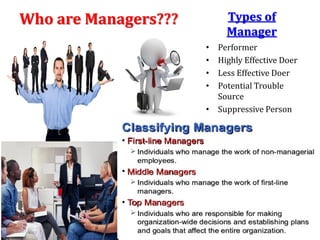
Types of
Manager
• Performer
• Highly Effective Doer
• Less Effective Doer
• Potential Trouble
Source
• Suppressive Person
Who are Managers???
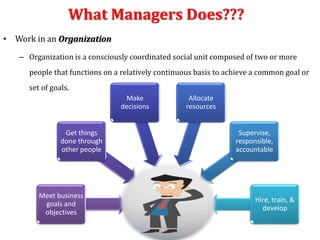
What Managers Does???
• Work in an Organization
– Organization is a consciously coordinated social unit composed of two or more
people that functions on a relatively continuous basis to achieve a common goal or
set of goals.
Meet business
goals and
objectives
Get things
done through
other people
Make
decisions
Allocate
resources
Supervise,
responsible,
accountable
Hire, train, &
develop
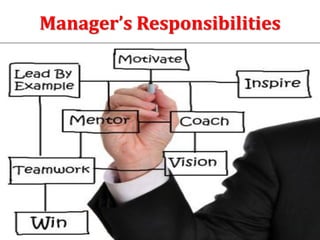
Manager’s Responsibilities
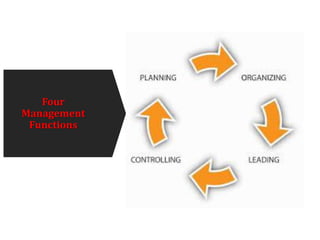
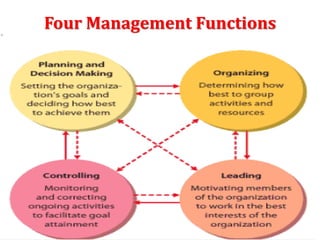
Four
Management
Functions
Four Management Functions
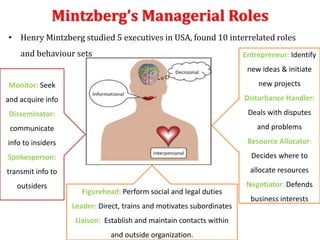
Mintzberg’s Managerial Roles
• Henry Mintzberg studied 5 executives in USA, found 10 interrelated roles
and behaviour sets
Monitor: Seek
and acquire info
Disseminator:
communicate
info to insiders
Spokesperson:
transmit info to
outsiders
Entrepreneur: Identify
new ideas & initiate
new projects
Disturbance Handler:
Deals with disputes
and problems
Resource Allocator:
Decides where to
allocate resources
Negotiator: Defends
business interests
Figurehead: Perform social and legal duties
Leader: Direct, trains and motivates subordinates
Liaison: Establish and maintain contacts within
and outside organization.
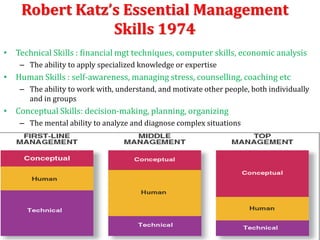
Robert Katz’s Essential Management
Skills 1974
• Technical Skills : financial mgt techniques, computer skills, economic analysis
– The ability to apply specialized knowledge or expertise
• Human Skills : self-awareness, managing stress, counselling, coaching etc
– The ability to work with, understand, and motivate other people, both individually
and in groups
• Conceptual Skills: decision-making, planning, organizing
– The mental ability to analyze and diagnose complex situations
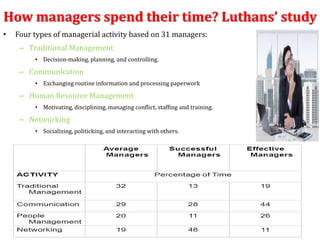
How managers spend their time? Luthans’ study
• Four types of managerial activity based on 31 managers:
– Traditional Management
• Decision-making, planning, and controlling.
– Communication
• Exchanging routine information and processing paperwork
– Human Resource Management
• Motivating, disciplining, managing conflict, staffing and training.
– Networking
• Socializing, politicking, and interacting with others.
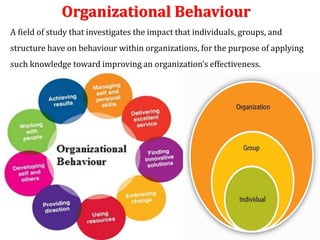
Organizational Behaviour
A field of study that investigates the impact that individuals, groups, and
structure have on behaviour within organizations, for the purpose of applying
such knowledge toward improving an organization’s effectiveness.
Nature of OB
OB has emerged as a separate field of study.
1. A Separate Field of Study and not a
Discipline Only
O.B. has a multidisciplinary orientation and is,
thus, not based on a specific theoretical
background.
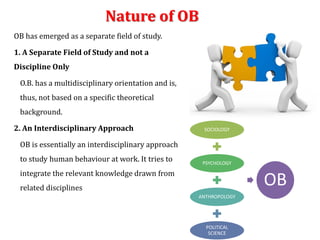
2. An Interdisciplinary Approach
OB is essentially an interdisciplinary approach
to study human behaviour at work. It tries to
integrate the relevant knowledge drawn from
related disciplines
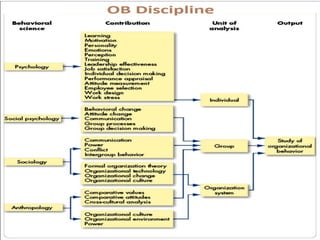
SOCIOLOGY
PSYCHOLOGY
ANTHROPOLOGY
POLITICAL
SCIENCE
OB
Nature of OB
3. An Applied Science
It solves the organizational problems related to human behaviour. O.B.
involves both applied research and its application in organizational
analysis. Hence, O.B. can be called both science as well as art.
4. A Normative Science
While the positive science discusses only cause effect relationship, O.B.
prescribes how the findings of applied researches can be applied to
socially accepted organizational goals.
5. A Humanistic and Optimistic Approach
OB deals with the thinking and feeling of human beings. It is about belief
that they want to be independent, creative and productive and how they
can actualize these potentials.
6. A Total System Approach
The system approach is one that integrates all the variables, affecting
organizational functioning.
Scope of OB
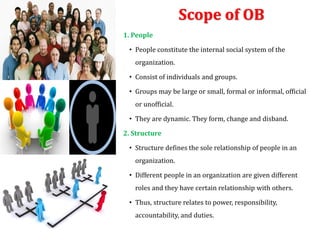
1. People
• People constitute the internal social system of the
organization.
• Consist of individuals and groups.
• Groups may be large or small, formal or informal, official
or unofficial.
• They are dynamic. They form, change and disband.
2. Structure
• Structure defines the sole relationship of people in an
organization.
• Different people in an organization are given different
roles and they have certain relationship with others.
• Thus, structure relates to power, responsibility,
accountability, and duties.
Scope of OB
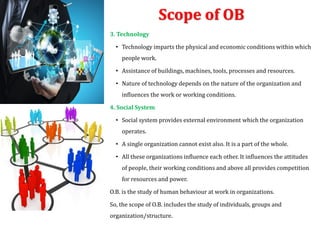
3. Technology
• Technology imparts the physical and economic conditions within which
people work.
• Assistance of buildings, machines, tools, processes and resources.
• Nature of technology depends on the nature of the organization and
influences the work or working conditions.
4. Social System
• Social system provides external environment which the organization
operates.
• A single organization cannot exist also. It is a part of the whole.
• All these organizations influence each other. It influences the attitudes
of people, their working conditions and above all provides competition
for resources and power.
O.B. is the study of human behaviour at work in organizations.
So, the scope of O.B. includes the study of individuals, groups and
organization/structure.
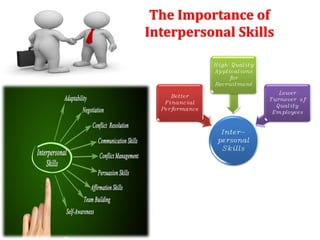
The Importance of
Interpersonal Skills
Inter-
personal
Skills
Better
Financial
Performance
High Quality
Applications
for
Recruitment
Lower
Turnover of
Quality
Employees
Predicting
Organizational
Behaviour
The two are complementary
means of predicting
behaviour.
• Intuition
– Gut feelings
– Individual
observation
– Common sense
• Systematic Study
– Looks at
relationships
– Scientific evidence
(EBM)
– Predicts behaviours
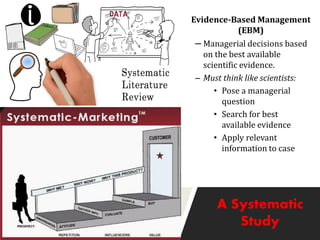
A Systematic
Study
Evidence-Based Management
(EBM)
– Managerial decisions based
on the best available
scientific evidence.
– Must think like scientists:
• Pose a managerial
question
• Search for best
available evidence
• Apply relevant
information to case
Managers Should Use
All Three Approaches
• Intuition is often based on
inaccurate information
• Faddism/ Favoritism prevails in
management
• Systematic study can be time-
consuming
Use evidence as much as possible to
inform your intuition and experience.
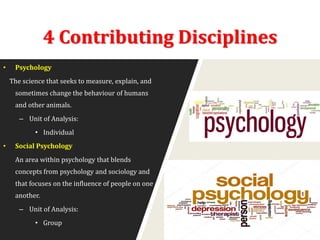
4 Contributing Disciplines
• Psychology
The science that seeks to measure, explain, and
sometimes change the behaviour of humans
and other animals.
– Unit of Analysis:
• Individual
• Social Psychology
An area within psychology that blends
concepts from psychology and sociology and
that focuses on the influence of people on one
another.
– Unit of Analysis:
• Group
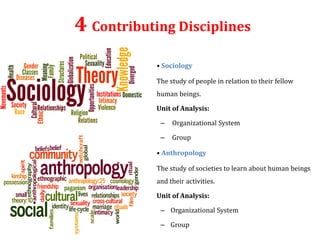
4 Contributing Disciplines
• Sociology
The study of people in relation to their fellow
human beings.
Unit of Analysis:
– Organizational System
– Group
• Anthropology
The study of societies to learn about human beings
and their activities.
Unit of Analysis:
– Organizational System
– Group
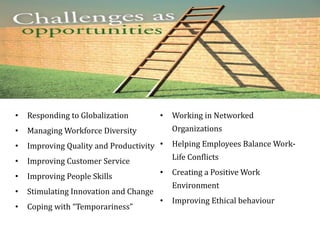
• Responding to Globalization
• Managing Workforce Diversity
• Improving Quality and Productivity
• Improving Customer Service
• Improving People Skills
• Stimulating Innovation and Change
• Coping with “Temporariness”
• Working in Networked
Organizations
• Helping Employees Balance Work-
Life Conflicts
• Creating a Positive Work
Environment
• Improving Ethical behaviour
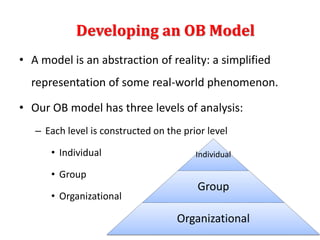
Developing an OB Model
• A model is an abstraction of reality: a simplified
representation of some real-world phenomenon.
• Our OB model has three levels of analysis:
– Each level is constructed on the prior level
• Individual
• Group
• Organizational
Individual
Group
Organizational
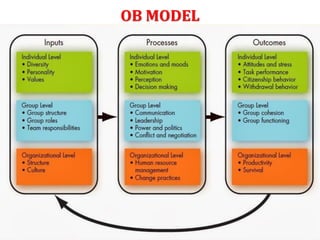
OB MODEL
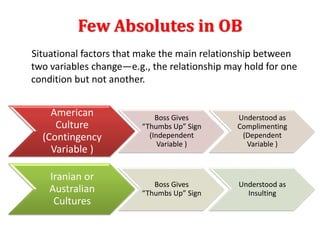
Few Absolutes in OB
Situational factors that make the main relationship between
two variables change—e.g., the relationship may hold for one
condition but not another.
American
Culture
(Contingency
Variable )
Boss Gives
“Thumbs Up” Sign
(Independent
Variable )
Understood as
Complimenting
(Dependent
Variable )
Iranian or
Australian
Cultures
Boss Gives
“Thumbs Up” Sign
Understood as
Insulting
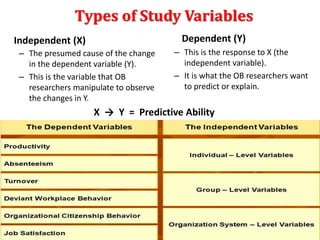
Types of Study Variables
Independent (X)
– The presumed cause of the change
in the dependent variable (Y).
– This is the variable that OB
researchers manipulate to observe
the changes in Y.
Dependent (Y)
– This is the response to X (the
independent variable).
– It is what the OB researchers want
to predict or explain.
X → Y = Predictive Ability
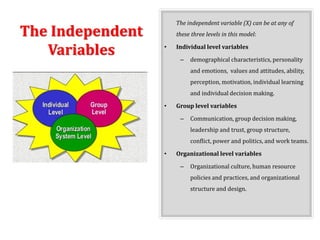
The Independent
Variables
The independent variable (X) can be at any of
these three levels in this model:
• Individual level variables
– demographical characteristics, personality
and emotions, values and attitudes, ability,
perception, motivation, individual learning
and individual decision making.
• Group level variables
– Communication, group decision making,
leadership and trust, group structure,
conflict, power and politics, and work teams.
• Organizational level variables
– Organizational culture, human resource
policies and practices, and organizational
structure and design.
Interesting OB Dependent Variables
• Productivity
– Transforming inputs to outputs at lowest cost. Includes the concepts of
effectiveness (achievement of goals) and efficiency (meeting goals at a
low cost).
• Absenteeism
– Failure to report to work – a huge cost to employers.
• Turnover
– Voluntary and involuntary permanent withdrawal from an organization.
• Deviant Workplace behaviour
– Voluntary behaviour that violates significant organizational norms and
thereby threatens the well-being of the organization and/or any of its
members.
Popular OB Dependent Variables
• Organizational Citizenship behaviour (OCB)
– Discretionary behaviour that is not part of an employee’s formal
job requirements, but that nevertheless promotes the effective
functioning of the organization.
• Job Satisfaction
– A general attitude (not a behaviour) toward one’s job; a positive
feeling about one's job resulting from an evaluation of its
characteristics.
Chapter 01  Organizational Behaviour.pdf

Chapter 01 Organizational Behaviour.pdf

  • 1.
    Dr. Sonali SandiptaSahoo Alliance University
  • 2.
    Types of Manager • Performer •Highly Effective Doer • Less Effective Doer • Potential Trouble Source • Suppressive Person Who are Managers???
  • 3.
    What Managers Does??? •Work in an Organization – Organization is a consciously coordinated social unit composed of two or more people that functions on a relatively continuous basis to achieve a common goal or set of goals. Meet business goals and objectives Get things done through other people Make decisions Allocate resources Supervise, responsible, accountable Hire, train, & develop
  • 4.
  • 5.
  • 6.
  • 7.
    Mintzberg’s Managerial Roles •Henry Mintzberg studied 5 executives in USA, found 10 interrelated roles and behaviour sets Monitor: Seek and acquire info Disseminator: communicate info to insiders Spokesperson: transmit info to outsiders Entrepreneur: Identify new ideas & initiate new projects Disturbance Handler: Deals with disputes and problems Resource Allocator: Decides where to allocate resources Negotiator: Defends business interests Figurehead: Perform social and legal duties Leader: Direct, trains and motivates subordinates Liaison: Establish and maintain contacts within and outside organization.
  • 8.
    Robert Katz’s EssentialManagement Skills 1974 • Technical Skills : financial mgt techniques, computer skills, economic analysis – The ability to apply specialized knowledge or expertise • Human Skills : self-awareness, managing stress, counselling, coaching etc – The ability to work with, understand, and motivate other people, both individually and in groups • Conceptual Skills: decision-making, planning, organizing – The mental ability to analyze and diagnose complex situations
  • 9.
    How managers spendtheir time? Luthans’ study • Four types of managerial activity based on 31 managers: – Traditional Management • Decision-making, planning, and controlling. – Communication • Exchanging routine information and processing paperwork – Human Resource Management • Motivating, disciplining, managing conflict, staffing and training. – Networking • Socializing, politicking, and interacting with others.
  • 10.
    Organizational Behaviour A fieldof study that investigates the impact that individuals, groups, and structure have on behaviour within organizations, for the purpose of applying such knowledge toward improving an organization’s effectiveness.
  • 11.
    Nature of OB OBhas emerged as a separate field of study. 1. A Separate Field of Study and not a Discipline Only O.B. has a multidisciplinary orientation and is, thus, not based on a specific theoretical background. 2. An Interdisciplinary Approach OB is essentially an interdisciplinary approach to study human behaviour at work. It tries to integrate the relevant knowledge drawn from related disciplines SOCIOLOGY PSYCHOLOGY ANTHROPOLOGY POLITICAL SCIENCE OB
  • 12.
    Nature of OB 3.An Applied Science It solves the organizational problems related to human behaviour. O.B. involves both applied research and its application in organizational analysis. Hence, O.B. can be called both science as well as art. 4. A Normative Science While the positive science discusses only cause effect relationship, O.B. prescribes how the findings of applied researches can be applied to socially accepted organizational goals. 5. A Humanistic and Optimistic Approach OB deals with the thinking and feeling of human beings. It is about belief that they want to be independent, creative and productive and how they can actualize these potentials. 6. A Total System Approach The system approach is one that integrates all the variables, affecting organizational functioning.
  • 13.
    Scope of OB 1.People • People constitute the internal social system of the organization. • Consist of individuals and groups. • Groups may be large or small, formal or informal, official or unofficial. • They are dynamic. They form, change and disband. 2. Structure • Structure defines the sole relationship of people in an organization. • Different people in an organization are given different roles and they have certain relationship with others. • Thus, structure relates to power, responsibility, accountability, and duties.
  • 14.
    Scope of OB 3.Technology • Technology imparts the physical and economic conditions within which people work. • Assistance of buildings, machines, tools, processes and resources. • Nature of technology depends on the nature of the organization and influences the work or working conditions. 4. Social System • Social system provides external environment which the organization operates. • A single organization cannot exist also. It is a part of the whole. • All these organizations influence each other. It influences the attitudes of people, their working conditions and above all provides competition for resources and power. O.B. is the study of human behaviour at work in organizations. So, the scope of O.B. includes the study of individuals, groups and organization/structure.
  • 15.
    The Importance of InterpersonalSkills Inter- personal Skills Better Financial Performance High Quality Applications for Recruitment Lower Turnover of Quality Employees
  • 16.
    Predicting Organizational Behaviour The two arecomplementary means of predicting behaviour. • Intuition – Gut feelings – Individual observation – Common sense • Systematic Study – Looks at relationships – Scientific evidence (EBM) – Predicts behaviours
  • 17.
    A Systematic Study Evidence-Based Management (EBM) –Managerial decisions based on the best available scientific evidence. – Must think like scientists: • Pose a managerial question • Search for best available evidence • Apply relevant information to case
  • 18.
    Managers Should Use AllThree Approaches • Intuition is often based on inaccurate information • Faddism/ Favoritism prevails in management • Systematic study can be time- consuming Use evidence as much as possible to inform your intuition and experience.
  • 19.
    4 Contributing Disciplines •Psychology The science that seeks to measure, explain, and sometimes change the behaviour of humans and other animals. – Unit of Analysis: • Individual • Social Psychology An area within psychology that blends concepts from psychology and sociology and that focuses on the influence of people on one another. – Unit of Analysis: • Group
  • 20.
    4 Contributing Disciplines •Sociology The study of people in relation to their fellow human beings. Unit of Analysis: – Organizational System – Group • Anthropology The study of societies to learn about human beings and their activities. Unit of Analysis: – Organizational System – Group
  • 22.
    • Responding toGlobalization • Managing Workforce Diversity • Improving Quality and Productivity • Improving Customer Service • Improving People Skills • Stimulating Innovation and Change • Coping with “Temporariness” • Working in Networked Organizations • Helping Employees Balance Work- Life Conflicts • Creating a Positive Work Environment • Improving Ethical behaviour
  • 23.
    Developing an OBModel • A model is an abstraction of reality: a simplified representation of some real-world phenomenon. • Our OB model has three levels of analysis: – Each level is constructed on the prior level • Individual • Group • Organizational Individual Group Organizational
  • 24.
  • 25.
    Few Absolutes inOB Situational factors that make the main relationship between two variables change—e.g., the relationship may hold for one condition but not another. American Culture (Contingency Variable ) Boss Gives “Thumbs Up” Sign (Independent Variable ) Understood as Complimenting (Dependent Variable ) Iranian or Australian Cultures Boss Gives “Thumbs Up” Sign Understood as Insulting
  • 26.
    Types of StudyVariables Independent (X) – The presumed cause of the change in the dependent variable (Y). – This is the variable that OB researchers manipulate to observe the changes in Y. Dependent (Y) – This is the response to X (the independent variable). – It is what the OB researchers want to predict or explain. X → Y = Predictive Ability
  • 27.
    The Independent Variables The independentvariable (X) can be at any of these three levels in this model: • Individual level variables – demographical characteristics, personality and emotions, values and attitudes, ability, perception, motivation, individual learning and individual decision making. • Group level variables – Communication, group decision making, leadership and trust, group structure, conflict, power and politics, and work teams. • Organizational level variables – Organizational culture, human resource policies and practices, and organizational structure and design.
  • 28.
    Interesting OB DependentVariables • Productivity – Transforming inputs to outputs at lowest cost. Includes the concepts of effectiveness (achievement of goals) and efficiency (meeting goals at a low cost). • Absenteeism – Failure to report to work – a huge cost to employers. • Turnover – Voluntary and involuntary permanent withdrawal from an organization. • Deviant Workplace behaviour – Voluntary behaviour that violates significant organizational norms and thereby threatens the well-being of the organization and/or any of its members.
  • 29.
    Popular OB DependentVariables • Organizational Citizenship behaviour (OCB) – Discretionary behaviour that is not part of an employee’s formal job requirements, but that nevertheless promotes the effective functioning of the organization. • Job Satisfaction – A general attitude (not a behaviour) toward one’s job; a positive feeling about one's job resulting from an evaluation of its characteristics.