ORGANIZATIONAL
BEHAVIOR
AN INTRODUCTION
BBA
UNIT-I
By:
Saurabh Srivastava SMS Varanasi
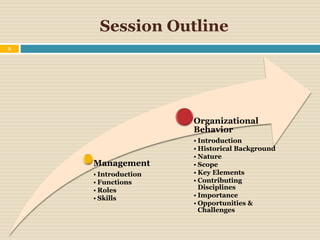
Session Outline
Management
• Introduction
• Functions
• Roles
• Skills
Organizational
Behavior
• Introduction
• Historical Background
• Nature
• Scope
• Key Elements
• Contributing
Disciplines
• Importance
• Opportunities &
Challenges
2
Individuals responsible
for administering an
organization by
managing its people.
•Make decisions
•Allocate resources
•Direct activities of others
to attain goals
3
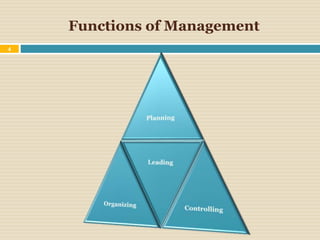
Functions of Management
4
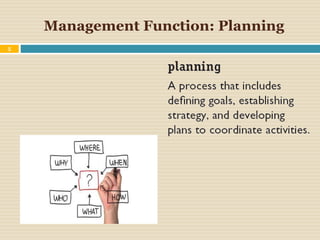
Management Function: Planning
5
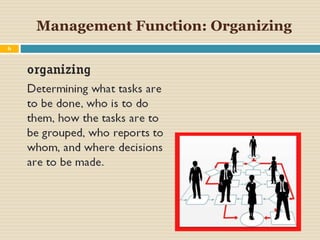
Management Function: Organizing
6
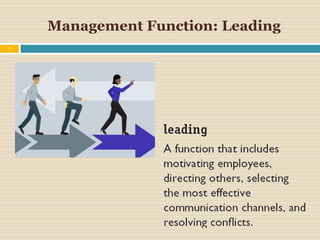
Management Function: Leading
7
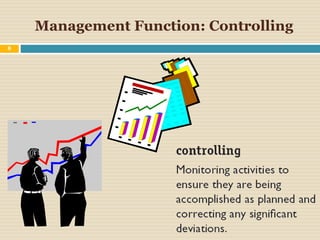
Management Function: Controlling
8
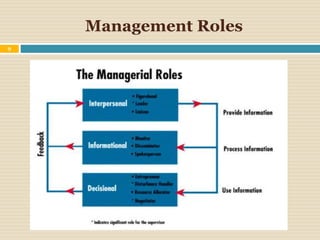
Management Roles
9
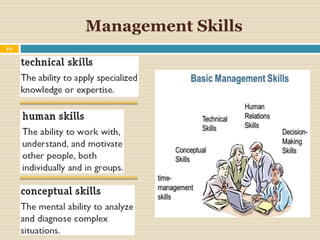
Management Skills
10
The knowledge and application
of Organizational Behaviour
lead to effective managerial
functioning and enhance the
managerial skills.
11
Organizational Behavior
OB
People are the most
important asset of
an organization.
Organizational behavior
(OB) is the study of how
people interact in
organizations.
12
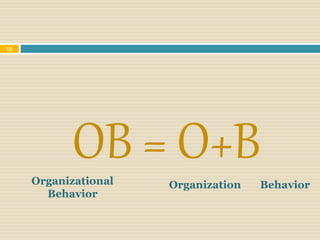
OB = O+B
Organization Behavior
Organizational
Behavior
13
Organization
 An organization is a
collection of individuals
arranged in a particular
way and embedded in an
ever-changing
environment in order to
achieve a common goal.
14
Behavior
 Behavior refers to the
response of an individual
or group to an action,
environment, person, or
stimulus.
 This behavior occurs in
organizations.
15
Organizational Behavior: A
Historical Background
 While Organizational Behavior as a field of academic study wasn’t
fully recognized by the American Psychological Association until
the 1970’s, it’s roots go back to the late 1920’s when the
Hawthorne Electric Company set up a series of experiments
designed to discern how changes in environment and design
changed the productivity of their employees.
 The studies included the effect of various types of breaks (lots of
small breaks, a few long ones, etc.) on productivity, productivity in
isolation, and productivity in varying levels of light.
16
Organizational Behavior... Contd.
 OB is based upon the idea of looking scientifically at behavior and
productivity in the workplace with the goal of increasing the amount and
quality of work an employee can get done, along with the idea that
workers were not interchangeable resources but were instead unique in
terms of their psychology and potential fit with a company.
 Since the 1970’s, a good deal of the work being done in the field of
organizational behavior has been on cultural components of
organizations, including topics such as race, class, gender roles, and
cultural relativism and their roles on group building and productivity.
17
Organizational Behavior
 Organizational behaviour refers to the way individuals
and groups interact within and toward an organization.
 The combined behaviours create a company climate that
can bolster or undermine an organization's success.
 OB is directly concerned with the understanding,
prediction, and control of human behaviour in an
organization.
18
Organizational Behavior... Contd.
 “Organizational Behavior studies the influence and impact that
individuals, groups, and organizational structure have on behavior
within organization for the purpose of applying such knowledge
toward improving an organization's effectiveness.”
- Robins & Judge
 “OB is concerned with the study of human behavior at work. In
other words, OB is study and application of knowledge about how
people as individuals and as groups behave or act in the
organization.”
19
Nature of Organizational
Behavior
20
 OB is a Separate Field of Study
 An Interdisciplinary Approach
 An Applied Science
 A Normative Science
 A Human and Optimistic Approach
 A Total System Approach
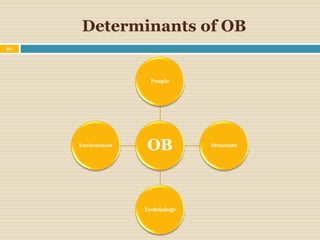
Determinants of OB
OB
People
Structure
Technology
Environment
21
People
22
 An organization consists of people with different
traits, personality, skills, qualities, interests,
background, beliefs, values and intelligence. In order
to maintain a healthy environment, all the employees
should be treated equally and be judged according to
their work and other aspects that affects the firm.
 Example − A company offers campus placement to
trainees from different states like Orissa, Haryana,
Arunachal Pradesh and many more. However, during
and after training, all trainees are examined only on
the basis of their performance in the tasks assigned.
Organizational Structure
23
 Structure is the layout design of an
organization. It is the construction and
arrangement of relationships, strategies
according to the organizational goal.
 Example − Organizational structure defines
the relation of a manager with employees and
co-workers.
Technology
24
Technology can be defined as the
implementation of scientific knowledge for
practical usage. It also provides the resources
required by the people that affect their work and
task performance in the right direction.
Example − Introduction of SAP, big data and
other software in the market determines
individual and organizational performance.
Environment
25
All companies function within a given internal and external
environment. Internal environment can be defined as the
conditions, factors, and elements within an enterprise that
influences the activities, choices made by the firm, and
especially the behavior of the employees. While external
environment can be defined as outside factors that affect the
company's ability to operate. Some of them can be manipulated
by the company’s marketing, while others require the company
to make adjustments.
Some examples of internal environment include employee
morale, culture changes, financial changes or issues, and some
examples of external environment include political factors,
changes to the economy and the company itself.
Scope of Organizational Behavior
26
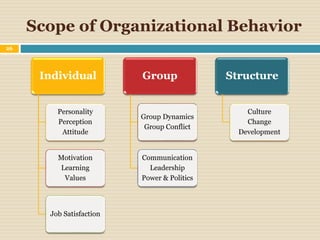
Individual
Personality
Perception
Attitude
Motivation
Learning
Values
Job Satisfaction
Group
Group Dynamics
Group Conflict
Communication
Leadership
Power & Politics
Structure
Culture
Change
Development
27
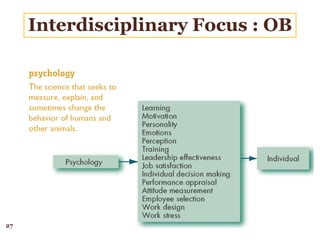
Interdisciplinary Focus : OB
28
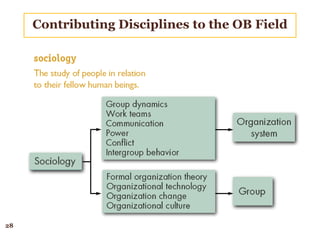
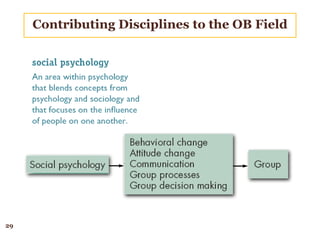
Contributing Disciplines to the OB Field
29
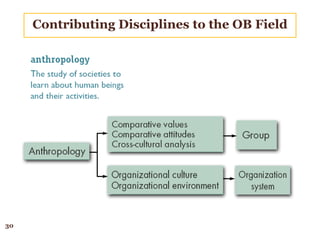
Contributing Disciplines to the OB Field
30
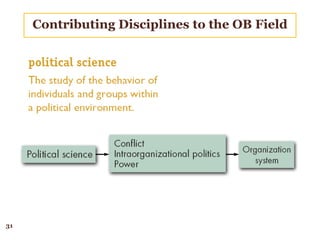
Contributing Disciplines to the OB Field
31
Contributing Disciplines to the OB Field
Importance of OB
32
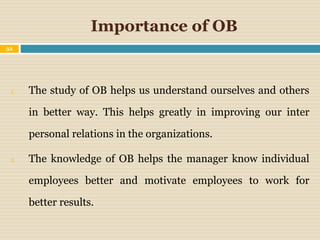
1. The study of OB helps us understand ourselves and others
in better way. This helps greatly in improving our inter
personal relations in the organizations.
2. The knowledge of OB helps the manager know individual
employees better and motivate employees to work for
better results.
Importance... Contd.
33
3. Understanding OB helps determine manager effectiveness
• Technical and quantitative skills important
• But leadership and communication skills are CRITICAL
4. Organizational benefits of skilled managers
• Lower turnover of quality employees
• Higher quality applications for recruitment
• Better financial performance
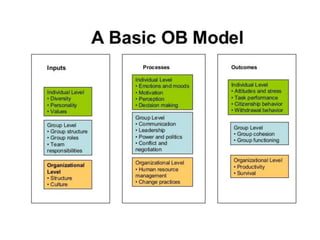
Basic OB Model
34
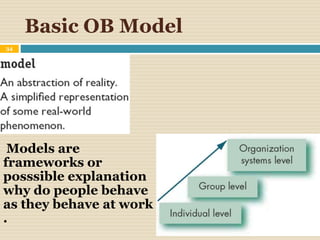
Models are
frameworks or
posssible explanation
why do people behave
as they behave at work
.
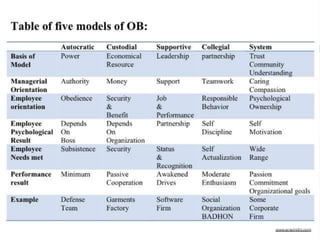
Models of OB
35
 Autocratic Model
 Custodial Model
 Supportive Model
 Collegial Model
 System Model
 System Model
Autocratic Model
36
 Autocratic model depends on power. The
people who are in command must have the
power to demand “you do this or else”,
meaning that an employee who does not follow
order will be penalizes.
 In the autocratic environment the managerial
orientation is formal, official, authority. This
authority is delegated by right of command
over the people to whom it applies.
Custodial Model
37
 In autocratic model employees did not talk back to
their boss, but they certainly thought back.
 A successful custodial approach depends on
economic resources. The resulting managerial
orientation is toward money to pay wages and
benefits. Since employees’ physical needs are
already reasonably met, the employer looks to
security needs as a motivating force. If an
organization does not have the wealth to provide
pensions and pay other benefits, it cannot follow a
custodial approach
Supportive Model
38
 The supportive model of organizational
behavior had its origins in the “principle of
supportive relationships”. It depends on
leadership instead of power or money .
 Through leadership, management
provides a climate to hope employees grow
and accomplish in the interests of the
organization the things of which theft are
capable.
Collegial Model
39
 A useful extension of the supportive model is the
collegial model. The term “collegial” relates to a
body of people working together cooperatively.
The collegial model embodies a team concept.

 The collegial model depends on management’s
building a feeling of partnership with employees.
The result is that employees feel needed and
useful. They feel that managers are contributing
also , so it is easy to accept and respect their roles
in the organization. Managers are seen as joint
contributors rather than as bosses.
System Model
40
Under the system model managers try to convey to
each worker, “you are an important part of our
whole system. We sincerely care about each of you.
We want to join together to achieve a better
product or service, local community and society at
large. We will make every effort to make products
that are environmentally friendly.”
41
42
Challenges and Opportunities for OB
43
 Responding to Globalization
- Inter-country – Need differences – Culture
 Managing Workforce Diversity
- The people in organizations are becoming more
heterogeneous demographically (Age–Gender–Life Style–
Values–Family need–Culture)
- Management philosophy changes
- Recognizing and responding to differences
 Improving Quality and Productivity Human Resource
 Changing Employee Expectation
Opportunities for OB
44
 Improving Quality and Productivity
 Improving Customer Service
 Improving People Skills
 Stimulating Innovation and Change
 Coping with “Temporariness”
 Working in Networked Organizations
 Helping Employees Balance Work-Life Conflicts
 Creating a Positive Work Environment
 Improving Ethical Behavior
Approaches to OB
45
 Human Resources Approach
 Contingency Approach
 Productivity Approach
 System Approach
Human Resources Approach
46
 This approach recognizes that human resources in an
organization are the central force. Their development will
contribute to the success of the organization. Human
resources approach provides for the changes in the
managerial role. It requires that the managers, instead of
controlling the employees, should provide active support to
them by treating them as part of the group.
 The superiors and managers should practice a style where
workers are given the opportunities and encouragement to
perform under less supervision. By treating individuals as
mature adults, organizations can increase productivity and at
the same time meet the needs of individuals for independence
and growth.
Contingency Approach
47
 The approach stresses that there is no single way to manage
effectively under all circumstances. The methods of
behaviours which work effectively in one situation may fail in
another. The organisational structure and the processes of
management are governed by the external environment and
several aspects of the internal environment. Effective
management processes will vary in different situations
depending on the individuals and groups in the organisation,
the nature of the job and technology, the environment facing
the organisation and its structure.
 The manager’s task therefore, is to identify which method
will, in a particular situation, under particular circumstances
and at a particular time, best contribute to the attainment of
organization’s goals. Thus, the manager will have to analyze
each situation prior to action and different managerial
practices and styles are needed for effective management.
Productivity Approach
48
Productivity means the numerical value of the ratio of
output to input. Higher the value of this ratio, greater is
the efficiency and effectiveness of the management. The
traditional concept of productivity was concerned with
economic inputs and output only. But nowadays human
and social inputs and outputs are equally important.
Productivity, a significant part of organisational
behaviour decisions, is recognized and discussed
extensively. These decisions relate to human, social and
economic issues. For example if better organisational
behaviour can reduce worker’s turnover or the number
of absentees, a human output or benefit occurs.
System Approach
49
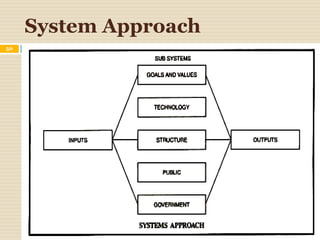
The systems approach is of the view that an organisation is a powerful
system with several subsystems which are highly and closely
interconnected. Any action taken to solve the problems in one
subsystem will have its effect on the other subsystems as well; since all
the parts of the organisation are closely connected. Thus, this approach
gives the managers a way of looking at the organisation as a whole,
whole group, and the whole social system. Systems approach has
become an integral part of modern organisational theory.
Organisations are termed as complex systems comprising of
interrelated and interlocking systems.
According to this approach, an organisation receives several inputs
from its environment such as material, human and financial. These
inputs are then processed so as to produce the final output in terms of
products or services.
System Approach
50

OB -Unit-I- BBA.pptx

  • 1.
  • 2.
    Session Outline Management • Introduction •Functions • Roles • Skills Organizational Behavior • Introduction • Historical Background • Nature • Scope • Key Elements • Contributing Disciplines • Importance • Opportunities & Challenges 2
  • 3.
    Individuals responsible for administeringan organization by managing its people. •Make decisions •Allocate resources •Direct activities of others to attain goals 3
  • 4.
  • 5.
  • 6.
  • 7.
  • 8.
  • 9.
  • 10.
  • 11.
    The knowledge andapplication of Organizational Behaviour lead to effective managerial functioning and enhance the managerial skills. 11
  • 12.
    Organizational Behavior OB People arethe most important asset of an organization. Organizational behavior (OB) is the study of how people interact in organizations. 12
  • 13.
    OB = O+B OrganizationBehavior Organizational Behavior 13
  • 14.
    Organization  An organizationis a collection of individuals arranged in a particular way and embedded in an ever-changing environment in order to achieve a common goal. 14
  • 15.
    Behavior  Behavior refersto the response of an individual or group to an action, environment, person, or stimulus.  This behavior occurs in organizations. 15
  • 16.
    Organizational Behavior: A HistoricalBackground  While Organizational Behavior as a field of academic study wasn’t fully recognized by the American Psychological Association until the 1970’s, it’s roots go back to the late 1920’s when the Hawthorne Electric Company set up a series of experiments designed to discern how changes in environment and design changed the productivity of their employees.  The studies included the effect of various types of breaks (lots of small breaks, a few long ones, etc.) on productivity, productivity in isolation, and productivity in varying levels of light. 16
  • 17.
    Organizational Behavior... Contd. OB is based upon the idea of looking scientifically at behavior and productivity in the workplace with the goal of increasing the amount and quality of work an employee can get done, along with the idea that workers were not interchangeable resources but were instead unique in terms of their psychology and potential fit with a company.  Since the 1970’s, a good deal of the work being done in the field of organizational behavior has been on cultural components of organizations, including topics such as race, class, gender roles, and cultural relativism and their roles on group building and productivity. 17
  • 18.
    Organizational Behavior  Organizationalbehaviour refers to the way individuals and groups interact within and toward an organization.  The combined behaviours create a company climate that can bolster or undermine an organization's success.  OB is directly concerned with the understanding, prediction, and control of human behaviour in an organization. 18
  • 19.
    Organizational Behavior... Contd. “Organizational Behavior studies the influence and impact that individuals, groups, and organizational structure have on behavior within organization for the purpose of applying such knowledge toward improving an organization's effectiveness.” - Robins & Judge  “OB is concerned with the study of human behavior at work. In other words, OB is study and application of knowledge about how people as individuals and as groups behave or act in the organization.” 19
  • 20.
    Nature of Organizational Behavior 20 OB is a Separate Field of Study  An Interdisciplinary Approach  An Applied Science  A Normative Science  A Human and Optimistic Approach  A Total System Approach
  • 21.
  • 22.
    People 22  An organizationconsists of people with different traits, personality, skills, qualities, interests, background, beliefs, values and intelligence. In order to maintain a healthy environment, all the employees should be treated equally and be judged according to their work and other aspects that affects the firm.  Example − A company offers campus placement to trainees from different states like Orissa, Haryana, Arunachal Pradesh and many more. However, during and after training, all trainees are examined only on the basis of their performance in the tasks assigned.
  • 23.
    Organizational Structure 23  Structureis the layout design of an organization. It is the construction and arrangement of relationships, strategies according to the organizational goal.  Example − Organizational structure defines the relation of a manager with employees and co-workers.
  • 24.
    Technology 24 Technology can bedefined as the implementation of scientific knowledge for practical usage. It also provides the resources required by the people that affect their work and task performance in the right direction. Example − Introduction of SAP, big data and other software in the market determines individual and organizational performance.
  • 25.
    Environment 25 All companies functionwithin a given internal and external environment. Internal environment can be defined as the conditions, factors, and elements within an enterprise that influences the activities, choices made by the firm, and especially the behavior of the employees. While external environment can be defined as outside factors that affect the company's ability to operate. Some of them can be manipulated by the company’s marketing, while others require the company to make adjustments. Some examples of internal environment include employee morale, culture changes, financial changes or issues, and some examples of external environment include political factors, changes to the economy and the company itself.
  • 26.
    Scope of OrganizationalBehavior 26 Individual Personality Perception Attitude Motivation Learning Values Job Satisfaction Group Group Dynamics Group Conflict Communication Leadership Power & Politics Structure Culture Change Development
  • 27.
  • 28.
  • 29.
  • 30.
  • 31.
  • 32.
    Importance of OB 32 1.The study of OB helps us understand ourselves and others in better way. This helps greatly in improving our inter personal relations in the organizations. 2. The knowledge of OB helps the manager know individual employees better and motivate employees to work for better results.
  • 33.
    Importance... Contd. 33 3. UnderstandingOB helps determine manager effectiveness • Technical and quantitative skills important • But leadership and communication skills are CRITICAL 4. Organizational benefits of skilled managers • Lower turnover of quality employees • Higher quality applications for recruitment • Better financial performance
  • 34.
    Basic OB Model 34 Modelsare frameworks or posssible explanation why do people behave as they behave at work .
  • 35.
    Models of OB 35 Autocratic Model  Custodial Model  Supportive Model  Collegial Model  System Model  System Model
  • 36.
    Autocratic Model 36  Autocraticmodel depends on power. The people who are in command must have the power to demand “you do this or else”, meaning that an employee who does not follow order will be penalizes.  In the autocratic environment the managerial orientation is formal, official, authority. This authority is delegated by right of command over the people to whom it applies.
  • 37.
    Custodial Model 37  Inautocratic model employees did not talk back to their boss, but they certainly thought back.  A successful custodial approach depends on economic resources. The resulting managerial orientation is toward money to pay wages and benefits. Since employees’ physical needs are already reasonably met, the employer looks to security needs as a motivating force. If an organization does not have the wealth to provide pensions and pay other benefits, it cannot follow a custodial approach
  • 38.
    Supportive Model 38  Thesupportive model of organizational behavior had its origins in the “principle of supportive relationships”. It depends on leadership instead of power or money .  Through leadership, management provides a climate to hope employees grow and accomplish in the interests of the organization the things of which theft are capable.
  • 39.
    Collegial Model 39  Auseful extension of the supportive model is the collegial model. The term “collegial” relates to a body of people working together cooperatively. The collegial model embodies a team concept.   The collegial model depends on management’s building a feeling of partnership with employees. The result is that employees feel needed and useful. They feel that managers are contributing also , so it is easy to accept and respect their roles in the organization. Managers are seen as joint contributors rather than as bosses.
  • 40.
    System Model 40 Under thesystem model managers try to convey to each worker, “you are an important part of our whole system. We sincerely care about each of you. We want to join together to achieve a better product or service, local community and society at large. We will make every effort to make products that are environmentally friendly.”
  • 41.
  • 42.
  • 43.
    Challenges and Opportunitiesfor OB 43  Responding to Globalization - Inter-country – Need differences – Culture  Managing Workforce Diversity - The people in organizations are becoming more heterogeneous demographically (Age–Gender–Life Style– Values–Family need–Culture) - Management philosophy changes - Recognizing and responding to differences  Improving Quality and Productivity Human Resource  Changing Employee Expectation
  • 44.
    Opportunities for OB 44 Improving Quality and Productivity  Improving Customer Service  Improving People Skills  Stimulating Innovation and Change  Coping with “Temporariness”  Working in Networked Organizations  Helping Employees Balance Work-Life Conflicts  Creating a Positive Work Environment  Improving Ethical Behavior
  • 45.
    Approaches to OB 45 Human Resources Approach  Contingency Approach  Productivity Approach  System Approach
  • 46.
    Human Resources Approach 46 This approach recognizes that human resources in an organization are the central force. Their development will contribute to the success of the organization. Human resources approach provides for the changes in the managerial role. It requires that the managers, instead of controlling the employees, should provide active support to them by treating them as part of the group.  The superiors and managers should practice a style where workers are given the opportunities and encouragement to perform under less supervision. By treating individuals as mature adults, organizations can increase productivity and at the same time meet the needs of individuals for independence and growth.
  • 47.
    Contingency Approach 47  Theapproach stresses that there is no single way to manage effectively under all circumstances. The methods of behaviours which work effectively in one situation may fail in another. The organisational structure and the processes of management are governed by the external environment and several aspects of the internal environment. Effective management processes will vary in different situations depending on the individuals and groups in the organisation, the nature of the job and technology, the environment facing the organisation and its structure.  The manager’s task therefore, is to identify which method will, in a particular situation, under particular circumstances and at a particular time, best contribute to the attainment of organization’s goals. Thus, the manager will have to analyze each situation prior to action and different managerial practices and styles are needed for effective management.
  • 48.
    Productivity Approach 48 Productivity meansthe numerical value of the ratio of output to input. Higher the value of this ratio, greater is the efficiency and effectiveness of the management. The traditional concept of productivity was concerned with economic inputs and output only. But nowadays human and social inputs and outputs are equally important. Productivity, a significant part of organisational behaviour decisions, is recognized and discussed extensively. These decisions relate to human, social and economic issues. For example if better organisational behaviour can reduce worker’s turnover or the number of absentees, a human output or benefit occurs.
  • 49.
    System Approach 49 The systemsapproach is of the view that an organisation is a powerful system with several subsystems which are highly and closely interconnected. Any action taken to solve the problems in one subsystem will have its effect on the other subsystems as well; since all the parts of the organisation are closely connected. Thus, this approach gives the managers a way of looking at the organisation as a whole, whole group, and the whole social system. Systems approach has become an integral part of modern organisational theory. Organisations are termed as complex systems comprising of interrelated and interlocking systems. According to this approach, an organisation receives several inputs from its environment such as material, human and financial. These inputs are then processed so as to produce the final output in terms of products or services.
  • 50.

Editor's Notes

  • #17 https://www.investopedia.com/terms/o/organizational-behavior.asp