Module 04
Computational Electromagnetics
Awab Sir (www.awabsir.com) 8976104646
Computational Electromagnetics
• The evaluation of electric and magnetic fields in an
electromagnetic system is of utmost importance.
• Depending on the nature of the electromagnetic system,
Laplace or Poisson equation may be suitable to model the
system for low frequency operating conditions.
• In high frequency applications we must solve the wave
equation in either the time domain or the frequency
domain to accurately predict the electric and magnetic
fields.
• All these solutions are subject to boundary conditions.
• Analytical solutions are available only for problems of
regular geometry with simple boundary conditions.
Awab Sir (www.awabsir.com) 8976104646
Computational Electromagnetics
When the complexities of theoretical formulas
make analytic solution intractable, we resort
to non analytic methods, which include
• Graphical methods
• Experimental methods
• Analog methods
• Numerical methods
Awab Sir (www.awabsir.com) 8976104646
Computational Electromagnetics
Graphical, experimental, and analog methods are
applicable to solving relatively few problems.
Numerical methods have come into prominence
and become more attractive with the advent of
fast digital computers. The three most commonly
used simple numerical techniques in EM are
• Moment method
• Finite difference method
• Finite element method
Awab Sir (www.awabsir.com) 8976104646
Computational Electromagnetics
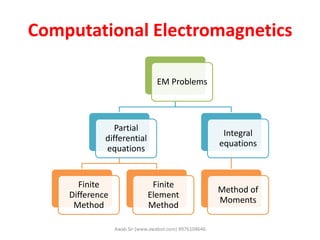
EM Problems
Partial
differential
equations
Finite
Difference
Method
Finite
Element
Method
Integral
equations
Method of
Moments
Awab Sir (www.awabsir.com) 8976104646
Computational Electromagnetics
We now use numerical techniques to compute
electric and magnetic fields
In principle, each method discretizes a
continuous domain into finite number of
sections and then requires a solution of a set
of algebraic equations instead of differential
or integral equations.
Awab Sir (www.awabsir.com) 8976104646
Computational Electromagnetics
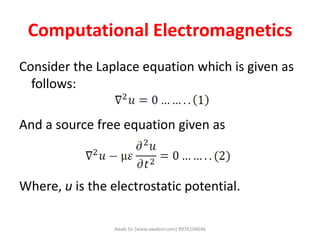
Consider the Laplace equation which is given as
follows:
And a source free equation given as
Where, u is the electrostatic potential.
Awab Sir (www.awabsir.com) 8976104646
Why do we need to use numerical
methods?
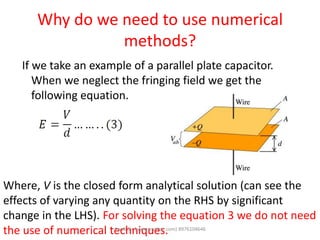
If we take an example of a parallel plate capacitor.
When we neglect the fringing field we get the
following equation.
Where, V is the closed form analytical solution (can see the
effects of varying any quantity on the RHS by significant
change in the LHS). For solving the equation 3 we do not need
the use of numerical techniques.Awab Sir (www.awabsir.com) 8976104646
Why do we need to use numerical
methods?
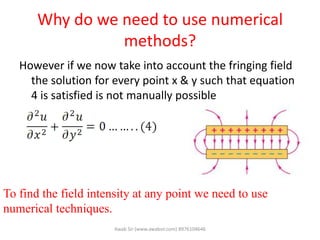
However if we now take into account the fringing field
the solution for every point x & y such that equation
4 is satisfied is not manually possible
To find the field intensity at any point we need to use
numerical techniques.
Awab Sir (www.awabsir.com) 8976104646
Step 1:
Divide the given problem domain into
sub-domains
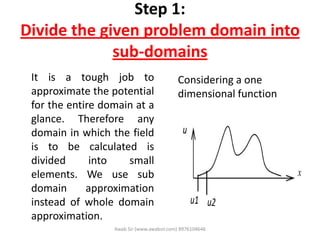
It is a tough job to
approximate the potential
for the entire domain at a
glance. Therefore any
domain in which the field
is to be calculated is
divided into small
elements. We use sub
domain approximation
instead of whole domain
approximation.
Considering a one
dimensional function
Awab Sir (www.awabsir.com) 8976104646
Step 2:
Approximate the potential for each
element
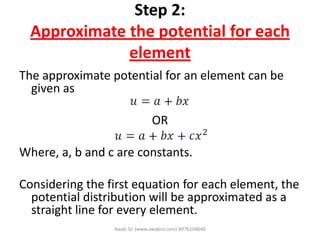
The approximate potential for an element can be
given as
OR
Where, a, b and c are constants.
Considering the first equation for each element, the
potential distribution will be approximated as a
straight line for every element.
Awab Sir (www.awabsir.com) 8976104646
Step 3:
Find the potential u for every element
in terms of end point potentials
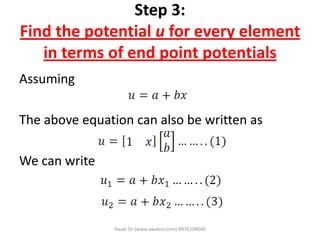
Assuming
The above equation can also be written as
We can write
Awab Sir (www.awabsir.com) 8976104646
Step 3:
Find the potential u for every element
in terms of end point potentials
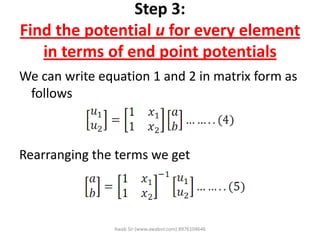
We can write equation 1 and 2 in matrix form as
follows
Rearranging the terms we get
Awab Sir (www.awabsir.com) 8976104646
Step 3:
Find the potential u for every element
in terms of end point potentials
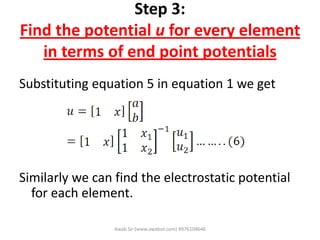
Substituting equation 5 in equation 1 we get
Similarly we can find the electrostatic potential
for each element.
Awab Sir (www.awabsir.com) 8976104646
Step 4:
Find the energy for every element
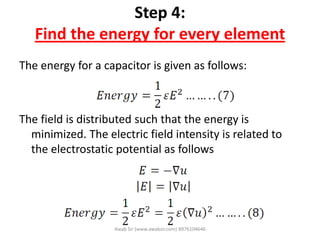
The energy for a capacitor is given as follows:
The field is distributed such that the energy is
minimized. The electric field intensity is related to
the electrostatic potential as follows
Awab Sir (www.awabsir.com) 8976104646
Step 5:
Find the total energy
The total energy is the summation of the
individual electrostatic energy of every
element in the domain.
Awab Sir (www.awabsir.com) 8976104646
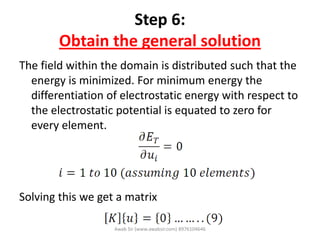
Step 6:
Obtain the general solution
The field within the domain is distributed such that the
energy is minimized. For minimum energy the
differentiation of electrostatic energy with respect to
the electrostatic potential is equated to zero for
every element.
Solving this we get a matrix
Awab Sir (www.awabsir.com) 8976104646
Step 6:
Obtain the general solution
The matrix [K] is a function of geometry and
the material properties. The curly brackets
denote column matrix. Equation 9 does not
lead to a unique solution. For a unique
solution we have to apply boundary
conditions.
Awab Sir (www.awabsir.com) 8976104646
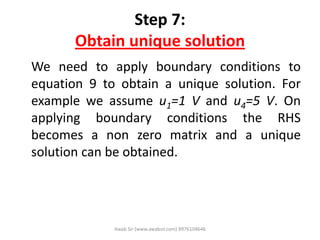
Step 7:
Obtain unique solution
We need to apply boundary conditions to
equation 9 to obtain a unique solution. For
example we assume u1=1 V and u4=5 V. On
applying boundary conditions the RHS
becomes a non zero matrix and a unique
solution can be obtained.
Awab Sir (www.awabsir.com) 8976104646
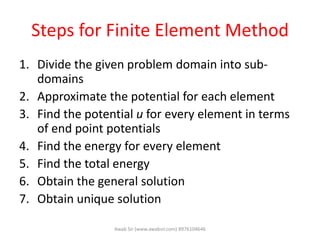
Steps for Finite Element Method
1. Divide the given problem domain into sub-
domains
2. Approximate the potential for each element
3. Find the potential u for every element in terms
of end point potentials
4. Find the energy for every element
5. Find the total energy
6. Obtain the general solution
7. Obtain unique solution
Awab Sir (www.awabsir.com) 8976104646
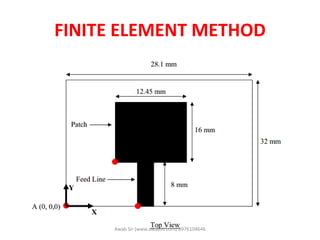
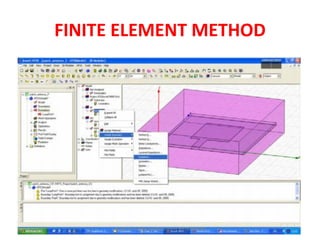
FINITE ELEMENT METHOD
Awab Sir (www.awabsir.com) 8976104646
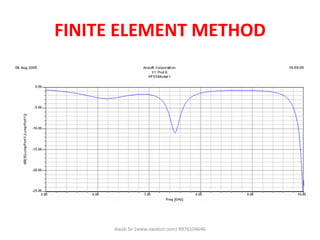
FINITE ELEMENT METHOD
Awab Sir (www.awabsir.com) 8976104646
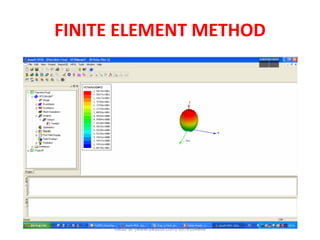
FINITE ELEMENT METHOD
Awab Sir (www.awabsir.com) 8976104646
FINITE ELEMENT METHOD
Awab Sir (www.awabsir.com) 8976104646
FINITE ELEMENT METHOD
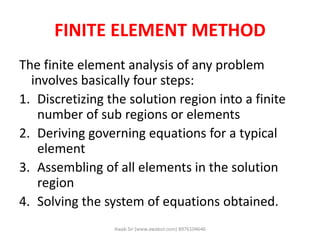
The finite element analysis of any problem
involves basically four steps:
1. Discretizing the solution region into a finite
number of sub regions or elements
2. Deriving governing equations for a typical
element
3. Assembling of all elements in the solution
region
4. Solving the system of equations obtained.
Awab Sir (www.awabsir.com) 8976104646
1. Finite Element Discretization
Awab Sir (www.awabsir.com) 8976104646
1. Finite Element Discretization
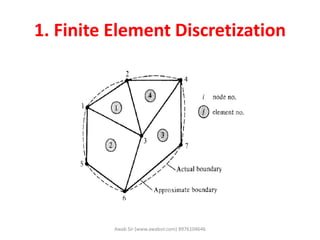
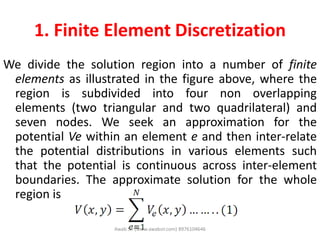
We divide the solution region into a number of finite
elements as illustrated in the figure above, where the
region is subdivided into four non overlapping
elements (two triangular and two quadrilateral) and
seven nodes. We seek an approximation for the
potential Ve within an element e and then inter-relate
the potential distributions in various elements such
that the potential is continuous across inter-element
boundaries. The approximate solution for the whole
region is
Awab Sir (www.awabsir.com) 8976104646
1. Finite Element Discretization
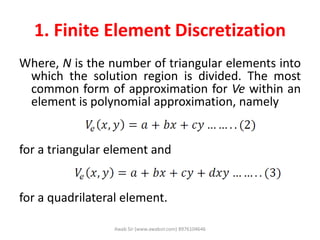
Where, N is the number of triangular elements into
which the solution region is divided. The most
common form of approximation for Ve within an
element is polynomial approximation, namely
for a triangular element and
for a quadrilateral element.
Awab Sir (www.awabsir.com) 8976104646
1. Finite Element Discretization
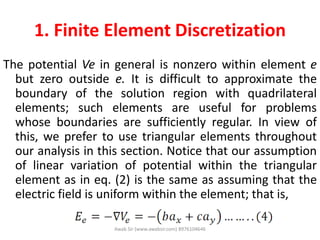
The potential Ve in general is nonzero within element e
but zero outside e. It is difficult to approximate the
boundary of the solution region with quadrilateral
elements; such elements are useful for problems
whose boundaries are sufficiently regular. In view of
this, we prefer to use triangular elements throughout
our analysis in this section. Notice that our assumption
of linear variation of potential within the triangular
element as in eq. (2) is the same as assuming that the
electric field is uniform within the element; that is,
Awab Sir (www.awabsir.com) 8976104646
2. Element Governing Equations
Awab Sir (www.awabsir.com) 8976104646
2. Element Governing Equations
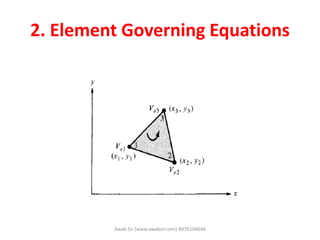
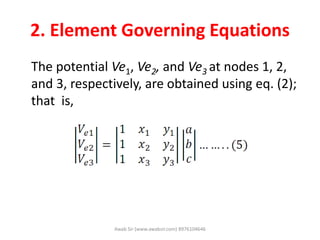
The potential Ve1, Ve2, and Ve3 at nodes 1, 2,
and 3, respectively, are obtained using eq. (2);
that is,
Awab Sir (www.awabsir.com) 8976104646
2. Element Governing Equations
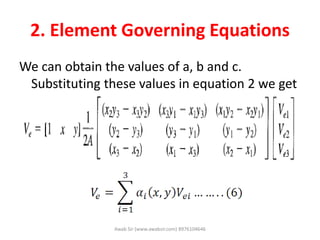
We can obtain the values of a, b and c.
Substituting these values in equation 2 we get
Awab Sir (www.awabsir.com) 8976104646
2. Element Governing Equations
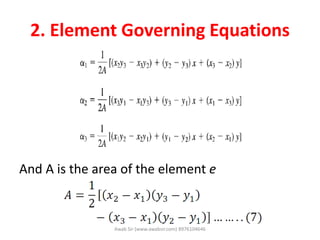
And A is the area of the element e
Awab Sir (www.awabsir.com) 8976104646
2. Element Governing Equations
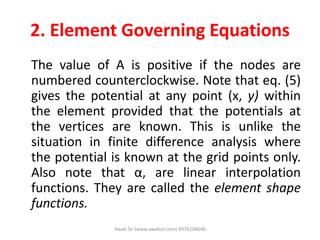
The value of A is positive if the nodes are
numbered counterclockwise. Note that eq. (5)
gives the potential at any point (x, y) within
the element provided that the potentials at
the vertices are known. This is unlike the
situation in finite difference analysis where
the potential is known at the grid points only.
Also note that α, are linear interpolation
functions. They are called the element shape
functions.
Awab Sir (www.awabsir.com) 8976104646
2. Element Governing Equations
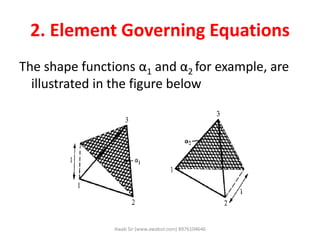
The shape functions α1 and α2 for example, are
illustrated in the figure below
Awab Sir (www.awabsir.com) 8976104646
2. Element Governing Equations
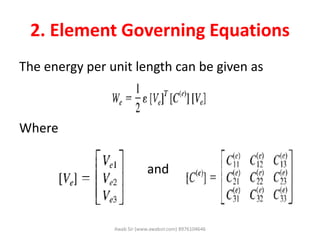
The energy per unit length can be given as
Where
and
Awab Sir (www.awabsir.com) 8976104646
2. Element Governing Equations
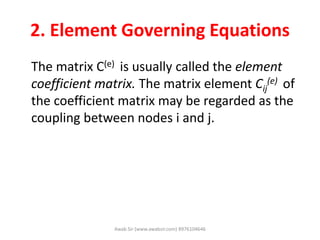
The matrix C(e) is usually called the element
coefficient matrix. The matrix element Cij
(e) of
the coefficient matrix may be regarded as the
coupling between nodes i and j.
Awab Sir (www.awabsir.com) 8976104646
3. Assembling of all Elements
Having considered a typical element, the next step is to
assemble all such elements in the solution region. The
energy associated with the assemblage of all elements
in the mesh is
Where n is the number of nodes,
N is the number of elements, and
[C] is called the overall or global coefficient matrix, which
is the assemblage of individual element coefficient
matrices.
Awab Sir (www.awabsir.com) 8976104646
3. Assembling of all Elements
The properties of matrix [C] are
1. It is symmetric (Cij = Cji) just as the element
coefficient matrix.
2. Since Cij = 0 if no coupling exists between
nodes i and j, it is evident that for a large
number of elements [C] becomes sparse and
banded.
3. It is singular.
Awab Sir (www.awabsir.com) 8976104646
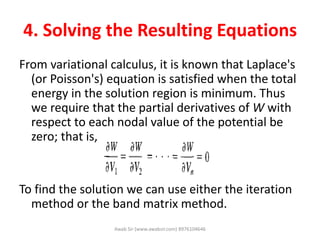
4. Solving the Resulting Equations
From variational calculus, it is known that Laplace's
(or Poisson's) equation is satisfied when the total
energy in the solution region is minimum. Thus
we require that the partial derivatives of W with
respect to each nodal value of the potential be
zero; that is,
To find the solution we can use either the iteration
method or the band matrix method.
Awab Sir (www.awabsir.com) 8976104646
Advantages
FEM has the following advantages over FDM and
MoM
1. FEM can easily handle complex solution
region.
2. The generality of FEM makes it possible to
construct a general-purpose program for
solving a wide range of problems.
Awab Sir (www.awabsir.com) 8976104646
Drawbacks
1. It is harder to understand and program than
FDM and MOM.
2. It also requires preparing input data, a
process that could be tedious.
Awab Sir (www.awabsir.com) 8976104646
FINITE DIFFERENCE METHOD
Boundary Conditions
A unique solution can be obtained only with a
specified set of boundary conditions. There
are basically three kinds of boundary
conditions:
1. Dirichlet type of boundary
2. Neumann type of boundary
3. Mixed boundary conditions
Awab Sir (www.awabsir.com) 8976104646
Boundary Conditions
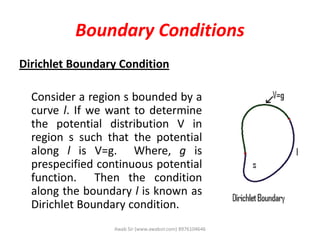
Dirichlet Boundary Condition
Consider a region s bounded by a
curve l. If we want to determine
the potential distribution V in
region s such that the potential
along l is V=g. Where, g is
prespecified continuous potential
function. Then the condition
along the boundary l is known as
Dirichlet Boundary condition.
Awab Sir (www.awabsir.com) 8976104646
Boundary Conditions
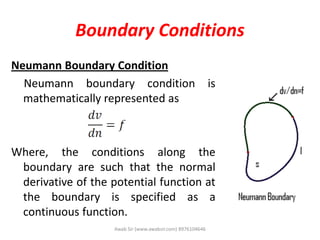
Neumann Boundary Condition
Neumann boundary condition is
mathematically represented as
Where, the conditions along the
boundary are such that the normal
derivative of the potential function at
the boundary is specified as a
continuous function.
Awab Sir (www.awabsir.com) 8976104646
Boundary Conditions
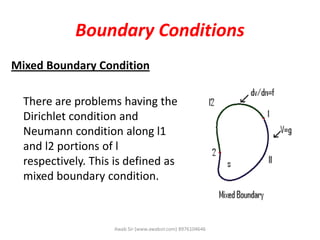
Mixed Boundary Condition
There are problems having the
Dirichlet condition and
Neumann condition along l1
and l2 portions of l
respectively. This is defined as
mixed boundary condition.
Awab Sir (www.awabsir.com) 8976104646
FINITE DIFFERENCE METHOD
A problem is uniquely defined by three things:
1. A partial differential equation such as
Laplace's or Poisson's equations.
2. A solution region.
3. Boundary and/or initial conditions.
Awab Sir (www.awabsir.com) 8976104646
FINITE DIFFERENCE METHOD
A finite difference solution to Poisson's or Laplace's
equation, for example, proceeds in three steps:
1. Dividing the solution region into a grid of nodes.
2. Approximating the differential equation and
boundary conditions by a set of linear algebraic
equations (called difference equations) on grid
points within the solution region.
3. Solving this set of algebraic equations.
Awab Sir (www.awabsir.com) 8976104646
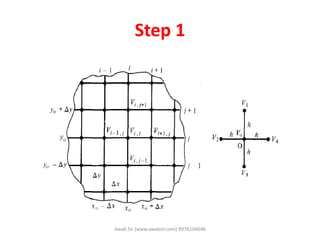
Step 1
Suppose we intend to apply the finite
difference method to determine the electric
potential in a region, shown in the figure
below. The solution region is divided into
rectangular meshes with grid points or nodes
as shown. A node on the boundary of the
region where the potential is specified is
called a fixed node (fixed by the problem) and
interior points in the region are called free
points (free in that the potential is unknown).
Awab Sir (www.awabsir.com) 8976104646
Step 1
Awab Sir (www.awabsir.com) 8976104646
Step 2
Our objective is to obtain the finite difference
approximation to Poisson's equation and use
this to determine the potentials at all the free
points.
Awab Sir (www.awabsir.com) 8976104646
Step 3
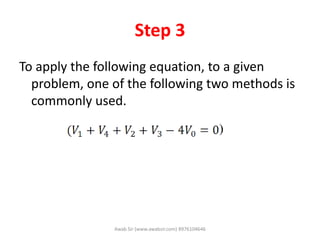
To apply the following equation, to a given
problem, one of the following two methods is
commonly used.
)
Awab Sir (www.awabsir.com) 8976104646
Iteration Method
We start by setting initial values of the potentials at the
free nodes equal to zero or to any reasonable guessed
value. Keeping the potentials at the fixed nodes
unchanged at all times, we apply eq. (1) to every free node
in turn until the potentials at all free nodes are calculated.
The potentials obtained at the end of this first iteration are
not accurate but just approximate. To increase the
accuracy of the potentials, we repeat the calculation at
every free node using old values to determine new ones.
The iterative or repeated modification of the potential at
each free node is continued until a prescribed degree of
accuracy is achieved or until the old and the new values at
each node are satisfactorily close.
Awab Sir (www.awabsir.com) 8976104646
Band Matrix Method
Equation (1) applied to all free nodes results in a set
of simultaneous equations of the form
Where: [A] is a sparse matrix (i.e., one having many
zero terms),
[V] consists of the unknown potentials at the free
nodes, and
[B] is another column matrix formed by the known
potentials at the fixed nodes.
Awab Sir (www.awabsir.com) 8976104646
Band Matrix Method
Matrix [A] is also banded in that its nonzero
terms appear clustered near the main
diagonal because only nearest neighboring
nodes affect the potential at each node. The
sparse, band matrix is easily inverted to
determine [V]. Thus we obtain the potentials
at the free nodes from matrix [V] as
Awab Sir (www.awabsir.com) 8976104646
The concept of FDM can be extended to Poisson's,
Laplace's, or wave equations in other coordinate
systems. The accuracy of the method depends on the
fineness of the grid and the amount of time spent in
refining the potentials. We can reduce computer time
and increase the accuracy and convergence rate by the
method of successive over relaxation, by making
reasonable guesses at initial values, by taking
advantage of symmetry if possible, by making the
mesh size as small as possible, and by using more
complex finite difference molecules. One limitation of
the finite difference method is that interpolation of
some kind must be used to determine solutions at
points not on the grid. One obvious way to overcome
this is to use a finer grid, but this would require a
greater number of computations and a larger amount
of computer storage.
Awab Sir (www.awabsir.com) 8976104646
METHOD OF MOMENTS
Awab Sir (www.awabsir.com) 8976104646
METHOD OF MOMENTS
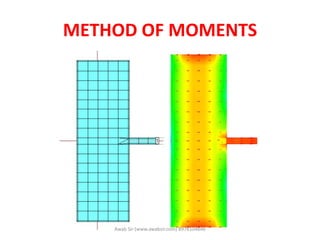
Like the finite difference method, the moment method
or the method of moments (MOM) has the advantage
of being conceptually simple. While the finite difference
method is used in solving differential equations, the
moment method is commonly used in solving integral
equations.
MoM uses integral method. The advantage of this
method is that the order of the problem is reduced by
one. For example a parallel plate capacitor is a 3-D
domain. However, we will be working only on the
surface of the capacitor plates, it becomes reduced to
2-D domain. Awab Sir (www.awabsir.com) 8976104646
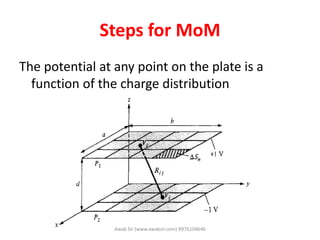
Steps for MoM
The potential at any point on the plate is a
function of the charge distribution
Awab Sir (www.awabsir.com) 8976104646
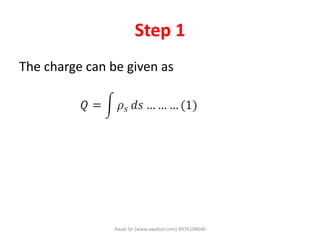
Step 1
The charge can be given as
Awab Sir (www.awabsir.com) 8976104646
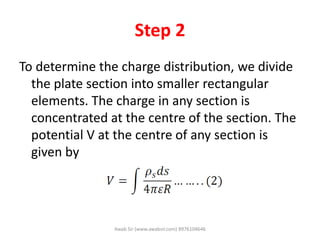
Step 2
To determine the charge distribution, we divide
the plate section into smaller rectangular
elements. The charge in any section is
concentrated at the centre of the section. The
potential V at the centre of any section is
given by
Awab Sir (www.awabsir.com) 8976104646
Step 3
Assuming there is uniform charge distribution on each
subsection we get
This equation can be rearranged to obtain
Where, [B]: column matrix defining the potentials
[A]: square matrix
In MoM, the potential at any point is the function of
potential distribution at all points, this was not done in
FDM and FEM. Awab Sir (www.awabsir.com) 8976104646
Finite Difference
Method (FDM)
Finite Element Method
(FEM)
Method of Moments
(MoM)
Basic
principle
Based on differentiation
i.e. the differential
equation is converted to a
difference equation.
1. Energy based (energy
minimization)
2. Weighted residual
(reducing the error)
Based on integral
method
Advantage 1. Simplest method
2. Taylor series based
1. Computationally easier
than MoM
2. Can be applied to
unisotropic media.
3. [K] matrix is sparse
1. More accurate
(errors effectively
tend to cancel each
other)
2. Ideally suited for
open boundary
conditions
3. Popular for
antennas
Disadvantage 1. Need to have uniform
rectangular sections
(not possible for real
life structures)
2. Outdated
1. Difficult as compared to
FDM
1. Mathematically
complex
Awab Sir (www.awabsir.com) 8976104646

Computational electromagnetics

  • 1.
    Module 04 Computational Electromagnetics AwabSir (www.awabsir.com) 8976104646
  • 2.
    Computational Electromagnetics • Theevaluation of electric and magnetic fields in an electromagnetic system is of utmost importance. • Depending on the nature of the electromagnetic system, Laplace or Poisson equation may be suitable to model the system for low frequency operating conditions. • In high frequency applications we must solve the wave equation in either the time domain or the frequency domain to accurately predict the electric and magnetic fields. • All these solutions are subject to boundary conditions. • Analytical solutions are available only for problems of regular geometry with simple boundary conditions. Awab Sir (www.awabsir.com) 8976104646
  • 3.
    Computational Electromagnetics When thecomplexities of theoretical formulas make analytic solution intractable, we resort to non analytic methods, which include • Graphical methods • Experimental methods • Analog methods • Numerical methods Awab Sir (www.awabsir.com) 8976104646
  • 4.
    Computational Electromagnetics Graphical, experimental,and analog methods are applicable to solving relatively few problems. Numerical methods have come into prominence and become more attractive with the advent of fast digital computers. The three most commonly used simple numerical techniques in EM are • Moment method • Finite difference method • Finite element method Awab Sir (www.awabsir.com) 8976104646
  • 5.
  • 6.
    Computational Electromagnetics We nowuse numerical techniques to compute electric and magnetic fields In principle, each method discretizes a continuous domain into finite number of sections and then requires a solution of a set of algebraic equations instead of differential or integral equations. Awab Sir (www.awabsir.com) 8976104646
  • 7.
    Computational Electromagnetics Consider theLaplace equation which is given as follows: And a source free equation given as Where, u is the electrostatic potential. Awab Sir (www.awabsir.com) 8976104646
  • 8.
    Why do weneed to use numerical methods? If we take an example of a parallel plate capacitor. When we neglect the fringing field we get the following equation. Where, V is the closed form analytical solution (can see the effects of varying any quantity on the RHS by significant change in the LHS). For solving the equation 3 we do not need the use of numerical techniques.Awab Sir (www.awabsir.com) 8976104646
  • 9.
    Why do weneed to use numerical methods? However if we now take into account the fringing field the solution for every point x & y such that equation 4 is satisfied is not manually possible To find the field intensity at any point we need to use numerical techniques. Awab Sir (www.awabsir.com) 8976104646
  • 10.
    Step 1: Divide thegiven problem domain into sub-domains It is a tough job to approximate the potential for the entire domain at a glance. Therefore any domain in which the field is to be calculated is divided into small elements. We use sub domain approximation instead of whole domain approximation. Considering a one dimensional function Awab Sir (www.awabsir.com) 8976104646
  • 11.
    Step 2: Approximate thepotential for each element The approximate potential for an element can be given as OR Where, a, b and c are constants. Considering the first equation for each element, the potential distribution will be approximated as a straight line for every element. Awab Sir (www.awabsir.com) 8976104646
  • 12.
    Step 3: Find thepotential u for every element in terms of end point potentials Assuming The above equation can also be written as We can write Awab Sir (www.awabsir.com) 8976104646
  • 13.
    Step 3: Find thepotential u for every element in terms of end point potentials We can write equation 1 and 2 in matrix form as follows Rearranging the terms we get Awab Sir (www.awabsir.com) 8976104646
  • 14.
    Step 3: Find thepotential u for every element in terms of end point potentials Substituting equation 5 in equation 1 we get Similarly we can find the electrostatic potential for each element. Awab Sir (www.awabsir.com) 8976104646
  • 15.
    Step 4: Find theenergy for every element The energy for a capacitor is given as follows: The field is distributed such that the energy is minimized. The electric field intensity is related to the electrostatic potential as follows Awab Sir (www.awabsir.com) 8976104646
  • 16.
    Step 5: Find thetotal energy The total energy is the summation of the individual electrostatic energy of every element in the domain. Awab Sir (www.awabsir.com) 8976104646
  • 17.
    Step 6: Obtain thegeneral solution The field within the domain is distributed such that the energy is minimized. For minimum energy the differentiation of electrostatic energy with respect to the electrostatic potential is equated to zero for every element. Solving this we get a matrix Awab Sir (www.awabsir.com) 8976104646
  • 18.
    Step 6: Obtain thegeneral solution The matrix [K] is a function of geometry and the material properties. The curly brackets denote column matrix. Equation 9 does not lead to a unique solution. For a unique solution we have to apply boundary conditions. Awab Sir (www.awabsir.com) 8976104646
  • 19.
    Step 7: Obtain uniquesolution We need to apply boundary conditions to equation 9 to obtain a unique solution. For example we assume u1=1 V and u4=5 V. On applying boundary conditions the RHS becomes a non zero matrix and a unique solution can be obtained. Awab Sir (www.awabsir.com) 8976104646
  • 20.
    Steps for FiniteElement Method 1. Divide the given problem domain into sub- domains 2. Approximate the potential for each element 3. Find the potential u for every element in terms of end point potentials 4. Find the energy for every element 5. Find the total energy 6. Obtain the general solution 7. Obtain unique solution Awab Sir (www.awabsir.com) 8976104646
  • 21.
    FINITE ELEMENT METHOD AwabSir (www.awabsir.com) 8976104646
  • 22.
    FINITE ELEMENT METHOD AwabSir (www.awabsir.com) 8976104646
  • 23.
    FINITE ELEMENT METHOD AwabSir (www.awabsir.com) 8976104646
  • 24.
    FINITE ELEMENT METHOD AwabSir (www.awabsir.com) 8976104646
  • 25.
    FINITE ELEMENT METHOD Thefinite element analysis of any problem involves basically four steps: 1. Discretizing the solution region into a finite number of sub regions or elements 2. Deriving governing equations for a typical element 3. Assembling of all elements in the solution region 4. Solving the system of equations obtained. Awab Sir (www.awabsir.com) 8976104646
  • 26.
    1. Finite ElementDiscretization Awab Sir (www.awabsir.com) 8976104646
  • 27.
    1. Finite ElementDiscretization We divide the solution region into a number of finite elements as illustrated in the figure above, where the region is subdivided into four non overlapping elements (two triangular and two quadrilateral) and seven nodes. We seek an approximation for the potential Ve within an element e and then inter-relate the potential distributions in various elements such that the potential is continuous across inter-element boundaries. The approximate solution for the whole region is Awab Sir (www.awabsir.com) 8976104646
  • 28.
    1. Finite ElementDiscretization Where, N is the number of triangular elements into which the solution region is divided. The most common form of approximation for Ve within an element is polynomial approximation, namely for a triangular element and for a quadrilateral element. Awab Sir (www.awabsir.com) 8976104646
  • 29.
    1. Finite ElementDiscretization The potential Ve in general is nonzero within element e but zero outside e. It is difficult to approximate the boundary of the solution region with quadrilateral elements; such elements are useful for problems whose boundaries are sufficiently regular. In view of this, we prefer to use triangular elements throughout our analysis in this section. Notice that our assumption of linear variation of potential within the triangular element as in eq. (2) is the same as assuming that the electric field is uniform within the element; that is, Awab Sir (www.awabsir.com) 8976104646
  • 30.
    2. Element GoverningEquations Awab Sir (www.awabsir.com) 8976104646
  • 31.
    2. Element GoverningEquations The potential Ve1, Ve2, and Ve3 at nodes 1, 2, and 3, respectively, are obtained using eq. (2); that is, Awab Sir (www.awabsir.com) 8976104646
  • 32.
    2. Element GoverningEquations We can obtain the values of a, b and c. Substituting these values in equation 2 we get Awab Sir (www.awabsir.com) 8976104646
  • 33.
    2. Element GoverningEquations And A is the area of the element e Awab Sir (www.awabsir.com) 8976104646
  • 34.
    2. Element GoverningEquations The value of A is positive if the nodes are numbered counterclockwise. Note that eq. (5) gives the potential at any point (x, y) within the element provided that the potentials at the vertices are known. This is unlike the situation in finite difference analysis where the potential is known at the grid points only. Also note that α, are linear interpolation functions. They are called the element shape functions. Awab Sir (www.awabsir.com) 8976104646
  • 35.
    2. Element GoverningEquations The shape functions α1 and α2 for example, are illustrated in the figure below Awab Sir (www.awabsir.com) 8976104646
  • 36.
    2. Element GoverningEquations The energy per unit length can be given as Where and Awab Sir (www.awabsir.com) 8976104646
  • 37.
    2. Element GoverningEquations The matrix C(e) is usually called the element coefficient matrix. The matrix element Cij (e) of the coefficient matrix may be regarded as the coupling between nodes i and j. Awab Sir (www.awabsir.com) 8976104646
  • 38.
    3. Assembling ofall Elements Having considered a typical element, the next step is to assemble all such elements in the solution region. The energy associated with the assemblage of all elements in the mesh is Where n is the number of nodes, N is the number of elements, and [C] is called the overall or global coefficient matrix, which is the assemblage of individual element coefficient matrices. Awab Sir (www.awabsir.com) 8976104646
  • 39.
    3. Assembling ofall Elements The properties of matrix [C] are 1. It is symmetric (Cij = Cji) just as the element coefficient matrix. 2. Since Cij = 0 if no coupling exists between nodes i and j, it is evident that for a large number of elements [C] becomes sparse and banded. 3. It is singular. Awab Sir (www.awabsir.com) 8976104646
  • 40.
    4. Solving theResulting Equations From variational calculus, it is known that Laplace's (or Poisson's) equation is satisfied when the total energy in the solution region is minimum. Thus we require that the partial derivatives of W with respect to each nodal value of the potential be zero; that is, To find the solution we can use either the iteration method or the band matrix method. Awab Sir (www.awabsir.com) 8976104646
  • 41.
    Advantages FEM has thefollowing advantages over FDM and MoM 1. FEM can easily handle complex solution region. 2. The generality of FEM makes it possible to construct a general-purpose program for solving a wide range of problems. Awab Sir (www.awabsir.com) 8976104646
  • 42.
    Drawbacks 1. It isharder to understand and program than FDM and MOM. 2. It also requires preparing input data, a process that could be tedious. Awab Sir (www.awabsir.com) 8976104646
  • 43.
    FINITE DIFFERENCE METHOD BoundaryConditions A unique solution can be obtained only with a specified set of boundary conditions. There are basically three kinds of boundary conditions: 1. Dirichlet type of boundary 2. Neumann type of boundary 3. Mixed boundary conditions Awab Sir (www.awabsir.com) 8976104646
  • 44.
    Boundary Conditions Dirichlet BoundaryCondition Consider a region s bounded by a curve l. If we want to determine the potential distribution V in region s such that the potential along l is V=g. Where, g is prespecified continuous potential function. Then the condition along the boundary l is known as Dirichlet Boundary condition. Awab Sir (www.awabsir.com) 8976104646
  • 45.
    Boundary Conditions Neumann BoundaryCondition Neumann boundary condition is mathematically represented as Where, the conditions along the boundary are such that the normal derivative of the potential function at the boundary is specified as a continuous function. Awab Sir (www.awabsir.com) 8976104646
  • 46.
    Boundary Conditions Mixed BoundaryCondition There are problems having the Dirichlet condition and Neumann condition along l1 and l2 portions of l respectively. This is defined as mixed boundary condition. Awab Sir (www.awabsir.com) 8976104646
  • 47.
    FINITE DIFFERENCE METHOD Aproblem is uniquely defined by three things: 1. A partial differential equation such as Laplace's or Poisson's equations. 2. A solution region. 3. Boundary and/or initial conditions. Awab Sir (www.awabsir.com) 8976104646
  • 48.
    FINITE DIFFERENCE METHOD Afinite difference solution to Poisson's or Laplace's equation, for example, proceeds in three steps: 1. Dividing the solution region into a grid of nodes. 2. Approximating the differential equation and boundary conditions by a set of linear algebraic equations (called difference equations) on grid points within the solution region. 3. Solving this set of algebraic equations. Awab Sir (www.awabsir.com) 8976104646
  • 49.
    Step 1 Suppose weintend to apply the finite difference method to determine the electric potential in a region, shown in the figure below. The solution region is divided into rectangular meshes with grid points or nodes as shown. A node on the boundary of the region where the potential is specified is called a fixed node (fixed by the problem) and interior points in the region are called free points (free in that the potential is unknown). Awab Sir (www.awabsir.com) 8976104646
  • 50.
    Step 1 Awab Sir(www.awabsir.com) 8976104646
  • 51.
    Step 2 Our objectiveis to obtain the finite difference approximation to Poisson's equation and use this to determine the potentials at all the free points. Awab Sir (www.awabsir.com) 8976104646
  • 52.
    Step 3 To applythe following equation, to a given problem, one of the following two methods is commonly used. ) Awab Sir (www.awabsir.com) 8976104646
  • 53.
    Iteration Method We startby setting initial values of the potentials at the free nodes equal to zero or to any reasonable guessed value. Keeping the potentials at the fixed nodes unchanged at all times, we apply eq. (1) to every free node in turn until the potentials at all free nodes are calculated. The potentials obtained at the end of this first iteration are not accurate but just approximate. To increase the accuracy of the potentials, we repeat the calculation at every free node using old values to determine new ones. The iterative or repeated modification of the potential at each free node is continued until a prescribed degree of accuracy is achieved or until the old and the new values at each node are satisfactorily close. Awab Sir (www.awabsir.com) 8976104646
  • 54.
    Band Matrix Method Equation(1) applied to all free nodes results in a set of simultaneous equations of the form Where: [A] is a sparse matrix (i.e., one having many zero terms), [V] consists of the unknown potentials at the free nodes, and [B] is another column matrix formed by the known potentials at the fixed nodes. Awab Sir (www.awabsir.com) 8976104646
  • 55.
    Band Matrix Method Matrix[A] is also banded in that its nonzero terms appear clustered near the main diagonal because only nearest neighboring nodes affect the potential at each node. The sparse, band matrix is easily inverted to determine [V]. Thus we obtain the potentials at the free nodes from matrix [V] as Awab Sir (www.awabsir.com) 8976104646
  • 56.
    The concept ofFDM can be extended to Poisson's, Laplace's, or wave equations in other coordinate systems. The accuracy of the method depends on the fineness of the grid and the amount of time spent in refining the potentials. We can reduce computer time and increase the accuracy and convergence rate by the method of successive over relaxation, by making reasonable guesses at initial values, by taking advantage of symmetry if possible, by making the mesh size as small as possible, and by using more complex finite difference molecules. One limitation of the finite difference method is that interpolation of some kind must be used to determine solutions at points not on the grid. One obvious way to overcome this is to use a finer grid, but this would require a greater number of computations and a larger amount of computer storage. Awab Sir (www.awabsir.com) 8976104646
  • 57.
    METHOD OF MOMENTS AwabSir (www.awabsir.com) 8976104646
  • 58.
    METHOD OF MOMENTS Likethe finite difference method, the moment method or the method of moments (MOM) has the advantage of being conceptually simple. While the finite difference method is used in solving differential equations, the moment method is commonly used in solving integral equations. MoM uses integral method. The advantage of this method is that the order of the problem is reduced by one. For example a parallel plate capacitor is a 3-D domain. However, we will be working only on the surface of the capacitor plates, it becomes reduced to 2-D domain. Awab Sir (www.awabsir.com) 8976104646
  • 59.
    Steps for MoM Thepotential at any point on the plate is a function of the charge distribution Awab Sir (www.awabsir.com) 8976104646
  • 60.
    Step 1 The chargecan be given as Awab Sir (www.awabsir.com) 8976104646
  • 61.
    Step 2 To determinethe charge distribution, we divide the plate section into smaller rectangular elements. The charge in any section is concentrated at the centre of the section. The potential V at the centre of any section is given by Awab Sir (www.awabsir.com) 8976104646
  • 62.
    Step 3 Assuming thereis uniform charge distribution on each subsection we get This equation can be rearranged to obtain Where, [B]: column matrix defining the potentials [A]: square matrix In MoM, the potential at any point is the function of potential distribution at all points, this was not done in FDM and FEM. Awab Sir (www.awabsir.com) 8976104646
  • 63.
    Finite Difference Method (FDM) FiniteElement Method (FEM) Method of Moments (MoM) Basic principle Based on differentiation i.e. the differential equation is converted to a difference equation. 1. Energy based (energy minimization) 2. Weighted residual (reducing the error) Based on integral method Advantage 1. Simplest method 2. Taylor series based 1. Computationally easier than MoM 2. Can be applied to unisotropic media. 3. [K] matrix is sparse 1. More accurate (errors effectively tend to cancel each other) 2. Ideally suited for open boundary conditions 3. Popular for antennas Disadvantage 1. Need to have uniform rectangular sections (not possible for real life structures) 2. Outdated 1. Difficult as compared to FDM 1. Mathematically complex Awab Sir (www.awabsir.com) 8976104646