Introduction
 Peptide- is a compound consisting of 2 or more amino acids
 2 amino acid molecules are linked, through peptide bonds then
the product is called dipeptide
 3 amino acid molecules are linked, through 2 peptide bonds
then the product is called tripeptide
 Peptide chains of more than 12 and less than about 20 amino
acid residues are usually called oligopeptide
 Some peptides are cyclic in nature
 Ex. 2 cyclic decapeptides produced by bacterium Bacillus brevis
 some peptides play many roles in organisms such as, oxytocin
and vasopressin are important hormones
 Glutathione regulate oxidation –reduction reactions
 Enkephalins are naturally occurring painkillers
 Aspartame is commercially synthesized dipeptide used as
artificial sweetener
Polypeptide
 When many amino acid residues are
joined and the product is called as
polypeptide
 In a polypeptide, the let end represented
by 1st amino acid while right end
represented by last amino acid
 The first amino acid is also called N-
terminal amino acid residue and the last
amino acid is called C-terminal amino
acid residue
Polypeptide
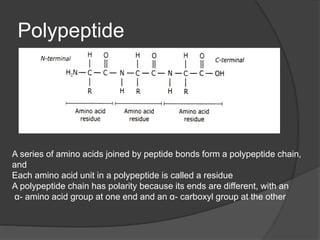
A series of amino acids joined by peptide bonds form a polypeptide chain,
and
Each amino acid unit in a polypeptide is called a residue
A polypeptide chain has polarity because its ends are different, with an
α- amino acid group at one end and an α- carboxyl group at the other
Peptide bond
 Peptides and polypeptides are linear and unbranched
polymers composed of amino acids linked together by
peptide bonds
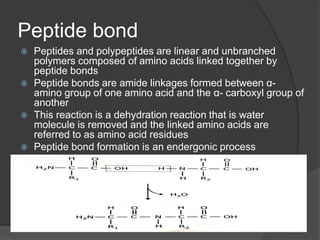
 Peptide bonds are amide linkages formed between α-
amino group of one amino acid and the α- carboxyl group of
another
 This reaction is a dehydration reaction that is water
molecule is removed and the linked amino acids are
referred to as amino acid residues
 Peptide bond formation is an endergonic process
Peptide bond
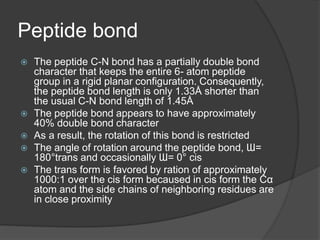
 The peptide C-N bond has a partially double bond
character that keeps the entire 6- atom peptide
group in a rigid planar configuration. Consequently,
the peptide bond length is only 1.33Å shorter than
the usual C-N bond length of 1.45Å
 The peptide bond appears to have approximately
40% double bond character
 As a result, the rotation of this bond is restricted
 The angle of rotation around the peptide bond, Ɯ=
180°trans and occasionally Ɯ= 0° cis
 The trans form is favored by ration of approximately
1000:1 over the cis form becaused in cis form the Cα
atom and the side chains of neighboring residues are
in close proximity
Peptide bond
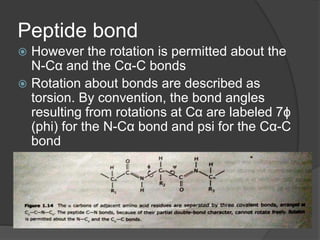
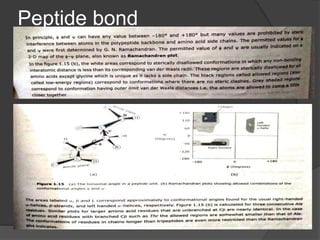
 However the rotation is permitted about the
N-Cα and the Cα-C bonds
 Rotation about bonds are described as
torsion. By convention, the bond angles
resulting from rotations at Cα are labeled 7ϕ
(phi) for the N-Cα bond and psi for the Cα-C
bond
Peptide bond
Protein structure
 Proteins are unbranched polymers constructed from
22 standard α- amino acids
 They have 4 levels of the structural organization
 Primary structure- the amino acid sequence, is
specified by genetic information
 As the polypeptide chain folds, it forms certain
localized arrangements of adjacent amino acids that
constitute secondary structure
 The overall 3 dimensional shape that a polypeptide
assumes is called tertiary structures
 Proteins that consists of 2 or more polypeptide
chains / subunits are said to have a quaternary
structure
Primary structure
 The primary structure( 1° structure ) of a
polypeptide is its amino acid sequence
 The amino acids are connected by
peptide bonds.
 Primary structure of polypeptide
determines the higher levels of structural
organization
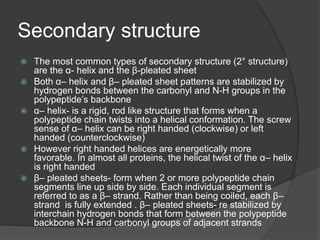
Secondary structure
 The most common types of secondary structure (2° structure)
are the α- helix and the β-pleated sheet
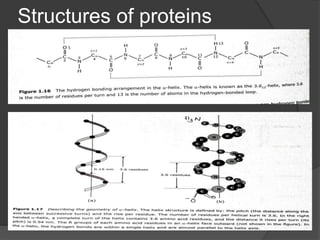
 Both α– helix and β– pleated sheet patterns are stabilized by
hydrogen bonds between the carbonyl and N-H groups in the
polypeptide’s backbone
 α– helix- is a rigid, rod like structure that forms when a
polypeptide chain twists into a helical conformation. The screw
sense of α– helix can be right handed (clockwise) or left
handed (counterclockwise)
 However right handed helices are energetically more
favorable. In almost all proteins, the helical twist of the α– helix
is right handed
 β– pleated sheets- form when 2 or more polypeptide chain
segments line up side by side. Each individual segment is
referred to as a β– strand. Rather than being coiled, each β–
strand is fully extended . β– pleated sheets- re stabilized by
interchain hydrogen bonds that form between the polypeptide
backbone N-H and carbonyl groups of adjacent strands
Structures of proteins
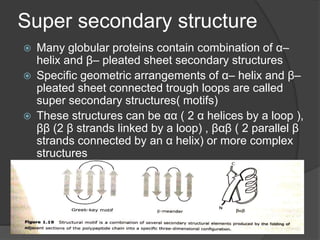
Super secondary structure
 Many globular proteins contain combination of α–
helix and β– pleated sheet secondary structures
 Specific geometric arrangements of α– helix and β–
pleated sheet connected trough loops are called
super secondary structures( motifs)
 These structures can be αα ( 2 α helices by a loop ),
ββ (2 β strands linked by a loop) , βαβ ( 2 parallel β
strands connected by an α helix) or more complex
structures
Tertiary structures
 Term tertiary structure (3° structure) refers to the unique 3 dimensional
confirmations that globular proteins assume as a consequence of the
interaction between the side chains in their primary structure
 The following types of covalent and non- covalent interactions stabilizes
tertiary structure- hydrophobic interactions(major form of non- covalent
interaction), electrostatic interaction( or salt bridges), hydrogen bonds,
van der waals force of interaction,
 covalent bonds: the covalent bond present in tertiary structure is the
intrachain disulfide bonds
 A disulfide bond (also called as a S-S bond) forms between 2 cysteine
residues due to oxidation of their thiol or sulfhydryl groups. The oxidized
dimer form of the amino acid cysteine is called cysteine. The other sulfur
containing amino acid, methionine, cannot form disulfide bonds
 The fundamental unit of tertiary strucutre is the domain
Quaternary structure
 Many proteins like hemoglobin, are composed of 2 or
more polypeptide chains. These proteins are called
multimeric proteins and each polypeptide chain is
called subunit
 Subunits in a multimeric protein may be identical
(homomultimeric) or quite different (heteromultimeric)
 Polypeptide subunits assemble to form quaternary
structure (4° structure) and are held together by non-
covalent interactions (such as hydrophobic
interactions, electrostatic interactions and hydrogen
bonds) as well as covalent interactions (interchain
disulfide bonds)
Denaturation of proteins
 Is a process in which proteins lose their native
confirmation that is normal biologically active folded
confirmation. It includes loss of quaternary, tertiary
and secondary strucutre of protein which is present
in the native state
 Denaturation includes breaking of non covalent
(electrostatic interactions, H bonds, van der waals
force of interactions and hydrophobic interactions)
and covalent (disulfide bonds)
 Denaturation usually does not include the breaking
of peptide bonds, denaturation results in loss of
activity
 Depending upon the degree of denaturation, the
molecule may partially or completely lose its
biological activity
Denaturation of proteins
 Denaturating agents-
 Strong acids or bases- changes in PH result in protonation or
deprotonation of the side group of amino acids of proteins which alters
hydrogen bonding and salt bridge patterns
 Organic solvents- reagents such as ethanol that are capable of forming
intermolecular hydrogen bonds with protein molecules disrupt the
intramolecular hydrogen bonding within the molecules
 Detergents- are amphipathetic molecules which disrupt hydrophobic
interactions and unfold proteins into extended polypeptide chains
 Reducing agents- such as β- marcaptoethanol reduces the disulfide
bonds to sulfhydryl groups and breaks intra or interchain disulfide
bonds
 Heavy metal ions- such as mercury and lead affect protein strucutre In
several ways. They may disrupt salt bridges by forming ionic bonds
with negatively charged groups. Heavy metal also bond with sulfhydryl
groups
 Heat- as the temperature increases, the rate of molecular vibration
increases. Eventually weak interactions such as hydrogen bonds and
van der waals interaction are disrupted and proteins unfold
Solubility of proteins
 The solubility of proteins in aqueous solution varies
considerably in given set of conditions. It depends upon
several factors- pH, ionic strength, nature of solvent,
temperature etc.
 Effect of pH- the surface of protein molecules is covered
by both negatively and positively charged groups. Above
pI the surface is predominantly negatively charged and
therefore like charged molecules will repel each other
 Conversely below the pI the overall charge will be positive
and again like charged molecules will repel one another.
At pI the protein molecule carries no net charge. The
negative and positive charges on the surface of protein
molecule cancel one another. Thus electrostatic repulsion
between individual molecules no longer occurs and
electrostatic attraction between molecules occur, resulting
in the formation of a precipitate due to decrease in the
solubility (isoelectric precipitation )
Solubility of proteins
 Effect of ionic strength- the solubility of protein at low ionic strength
generally increases with increasing salt concentration. This
process is known as salting in. it occurs due to the binding of salt
ions to the protein’s ionizable groups which decrease the
interaction between oppositely charged groups on the protein
molecules. Water molecules then form solvation spheres around
the groups. However when large amount of salt are added to a
protein in a solution, a precipitate forms. This process is referred to
as salting out. . The cause of insolubility in this case is different
from that for isoelectric precipitation. Salting out is dependent on
the hydrophobic nature of the surface of the protein.
 Hydrophobic groups predominate in the interior of the protein, but
some are located at the surface. Water is forced into contact with
these groups. When salts are added to the system, water solvates
the salt ions and as salt concentration increases water is removed
from around the protein, eventually exposing the hydrophobic
groups. Hydrophobic groups on one protein molecule can interact
with those of another, resulting in aggregation and thus
precipitation.
Solubility of proteins
 Effect of solvent- organic solvents such
as acetone, ethanol, decreases the
dielectric constant of the aqueous
solution, which in effect allows 2
proteins to come close together through
electrostatic force of attraction, these
solvents due to their low dielectric
constants lower the solvating power of
aqueous solutions.

Peptide and polypeptide, protein structure.pptx

  • 2.
    Introduction  Peptide- isa compound consisting of 2 or more amino acids  2 amino acid molecules are linked, through peptide bonds then the product is called dipeptide  3 amino acid molecules are linked, through 2 peptide bonds then the product is called tripeptide  Peptide chains of more than 12 and less than about 20 amino acid residues are usually called oligopeptide  Some peptides are cyclic in nature  Ex. 2 cyclic decapeptides produced by bacterium Bacillus brevis  some peptides play many roles in organisms such as, oxytocin and vasopressin are important hormones  Glutathione regulate oxidation –reduction reactions  Enkephalins are naturally occurring painkillers  Aspartame is commercially synthesized dipeptide used as artificial sweetener
  • 3.
    Polypeptide  When manyamino acid residues are joined and the product is called as polypeptide  In a polypeptide, the let end represented by 1st amino acid while right end represented by last amino acid  The first amino acid is also called N- terminal amino acid residue and the last amino acid is called C-terminal amino acid residue
  • 4.
    Polypeptide A series ofamino acids joined by peptide bonds form a polypeptide chain, and Each amino acid unit in a polypeptide is called a residue A polypeptide chain has polarity because its ends are different, with an α- amino acid group at one end and an α- carboxyl group at the other
  • 5.
    Peptide bond  Peptidesand polypeptides are linear and unbranched polymers composed of amino acids linked together by peptide bonds  Peptide bonds are amide linkages formed between α- amino group of one amino acid and the α- carboxyl group of another  This reaction is a dehydration reaction that is water molecule is removed and the linked amino acids are referred to as amino acid residues  Peptide bond formation is an endergonic process
  • 6.
    Peptide bond  Thepeptide C-N bond has a partially double bond character that keeps the entire 6- atom peptide group in a rigid planar configuration. Consequently, the peptide bond length is only 1.33Å shorter than the usual C-N bond length of 1.45Å  The peptide bond appears to have approximately 40% double bond character  As a result, the rotation of this bond is restricted  The angle of rotation around the peptide bond, Ɯ= 180°trans and occasionally Ɯ= 0° cis  The trans form is favored by ration of approximately 1000:1 over the cis form becaused in cis form the Cα atom and the side chains of neighboring residues are in close proximity
  • 7.
    Peptide bond  Howeverthe rotation is permitted about the N-Cα and the Cα-C bonds  Rotation about bonds are described as torsion. By convention, the bond angles resulting from rotations at Cα are labeled 7ϕ (phi) for the N-Cα bond and psi for the Cα-C bond
  • 8.
  • 9.
    Protein structure  Proteinsare unbranched polymers constructed from 22 standard α- amino acids  They have 4 levels of the structural organization  Primary structure- the amino acid sequence, is specified by genetic information  As the polypeptide chain folds, it forms certain localized arrangements of adjacent amino acids that constitute secondary structure  The overall 3 dimensional shape that a polypeptide assumes is called tertiary structures  Proteins that consists of 2 or more polypeptide chains / subunits are said to have a quaternary structure
  • 10.
    Primary structure  Theprimary structure( 1° structure ) of a polypeptide is its amino acid sequence  The amino acids are connected by peptide bonds.  Primary structure of polypeptide determines the higher levels of structural organization
  • 11.
    Secondary structure  Themost common types of secondary structure (2° structure) are the α- helix and the β-pleated sheet  Both α– helix and β– pleated sheet patterns are stabilized by hydrogen bonds between the carbonyl and N-H groups in the polypeptide’s backbone  α– helix- is a rigid, rod like structure that forms when a polypeptide chain twists into a helical conformation. The screw sense of α– helix can be right handed (clockwise) or left handed (counterclockwise)  However right handed helices are energetically more favorable. In almost all proteins, the helical twist of the α– helix is right handed  β– pleated sheets- form when 2 or more polypeptide chain segments line up side by side. Each individual segment is referred to as a β– strand. Rather than being coiled, each β– strand is fully extended . β– pleated sheets- re stabilized by interchain hydrogen bonds that form between the polypeptide backbone N-H and carbonyl groups of adjacent strands
  • 12.
  • 13.
    Super secondary structure Many globular proteins contain combination of α– helix and β– pleated sheet secondary structures  Specific geometric arrangements of α– helix and β– pleated sheet connected trough loops are called super secondary structures( motifs)  These structures can be αα ( 2 α helices by a loop ), ββ (2 β strands linked by a loop) , βαβ ( 2 parallel β strands connected by an α helix) or more complex structures
  • 14.
    Tertiary structures  Termtertiary structure (3° structure) refers to the unique 3 dimensional confirmations that globular proteins assume as a consequence of the interaction between the side chains in their primary structure  The following types of covalent and non- covalent interactions stabilizes tertiary structure- hydrophobic interactions(major form of non- covalent interaction), electrostatic interaction( or salt bridges), hydrogen bonds, van der waals force of interaction,  covalent bonds: the covalent bond present in tertiary structure is the intrachain disulfide bonds  A disulfide bond (also called as a S-S bond) forms between 2 cysteine residues due to oxidation of their thiol or sulfhydryl groups. The oxidized dimer form of the amino acid cysteine is called cysteine. The other sulfur containing amino acid, methionine, cannot form disulfide bonds  The fundamental unit of tertiary strucutre is the domain
  • 15.
    Quaternary structure  Manyproteins like hemoglobin, are composed of 2 or more polypeptide chains. These proteins are called multimeric proteins and each polypeptide chain is called subunit  Subunits in a multimeric protein may be identical (homomultimeric) or quite different (heteromultimeric)  Polypeptide subunits assemble to form quaternary structure (4° structure) and are held together by non- covalent interactions (such as hydrophobic interactions, electrostatic interactions and hydrogen bonds) as well as covalent interactions (interchain disulfide bonds)
  • 16.
    Denaturation of proteins Is a process in which proteins lose their native confirmation that is normal biologically active folded confirmation. It includes loss of quaternary, tertiary and secondary strucutre of protein which is present in the native state  Denaturation includes breaking of non covalent (electrostatic interactions, H bonds, van der waals force of interactions and hydrophobic interactions) and covalent (disulfide bonds)  Denaturation usually does not include the breaking of peptide bonds, denaturation results in loss of activity  Depending upon the degree of denaturation, the molecule may partially or completely lose its biological activity
  • 17.
    Denaturation of proteins Denaturating agents-  Strong acids or bases- changes in PH result in protonation or deprotonation of the side group of amino acids of proteins which alters hydrogen bonding and salt bridge patterns  Organic solvents- reagents such as ethanol that are capable of forming intermolecular hydrogen bonds with protein molecules disrupt the intramolecular hydrogen bonding within the molecules  Detergents- are amphipathetic molecules which disrupt hydrophobic interactions and unfold proteins into extended polypeptide chains  Reducing agents- such as β- marcaptoethanol reduces the disulfide bonds to sulfhydryl groups and breaks intra or interchain disulfide bonds  Heavy metal ions- such as mercury and lead affect protein strucutre In several ways. They may disrupt salt bridges by forming ionic bonds with negatively charged groups. Heavy metal also bond with sulfhydryl groups  Heat- as the temperature increases, the rate of molecular vibration increases. Eventually weak interactions such as hydrogen bonds and van der waals interaction are disrupted and proteins unfold
  • 18.
    Solubility of proteins The solubility of proteins in aqueous solution varies considerably in given set of conditions. It depends upon several factors- pH, ionic strength, nature of solvent, temperature etc.  Effect of pH- the surface of protein molecules is covered by both negatively and positively charged groups. Above pI the surface is predominantly negatively charged and therefore like charged molecules will repel each other  Conversely below the pI the overall charge will be positive and again like charged molecules will repel one another. At pI the protein molecule carries no net charge. The negative and positive charges on the surface of protein molecule cancel one another. Thus electrostatic repulsion between individual molecules no longer occurs and electrostatic attraction between molecules occur, resulting in the formation of a precipitate due to decrease in the solubility (isoelectric precipitation )
  • 19.
    Solubility of proteins Effect of ionic strength- the solubility of protein at low ionic strength generally increases with increasing salt concentration. This process is known as salting in. it occurs due to the binding of salt ions to the protein’s ionizable groups which decrease the interaction between oppositely charged groups on the protein molecules. Water molecules then form solvation spheres around the groups. However when large amount of salt are added to a protein in a solution, a precipitate forms. This process is referred to as salting out. . The cause of insolubility in this case is different from that for isoelectric precipitation. Salting out is dependent on the hydrophobic nature of the surface of the protein.  Hydrophobic groups predominate in the interior of the protein, but some are located at the surface. Water is forced into contact with these groups. When salts are added to the system, water solvates the salt ions and as salt concentration increases water is removed from around the protein, eventually exposing the hydrophobic groups. Hydrophobic groups on one protein molecule can interact with those of another, resulting in aggregation and thus precipitation.
  • 20.
    Solubility of proteins Effect of solvent- organic solvents such as acetone, ethanol, decreases the dielectric constant of the aqueous solution, which in effect allows 2 proteins to come close together through electrostatic force of attraction, these solvents due to their low dielectric constants lower the solvating power of aqueous solutions.