Peptide Modifications To Increase Metabolic
Stability And Activity 2013th Predrag Cudic

download
https://ebookbell.com/product/peptide-modifications-to-increase-
metabolic-stability-and-activity-2013th-predrag-cudic-47757388
Explore and download more ebooks at ebookbell.com
Here are some recommended products that we believe you will be
interested in. You can click the link to download.
Study Of The Peptidepeptide And Peptideprotein Interactions And Their
Applications In Cell Imaging And Nanoparticle Surface Modification 1st
Edition Jianpeng Wang Auth
https://ebookbell.com/product/study-of-the-peptidepeptide-and-
peptideprotein-interactions-and-their-applications-in-cell-imaging-
and-nanoparticle-surface-modification-1st-edition-jianpeng-wang-
auth-5608946
Peptide Therapeutics Fundamentals Of Design Development And Delivery
Seetharama D Jois Ed
https://ebookbell.com/product/peptide-therapeutics-fundamentals-of-
design-development-and-delivery-seetharama-d-jois-ed-46274062
Peptide Microarrays 3rd Marina Cretich Alessandro Gori
https://ebookbell.com/product/peptide-microarrays-3rd-marina-cretich-
alessandro-gori-46364678
Peptide And Peptidomimetic Therapeutics From Bench To Bedside Nir Qvit
https://ebookbell.com/product/peptide-and-peptidomimetic-therapeutics-
from-bench-to-bedside-nir-qvit-46432252
Peptide Conjugation 1st Waleed M Hussein Rachel J Stephenson
https://ebookbell.com/product/peptide-conjugation-1st-waleed-m-
hussein-rachel-j-stephenson-47691224
Peptide Nucleic Acids 3rd Ed 2020 Edition Peter E Nielsen
https://ebookbell.com/product/peptide-nucleic-acids-3rd-
ed-2020-edition-peter-e-nielsen-47706476
Peptide Synthesis And Applications 2nd Ed Knud J Jensen Pernille
Tofteng Shelton
https://ebookbell.com/product/peptide-synthesis-and-applications-2nd-
ed-knud-j-jensen-pernille-tofteng-shelton-47777036
Peptide Bionanomaterials From Design To Application 1st Ed 2023
Mohamed A Elsawy
https://ebookbell.com/product/peptide-bionanomaterials-from-design-to-
application-1st-ed-2023-mohamed-a-elsawy-51797072
Peptide Antibodies Methods And Protocols 2nd Edition 2nd Gunnar Houen
https://ebookbell.com/product/peptide-antibodies-methods-and-
protocols-2nd-edition-2nd-gunnar-houen-58449342
Peptide
Modifications
toIncrease
MetabolicStability
andActivity
Predrag Cudic Editor
Methods in
Molecular Biology 1081
ME T H O D S I N MO L E C U L A R BI O L O G Y ™
Series Editor
John M. Walker
School of Life Sciences
University of Hertfordshire
Hatfield, Hertfordshire, AL10 9AB, UK
For further volumes:
http://www.springer.com/series/7651
Peptide Modifications to
Increase Metabolic Stability
and Activity
Edited by
Predrag Cudic
TorreyPinesInstituteforMolecularStudies,PortSt.Lucie,FL,USA
ISSN 1064-3745 ISSN 1940-6029 (electronic)
ISBN 978-1-62703-651-1 ISBN 978-1-62703-652-8 (eBook)
DOI 10.1007
/978-1-62703-652-8
Springer New York Heidelberg Dordrecht London
Library of Congress Control Number: 2013947403
© Springer Science+Business Media New York 2013
This work is subject to copyright. All rights are reserved by the Publisher, whether the whole or part of the material is
concerned, specifically the rights of translation, reprinting, reuse of illustrations, recitation, broadcasting, reproduction
on microfilms or in any other physical way, and transmission or information storage and retrieval, electronic adaptation,
computer software, or by similar or dissimilar methodology now known or hereafter developed. Exempted from this
legal reservation are brief excerpts in connection with reviews or scholarly analysis or material supplied specifically for
the purpose of being entered and executed on a computer system, for exclusive use by the purchaser of the work.
Duplication of this publication or parts thereof is permitted only under the provisions of the Copyright Law of the
Publisher’s location, in its current version, and permission for use must always be obtained from Springer. Permissions
for use may be obtained through RightsLink at the Copyright Clearance Center. Violations are liable to prosecution
under the respective Copyright Law.
The use of general descriptive names, registered names, trademarks, service marks, etc. in this publication does not
imply, even in the absence of a specific statement, that such names are exempt from the relevant protective laws and
regulations and therefore free for general use.
While the advice and information in this book are believed to be true and accurate at the date of publication, neither
the authors nor the editors nor the publisher can accept any legal responsibility for any errors or omissions that may be
made. The publisher makes no warranty, express or implied, with respect to the material contained herein.
Printed on acid-free paper
Humana Press is a brand of Springer
Springer is part of Springer Science+Business Media (www.springer.com)
Editor
Predrag Cudic
Torrey Pines Institute for Molecular Studies
Port St. Lucie, FL, USA
v
Historically, natural products have served as important sources of pharmacologically active
compounds or lead structures for the development of new drugs. Among natural products,
peptides are particularly interesting because of the key roles they play in biological pro-
cesses. Peptides’ potential for high efficacy and their minimal side effects combined with
advances in recombinant DNA technology, solid-phase synthetic chemistry, purification
technology, and new strategies for peptide drug delivery made them widely considered as
lead compounds in drug development. At present around 67 peptides are in the world
market for clinical applications, some 270 are in clinical phases, and more than 400 are in
advanced preclinical trials worldwide. Peptide-based therapeutics exist for a variety of
human diseases, including osteoporosis (calcitonin), diabetes (insulin), infertility (gonad-
orelin), carcinoid tumors and acromegaly (octreotide), hypothyroidism (thyrotropin-
releasing hormone [TRH]), and bacterial infections (vancomycin, daptomycin). However,
despite their great potential, there are still limitations for peptides as drugs per se. Major
disadvantages are short half-life, rapid metabolism, and poor permeation across biological
barriers such as the blood–brain barrier (BBB) and intestinal mucosa. Nevertheless, phar-
macokinetic properties of peptides can be improved and optimized through synthetic mod-
ifications. Peptidomimetic modifications, cyclization of linear peptides, or incorporation of
D- and non-proteinogenic amino acids are traditionally used, both in academia and in
industry, as an attractive method to provide more stable and bioactive peptides. In addition,
linear peptide sequence modification by cyclization, glycosylation, and incorporation of
non-proteinogenic amino acids have been widely used to enhance the potential of peptides
as therapeutic agents. Peptide modifications to increase metabolic stability and activity is the
first volume of a series that summarizes methods for preparation and purification of these
peptides, and assessment of their biochemical activity. Readers of this volume will find
detailed synthetic protocols that lead to modifications of the peptide backbone, side chains
chapter, and terminal residues. Among these are protocols for preparation of conforma-
tionally constrained peptides (Chapters 1 and 2), modification of peptide bonds (Chapters
3 and 4), introduction of non-proteinogenic amino acids (Chapters 5–7), and alteration of
peptides’ physical and biological properties by modification of the amino acid side chains
and/or terminal residues (Chapters 8–12). Last chapter (Chapter 13) describes a new
experimental approach for the detection of exogenous peptides within living cells using
peptides labeled with heavy isotopes and confocal Raman microscopy. This method allows
peptide structure–activity relationships and metabolism to be explored directly within the
targeted cellular environment. Of course, there are many other ways to improve peptides’
metabolic stability and activity (e.g., peptide PEGylation or N-methylation of peptide bond
and/or incorporation of D-amino acids) and they are well documented in the literature.
However, my goal in this volume is to provide alternative approaches to peptide modifica-
tion that many researchers may find applicable to their specific research requirements.
Preface
vi
I believe that the readers will find protocols collected in this volume beneficial and
helpful for their own research. At the end, I would like to thank all the authors and coauthors
for their generous and enthusiastic contributions to this book. Their efforts and time are
much appreciated.
Port St. Lucie, FL, USA Predrag Cudic
Preface
vii
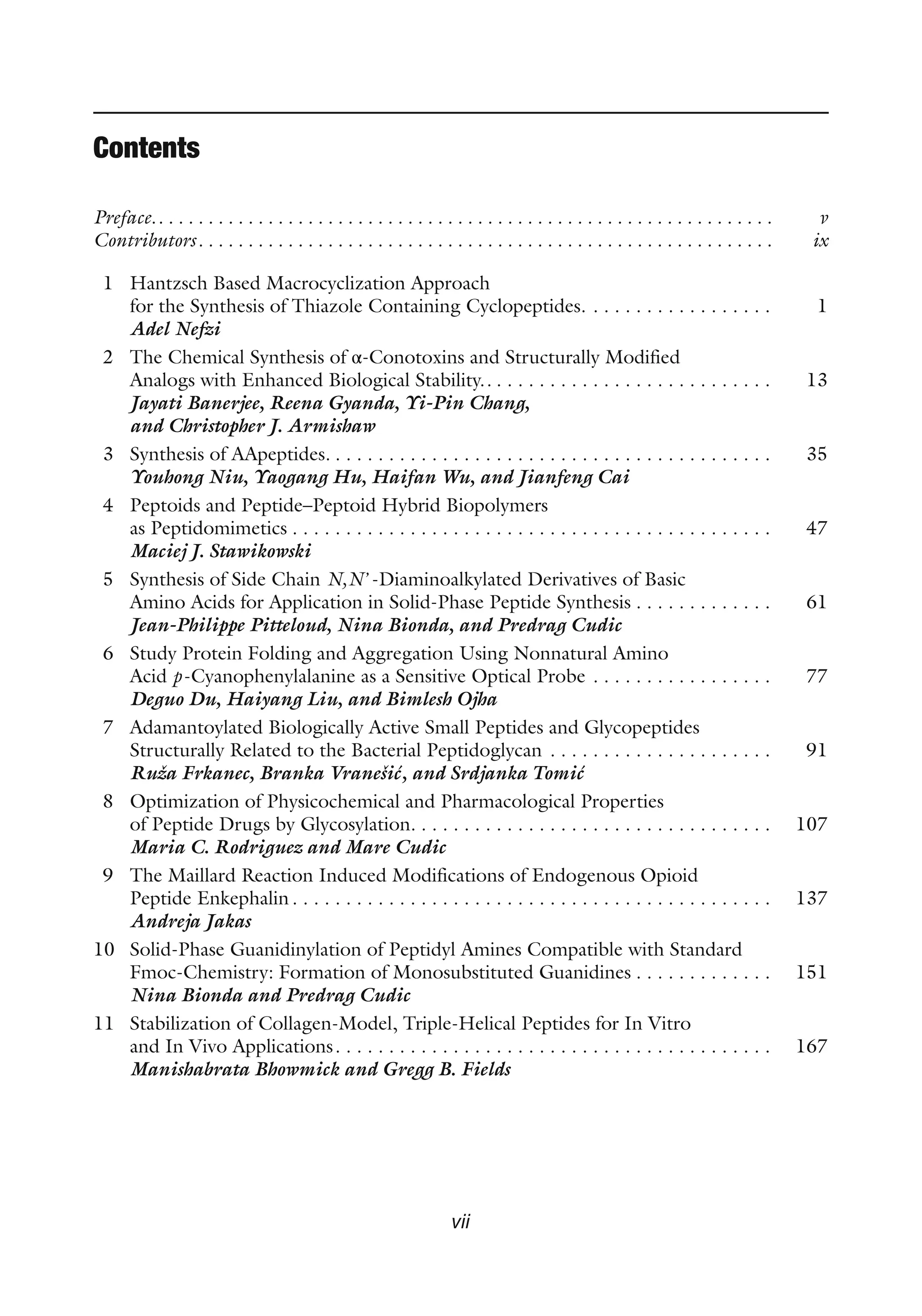
Contents
Preface.. . . . . . . . . . . . . . . . . . . . . . . . . . . . . . . . . . . . . . . . . . . . . . . . . . . . . . . . . . . . . . v
Contributors. . . . . . . . . . . . . . . . . . . . . . . . . . . . . . . . . . . . . . . . . . . . . . . . . . . . . . . . . . ix
1 Hantzsch Based Macrocyclization Approach
for the Synthesis of Thiazole Containing Cyclopeptides. . . . . . . . . . . . . . . . . . 1
Adel Nefzi
2 The Chemical Synthesis of α-Conotoxins and Structurally Modified
Analogs with Enhanced Biological Stability.. . . . . . . . . . . . . . . . . . . . . . . . . . . 13
Jayati Banerjee, Reena Gyanda, Yi-Pin Chang,
and Christopher J. Armishaw
3 Synthesis of AApeptides. . . . . . . . . . . . . . . . . . . . . . . . . . . . . . . . . . . . . . . . . . 35
Youhong Niu, Yaogang Hu, Haifan Wu, and Jianfeng Cai
4 Peptoids and Peptide–Peptoid Hybrid Biopolymers
as Peptidomimetics . . . . . . . . . . . . . . . . . . . . . . . . . . . . . . . . . . . . . . . . . . . . . 47
Maciej J. Stawikowski
5 Synthesis of Side Chain N,N’-Diaminoalkylated Derivatives of Basic
Amino Acids for Application in Solid-Phase Peptide Synthesis . . . . . . . . . . . . . 61
Jean-Philippe Pitteloud, Nina Bionda, and Predrag Cudic
6 Study Protein Folding and Aggregation Using Nonnatural Amino
Acid p-Cyanophenylalanine as a Sensitive Optical Probe . . . . . . . . . . . . . . . . . 77
Deguo Du, Haiyang Liu, and Bimlesh Ojha
7 Adamantoylated Biologically Active Small Peptides and Glycopeptides
Structurally Related to the Bacterial Peptidoglycan . . . . . . . . . . . . . . . . . . . . . 91
Ruža Frkanec, Branka Vranešić, and Srdjanka Tomić
8 Optimization of Physicochemical and Pharmacological Properties
of Peptide Drugs by Glycosylation. . . . . . . . . . . . . . . . . . . . . . . . . . . . . . . . . . 107
Maria C. Rodriguez and Mare Cudic
9 The Maillard Reaction Induced Modifications of Endogenous Opioid
Peptide Enkephalin . . . . . . . . . . . . . . . . . . . . . . . . . . . . . . . . . . . . . . . . . . . . . 137
Andreja Jakas
10 Solid-Phase Guanidinylation of Peptidyl Amines Compatible with Standard
Fmoc-Chemistry: Formation of Monosubstituted Guanidines . . . . . . . . . . . . . 151
Nina Bionda and Predrag Cudic
11 Stabilization of Collagen-Model, Triple-Helical Peptides for In Vitro
and In Vivo Applications. . . . . . . . . . . . . . . . . . . . . . . . . . . . . . . . . . . . . . . . . 167
Manishabrata Bhowmick and Gregg B. Fields
viii
12 Identification of Adipokine Receptor Agonists and Turning Them
to Antagonists. . . . . . . . . . . . . . . . . . . . . . . . . . . . . . . . . . . . . . . . . . . . . . . . . . . . . 195
Laszlo Otvos Jr.
13 Peptide Detection and Structure Determination in Live Cells Using
Confocal Raman Microscopy. . . . . . . . . . . . . . . . . . . . . . . . . . . . . . . . . . . . . . . . . . 211
Andrew C. Terentis and Jing Ye
Index . . . . . . . . . . . . . . . . . . . . . . . . . . . . . . . . . . . . . . . . . . . . . . . . . . . . . . . . . . . . . . . . . 237
Contents
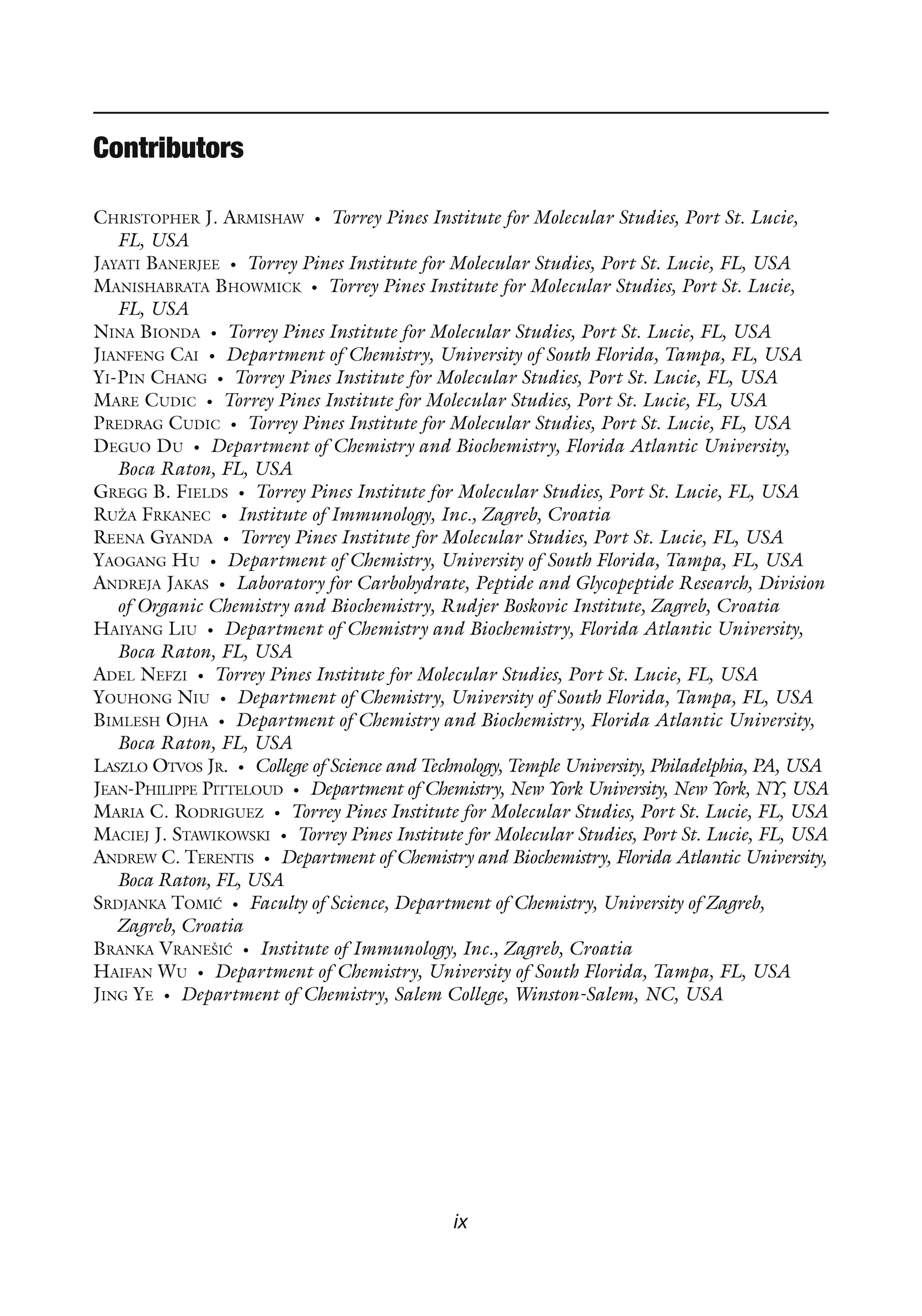
ix
CHRISTOPHER J. ARMISHAW • Torrey Pines Institute for Molecular Studies, Port St. Lucie,
FL, USA
JAYATI BANERJEE • Torrey Pines Institute for Molecular Studies, Port St. Lucie, FL, USA
MANISHABRATA BHOWMICK • Torrey Pines Institute for Molecular Studies, Port St. Lucie,
FL, USA
NINA BIONDA • Torrey Pines Institute for Molecular Studies, Port St. Lucie, FL, USA
JIANFENG CAI • Department of Chemistry, University of South Florida, Tampa, FL, USA
YI-PIN CHANG • Torrey Pines Institute for Molecular Studies, Port St. Lucie, FL, USA
MARE CUDIC • Torrey Pines Institute for Molecular Studies, Port St. Lucie, FL, USA
PREDRAG CUDIC • Torrey Pines Institute for Molecular Studies, Port St. Lucie, FL, USA
DEGUO DU • Department of Chemistry and Biochemistry, Florida Atlantic University,
Boca Raton, FL, USA
GREGG B. FIELDS • Torrey Pines Institute for Molecular Studies, Port St. Lucie, FL, USA
RUŽA FRKANEC • Institute of Immunology, Inc., Zagreb, Croatia
REENA GYANDA • Torrey Pines Institute for Molecular Studies, Port St. Lucie, FL, USA
YAOGANG HU • Department of Chemistry, University of South Florida, Tampa, FL, USA
ANDREJA JAKAS • Laboratory for Carbohydrate, Peptide and Glycopeptide Research, Division
of Organic Chemistry and Biochemistry, Rudjer Boskovic Institute, Zagreb, Croatia
HAIYANG LIU • Department of Chemistry and Biochemistry, Florida Atlantic University,
Boca Raton, FL, USA
ADEL NEFZI • Torrey Pines Institute for Molecular Studies, Port St. Lucie, FL, USA
YOUHONG NIU • Department of Chemistry, University of South Florida, Tampa, FL, USA
BIMLESH OJHA • Department of Chemistry and Biochemistry, Florida Atlantic University,
Boca Raton, FL, USA
LASZLO OTVOS JR. • College of Science and Technology, Temple University, Philadelphia, PA, USA
JEAN-PHILIPPE PITTELOUD • Department of Chemistry, New York University, New York, NY, USA
MARIA C. RODRIGUEZ • Torrey Pines Institute for Molecular Studies, Port St. Lucie, FL, USA
MACIEJ J. STAWIKOWSKI • Torrey Pines Institute for Molecular Studies, Port St. Lucie, FL, USA
ANDREW C. TERENTIS • Department of Chemistry and Biochemistry, Florida Atlantic University,
Boca Raton, FL, USA
SRDJANKA TOMIĆ • Faculty of Science, Department of Chemistry, University of Zagreb,
Zagreb, Croatia
BRANKA VRANEŠIĆ • Institute of Immunology, Inc., Zagreb, Croatia
HAIFAN WU • Department of Chemistry, University of South Florida, Tampa, FL, USA
JING YE • Department of Chemistry, Salem College, Winston-Salem, NC, USA
Contributors
1
Predrag Cudic (ed.), Peptide Modifications to Increase Metabolic Stability and Activity, Methods in Molecular Biology, vol. 1081,
DOI 10.1007/978-1-62703-652-8_1, © Springer Science+Business Media New York 2013
Chapter 1
Hantzsch Based Macrocyclization Approach
for the Synthesis of Thiazole Containing Cyclopeptides
Adel Nefzi
Abstract
An innovative macrocyclization approach via high-yielding solid-phase intramolecular thioalkylation reac-
tion is described. The reaction of S-nucleophiles with newly generated N-terminal 4-chloromethyl thia-
zoles leads to the desired cyclic products in high purities and good yields.
Key words Cyclic peptides, Thioalkylation, Solid-phase synthesis, Parallel synthesis, 4-Chloromethyl
thiazoles
1 Introduction
Cyclic peptides have been difficult to prepare using traditional syn-
thetic methods. In order for macrocyclization to occur, the acti-
vated peptide must adopt an entropically disfavored pre-cyclization
state before forming the desired product. Conformational con-
straint by cyclization is a common approach used to restrict the
flexibility of peptides and therefore is a valuable approach to study
topographical requirements of receptors [1–6]. Cyclization of pep-
tides can provide potent and selective ligands for receptors when
appropriate conformational constraints are incorporated.
Furthermore cyclic peptides are often more stable to peptidases,
and therefore they can have improved pharmacokinetic profiles
and serve as promising lead compounds for further development
[7–13]. Macrocycles are known for their broad range of activities
including antitumor activities and antibiotic activities such as the
structurally complex vancomycin family [14, 15]. Of the various
methods of synthesizing cyclic peptides, most often the final ring-
closing reaction is a lactamization, a lactonization (depsipeptides), or
the formation of a disulfide bridge. Reported approaches on the
solid-phase synthesis of macrocyclic compounds include intramolec-
ular nucleophilic substitutions [16, 17], intramolecular amide forma-
tions [18–20], disulfide formations [21–23], intramolecular Suzuki
2
reactions [24–26], ring closing metathesis reactions [27–29], and
SNAr displacement reactions [30–33]. Of particular interest, thio-
alkylation reactions offer a facile and versatile approach to the syn-
thesis of cyclic peptides [16, 17, 34–37]. Examples of described
macrocyclizations via thioalkylation include the reaction of the
thiol group of a C-terminal cysteine with N-terminal acetyl bro-
mide or N-terminal benzyl bromide [16, 17, 34–37]. A conceptu-
ally different approach, wherein thioalkylation proceeds via Michael
addition of a thiolate anion to an α,β-unsaturated ester, has been
reported for the synthesis of cyclic thioether dipeptides [38].
Many reagents and techniques have been developed to facili-
tate the synthesis of cyclic peptides, for which the yield-limiting
step is generally the cyclization reaction. Particularly, the cycliza-
tion of tetra-, penta-, and hexapeptides in the all L-configuration
can be problematic, especially in the absence of beta-turn promot-
ing structures such as glycine, proline, or a D-amino acid [6, 39–42].
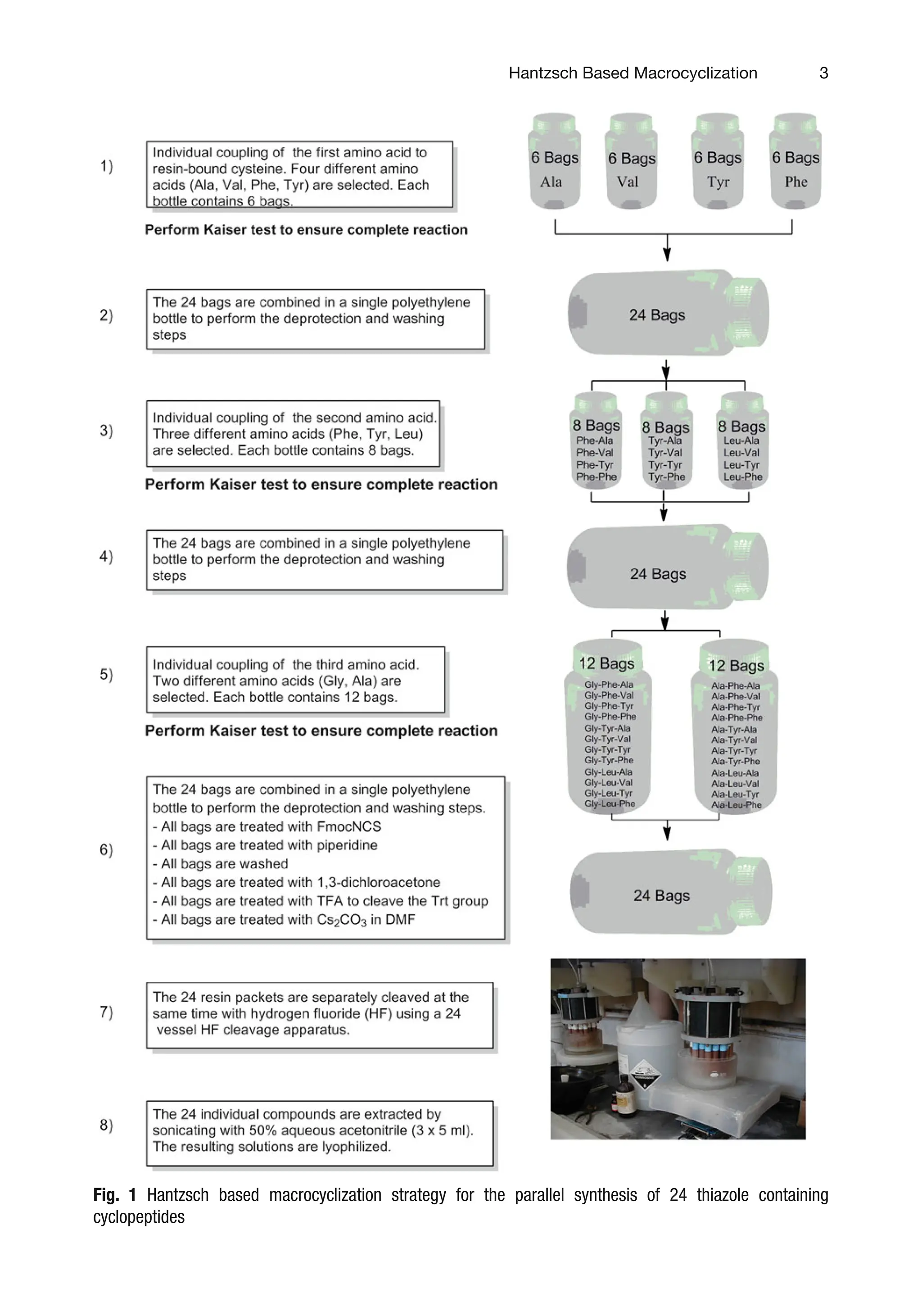
Our approach outlined in Fig. 1, was tested by performing the
parallel synthesis of various thiazole containing cyclic tetrapeptides
and pentapeptides from all L-amino acids.
An innovative thioalkylation approach toward the generation
of macrocyclic peptides following the intramolecular nucleophilic
substitution (SN2) of N terminus 4-chloro methyl thiazole pep-
tides with the thiol group of cysteine was described. The final
products are not entirely peptidic and the described newly gener-
ated macrocyclic compounds contain the thiazole ring, a pharma-
cophore present in many natural and synthetic products with a
wide range of pharmacological activities that can be well illustrated
by the large numbers of naturally occurring thiazole containing
macrocyclic compounds [43–45] and drugs in the market contain-
ing this function group [46–48]. We have also performed com-
parative computational studies of the chemical distribution of
different cyclic peptides in the chemical space. This studies show
that the prepared thiazole containing cyclic peptides occupy a dif-
ferent region in chemical space as compared to other cyclic forms.
2 Materials
1. All reagents such as 1,3-dichloroacetone, and solvents such as
dichloromethane (DCM), Dimethylformamide (DMF) were
obtained from Sigma-Aldrich (St. Louis, MO).
2. FmocNCS was obtained from ChemImpex (Wood Dale, IL).
3. Amino acids, Fmoc-isothiocyanate, piperidine, Cs2CO3, tri-
fluoroacetic acid (TFA), (But
)3SiH, diisopropylethylamine
(DIEA), p-methylbenzhydrylamine hydrochloride (MBHA⋅
HCl) resin (100–200 mesh, cross-linked with 1 % divinylben-
zene), and peptide coupling reagents such as diisopropylcar-
bodiimide (DICI), hydroxybenzotriazole (HOBt) were
Adel Nefzi
3
Fig. 1 Hantzsch based macrocyclization strategy for the parallel synthesis of 24 thiazole containing
cyclopeptides
Hantzsch Based Macrocyclization
4
obtained from Fisher Scientific (Waltham, MA), ChemImpex
and Novabiochem (San Diego, CA).
4. The ninhydrin test kit was obtained from AnaSpec
(Fremount, CA).
3 Methods
T-bags (Fig. 2) are prepared by containing solid phase resins within
polypropylene mesh material [49]. Polypropylene is chemically
inert and fairly thermally stable (to 150 °C), allowing a wide range
of chemical reactions to be used for solid phase synthesis without
affecting the bag material. Polystyrene cross-linked with 1 % divi-
nylbenzene, 100–200 mesh, is mainly used as the solid support. It
is very important that the size of the resin beads exceeds the size of
the pores of the polypropylene mesh material of the T-bags to
avoid resin loss during synthesis. Syntheses are carried out manu-
ally using polyethylene bottles.
Figure 1 illustrates the applicability of the proposed approach for
the parallel synthesis of 24 different thiazole containing macrocy-
clic peptides. Starting from resin-bound orthogonally protected
Fmoc-Cys-(Trt)-OH 1, the thiomethyl thiazolyl macrocyclic pep-
tidomimetics 6 were synthesized following stepwise Fmoc deprot-
ection [50] and standard repetitive Fmoc-amino-acid couplings
yielding the resin-bound linear tetrapeptide 2. The resulting
N-terminal free amine is treated with Fmoc-isothiocyanate.
Following Fmoc deprotection, the thioureas are treated with
1,3-dichloroacetone to afford following Hantzsch’s cycloconden-
sation [51–54] the resulting resin-bound chloro methyl thiazolyl
peptide 5. The Trt group is deprotected in the presence of 5 %TFA
in DCM and the resin is treated with a solution of Cs2CO3 in DMF
to undergo an SN2 intramolecular cyclization. The resin is cleaved
with HF/anisole and the desired thiazolyl thioether cyclic peptides
3.1 The T-Bag
Method
3.2 Simultaneous
Multiple Peptide
Synthesis: Parallel
Solid Phase Peptide
Synthesis of the
Resin-Bound Linear
Peptides
Fig. 2 Simultaneous parallel synthesis “Tea Bag”
Adel Nefzi
5
6 are obtained in good yield and high purity. The identity of the
final products was confirmed by LC-MS and NMR spectroscopy
(see Note 1).
Preparation of T-bags for solid phase synthesis: All syntheses
were performed using p-methylbenzhydrylamine hydrochloride
(MBHA·HCl) resin (1.15 meq/g), and starting with 100 mg resin
per bag. Synthesis using the T-bag method can be performed using
either Boc [55, 56] or Fmoc [49] synthetic strategies. For all
manipulations, enough solvent should be used to cover the T-bags
(about 3–4 ml per bag containing 100 mg of resin). To enable
efficient washings and reactions, the reaction vessels (polyethylene
bottles) should be shaken vigorously, preferably through the use of
a reciprocating shaker. Thus, during a T-bag synthesis of various
sequences in parallel, the deprotection and washing steps can be
performed with all bags combined in a single polyethylene bottle
(Fig. 1). For the amino acid couplings, the bags are separated
depending on the different corresponding sequences to be pre-
pared. Following the coupling reactions, two washing cycles are
done separately before combining all the bags again for subsequent
washing and deprotection steps (see Note 2).
As outlined in Fig. 3, a 100 mg sample of MBHA⋅HCl resin
(1.15 meq/g) was contained within a sealed polypropylene mesh
bag. For the parallel synthesis of 24 different compounds:
1. Prepare 24 separate bags (24×100 mg resin, 2.76 mmol).
2. Put all bags in a polyethylene bottle.
3. Neutralize the resin with 500 ml of 5 % DIEA in DCM.
4. Decant the solution.
5. Couple L-Fmoc-Cys(Trt)-OH (3 eq, 4.85 g, 8.28 mmol)
using the conventional reagents HOBt (1.07 g, 8.28 mmol)
and DIC (1.16 ml, 8.28 mmol) in 300 ml anhydrous DMF
overnight at room temperature.
6. Decant the solution.
7. Wash the resin-bound dipeptide with DMF (3×) and DCM (3×).
8. Monitor the completion of the coupling by the ninhydrin
test [57].
3.3 Synthesis
of Resin-Bound
Cysteine 1
Fig. 3 Synthesis of p-methylbenzhydrylamine resin-bound cysteine
Hantzsch Based Macrocyclization
6
Starting from resin-bound orthogonally protected Fmoc-Cys-
(Trt)-OH 1, the linear peptides 2 are synthesized following step-
wise Fmoc deprotection [14] and standard repetitive
Fmoc-amino-acid couplings (Fig. 4).
Following is the procedure for the preparation of one resin-
bound linear peptide:
1. Prepare one bag of resin 1 (100 mg, 0.115 mmol) in a small
polyethylene bottle.
2. Deprotect the Fmoc group with 10 ml 20 % piperidine in
DMF (2×10 min).
3. Wash the resin with 10 ml DMF (3×) and 10 ml DCM (3×).
4. Couple the first amino acid L-Fmoc-Xaa1-OH (6 eq,
0.69 mmol) in the presence of HOBt (6 eq, 0.094 g,
0.69 mmol) and DIC (6 eq, 0.101 ml, 0.69 mmol) in 10 ml
of anhydrous DMF for 2 h at room temperature.
5. Decant the solution.
6. Wash the resin-bound dipeptide with DMF (3×) and DCM (3×).
7. Monitor the completion of the coupling by the ninhydrin test.
8. Deprotect the Fmoc group with 10 ml 20 % piperidine in
DMF (2×10 min).
9. Wash the resin-bound dipeptide with DMF (3×) and DCM (3×).
10. Proceed with the coupling of the second amino acid L-FMOC-
XAA2-OH (6 eq, 0.69 mmol) using the same reaction conditions.
11. Monitor the completion of the coupling by the ninhydrin test.
12. Deprotect the Fmoc group with 10 ml 20 % piperidine in
DMF (2×10 min).
13. Wash the resin-bound dipeptide with DMF (3×) and DCM (3×).
14. Couple L-Fmoc-Xaa3-OH to the resin-bound tripeptide in the
same conditions to yield the corresponding resin-bound pro-
tected linear peptide 2.
15. Decant the solution.
16. Wash the resin-bound dipeptide with DMF (3×) and DCM (3×).
17. Monitor the completion of the coupling by the ninhydrin
test [57].
3.4 General
Procedure for the
Solid-Phase Synthesis
of Resin-Bound Linear
Peptide 2
Fig. 4 Solid phase peptide synthesis of the resin-bound linear peptides using
Fmoc-chemistry
Adel Nefzi
7
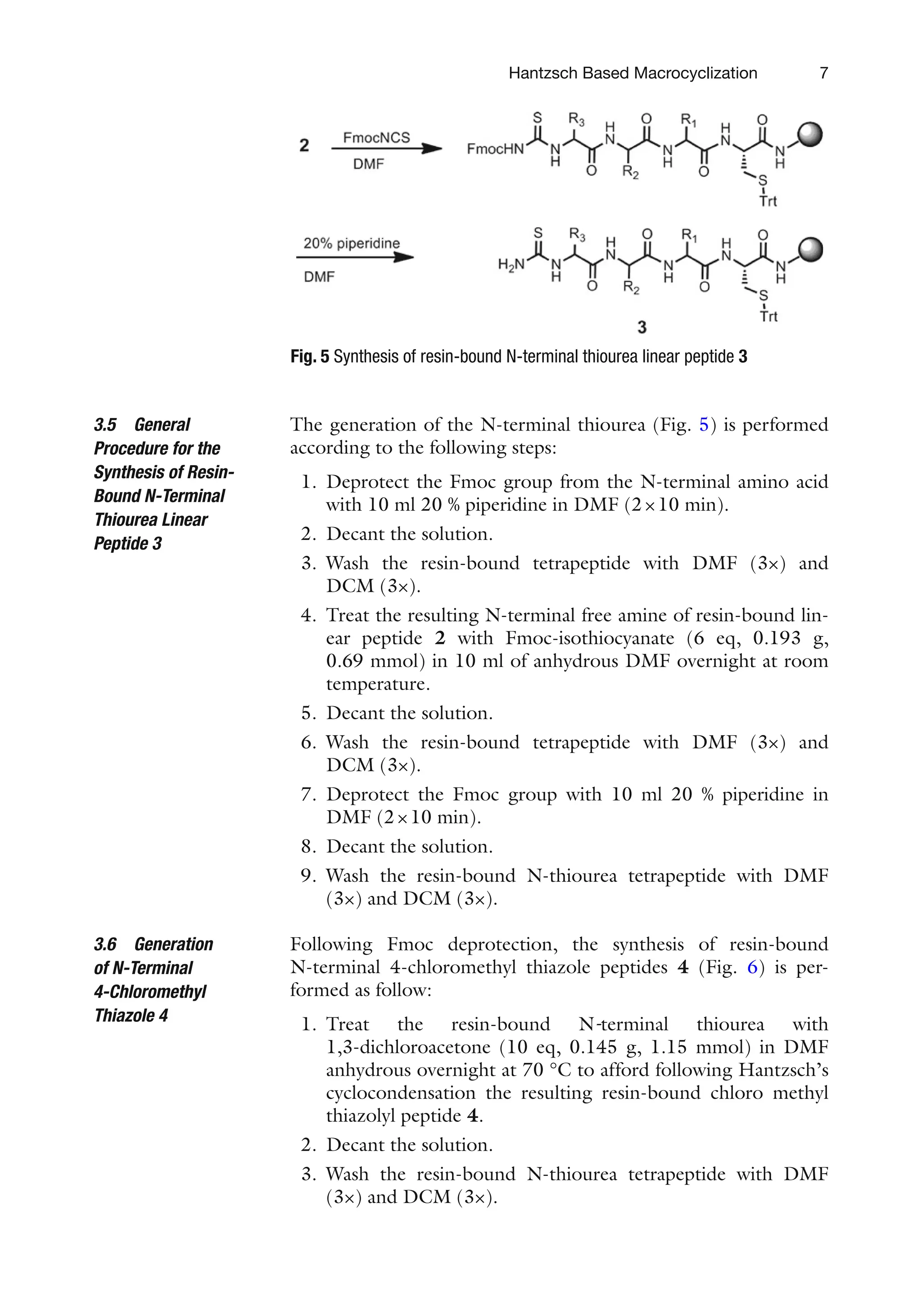
The generation of the N-terminal thiourea (Fig. 5) is performed
according to the following steps:
1. Deprotect the Fmoc group from the N-terminal amino acid
with 10 ml 20 % piperidine in DMF (2×10 min).
2. Decant the solution.
3. Wash the resin-bound tetrapeptide with DMF (3×) and
DCM (3×).
4. Treat the resulting N-terminal free amine of resin-bound lin-
ear peptide 2 with Fmoc-isothiocyanate (6 eq, 0.193 g,
0.69 mmol) in 10 ml of anhydrous DMF overnight at room
temperature.
5. Decant the solution.
6. Wash the resin-bound tetrapeptide with DMF (3×) and
DCM (3×).
7. Deprotect the Fmoc group with 10 ml 20 % piperidine in
DMF (2×10 min).
8. Decant the solution.
9. Wash the resin-bound N-thiourea tetrapeptide with DMF
(3×) and DCM (3×).
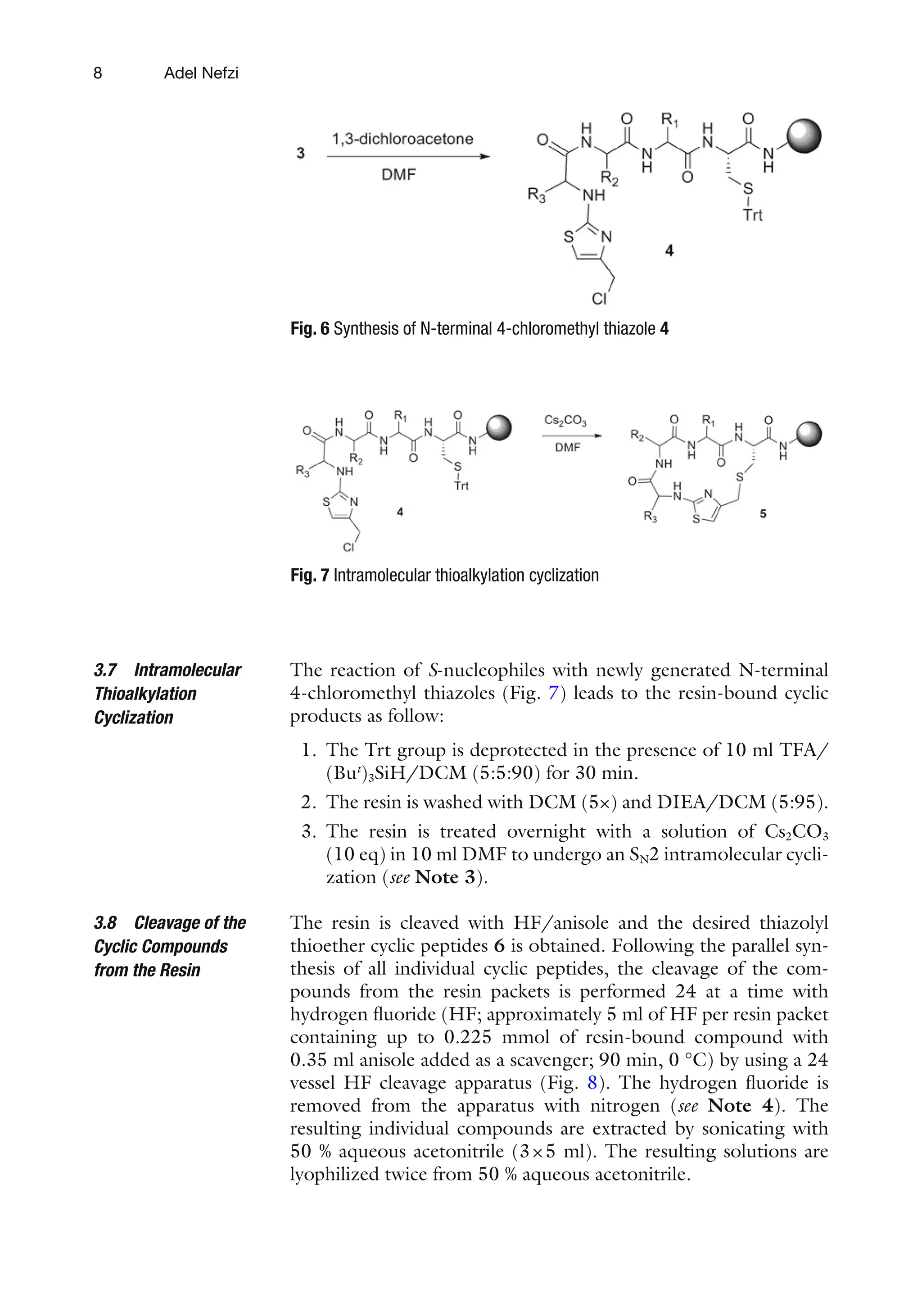
Following Fmoc deprotection, the synthesis of resin-bound
N-terminal 4-chloromethyl thiazole peptides 4 (Fig. 6) is per-
formed as follow:
1. Treat the resin-bound N-terminal thiourea with
1,3-dichloroacetone (10 eq, 0.145 g, 1.15 mmol) in DMF
anhydrous overnight at 70 °C to afford following Hantzsch’s
cyclocondensation the resulting resin-bound chloro methyl
thiazolyl peptide 4.
2. Decant the solution.
3. Wash the resin-bound N-thiourea tetrapeptide with DMF
(3×) and DCM (3×).
3.5 General
Procedure for the
Synthesis of Resin-
Bound N-Terminal
Thiourea Linear
Peptide 3
3.6 Generation
of N-Terminal
4-Chloromethyl
Thiazole 4
Fig. 5 Synthesis of resin-bound N-terminal thiourea linear peptide 3
Hantzsch Based Macrocyclization
8
The reaction of S-nucleophiles with newly generated N-terminal
4-chloromethyl thiazoles (Fig. 7) leads to the resin-bound cyclic
products as follow:
1. The Trt group is deprotected in the presence of 10 ml TFA/
(But
)3SiH/DCM (5:5:90) for 30 min.
2. The resin is washed with DCM (5×) and DIEA/DCM (5:95).
3. The resin is treated overnight with a solution of Cs2CO3
(10 eq) in 10 ml DMF to undergo an SN2 intramolecular cycli-
zation (see Note 3).
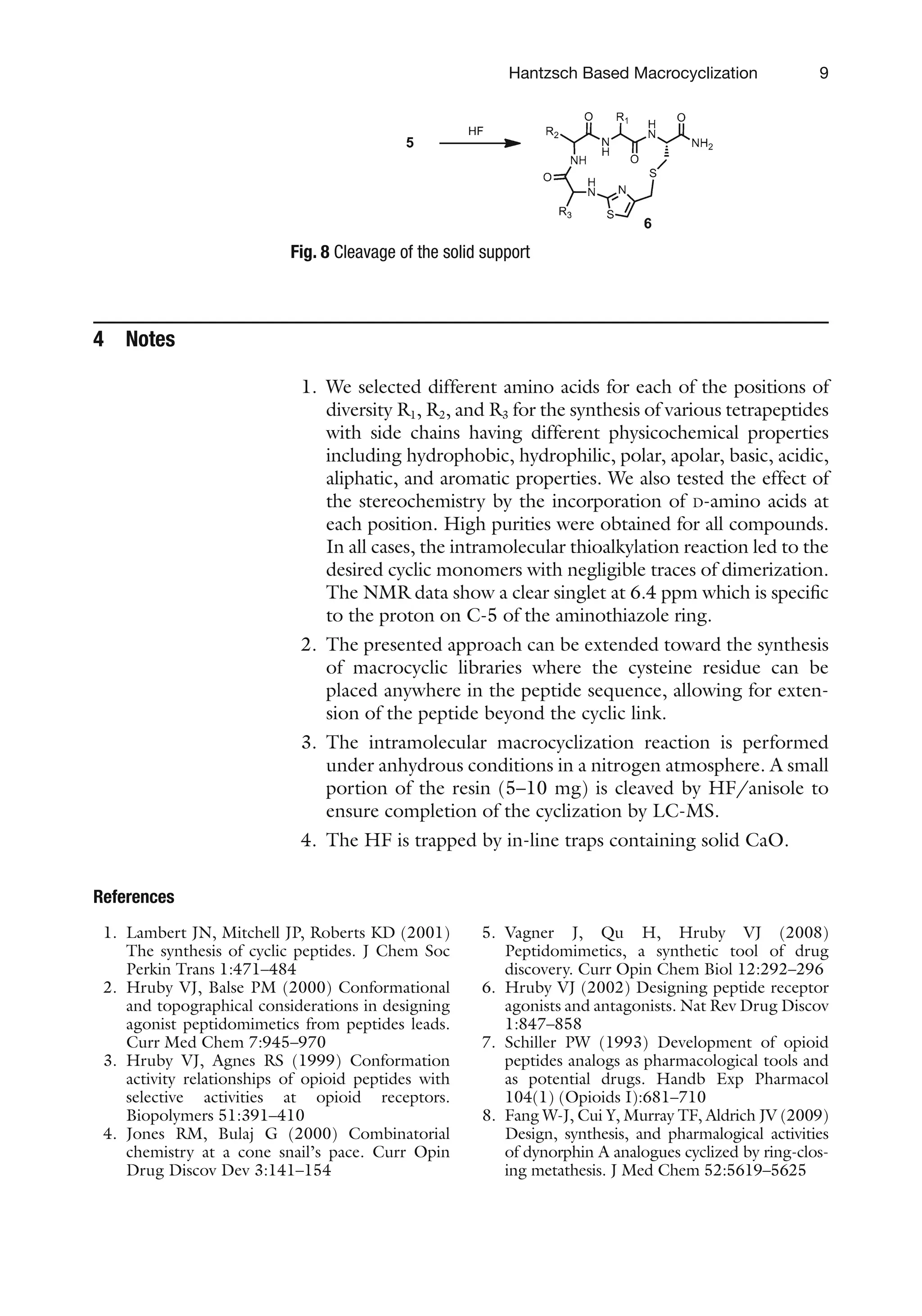
The resin is cleaved with HF/anisole and the desired thiazolyl
thioether cyclic peptides 6 is obtained. Following the parallel syn-
thesis of all individual cyclic peptides, the cleavage of the com-
pounds from the resin packets is performed 24 at a time with
hydrogen fluoride (HF; approximately 5 ml of HF per resin packet
containing up to 0.225 mmol of resin-bound compound with
0.35 ml anisole added as a scavenger; 90 min, 0 °C) by using a 24
vessel HF cleavage apparatus (Fig. 8). The hydrogen fluoride is
removed from the apparatus with nitrogen (see Note 4). The
resulting individual compounds are extracted by sonicating with
50 % aqueous acetonitrile (3×5 ml). The resulting solutions are
lyophilized twice from 50 % aqueous acetonitrile.
3.7 Intramolecular
Thioalkylation
Cyclization
3.8 Cleavage of the
Cyclic Compounds
from the Resin
Fig. 6 Synthesis of N-terminal 4-chloromethyl thiazole 4
Fig. 7 Intramolecular thioalkylation cyclization
Adel Nefzi
9
4 Notes
1. We selected different amino acids for each of the positions of
diversity R1, R2, and R3 for the synthesis of various tetrapeptides
with side chains having different physicochemical properties
including hydrophobic, hydrophilic, polar, apolar, basic, acidic,
aliphatic, and aromatic properties. We also tested the effect of
the stereochemistry by the incorporation of D-amino acids at
each position. High purities were obtained for all compounds.
In all cases, the intramolecular thioalkylation reaction led to the
desired cyclic monomers with negligible traces of dimerization.
The NMR data show a clear singlet at 6.4 ppm which is specific
to the proton on C-5 of the aminothiazole ring.
2. The presented approach can be extended toward the synthesis
of macrocyclic libraries where the cysteine residue can be
placed anywhere in the peptide sequence, allowing for exten-
sion of the peptide beyond the cyclic link.
3. The intramolecular macrocyclization reaction is performed
under anhydrous conditions in a nitrogen atmosphere. A small
portion of the resin (5–10 mg) is cleaved by HF/anisole to
ensure completion of the cyclization by LC-MS.
4. The HF is trapped by in-line traps containing solid CaO.
References
Fig. 8 Cleavage of the solid support
1. Lambert JN, Mitchell JP, Roberts KD (2001)
The synthesis of cyclic peptides. J Chem Soc
Perkin Trans 1:471–484
2. Hruby VJ, Balse PM (2000) Conformational
and topographical considerations in designing
agonist peptidomimetics from peptides leads.
Curr Med Chem 7:945–970
3. Hruby VJ, Agnes RS (1999) Conformation
activity relationships of opioid peptides with
selective activities at opioid receptors.
Biopolymers 51:391–410
4. Jones RM, Bulaj G (2000) Combinatorial
chemistry at a cone snail’s pace. Curr Opin
Drug Discov Dev 3:141–154
5. Vagner J, Qu H, Hruby VJ (2008)
Peptidomimetics, a synthetic tool of drug
discovery. Curr Opin Chem Biol 12:292–296
6. Hruby VJ (2002) Designing peptide receptor
agonists and antagonists. Nat Rev Drug Discov
1:847–858
7. Schiller PW (1993) Development of opioid
peptides analogs as pharmacological tools and
as potential drugs. Handb Exp Pharmacol
104(1) (Opioids I):681–710
8. Fang W-J, Cui Y, Murray TF, Aldrich JV (2009)
Design, synthesis, and pharmalogical activities
of dynorphin A analogues cyclized by ring-clos-
ing metathesis. J Med Chem 52:5619–5625
Hantzsch Based Macrocyclization
10
9. Berezowska I, Lemieux C, Chung NN, Wilkes
BC, Schiller PW (2009) Dicarba analogues of
the cyclic enkephalin peptides H-Tyr-c-[D-Cys-
Gly-Phe-D9or L)-Cys]NH2 retain high opioid
activity. Chem Biol Drug Des 74: 329–334
10. Purington LC, Pogozheva ID, Traynor JR,
Mosberg HI (2009) Pentapeptides displaying
mu opioid receptor agonist and sigma opioid
receptor partial agonist/antagonist properties.
J Med Chem 52:7724–7731
11. Mollica A, Guardiani G, Davis P, Ma S, Porreca
F, Lai J, Manina L, Sobolev AP, Hruby VJ
(2007) Synthesis of stable and potent sigma/
mu opioid peptides: analogues of H-Tyr-c[D-
Cys-Gly-Phe-D-Cys]-OH by ring closing
metathesis. J Med Chem 50:3138–3142
12. Weltrowska G, Lu Y, Lemieux C, Chung NN,
Schiller PW (2004) A novel cyclic enkephalin
analogue with potent opioid antagonist activ-
ity. Bioorg Med Chem Lett 14:4731–4733
13. Mollica A, Davis P, Ma S, Porreca F, Lai J,
Hruby VJ (2006) Synthesis and biological
activity of the first cyclic biphalin analogues.
Bioorg Med Chem Lett 16:367–372
14. Driggers EM, Hale SP, Lee J, Terrett NK
(2008) The exploration of macrocycles for
drug discovery—an underexploited structural
class. Nat Rev Drug Discov 7:608–624
15. Blout ER (1981) Cyclic peptides: Past, pres-
ent, and future. Biopolymers 20:1901–1912
16. Feng Y, Pattarawarapan M, Wang Z, Burgess K
(1999) Solid-phase SN2 macrocyclization reac-
tions to form β-turn mimics. Org Lett 1:
121–124
17. Roberts KD, Lambert JN, Ede NJ, Bray AM
(2006) Efficient methodology for the cycliza-
tion of linear peptide libraries via intramolecu-
lar S-alkylation using multipin solid phase
peptide synthesis. J Pept Sci 12:525–532
18. Dixon MJ, Nathubhai A, Andersen OA, van
Aalten DMF, Eggleston IM (2009) An effi-
cient synthesis of argifin: a natural product chi-
tinase inhibitor with chemotherapeutic
potential. Org Biomol Chem 7:259–268
19. Romanovskis P, Spatola AF (1988) Preparation
of head-to-tail cyclic peptides via side-chain
attachment: implications for library synthesis. J
Pept Res 52:356
20. Alsina J, Jensen KJ, Albericio F, Barany G
(1999) Solid-phase synthesis with tris(alkoxy)
benzyl backbone amide linkage (BAL). Chem
Eur J 5:2787–2795
21. Craik DJ, Cemazar M, Daly NL (2007) The
chemistry and biology of cyclotides. Curr
Opin Drug Discov Dev 10:176–184
22. Pons M, Albericio F, Royo M, Giralt E (2000)
Disulfide bonded cyclic peptide dimers and tri-
mers: an easy entry to high symmetry peptide
frameworks. Synlett 2:172–181
23. Annis I, Chen L, Barany G (1998) Novel
solid-phase reagents for facile formation of
intramolecular disulfide bridges in peptides
under mild conditions. J Am Chem Soc
120:7226–7238
24. Feliu L, Planas M (2005) Cyclic peptides con-
taining biaryl and biaryl ether linkages. Int J
Pept Res Ther 11:53–97
25. Li P, Roller PP, Xu J (2002) Current synthetic
approaches to peptide and peptidomimetic
cyclization. Curr Org Chem 6:411–440
26. Kaiser M, Siciliano C, Assfalg-Machleidt I,
Groll M, Milbradt AG, Moroder L (2003)
Synthesis of a TMC-95A ketomethylene ana-
logue by cyclization via intramolecular Suzuki
coupling. Org Lett 5:3435–3437
27. Blackwell HE, Grubbs RH (1988) Highly effi-
cient synthesis of covalently cross-linked pep-
tide helices by ring-closing metathesis. Angew
Chem Int Ed 37:3281–3284
28. Reichwein JF, Versluis C, Liskamp RMJ (2000)
Synthesis of cyclic peptides by ring-closing
metathesis. J Org Chem 65:6187–6195
29. Boyle TP, Bremner JB, Coates J, Deadman J,
Keller PA, Pyne SG, Rhodes DI (2008) New
cyclic peptides via ring-closing metathesis reac-
tions and their anti-bacterial activities.
Tetrahedron 64:11270–11290
30. Feng Y, Burgess K (1999) Solid phase SNAr
macrocyclizations to give turn-extended-turn
peptidomimetics. Chem Eur J 5:3261–3272
31. Grieco P, Cai M, Liu L, Mayorov A, Chandler
K, Trivedi D, Lin G, Campiglia P, Novellino E,
Hruby VJ (2008) Design and microwave-
assisted synthesis of novel macrocyclic peptides
active at melanocortin receptors: discovery of
potent and selective hMC5R receptor antago-
nists. J Med Chem 51:2701–2707
32. Derbal S, Ghedira K, Nefzi A (2010) Parallel
synthesis of 19-membered ring macro-
heterocycles via intramolecular thioether for-
mation. Tetrahedron Lett 51:3607–3609
33. Giulianotti M, Nefzi A (2003) Efficient
approach for the diversity-oriented synthesis of
macro-heterocycles on solid-support.
Tetrahedron Lett 44:5307–5309
34. Jung G (1991) Lantibiotics—ribosomally syn-
thesized biologically active polypeptides con-
tainingsulfidebridgesanda,b,-didehydroamino
acids. Angew Chem Int Ed Engl 30:
1051–1068
35. Campiglia P, Gomez-Monterrey I,
Longobardo L, Lama T, Novellino E, Grieco
P (2004) A novel route to synthesize Freidinger
lactams by microwave irradiation. Tetrahedron
Lett 45:1453–1456
36. Jack RW, Jung G (2000) Lantibiotics and
microcins: polypeptides with unusual chemical
diversity. Curr Opin Chem Biol 4:310–317
Adel Nefzi
11
37. Kaiser D, Jack RW, Jung G (1998) Lantibiotics
and microcins: novel posttranslational modifi-
cations of polypeptides. Pure Appl Chem
70:97–104
38. Crescenza A, Botta M, Corelli F, Santini A,
Tafi A (1999) Cyclic dipeptides. Synthesis of
methyl (R)-6-[(tert-butoxycarbonyl)amino]-
4,5,6,7- tetrahydro-2-methyl-5-oxo-1,4-
thiazepine-3-carboxylate and its hexahydro
analogues: elaboration of a novel dual ACE/
NEP inhibitor. J Org Chem 64:3019–3025
39. Olson GL, Bolin DR, Bonner MP, Bos M,
Cook CM, Fry DC, Graves BJ, Hatada M, Hill
DE, Kahn M, Madison VS, Rusiecki VK,
Sarabu R, Sepinwall J, Vincent GP, Voss ME
(1993) Concepts and progress in the develop-
ment of peptide mimetics. J Med Chem
36:3039–3046
40. MacDonald M, Aube J (2001) Approaches to
cyclic peptide beta-turn mimics. Curr Org
Chem 5:417–421
41. Suat Kee K, Jois SDS (2003) Design of β-turn
based therapeutic agents. Curr Pharm Des
9:1209–1212
42. Zhang J, Xiong C, Ying J, Wang W, Hruby V
(2003) Stereoselective synthesis of novel
dipeptide β-turn mimetics targeting melano-
cortin peptide receptors. J Org Lett 5:
3115–3118
43. Jin Z (2003) Muscarine, imidazole, oxazole,
and thiazole alkaloids. Nat Prod Rep 20:
584–605
44. Bertram A, Blake AJ, de Turiso F, Hannam JS,
Jolliffe KA, Pattenden G, Skae M (2003)
Concise synthesis of stereodefined, thiazole-
containing cyclic hexa- and octapeptide relatives
of the Lissoclinums, via cyclooligomerisation
reactions. Tetrahedron 59:6979–6990
45. Jin Z (2006) Imidazole, oxazole and thiazole
alkaloids. Nat Prod Rep 23:464–496
46. Aulakh VS, Ciufolini MA (2011) Total synthe-
sis and complete structural assignment of thio-
cillin I. J Am Chem Soc 133:5900–5904
47. Sanfilippo PJ, Jetter MC, Cordova R, Noe RA,
Chourmousis E, Lau CY, Wang E (1995)
Novel thiazole based heterocycles as inhibitors
of LFA-1/ICAM-1 mediated cell adhesion. J
Med Chem 38:1057–1059
48. Suzuki S, Yonezawa Y, Shin C (2004) Useful
synthesis of fragment A–C–D of a thiostrepton-
type macrocylic antibiotic, thiocilline I. Chem
Lett 33:814–815
49. Houghten RA (1985) General method for the
rapid solid-phase synthesis of larger numbers
of peptides: specificity of antigen–antibody
interaction at the level of individual amino
acids. Proc Natl Acad Sci USA 82:5131–5135
50. Fields GB, Noble RL (1999) Solid phase peptide
synthesis utilizing 9-fluorenylmethoxycarbonyl
amino acids. Int J Pept Protein Res 35:161–214
51. Hantzsch AR, Weber JH (1987) Ueber
verbindungen des thiazols pyridins der thio-
phenreihe. Ber Dtsch Chem Gen 20:
3118–3132
52. Garcia-Egido E, Wong SYF, Warrington BH
(2002) A Hantzsch synthesis of
2-aminothiazoles performed in a heated
microreactor system. Lab Chip 2:31–33
53. Lin PY, Hou RS, Wang HM, Kang IJ, Chen
LC (2009) Efficient synthesis of
2-aminothiazoles and fanetizole in liquid
PEG-400 at ambient conditions. J Chin Chem
Soc 56:455–458
54. Arutyunyan S, Nefzi A (2010) Synthesis of
chiral polyaminothiazoles. J Comb Chem
12:315–317
55. Gunnarsson K, Grehn L, Ragnarsson U (1988)
Synthesis and properties of N'-di-Ter-
butoxycarbonyl and N-benzyloxycarbonyl
tertbutoxycarbonyl amino acids. Angew Chem
Int Ed Engl 27:400–401
56. Gunnarsson K, Ragnarsson U (1990)
Preparation and properties of N'-di-
tertbutoxycarbonyl amino acids. Applicability
in the synthesis of Leu-enkephalin. Acta Chem
Scand 44:944–951
57. Kaiser E, Colescott RL, Bossinger CD, Cook
PI (1970) Color test for detection of free ter-
minal amino groups in the solid-phase synthe-
sis of peptides. Anal Biochem 34:595–598
Hantzsch Based Macrocyclization
13
Predrag Cudic (ed.), Peptide Modifications to Increase Metabolic Stability and Activity, Methods in Molecular Biology, vol. 1081,
DOI 10.1007/978-1-62703-652-8_2, © Springer Science+Business Media New York 2013
Chapter 2
The Chemical Synthesis of α-Conotoxins and Structurally
Modified Analogs with Enhanced Biological Stability
Jayati Banerjee, Reena Gyanda, Yi-Pin Chang,
and Christopher J. Armishaw
Abstract
α-Conotoxins are peptide neurotoxins isolated from the venom ducts of carnivorous marine cone snails
that exhibit exquisite pharmacological potency and selectivity for various nicotinic acetylcholine receptor
subtypes. As such, they are important research tools and drug leads for treating various diseases of the
central nervous system, including pain and tobacco addiction. Despite their therapeutic potential, the
chemical synthesis of α-conotoxins for use in structure–activity relationship studies is complicated by
the possibility of three disulfide bond isomers, where inefficient folding methods can lead to a poor recovery
of the pharmacologically active isomer. In order to achieve higher yields of the native isomer, especially in
high-throughput syntheses it is necessary to select appropriate oxidative folding conditions. Moreover, the
poor biochemical stability exhibited by α-conotoxins limits their general therapeutic applicability in vivo.
Numerous strategies to enhance their stability including the substitution of disulfide bond with diselenide
bond and N-to-C cyclization via an oligopeptide spacer have successfully overcome these limitations. This
chapter describes methods for performing both selective and nonselective disulfide bond oxidation strate-
gies for controlling the yields and formation of α-conotoxin disulfide bond isomers, as well as methods for
the production of highly stable diselenide-containing and N-to-C cyclized conotoxin analogs.
Key words Conotoxins, Disulfide bonds, Diselenide bonds, Cyclized conotoxins
1 Introduction
Disulfide rich polypeptides isolated from venom sources have
provided researchers with a vast array of research probes for studying
a variety of neuropathological conditions such as pain, depression,
schizophrenia, and drug addiction, with enormous potential as
drug leads [1]. Of increasing interest are the conotoxins, which are
isolated from marine gastropods that inhabit tropical reef ecosys-
tems [2]. Conotoxins exhibit a small number of conserved disul-
fide bond frameworks, which give rise to very rigid and well defined
three dimensional scaffolds that project hypervariable amino acid
14
residues thus accounting for their exquisite selectivity for different
ion-channelsandreceptorclasses[3].Amongthese,theα-conotoxins
can target different subtypes of nicotinic acetylcholine receptors
(nAChRs) with a high degree of specificity [4]. As such, they can be
used as novel subtype specific probes to map the role that nAChRs
play in the central nervous system and in the development of drug
leads for treating pain and tobacco addiction. The χ-conotoxins are
a structurally related class, which are selective norepinephrine trans-
porter inhibitors [5]. Importantly, a synthetic χ-conotoxin deriva-
tive, Xen2174, is currently undergoing phase II clinical trials as an
analgesic for treating chronic neuropathic pain [6].
α-Conotoxins consist of 12–20 amino acids that exhibit a
highly conserved cysteine framework consisting of two disulfide
bonds (Fig. 1). Residues Cys1 and Cys2 are always adjacent to
each other, with Cys4 occurring at or near the C-terminal. The
two intervening loops of amino acids are projected from the scaf-
fold between Cys2-Cys3 and Cys3-Cys4, denoted by letters “m”
and “n” respectively. The predominant disulfide bond connectivity
of naturally occurring α-conotoxins occurs between Cys[1–3, 2–4]
and is commonly referred to as the “globular” isomer. However,
two additional disulfide bond isomers are also possible, namely, the
“ribbon” (Cys[1–4, 2–3]) and “beads” (Cys[1–2, 3–4]) isomers.
While in most cases the globular isomer is the predominant bioac-
tive isomer in α-conotoxins, χ-conotoxins exhibit the ribbon
isomer in their natural bioactive form [5]. Nonetheless, nonnative
isomers of α-conotoxins have been reported to exhibit novel phar-
macological profiles. For example, the ribbon isomer of α-AuIB
has been shown to be several times more potent at rat parasympa-
thetic nAChR than the globular isomer [7]. As such, access to all
three synthetic conotoxin isomers is a valuable tool for performing
structure–activity relationship studies. With increasing use of com-
binatorial chemistry for performing accelerated structure–activity
relationship studies of α-conotoxins, high-throughput methods for
Fig. 1 Three possible disulfide bond isomers of α-conotoxins
Jayati Banerjee et al.
15
the production of synthetic analogs and their respective disulfide
bond isomers are essential [8].
Like most other classes of peptides, α-conotoxins exhibit poor
biochemical stability and resistance to proteolytic degradation,
resulting in a short biological half-life that limits their general
applicability as therapeutics. Furthermore, the disulfide bonds in
α-conotoxins are inherently unstable and can undergo reduction
or scrambling to other isomers under biological reducing condi-
tions encountered in vivo [9]. Engineering conotoxin analogs with
higher biochemical stability has proven to be very effective in
slowing down the process of degradation in human serum and
extending their biological half-life in vivo.
This chapter describes common methods for accessing synthetic
isomers of α-conotoxins, as well as engineering highly stable
analogs for use in structure–activity relationship studies. Such
strategies that will be addressed include substitution of disulfide
bonds with non-reducible diselenide bonds, and N-to-C backbone
cyclization. Although the methods here describe the synthesis of
α-conotoxins, they can be readily applied to any class of disulfide
rich peptides.
2 Materials
1. All syntheses are performed manually as previously described
using either a glass peptide synthesis vessel with a fritted filter,
screw cap, and PTFE stop-cock (VWR, Radnor PA) [10], or
tea bags prepared from 74 μM polypropylene mesh (Spectrum,
Houston TX) using an impulse sealer as previously described
(see Note 1) [11].
2. Unless otherwise indicated, 4-methylbenzyl-1-yl (MBHA)
polystyrene resin (Chem-Impex, Wood Dale IL) is used for all
syntheses.
3. 2-(1H-benzotriazole-1-yl)-1,1,3,3-tetramethyluroniumhexafl
uorophosphate (HBTU) (ChemPep, Miami FL).
4. Dichloromethane (DCM), dimethylformamide (DMF), iso-
propanol (IPA), methanol, acetonitrile and trifluoroacetic acid
(TFA) (Sigma-Aldrich, St. Louis MO). All solvents are reagent
grade and are used without further purification.
5. Nα
-tert-butyloxycarbonyl (Boc) amino acids with the following
side chain protecting groups: Asn and Gln, xanthanyl (Xan); Asp
and Glu, O-cyclohexyl (OcHxl); Arg and His, p-toluenesulfonyl
(Tos); Cys, 4-methylbenzyl (MeBzl) or acetomidomethyl
(Acm); Lys, 2-chlorobenzyloxycarbonyl (ClZ); Ser, Hyp and
Thr, benzyl (Bzl); Tyr, 2-bromobenzyloxycarbonyl (BrZ); Trp,
N-formyl (For) (Chem-Impex).
2.1 General
Requirements for
Peptide Synthesis
Synthesis of α-Conotoxins and Stable Analogs
16
6. N,N-Diisopropylethylamine (DIEA) (Chem-Impex).
7. Anhydrous hydrogen fluoride (HF) (Airgas, La Porte TX) and a
specialized HF cleavage apparatus constructed of corrosion resis-
tant material (Peptides International, Louisville KY) [12, 13].
8. Scavengers for HF cleavage as follows: p-cresol, p-thiocresol,
dimethylsulfide (DMS) and 1,2-ethanedithiol (EDT) (Sigma-
Aldrich).
1. A liquid chromatography mass spectrometer (LC-MS)
(Shimadzu, Kyoto, Japan) is used to assess the molecular
weight and purity of crude and purified peptide products, and
to assess the completion of oxidation reactions. Analytical
LC-MS is performed using a Jupiter, 50 mm×4.6 mm ID
reversed phase C18 HPLC column (Phenomenex, Torrance
CA). Buffer “A” 0.05 % aqueous formic acid; Buffer “B” 95 %
acetonitrile, 5 % water, 0.05 % formic acid; Linear gradient,
0–60 % over 12 min; Flow rate 0.5 mL/min.
2. Peptides are purified using a preparative HPLC system (Waters,
Milford MA) using a Luna, 150 mm×21.2 mm ID reversed
phase C18 HPLC column (Phenomenex); Buffer “A” 0.1 %
aqueous TFA; Buffer “B” 95 % acetonitrile, 5 % water, 0.1 %
TFA; Linear gradient; 0–40 % or 0–60 % “B” over 40 min.
Flow rate 20 mL/min. Detection wavelength 214 nm. The
product peak is fractionated and the purity analyzed by LC-MS.
3. CD spectra are recorded using a J-720 spectropolarimeter
(Jasco, Easton MD) using a 400 μL photometer cell with a
1 mm path length. Spectra are recorded between 190 and
260 nm, with an average of 4 scans.
1. 0.1 M Ammonium bicarbonate. Prepared by dissolving ammo-
nium bicarbonate (7.91 g) in 1 L deionized water and then
adjusting the pH with 1 M HCl or NH4OH as required.
2. 0.1 M Ammonium acetate. Prepared by dissolving ammonium
acetate (7.71 g) in 1 L deionized water and then adjusting the
pH with glacial acetic acid or NH4OH as required.
1. 80 % Methanol in deionized water (v/v).
2. 0.1 M HCl solution.
3. 0.1 M Na2S2O3 solution. Prepared by dissolving Na2S2O3
(1.58 g) in 100 mL deionized water.
4. 0.1 M Iodine in methanol. Prepared by dissolving elemental
iodine (0.253 g) in 10 mL of methanol.
1. Metallic selenium powder, NaBH4, NH4NH2⋅HCl, celite,
α-bromo-p-xylene, K2CO3, MgSO4 and tert-butyloxycarbonyl
dicarbonate (Sigma-Aldrich).
2. L-β-chloroalanine (Bachem, Bubendorf, Switzerland).
2.2 Analysis
and Purification
2.3 Oxidation
of Conotoxins
2.3.1 Preparation
of Oxidation Buffers
2.3.2 Iodine Mediated
Oxidation of Conotoxins
2.4 Selenocysteine
Directed Folding
2.4.1 Synthesis of
Boc–Sec[MeBzl]OH
Jayati Banerjee et al.
17
1. Fmoc-SCAL Linker (Chem Impex) and aminomethyl
ChemMatrixresin(BioMatrix,Saint-JeanSur-Richelieu,Quebec).
2. NH4I (Sigma-Aldrich).
3. 0.1 M Ammonium formate, pH 4.2. Prepared by dissolving
ammonium formate (6.31 g) in 1 L deionized water, then
adjusting the pH with formic acid or NH4OH as required.
1. S-trityl-β-mercaptopropionyl MBHA resin (Peptides
International).
2. 0.1 M Phosphate buffer, pH 8.2. Prepared by slowly adding
0.1 M sodium phosphate (dibasic) to 0.1 M sodium phosphate
(monobasic) while monitoring with a pH meter as required.
0.1 M Phosphate buffer (dibasic) is prepared by dissolving
Na2HPO4 (14.2 g) in 1 L deionized water. 0.1 M Phosphate
buffer (monobasic) is prepared by dissolving NaH2PO4
(11.9 g) in 1 L deionized water.
3 Methods
All of the procedures described in this chapter use the Boc-chemistry
approach. However, the Fmoc-chemistry approach may be used
with equal effectiveness where indicated. For detailed procedures
on solid phase peptide synthesis using both Boc or Fmoc chemistry,
readers are referred to refs. [14, 15].
1. 55 % TFA in DCM (v/v) is used for the stepwise removal of
the Nα-Boc protecting group.
2. For syntheses using tea bags, batch washes with DCM (2×),
IPA (2×) and DCM (2×) are used following Boc deprotection.
Prior to coupling, the tea bags are neutralized using 5 %
DIEA/DCM (v/v) (3×), followed by additional washes with
DCM (3×) and DMF (3×).
3. For syntheses using a glass peptide synthesis vessel, in situ
neutralization procedures and flow washes with DMF are used
as previously described [15, 16].
4. For all syntheses, HBTU and DIEA are used to activate the
amino acid prior to coupling. DMF is used as the coupling
solvent.
5. Coupling reactions are monitored using the quantitative
ninhydrin assay [17].
6. HF cleavage reactions are performed using either a two-step
“low-high,” or a one step “high” HF cleavage procedure as
indicated for each method. For the low HF cleavage, tea bags
containing peptide-resin are treated with “low” HF cleavage
cocktail (25 % HF, 60 % DMS, 10 % p-cresol, and 5 %
EDT (v/v/v/v)) for 2 h at 0 °C. The HF cleavage cocktail is
2.4.2 Synthesis of
Diselenide Containing
Conotoxins
2.5 Cyclized
Conotoxin Analogs
3.1 General Boc
Solid Phase Peptide
Synthesis Procedure
Synthesis of α-Conotoxins and Stable Analogs
18
discarded and the tea bags are washed alternately with DCM
and IPA (6×), then alternately with DMF and DCM (6×), and
finally with methanol (6×) before drying under high vacuum.
7. For the “high” HF cleavage, peptide-resin is cleaved (95 %
HF, 5 % p-cresol (v/v)) for 2 h at 0 °C. Following cleavage,
the HF is evaporated and the peptide is precipitated with cold
diethyl ether, centrifuged for 1 min (or filtered) and then
washed again with additional diethyl ether. The peptide is then
extracted with 95 % acetic acid/5 % H2O (v/v) and lyophilized
(see Note 2).
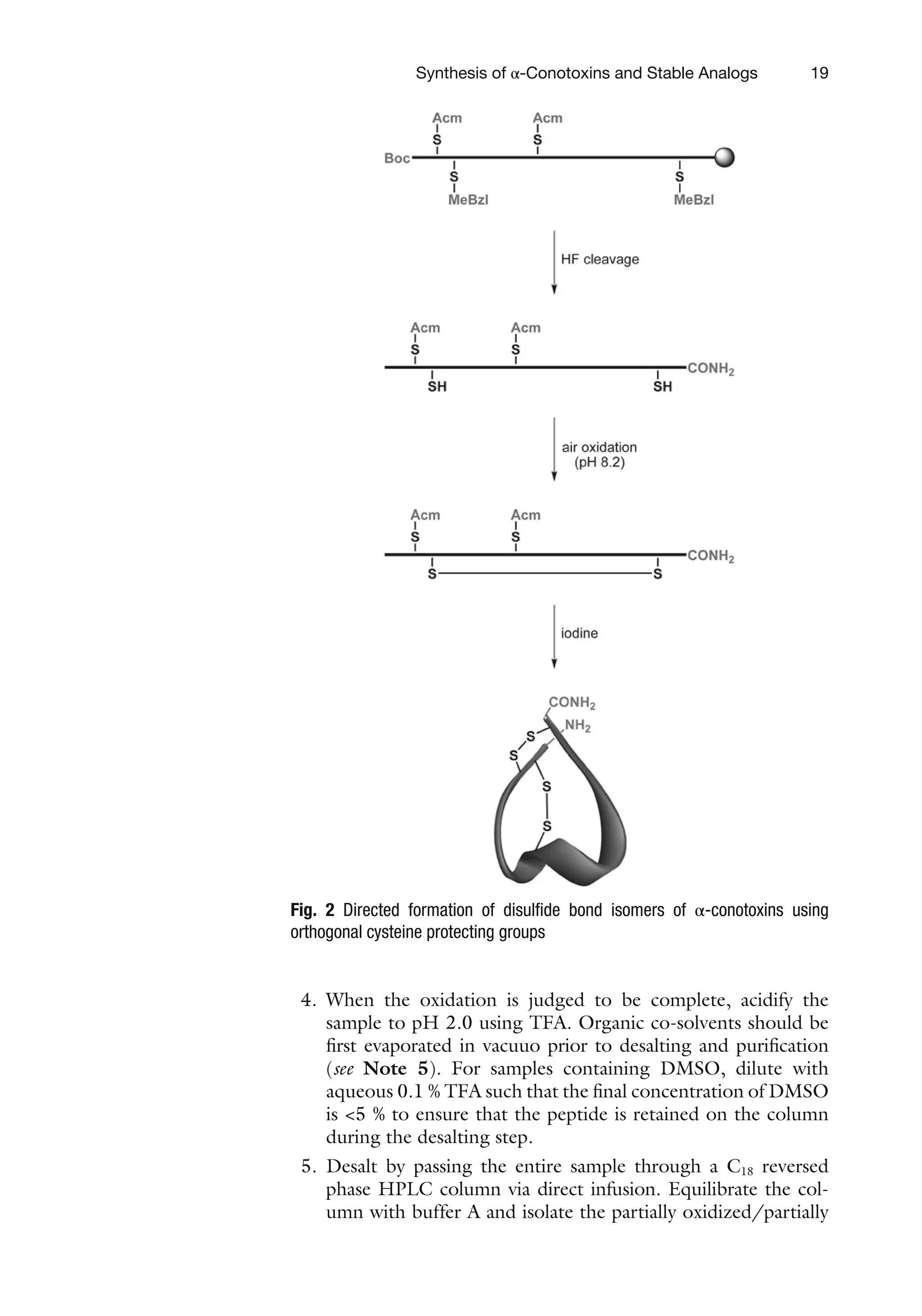
The use of orthogonal protecting groups on each pair of cysteine
residues can direct the formation of the desired target disulfide
bond isomer (Fig. 2). For this approach, the S-acetomidomethyl
(Acm) in combination with S-methylbenzyl (MeBzl) is widely
employed for Boc chemistry. Similarly, the S-triphenylmethyl
(Trityl, Trt) protecting group can be used with equal effectiveness
for Fmoc-chemistry. The Acm protecting group is particularly ver-
satile since deprotection and oxidation occurs simultaneously using
iodine as the oxidation reagent [18, 19]. However, sensitive side
chain residues, in particular Met and Trp are vulnerable to side
reactions, which include oxidation of methionine or formation of
tryptophan 2-thioether [20]. Depending on the extent of trypto-
phan 2-thioether formation, the use of Trp[For] with Boc chemis-
try can prevent this side reaction; however, this requires an
additional deprotection and purification step (see Note 3) and may
decrease the final yield [21].
1. Assemble the linear precursor conotoxin using orthogonal
Boc-Cys[Acm]-OH and Boc-Cys[MeBzl]-OH on each pair of
cysteine residues. Cleave from the resin using the “low-high”
HF procedure and lyophilize (for peptides containing
Trp[For], see Note 3).
2. Check the quality of the crude sample using LC-MS. If the
sample purity is sufficiently high (>80 %), proceed to the next
step. Otherwise, prior purification by preparative RP-HPLC
may be required.
3. Dissolve the reduced precursor conotoxin in 100 mL of 0.1 M
ammonium bicarbonate, pH 8.2. Up to 50 % organic co-solvent
(e.g., isopropanol or methanol) may be added to aid dissolu-
tion. For particularly hydrophobic sequences, or those that are
sensitive to basic conditions (e.g., sequences containing Asn,
Gly, or Trp[For]), dissolve the peptide in 0.1 M ammonium
acetate, pH 5.8 containing up to 30 % dimethylsulfoxide
(DMSO). Agitate for 24 h using either a magnetic stirrer plate,
or an orbital shaker platform (for parallel oxidation of multiple
samples) in an open vessel (see Note 4). Monitor the progress
of the reaction by analytical LC-MS.
3.2 Directed
Formation of
Disulfide Bonds
Jayati Banerjee et al.
19
4. When the oxidation is judged to be complete, acidify the
sample to pH 2.0 using TFA. Organic co-solvents should be
first evaporated in vacuuo prior to desalting and purification
(see Note 5). For samples containing DMSO, dilute with
aqueous 0.1 % TFA such that the final concentration of DMSO
is <5 % to ensure that the peptide is retained on the column
during the desalting step.
5. Desalt by passing the entire sample through a C18 reversed
phase HPLC column via direct infusion. Equilibrate the col-
umn with buffer A and isolate the partially oxidized/partially
Fig. 2 Directed formation of disulfide bond isomers of α-conotoxins using
orthogonal cysteine protecting groups
Synthesis of α-Conotoxins and Stable Analogs
20
protected peptide using a HPLC gradient. Alternatively, samples
can be evaporated to dryness and redissolved in a smaller vol-
ume (<5 mL) for injection using an autosampler. Following
purification, lyophilize the purified partially oxidized peptide.
6. Dissolve the partially oxidized purified conotoxin in 80 %
methanol to a concentration of approximately 2.5 mg/mL.
Add 1 M HCl to a final concentration of 10 mM HCl. Add 10
equivalents of I2 solution per Cys[Acm] group and stir for
5 min using a magnetic stirrer. To quench the reaction, add
0.1 M aqueous sodium thiosulfate solution until the reaction
mixture becomes colorless. Dilute the sample to <5 % metha-
nol with 0.1 % aqueous TFA prior to desalting.
7. Desalt by passing the entire sample through a C18 reversed
phase HPLC column via direct infusion and isolate the fully
oxidized peptide using a HPLC gradient.
The nondirected formation of disulfide bond isomers is a simplified
one step oxidation procedure, which is more generally applicable
to the synthesis of native α-conotoxins and their analogs (Fig. 3).
3.3 Nondirected
Formation of Disulfide
Bonds
Fig. 3 Nondirected formation of α-conotoxin disulfide bonds using random oxidation of unprotected cysteine
residues
Jayati Banerjee et al.
21
This strategy may be performed in one step, thus it is less labor
intensive and is very useful for accelerating the high-throughput
production of conotoxin libraries. Furthermore, it leads to
increased product yields due to fewer purification steps and has
fewer propensities for side reactions.
However, a mixture of disulfide bond isomers may be obtained
in varying ratios, thus it is important to select conditions to maxi-
mize the accumulation of the native globular isomer. As such,
optimization of oxidation conditions through a series of small scale
trial oxidations may be required to obtain the desired isomer in high
yield and purity. To this end, directed formation of each disulfide
bond isomer can be carried out prior to commencing oxidation
trials, which can be used as retention time markers by analytical
RP-HPLC. Alternatively, native α-conotoxin isomers exhibit distinct
circular dichroism (CD) spectra, with a minima occurring at 222 nm
that is characteristic of a helical structure, whereas ribbon and bead
isomers exhibit a more random conformation (Fig. 4).
When designing a series of random oxidation trials, one should
consider a variety of factors, including the choice of oxidation buf-
fer, organic co-solvents, redox reagents, pH, and temperature. Each
of these factors can be investigated to obtain the best optimized
conditions for maximization of yield and purity of the final isomer
[22]. Generally, 0.1 M ammonium bicarbonate or 0.1 M ammo-
nium acetate is used as oxidation buffers due to their compatibility
with performing LC-MS analysis. In many cases, yields of native
disulfide bond isomer have been found to increase by adding up to
Fig. 4 Circular dichroism spectra of the three disulfide bond isomers of
α-conotoxin MII
Synthesis of α-Conotoxins and Stable Analogs
22
50 % organic co-solvents such as isopropanol to the reaction mixture
[23]. Additionally, inclusion of redox reagents such as a mixture of
reduced and oxidized glutathione have been used to mimic physi-
ological conditions to allow intermolecular disulfide interchange to
occur more rapidly [22].
1. Synthesize each of the globular, ribbon and beads isomers
using directed disulfide bond formation as described in
Subheading 3.1. Analyze by analytical RP-HPLC and record
the retention time of each isomer.
2. Assemble the linear precursor conotoxin using Boc-Cys
[MeBzl]-OH on all four cysteine residues (see Note 6). Cleave
from the resin, lyophilize and purify the reduced linear precur-
sor by preparative RP-HPLC.
3. Prepare a series of oxidation buffers to examine the effect of
buffer salt (e.g., ammonium bicarbonate or ammonium acetate),
organic co-solvents (e.g., isopropanol, methanol, ethanol, or
acetonitrile), redox reagents (e.g., reduced and oxidized gluta-
thione), pH (e.g., 6.0–9.0) and temperature (e.g., 4 °C and
ambient temperature) and time (24–72 h). Place 990 μL aliquots
of each oxidation buffer into individual 3 mL glass vials contain-
ing a magnetic stirrer flea.
4. Prepare a 10 mg/mL aqueous stock solution of purified
reduced conotoxin in deionized water. Aliquot 10 μL of cono-
toxin stock solution into each vial containing oxidation buffer
(the final concentration of conotoxin in each trial should be
0.1 mg/mL). Agitate the vials for 24–72 h using a magnetic
stirrer plate (see Note 3).
5. At various time points, remove an aliquot and quench the
oxidation by acidifying to pH 2.0 with a solution of 10 %
aqueous TFA. Analyze the reaction mixture by analytical
HPLC and compare the retention times of the products with
each isomer obtained using directed disulfide bond formation
to identify the proportion of each isomer for each condition.
1. Assemble the linear precursor conotoxin using Boc-Cys
[MeBzl]-OH on all four cysteine residues (see Note 6). Cleave
from the resin using the “low-high” HF procedure and
lyophilize.
2. Check the quality of the crude sample using LC-MS. If the
sample purity is sufficiently high (>80 %), then proceed to
the next step. Otherwise, prior purification by preparative
RP-HPLC may be required.
3. Weigh 20–50 mg of the reduced precursor conotoxin into a
125 mL Erlenmeyer or round bottom flask and dissolve in
100 mL of optimized oxidation buffer as determined from
small scale trial oxidations (see Subheading 3.2, step 1).
3.3.1 Oxidation Trials
for Optimizing α-Conotoxin
Folding
3.3.2 Large Scale
Random Oxidation
of α-Conotoxins
Jayati Banerjee et al.
23
Agitate for 24–72 h using either a magnetic stirrer plate, or an
orbital shaker platform (for parallel oxidation of multiple
samples) in an open vessel (see Note 4). Monitor the progress
of the reaction by analytical LC-MS or analytical HPLC.
4. When judged to be complete, acidify to pH 2.0 using a
solution of 50 % aqueous TFA (2 mL). Organic co-solvents
should be first evaporated in vacuuo prior to desalting and
purification (see Note 5).
5. Desalt by passing the entire sample through a C18 reversed
phase HPLC column via direct infusion and isolate the fully
oxidized α-conotoxin using a HPLC gradient.
Although the presence of multiple disulfide bonds in α-conotoxins is
crucial for stabilizing their three dimensional conformations, they
are very prone to reduction or scrambling to other isomers by thiol
containing molecules usually found in blood plasma, which can
decrease their efficacy in vivo. Several strategies have been explored
to overcome this problem, including substitution of disulfides with
non-reducible moieties such as diselenide, lactam, thioether, or
dicarba-linkages [9, 24–26]. Among these approaches, systematic
replacement of disulfide bonds with diselenide bonds has been
shown to be the most promising for increasing stability in vivo, while
retaining pharmacological activity at the target receptors [9, 27].
Selenocysteine (Sec) is a naturally occurring amino acid, which
exhibits the propensity to oxidatively form a diselenide bond in
analogy to the disulfide bond. Diselenide bonds exhibit very simi-
lar bond geometry to disulfide bond and can be viewed as one of
the most conservative amino acid substitutions available [28].
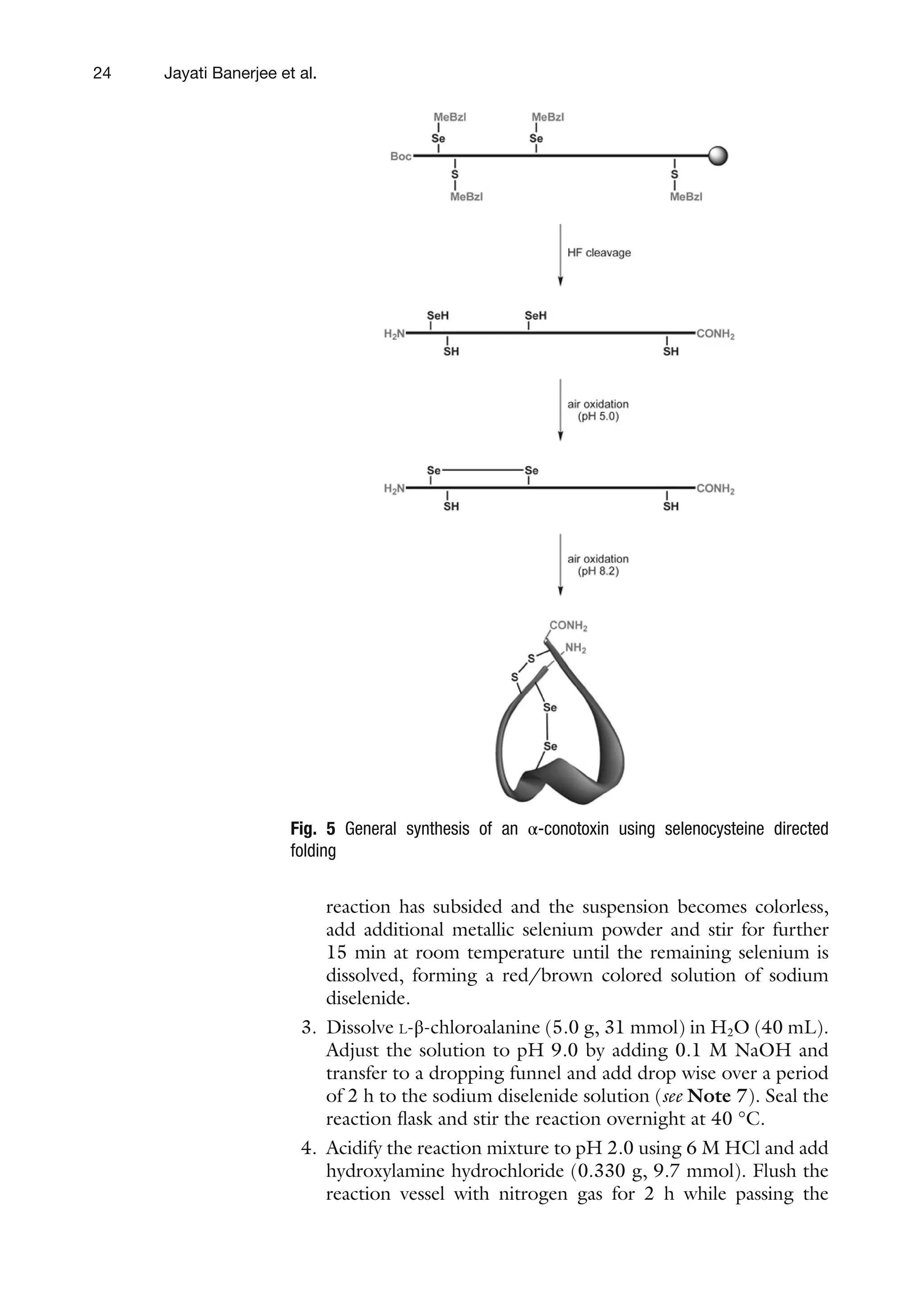
Importantly, oxidation of selenocysteine to the corresponding dis-
elenide bond occurs much faster than cysteine at pH 5.0, allowing
selenocysteine to be selectively oxidized over cysteine at lower pH.
Furthermore, the redox potential for a mixed sulfide/selenide
bond is higher than that of a diselenide bond, suggesting that its
formation is unfavorable. As such, selenocysteine can be used to
selectively control the formation of α-conotoxin disulfide bond
isomers in a one-pot reaction without the requirement of multiple
isolation steps when appropriately incorporated into the precursor
peptide sequence (Fig. 5) [9]. Moreover, diselenide containing
α-conotoxin analogs exhibit increased resistance to reduction or
scrambling under several biological reducing conditions, including
blood plasma [9, 27].
1. Suspend metallic selenium powder (4.5 g, 57 mmol) in H2O
(25 mL) in a two-neck 250 mL round bottom flask with a
magnetic stirrer bar. Cool the flask to 0 °C in an ice/salt bath.
2. Dissolve NaBH4 (4.5 g, 119 mmol) in H2O (25 mL) and trans-
fer to a dropping funnel. Slowly add the NaBH4 solution drop
wise to the reaction mixture. After the vigorous exothermic
3.4 Selenocysteine
Directed Folding
3.4.1 Synthesis of
Boc-Sec[MeBzl]-OH
L-Selenocysteine ([Sec]2)
Synthesis of α-Conotoxins and Stable Analogs
24
reaction has subsided and the suspension becomes colorless,
add additional metallic selenium powder and stir for further
15 min at room temperature until the remaining selenium is
dissolved, forming a red/brown colored solution of sodium
diselenide.
3. Dissolve L-β-chloroalanine (5.0 g, 31 mmol) in H2O (40 mL).
Adjust the solution to pH 9.0 by adding 0.1 M NaOH and
transfer to a dropping funnel and add drop wise over a period
of 2 h to the sodium diselenide solution (see Note 7). Seal the
reaction flask and stir the reaction overnight at 40 °C.
4. Acidify the reaction mixture to pH 2.0 using 6 M HCl and add
hydroxylamine hydrochloride (0.330 g, 9.7 mmol). Flush the
reaction vessel with nitrogen gas for 2 h while passing the
Fig. 5 General synthesis of an α-conotoxin using selenocysteine directed
folding
Jayati Banerjee et al.
25
exhaust gas through two successive NaOCl traps. Filter the
reaction mixture though a celite plug to remove any excess
selenium powder. Flush the yellow filtrate with nitrogen for an
additional 1 h using a fritted Drescher bottle.
5. Carefully adjust the pH of the yellow filtrate to 6.5 using 10 M
NaOH, allowing the product to precipitate as a yellow solid.
Filter using a Buchner funnel and redissolve in minimum
volume of 2 M HCl. Filter any residual elemental selenium
and again precipitate the product by adjusting the solution to
pH 6.5 using 10 M NaOH. Filter the final amorphous yellow
product using vacuum filtration (yield 4.62 g, 70 %).
6. Characterize the product using NMR spectroscopy. 1
H NMR
(300 MHz, D2O+DCl+DSS) δ 8.2 (d, 2H), 7.9 (d, 2H), 5.1
(m, 1H), 4.8 (s, 2H), 3.9 (m, 1H), 3.1 (s, 3H).
1. Suspend L-selenocysteine (3.80 g, 9.3 mmol) in 0.5 M NaOH
(15 mL) with magnetic stirring. Cool the suspension to 0 °C
with an ice/salt bath.
2. Dissolve NaBH4 (3.60 g, 95 mmol) in H2O (15 mL) and
transfer to a dropping funnel. Add the NaBH4 solution drop
wise to the reaction vessel. After the vigorous exothermic reac-
tion has subsided and the suspension becomes colorless
(approximately 30 min), adjust the solution to pH 7.0 under
a blanket of argon using glacial acetic acid.
3. Dissolve α-bromo-p-xylene (1.11 g, 60 mmol) in ethanol
(15 mL) and add dropwise to the reaction mixture over
30 min. Stir the reaction mixture for a further 2 h at 0 °C
under argon.
4. Acidify the reaction mixture to pH 2 using 6 M HCl, which
will produce the product as a white precipitate. Filter the
product under vacuum, wash with water and then diethyl
ether. The final product is recrystallized from hot water (yield
3.50 g, 61.1 %).
5. Characterize the product using NMR spectroscopy. 1
H NMR
(300 MHz, CD3OD+D2O+DCl+DSS) δ 8.2 (d, 2H), 7.9
(d, 2H), 5.1 (m, 1H) 4.8, (s, 2H), 3.9 (m, 1H), 3.1 (s, 3H);
13C NMR (75.4 MHz, CD3OD+D2O+DCl) δ 170.7, 138.0,
136.8, 130.3, 130.1, 53.9, 28.7, 23.2, 21.4.
1. Dissolve Se-(4-methoxybenzyl)-L-selenocysteine (3.24 g,
10 mmol) together with K2CO3 (3.4 g, 0.25 mmol) in water
(25 mL) with magnetic stirring. Gently heat to aid dissolution.
2. Dissolve tert-Butyloxycarbonyl dicarbonate (2.30 g, 11 mmol)
in THF (25 mL) and add to the reaction mixture. Stir the
reaction for 1 h at room temperature.
Se-(4-methylbenzyl)-L-
selenocysteine
Boc-Sec[MeBzl]-OH
Synthesis of α-Conotoxins and Stable Analogs
26
3. Add 100 mL of H2O to the reaction mixture and transfer to a
separating funnel. Wash the mixture with diethyl ether
(2×100 mL) and then separate the aqueous layer.
4. Acidify the aqueous layer to pH 4.0 with solid citric acid and
extract with ethyl acetate (3×100 mL). Combine the ethyl
acetate extracts and wash with 10 % citric acid (3×100 mL)
and then brine (100 mL). Dry over solid MgSO4, filter and
evaporate the solvent using a rotary evaporator. Recrystallize
the final product using petroleum spirits/diethyl ether (yield
2.8 g, 75.3 %).
5. Characterize the product using NMR spectroscopy. 1
H NMR
(300 MHz, CDCl3 +TMS) δ 7.14 (d, 2H), 7.02 (d, 2H), 5.29
(d, 2H), 3.79 (m, 2H), 2.87 (s, 2H), 2.32 (s, 3H), 1.45
(s, 9H); 13
C NMR (75.4 MHz, CDCl3) δ 175.6, 155.4, 136.6,
135.4, 129.3, 128.8, 80.5, 53.3, 28.3, 27.8, 25.3, 21.1.
1. Assemble the linear precursor conotoxin using Boc-solid phase
peptide synthesis with combinations of Boc-Sec[MeBzl]-OH
and Boc-Cys[MeBzl]-OH to achieve the desired disulfide/
diselenide bond connectivity.
2. Cleave the peptide from the resin using the high HF proce-
dure for 2 h at 0 °C.
3. Following evaporation of HF, precipitate the conotoxin with
cold ethyl acetate degassed with nitrogen. Filter and wash the
precipitated peptide with additional cold ethyl acetate.
4. The crude reduced conotoxin can be immediately dissolved in
0.1 M ammonium formate buffer (pH 4.2) containing 50 %
isopropanol to a concentration <10 mmol and stirred for 2 h
at room temperature in an open vessel.
5. Carefully adjust the pH of the solution to 8.2 using ammo-
nium hydroxide solution and continue stirring overnight at
room temperature in an open vessel. Monitor the oxidation
progress using LC-MS.
6. When the oxidation is judged to be complete, acidify the
sample to pH 2.0 using TFA. Remove the isopropanol in
vacuo (see Note 4). Desalt by passing the entire sample
through a C18 reversed phase HPLC column via direct infusion
and isolate fully oxidized selenoconotoxin using a HPLC
gradient.
On resin supported oxidation of selenocysteine containing
conotoxins can potentially be used in the parallel production of syn-
thetic combinatorial libraries of α-conotoxins [27]. In this synthesis,
the peptide is assembled on an amphiphilic resin containing a HF
stable safety catch amide linker (SCAL), thus allowing deprotection
3.4.2 General Synthesis
of Diselenide Containing
Conotoxins
3.4.3 On-Resin Oxidation
of Diselenide Containing
Conotoxins
Jayati Banerjee et al.
27
of all side chain protecting groups using HF. This facilitates on-resin
oxidation of the disulfide/diselenide bond framework prior to cleav-
age of the fully oxidized conotoxin from the resin (Fig. 6).
1. Couple the Fmoc-SCAL linker to aminomethyl ChemMatrix®
resin containing three glycine residues as a spacer. Deprotect
with 50 % piperidine/DMF (v/v).
2. Transfer 100–500 mg of resin to 74 μm mesh polypropylene
tea bags. Assemble the linear precursor conotoxin using
Boc-solid phase peptide synthesis with combinations of Boc-
Sec[MeBzl]-OH and Boc-Cys[MeBzl]-OH to achieve the
desired disulfide/diselenide bond connectivity.
3. Deprotect the side-chain protecting groups using the “high”
HF procedure (90 % HF, 5 % p-cresol, 5 % p-thiocresol) for
2 h at 0 °C. After evaporating the HF, wash the tea bags TFA
(2×), DCM (6×), DMF (6×) and H2O (6×).
Fig. 6 On-resin selenocysteine directed folding of a α-conotoxin using a safety catch amide linker
Synthesis of α-Conotoxins and Stable Analogs
28
4. Place the tea bags containing resin into a solution of 0.1 M
NH4HCO3, pH 8.4 (10 mL/100 mg of resin). Shake over-
night in a Nalgene container at room temperature and then
wash with methanol (6×) and dry under vacuum.
5. Remove the resin from the tea bags and weigh approximately
300 mg into a 25 mL round bottom flask. Add a solution of
NH4I (100 mg), dimethyl sulfide (200 μL), and TFA (5 mL)
to the resin and stir for 4 h at room temperature.
6. Evaporate the TFA under a stream of nitrogen. Precipitate the
peptide product with cold ethyl acetate, filter and wash with
additional ethyl acetate. Redissolve the peptide in 50 %
aqueous acetonitrile containing 0.1 % TFA and lyophilize.
Purify the final product by preparative C18 RP-HPLC.
Cyclization is an effective modification strategy to increase overall
biochemical stability of therapeutically relevant peptides in vivo.
Numerous classes of disulfide rich cyclic peptides are found in
nature which exhibit compact three-dimensional structures and
remarkable stability. These include the plant cyclotides, sunflower
trypsin inhibitor, and mammalian theta-defensins [29–31]. In view
of the superior stability offered by cyclic disulfide rich peptides,
reengineering of stable conotoxins through backbone cyclization
serves as a useful synthetic modification strategy to enhance their
in vivo stability.
N-to-C cyclization of α-conotoxins via an inert oligopeptide
spacer unit has yielded analogs with vastly improved stability than the
native toxin under biological conditions, while retaining the pharma-
cological activity of the native conotoxin (Fig. 7) [32]. This has been
attributed to the fact that cyclization leads to an overall tightening of
the peptide structure resulting in a loss of flexibility, while preserving
key structural characteristics that are crucial for maintaining
pharmacological activity [32]. As such, cyclized α-conotoxins exhibit
increased resistance towards proteolytic degradation and improved
stability in human serum. Significantly, a cyclized analog of
α-conotoxin Vc1.1 has recently shown promise as an orally available
analgesic in rodent neuropathic pain models [33].
Cyclization of conotoxins is usually achieved in mildly basic
aqueous buffer through intramolecular native chemical ligation
(NCL) reaction between an N-terminal cysteine residue and a
C-terminal thioester and subsequent rearrangement to form a pep-
tide amide bond with the regeneration of N-terminal cysteine side
chain (Fig. 8) [34]. As such, the linear thioester precursor
α-conotoxin is assembled as a cyclic permutant such that one of the
four cysteine residues occurs at the N-terminal. While there are four
potential ligation sites to consider, a convenient Gly-Cys occurs in
many α-conotoxins, which offers minimal steric hindrance and
increased reaction rates. The presence of internal disulfide bonds
has also been proposed to accelerate the cyclization process via a
3.5 Cyclized
Conotoxin Analogs
Jayati Banerjee et al.
29
thiazip mechanism, with complete conversion to the cyclized
product occurring within minutes [35]. As such, cyclization and
oxidation can be performed using a one-pot reaction, since oxida-
tive formation of the disulfide bonds occurs at a much slower rate
than cyclization. Although numerous methods have been reported
for the production of C-terminal thioesters using Fmoc SPPS [36–
38], Boc chemistry represents the most widely applicable and
robust approach for synthesizing cyclized conotoxin analogs.
Disulfide bond formation can be achieved using either the two-step
directed strategy, or a one-pot nondirected strategy. However,
varying disulfide bond isomers may be obtained by using a nondi-
rected approach, particularly if the length of the spacer is not
optimized.
When designing cyclic α-conotoxin analogs, the length and
nature of the oligopeptide spacer spanning the N- and C-termini
must be considered. Spacers consisting of consecutive arrange-
ments of functionally inert Gly-Ala residues have proven to be
effective for enhancing the biological stability of numerous
α-conotoxins. Moreover, the use of an inert Gly-Ala linker allows
for the possibility of introducing additional functional groups to
further enhance the physical properties of cyclized conotoxins
without interfering with the pharmacophore [39]. The spacer
length must be optimized in order to achieve the correct orienta-
tion of key binding residues that form the α-conotoxin pharmaco-
phore. Additionally, the spacer length also plays an important role
in dictating the formation of disulfide bond isomers in one pot
nonselective oxidation and cyclization reactions. For example,
cyclization of α-conotoxins ImI and AuIB with three or fewer
amino acid spacers showed greater preferences towards formation
of the ribbon isomer [21, 40]. In such cases directed oxidation
strategy implementing orthogonal cysteine protection was used for
increasing the yield of the globular isomer. Therefore an important
criteria for choosing linker size will depend on the three dimen-
sional conformation of the native conotoxins and the directed
Fig. 7 N-to-C cyclization of an α-conotoxin through an inert spacer
Synthesis of α-Conotoxins and Stable Analogs
30
oxidation approach employing orthogonal protection of two
cysteine residues can be used to obtain desired disulfide bond
isomers in major proportion.
1. Deprotect S-trityl-β-mercaptopropionyl MBHA the resin by
treating with a cocktail of 90 % TFA, 5 % H2O and 5 % triiso-
propylsilane (2×10 min treatments).
2. Assemble the conotoxin sequence as a cyclic permutant using
pairs of Boc-Cys[MeBzl]-OH and Boc-Cys[Acm]-OH to
achieve the desired disulfide bond connectivity (see Note 8).
3. Cleave the linear thioester peptide precursor from the resin
using the “high” HF procedure using 90 % HF, 10 % p-cresol
3.5.1 Preparation of
Cyclized Conotoxin Analogs
(Directed Folding
Approach)
Fig. 8 Intramolecular native chemical ligation reaction in the synthesis of cyclized
α-conotoxin analogs
Jayati Banerjee et al.
31
(see Note 9). Check the quality of the crude sample using
LC-MS. If the sample quality is sufficiently good, proceed to
the cyclization step. Otherwise, prior purification by prepara-
tive RP-HPLC may be required.
4. Dissolve 30–50 mg of crude sample in 180 mL of 0.1 M phos-
phate buffer, pH 8.2 and shake or stir vigorously for 24–48 h
in an open vessel (see Note 4). An organic co-solvent may be
used to aid dissolution of hydrophobic peptides. Monitor the
progress of the cyclization using LC-MS.
5. When the oxidation is judged to be complete, acidify the
sample to pH 2.0 using TFA. For samples containing organic
co-solvent, remove the solvent in vacuo (see Note 5). Desalt
by passing the entire sample through a C18 reversed phase
HPLC column via direct infusion. Equilibrate the column
with buffer A and isolate the partially oxidized/partially pro-
tected peptide using a HPLC gradient.
6. Dissolve the partially oxidized peptide in 80 % methanol
containing 10 mM HCl to a concentration of 2.5 mg/mL.
Prepare a 0.1 M solution of I2 in methanol. Add 10 equiva-
lents of the I2 solution per Cys[Acm] group and stir for 5 min
using a magnetic stirrer. Add 0.1 M aqueous sodium thiosul-
fate solution until the reaction becomes colorless. Dilute the
sample to <5 % methanol prior to desalting.
7. Desalt by passing the entire sample through a C18 reversed
phase HPLC column via direct infusion and isolate the fully
oxidized cyclized conotoxin using a HPLC gradient.
4 Notes
1. Tea bags may be used to efficiently prepare large synthetic
combinatorial libraries of α-conotoxins and cyclic analogs as
previously described [8, 40]. For detailed procedures regarding
synthetic combinatorial libraries, readers are referred to [41].
2. Peptides can appear oily after lyophilization with 95 % acetic
acid. Further lyophilization with 50 % aqueous acetonitrile
containing 0.1 % TFA may be required to obtain crude solid
peptide material.
3. For sequences containing a protected Trp[For], HF cleavage
procedures using thiol scavengers should be avoided to prevent
premature removal of the formyl protecting group. As such,
the “low” HF cleavage is not compatible. To remove the for-
myl protecting group following oxidation, redissolve the
oxidized conotoxin (approximately 10 mg) in 6 M guanidine
hydrochloride (16 mL) and cool to 0 °C. Add 1 mL of etha-
nolamine and stir for 5 min at 0 °C. Acidify to pH 2 using 1 M
Synthesis of α-Conotoxins and Stable Analogs
32
HCl, dilute to >100 mL and purify by C18 preparative
RP-HPLC.
4. The mouth of each vessel can be sealed with plastic laboratory
film and pierced with a pipette tip to allow air to permeate the
oxidation mixture while preventing foreign objects from
entering.
5. A rotary solvent evaporator can be used to evaporate co-solvents
for single samples, or an automated system can be used for
multiple samples (e.g., Genevac Rocket or Biotage V10
evaporators).
6. When using tea bags, assembly and cleavage can be performed
in parallel with the synthesis of individual isomer via the
directed synthesis strategy to increase efficiency.
7. Dropwise addition over 2 h is required to prevent selenome-
thionine formation.
8. It is crucial that a free cysteine side chain is present as the
N-terminal residue in the linear thioester precursor to allow
the internal NCL reaction to occur. As such, the location of
Cys[Acm] residues should be considered carefully to achieve
the desired disulfide bond connectivity.
9. HF cleavage procedures using thiol scavengers should be
avoided to prevent premature cleavage of the peptide via
thioester exchange. As such, the “low” HF cleavage is not
compatible with thioester peptides.
Acknowledgment
The authors acknowledge financial support by the James and Esther
King Biomedical Research Program (New Investigator Grant,
1KN02-33990), the Arthritis and Chronic Pain Research Institute,
and the State of Florida.
References
1. Lewis RJ, Garcia ML (2003) Therapeutic
potential of venom peptides. Nat Rev Drug
Discov 2:790–802
2. Han TS, Teichert RW, Olivera BM, Bulaj G
(2008) Conus venoms—a rich source of
peptide-based therapeutics. Curr Pharm Des
14:2462–2479
3. Woodward SR, Cruz LJ, Olivera BM, Hillyard
DR (1990) Constant and hypervariable regions
in conotoxin peptides. EMBO J 9:1015–1020
4. Armishaw CJ (2010) Synthetic α-conotoxin
mutants as probes for studying nicotinic
acetylcholine receptors and in the development
of novel drug leads. Toxins (Basel) 2:
1470–1498
5. Sharpe IA, Gehrmann J, Loughnan ML,
Thomas L, Adams DA, Atkins A, Palant E,
Craik DJ, Alewood PF, Lewis RJ (2001) Two
new classes of conopeptides inhibit the α1-
adrenoreceptor and noradrenaline transporter.
Nat Neurosci 4:902–907
6. Brust A, Palant E, Croker DE, Colless B,
Drinkwater R, Patterson B, Schroeder C,
Wilson D, Nielsen CK, Smith MT, Alewood D,
Alewood PF, Lewis RJ (2009) χ-Conopeptide
pharmacophore development: Toward a novel
Jayati Banerjee et al.
33
class of norepinephrine transporter inhibitor
(Xen2174) for pain. J Med Chem 52:
6991–7002
7. Dutton JL, Bansal PS, Hogg RC, Adams DJ,
Alewood PF, Craik DJ (2002) A new level of
conotoxin diversity, a non-native disulfide
bond connectivity in α-conotoxin AuIB reduces
structural definition but increases biological
activity. J Biol Chem 277: 48849–48857
8. Armishaw CJ, Singh N, Medina-Franco J,
Clark RJ, Scott KCM, Houghten RA, Jensen
AA (2010) A synthetic combinatorial strategy
for developing α-conotoxin analogs as potent
α7 nicotinic acetylcholine receptor antagonists.
J Biol Chem 285:1809–1821
9. Armishaw CJ, Daly NL, Nevin ST, Adams DJ,
Craik DJ, Alewood PF (2006)
α-Selenoconotoxins: a new class of potent α7
neuronal nicotinic receptor antagonists. J Biol
Chem 281:14136–14143
10. Schnölzer M, Alewood P, Jones A, Alewood D,
Kent SBH (1992) In situ neutralization in Boc-
chemistry solid phase peptide synthesis. Int J
Protein Pept Res 40:180–193
11. Houghten RA (1985) General-method for the
rapid solid-phase synthesis of large numbers of
peptides—specificity of antigen-antibody inter-
action at the level of individual amino-acids.
Proc Natl Acad Sci USA 82:5131–5135
12. Houghten RA, Bray MK, Degraw ST, Kirby CJ
(1986) Simplified procedure for carrying out
simultaneous multiple hydrogen fluoride cleav-
ages of protected peptide resins. Int J Pept
Protein Res 27:673–678
13. Stewart JM (1997) Cleavage methods follow-
ing boc-based solid phase peptide synthesis. In:
Fields GB (ed) Methods in enzymology.
Academic, New York, pp 29–44
14. Pennington MW, Dunn BM (eds) (1994)
Peptide synthesis protocols. Methods in molec-
ular biology. Humana, Totowa, NJ
15. Fields GB (ed) (1997) Solid-phase peptide syn-
thesis. Methods in enzymology, vol 289.
Academic, New York, NY
16. Schnölzer M, Alewood P, Jones A, Alewood D,
Kent SBH (2007) In situ neutralization in Boc-
chemistry solid phase peptide synthesis. Int J
Pept Res Ther 13:31–44
17. Sarin VK, Kent SBH, Tam JP, Merrifield RB
(1981) Quantitative monitoring of solid phase
peptide synthesis by the ninhydrin reaction.
Anal Biochem 117:147–157
18. Kamber B, Hartmann A, Eisler K, Riniker B,
Rink H, Sieber P, Rittel W (1980) The synthesis
of cystine peptides by iodine oxidation of
S-trityl-cysteine and S-acetamidomethyl-
cysteine peptides. Helv Chim Acta 63:899–915
19. Ponsati B, Giralt E, Andreu D (1990)
Solid-phase approaches to regiospecific double
disulfide bond formation. Application to a frag-
ment of bovine pituitary peptide. Tetrahedron
46:8255–8266
20. Sieber P, Kamber B, Riniker B, Rittel W
(1980) Iodine oxidation of S-trityl- and
S-acetomidomethyl-cysteine-peptides contain-
ing tryptophan: conditions leading to the
formation of tryptophan-2-thioethers. Helv
Chim Acta 63:2358–2362
21. Armishaw CJ, Dutton JL, Craik DJ, Alewood
PF (2010) Establishing regiocontrol of disul-
fide bond isomers of α-conotoxin ImI via the
synthesis of N-to-C cyclic analogs. Biopolymers
94:307–313
22. Bulaj G (2005) Formation of disulfide bonds in
proteins and peptides. Biotechnol Adv 23:
87–92
23. Neilsen JS, Buczek P, Bulaj G (2004)
Cosolvent-assisted oxidative folding of a bicy-
clic α-conotoxin ImI. J Pept Sci 10:249–256
24. Hargittai B, Solé NA, Groebe DR, Abramson
SN, Barany G (2000) Chemical synthesis and
biological activities of lactam analogues of
α-conotoxin SI. J Med Chem 43:4787–4792
25. Dekan Z, Vetter I, Daly NL, Craik DJ, Lewis
RJ, Alewood PF (2011) α-Conotoxin ImI
incorporating stable cystathione bridges
maintains full potency and identical three-
dimensional structure. J Am Chem Soc 133:
15866–15869
26. MacRaild CA, Illesinghe J, van Lierop BJ,
Townsend AL, Chebib M, Livett BG, Robinson
AJ, Norton RS (2009) Structure and activity of
(2,8)-Dicarba-(3,12)-cystino α-ImI, an
α-conotoxin containing a nonreducible cystine
analogue. J Med Chem 52:755–762
27. Muttenthaler M, Nevin ST, Grishin AA, Ngo
ST, Choy PT, Daly NL, Hu S-H, Armishaw CJ,
Wang C-I, Lewis RJ, Martin JL, Noakes PG,
Craik DJ, Adams DJ, Alewood PF (2010)
Solving the α-conotoxin folding problem: effi-
cient selenium-directed on-resin generation of
more potent and stable nicotinic acetylcholine
receptor antagonists. J Am Chem Soc 132:
3514–3522
28. Muttenthaler M, Alewood PF (2008)
Selenopeptide chemistry. J Pept Sci 14:
1223–1239
29. Craik DJ (2006) Seamless proteins tie up their
loose ends. Science 311:1563–1564
30. Luckett S, Santiago-Garcia R, Barker JJ,
Konarev AV, Shewry PR, Clarke AR, Brady RL
(1999) High-resolution structure of a potent,
cyclic proteinase inhibitor from sunflower
seeds. J Mol Biol 290:525–533
Synthesis of α-Conotoxins and Stable Analogs
34
31. Tang Y-Q, Yuan J, Ösapay G, Ösapay K, Tran
D, Miller CJ, Ouellette AJ, Selsted ME (1999)
A cyclic antimicrobial peptide produced in pri-
mary leukocytes by the ligation of two trun-
cated α-defensins. Science 286:498–502
32. Clark RJ, Fischer H, Dempster L, Daly NL,
Rosengren KJ, Nevin ST, Meunier FA,
Adams DJ, Craik DJ (2005) Engineering stable
peptide toxins by means of backbone cycliza-
tion: stabilization of the α-conotoxin MII. Proc
Natl Acad Sci USA 102:13767–13772
33. Clark RJ, Jensen J, Nevin ST, Callaghan BP,
Adams DJ, Craik DJ (2010) The engineering
of an orally active conotoxin for the treatment
of neuropathic pain. Angew Chem Int Ed
49:6545–6548
34. Camarero JA, Muir TW (1997) Chemoselective
backbone cyclisation of unprotected peptides.
Chem Commun 1997:1369–1370
35. Tam JP, Lu Y, Yu Q (1999) Thia zip reaction
for synthesis of large cyclic peptides: mecha-
nisms and applications. J Am Chem Soc 121:
4316–4324
36. Clippingdale AB, Barrow CJ, Wade JD (2000)
Peptide thioester preparation by Fmoc solid
phase peptide synthesis for use in native
chemical ligation. J Pept Sci 6:225–234
37. Brask J, Albericio F, Jensen KJ (2003) Fmoc
solid-phase synthesis of peptide thioesters by
masking as trithioortho esters. Org Lett 5:
2951–2953
38. Tofteng AP, Jensen KJ, Hoeg-Jensen T
(2007) Peptide dithioethanol esters for in situ
generation of thioesters for use in native
chemical ligation. Tetrahedron Lett 48:
2105–2107
39. Dekan Z, Paczkowski FA, Lewis RJ, Alewood
PF (2007) Synthesis and in vitro biological
activity of cyclic lipophilic χ-conotoxin MrIA
analogues. Int J Pept Res Ther 13: 307–312
40. Armishaw CJ, Jensen AA, Balle LD, Scott
KCM, Sørensen L, Strømgaard K (2011)
Improving the stability of α-conotoxin AuIB
through N-to-C cyclization: the effect of spacer
length on stability and activity at nicotinic ace-
tylcholine receptors. Antioxid Redox Signal
14:65–76
41. Cabilly S (ed) (1998) Combinatorial peptide
library protocols. Methods in molecular biol-
ogy, vol 87. Humana, Totowa, NJ
Jayati Banerjee et al.
35
Predrag Cudic (ed.), Peptide Modifications to Increase Metabolic Stability and Activity, Methods in Molecular Biology, vol. 1081,
DOI 10.1007/978-1-62703-652-8_3, © Springer Science+Business Media New York 2013
Chapter 3
Synthesis of AApeptides
Youhong Niu, Yaogang Hu, Haifan Wu, and Jianfeng Cai
Abstract
The creation and development of nonnatural peptidomimetics has become an area of increasing significance
in bioorganic and chemical biology. A wide range of new peptide mimics with novel structures and func-
tions are urgently needed to be explored in order to identify potential drug candidates and targeted
probes, and to study protein functions. AApeptides are a new class of peptide mimics based on chiral PNA
backbone. They are resistant to proteolytic degradation and have limitless potential for diversification.
They have been found to have a wide variety of biological applications including cellular translocation,
disruption of protein–protein interactions, formation of nanostructures, antimicrobial activity, etc. The
synthesis of AApeptides is modular and straightforward. In this chapter, methods for the synthesis of
AApeptides (including different subclasses) are described.
Key words α-AApeptides, γ-AApeptides, Solid-phase synthesis, Cyclization, Lipidation
1 Introduction
The creation of novel peptidomimetics with discrete structures
and functions has become an area of high significance in chemical
biology and biomedical sciences [1]. There has been extensive
effort in the past two decades to develop sequence-specific oligo-
mers [2, 3], including α/β-peptides [4, 5], polyamides [6], pep-
toids [7], β-peptides [8–10], γ- and δ-peptides [11–13], oligoureas
[14, 15], azapeptides [16, 17], α-aminoxy-peptides [18], sugar-
based peptides, γ- and δ-peptides [11–13], and phenylene ethyn-
ylenes [19]. These different classes of peptidomimetics are
designed through the modification of α-peptide backbone, or
introduction of peptide isosteres. As a result, they can at least
mimic peptide primary structure, as well as secondary folding
structure. It is noticeable that because of their nature of unnatural
backbone, they are often resistant to proteolytic degradation, and
are believed to have reduced immunogenicity and improved bio-
availability compared to peptides [20]. Indeed, they have begun to
36
find some important biological and biomedical applications [21, 22].
Despite great potential, the applications of peptidomimetics are
still under developed, partially due to the limited frameworks [22].
New peptide mimics with novel structures and functions are
urgently needed to be designed and investigated [5, 22]. Such
new classes of peptidomimetics are increasingly important for the
generation of chemically diverse library for drug discovery, design
of protein/peptide mimics to study their biological functions, and
design of novel biological probes, etc. To facilitate the application
of peptidomimetics and to advance the field, we recently have
developed a new class of peptide mimics termed “AApeptides”
(Fig. 1), called so because the residues of this class of peptidomi-
metics are N-acylated-N-aminoethyl amino acids [23–30]. The
scaffold of AApeptides is organically derived from chiral PNAs;
however, unlike PNAs which are used for the mimicry of nucleic
acids, AApeptides are developed to mimic the structure and func-
tion of peptides. Depending on the position of the side chains, two
subclasses of AApeptides, α-AApeptides and γ-AApeptides were
designed and synthesized.
As shown in Fig. 1, in a unit of AApeptides, one side chain is
connected to either α- or γ-C in relation to the carbonyl group,
and the other side chain is linked to the central N through acyla-
tion. Compared with natural α-peptides, the repeating unit (build-
ing block) of AApeptides is comparable to a dipeptide residue.
As a result, AApeptides project an identical number of functional
side groups as conventional peptides of the same length [26, 30].
As such, AApeptides can presumably mimic the primary structure
and function of peptides. As half of side chains are introduced
through acylation by any carboxylic acids, the potential of devel-
oping AApeptides with chemically diverse functional groups is
limitless. In addition, half of side chains are still chiral, which may
pose conformational bias onto AApeptides, and lead to the for-
mation of certain folding structure. Similar to other classes of
peptidomimetics, AApeptides are highly resistant to protease deg-
radation [26, 30]. They are not digested by a mixture of enzymes
in 24 h [26, 30]. They also have found to have some important
Fig. 1 General structures of conventional α-peptides, α-AApeptides, and
γ-AApeptides
Youhong Niu et al.
37
biological applications. For instance, they can mimic the structure
of p53 and disrupt cancer-related p53/MDM2 protein–protein
interactions [26, 30]. One AApeptide is able to bind to RNA with
high affinity comparable to the Tat peptide [24], demonstrating
the potential of AApeptides to mimic bioactive peptides. Two
AApeptides have also shown the capability to translocate the cel-
lular membrane with high efficiency, indicating their potential use
as drug carriers for cellular delivery of cargos [28, 29]. In addi-
tion, AApeptides have also found applications in nanotechnology.
Two AApeptides are able to form novel nanorods and nanovesi-
cles, with the morphology different from those formed from pep-
tides, which shows the potential use of AApeptides in the
development of novel nanomaterials [31]. Very recently, a few
AApeptides were designed and have shown potent and broad-
spectrum activity against a range of gram-positive and gram-nega-
tive bacteria by mimicking the structure, function and mechanisms
of antimicrobial peptides [25, 27, 32, 33]. There is no doubt that
AApeptides will have enormous biological and biomedical applica-
tions in the future.
The synthesis of AApeptides is also very straightforward, which is
expected to further facilitate their potential applications. So far the
synthetic protocols for both α-AApeptides and γ-AApeptides have
been well established, including their subclasses, such as lipidated and
cyclic forms. A general synthetic strategy can be outlined below:
1. Synthesis of AApeptide building blocks.
2. Synthesis of AApeptide sequences through the incorporation
of AApeptide building blocks.
3. Lipidation (for lipidated version) or cyclization (for cyclized
form) on solid phase.
4. Cleavage from solid support, purification by HPLC and
lyophilization.
In this chapter we will briefly describe the synthetic protocol of
α-AApeptides, γ-AApeptides, including their lipidated and cyclized
forms. As chemistry is still being developed in our lab, we envision
the synthetic procedure of AApeptides will be further evolved and
simplified in the near future.
2 Materials
1. All materials and reagents are commercially available and used
as received.
2. Organic solvents, such as ethyl acetate (EtOAc), dichlorometh-
ane (DCM), tert-butanol (t-BuOH), tetrahydrofurane (THF),
methanol (MeOH), and hexanes were ACS grade and can be
obtained from Sigma-Aldrich and Fisher. Acetonitrile was HPLC
grade and used for HPLC purification of AApeptides.
AApeptide Synthesis
38
3. Peptide coupling reagents such as diisopropylcarbodiimide
(DIC),andbenzotriazole-1-yl-oxy-tris-pyrrolidino-phosphonium
hexafluorophosphate(PyBOP),wereobtainedfromChemImpex,
and Aksci.
4. Aminoacids(Fmoc-protected)wereobtainedfromChemImpex.
5. Resins for solid-support synthesis can be obtained from
ChemImpex and Aapptec.
3 Methods
Solid phase synthesis has been the general approach for the prepa-
ration of peptides and other natural biomacromolecules including
oligonucleotides and polysaccharides. Meanwhile, it is also the
routine strategy to generate oligomeric peptidomimetic sequences.
Since AApeptides are a new class of peptidomimetics, no synthetic
protocols have been summarized systematically. In this chapter, we
are trying to highlight some most important tips in the preparation
of AApeptides. We will first discuss the synthesis of different
subclasses of α-AApeptides (linear and lipo-linear forms), and then
we will elaborate the synthetic procedure of γ-AApeptides (linear,
cyclic, and lipo-cyclic forms).
Both canonical α-AApeptides and lipidated α-AApeptides are syn-
thesized on a Rink-amide resin using α-AApeptide building blocks.
Lipidation was achieved by capping the amino terminus of
α-AApeptides with desired fatty acids.
The general synthetic scheme of α-AApeptide building blocks is
shown in Fig. 2 [30].
3.1 Synthesis
of α-AApeptides
3.1.1 Synthesis
of α-AApeptide
Building Blocks
Fig. 2 Synthesis of α-AApeptide building blocks. (a) Fmoc-amino ethyl aldehyde,
NaBH3CN, CH3OH; (b) RCH2COOH, DhBtOH/DIC. (c) Pd/C, H2, EtOAc. DhBtOH=Ox
ohydroxybenzotriazole, DIC=Diisopropylcarbodiimide, EtOAc=Ethyl acetate
Youhong Niu et al.
39
The typical synthetic protocol is shown as follows:
Synthesis of 2:
1. Dissolve the amino acid ester hydrochloride in methanol in a
round bottom flask.
2. Add 1.1 eq of triethylamine and stir the solution at 0 °C for
15 min.
3. Add 1 eq Fmoc-glycinaldehyde and stir the solution for
another 30 min.
4. Add 2–5 drops of acetic acid, then add 2 eq of NaBH3CN.
5. Stir the solution at 0 °C for 1 h and then at room temperature
overnight.
6. Evaporate the solvent, and wash the residue with ethyl acetate
and saturated sodium bicarbonate solution.
7. After washing the organic layer with brine for three times, dry
it over Na2SO4, and concentrate it in vacuo.
8. Purify the residue by flash chromatography.
Synthesis of 3:
1. Add compound 2, 1.2 eq of DIC, DhBtOH, and RCH2COOH
in DMF in a round bottom flask, and stir overnight.
2. Add ethyl acetate and water to the flask.
3. Separate organic layer and wash with water (3×) and Brine (2×).
4. Dry organic layer anhydrous sodium sulfate, concentrate in
vacuo, and purify by Flash chromatography.
Typical synthesis of 4:
1. Dissolve 3 in 20 ml ethyl acetate in a round bottom flask.
2. Add 10 % Pd/C and hydrogenate the solution at atmospheric
pressure overnight.
3. Evaporate the solution and purify the residue by flash
chromatography (see Note 1).
The general synthetic scheme of α-AApeptides is shown in Fig. 3 [30].
The typical synthetic protocol is shown below.
1. Place Rink-amide resin in a peptide synthesis vessel.
2. Wash the resin three times with DMF and DCM (Dichloro-
methane) and then swell in DCM.
3.1.2 Synthesis of Linear
α-AApeptides
Fig. 3 Synthesis of linear α-AApeptides. DMF=dimethylformamide
AApeptide Synthesis
40
3. Dissolve 1.5 eq (based on the loading of the resin) α-AApeptide
building block in DMF in a vial, and add DhBtOH and DIC.
4. Add the solution to the resin in the peptide synthesis vessel,
and stir for 4 h.
5. Wash the resin three times with DMF and DCM
(Dichloromethane) and then swell in DCM (see Note 2).
6. Add 20 % Piperidine in DMF to the vessel and stir for 30 min
(see Note 3).
7. Repeat steps 2–6 until the desired sequence is synthesized on
the resin (see Note 4).
8. Transfer the resin to a vial, add TFA/TIS/H2O (95:2.5:2.5),
and incubate for 2 h (see Note 5).
9. Evaporate the solvent and purify the residue by HPLC.
The general synthetic scheme of lipidated linear α-AApeptides is
shown in Fig. 4 [32]. Lipidated linear α-AApeptides have been
found to be antimicrobial agents [32].
The typical synthetic protocol is shown below.
1. Follow the steps 1–7 of Subheading 3.1.2, until the desired
residues are assembled on the solid phase.
2. Dissolve the fatty acid in DMF in a vial, and add DIC and
DhbtOH.
3. Add the solution to the resin in the peptide synthesis vessel,
and stir for 4 h.
4. Wash the resin three times with DMF and DCM
(Dichloromethane) and then swell in DCM.
5. Transfer the resin to a vial, add TFA/TIS/H2O (95:2.5:2.5),
and incubate for 2 h (see Note 5).
6. Evaporate the solvent and purify the residue by HPLC.
Both canonical γ-AApeptides, lipidated linear γ-AApeptides and
cyclic γ-AApeptides, are synthesized on a Rink-amide resin using
γ-AApeptide building blocks. Lipidation was achieved by capping
the amino terminus of γ-AApeptides with desired fatty acids.
3.1.3 Synthesis
of Lipidated Linear
α-AApeptides
3.2 Synthesis
of γ-AApeptides
Fig. 4 Synthesis of lipidated linear α-AApeptides. AA=α-AApeptide building
blocks. CxCOOH=fatty acids
Youhong Niu et al.
41
Cyclization was achieved on the solid support by utilizing an allyl
carboxylate ester-containing γ-AApeptide building block.
The general synthetic scheme of γ-AApeptide building blocks is
shown in Fig. 5 [26].
The typical synthetic protocol is shown as follows:
Synthesis of 6:
1. Dissolve glycine benzyl ester hydrochloride in methanol in a
round bottom flask.
2. Add 1.1 eq of triethylamine and stir the solution at 0 °C for
15 min.
3. Add 1 eq Fmoc protected amino acid aldehyde [34, 35] and
stir the solution for another 30 min.
4. Add 2–5 drops of acetic acid, then add 2 eq of NaBH3CN.
5. Stir the solution at 0 °C for 1 h and then at room temperature
overnight.
6. Evaporate the solvent, and wash the residue with ethyl acetate
and saturated sodium bicarbonate solution.
7. After washing the organic layer with brine for three times, dry
it over Na2SO4, and concentrate it in vacuo.
8. Purify the residue by flash chromatography.
Synthesis of 7:
1. Add compound 6, 1.2 eq of DIC, DhBtOH, and RCH2COOH
in DMF in a round bottom flask, and stir overnight.
2. Add ethyl acetate and water to the flask.
3. Separate organic layer and wash with water (3×) and brine (2×).
4. Dry organic layer anhydrous sodium sulfate, concentrate under
the reduced pressure, and purify by flash chromatography.
3.2.1 Synthesis
of γ-AApeptide
Building Blocks
Fig. 5 Synthesis of γ-AApeptide building blocks
AApeptide Synthesis
Random documents with unrelated
content Scribd suggests to you:
President and the Collector, who are bound in friendship by other
ties than those of seaside neighborhood. The Collector was
determined to obtain the control of the Republican State Convention,
and appealed to a patriot citizen for help, who replied, that in his
judgment “it would be a delicate matter for office-holders to
undertake to dictate to the associations in the different districts who
should go from them to the State Convention, and still more delicate
to attempt to control the judgments of men employed in the
different departments as to the best men to represent them.” The
brave Collector lieutenant of the President said, “that he should not
hesitate to do it; that it was General Grant’s wish, and General Grant
was the head of the Republican Party, and should be authority on
this subject.”[146]
Plainly, the Republican Party was his perquisite, and
all Republicans were to do his bidding. From other testimony it
appears that the President, according to the statement of his
lieutenant, “wanted to be represented in the Convention,” being the
Republican State Convention of New York,—“wanted to have his
friends there in the Convention”; and the Presidential lieutenant,
being none other than the famous Collector, offered to appoint four
men in the custom-house for the witness, if he would secure the
nomination of certain persons as delegates from his district, and he
promised “that he would immediately send their names on to
Washington and have them appointed.”[147]
And so the Presidential
dictatorship was administered. Offices in the custom-house were
openly bartered for votes in the State Convention. Here was
intolerable tyranny, with demoralization like that of the slave-market.
But New York is not the only scene of this outrage. The
Presidential pretension extends everywhere; nor is it easy to
measure the arrogance of corruption or the honest indignation it
quickens into life.
PRESIDENTIAL CONTRIVANCE AGAINST SAN DOMINGO.
These Presidential pretensions, in all their variety, personal and
military, with reckless indifference to law, naturally ripened in the
contrivance, nursed in hot-house secrecy, against the peace of the
island of San Domingo: I say deliberately, against the peace of that
island, for under the guise of annexing a portion there was menace
to the Black Republic of Hayti. This whole business, absolutely
indefensible from beginning to end, being wrong at every point, is
the special and most characteristic product of the Administration,
into which it infused and projected itself more than into anything
else. In this multiform disobedience we behold our President.
Already I have referred to this contrivance as marking an epoch in
Presidential pretensions. It is my duty now to show its true character
as a warning against its author.
A few weeks only after beginning his career as a civilian, and
while occupied with military usurpations and the perquisites of
office, he was tempted by overtures of Dominican plotters, headed
by the usurper Baez and the speculator Cazneau: the first an
adventurer, conspirator, and trickster, described by one who knows
him well as “the worst man living of whom he has any personal
knowledge”;[148]
and the second, one of our own countrymen, long
resident on the island, known as disloyal throughout the war, and
entirely kindred in character to Baez. Listening to these prompters,
and without one word in Congress or in the press suggesting
annexion of the island or any part of it, the President began his
contrivance; and here we see abuse in every form and at every step,
absolutely without precedent in our history.
The agent in this transaction was Orville E. Babcock, a young
officer figuring in the Blue Book of the time as one of the
unauthorized “secretaries” at the Executive Mansion, and also as a
major of engineers. His published instructions, under date of July 13,
1869, were simply to make inquiries; but the plot appears in a
communication of the same date from the Secretary of the Navy,
directed to the Seminole, a war-ship, with an armament of one
eleven-inch gun and four thirty-two pounders, “to give him the moral
support of its guns”; and this was followed by a telegraphic
instruction to Key West for another war-ship “to proceed without a
moment’s delay to San Domingo City, to be placed at the disposal of
General Babcock while on that coast.”[149]
With such “moral support”
the emissary of the President obtained from the usurper Baez that
famous Protocol stipulating the annexion of Dominica to the United
States in consideration of $1,500,000, which the young officer, fresh
from the Executive Mansion, professed to execute as “Aide-de-Camp
to his Excellency General Ulysses S. Grant, President of the United
States,”—as if, instead of Chief Magistrate of a Republic, the
President were a military chieftain with his foot in the stirrup,
surrounded by a military staff. The same instrument contained the
unblushing stipulation, that “his Excellency General Grant, President
of the United States, promises, privately, to use all his influence, in
order that the idea of annexing the Dominican Republic to the
United States may acquire such a degree of popularity among
members of Congress as will be necessary for its accomplishment”:
[150]
which is simply that the President shall become a lobbyist to
bring about the annexion by Congress. Such was the strange
beginning, illegal, unconstitutional, and offensive in every particular,
but showing the Presidential character.
On his return to Washington, the young officer, who had assumed
to be “Aide-de-Camp to his Excellency General Ulysses S. Grant,” and
had bound the President to become a lobbyist for a wretched
scheme, instead of being disowned and reprimanded, was sent back
to the usurper with instructions to negotiate two treaties,—one for
the annexion of the half-island of Dominica, and the other for the
lease of the Bay of Samana.[151]
By the Constitution of the United
States “ambassadors and other public ministers” are appointed by
the President by and with the advice and consent of the Senate; but
our Aide-de-Camp had no such commission. Presidential prerogative
empowered him. Nor was naval force wanting. With three war-ships
at his disposal,[152]
he concluded negotiations with Baez and
obtained the two treaties. Naturally force was needed to keep the
usurper in power while he sold his country, and naturally such a
transaction required a Presidential Aide-de-Camp unknown to
Constitution or Law, rather than a civilian duly appointed according
to both.
PRESIDENTIAL VIOLATIONS OF CONSTITUTIONAL AND
INTERNATIONAL LAW.
On other occasions it has been my solemn duty to expose the
outrages which attended this hateful business, where at each step
we are brought face to face with Presidential pretension: first, in the
open seizure of the war powers of the Government, as if he were
already Cæsar, forcibly intervening in Dominica and menacing war to
Hayti, all of which is proved by the official reports of the State
Department and Navy Department, being nothing less than war by
kingly prerogative, in defiance of that distinctive principle of
Republican Government, first embodied in our Constitution, which
places the war powers under the safeguard of the legislative branch,
making any attempt by the President “to declare war” an undoubted
usurpation. But our President, like Gallio, cares for none of these
things. The open violation of the Constitution was naturally followed
by a barefaced disregard of that equality of nations which is the first
principle of International Law, as the equality of men is the first
principle of the Declaration of Independence; and this sacred rule
was set aside in order to insult and menace Hayti, doing unto the
Black Republic what we would not have that Republic do unto us,
nor what we would have done to any white power. To these eminent
and most painful Presidential pretensions, the first adverse to the
Constitution and the second adverse to International Law, add the
imprisonment of an American citizen in Dominica by the Presidential
confederate, Baez, for fear of his hostility to the treaty, if he were
allowed to reach New York,—all of which was known to his
subordinates, Babcock and Cazneau, and doubtless to himself. What
was the liberty of an American citizen compared with the Presidential
prerogative? To one who had defied the Constitution, on which
depends the liberty of all, and then defied International Law, on
which depends the peace of the world, a single citizen immured in a
distant dungeon was of small moment. But this is only an
illustration. Add now the lawless occupation of the Bay of Samana
for many months after the lapse of the treaty, keeping the national
flag flying there, and assuming a territorial sovereignty which did not
exist. Then add the protracted support of Baez in his usurped power,
to the extent of placing the national flag at his disposal, and girdling
the island with our ships of war, all at immense cost, and to the
neglect of other service where the Navy was needed.
This strange succession of acts, which, if established for a
precedent, would overturn Constitution and Law, was followed by
another class of Presidential manifestations: first, an unseemly
importunity of Senators during the pendency of the treaty, visiting
the Capitol as a lobbyist, and summoning them to his presence in
squads, in obvious pursuance of the stipulation made by his Aide-de-
Camp and never disowned by him,—being intervention in the
Senate, reinforced by all the influence of the appointing power,
whether by reward or menace, all of which was as unconstitutional
in character as that warlike intervention on the island; and then,
after debate in the Senate, when the treaty was lost on solemn vote,
we were called to witness his self-willed effrontery in prosecuting the
fatal error, returning to the charge in his Annual Message at the
ensuing session, insisting upon his contrivance as nothing less than
the means by which “our large debt abroad is ultimately to be
extinguished,” and gravely charging the Senate with “folly” in
rejecting the treaty,—and yet, while making this astounding charge
against a coördinate branch of Government, and claiming such
astounding profits, he blundered geographically in describing the
prize.[153]
All this diversified performance, with its various eccentricity of
effort, failed. The report of able commissioners transported to the
island in an expensive war-ship ended in nothing. The American
people rose against the undertaking and insisted upon its
abandonment. By a message charged with Parthian shafts the
President at length announced that he would proceed no further in
this business.[154]
His senatorial partisans, being a majority of the
Chamber, after denouncing those who had exposed the business,
arrested the discussion. In obedience to irrepressible sentiments,
and according to the logic of my life, I felt it my duty to speak; but
the President would not forgive me, and his peculiar representatives
found me disloyal to the party which I had served so long and
helped to found. Then was devotion to the President made the
shibboleth of party.
WHERE WAS THE GRAND INQUEST OF THE NATION?
Such is a summary of the San Domingo business in its
characteristic features. But here are transgressions in every form,—
open violation of the Constitution in more than one essential
requirement; open violation of International Law in more than one of
its most beautiful principles; flagrant insult to the Black Republic,
with menace of war; complicity with the wrongful imprisonment of
an American citizen; lawless assumption of territorial sovereignty in
a foreign jurisdiction; employment of the national navy to sustain a
usurper,—being all acts of substance, maintained by an agent calling
himself “Aide-de-Camp to Ulysses S. Grant, President of the United
States,” and stipulating that his chief should play the lobbyist to help
the contrivance through Congress, then urged by private appeals to
Senators, and the influence of the appointing power tyrannically
employed by the Presidential lobbyist, and finally urged anew in an
Annual Message, where undisguised insult to the Senate vies with
absurdity in declaring prospective profits and with geographical
ignorance. Such, in brief, is this multiform disobedience, where every
particular is of such aggravation as to merit the most solemn
judgment. Why the grand inquest of the nation, which brought
Andrew Johnson to the bar of the Senate, should have slept on this
conglomerate misdemeanor, every part of which was offensive
beyond any technical offence charged against his predecessor, while
it had a background of nepotism, gift-taking with official
compensation, and various Presidential pretensions beyond all
precedent,—all this will be one of the riddles of American history, to
be explained only by the extent to which the One-Man Power had
succeeded in subjugating the Government.
INDIGNITY TO THE AFRICAN RACE.
Let me confess, Sir, that, while at each stage I have felt this
tyranny most keenly, and never doubted that it ought to be arrested
by impeachment, my feelings have been most stirred by the outrage
to Hayti, which, besides being a wrong to the Black Republic, was an
insult to the colored race, not only abroad, but here at home. How a
Chief Magistrate with four millions of colored fellow-citizens could
have done this thing passes comprehension. Did he suppose it would
not be known? Did he imagine it could be hushed in official
pigeonholes? Or was he insensible to the true character of his own
conduct? The facts are indisputable. For more than two generations
Hayti had been independent, entitled under International Law to
equality among nations, and since Emancipation in our country
commended to us as an example of self-government, being the first
in the history of the African race and the promise of the future. And
yet our President, in his effort to secure that Naboth’s Vineyard on
which he had set his eyes, not content with maintaining the usurper
Baez in power, occupying the harbors of Dominica with war-ships,
sent other war-ships, being none other than our most powerful
monitor, the Dictator, with the frigate Severn as consort, and with
yet other monitors in their train, to strike at the independence of the
Black Republic, and to menace it with war. Do I err in any way, am I
not entirely right, when I say that here was unpardonable outrage to
the African race? As one who for years has stood by the side of this
much-oppressed people, sympathizing always in their woes and
struggling for them, I felt the blow which the President dealt, and it
became the more intolerable from the heartless attempts to defend
it. Alas, that our President should be willing to wield the giant
strength of the Great Republic in trampling upon the representative
government of the African race! Alas, that he did not see the infinite
debt of friendship, kindness, and protection due to that people, so
that instead of monitors and war-ships, breathing violence, he had
sent a messenger of peace and good-will!
This outrage was followed by an incident in which the same
sentiments were revealed. Frederick Douglass, remarkable for his
intelligence as for his eloquence, and always agreeable in personal
relations, whose only offence is a skin not entirely Caucasian, was
selected by the President to accompany the Commissioners to San
Domingo,—and yet on his return, and almost within sight of the
Executive Mansion, he was repelled from the common table of the
mail-steamer on the Potomac, where his companions were already
seated; and thus through him was the African race insulted and their
equal rights denied. But the President, whose commission he had
borne, neither did nor said anything to right this wrong, and a few
days later, when entertaining the Commissioners at the Executive
Mansion, actually forgot the colored orator whose services he had
sought.[155]
But this indignity is in unison with the rest. After insulting
the Black Republic, it is easy to see how natural it was to treat with
insensibility the representative of the African race.
ALL THESE THINGS IN ISSUE NOW.
Here I stay this painful catalogue in its various heads, beginning
with nepotism and gift-taking with repayment by office, and ending
in the contrivance against San Domingo with indignity to the African
race,—not because it is complete, but because it is enough. With
sorrow unspeakable have I made this exposure of pretensions,
which, for the sake of republican institutions, every good citizen
should wish expunged from history; but I had no alternative. The
President himself insists upon putting them in issue; he will not allow
them to be forgotten. As a candidate for reëlection he invites
judgment, while partisans acting in his behalf make it absolutely
necessary by the brutality of their assault on faithful Republicans
unwilling to see their party, like the Presidential office, a personal
perquisite. If his partisans are exacting, vindictive, and unjust, they
act only in harmony with his nature, too truly represented in them.
There is not a ring, whether military or senatorial, that does not
derive its distinctive character from himself. Therefore, what they do
and what they say must be considered as done and said by the
chieftain they serve. And here is a new manifestation of that
sovereign egotism which no taciturnity can cover up, and a new
motive for inquiry into its pernicious influence.
THE GREAT PRESIDENTIAL QUARRELLER.
Any presentment of the President would be imperfect which did
not show how this ungovernable personality breaks forth in quarrel,
making him the great Presidential quarreller of our history. As in
nepotism, gift-taking with repayment by office, and Presidential
pretensions generally, here again he is foremost, having quarrelled
not only more than any other President, but more than all others
together, from George Washington to himself. His own Cabinet, the
Senate, the House of Representatives, the diplomatic service, and
the civil service generally, all have their victims, nearly every one of
whom, besides serving the Republican Party, had helped to make
him President. Nor have Army officers, his companions in the field,
or even his generous patrons, been exempt. To him a quarrel is not
only a constant necessity, but a perquisite of office. To nurse a
quarrel, like tending a horse, is in his list of Presidential duties. How
idle must he be, should the words of Shakespeare be fulfilled, “This
day all quarrels die”![156]
To him may be applied those other words of
Shakespeare, “As quarrellous as the weasel.”[157]
Evidently our President has never read the Eleventh
Commandment: “A President of the United States shall never
quarrel.” At least he lives in perpetual violation of it, listening to
stories from horse-cars, gobbling the gossip of his military ring,
discoursing on imaginary griefs, and nursing an unjust anger. The
elect of forty millions of people has no right to quarrel with anybody.
His position is too exalted. He cannot do it without offence to the
requirements of patriotism, without a shock to the decencies of life,
without a jar to the harmony of the universe. If lesson were needed
for his conduct, he might find it in that king of France who on
ascending the throne made haste to declare that he did not
remember injuries received as Dauphin.[158]
Perhaps a better model
still would be Tancred, the acknowledged type of the perfect
Christian knight, who “disdained to speak ill of whoever it might be,
even when ill had been spoken of himself.”[159]
Our soldier President
could not err in following this knightly example. If this were too
much, then at least might we hope that he would consent to limit
the sphere of his quarrelsome operations so that the public service
might not be disturbed. Of this be assured,—in every quarrel he is
the offender, according to the fact, as according to every reasonable
presumption; especially is he responsible for its continuance. The
President can always choose his relations with any citizen. But he
chooses discord. With the arrogance of arms he resents any
impediment in his path,—as when, in the spring of 1870, without
allusion to himself, I felt it my duty to oppose his San Domingo
contrivance. The verse of Juvenal, as translated by Dryden,
describes his conduct:—
“Poor me he fights,—if that be fighting where
He only cudgels and I only bear.
…
Answer or answer not, ’tis all the same,
He lays me on and makes me bear the blame.”[160]
Another scholarly translator gives to this description of the
Presidential quarrel another form, which is also applicable:—
“If that be deemed a quarrel, where, Heaven knows,
He only gives and I receive the blows;
Across my path he strides and bids me Stand!—
I bow obsequious to the dread command.”[161]
If the latter verse is not entirely true in my case, something must be
pardoned to that Liberty in which I was born.
Men take their places in history according to their deeds. The
flattery of life is then superseded by the truthful record, and rulers
do not escape judgment. Louis the Tenth of France has the
designation of Le Hutin, or “The Quarreller,” by which he is known in
the long line of French kings. And so in the long line of American
Chief-Magistrates has our President vindicated for himself the same
title. He must wear it. The French monarch was younger than our
President; but there are other points in his life which are not without
parallel. According to a contemporary chronicle, he was “well
disposed, but not very attentive to the needs of the kingdom”;[162]
and then again it was his rare fortune to sign one of the greatest
ordinances of French history, declaring that “according to the Law of
Nature every one must be born free”;[163]
but the Quarreller was in
no respect author of this illustrious act, and was moved to its
adoption by considerations of personal advantage. It will be for
impartial History to determine if our Quarreller, who treated his great
office as a personal perquisite, and all his life long was against that
Enfranchisement to which he put his name, does not fall into the
same category.
DUTY OF THE REPUBLICAN PARTY.
And now the question of Duty is distinctly presented to the
Republican Party. I like that word. It is at the mandate of Duty that
we must act. Do the Presidential pretensions merit the sanction of
the party? Can Republicans, without departing from all obligations,
whether of party or patriotism, recognize our ambitious Cæsar as a
proper representative? Can we take the fearful responsibility of his
prolonged empire? I put these questions solemnly, as a member of
the Republican Party, with all the earnestness of a life devoted to the
triumph of this party, but which I served always with the conviction
that I gave up nothing that was meant for country or mankind. With
me, the party was country and mankind; but with the adoption of all
these Presidential pretensions the party loses its distinctive character
and drops from its sphere. Its creed ceases to be Republicanism and
becomes Grantism; its members cease to be Republicans and
become Grant-men. It is no longer a political party, but a personal
party. For myself, I say openly, I am no man’s man, nor do I belong
to any personal party.
ONE TERM FOR PRESIDENT.
The attempt to change the character of the Republican Party
begins by assault on the principle of One Term for President.
Therefore must our support of this requirement be made manifest;
and here we have the testimony of our President, and what is
stronger, his example, showing the necessity of such limitation.
Authentic report attests that before his nomination he declared that
“the liberties of the country cannot be maintained without a One-
Term Amendment of the Constitution.” At this time Mr. Wade was
pressing this very Amendment. Then after his nomination, and while
his election was pending, the organ of the Republican Party at
Washington, where he resided, commended him constantly as
faithful to the principle. The “Morning Chronicle” of June 3, 1868,
after the canvass had commenced, proclaimed of the candidate,—
“He is, moreover, an advocate of the One-Term
principle, as conducing toward the proper
administration of the law,—a principle with which so
many prominent Republicans have identified
themselves that it may be accepted as an article of
party faith.”
Then again, July 14th, the same organ insisted,—
“Let not Congress adjourn without passing the One-
Term Amendment to the Constitution. There has never
been so favorable an opportunity. All parties are in
favor of it.… General Grant is in favor of it. The party
which supports General Grant demands it; and above
all else public morality calls for it.”
Considering that these pledges were made by an organ of the
party, and in his very presence, they may be accepted as proceeding
from him. His name must be added to the list with Andrew Jackson,
William Henry Harrison, Henry Clay, and Benjamin F. Wade, all of
whom are enrolled against the reëligibility of a President.
But his example as President is more than his testimony in
showing the necessity of this limitation. Andrew Jackson did not
hesitate to say that it was required in order to place the President
“beyond the reach of any improper influences,” and “uncommitted to
any other course than the strict line of constitutional duty.”[164]
William Henry Harrison followed in declaring that with the adoption
of this principle “the incumbent would devote all his time to the
public interest, and there would be no cause to misrule the
country.”[165]
Henry Clay was satisfied, after much observation and
reflection, “that too much of the time, the thoughts, and the
exertions of the incumbent are occupied during his first term in
securing his reëlection.”[166]
Benjamin F. Wade, after denouncing the
reëligibility of the President, said: “There are defects in the
Constitution, and this is among the most glaring.”[167]
And now our President by his example, besides his testimony,
vindicates all these authorities. He makes us see how all that has
been predicted of Presidents seeking reëlection is fulfilled: how this
desire dominates official conduct; how naturally the resources of the
Government are employed to serve a personal purpose; how the
national interests are subordinate to individual advancement; how all
questions, foreign or domestic, whether of treaties or laws, are
handled with a view to electoral votes; how the appointing power
lends itself to a selfish will, acting now by the temptation of office
and then by the menace of removal; and, since every office-holder
and every office-seeker has a brevet commission in the predominant
political party, how the President, desiring reëlection, becomes the
active head of three coöperating armies,—the army of office-holders,
eighty thousand strong, the larger army of office-seekers, and the
army of the political party, the whole constituting a consolidated
power which no candidate can possess without peril to his country.
Of these vast coöperating armies the President is commander-in-
chief and generalissimo. Through these he holds in submission even
Representatives and Senators, and makes the country his vassal with
a condition not unlike that of martial law, where the disobedient are
shot, while the various rings help secure the prize. That this is not
too strong appears from testimony before a Senate Committee,
where a Presidential lieutenant boldly denounced an eminent New
York citizen, who was a prominent candidate for Governor, as
“obnoxious to General Grant,”—and then, with an effrontery like the
Presidential pretension, announced that “President Grant was the
representative and head of the Republican Party, and all good
Republicans should support him in all his measures and
appointments, and any one who did not do it should be crushed
out.”[168]
Such things teach how wise were those statesmen who
would not subject the President to the temptation or even the
suspicion of using his vast powers in promoting personal ends.
Unquestionably the One-Man Power has increased latterly beyond
example,—owing partly to the greater facilities of intercourse,
especially by telegraph, so that the whole country is easily reached,
—partly to improvements in organization, by which distant places
are brought into unity,—and partly through the protracted
prevalence of the military spirit created by the war. There was a time
in English history when the House of Commons, on the motion of
the famous lawyer Mr. Dunning, adopted the resolution, “That the
influence of the Crown has increased, is increasing, and ought to be
diminished.”[169]
The same declaration is needed with regard to the
President; and the very words of the Parliamentary patriot may be
repeated. In his memorable speech, Mr. Dunning, after saying that
he did not rest “upon proof idle to require,” declared that the
question “must be decided by the consciences of those who as a
jury were called upon to determine what was or was not within their
own knowledge.”[170]
It was on ground of notoriety cognizable to all
that he acted. And precisely on this ground, but also with specific
proofs, do I insist that the influence of the President has increased,
is increasing, and ought to be diminished. But in this excellent work,
well worthy the best efforts of all, nothing is more important than
the limitation to one term.
There is a demand for reform in the civil service, and the President
formally adopts this demand; but he neglects the first step, which
depends only on himself. From this we may judge his little
earnestness in the cause. Beyond all question Civil-Service Reform
must begin by a limitation of the President to one term, so that the
temptation to use the appointing power for personal ends may
disappear from our system, and this great disturbing force cease to
exist. If the President is sincere for reform, it will be easy for him to
set the example by declaring again his adhesion to the One-Term
principle. But even if he fails, we must do our duty.
Therefore, in opposing the prolonged power of the present
incumbent, I begin by insisting, that, for the good of the country,
and without reference to any personal failure, no President should
be a candidate for reëlection; and it is our duty now to set an
example worthy of republican institutions. In the name of the One-
Term principle, once recognized by him, and which needs no other
evidence of its necessity than his own Presidency, I protest against
his attempt to obtain another lease of power. But this protest is on
the threshold.
HIS UNFITNESS FOR THE PRESIDENTIAL OFFICE.
I protest against him as radically unfit for the Presidential office,
being essentially military in nature, without experience in civil life,
without aptitude for civil duties, and without knowledge of
republican institutions,—all of which is perfectly apparent, unless we
are ready to assume that the matters and things set forth to-day are
of no account, and then, in further support of the candidate, boldly
declare that nepotism in a President is nothing, that gift-taking with
repayment in official patronage is nothing, that violation of the
Constitution and of International and Municipal Law is nothing, that
indignity to the African race is nothing, that quarrel with political
associates is nothing, and that all his Presidential pretensions in their
motley aggregation, being a new Cæsarism or personal government,
are nothing. But if these are all nothing, then is the Republican Party
nothing, nor is there any safeguard for Republican Institutions.
APOLOGIES FOR THE PRESIDENT.
Two apologies I hear. The first is that he means well, and errs
from want of knowledge. This is not much. It was said of Louis the
Quarreller, that he meant well; nor is there a slate head-stone in any
village burial-ground that does not record as much of the humble
lodger beneath. Something more is needed for a President. Nor can
we afford to perpetuate power in a ruler who errs so much from
ignorance. Charity for the past I concede, but no investiture for the
future.
The other apology is, that his Presidency has been successful.
How? When? Where? Not to him can be attributed that general
prosperity which is the natural outgrowth of our people and country;
for his contribution is not traced in the abounding result. Our golden
fields, productive mines, busy industry, diversified commerce, owe
nothing to him. Show, then, his success. Is it in the finances? The
national debt has been reduced, but not to so large an amount as by
Andrew Johnson in the same space of time. Little merit is due to
either, for each employed the means allowed by Congress. To the
American people is this reduction due, and not to any President. And
while our President in this respect is no better than his predecessor,
he can claim no merit for any systematic effort to reduce taxation or
restore specie payments. Perhaps, then, it is in foreign relations that
he claims the laurels he is to wear. Knowing something of these from
careful study and years of practical acquaintance, I am bound to say
that never before has their management been so wanting in ability
and so absolutely without character. With so much pretension and so
little knowledge, how could it be otherwise? Here the President
touches nothing which he does not muddle. In every direction is
muddle,—muddle with Spain, muddle with Cuba, muddle with the
Black Republic, muddle with distant Corea, muddle with Venezuela,
muddle with Russia, muddle with England,—on all sides one
diversified muddle. If there is not muddle with Germany and France,
it must be from their forbearance. To this condition are we reduced.
When before in our history have we reached any such bathos as that
to which we have been carried in our questions with England? Are
these the laurels for a Presidential candidate?
But where else shall we look for them? Are they found on the
Indian frontier? Let the cry of massacre and blood from that distant
region answer. Are they in reform of the civil service? But here the
initial point is the limitation of the President to one term, so that he
may be placed above temptation; yet this he opposes. Evidently he
is no true reformer. Are these laurels found in the administration of
the Departments? Let the discreditable sale of arms to France in
violation of neutral duties and of municipal statute be the answer;
and let the custom-houses of New York and New Orleans, with their
tales of favoritism and of nepotism, and with their prostitution as
agencies, mercenary and political, echo back the answer; while
senatorial committees, organized contrary to a cardinal principle of
Parliamentary Law as a cover to these scandals, testify also. And
again, let the War Department recall the disappearance of important
archives bearing on an important event of the war, so that empty
boxes remain like a coffin without a corpse. Where, then, are the
laurels? At last I find them, fresh and brilliant, in the harmony which
the President has preserved among Republicans. Harmony, do I say?
This should have been his congenial task; nor would any aid or
homage of mine have been wanting. But instead he has organized
discord, operating through a succession of rings, and for laurels we
find only weeds and thistles.
But I hear that he is successful in the States once in rebellion.
Strange that this should be said while we are harrowed by the
reports of Ku-Klux outrages. Here, as in paying the national debt,
Congress has been the effective power. Even the last extraordinary
measure became necessary, in my judgment, to supplement his little
efficiency. Had the President put into the protection of the colored
people at the South half the effort and earnest will with which he
maintained his San Domingo contrivance, the murderous Ku-Klux
would have been driven from the field and peace assured. Nor has
he ever exhibited to the colored people any true sympathy. His
conduct to Frederick Douglass on his return from San Domingo is an
illustration; and so also was his answer to the committee of colored
fellow-citizens seeking his countenance for the pending measure of
Civil Rights. Some thought him indifferent; others found him
insulting. Then came his recent letter to the great meeting at
Washington, May 9, 1872, called to assert these rights, where he
could say nothing more than this: “I beg to assure you, however,
that I sympathize most cordially in any effort to secure for all our
people, of whatever race, nativity, or color, the exercise of those
rights to which every citizen should be entitled.”[171]
Of course
everybody is in favor of “the rights to which every citizen should be
entitled.” But what are these rights? And this meaningless juggle of
words, entirely worthy of the days of Slavery, is all that is
vouchsafed by a Republican President for the equal rights of his
colored fellow-citizens.
I dismiss the apologies with the conclusion, that in the matters to
which they invite attention his Presidency is an enormous failure.
THE PRESIDENT AS CANDIDATE.
Looking at his daily life as it becomes known through the press or
conversation, his chief employment seems the dispensation of
patronage, unless society is an employment. For this he is visited
daily by Senators and Representatives bringing distant constituents.
The Executive Mansion has become that famous “Treasury trough”
described so well by an early Congressional orator:—
“Such running, such jostling, such wriggling, such
clambering over one another’s backs, such squealing,
because the tub is so narrow and the company is so
crowded.”[172]
To sit behind is the Presidential occupation, watching and feeding
the animals. If this were an amusement only, it might be pardoned;
but it must be seen in a more serious light. Some nations are
governed by the sword,—in other words, by central force
commanding obedience. Our President governs by offices,—in other
words, by the appointing power, being a central force by which he
coerces obedience to his personal will. Let a Senator or
Representative hesitate in the support of his autocracy, or doubt if
he merits a second term, and forthwith some distant consul or
postmaster, appointed by his influence, begins to tremble. The
“Head Centre” makes himself felt to the most distant circumference.
Can such tyranny, where the military spirit of our President finds a
congenial field, be permitted to endure?
In adopting him as a candidate for reëlection we undertake to
vindicate his Presidency, and adopt in all things the insulting,
incapable, aide-de-campish dictatorship which he has inaugurated.
Presenting his name, we vouch for his fitness, not only in original
nature, but in experience of civil life, in aptitude for civil duties, in
knowledge of republican institutions, and elevation of purpose; and
we must be ready to defend openly what he has openly done. Can
Republicans honestly do this thing? Let it be said that he is not only
the greatest nepotist among Presidents, but greater than all others
together, and what Republican can reply? Let it be said that he is not
only the greatest gift-taker among Presidents, but the only one who
repaid his patrons at the public expense, and what Republican can
reply? Let it be said that he has openly violated the Constitution and
International Law, in the prosecution of a wretched contrivance
against the peace of San Domingo, and what Republican can reply?
Let it be said, that, wielding the power of the Great Republic, he has
insulted the Black Republic with a menace of war, involving indignity
to the African Race, and what Republican can reply? Let it be said
that he has set up Presidential pretensions without number,
constituting an undoubted Cæsarism or personal government, and
what Republican can reply? And let it be added, that, unconscious of
all this misrule, he quarrels without cause even with political
supporters, and on such a scale as to become the greatest
Presidential quarreller of our history, quarrelling more than all other
Presidents together, and what Republican can reply? It will not be
enough to say that he was triumphant in war,—as Scipio, the victor
of Hannibal, reminded the Roman people that on this day he
conquered at Zama.[173]
Others have been triumphant in war and
failed in civil life,—as Marlborough, whose heroic victories seemed
unaccountable, in the frivolity, the ignorance, and the heartlessness
of his pretended statesmanship. To Washington was awarded that
rarest tribute, “First in war, first in peace, and first in the hearts of
his countrymen.”[174]
Of our President it will be said willingly, “first in
war,” but the candid historian will add, “first in nepotism, first in gift-
taking and repaying by official patronage, first in Presidential
pretensions, and first in quarrel with his countrymen.”
Anxiously, earnestly, the country asks for reform, and stands tiptoe
to greet the coming. But how expect reform from a President who
needs it so much himself? Who shall reform the reformer? So also
does the country ask for purity. But is it not vain to seek this boon
from one whose Presidential pretensions are so demoralizing? Who
shall purify the purifier? The country asks for reform in the civil
service. But how expect any such change from one who will not
allow the Presidential office to be secured against its worst
temptation? The country desires an example for the youth of the
land, where intelligence shall blend with character, and both be
elevated by a constant sense of duty with unselfish devotion to the
public weal. But how accord this place to a President who makes his
great office a plaything and perquisite, while his highest industry is
in quarrelling? Since Sancho Panza at Barataria, no Governor has
provided so well for his relations at the expense of his country; and
if any other has made Cabinet appointments the return for personal
favors, his name has dropped out of history. A man is known by his
acts; so also by the company he keeps. And is not our President
known by his intimacy with those who are by-words of distrust? But
all these by-words look to another term for perpetuation of their
power. Therefore, for the sake of reform and purity, which are a
longing of the people, and also that the Chief Magistrate may be an
example, we must seek a remedy.
See for one moment how pernicious must be the Presidential
example. First in place, his personal influence is far-reaching beyond
that of any other citizen. What he does others will do. What he fails
to do others will fail to do. His standard of conduct will be accepted
at least by his political supporters. His measure of industry and his
sense of duty will be the pattern for the country. If he appoints
relations to office and repays gifts by official patronage, making his
Presidency a great “gift-enterprise,” may not every office-holder do
likewise, each in his sphere, so that nepotism and gift-taking with
official remuneration will be general, and gift-enterprises be
multiplied indefinitely in the public service? If he treats his trust as
plaything and perquisite, why may not every office-holder do the
same? If he disregards Constitution and Law in the pursuit of
personal objects, how can we expect a just subordination from
others? If he sets up pretensions without number repugnant to
republican institutions, must not the good cause suffer? If he is
stubborn, obstinate, and perverse, are not stubbornness, obstinacy,
and perversity commended for imitation? If he insults and wrongs
associates in official trust, who is safe from the malignant influence
having its propulsion from the Executive Mansion? If he fraternizes
with jobbers and Hessians, where is the limit to the demoralization
that must ensue? Necessarily the public service takes its character
from its elected chief, and the whole country reflects the President.
His example is a law. But a bad example must be corrected as a bad
law.
To the Republican Party, devoted to ideas and principles, I turn
now with more than ordinary solicitude. Not willingly can I see it
sacrificed. Not without earnest effort against the betrayal can I
suffer its ideas and principles to be lost in the personal pretensions
of one man. Both the old parties are in a crisis, with this difference
between the two: the Democracy is dissolving, the Republican party
is being absorbed; the Democracy is falling apart, thus visibly losing
its vital unity,—the Republican Party is submitting to a personal
influence, thus visibly losing its vital character; the Democracy is
ceasing to exist, the Republican Party is losing its identity. Let the
process be completed, and it will be no longer that Republican Party
which I helped to found and have always served, but only a personal
party,—while instead of those ideas and principles which we have
been so proud to uphold will be Presidential pretensions, and instead
of Republicanism there will be nothing but Grantism.
Political parties are losing their sway. Higher than party are
country and the duty to save it from Cæsar. The Caucus is at last
understood as a political engine moved by wire-pullers, and it
becomes more insupportable in proportion as directed to personal
ends. Nor is its character changed when called a National
Convention. Here, too, are wire-pullers; and when the great Office-
Holder and the great Office-Seeker are one and the same, it is easy
to see how naturally the engine responds to the central touch. A
political convention is an agency and convenience, but never a law,
least of all a despotism; and when it seeks to impose a candidate
whose name is a synonym of pretensions unrepublican in character
and hostile to good government, it will be for earnest Republicans to
consider well how clearly party is subordinate to country. Such a
nomination can have no just obligation. Therefore with unspeakable
interest will the country watch the National Convention at
Philadelphia. It may be an assembly (and such is my hope) where
ideas and principles are above all personal pretensions, and the
unity of the party is symbolized in the candidate; or it may add
another to Presidential rings, being an expansion of the military ring
at the Executive Mansion, the senatorial ring in this Chamber, and
the political ring in the custom-houses of New York and New
Orleans. A National Convention which is a Presidential ring cannot
represent the Republican Party.
Much rather would I see the party to which I am dedicated, under
the image of a life-boat not to be sunk by wind or wave. How often
have I said this to cheer my comrades! I do not fear the Democratic
Party. Nothing from them can harm our life-boat. But I do fear a
quarrelsome pilot, unused to the sea, but pretentious in command,
who occupies himself in loading aboard his own unserviceable
relations and personal patrons, while he drives away the experienced
seamen who know the craft and her voyage. Here is a peril which no
life-boat can stand.
Meanwhile I wait the determination of the National Convention,
where are delegates from my own much-honored Commonwealth
with whom I rejoice to act. Not without anxiety do I wait, but with
the earnest hope that the Convention will bring the Republican Party
into ancient harmony, saving it especially from the suicidal folly of an
issue on the personal pretensions of one man.
INTEREST AND DUTY OF COLORED
CITIZENS IN THE PRESIDENTIAL
ELECTION.
Letter To Colored Citizens, July 29, 1872.
I will say to the North, Give up; and to the South, Keep not
back.—Isaiah, xliii. 6.
The immediate occasion of the present Letter appears in the following, from
colored citizens of Washington to Mr. Sumner:—
Washington, D. C., July 11, 1872.
Sir,—We, the undersigned, citizens of color, regarding you as
the purest and best friend of our race, admiring your consistent
course in the United States Senate and elsewhere as the special
advocate of our rights, and believing that your counsel at this
critical juncture in the period of our citizenship would be free from
personal feeling and partisan prejudice, have ventured to request
your opinion as to what action the colored voters of the nation
should take in the Presidential contest now pending.
The choice of our people is now narrowed down to General
Grant or Horace Greeley. Your long acquaintance with both and
your observation have enabled you to arrive at a correct
conclusion as to which of the candidates, judging from their
antecedents as well as their present position, will, if elected,
enforce the requirements of the Constitution and the laws
respecting our civil and political rights with the most heart-felt
sympathy and the greatest vigor.
We hope and trust you will favor us with such reply as will
serve to enlighten our minds upon this subject and impel our
people to go forward in the right direction. Our confidence in your
judgment is so firm, that, in our opinion, thousands of the
intelligent colored voters of the country will be guided in their
action by your statement and advice.
Hoping to receive a reply soon, we have the honor to be,
With great respect,
Your obedient servants,
A. T. Augusta, m. d.
Samuel Proctor.
David Fisher, sr.
J. J. Ketchum.
Jno. H. Smith.
Chas. N. Thomas.
Edward Crusor.
Wm. H. Shorter.
Wm. H. A. Wormley.
Henry Hill.
William P. Wilson.
Furman J. Shadd.
R. W. Tompkins.
Geo. D. Johnson.
John H. Brown.
Chris. A. Fleetwood.
Henry Lacy.
Chas. F. Bruce.
W. H. Bell.
David Fisher, jr.
J. L. N. Bowen.
David King.
Jacob De Witter.
Wm. Polkeny.
Hon. Charles Sumner.
LETTER.
I
Washington, July 29, 1872.
Gentlemen and Fellow-Citizens:—
f I have delayed answering your communication of
July 11th, which was duly placed in my hands by
your committee, it was not because the proper course
for you seemed doubtful, but because I wished to
reflect upon it and be aided by information which time
might supply. Since then I have carefully considered
the inquiries addressed to me, and have listened to
much on both sides; but my best judgment now is in
harmony with my early conclusion.
I am touched by the appeal you make. It is true that
I am the friend of your race, and I am glad to be
assured that in your opinion I have held a consistent
course in the Senate and elsewhere as the special
advocate of your rights. That course, by the blessing
of God, I mean to hold so long as life lasts. I know
your infinite wrongs, and feel for them as my own. You
only do me simple justice, when you add a belief that
my counsel at this critical juncture of your citizenship
“would be free from personal feelings and partisan
prejudice.” In answering your inquiries I can have no
sentiment except for your good, which I most
anxiously seek; nor can any disturbing influence be
allowed to interfere. The occasion is too solemn.
Especially is there no room for personal feeling or for
partisan prejudice. No man or party can expect power
except for the general welfare. Therefore they must be
brought to the standard of truth, which is without
feeling or prejudice.
QUESTIONS PROPOSED.
You are right in saying that the choice for the
Presidency is now “narrowed down” to President Grant
or Horace Greeley. One of these is to be taken, and,
assuming my acquaintance with both and my
observation of their lives, you invite my judgment
between them, asking me especially which of the two,
“judging from their antecedents as well as present
position,” would enforce the Constitution and laws
securing your civil and political rights “with the most
heart-felt sympathy and the greatest vigor.” Here I
remark that in this inquiry you naturally put your rights
in the foreground. So do I,—believing most sincerely
that the best interests of the whole country are
associated with the completest recognition of your
rights, so that the two races shall live together in
unbroken harmony. I also remark that you call
attention to two things,—the “antecedents” of the
candidates, and their “present position.” You wish to
know from these which gives assurance of the most
heart-felt sympathy and greatest vigor in the
maintenance of your rights,—in other words, which,
judging by the past, will be your truest friend.
The communication with which you have honored
me is not alone. Colored fellow-citizens in other parts
of the country, I may say in nearly every State of the
Union, have made a similar request, and some
complain that I have thus far kept silent. I am not
insensible to the trust reposed in me. But if my opinion
is given, it must be candidly, according to my
conscience. In this spirit I answer your inquiries,
beginning with the antecedents of the two candidates.
ANTECEDENTS OF THE CANDIDATES.
Horace Greeley was born to poverty and educated
himself in a printing-office. President Grant, fortunate
in early patronage, became a cadet at West Point and
was educated at the public expense. One started with
nothing but industry and character; the other started
with a military commission. One was trained as a
civilian; the other as a soldier. Horace Greeley stood
forth as a Reformer and Abolitionist. President Grant
enlisted as a Proslavery Democrat, and, at the election
of James Buchanan, fortified by his vote all the
pretensions of Slavery, including the Dred Scott
decision. Horace Greeley from early life was earnest
and constant against Slavery, full of sympathy with the
colored race, and always foremost in the great battle
for their rights. President Grant, except as a soldier
summoned by the terrible accident of war, never did
anything against Slavery, nor has he at any time
shown any sympathy with the colored race, but rather
indifference, if not aversion. Horace Greeley earnestly
desired that colored citizens should vote, and ably
championed impartial suffrage; but President Grant
was on the other side.
Beyond these contrasts, which are marked, it cannot
be forgotten that Horace Greeley is a person of large
heart and large understanding, trained to the support
of Human Rights, always beneficent to the poor,
always ready for any good cause, and never deterred
by opposition or reproach, as when for long years he
befriended your people. Add to these qualities,
conspicuous in his life, untiring industry which leaves
no moment without its fruit, abundant political
knowledge, acquaintance with history, the instinct and
grasp of statesmanship, an amiable nature, a
magnanimous soul, and above all an honesty which no
suspicion has touched,—and you have a brief
portraiture where are antecedents of Horace Greeley.
Few of these things appear in the President. His
great success in war, and the honors he has won,
cannot change the record of his conduct toward your
people, especially in contrast with the life-time fidelity
of his competitor, while there are unhappy
“antecedents” showing that in the prosecution of his
plans he cares nothing for the colored race. The story
is painful; but it must be told.
GRANT’S INDIGNITY TO THE COLORED RACE.
I refer to the outrage he perpetrated upon Hayti,
with its six hundred thousand blacks engaged in the
great experiment of self-government. Here is a most
instructive “antecedent,” revealing beyond question his
true nature, and the whole is attested by documentary
evidence. Conceiving the idea of annexing Dominica,
which is the Spanish part of the island, and shrinking
at nothing, he began by seizing the war powers of the
Government, in flagrant violation of the Constitution,
and then, at great expenditure of money, sent several
armed ships of the Navy, including monitors, to
maintain the usurper Baez in power, that through him
he might obtain the coveted prize. Not content with
this audacious dictatorship, he proceeded to strike at
the independence of the Black Republic by open
menace of war, and all without the sanction of
Congress, to which is committed the power to make
war. Sailing into the harbor of Port-au-Prince with our
most powerful monitor, the Dictator, (properly named
for this service,) also the frigate Severn as consort,
and other monitors in their train, the Admiral, acting
under instructions from Washington, proceeded to the
Executive Mansion accompanied by officers of his
squadron, and then, pointing to the great war-ships in
sight from the windows, dealt his unjust menace,
threatening to sink or capture Haytian ships. The
President was black, not white. The Admiral would
have done no such thing to any white ruler, nor would
our country have tolerated such menace from any
Government in the world. Here was indignity not only
to the Black Republic with its population of six hundred
thousand, but to the African race everywhere, and
especially in our own country. Nor did it end here. For
months the Navy of the United States was kept
hovering on the coast, holding that insulted people in
constant dread and anxiety, while President Grant was
to them like a hawk sailing in the air, ready to swoop
upon his prey.
FALSE IMPRISONMENT OF AN AMERICAN
CITIZEN.
This heartless, cruel proceeding found a victim
among our white fellow-citizens. An excellent merchant
of Connecticut, praised by all who know him, was
plunged into prison by Baez, where he was immured
because it was feared that on his return to New York
he would expose the frauds of the plotters; and this
captivity was prolonged with the connivance of two
agents of the President, one of whom finds constant
favor with him and is part of the military ring
immediately about him. That such an outrage could go
unpunished shows the little regard of the President for
human rights, whether in white or black.
HARD TO BEAR THESE OUTRAGES.
I confess my trials, as I was called to witness these
things. Always a supporter of the Administration, and
sincerely desiring to labor with it, I had never uttered a
word with regard to it except in kindness. My early
opposition to the Treaty of Annexion was reserved, so
that for some time my opinions were unknown. It was
only when I saw the breach of all law, human and
divine, that I was aroused; and then began the anger
of the President and of his rings, military and
senatorial. Devoted to the African race, I felt for them,
—besides being humbled that the Great Republic,
acting through its President, could set such an
example, where the National Constitution,
International Law, and Humanity were all sacrificed.
Especially was I moved when I saw the indignity to the
colored race, which was accomplished by trampling
upon a fundamental principle of International Law,
declaring the equality of nations, as our Declaration of
Independence declares the equality of men.
This terrible transaction, which nobody can defend,
is among the “antecedents” of President Grant, from
which you can judge how much the colored race can
rely upon his “heart-felt sympathy.” Nor can it be
forgotten that shortly afterward, on the return of the
Commission from this island, Hon. Frederick Douglass,
the colored orator, accomplished in manners as in
eloquence, was thrust away from the company of the
Commissioners at the common table of the mail-packet
on the Potomac, almost within sight of the Executive
Mansion, simply on account of his color; but the
President, at whose invitation he had joined the
Commission, never uttered a word in condemnation of
this exclusion, and when entertaining the returned
Commissioners at dinner carefully omitted Mr.
Welcome to our website – the perfect destination for book lovers and
knowledge seekers. We believe that every book holds a new world,
offering opportunities for learning, discovery, and personal growth.
That’s why we are dedicated to bringing you a diverse collection of
books, ranging from classic literature and specialized publications to
self-development guides and children's books.
More than just a book-buying platform, we strive to be a bridge
connecting you with timeless cultural and intellectual values. With an
elegant, user-friendly interface and a smart search system, you can
quickly find the books that best suit your interests. Additionally,
our special promotions and home delivery services help you save time
and fully enjoy the joy of reading.
Join us on a journey of knowledge exploration, passion nurturing, and
personal growth every day!
ebookbell.com

Peptide Modifications To Increase Metabolic Stability And Activity 2013th Predrag Cudic

  • 1.
    Peptide Modifications ToIncrease Metabolic Stability And Activity 2013th Predrag Cudic download https://ebookbell.com/product/peptide-modifications-to-increase- metabolic-stability-and-activity-2013th-predrag-cudic-47757388 Explore and download more ebooks at ebookbell.com

  • 2.
    Here are somerecommended products that we believe you will be interested in. You can click the link to download. Study Of The Peptidepeptide And Peptideprotein Interactions And Their Applications In Cell Imaging And Nanoparticle Surface Modification 1st Edition Jianpeng Wang Auth https://ebookbell.com/product/study-of-the-peptidepeptide-and- peptideprotein-interactions-and-their-applications-in-cell-imaging- and-nanoparticle-surface-modification-1st-edition-jianpeng-wang- auth-5608946 Peptide Therapeutics Fundamentals Of Design Development And Delivery Seetharama D Jois Ed https://ebookbell.com/product/peptide-therapeutics-fundamentals-of- design-development-and-delivery-seetharama-d-jois-ed-46274062 Peptide Microarrays 3rd Marina Cretich Alessandro Gori https://ebookbell.com/product/peptide-microarrays-3rd-marina-cretich- alessandro-gori-46364678 Peptide And Peptidomimetic Therapeutics From Bench To Bedside Nir Qvit https://ebookbell.com/product/peptide-and-peptidomimetic-therapeutics- from-bench-to-bedside-nir-qvit-46432252
  • 3.
    Peptide Conjugation 1stWaleed M Hussein Rachel J Stephenson https://ebookbell.com/product/peptide-conjugation-1st-waleed-m- hussein-rachel-j-stephenson-47691224 Peptide Nucleic Acids 3rd Ed 2020 Edition Peter E Nielsen https://ebookbell.com/product/peptide-nucleic-acids-3rd- ed-2020-edition-peter-e-nielsen-47706476 Peptide Synthesis And Applications 2nd Ed Knud J Jensen Pernille Tofteng Shelton https://ebookbell.com/product/peptide-synthesis-and-applications-2nd- ed-knud-j-jensen-pernille-tofteng-shelton-47777036 Peptide Bionanomaterials From Design To Application 1st Ed 2023 Mohamed A Elsawy https://ebookbell.com/product/peptide-bionanomaterials-from-design-to- application-1st-ed-2023-mohamed-a-elsawy-51797072 Peptide Antibodies Methods And Protocols 2nd Edition 2nd Gunnar Houen https://ebookbell.com/product/peptide-antibodies-methods-and- protocols-2nd-edition-2nd-gunnar-houen-58449342
  • 5.
  • 6.
    ME T HO D S I N MO L E C U L A R BI O L O G Y ™ Series Editor John M. Walker School of Life Sciences University of Hertfordshire Hatfield, Hertfordshire, AL10 9AB, UK For further volumes: http://www.springer.com/series/7651
  • 8.
    Peptide Modifications to IncreaseMetabolic Stability and Activity Edited by Predrag Cudic TorreyPinesInstituteforMolecularStudies,PortSt.Lucie,FL,USA
  • 9.
    ISSN 1064-3745 ISSN1940-6029 (electronic) ISBN 978-1-62703-651-1 ISBN 978-1-62703-652-8 (eBook) DOI 10.1007 /978-1-62703-652-8 Springer New York Heidelberg Dordrecht London Library of Congress Control Number: 2013947403 © Springer Science+Business Media New York 2013 This work is subject to copyright. All rights are reserved by the Publisher, whether the whole or part of the material is concerned, specifically the rights of translation, reprinting, reuse of illustrations, recitation, broadcasting, reproduction on microfilms or in any other physical way, and transmission or information storage and retrieval, electronic adaptation, computer software, or by similar or dissimilar methodology now known or hereafter developed. Exempted from this legal reservation are brief excerpts in connection with reviews or scholarly analysis or material supplied specifically for the purpose of being entered and executed on a computer system, for exclusive use by the purchaser of the work. Duplication of this publication or parts thereof is permitted only under the provisions of the Copyright Law of the Publisher’s location, in its current version, and permission for use must always be obtained from Springer. Permissions for use may be obtained through RightsLink at the Copyright Clearance Center. Violations are liable to prosecution under the respective Copyright Law. The use of general descriptive names, registered names, trademarks, service marks, etc. in this publication does not imply, even in the absence of a specific statement, that such names are exempt from the relevant protective laws and regulations and therefore free for general use. While the advice and information in this book are believed to be true and accurate at the date of publication, neither the authors nor the editors nor the publisher can accept any legal responsibility for any errors or omissions that may be made. The publisher makes no warranty, express or implied, with respect to the material contained herein. Printed on acid-free paper Humana Press is a brand of Springer Springer is part of Springer Science+Business Media (www.springer.com) Editor Predrag Cudic Torrey Pines Institute for Molecular Studies Port St. Lucie, FL, USA
  • 10.
    v Historically, natural productshave served as important sources of pharmacologically active compounds or lead structures for the development of new drugs. Among natural products, peptides are particularly interesting because of the key roles they play in biological pro- cesses. Peptides’ potential for high efficacy and their minimal side effects combined with advances in recombinant DNA technology, solid-phase synthetic chemistry, purification technology, and new strategies for peptide drug delivery made them widely considered as lead compounds in drug development. At present around 67 peptides are in the world market for clinical applications, some 270 are in clinical phases, and more than 400 are in advanced preclinical trials worldwide. Peptide-based therapeutics exist for a variety of human diseases, including osteoporosis (calcitonin), diabetes (insulin), infertility (gonad- orelin), carcinoid tumors and acromegaly (octreotide), hypothyroidism (thyrotropin- releasing hormone [TRH]), and bacterial infections (vancomycin, daptomycin). However, despite their great potential, there are still limitations for peptides as drugs per se. Major disadvantages are short half-life, rapid metabolism, and poor permeation across biological barriers such as the blood–brain barrier (BBB) and intestinal mucosa. Nevertheless, phar- macokinetic properties of peptides can be improved and optimized through synthetic mod- ifications. Peptidomimetic modifications, cyclization of linear peptides, or incorporation of D- and non-proteinogenic amino acids are traditionally used, both in academia and in industry, as an attractive method to provide more stable and bioactive peptides. In addition, linear peptide sequence modification by cyclization, glycosylation, and incorporation of non-proteinogenic amino acids have been widely used to enhance the potential of peptides as therapeutic agents. Peptide modifications to increase metabolic stability and activity is the first volume of a series that summarizes methods for preparation and purification of these peptides, and assessment of their biochemical activity. Readers of this volume will find detailed synthetic protocols that lead to modifications of the peptide backbone, side chains chapter, and terminal residues. Among these are protocols for preparation of conforma- tionally constrained peptides (Chapters 1 and 2), modification of peptide bonds (Chapters 3 and 4), introduction of non-proteinogenic amino acids (Chapters 5–7), and alteration of peptides’ physical and biological properties by modification of the amino acid side chains and/or terminal residues (Chapters 8–12). Last chapter (Chapter 13) describes a new experimental approach for the detection of exogenous peptides within living cells using peptides labeled with heavy isotopes and confocal Raman microscopy. This method allows peptide structure–activity relationships and metabolism to be explored directly within the targeted cellular environment. Of course, there are many other ways to improve peptides’ metabolic stability and activity (e.g., peptide PEGylation or N-methylation of peptide bond and/or incorporation of D-amino acids) and they are well documented in the literature. However, my goal in this volume is to provide alternative approaches to peptide modifica- tion that many researchers may find applicable to their specific research requirements. Preface
  • 11.
    vi I believe thatthe readers will find protocols collected in this volume beneficial and helpful for their own research. At the end, I would like to thank all the authors and coauthors for their generous and enthusiastic contributions to this book. Their efforts and time are much appreciated. Port St. Lucie, FL, USA Predrag Cudic Preface
  • 12.
    vii Contents Preface.. . .. . . . . . . . . . . . . . . . . . . . . . . . . . . . . . . . . . . . . . . . . . . . . . . . . . . . . . . . . . . v Contributors. . . . . . . . . . . . . . . . . . . . . . . . . . . . . . . . . . . . . . . . . . . . . . . . . . . . . . . . . . ix 1 Hantzsch Based Macrocyclization Approach for the Synthesis of Thiazole Containing Cyclopeptides. . . . . . . . . . . . . . . . . . 1 Adel Nefzi 2 The Chemical Synthesis of α-Conotoxins and Structurally Modified Analogs with Enhanced Biological Stability.. . . . . . . . . . . . . . . . . . . . . . . . . . . 13 Jayati Banerjee, Reena Gyanda, Yi-Pin Chang, and Christopher J. Armishaw 3 Synthesis of AApeptides. . . . . . . . . . . . . . . . . . . . . . . . . . . . . . . . . . . . . . . . . . 35 Youhong Niu, Yaogang Hu, Haifan Wu, and Jianfeng Cai 4 Peptoids and Peptide–Peptoid Hybrid Biopolymers as Peptidomimetics . . . . . . . . . . . . . . . . . . . . . . . . . . . . . . . . . . . . . . . . . . . . . 47 Maciej J. Stawikowski 5 Synthesis of Side Chain N,N’-Diaminoalkylated Derivatives of Basic Amino Acids for Application in Solid-Phase Peptide Synthesis . . . . . . . . . . . . . 61 Jean-Philippe Pitteloud, Nina Bionda, and Predrag Cudic 6 Study Protein Folding and Aggregation Using Nonnatural Amino Acid p-Cyanophenylalanine as a Sensitive Optical Probe . . . . . . . . . . . . . . . . . 77 Deguo Du, Haiyang Liu, and Bimlesh Ojha 7 Adamantoylated Biologically Active Small Peptides and Glycopeptides Structurally Related to the Bacterial Peptidoglycan . . . . . . . . . . . . . . . . . . . . . 91 Ruža Frkanec, Branka Vranešić, and Srdjanka Tomić 8 Optimization of Physicochemical and Pharmacological Properties of Peptide Drugs by Glycosylation. . . . . . . . . . . . . . . . . . . . . . . . . . . . . . . . . . 107 Maria C. Rodriguez and Mare Cudic 9 The Maillard Reaction Induced Modifications of Endogenous Opioid Peptide Enkephalin . . . . . . . . . . . . . . . . . . . . . . . . . . . . . . . . . . . . . . . . . . . . . 137 Andreja Jakas 10 Solid-Phase Guanidinylation of Peptidyl Amines Compatible with Standard Fmoc-Chemistry: Formation of Monosubstituted Guanidines . . . . . . . . . . . . . 151 Nina Bionda and Predrag Cudic 11 Stabilization of Collagen-Model, Triple-Helical Peptides for In Vitro and In Vivo Applications. . . . . . . . . . . . . . . . . . . . . . . . . . . . . . . . . . . . . . . . . 167 Manishabrata Bhowmick and Gregg B. Fields
  • 13.
    viii 12 Identification ofAdipokine Receptor Agonists and Turning Them to Antagonists. . . . . . . . . . . . . . . . . . . . . . . . . . . . . . . . . . . . . . . . . . . . . . . . . . . . . 195 Laszlo Otvos Jr. 13 Peptide Detection and Structure Determination in Live Cells Using Confocal Raman Microscopy. . . . . . . . . . . . . . . . . . . . . . . . . . . . . . . . . . . . . . . . . . 211 Andrew C. Terentis and Jing Ye Index . . . . . . . . . . . . . . . . . . . . . . . . . . . . . . . . . . . . . . . . . . . . . . . . . . . . . . . . . . . . . . . . . 237 Contents
  • 14.
    ix CHRISTOPHER J. ARMISHAW• Torrey Pines Institute for Molecular Studies, Port St. Lucie, FL, USA JAYATI BANERJEE • Torrey Pines Institute for Molecular Studies, Port St. Lucie, FL, USA MANISHABRATA BHOWMICK • Torrey Pines Institute for Molecular Studies, Port St. Lucie, FL, USA NINA BIONDA • Torrey Pines Institute for Molecular Studies, Port St. Lucie, FL, USA JIANFENG CAI • Department of Chemistry, University of South Florida, Tampa, FL, USA YI-PIN CHANG • Torrey Pines Institute for Molecular Studies, Port St. Lucie, FL, USA MARE CUDIC • Torrey Pines Institute for Molecular Studies, Port St. Lucie, FL, USA PREDRAG CUDIC • Torrey Pines Institute for Molecular Studies, Port St. Lucie, FL, USA DEGUO DU • Department of Chemistry and Biochemistry, Florida Atlantic University, Boca Raton, FL, USA GREGG B. FIELDS • Torrey Pines Institute for Molecular Studies, Port St. Lucie, FL, USA RUŽA FRKANEC • Institute of Immunology, Inc., Zagreb, Croatia REENA GYANDA • Torrey Pines Institute for Molecular Studies, Port St. Lucie, FL, USA YAOGANG HU • Department of Chemistry, University of South Florida, Tampa, FL, USA ANDREJA JAKAS • Laboratory for Carbohydrate, Peptide and Glycopeptide Research, Division of Organic Chemistry and Biochemistry, Rudjer Boskovic Institute, Zagreb, Croatia HAIYANG LIU • Department of Chemistry and Biochemistry, Florida Atlantic University, Boca Raton, FL, USA ADEL NEFZI • Torrey Pines Institute for Molecular Studies, Port St. Lucie, FL, USA YOUHONG NIU • Department of Chemistry, University of South Florida, Tampa, FL, USA BIMLESH OJHA • Department of Chemistry and Biochemistry, Florida Atlantic University, Boca Raton, FL, USA LASZLO OTVOS JR. • College of Science and Technology, Temple University, Philadelphia, PA, USA JEAN-PHILIPPE PITTELOUD • Department of Chemistry, New York University, New York, NY, USA MARIA C. RODRIGUEZ • Torrey Pines Institute for Molecular Studies, Port St. Lucie, FL, USA MACIEJ J. STAWIKOWSKI • Torrey Pines Institute for Molecular Studies, Port St. Lucie, FL, USA ANDREW C. TERENTIS • Department of Chemistry and Biochemistry, Florida Atlantic University, Boca Raton, FL, USA SRDJANKA TOMIĆ • Faculty of Science, Department of Chemistry, University of Zagreb, Zagreb, Croatia BRANKA VRANEŠIĆ • Institute of Immunology, Inc., Zagreb, Croatia HAIFAN WU • Department of Chemistry, University of South Florida, Tampa, FL, USA JING YE • Department of Chemistry, Salem College, Winston-Salem, NC, USA Contributors
  • 15.
    1 Predrag Cudic (ed.),Peptide Modifications to Increase Metabolic Stability and Activity, Methods in Molecular Biology, vol. 1081, DOI 10.1007/978-1-62703-652-8_1, © Springer Science+Business Media New York 2013 Chapter 1 Hantzsch Based Macrocyclization Approach for the Synthesis of Thiazole Containing Cyclopeptides Adel Nefzi Abstract An innovative macrocyclization approach via high-yielding solid-phase intramolecular thioalkylation reac- tion is described. The reaction of S-nucleophiles with newly generated N-terminal 4-chloromethyl thia- zoles leads to the desired cyclic products in high purities and good yields. Key words Cyclic peptides, Thioalkylation, Solid-phase synthesis, Parallel synthesis, 4-Chloromethyl thiazoles 1 Introduction Cyclic peptides have been difficult to prepare using traditional syn- thetic methods. In order for macrocyclization to occur, the acti- vated peptide must adopt an entropically disfavored pre-cyclization state before forming the desired product. Conformational con- straint by cyclization is a common approach used to restrict the flexibility of peptides and therefore is a valuable approach to study topographical requirements of receptors [1–6]. Cyclization of pep- tides can provide potent and selective ligands for receptors when appropriate conformational constraints are incorporated. Furthermore cyclic peptides are often more stable to peptidases, and therefore they can have improved pharmacokinetic profiles and serve as promising lead compounds for further development [7–13]. Macrocycles are known for their broad range of activities including antitumor activities and antibiotic activities such as the structurally complex vancomycin family [14, 15]. Of the various methods of synthesizing cyclic peptides, most often the final ring- closing reaction is a lactamization, a lactonization (depsipeptides), or the formation of a disulfide bridge. Reported approaches on the solid-phase synthesis of macrocyclic compounds include intramolec- ular nucleophilic substitutions [16, 17], intramolecular amide forma- tions [18–20], disulfide formations [21–23], intramolecular Suzuki
  • 16.
    2 reactions [24–26], ringclosing metathesis reactions [27–29], and SNAr displacement reactions [30–33]. Of particular interest, thio- alkylation reactions offer a facile and versatile approach to the syn- thesis of cyclic peptides [16, 17, 34–37]. Examples of described macrocyclizations via thioalkylation include the reaction of the thiol group of a C-terminal cysteine with N-terminal acetyl bro- mide or N-terminal benzyl bromide [16, 17, 34–37]. A conceptu- ally different approach, wherein thioalkylation proceeds via Michael addition of a thiolate anion to an α,β-unsaturated ester, has been reported for the synthesis of cyclic thioether dipeptides [38]. Many reagents and techniques have been developed to facili- tate the synthesis of cyclic peptides, for which the yield-limiting step is generally the cyclization reaction. Particularly, the cycliza- tion of tetra-, penta-, and hexapeptides in the all L-configuration can be problematic, especially in the absence of beta-turn promot- ing structures such as glycine, proline, or a D-amino acid [6, 39–42]. Our approach outlined in Fig. 1, was tested by performing the parallel synthesis of various thiazole containing cyclic tetrapeptides and pentapeptides from all L-amino acids. An innovative thioalkylation approach toward the generation of macrocyclic peptides following the intramolecular nucleophilic substitution (SN2) of N terminus 4-chloro methyl thiazole pep- tides with the thiol group of cysteine was described. The final products are not entirely peptidic and the described newly gener- ated macrocyclic compounds contain the thiazole ring, a pharma- cophore present in many natural and synthetic products with a wide range of pharmacological activities that can be well illustrated by the large numbers of naturally occurring thiazole containing macrocyclic compounds [43–45] and drugs in the market contain- ing this function group [46–48]. We have also performed com- parative computational studies of the chemical distribution of different cyclic peptides in the chemical space. This studies show that the prepared thiazole containing cyclic peptides occupy a dif- ferent region in chemical space as compared to other cyclic forms. 2 Materials 1. All reagents such as 1,3-dichloroacetone, and solvents such as dichloromethane (DCM), Dimethylformamide (DMF) were obtained from Sigma-Aldrich (St. Louis, MO). 2. FmocNCS was obtained from ChemImpex (Wood Dale, IL). 3. Amino acids, Fmoc-isothiocyanate, piperidine, Cs2CO3, tri- fluoroacetic acid (TFA), (But )3SiH, diisopropylethylamine (DIEA), p-methylbenzhydrylamine hydrochloride (MBHA⋅ HCl) resin (100–200 mesh, cross-linked with 1 % divinylben- zene), and peptide coupling reagents such as diisopropylcar- bodiimide (DICI), hydroxybenzotriazole (HOBt) were Adel Nefzi
  • 17.
    3 Fig. 1 Hantzschbased macrocyclization strategy for the parallel synthesis of 24 thiazole containing cyclopeptides Hantzsch Based Macrocyclization
  • 18.
    4 obtained from FisherScientific (Waltham, MA), ChemImpex and Novabiochem (San Diego, CA). 4. The ninhydrin test kit was obtained from AnaSpec (Fremount, CA). 3 Methods T-bags (Fig. 2) are prepared by containing solid phase resins within polypropylene mesh material [49]. Polypropylene is chemically inert and fairly thermally stable (to 150 °C), allowing a wide range of chemical reactions to be used for solid phase synthesis without affecting the bag material. Polystyrene cross-linked with 1 % divi- nylbenzene, 100–200 mesh, is mainly used as the solid support. It is very important that the size of the resin beads exceeds the size of the pores of the polypropylene mesh material of the T-bags to avoid resin loss during synthesis. Syntheses are carried out manu- ally using polyethylene bottles. Figure 1 illustrates the applicability of the proposed approach for the parallel synthesis of 24 different thiazole containing macrocy- clic peptides. Starting from resin-bound orthogonally protected Fmoc-Cys-(Trt)-OH 1, the thiomethyl thiazolyl macrocyclic pep- tidomimetics 6 were synthesized following stepwise Fmoc deprot- ection [50] and standard repetitive Fmoc-amino-acid couplings yielding the resin-bound linear tetrapeptide 2. The resulting N-terminal free amine is treated with Fmoc-isothiocyanate. Following Fmoc deprotection, the thioureas are treated with 1,3-dichloroacetone to afford following Hantzsch’s cycloconden- sation [51–54] the resulting resin-bound chloro methyl thiazolyl peptide 5. The Trt group is deprotected in the presence of 5 %TFA in DCM and the resin is treated with a solution of Cs2CO3 in DMF to undergo an SN2 intramolecular cyclization. The resin is cleaved with HF/anisole and the desired thiazolyl thioether cyclic peptides 3.1 The T-Bag Method 3.2 Simultaneous Multiple Peptide Synthesis: Parallel Solid Phase Peptide Synthesis of the Resin-Bound Linear Peptides Fig. 2 Simultaneous parallel synthesis “Tea Bag” Adel Nefzi
  • 19.
    5 6 are obtainedin good yield and high purity. The identity of the final products was confirmed by LC-MS and NMR spectroscopy (see Note 1). Preparation of T-bags for solid phase synthesis: All syntheses were performed using p-methylbenzhydrylamine hydrochloride (MBHA·HCl) resin (1.15 meq/g), and starting with 100 mg resin per bag. Synthesis using the T-bag method can be performed using either Boc [55, 56] or Fmoc [49] synthetic strategies. For all manipulations, enough solvent should be used to cover the T-bags (about 3–4 ml per bag containing 100 mg of resin). To enable efficient washings and reactions, the reaction vessels (polyethylene bottles) should be shaken vigorously, preferably through the use of a reciprocating shaker. Thus, during a T-bag synthesis of various sequences in parallel, the deprotection and washing steps can be performed with all bags combined in a single polyethylene bottle (Fig. 1). For the amino acid couplings, the bags are separated depending on the different corresponding sequences to be pre- pared. Following the coupling reactions, two washing cycles are done separately before combining all the bags again for subsequent washing and deprotection steps (see Note 2). As outlined in Fig. 3, a 100 mg sample of MBHA⋅HCl resin (1.15 meq/g) was contained within a sealed polypropylene mesh bag. For the parallel synthesis of 24 different compounds: 1. Prepare 24 separate bags (24×100 mg resin, 2.76 mmol). 2. Put all bags in a polyethylene bottle. 3. Neutralize the resin with 500 ml of 5 % DIEA in DCM. 4. Decant the solution. 5. Couple L-Fmoc-Cys(Trt)-OH (3 eq, 4.85 g, 8.28 mmol) using the conventional reagents HOBt (1.07 g, 8.28 mmol) and DIC (1.16 ml, 8.28 mmol) in 300 ml anhydrous DMF overnight at room temperature. 6. Decant the solution. 7. Wash the resin-bound dipeptide with DMF (3×) and DCM (3×). 8. Monitor the completion of the coupling by the ninhydrin test [57]. 3.3 Synthesis of Resin-Bound Cysteine 1 Fig. 3 Synthesis of p-methylbenzhydrylamine resin-bound cysteine Hantzsch Based Macrocyclization
  • 20.
    6 Starting from resin-boundorthogonally protected Fmoc-Cys- (Trt)-OH 1, the linear peptides 2 are synthesized following step- wise Fmoc deprotection [14] and standard repetitive Fmoc-amino-acid couplings (Fig. 4). Following is the procedure for the preparation of one resin- bound linear peptide: 1. Prepare one bag of resin 1 (100 mg, 0.115 mmol) in a small polyethylene bottle. 2. Deprotect the Fmoc group with 10 ml 20 % piperidine in DMF (2×10 min). 3. Wash the resin with 10 ml DMF (3×) and 10 ml DCM (3×). 4. Couple the first amino acid L-Fmoc-Xaa1-OH (6 eq, 0.69 mmol) in the presence of HOBt (6 eq, 0.094 g, 0.69 mmol) and DIC (6 eq, 0.101 ml, 0.69 mmol) in 10 ml of anhydrous DMF for 2 h at room temperature. 5. Decant the solution. 6. Wash the resin-bound dipeptide with DMF (3×) and DCM (3×). 7. Monitor the completion of the coupling by the ninhydrin test. 8. Deprotect the Fmoc group with 10 ml 20 % piperidine in DMF (2×10 min). 9. Wash the resin-bound dipeptide with DMF (3×) and DCM (3×). 10. Proceed with the coupling of the second amino acid L-FMOC- XAA2-OH (6 eq, 0.69 mmol) using the same reaction conditions. 11. Monitor the completion of the coupling by the ninhydrin test. 12. Deprotect the Fmoc group with 10 ml 20 % piperidine in DMF (2×10 min). 13. Wash the resin-bound dipeptide with DMF (3×) and DCM (3×). 14. Couple L-Fmoc-Xaa3-OH to the resin-bound tripeptide in the same conditions to yield the corresponding resin-bound pro- tected linear peptide 2. 15. Decant the solution. 16. Wash the resin-bound dipeptide with DMF (3×) and DCM (3×). 17. Monitor the completion of the coupling by the ninhydrin test [57]. 3.4 General Procedure for the Solid-Phase Synthesis of Resin-Bound Linear Peptide 2 Fig. 4 Solid phase peptide synthesis of the resin-bound linear peptides using Fmoc-chemistry Adel Nefzi
  • 21.
    7 The generation ofthe N-terminal thiourea (Fig. 5) is performed according to the following steps: 1. Deprotect the Fmoc group from the N-terminal amino acid with 10 ml 20 % piperidine in DMF (2×10 min). 2. Decant the solution. 3. Wash the resin-bound tetrapeptide with DMF (3×) and DCM (3×). 4. Treat the resulting N-terminal free amine of resin-bound lin- ear peptide 2 with Fmoc-isothiocyanate (6 eq, 0.193 g, 0.69 mmol) in 10 ml of anhydrous DMF overnight at room temperature. 5. Decant the solution. 6. Wash the resin-bound tetrapeptide with DMF (3×) and DCM (3×). 7. Deprotect the Fmoc group with 10 ml 20 % piperidine in DMF (2×10 min). 8. Decant the solution. 9. Wash the resin-bound N-thiourea tetrapeptide with DMF (3×) and DCM (3×). Following Fmoc deprotection, the synthesis of resin-bound N-terminal 4-chloromethyl thiazole peptides 4 (Fig. 6) is per- formed as follow: 1. Treat the resin-bound N-terminal thiourea with 1,3-dichloroacetone (10 eq, 0.145 g, 1.15 mmol) in DMF anhydrous overnight at 70 °C to afford following Hantzsch’s cyclocondensation the resulting resin-bound chloro methyl thiazolyl peptide 4. 2. Decant the solution. 3. Wash the resin-bound N-thiourea tetrapeptide with DMF (3×) and DCM (3×). 3.5 General Procedure for the Synthesis of Resin- Bound N-Terminal Thiourea Linear Peptide 3 3.6 Generation of N-Terminal 4-Chloromethyl Thiazole 4 Fig. 5 Synthesis of resin-bound N-terminal thiourea linear peptide 3 Hantzsch Based Macrocyclization
  • 22.
    8 The reaction ofS-nucleophiles with newly generated N-terminal 4-chloromethyl thiazoles (Fig. 7) leads to the resin-bound cyclic products as follow: 1. The Trt group is deprotected in the presence of 10 ml TFA/ (But )3SiH/DCM (5:5:90) for 30 min. 2. The resin is washed with DCM (5×) and DIEA/DCM (5:95). 3. The resin is treated overnight with a solution of Cs2CO3 (10 eq) in 10 ml DMF to undergo an SN2 intramolecular cycli- zation (see Note 3). The resin is cleaved with HF/anisole and the desired thiazolyl thioether cyclic peptides 6 is obtained. Following the parallel syn- thesis of all individual cyclic peptides, the cleavage of the com- pounds from the resin packets is performed 24 at a time with hydrogen fluoride (HF; approximately 5 ml of HF per resin packet containing up to 0.225 mmol of resin-bound compound with 0.35 ml anisole added as a scavenger; 90 min, 0 °C) by using a 24 vessel HF cleavage apparatus (Fig. 8). The hydrogen fluoride is removed from the apparatus with nitrogen (see Note 4). The resulting individual compounds are extracted by sonicating with 50 % aqueous acetonitrile (3×5 ml). The resulting solutions are lyophilized twice from 50 % aqueous acetonitrile. 3.7 Intramolecular Thioalkylation Cyclization 3.8 Cleavage of the Cyclic Compounds from the Resin Fig. 6 Synthesis of N-terminal 4-chloromethyl thiazole 4 Fig. 7 Intramolecular thioalkylation cyclization Adel Nefzi
  • 23.
    9 4 Notes 1. Weselected different amino acids for each of the positions of diversity R1, R2, and R3 for the synthesis of various tetrapeptides with side chains having different physicochemical properties including hydrophobic, hydrophilic, polar, apolar, basic, acidic, aliphatic, and aromatic properties. We also tested the effect of the stereochemistry by the incorporation of D-amino acids at each position. High purities were obtained for all compounds. In all cases, the intramolecular thioalkylation reaction led to the desired cyclic monomers with negligible traces of dimerization. The NMR data show a clear singlet at 6.4 ppm which is specific to the proton on C-5 of the aminothiazole ring. 2. The presented approach can be extended toward the synthesis of macrocyclic libraries where the cysteine residue can be placed anywhere in the peptide sequence, allowing for exten- sion of the peptide beyond the cyclic link. 3. The intramolecular macrocyclization reaction is performed under anhydrous conditions in a nitrogen atmosphere. A small portion of the resin (5–10 mg) is cleaved by HF/anisole to ensure completion of the cyclization by LC-MS. 4. The HF is trapped by in-line traps containing solid CaO. References Fig. 8 Cleavage of the solid support 1. Lambert JN, Mitchell JP, Roberts KD (2001) The synthesis of cyclic peptides. J Chem Soc Perkin Trans 1:471–484 2. Hruby VJ, Balse PM (2000) Conformational and topographical considerations in designing agonist peptidomimetics from peptides leads. Curr Med Chem 7:945–970 3. Hruby VJ, Agnes RS (1999) Conformation activity relationships of opioid peptides with selective activities at opioid receptors. Biopolymers 51:391–410 4. Jones RM, Bulaj G (2000) Combinatorial chemistry at a cone snail’s pace. Curr Opin Drug Discov Dev 3:141–154 5. Vagner J, Qu H, Hruby VJ (2008) Peptidomimetics, a synthetic tool of drug discovery. Curr Opin Chem Biol 12:292–296 6. Hruby VJ (2002) Designing peptide receptor agonists and antagonists. Nat Rev Drug Discov 1:847–858 7. Schiller PW (1993) Development of opioid peptides analogs as pharmacological tools and as potential drugs. Handb Exp Pharmacol 104(1) (Opioids I):681–710 8. Fang W-J, Cui Y, Murray TF, Aldrich JV (2009) Design, synthesis, and pharmalogical activities of dynorphin A analogues cyclized by ring-clos- ing metathesis. J Med Chem 52:5619–5625 Hantzsch Based Macrocyclization
  • 24.
    10 9. Berezowska I,Lemieux C, Chung NN, Wilkes BC, Schiller PW (2009) Dicarba analogues of the cyclic enkephalin peptides H-Tyr-c-[D-Cys- Gly-Phe-D9or L)-Cys]NH2 retain high opioid activity. Chem Biol Drug Des 74: 329–334 10. Purington LC, Pogozheva ID, Traynor JR, Mosberg HI (2009) Pentapeptides displaying mu opioid receptor agonist and sigma opioid receptor partial agonist/antagonist properties. J Med Chem 52:7724–7731 11. Mollica A, Guardiani G, Davis P, Ma S, Porreca F, Lai J, Manina L, Sobolev AP, Hruby VJ (2007) Synthesis of stable and potent sigma/ mu opioid peptides: analogues of H-Tyr-c[D- Cys-Gly-Phe-D-Cys]-OH by ring closing metathesis. J Med Chem 50:3138–3142 12. Weltrowska G, Lu Y, Lemieux C, Chung NN, Schiller PW (2004) A novel cyclic enkephalin analogue with potent opioid antagonist activ- ity. Bioorg Med Chem Lett 14:4731–4733 13. Mollica A, Davis P, Ma S, Porreca F, Lai J, Hruby VJ (2006) Synthesis and biological activity of the first cyclic biphalin analogues. Bioorg Med Chem Lett 16:367–372 14. Driggers EM, Hale SP, Lee J, Terrett NK (2008) The exploration of macrocycles for drug discovery—an underexploited structural class. Nat Rev Drug Discov 7:608–624 15. Blout ER (1981) Cyclic peptides: Past, pres- ent, and future. Biopolymers 20:1901–1912 16. Feng Y, Pattarawarapan M, Wang Z, Burgess K (1999) Solid-phase SN2 macrocyclization reac- tions to form β-turn mimics. Org Lett 1: 121–124 17. Roberts KD, Lambert JN, Ede NJ, Bray AM (2006) Efficient methodology for the cycliza- tion of linear peptide libraries via intramolecu- lar S-alkylation using multipin solid phase peptide synthesis. J Pept Sci 12:525–532 18. Dixon MJ, Nathubhai A, Andersen OA, van Aalten DMF, Eggleston IM (2009) An effi- cient synthesis of argifin: a natural product chi- tinase inhibitor with chemotherapeutic potential. Org Biomol Chem 7:259–268 19. Romanovskis P, Spatola AF (1988) Preparation of head-to-tail cyclic peptides via side-chain attachment: implications for library synthesis. J Pept Res 52:356 20. Alsina J, Jensen KJ, Albericio F, Barany G (1999) Solid-phase synthesis with tris(alkoxy) benzyl backbone amide linkage (BAL). Chem Eur J 5:2787–2795 21. Craik DJ, Cemazar M, Daly NL (2007) The chemistry and biology of cyclotides. Curr Opin Drug Discov Dev 10:176–184 22. Pons M, Albericio F, Royo M, Giralt E (2000) Disulfide bonded cyclic peptide dimers and tri- mers: an easy entry to high symmetry peptide frameworks. Synlett 2:172–181 23. Annis I, Chen L, Barany G (1998) Novel solid-phase reagents for facile formation of intramolecular disulfide bridges in peptides under mild conditions. J Am Chem Soc 120:7226–7238 24. Feliu L, Planas M (2005) Cyclic peptides con- taining biaryl and biaryl ether linkages. Int J Pept Res Ther 11:53–97 25. Li P, Roller PP, Xu J (2002) Current synthetic approaches to peptide and peptidomimetic cyclization. Curr Org Chem 6:411–440 26. Kaiser M, Siciliano C, Assfalg-Machleidt I, Groll M, Milbradt AG, Moroder L (2003) Synthesis of a TMC-95A ketomethylene ana- logue by cyclization via intramolecular Suzuki coupling. Org Lett 5:3435–3437 27. Blackwell HE, Grubbs RH (1988) Highly effi- cient synthesis of covalently cross-linked pep- tide helices by ring-closing metathesis. Angew Chem Int Ed 37:3281–3284 28. Reichwein JF, Versluis C, Liskamp RMJ (2000) Synthesis of cyclic peptides by ring-closing metathesis. J Org Chem 65:6187–6195 29. Boyle TP, Bremner JB, Coates J, Deadman J, Keller PA, Pyne SG, Rhodes DI (2008) New cyclic peptides via ring-closing metathesis reac- tions and their anti-bacterial activities. Tetrahedron 64:11270–11290 30. Feng Y, Burgess K (1999) Solid phase SNAr macrocyclizations to give turn-extended-turn peptidomimetics. Chem Eur J 5:3261–3272 31. Grieco P, Cai M, Liu L, Mayorov A, Chandler K, Trivedi D, Lin G, Campiglia P, Novellino E, Hruby VJ (2008) Design and microwave- assisted synthesis of novel macrocyclic peptides active at melanocortin receptors: discovery of potent and selective hMC5R receptor antago- nists. J Med Chem 51:2701–2707 32. Derbal S, Ghedira K, Nefzi A (2010) Parallel synthesis of 19-membered ring macro- heterocycles via intramolecular thioether for- mation. Tetrahedron Lett 51:3607–3609 33. Giulianotti M, Nefzi A (2003) Efficient approach for the diversity-oriented synthesis of macro-heterocycles on solid-support. Tetrahedron Lett 44:5307–5309 34. Jung G (1991) Lantibiotics—ribosomally syn- thesized biologically active polypeptides con- tainingsulfidebridgesanda,b,-didehydroamino acids. Angew Chem Int Ed Engl 30: 1051–1068 35. Campiglia P, Gomez-Monterrey I, Longobardo L, Lama T, Novellino E, Grieco P (2004) A novel route to synthesize Freidinger lactams by microwave irradiation. Tetrahedron Lett 45:1453–1456 36. Jack RW, Jung G (2000) Lantibiotics and microcins: polypeptides with unusual chemical diversity. Curr Opin Chem Biol 4:310–317 Adel Nefzi
  • 25.
    11 37. Kaiser D,Jack RW, Jung G (1998) Lantibiotics and microcins: novel posttranslational modifi- cations of polypeptides. Pure Appl Chem 70:97–104 38. Crescenza A, Botta M, Corelli F, Santini A, Tafi A (1999) Cyclic dipeptides. Synthesis of methyl (R)-6-[(tert-butoxycarbonyl)amino]- 4,5,6,7- tetrahydro-2-methyl-5-oxo-1,4- thiazepine-3-carboxylate and its hexahydro analogues: elaboration of a novel dual ACE/ NEP inhibitor. J Org Chem 64:3019–3025 39. Olson GL, Bolin DR, Bonner MP, Bos M, Cook CM, Fry DC, Graves BJ, Hatada M, Hill DE, Kahn M, Madison VS, Rusiecki VK, Sarabu R, Sepinwall J, Vincent GP, Voss ME (1993) Concepts and progress in the develop- ment of peptide mimetics. J Med Chem 36:3039–3046 40. MacDonald M, Aube J (2001) Approaches to cyclic peptide beta-turn mimics. Curr Org Chem 5:417–421 41. Suat Kee K, Jois SDS (2003) Design of β-turn based therapeutic agents. Curr Pharm Des 9:1209–1212 42. Zhang J, Xiong C, Ying J, Wang W, Hruby V (2003) Stereoselective synthesis of novel dipeptide β-turn mimetics targeting melano- cortin peptide receptors. J Org Lett 5: 3115–3118 43. Jin Z (2003) Muscarine, imidazole, oxazole, and thiazole alkaloids. Nat Prod Rep 20: 584–605 44. Bertram A, Blake AJ, de Turiso F, Hannam JS, Jolliffe KA, Pattenden G, Skae M (2003) Concise synthesis of stereodefined, thiazole- containing cyclic hexa- and octapeptide relatives of the Lissoclinums, via cyclooligomerisation reactions. Tetrahedron 59:6979–6990 45. Jin Z (2006) Imidazole, oxazole and thiazole alkaloids. Nat Prod Rep 23:464–496 46. Aulakh VS, Ciufolini MA (2011) Total synthe- sis and complete structural assignment of thio- cillin I. J Am Chem Soc 133:5900–5904 47. Sanfilippo PJ, Jetter MC, Cordova R, Noe RA, Chourmousis E, Lau CY, Wang E (1995) Novel thiazole based heterocycles as inhibitors of LFA-1/ICAM-1 mediated cell adhesion. J Med Chem 38:1057–1059 48. Suzuki S, Yonezawa Y, Shin C (2004) Useful synthesis of fragment A–C–D of a thiostrepton- type macrocylic antibiotic, thiocilline I. Chem Lett 33:814–815 49. Houghten RA (1985) General method for the rapid solid-phase synthesis of larger numbers of peptides: specificity of antigen–antibody interaction at the level of individual amino acids. Proc Natl Acad Sci USA 82:5131–5135 50. Fields GB, Noble RL (1999) Solid phase peptide synthesis utilizing 9-fluorenylmethoxycarbonyl amino acids. Int J Pept Protein Res 35:161–214 51. Hantzsch AR, Weber JH (1987) Ueber verbindungen des thiazols pyridins der thio- phenreihe. Ber Dtsch Chem Gen 20: 3118–3132 52. Garcia-Egido E, Wong SYF, Warrington BH (2002) A Hantzsch synthesis of 2-aminothiazoles performed in a heated microreactor system. Lab Chip 2:31–33 53. Lin PY, Hou RS, Wang HM, Kang IJ, Chen LC (2009) Efficient synthesis of 2-aminothiazoles and fanetizole in liquid PEG-400 at ambient conditions. J Chin Chem Soc 56:455–458 54. Arutyunyan S, Nefzi A (2010) Synthesis of chiral polyaminothiazoles. J Comb Chem 12:315–317 55. Gunnarsson K, Grehn L, Ragnarsson U (1988) Synthesis and properties of N'-di-Ter- butoxycarbonyl and N-benzyloxycarbonyl tertbutoxycarbonyl amino acids. Angew Chem Int Ed Engl 27:400–401 56. Gunnarsson K, Ragnarsson U (1990) Preparation and properties of N'-di- tertbutoxycarbonyl amino acids. Applicability in the synthesis of Leu-enkephalin. Acta Chem Scand 44:944–951 57. Kaiser E, Colescott RL, Bossinger CD, Cook PI (1970) Color test for detection of free ter- minal amino groups in the solid-phase synthe- sis of peptides. Anal Biochem 34:595–598 Hantzsch Based Macrocyclization
  • 26.
    13 Predrag Cudic (ed.),Peptide Modifications to Increase Metabolic Stability and Activity, Methods in Molecular Biology, vol. 1081, DOI 10.1007/978-1-62703-652-8_2, © Springer Science+Business Media New York 2013 Chapter 2 The Chemical Synthesis of α-Conotoxins and Structurally Modified Analogs with Enhanced Biological Stability Jayati Banerjee, Reena Gyanda, Yi-Pin Chang, and Christopher J. Armishaw Abstract α-Conotoxins are peptide neurotoxins isolated from the venom ducts of carnivorous marine cone snails that exhibit exquisite pharmacological potency and selectivity for various nicotinic acetylcholine receptor subtypes. As such, they are important research tools and drug leads for treating various diseases of the central nervous system, including pain and tobacco addiction. Despite their therapeutic potential, the chemical synthesis of α-conotoxins for use in structure–activity relationship studies is complicated by the possibility of three disulfide bond isomers, where inefficient folding methods can lead to a poor recovery of the pharmacologically active isomer. In order to achieve higher yields of the native isomer, especially in high-throughput syntheses it is necessary to select appropriate oxidative folding conditions. Moreover, the poor biochemical stability exhibited by α-conotoxins limits their general therapeutic applicability in vivo. Numerous strategies to enhance their stability including the substitution of disulfide bond with diselenide bond and N-to-C cyclization via an oligopeptide spacer have successfully overcome these limitations. This chapter describes methods for performing both selective and nonselective disulfide bond oxidation strate- gies for controlling the yields and formation of α-conotoxin disulfide bond isomers, as well as methods for the production of highly stable diselenide-containing and N-to-C cyclized conotoxin analogs. Key words Conotoxins, Disulfide bonds, Diselenide bonds, Cyclized conotoxins 1 Introduction Disulfide rich polypeptides isolated from venom sources have provided researchers with a vast array of research probes for studying a variety of neuropathological conditions such as pain, depression, schizophrenia, and drug addiction, with enormous potential as drug leads [1]. Of increasing interest are the conotoxins, which are isolated from marine gastropods that inhabit tropical reef ecosys- tems [2]. Conotoxins exhibit a small number of conserved disul- fide bond frameworks, which give rise to very rigid and well defined three dimensional scaffolds that project hypervariable amino acid
  • 27.
    14 residues thus accountingfor their exquisite selectivity for different ion-channelsandreceptorclasses[3].Amongthese,theα-conotoxins can target different subtypes of nicotinic acetylcholine receptors (nAChRs) with a high degree of specificity [4]. As such, they can be used as novel subtype specific probes to map the role that nAChRs play in the central nervous system and in the development of drug leads for treating pain and tobacco addiction. The χ-conotoxins are a structurally related class, which are selective norepinephrine trans- porter inhibitors [5]. Importantly, a synthetic χ-conotoxin deriva- tive, Xen2174, is currently undergoing phase II clinical trials as an analgesic for treating chronic neuropathic pain [6]. α-Conotoxins consist of 12–20 amino acids that exhibit a highly conserved cysteine framework consisting of two disulfide bonds (Fig. 1). Residues Cys1 and Cys2 are always adjacent to each other, with Cys4 occurring at or near the C-terminal. The two intervening loops of amino acids are projected from the scaf- fold between Cys2-Cys3 and Cys3-Cys4, denoted by letters “m” and “n” respectively. The predominant disulfide bond connectivity of naturally occurring α-conotoxins occurs between Cys[1–3, 2–4] and is commonly referred to as the “globular” isomer. However, two additional disulfide bond isomers are also possible, namely, the “ribbon” (Cys[1–4, 2–3]) and “beads” (Cys[1–2, 3–4]) isomers. While in most cases the globular isomer is the predominant bioac- tive isomer in α-conotoxins, χ-conotoxins exhibit the ribbon isomer in their natural bioactive form [5]. Nonetheless, nonnative isomers of α-conotoxins have been reported to exhibit novel phar- macological profiles. For example, the ribbon isomer of α-AuIB has been shown to be several times more potent at rat parasympa- thetic nAChR than the globular isomer [7]. As such, access to all three synthetic conotoxin isomers is a valuable tool for performing structure–activity relationship studies. With increasing use of com- binatorial chemistry for performing accelerated structure–activity relationship studies of α-conotoxins, high-throughput methods for Fig. 1 Three possible disulfide bond isomers of α-conotoxins Jayati Banerjee et al.
  • 28.
    15 the production ofsynthetic analogs and their respective disulfide bond isomers are essential [8]. Like most other classes of peptides, α-conotoxins exhibit poor biochemical stability and resistance to proteolytic degradation, resulting in a short biological half-life that limits their general applicability as therapeutics. Furthermore, the disulfide bonds in α-conotoxins are inherently unstable and can undergo reduction or scrambling to other isomers under biological reducing condi- tions encountered in vivo [9]. Engineering conotoxin analogs with higher biochemical stability has proven to be very effective in slowing down the process of degradation in human serum and extending their biological half-life in vivo. This chapter describes common methods for accessing synthetic isomers of α-conotoxins, as well as engineering highly stable analogs for use in structure–activity relationship studies. Such strategies that will be addressed include substitution of disulfide bonds with non-reducible diselenide bonds, and N-to-C backbone cyclization. Although the methods here describe the synthesis of α-conotoxins, they can be readily applied to any class of disulfide rich peptides. 2 Materials 1. All syntheses are performed manually as previously described using either a glass peptide synthesis vessel with a fritted filter, screw cap, and PTFE stop-cock (VWR, Radnor PA) [10], or tea bags prepared from 74 μM polypropylene mesh (Spectrum, Houston TX) using an impulse sealer as previously described (see Note 1) [11]. 2. Unless otherwise indicated, 4-methylbenzyl-1-yl (MBHA) polystyrene resin (Chem-Impex, Wood Dale IL) is used for all syntheses. 3. 2-(1H-benzotriazole-1-yl)-1,1,3,3-tetramethyluroniumhexafl uorophosphate (HBTU) (ChemPep, Miami FL). 4. Dichloromethane (DCM), dimethylformamide (DMF), iso- propanol (IPA), methanol, acetonitrile and trifluoroacetic acid (TFA) (Sigma-Aldrich, St. Louis MO). All solvents are reagent grade and are used without further purification. 5. Nα -tert-butyloxycarbonyl (Boc) amino acids with the following side chain protecting groups: Asn and Gln, xanthanyl (Xan); Asp and Glu, O-cyclohexyl (OcHxl); Arg and His, p-toluenesulfonyl (Tos); Cys, 4-methylbenzyl (MeBzl) or acetomidomethyl (Acm); Lys, 2-chlorobenzyloxycarbonyl (ClZ); Ser, Hyp and Thr, benzyl (Bzl); Tyr, 2-bromobenzyloxycarbonyl (BrZ); Trp, N-formyl (For) (Chem-Impex). 2.1 General Requirements for Peptide Synthesis Synthesis of α-Conotoxins and Stable Analogs
  • 29.
    16 6. N,N-Diisopropylethylamine (DIEA)(Chem-Impex). 7. Anhydrous hydrogen fluoride (HF) (Airgas, La Porte TX) and a specialized HF cleavage apparatus constructed of corrosion resis- tant material (Peptides International, Louisville KY) [12, 13]. 8. Scavengers for HF cleavage as follows: p-cresol, p-thiocresol, dimethylsulfide (DMS) and 1,2-ethanedithiol (EDT) (Sigma- Aldrich). 1. A liquid chromatography mass spectrometer (LC-MS) (Shimadzu, Kyoto, Japan) is used to assess the molecular weight and purity of crude and purified peptide products, and to assess the completion of oxidation reactions. Analytical LC-MS is performed using a Jupiter, 50 mm×4.6 mm ID reversed phase C18 HPLC column (Phenomenex, Torrance CA). Buffer “A” 0.05 % aqueous formic acid; Buffer “B” 95 % acetonitrile, 5 % water, 0.05 % formic acid; Linear gradient, 0–60 % over 12 min; Flow rate 0.5 mL/min. 2. Peptides are purified using a preparative HPLC system (Waters, Milford MA) using a Luna, 150 mm×21.2 mm ID reversed phase C18 HPLC column (Phenomenex); Buffer “A” 0.1 % aqueous TFA; Buffer “B” 95 % acetonitrile, 5 % water, 0.1 % TFA; Linear gradient; 0–40 % or 0–60 % “B” over 40 min. Flow rate 20 mL/min. Detection wavelength 214 nm. The product peak is fractionated and the purity analyzed by LC-MS. 3. CD spectra are recorded using a J-720 spectropolarimeter (Jasco, Easton MD) using a 400 μL photometer cell with a 1 mm path length. Spectra are recorded between 190 and 260 nm, with an average of 4 scans. 1. 0.1 M Ammonium bicarbonate. Prepared by dissolving ammo- nium bicarbonate (7.91 g) in 1 L deionized water and then adjusting the pH with 1 M HCl or NH4OH as required. 2. 0.1 M Ammonium acetate. Prepared by dissolving ammonium acetate (7.71 g) in 1 L deionized water and then adjusting the pH with glacial acetic acid or NH4OH as required. 1. 80 % Methanol in deionized water (v/v). 2. 0.1 M HCl solution. 3. 0.1 M Na2S2O3 solution. Prepared by dissolving Na2S2O3 (1.58 g) in 100 mL deionized water. 4. 0.1 M Iodine in methanol. Prepared by dissolving elemental iodine (0.253 g) in 10 mL of methanol. 1. Metallic selenium powder, NaBH4, NH4NH2⋅HCl, celite, α-bromo-p-xylene, K2CO3, MgSO4 and tert-butyloxycarbonyl dicarbonate (Sigma-Aldrich). 2. L-β-chloroalanine (Bachem, Bubendorf, Switzerland). 2.2 Analysis and Purification 2.3 Oxidation of Conotoxins 2.3.1 Preparation of Oxidation Buffers 2.3.2 Iodine Mediated Oxidation of Conotoxins 2.4 Selenocysteine Directed Folding 2.4.1 Synthesis of Boc–Sec[MeBzl]OH Jayati Banerjee et al.
  • 30.
    17 1. Fmoc-SCAL Linker(Chem Impex) and aminomethyl ChemMatrixresin(BioMatrix,Saint-JeanSur-Richelieu,Quebec). 2. NH4I (Sigma-Aldrich). 3. 0.1 M Ammonium formate, pH 4.2. Prepared by dissolving ammonium formate (6.31 g) in 1 L deionized water, then adjusting the pH with formic acid or NH4OH as required. 1. S-trityl-β-mercaptopropionyl MBHA resin (Peptides International). 2. 0.1 M Phosphate buffer, pH 8.2. Prepared by slowly adding 0.1 M sodium phosphate (dibasic) to 0.1 M sodium phosphate (monobasic) while monitoring with a pH meter as required. 0.1 M Phosphate buffer (dibasic) is prepared by dissolving Na2HPO4 (14.2 g) in 1 L deionized water. 0.1 M Phosphate buffer (monobasic) is prepared by dissolving NaH2PO4 (11.9 g) in 1 L deionized water. 3 Methods All of the procedures described in this chapter use the Boc-chemistry approach. However, the Fmoc-chemistry approach may be used with equal effectiveness where indicated. For detailed procedures on solid phase peptide synthesis using both Boc or Fmoc chemistry, readers are referred to refs. [14, 15]. 1. 55 % TFA in DCM (v/v) is used for the stepwise removal of the Nα-Boc protecting group. 2. For syntheses using tea bags, batch washes with DCM (2×), IPA (2×) and DCM (2×) are used following Boc deprotection. Prior to coupling, the tea bags are neutralized using 5 % DIEA/DCM (v/v) (3×), followed by additional washes with DCM (3×) and DMF (3×). 3. For syntheses using a glass peptide synthesis vessel, in situ neutralization procedures and flow washes with DMF are used as previously described [15, 16]. 4. For all syntheses, HBTU and DIEA are used to activate the amino acid prior to coupling. DMF is used as the coupling solvent. 5. Coupling reactions are monitored using the quantitative ninhydrin assay [17]. 6. HF cleavage reactions are performed using either a two-step “low-high,” or a one step “high” HF cleavage procedure as indicated for each method. For the low HF cleavage, tea bags containing peptide-resin are treated with “low” HF cleavage cocktail (25 % HF, 60 % DMS, 10 % p-cresol, and 5 % EDT (v/v/v/v)) for 2 h at 0 °C. The HF cleavage cocktail is 2.4.2 Synthesis of Diselenide Containing Conotoxins 2.5 Cyclized Conotoxin Analogs 3.1 General Boc Solid Phase Peptide Synthesis Procedure Synthesis of α-Conotoxins and Stable Analogs
  • 31.
    18 discarded and thetea bags are washed alternately with DCM and IPA (6×), then alternately with DMF and DCM (6×), and finally with methanol (6×) before drying under high vacuum. 7. For the “high” HF cleavage, peptide-resin is cleaved (95 % HF, 5 % p-cresol (v/v)) for 2 h at 0 °C. Following cleavage, the HF is evaporated and the peptide is precipitated with cold diethyl ether, centrifuged for 1 min (or filtered) and then washed again with additional diethyl ether. The peptide is then extracted with 95 % acetic acid/5 % H2O (v/v) and lyophilized (see Note 2). The use of orthogonal protecting groups on each pair of cysteine residues can direct the formation of the desired target disulfide bond isomer (Fig. 2). For this approach, the S-acetomidomethyl (Acm) in combination with S-methylbenzyl (MeBzl) is widely employed for Boc chemistry. Similarly, the S-triphenylmethyl (Trityl, Trt) protecting group can be used with equal effectiveness for Fmoc-chemistry. The Acm protecting group is particularly ver- satile since deprotection and oxidation occurs simultaneously using iodine as the oxidation reagent [18, 19]. However, sensitive side chain residues, in particular Met and Trp are vulnerable to side reactions, which include oxidation of methionine or formation of tryptophan 2-thioether [20]. Depending on the extent of trypto- phan 2-thioether formation, the use of Trp[For] with Boc chemis- try can prevent this side reaction; however, this requires an additional deprotection and purification step (see Note 3) and may decrease the final yield [21]. 1. Assemble the linear precursor conotoxin using orthogonal Boc-Cys[Acm]-OH and Boc-Cys[MeBzl]-OH on each pair of cysteine residues. Cleave from the resin using the “low-high” HF procedure and lyophilize (for peptides containing Trp[For], see Note 3). 2. Check the quality of the crude sample using LC-MS. If the sample purity is sufficiently high (>80 %), proceed to the next step. Otherwise, prior purification by preparative RP-HPLC may be required. 3. Dissolve the reduced precursor conotoxin in 100 mL of 0.1 M ammonium bicarbonate, pH 8.2. Up to 50 % organic co-solvent (e.g., isopropanol or methanol) may be added to aid dissolu- tion. For particularly hydrophobic sequences, or those that are sensitive to basic conditions (e.g., sequences containing Asn, Gly, or Trp[For]), dissolve the peptide in 0.1 M ammonium acetate, pH 5.8 containing up to 30 % dimethylsulfoxide (DMSO). Agitate for 24 h using either a magnetic stirrer plate, or an orbital shaker platform (for parallel oxidation of multiple samples) in an open vessel (see Note 4). Monitor the progress of the reaction by analytical LC-MS. 3.2 Directed Formation of Disulfide Bonds Jayati Banerjee et al.
  • 32.
    19 4. When theoxidation is judged to be complete, acidify the sample to pH 2.0 using TFA. Organic co-solvents should be first evaporated in vacuuo prior to desalting and purification (see Note 5). For samples containing DMSO, dilute with aqueous 0.1 % TFA such that the final concentration of DMSO is <5 % to ensure that the peptide is retained on the column during the desalting step. 5. Desalt by passing the entire sample through a C18 reversed phase HPLC column via direct infusion. Equilibrate the col- umn with buffer A and isolate the partially oxidized/partially Fig. 2 Directed formation of disulfide bond isomers of α-conotoxins using orthogonal cysteine protecting groups Synthesis of α-Conotoxins and Stable Analogs
  • 33.
    20 protected peptide usinga HPLC gradient. Alternatively, samples can be evaporated to dryness and redissolved in a smaller vol- ume (<5 mL) for injection using an autosampler. Following purification, lyophilize the purified partially oxidized peptide. 6. Dissolve the partially oxidized purified conotoxin in 80 % methanol to a concentration of approximately 2.5 mg/mL. Add 1 M HCl to a final concentration of 10 mM HCl. Add 10 equivalents of I2 solution per Cys[Acm] group and stir for 5 min using a magnetic stirrer. To quench the reaction, add 0.1 M aqueous sodium thiosulfate solution until the reaction mixture becomes colorless. Dilute the sample to <5 % metha- nol with 0.1 % aqueous TFA prior to desalting. 7. Desalt by passing the entire sample through a C18 reversed phase HPLC column via direct infusion and isolate the fully oxidized peptide using a HPLC gradient. The nondirected formation of disulfide bond isomers is a simplified one step oxidation procedure, which is more generally applicable to the synthesis of native α-conotoxins and their analogs (Fig. 3). 3.3 Nondirected Formation of Disulfide Bonds Fig. 3 Nondirected formation of α-conotoxin disulfide bonds using random oxidation of unprotected cysteine residues Jayati Banerjee et al.
  • 34.
    21 This strategy maybe performed in one step, thus it is less labor intensive and is very useful for accelerating the high-throughput production of conotoxin libraries. Furthermore, it leads to increased product yields due to fewer purification steps and has fewer propensities for side reactions. However, a mixture of disulfide bond isomers may be obtained in varying ratios, thus it is important to select conditions to maxi- mize the accumulation of the native globular isomer. As such, optimization of oxidation conditions through a series of small scale trial oxidations may be required to obtain the desired isomer in high yield and purity. To this end, directed formation of each disulfide bond isomer can be carried out prior to commencing oxidation trials, which can be used as retention time markers by analytical RP-HPLC. Alternatively, native α-conotoxin isomers exhibit distinct circular dichroism (CD) spectra, with a minima occurring at 222 nm that is characteristic of a helical structure, whereas ribbon and bead isomers exhibit a more random conformation (Fig. 4). When designing a series of random oxidation trials, one should consider a variety of factors, including the choice of oxidation buf- fer, organic co-solvents, redox reagents, pH, and temperature. Each of these factors can be investigated to obtain the best optimized conditions for maximization of yield and purity of the final isomer [22]. Generally, 0.1 M ammonium bicarbonate or 0.1 M ammo- nium acetate is used as oxidation buffers due to their compatibility with performing LC-MS analysis. In many cases, yields of native disulfide bond isomer have been found to increase by adding up to Fig. 4 Circular dichroism spectra of the three disulfide bond isomers of α-conotoxin MII Synthesis of α-Conotoxins and Stable Analogs
  • 35.
    22 50 % organicco-solvents such as isopropanol to the reaction mixture [23]. Additionally, inclusion of redox reagents such as a mixture of reduced and oxidized glutathione have been used to mimic physi- ological conditions to allow intermolecular disulfide interchange to occur more rapidly [22]. 1. Synthesize each of the globular, ribbon and beads isomers using directed disulfide bond formation as described in Subheading 3.1. Analyze by analytical RP-HPLC and record the retention time of each isomer. 2. Assemble the linear precursor conotoxin using Boc-Cys [MeBzl]-OH on all four cysteine residues (see Note 6). Cleave from the resin, lyophilize and purify the reduced linear precur- sor by preparative RP-HPLC. 3. Prepare a series of oxidation buffers to examine the effect of buffer salt (e.g., ammonium bicarbonate or ammonium acetate), organic co-solvents (e.g., isopropanol, methanol, ethanol, or acetonitrile), redox reagents (e.g., reduced and oxidized gluta- thione), pH (e.g., 6.0–9.0) and temperature (e.g., 4 °C and ambient temperature) and time (24–72 h). Place 990 μL aliquots of each oxidation buffer into individual 3 mL glass vials contain- ing a magnetic stirrer flea. 4. Prepare a 10 mg/mL aqueous stock solution of purified reduced conotoxin in deionized water. Aliquot 10 μL of cono- toxin stock solution into each vial containing oxidation buffer (the final concentration of conotoxin in each trial should be 0.1 mg/mL). Agitate the vials for 24–72 h using a magnetic stirrer plate (see Note 3). 5. At various time points, remove an aliquot and quench the oxidation by acidifying to pH 2.0 with a solution of 10 % aqueous TFA. Analyze the reaction mixture by analytical HPLC and compare the retention times of the products with each isomer obtained using directed disulfide bond formation to identify the proportion of each isomer for each condition. 1. Assemble the linear precursor conotoxin using Boc-Cys [MeBzl]-OH on all four cysteine residues (see Note 6). Cleave from the resin using the “low-high” HF procedure and lyophilize. 2. Check the quality of the crude sample using LC-MS. If the sample purity is sufficiently high (>80 %), then proceed to the next step. Otherwise, prior purification by preparative RP-HPLC may be required. 3. Weigh 20–50 mg of the reduced precursor conotoxin into a 125 mL Erlenmeyer or round bottom flask and dissolve in 100 mL of optimized oxidation buffer as determined from small scale trial oxidations (see Subheading 3.2, step 1). 3.3.1 Oxidation Trials for Optimizing α-Conotoxin Folding 3.3.2 Large Scale Random Oxidation of α-Conotoxins Jayati Banerjee et al.
  • 36.
    23 Agitate for 24–72h using either a magnetic stirrer plate, or an orbital shaker platform (for parallel oxidation of multiple samples) in an open vessel (see Note 4). Monitor the progress of the reaction by analytical LC-MS or analytical HPLC. 4. When judged to be complete, acidify to pH 2.0 using a solution of 50 % aqueous TFA (2 mL). Organic co-solvents should be first evaporated in vacuuo prior to desalting and purification (see Note 5). 5. Desalt by passing the entire sample through a C18 reversed phase HPLC column via direct infusion and isolate the fully oxidized α-conotoxin using a HPLC gradient. Although the presence of multiple disulfide bonds in α-conotoxins is crucial for stabilizing their three dimensional conformations, they are very prone to reduction or scrambling to other isomers by thiol containing molecules usually found in blood plasma, which can decrease their efficacy in vivo. Several strategies have been explored to overcome this problem, including substitution of disulfides with non-reducible moieties such as diselenide, lactam, thioether, or dicarba-linkages [9, 24–26]. Among these approaches, systematic replacement of disulfide bonds with diselenide bonds has been shown to be the most promising for increasing stability in vivo, while retaining pharmacological activity at the target receptors [9, 27]. Selenocysteine (Sec) is a naturally occurring amino acid, which exhibits the propensity to oxidatively form a diselenide bond in analogy to the disulfide bond. Diselenide bonds exhibit very simi- lar bond geometry to disulfide bond and can be viewed as one of the most conservative amino acid substitutions available [28]. Importantly, oxidation of selenocysteine to the corresponding dis- elenide bond occurs much faster than cysteine at pH 5.0, allowing selenocysteine to be selectively oxidized over cysteine at lower pH. Furthermore, the redox potential for a mixed sulfide/selenide bond is higher than that of a diselenide bond, suggesting that its formation is unfavorable. As such, selenocysteine can be used to selectively control the formation of α-conotoxin disulfide bond isomers in a one-pot reaction without the requirement of multiple isolation steps when appropriately incorporated into the precursor peptide sequence (Fig. 5) [9]. Moreover, diselenide containing α-conotoxin analogs exhibit increased resistance to reduction or scrambling under several biological reducing conditions, including blood plasma [9, 27]. 1. Suspend metallic selenium powder (4.5 g, 57 mmol) in H2O (25 mL) in a two-neck 250 mL round bottom flask with a magnetic stirrer bar. Cool the flask to 0 °C in an ice/salt bath. 2. Dissolve NaBH4 (4.5 g, 119 mmol) in H2O (25 mL) and trans- fer to a dropping funnel. Slowly add the NaBH4 solution drop wise to the reaction mixture. After the vigorous exothermic 3.4 Selenocysteine Directed Folding 3.4.1 Synthesis of Boc-Sec[MeBzl]-OH L-Selenocysteine ([Sec]2) Synthesis of α-Conotoxins and Stable Analogs
  • 37.
    24 reaction has subsidedand the suspension becomes colorless, add additional metallic selenium powder and stir for further 15 min at room temperature until the remaining selenium is dissolved, forming a red/brown colored solution of sodium diselenide. 3. Dissolve L-β-chloroalanine (5.0 g, 31 mmol) in H2O (40 mL). Adjust the solution to pH 9.0 by adding 0.1 M NaOH and transfer to a dropping funnel and add drop wise over a period of 2 h to the sodium diselenide solution (see Note 7). Seal the reaction flask and stir the reaction overnight at 40 °C. 4. Acidify the reaction mixture to pH 2.0 using 6 M HCl and add hydroxylamine hydrochloride (0.330 g, 9.7 mmol). Flush the reaction vessel with nitrogen gas for 2 h while passing the Fig. 5 General synthesis of an α-conotoxin using selenocysteine directed folding Jayati Banerjee et al.
  • 38.
    25 exhaust gas throughtwo successive NaOCl traps. Filter the reaction mixture though a celite plug to remove any excess selenium powder. Flush the yellow filtrate with nitrogen for an additional 1 h using a fritted Drescher bottle. 5. Carefully adjust the pH of the yellow filtrate to 6.5 using 10 M NaOH, allowing the product to precipitate as a yellow solid. Filter using a Buchner funnel and redissolve in minimum volume of 2 M HCl. Filter any residual elemental selenium and again precipitate the product by adjusting the solution to pH 6.5 using 10 M NaOH. Filter the final amorphous yellow product using vacuum filtration (yield 4.62 g, 70 %). 6. Characterize the product using NMR spectroscopy. 1 H NMR (300 MHz, D2O+DCl+DSS) δ 8.2 (d, 2H), 7.9 (d, 2H), 5.1 (m, 1H), 4.8 (s, 2H), 3.9 (m, 1H), 3.1 (s, 3H). 1. Suspend L-selenocysteine (3.80 g, 9.3 mmol) in 0.5 M NaOH (15 mL) with magnetic stirring. Cool the suspension to 0 °C with an ice/salt bath. 2. Dissolve NaBH4 (3.60 g, 95 mmol) in H2O (15 mL) and transfer to a dropping funnel. Add the NaBH4 solution drop wise to the reaction vessel. After the vigorous exothermic reac- tion has subsided and the suspension becomes colorless (approximately 30 min), adjust the solution to pH 7.0 under a blanket of argon using glacial acetic acid. 3. Dissolve α-bromo-p-xylene (1.11 g, 60 mmol) in ethanol (15 mL) and add dropwise to the reaction mixture over 30 min. Stir the reaction mixture for a further 2 h at 0 °C under argon. 4. Acidify the reaction mixture to pH 2 using 6 M HCl, which will produce the product as a white precipitate. Filter the product under vacuum, wash with water and then diethyl ether. The final product is recrystallized from hot water (yield 3.50 g, 61.1 %). 5. Characterize the product using NMR spectroscopy. 1 H NMR (300 MHz, CD3OD+D2O+DCl+DSS) δ 8.2 (d, 2H), 7.9 (d, 2H), 5.1 (m, 1H) 4.8, (s, 2H), 3.9 (m, 1H), 3.1 (s, 3H); 13C NMR (75.4 MHz, CD3OD+D2O+DCl) δ 170.7, 138.0, 136.8, 130.3, 130.1, 53.9, 28.7, 23.2, 21.4. 1. Dissolve Se-(4-methoxybenzyl)-L-selenocysteine (3.24 g, 10 mmol) together with K2CO3 (3.4 g, 0.25 mmol) in water (25 mL) with magnetic stirring. Gently heat to aid dissolution. 2. Dissolve tert-Butyloxycarbonyl dicarbonate (2.30 g, 11 mmol) in THF (25 mL) and add to the reaction mixture. Stir the reaction for 1 h at room temperature. Se-(4-methylbenzyl)-L- selenocysteine Boc-Sec[MeBzl]-OH Synthesis of α-Conotoxins and Stable Analogs
  • 39.
    26 3. Add 100mL of H2O to the reaction mixture and transfer to a separating funnel. Wash the mixture with diethyl ether (2×100 mL) and then separate the aqueous layer. 4. Acidify the aqueous layer to pH 4.0 with solid citric acid and extract with ethyl acetate (3×100 mL). Combine the ethyl acetate extracts and wash with 10 % citric acid (3×100 mL) and then brine (100 mL). Dry over solid MgSO4, filter and evaporate the solvent using a rotary evaporator. Recrystallize the final product using petroleum spirits/diethyl ether (yield 2.8 g, 75.3 %). 5. Characterize the product using NMR spectroscopy. 1 H NMR (300 MHz, CDCl3 +TMS) δ 7.14 (d, 2H), 7.02 (d, 2H), 5.29 (d, 2H), 3.79 (m, 2H), 2.87 (s, 2H), 2.32 (s, 3H), 1.45 (s, 9H); 13 C NMR (75.4 MHz, CDCl3) δ 175.6, 155.4, 136.6, 135.4, 129.3, 128.8, 80.5, 53.3, 28.3, 27.8, 25.3, 21.1. 1. Assemble the linear precursor conotoxin using Boc-solid phase peptide synthesis with combinations of Boc-Sec[MeBzl]-OH and Boc-Cys[MeBzl]-OH to achieve the desired disulfide/ diselenide bond connectivity. 2. Cleave the peptide from the resin using the high HF proce- dure for 2 h at 0 °C. 3. Following evaporation of HF, precipitate the conotoxin with cold ethyl acetate degassed with nitrogen. Filter and wash the precipitated peptide with additional cold ethyl acetate. 4. The crude reduced conotoxin can be immediately dissolved in 0.1 M ammonium formate buffer (pH 4.2) containing 50 % isopropanol to a concentration <10 mmol and stirred for 2 h at room temperature in an open vessel. 5. Carefully adjust the pH of the solution to 8.2 using ammo- nium hydroxide solution and continue stirring overnight at room temperature in an open vessel. Monitor the oxidation progress using LC-MS. 6. When the oxidation is judged to be complete, acidify the sample to pH 2.0 using TFA. Remove the isopropanol in vacuo (see Note 4). Desalt by passing the entire sample through a C18 reversed phase HPLC column via direct infusion and isolate fully oxidized selenoconotoxin using a HPLC gradient. On resin supported oxidation of selenocysteine containing conotoxins can potentially be used in the parallel production of syn- thetic combinatorial libraries of α-conotoxins [27]. In this synthesis, the peptide is assembled on an amphiphilic resin containing a HF stable safety catch amide linker (SCAL), thus allowing deprotection 3.4.2 General Synthesis of Diselenide Containing Conotoxins 3.4.3 On-Resin Oxidation of Diselenide Containing Conotoxins Jayati Banerjee et al.
  • 40.
    27 of all sidechain protecting groups using HF. This facilitates on-resin oxidation of the disulfide/diselenide bond framework prior to cleav- age of the fully oxidized conotoxin from the resin (Fig. 6). 1. Couple the Fmoc-SCAL linker to aminomethyl ChemMatrix® resin containing three glycine residues as a spacer. Deprotect with 50 % piperidine/DMF (v/v). 2. Transfer 100–500 mg of resin to 74 μm mesh polypropylene tea bags. Assemble the linear precursor conotoxin using Boc-solid phase peptide synthesis with combinations of Boc- Sec[MeBzl]-OH and Boc-Cys[MeBzl]-OH to achieve the desired disulfide/diselenide bond connectivity. 3. Deprotect the side-chain protecting groups using the “high” HF procedure (90 % HF, 5 % p-cresol, 5 % p-thiocresol) for 2 h at 0 °C. After evaporating the HF, wash the tea bags TFA (2×), DCM (6×), DMF (6×) and H2O (6×). Fig. 6 On-resin selenocysteine directed folding of a α-conotoxin using a safety catch amide linker Synthesis of α-Conotoxins and Stable Analogs
  • 41.
    28 4. Place thetea bags containing resin into a solution of 0.1 M NH4HCO3, pH 8.4 (10 mL/100 mg of resin). Shake over- night in a Nalgene container at room temperature and then wash with methanol (6×) and dry under vacuum. 5. Remove the resin from the tea bags and weigh approximately 300 mg into a 25 mL round bottom flask. Add a solution of NH4I (100 mg), dimethyl sulfide (200 μL), and TFA (5 mL) to the resin and stir for 4 h at room temperature. 6. Evaporate the TFA under a stream of nitrogen. Precipitate the peptide product with cold ethyl acetate, filter and wash with additional ethyl acetate. Redissolve the peptide in 50 % aqueous acetonitrile containing 0.1 % TFA and lyophilize. Purify the final product by preparative C18 RP-HPLC. Cyclization is an effective modification strategy to increase overall biochemical stability of therapeutically relevant peptides in vivo. Numerous classes of disulfide rich cyclic peptides are found in nature which exhibit compact three-dimensional structures and remarkable stability. These include the plant cyclotides, sunflower trypsin inhibitor, and mammalian theta-defensins [29–31]. In view of the superior stability offered by cyclic disulfide rich peptides, reengineering of stable conotoxins through backbone cyclization serves as a useful synthetic modification strategy to enhance their in vivo stability. N-to-C cyclization of α-conotoxins via an inert oligopeptide spacer unit has yielded analogs with vastly improved stability than the native toxin under biological conditions, while retaining the pharma- cological activity of the native conotoxin (Fig. 7) [32]. This has been attributed to the fact that cyclization leads to an overall tightening of the peptide structure resulting in a loss of flexibility, while preserving key structural characteristics that are crucial for maintaining pharmacological activity [32]. As such, cyclized α-conotoxins exhibit increased resistance towards proteolytic degradation and improved stability in human serum. Significantly, a cyclized analog of α-conotoxin Vc1.1 has recently shown promise as an orally available analgesic in rodent neuropathic pain models [33]. Cyclization of conotoxins is usually achieved in mildly basic aqueous buffer through intramolecular native chemical ligation (NCL) reaction between an N-terminal cysteine residue and a C-terminal thioester and subsequent rearrangement to form a pep- tide amide bond with the regeneration of N-terminal cysteine side chain (Fig. 8) [34]. As such, the linear thioester precursor α-conotoxin is assembled as a cyclic permutant such that one of the four cysteine residues occurs at the N-terminal. While there are four potential ligation sites to consider, a convenient Gly-Cys occurs in many α-conotoxins, which offers minimal steric hindrance and increased reaction rates. The presence of internal disulfide bonds has also been proposed to accelerate the cyclization process via a 3.5 Cyclized Conotoxin Analogs Jayati Banerjee et al.
  • 42.
    29 thiazip mechanism, withcomplete conversion to the cyclized product occurring within minutes [35]. As such, cyclization and oxidation can be performed using a one-pot reaction, since oxida- tive formation of the disulfide bonds occurs at a much slower rate than cyclization. Although numerous methods have been reported for the production of C-terminal thioesters using Fmoc SPPS [36– 38], Boc chemistry represents the most widely applicable and robust approach for synthesizing cyclized conotoxin analogs. Disulfide bond formation can be achieved using either the two-step directed strategy, or a one-pot nondirected strategy. However, varying disulfide bond isomers may be obtained by using a nondi- rected approach, particularly if the length of the spacer is not optimized. When designing cyclic α-conotoxin analogs, the length and nature of the oligopeptide spacer spanning the N- and C-termini must be considered. Spacers consisting of consecutive arrange- ments of functionally inert Gly-Ala residues have proven to be effective for enhancing the biological stability of numerous α-conotoxins. Moreover, the use of an inert Gly-Ala linker allows for the possibility of introducing additional functional groups to further enhance the physical properties of cyclized conotoxins without interfering with the pharmacophore [39]. The spacer length must be optimized in order to achieve the correct orienta- tion of key binding residues that form the α-conotoxin pharmaco- phore. Additionally, the spacer length also plays an important role in dictating the formation of disulfide bond isomers in one pot nonselective oxidation and cyclization reactions. For example, cyclization of α-conotoxins ImI and AuIB with three or fewer amino acid spacers showed greater preferences towards formation of the ribbon isomer [21, 40]. In such cases directed oxidation strategy implementing orthogonal cysteine protection was used for increasing the yield of the globular isomer. Therefore an important criteria for choosing linker size will depend on the three dimen- sional conformation of the native conotoxins and the directed Fig. 7 N-to-C cyclization of an α-conotoxin through an inert spacer Synthesis of α-Conotoxins and Stable Analogs
  • 43.
    30 oxidation approach employingorthogonal protection of two cysteine residues can be used to obtain desired disulfide bond isomers in major proportion. 1. Deprotect S-trityl-β-mercaptopropionyl MBHA the resin by treating with a cocktail of 90 % TFA, 5 % H2O and 5 % triiso- propylsilane (2×10 min treatments). 2. Assemble the conotoxin sequence as a cyclic permutant using pairs of Boc-Cys[MeBzl]-OH and Boc-Cys[Acm]-OH to achieve the desired disulfide bond connectivity (see Note 8). 3. Cleave the linear thioester peptide precursor from the resin using the “high” HF procedure using 90 % HF, 10 % p-cresol 3.5.1 Preparation of Cyclized Conotoxin Analogs (Directed Folding Approach) Fig. 8 Intramolecular native chemical ligation reaction in the synthesis of cyclized α-conotoxin analogs Jayati Banerjee et al.
  • 44.
    31 (see Note 9).Check the quality of the crude sample using LC-MS. If the sample quality is sufficiently good, proceed to the cyclization step. Otherwise, prior purification by prepara- tive RP-HPLC may be required. 4. Dissolve 30–50 mg of crude sample in 180 mL of 0.1 M phos- phate buffer, pH 8.2 and shake or stir vigorously for 24–48 h in an open vessel (see Note 4). An organic co-solvent may be used to aid dissolution of hydrophobic peptides. Monitor the progress of the cyclization using LC-MS. 5. When the oxidation is judged to be complete, acidify the sample to pH 2.0 using TFA. For samples containing organic co-solvent, remove the solvent in vacuo (see Note 5). Desalt by passing the entire sample through a C18 reversed phase HPLC column via direct infusion. Equilibrate the column with buffer A and isolate the partially oxidized/partially pro- tected peptide using a HPLC gradient. 6. Dissolve the partially oxidized peptide in 80 % methanol containing 10 mM HCl to a concentration of 2.5 mg/mL. Prepare a 0.1 M solution of I2 in methanol. Add 10 equiva- lents of the I2 solution per Cys[Acm] group and stir for 5 min using a magnetic stirrer. Add 0.1 M aqueous sodium thiosul- fate solution until the reaction becomes colorless. Dilute the sample to <5 % methanol prior to desalting. 7. Desalt by passing the entire sample through a C18 reversed phase HPLC column via direct infusion and isolate the fully oxidized cyclized conotoxin using a HPLC gradient. 4 Notes 1. Tea bags may be used to efficiently prepare large synthetic combinatorial libraries of α-conotoxins and cyclic analogs as previously described [8, 40]. For detailed procedures regarding synthetic combinatorial libraries, readers are referred to [41]. 2. Peptides can appear oily after lyophilization with 95 % acetic acid. Further lyophilization with 50 % aqueous acetonitrile containing 0.1 % TFA may be required to obtain crude solid peptide material. 3. For sequences containing a protected Trp[For], HF cleavage procedures using thiol scavengers should be avoided to prevent premature removal of the formyl protecting group. As such, the “low” HF cleavage is not compatible. To remove the for- myl protecting group following oxidation, redissolve the oxidized conotoxin (approximately 10 mg) in 6 M guanidine hydrochloride (16 mL) and cool to 0 °C. Add 1 mL of etha- nolamine and stir for 5 min at 0 °C. Acidify to pH 2 using 1 M Synthesis of α-Conotoxins and Stable Analogs
  • 45.
    32 HCl, dilute to>100 mL and purify by C18 preparative RP-HPLC. 4. The mouth of each vessel can be sealed with plastic laboratory film and pierced with a pipette tip to allow air to permeate the oxidation mixture while preventing foreign objects from entering. 5. A rotary solvent evaporator can be used to evaporate co-solvents for single samples, or an automated system can be used for multiple samples (e.g., Genevac Rocket or Biotage V10 evaporators). 6. When using tea bags, assembly and cleavage can be performed in parallel with the synthesis of individual isomer via the directed synthesis strategy to increase efficiency. 7. Dropwise addition over 2 h is required to prevent selenome- thionine formation. 8. It is crucial that a free cysteine side chain is present as the N-terminal residue in the linear thioester precursor to allow the internal NCL reaction to occur. As such, the location of Cys[Acm] residues should be considered carefully to achieve the desired disulfide bond connectivity. 9. HF cleavage procedures using thiol scavengers should be avoided to prevent premature cleavage of the peptide via thioester exchange. As such, the “low” HF cleavage is not compatible with thioester peptides. Acknowledgment The authors acknowledge financial support by the James and Esther King Biomedical Research Program (New Investigator Grant, 1KN02-33990), the Arthritis and Chronic Pain Research Institute, and the State of Florida. References 1. Lewis RJ, Garcia ML (2003) Therapeutic potential of venom peptides. Nat Rev Drug Discov 2:790–802 2. Han TS, Teichert RW, Olivera BM, Bulaj G (2008) Conus venoms—a rich source of peptide-based therapeutics. Curr Pharm Des 14:2462–2479 3. Woodward SR, Cruz LJ, Olivera BM, Hillyard DR (1990) Constant and hypervariable regions in conotoxin peptides. EMBO J 9:1015–1020 4. Armishaw CJ (2010) Synthetic α-conotoxin mutants as probes for studying nicotinic acetylcholine receptors and in the development of novel drug leads. Toxins (Basel) 2: 1470–1498 5. Sharpe IA, Gehrmann J, Loughnan ML, Thomas L, Adams DA, Atkins A, Palant E, Craik DJ, Alewood PF, Lewis RJ (2001) Two new classes of conopeptides inhibit the α1- adrenoreceptor and noradrenaline transporter. Nat Neurosci 4:902–907 6. Brust A, Palant E, Croker DE, Colless B, Drinkwater R, Patterson B, Schroeder C, Wilson D, Nielsen CK, Smith MT, Alewood D, Alewood PF, Lewis RJ (2009) χ-Conopeptide pharmacophore development: Toward a novel Jayati Banerjee et al.
  • 46.
    33 class of norepinephrinetransporter inhibitor (Xen2174) for pain. J Med Chem 52: 6991–7002 7. Dutton JL, Bansal PS, Hogg RC, Adams DJ, Alewood PF, Craik DJ (2002) A new level of conotoxin diversity, a non-native disulfide bond connectivity in α-conotoxin AuIB reduces structural definition but increases biological activity. J Biol Chem 277: 48849–48857 8. Armishaw CJ, Singh N, Medina-Franco J, Clark RJ, Scott KCM, Houghten RA, Jensen AA (2010) A synthetic combinatorial strategy for developing α-conotoxin analogs as potent α7 nicotinic acetylcholine receptor antagonists. J Biol Chem 285:1809–1821 9. Armishaw CJ, Daly NL, Nevin ST, Adams DJ, Craik DJ, Alewood PF (2006) α-Selenoconotoxins: a new class of potent α7 neuronal nicotinic receptor antagonists. J Biol Chem 281:14136–14143 10. Schnölzer M, Alewood P, Jones A, Alewood D, Kent SBH (1992) In situ neutralization in Boc- chemistry solid phase peptide synthesis. Int J Protein Pept Res 40:180–193 11. Houghten RA (1985) General-method for the rapid solid-phase synthesis of large numbers of peptides—specificity of antigen-antibody inter- action at the level of individual amino-acids. Proc Natl Acad Sci USA 82:5131–5135 12. Houghten RA, Bray MK, Degraw ST, Kirby CJ (1986) Simplified procedure for carrying out simultaneous multiple hydrogen fluoride cleav- ages of protected peptide resins. Int J Pept Protein Res 27:673–678 13. Stewart JM (1997) Cleavage methods follow- ing boc-based solid phase peptide synthesis. In: Fields GB (ed) Methods in enzymology. Academic, New York, pp 29–44 14. Pennington MW, Dunn BM (eds) (1994) Peptide synthesis protocols. Methods in molec- ular biology. Humana, Totowa, NJ 15. Fields GB (ed) (1997) Solid-phase peptide syn- thesis. Methods in enzymology, vol 289. Academic, New York, NY 16. Schnölzer M, Alewood P, Jones A, Alewood D, Kent SBH (2007) In situ neutralization in Boc- chemistry solid phase peptide synthesis. Int J Pept Res Ther 13:31–44 17. Sarin VK, Kent SBH, Tam JP, Merrifield RB (1981) Quantitative monitoring of solid phase peptide synthesis by the ninhydrin reaction. Anal Biochem 117:147–157 18. Kamber B, Hartmann A, Eisler K, Riniker B, Rink H, Sieber P, Rittel W (1980) The synthesis of cystine peptides by iodine oxidation of S-trityl-cysteine and S-acetamidomethyl- cysteine peptides. Helv Chim Acta 63:899–915 19. Ponsati B, Giralt E, Andreu D (1990) Solid-phase approaches to regiospecific double disulfide bond formation. Application to a frag- ment of bovine pituitary peptide. Tetrahedron 46:8255–8266 20. Sieber P, Kamber B, Riniker B, Rittel W (1980) Iodine oxidation of S-trityl- and S-acetomidomethyl-cysteine-peptides contain- ing tryptophan: conditions leading to the formation of tryptophan-2-thioethers. Helv Chim Acta 63:2358–2362 21. Armishaw CJ, Dutton JL, Craik DJ, Alewood PF (2010) Establishing regiocontrol of disul- fide bond isomers of α-conotoxin ImI via the synthesis of N-to-C cyclic analogs. Biopolymers 94:307–313 22. Bulaj G (2005) Formation of disulfide bonds in proteins and peptides. Biotechnol Adv 23: 87–92 23. Neilsen JS, Buczek P, Bulaj G (2004) Cosolvent-assisted oxidative folding of a bicy- clic α-conotoxin ImI. J Pept Sci 10:249–256 24. Hargittai B, Solé NA, Groebe DR, Abramson SN, Barany G (2000) Chemical synthesis and biological activities of lactam analogues of α-conotoxin SI. J Med Chem 43:4787–4792 25. Dekan Z, Vetter I, Daly NL, Craik DJ, Lewis RJ, Alewood PF (2011) α-Conotoxin ImI incorporating stable cystathione bridges maintains full potency and identical three- dimensional structure. J Am Chem Soc 133: 15866–15869 26. MacRaild CA, Illesinghe J, van Lierop BJ, Townsend AL, Chebib M, Livett BG, Robinson AJ, Norton RS (2009) Structure and activity of (2,8)-Dicarba-(3,12)-cystino α-ImI, an α-conotoxin containing a nonreducible cystine analogue. J Med Chem 52:755–762 27. Muttenthaler M, Nevin ST, Grishin AA, Ngo ST, Choy PT, Daly NL, Hu S-H, Armishaw CJ, Wang C-I, Lewis RJ, Martin JL, Noakes PG, Craik DJ, Adams DJ, Alewood PF (2010) Solving the α-conotoxin folding problem: effi- cient selenium-directed on-resin generation of more potent and stable nicotinic acetylcholine receptor antagonists. J Am Chem Soc 132: 3514–3522 28. Muttenthaler M, Alewood PF (2008) Selenopeptide chemistry. J Pept Sci 14: 1223–1239 29. Craik DJ (2006) Seamless proteins tie up their loose ends. Science 311:1563–1564 30. Luckett S, Santiago-Garcia R, Barker JJ, Konarev AV, Shewry PR, Clarke AR, Brady RL (1999) High-resolution structure of a potent, cyclic proteinase inhibitor from sunflower seeds. J Mol Biol 290:525–533 Synthesis of α-Conotoxins and Stable Analogs
  • 47.
    34 31. Tang Y-Q,Yuan J, Ösapay G, Ösapay K, Tran D, Miller CJ, Ouellette AJ, Selsted ME (1999) A cyclic antimicrobial peptide produced in pri- mary leukocytes by the ligation of two trun- cated α-defensins. Science 286:498–502 32. Clark RJ, Fischer H, Dempster L, Daly NL, Rosengren KJ, Nevin ST, Meunier FA, Adams DJ, Craik DJ (2005) Engineering stable peptide toxins by means of backbone cycliza- tion: stabilization of the α-conotoxin MII. Proc Natl Acad Sci USA 102:13767–13772 33. Clark RJ, Jensen J, Nevin ST, Callaghan BP, Adams DJ, Craik DJ (2010) The engineering of an orally active conotoxin for the treatment of neuropathic pain. Angew Chem Int Ed 49:6545–6548 34. Camarero JA, Muir TW (1997) Chemoselective backbone cyclisation of unprotected peptides. Chem Commun 1997:1369–1370 35. Tam JP, Lu Y, Yu Q (1999) Thia zip reaction for synthesis of large cyclic peptides: mecha- nisms and applications. J Am Chem Soc 121: 4316–4324 36. Clippingdale AB, Barrow CJ, Wade JD (2000) Peptide thioester preparation by Fmoc solid phase peptide synthesis for use in native chemical ligation. J Pept Sci 6:225–234 37. Brask J, Albericio F, Jensen KJ (2003) Fmoc solid-phase synthesis of peptide thioesters by masking as trithioortho esters. Org Lett 5: 2951–2953 38. Tofteng AP, Jensen KJ, Hoeg-Jensen T (2007) Peptide dithioethanol esters for in situ generation of thioesters for use in native chemical ligation. Tetrahedron Lett 48: 2105–2107 39. Dekan Z, Paczkowski FA, Lewis RJ, Alewood PF (2007) Synthesis and in vitro biological activity of cyclic lipophilic χ-conotoxin MrIA analogues. Int J Pept Res Ther 13: 307–312 40. Armishaw CJ, Jensen AA, Balle LD, Scott KCM, Sørensen L, Strømgaard K (2011) Improving the stability of α-conotoxin AuIB through N-to-C cyclization: the effect of spacer length on stability and activity at nicotinic ace- tylcholine receptors. Antioxid Redox Signal 14:65–76 41. Cabilly S (ed) (1998) Combinatorial peptide library protocols. Methods in molecular biol- ogy, vol 87. Humana, Totowa, NJ Jayati Banerjee et al.
  • 48.
    35 Predrag Cudic (ed.),Peptide Modifications to Increase Metabolic Stability and Activity, Methods in Molecular Biology, vol. 1081, DOI 10.1007/978-1-62703-652-8_3, © Springer Science+Business Media New York 2013 Chapter 3 Synthesis of AApeptides Youhong Niu, Yaogang Hu, Haifan Wu, and Jianfeng Cai Abstract The creation and development of nonnatural peptidomimetics has become an area of increasing significance in bioorganic and chemical biology. A wide range of new peptide mimics with novel structures and func- tions are urgently needed to be explored in order to identify potential drug candidates and targeted probes, and to study protein functions. AApeptides are a new class of peptide mimics based on chiral PNA backbone. They are resistant to proteolytic degradation and have limitless potential for diversification. They have been found to have a wide variety of biological applications including cellular translocation, disruption of protein–protein interactions, formation of nanostructures, antimicrobial activity, etc. The synthesis of AApeptides is modular and straightforward. In this chapter, methods for the synthesis of AApeptides (including different subclasses) are described. Key words α-AApeptides, γ-AApeptides, Solid-phase synthesis, Cyclization, Lipidation 1 Introduction The creation of novel peptidomimetics with discrete structures and functions has become an area of high significance in chemical biology and biomedical sciences [1]. There has been extensive effort in the past two decades to develop sequence-specific oligo- mers [2, 3], including α/β-peptides [4, 5], polyamides [6], pep- toids [7], β-peptides [8–10], γ- and δ-peptides [11–13], oligoureas [14, 15], azapeptides [16, 17], α-aminoxy-peptides [18], sugar- based peptides, γ- and δ-peptides [11–13], and phenylene ethyn- ylenes [19]. These different classes of peptidomimetics are designed through the modification of α-peptide backbone, or introduction of peptide isosteres. As a result, they can at least mimic peptide primary structure, as well as secondary folding structure. It is noticeable that because of their nature of unnatural backbone, they are often resistant to proteolytic degradation, and are believed to have reduced immunogenicity and improved bio- availability compared to peptides [20]. Indeed, they have begun to
  • 49.
    36 find some importantbiological and biomedical applications [21, 22]. Despite great potential, the applications of peptidomimetics are still under developed, partially due to the limited frameworks [22]. New peptide mimics with novel structures and functions are urgently needed to be designed and investigated [5, 22]. Such new classes of peptidomimetics are increasingly important for the generation of chemically diverse library for drug discovery, design of protein/peptide mimics to study their biological functions, and design of novel biological probes, etc. To facilitate the application of peptidomimetics and to advance the field, we recently have developed a new class of peptide mimics termed “AApeptides” (Fig. 1), called so because the residues of this class of peptidomi- metics are N-acylated-N-aminoethyl amino acids [23–30]. The scaffold of AApeptides is organically derived from chiral PNAs; however, unlike PNAs which are used for the mimicry of nucleic acids, AApeptides are developed to mimic the structure and func- tion of peptides. Depending on the position of the side chains, two subclasses of AApeptides, α-AApeptides and γ-AApeptides were designed and synthesized. As shown in Fig. 1, in a unit of AApeptides, one side chain is connected to either α- or γ-C in relation to the carbonyl group, and the other side chain is linked to the central N through acyla- tion. Compared with natural α-peptides, the repeating unit (build- ing block) of AApeptides is comparable to a dipeptide residue. As a result, AApeptides project an identical number of functional side groups as conventional peptides of the same length [26, 30]. As such, AApeptides can presumably mimic the primary structure and function of peptides. As half of side chains are introduced through acylation by any carboxylic acids, the potential of devel- oping AApeptides with chemically diverse functional groups is limitless. In addition, half of side chains are still chiral, which may pose conformational bias onto AApeptides, and lead to the for- mation of certain folding structure. Similar to other classes of peptidomimetics, AApeptides are highly resistant to protease deg- radation [26, 30]. They are not digested by a mixture of enzymes in 24 h [26, 30]. They also have found to have some important Fig. 1 General structures of conventional α-peptides, α-AApeptides, and γ-AApeptides Youhong Niu et al.
  • 50.
    37 biological applications. Forinstance, they can mimic the structure of p53 and disrupt cancer-related p53/MDM2 protein–protein interactions [26, 30]. One AApeptide is able to bind to RNA with high affinity comparable to the Tat peptide [24], demonstrating the potential of AApeptides to mimic bioactive peptides. Two AApeptides have also shown the capability to translocate the cel- lular membrane with high efficiency, indicating their potential use as drug carriers for cellular delivery of cargos [28, 29]. In addi- tion, AApeptides have also found applications in nanotechnology. Two AApeptides are able to form novel nanorods and nanovesi- cles, with the morphology different from those formed from pep- tides, which shows the potential use of AApeptides in the development of novel nanomaterials [31]. Very recently, a few AApeptides were designed and have shown potent and broad- spectrum activity against a range of gram-positive and gram-nega- tive bacteria by mimicking the structure, function and mechanisms of antimicrobial peptides [25, 27, 32, 33]. There is no doubt that AApeptides will have enormous biological and biomedical applica- tions in the future. The synthesis of AApeptides is also very straightforward, which is expected to further facilitate their potential applications. So far the synthetic protocols for both α-AApeptides and γ-AApeptides have been well established, including their subclasses, such as lipidated and cyclic forms. A general synthetic strategy can be outlined below: 1. Synthesis of AApeptide building blocks. 2. Synthesis of AApeptide sequences through the incorporation of AApeptide building blocks. 3. Lipidation (for lipidated version) or cyclization (for cyclized form) on solid phase. 4. Cleavage from solid support, purification by HPLC and lyophilization. In this chapter we will briefly describe the synthetic protocol of α-AApeptides, γ-AApeptides, including their lipidated and cyclized forms. As chemistry is still being developed in our lab, we envision the synthetic procedure of AApeptides will be further evolved and simplified in the near future. 2 Materials 1. All materials and reagents are commercially available and used as received. 2. Organic solvents, such as ethyl acetate (EtOAc), dichlorometh- ane (DCM), tert-butanol (t-BuOH), tetrahydrofurane (THF), methanol (MeOH), and hexanes were ACS grade and can be obtained from Sigma-Aldrich and Fisher. Acetonitrile was HPLC grade and used for HPLC purification of AApeptides. AApeptide Synthesis
  • 51.
    38 3. Peptide couplingreagents such as diisopropylcarbodiimide (DIC),andbenzotriazole-1-yl-oxy-tris-pyrrolidino-phosphonium hexafluorophosphate(PyBOP),wereobtainedfromChemImpex, and Aksci. 4. Aminoacids(Fmoc-protected)wereobtainedfromChemImpex. 5. Resins for solid-support synthesis can be obtained from ChemImpex and Aapptec. 3 Methods Solid phase synthesis has been the general approach for the prepa- ration of peptides and other natural biomacromolecules including oligonucleotides and polysaccharides. Meanwhile, it is also the routine strategy to generate oligomeric peptidomimetic sequences. Since AApeptides are a new class of peptidomimetics, no synthetic protocols have been summarized systematically. In this chapter, we are trying to highlight some most important tips in the preparation of AApeptides. We will first discuss the synthesis of different subclasses of α-AApeptides (linear and lipo-linear forms), and then we will elaborate the synthetic procedure of γ-AApeptides (linear, cyclic, and lipo-cyclic forms). Both canonical α-AApeptides and lipidated α-AApeptides are syn- thesized on a Rink-amide resin using α-AApeptide building blocks. Lipidation was achieved by capping the amino terminus of α-AApeptides with desired fatty acids. The general synthetic scheme of α-AApeptide building blocks is shown in Fig. 2 [30]. 3.1 Synthesis of α-AApeptides 3.1.1 Synthesis of α-AApeptide Building Blocks Fig. 2 Synthesis of α-AApeptide building blocks. (a) Fmoc-amino ethyl aldehyde, NaBH3CN, CH3OH; (b) RCH2COOH, DhBtOH/DIC. (c) Pd/C, H2, EtOAc. DhBtOH=Ox ohydroxybenzotriazole, DIC=Diisopropylcarbodiimide, EtOAc=Ethyl acetate Youhong Niu et al.
  • 52.
    39 The typical syntheticprotocol is shown as follows: Synthesis of 2: 1. Dissolve the amino acid ester hydrochloride in methanol in a round bottom flask. 2. Add 1.1 eq of triethylamine and stir the solution at 0 °C for 15 min. 3. Add 1 eq Fmoc-glycinaldehyde and stir the solution for another 30 min. 4. Add 2–5 drops of acetic acid, then add 2 eq of NaBH3CN. 5. Stir the solution at 0 °C for 1 h and then at room temperature overnight. 6. Evaporate the solvent, and wash the residue with ethyl acetate and saturated sodium bicarbonate solution. 7. After washing the organic layer with brine for three times, dry it over Na2SO4, and concentrate it in vacuo. 8. Purify the residue by flash chromatography. Synthesis of 3: 1. Add compound 2, 1.2 eq of DIC, DhBtOH, and RCH2COOH in DMF in a round bottom flask, and stir overnight. 2. Add ethyl acetate and water to the flask. 3. Separate organic layer and wash with water (3×) and Brine (2×). 4. Dry organic layer anhydrous sodium sulfate, concentrate in vacuo, and purify by Flash chromatography. Typical synthesis of 4: 1. Dissolve 3 in 20 ml ethyl acetate in a round bottom flask. 2. Add 10 % Pd/C and hydrogenate the solution at atmospheric pressure overnight. 3. Evaporate the solution and purify the residue by flash chromatography (see Note 1). The general synthetic scheme of α-AApeptides is shown in Fig. 3 [30]. The typical synthetic protocol is shown below. 1. Place Rink-amide resin in a peptide synthesis vessel. 2. Wash the resin three times with DMF and DCM (Dichloro- methane) and then swell in DCM. 3.1.2 Synthesis of Linear α-AApeptides Fig. 3 Synthesis of linear α-AApeptides. DMF=dimethylformamide AApeptide Synthesis
  • 53.
    40 3. Dissolve 1.5eq (based on the loading of the resin) α-AApeptide building block in DMF in a vial, and add DhBtOH and DIC. 4. Add the solution to the resin in the peptide synthesis vessel, and stir for 4 h. 5. Wash the resin three times with DMF and DCM (Dichloromethane) and then swell in DCM (see Note 2). 6. Add 20 % Piperidine in DMF to the vessel and stir for 30 min (see Note 3). 7. Repeat steps 2–6 until the desired sequence is synthesized on the resin (see Note 4). 8. Transfer the resin to a vial, add TFA/TIS/H2O (95:2.5:2.5), and incubate for 2 h (see Note 5). 9. Evaporate the solvent and purify the residue by HPLC. The general synthetic scheme of lipidated linear α-AApeptides is shown in Fig. 4 [32]. Lipidated linear α-AApeptides have been found to be antimicrobial agents [32]. The typical synthetic protocol is shown below. 1. Follow the steps 1–7 of Subheading 3.1.2, until the desired residues are assembled on the solid phase. 2. Dissolve the fatty acid in DMF in a vial, and add DIC and DhbtOH. 3. Add the solution to the resin in the peptide synthesis vessel, and stir for 4 h. 4. Wash the resin three times with DMF and DCM (Dichloromethane) and then swell in DCM. 5. Transfer the resin to a vial, add TFA/TIS/H2O (95:2.5:2.5), and incubate for 2 h (see Note 5). 6. Evaporate the solvent and purify the residue by HPLC. Both canonical γ-AApeptides, lipidated linear γ-AApeptides and cyclic γ-AApeptides, are synthesized on a Rink-amide resin using γ-AApeptide building blocks. Lipidation was achieved by capping the amino terminus of γ-AApeptides with desired fatty acids. 3.1.3 Synthesis of Lipidated Linear α-AApeptides 3.2 Synthesis of γ-AApeptides Fig. 4 Synthesis of lipidated linear α-AApeptides. AA=α-AApeptide building blocks. CxCOOH=fatty acids Youhong Niu et al.
  • 54.
    41 Cyclization was achievedon the solid support by utilizing an allyl carboxylate ester-containing γ-AApeptide building block. The general synthetic scheme of γ-AApeptide building blocks is shown in Fig. 5 [26]. The typical synthetic protocol is shown as follows: Synthesis of 6: 1. Dissolve glycine benzyl ester hydrochloride in methanol in a round bottom flask. 2. Add 1.1 eq of triethylamine and stir the solution at 0 °C for 15 min. 3. Add 1 eq Fmoc protected amino acid aldehyde [34, 35] and stir the solution for another 30 min. 4. Add 2–5 drops of acetic acid, then add 2 eq of NaBH3CN. 5. Stir the solution at 0 °C for 1 h and then at room temperature overnight. 6. Evaporate the solvent, and wash the residue with ethyl acetate and saturated sodium bicarbonate solution. 7. After washing the organic layer with brine for three times, dry it over Na2SO4, and concentrate it in vacuo. 8. Purify the residue by flash chromatography. Synthesis of 7: 1. Add compound 6, 1.2 eq of DIC, DhBtOH, and RCH2COOH in DMF in a round bottom flask, and stir overnight. 2. Add ethyl acetate and water to the flask. 3. Separate organic layer and wash with water (3×) and brine (2×). 4. Dry organic layer anhydrous sodium sulfate, concentrate under the reduced pressure, and purify by flash chromatography. 3.2.1 Synthesis of γ-AApeptide Building Blocks Fig. 5 Synthesis of γ-AApeptide building blocks AApeptide Synthesis
  • 55.
    Random documents withunrelated content Scribd suggests to you:
  • 56.
    President and theCollector, who are bound in friendship by other ties than those of seaside neighborhood. The Collector was determined to obtain the control of the Republican State Convention, and appealed to a patriot citizen for help, who replied, that in his judgment “it would be a delicate matter for office-holders to undertake to dictate to the associations in the different districts who should go from them to the State Convention, and still more delicate to attempt to control the judgments of men employed in the different departments as to the best men to represent them.” The brave Collector lieutenant of the President said, “that he should not hesitate to do it; that it was General Grant’s wish, and General Grant was the head of the Republican Party, and should be authority on this subject.”[146] Plainly, the Republican Party was his perquisite, and all Republicans were to do his bidding. From other testimony it appears that the President, according to the statement of his lieutenant, “wanted to be represented in the Convention,” being the Republican State Convention of New York,—“wanted to have his friends there in the Convention”; and the Presidential lieutenant, being none other than the famous Collector, offered to appoint four men in the custom-house for the witness, if he would secure the nomination of certain persons as delegates from his district, and he promised “that he would immediately send their names on to Washington and have them appointed.”[147] And so the Presidential dictatorship was administered. Offices in the custom-house were openly bartered for votes in the State Convention. Here was intolerable tyranny, with demoralization like that of the slave-market. But New York is not the only scene of this outrage. The Presidential pretension extends everywhere; nor is it easy to measure the arrogance of corruption or the honest indignation it quickens into life. PRESIDENTIAL CONTRIVANCE AGAINST SAN DOMINGO. These Presidential pretensions, in all their variety, personal and military, with reckless indifference to law, naturally ripened in the
  • 57.
    contrivance, nursed inhot-house secrecy, against the peace of the island of San Domingo: I say deliberately, against the peace of that island, for under the guise of annexing a portion there was menace to the Black Republic of Hayti. This whole business, absolutely indefensible from beginning to end, being wrong at every point, is the special and most characteristic product of the Administration, into which it infused and projected itself more than into anything else. In this multiform disobedience we behold our President. Already I have referred to this contrivance as marking an epoch in Presidential pretensions. It is my duty now to show its true character as a warning against its author. A few weeks only after beginning his career as a civilian, and while occupied with military usurpations and the perquisites of office, he was tempted by overtures of Dominican plotters, headed by the usurper Baez and the speculator Cazneau: the first an adventurer, conspirator, and trickster, described by one who knows him well as “the worst man living of whom he has any personal knowledge”;[148] and the second, one of our own countrymen, long resident on the island, known as disloyal throughout the war, and entirely kindred in character to Baez. Listening to these prompters, and without one word in Congress or in the press suggesting annexion of the island or any part of it, the President began his contrivance; and here we see abuse in every form and at every step, absolutely without precedent in our history. The agent in this transaction was Orville E. Babcock, a young officer figuring in the Blue Book of the time as one of the unauthorized “secretaries” at the Executive Mansion, and also as a major of engineers. His published instructions, under date of July 13, 1869, were simply to make inquiries; but the plot appears in a communication of the same date from the Secretary of the Navy, directed to the Seminole, a war-ship, with an armament of one eleven-inch gun and four thirty-two pounders, “to give him the moral support of its guns”; and this was followed by a telegraphic instruction to Key West for another war-ship “to proceed without a
  • 58.
    moment’s delay toSan Domingo City, to be placed at the disposal of General Babcock while on that coast.”[149] With such “moral support” the emissary of the President obtained from the usurper Baez that famous Protocol stipulating the annexion of Dominica to the United States in consideration of $1,500,000, which the young officer, fresh from the Executive Mansion, professed to execute as “Aide-de-Camp to his Excellency General Ulysses S. Grant, President of the United States,”—as if, instead of Chief Magistrate of a Republic, the President were a military chieftain with his foot in the stirrup, surrounded by a military staff. The same instrument contained the unblushing stipulation, that “his Excellency General Grant, President of the United States, promises, privately, to use all his influence, in order that the idea of annexing the Dominican Republic to the United States may acquire such a degree of popularity among members of Congress as will be necessary for its accomplishment”: [150] which is simply that the President shall become a lobbyist to bring about the annexion by Congress. Such was the strange beginning, illegal, unconstitutional, and offensive in every particular, but showing the Presidential character. On his return to Washington, the young officer, who had assumed to be “Aide-de-Camp to his Excellency General Ulysses S. Grant,” and had bound the President to become a lobbyist for a wretched scheme, instead of being disowned and reprimanded, was sent back to the usurper with instructions to negotiate two treaties,—one for the annexion of the half-island of Dominica, and the other for the lease of the Bay of Samana.[151] By the Constitution of the United States “ambassadors and other public ministers” are appointed by the President by and with the advice and consent of the Senate; but our Aide-de-Camp had no such commission. Presidential prerogative empowered him. Nor was naval force wanting. With three war-ships at his disposal,[152] he concluded negotiations with Baez and obtained the two treaties. Naturally force was needed to keep the usurper in power while he sold his country, and naturally such a transaction required a Presidential Aide-de-Camp unknown to
  • 59.
    Constitution or Law,rather than a civilian duly appointed according to both. PRESIDENTIAL VIOLATIONS OF CONSTITUTIONAL AND INTERNATIONAL LAW. On other occasions it has been my solemn duty to expose the outrages which attended this hateful business, where at each step we are brought face to face with Presidential pretension: first, in the open seizure of the war powers of the Government, as if he were already Cæsar, forcibly intervening in Dominica and menacing war to Hayti, all of which is proved by the official reports of the State Department and Navy Department, being nothing less than war by kingly prerogative, in defiance of that distinctive principle of Republican Government, first embodied in our Constitution, which places the war powers under the safeguard of the legislative branch, making any attempt by the President “to declare war” an undoubted usurpation. But our President, like Gallio, cares for none of these things. The open violation of the Constitution was naturally followed by a barefaced disregard of that equality of nations which is the first principle of International Law, as the equality of men is the first principle of the Declaration of Independence; and this sacred rule was set aside in order to insult and menace Hayti, doing unto the Black Republic what we would not have that Republic do unto us, nor what we would have done to any white power. To these eminent and most painful Presidential pretensions, the first adverse to the Constitution and the second adverse to International Law, add the imprisonment of an American citizen in Dominica by the Presidential confederate, Baez, for fear of his hostility to the treaty, if he were allowed to reach New York,—all of which was known to his subordinates, Babcock and Cazneau, and doubtless to himself. What was the liberty of an American citizen compared with the Presidential prerogative? To one who had defied the Constitution, on which depends the liberty of all, and then defied International Law, on which depends the peace of the world, a single citizen immured in a
  • 60.
    distant dungeon wasof small moment. But this is only an illustration. Add now the lawless occupation of the Bay of Samana for many months after the lapse of the treaty, keeping the national flag flying there, and assuming a territorial sovereignty which did not exist. Then add the protracted support of Baez in his usurped power, to the extent of placing the national flag at his disposal, and girdling the island with our ships of war, all at immense cost, and to the neglect of other service where the Navy was needed. This strange succession of acts, which, if established for a precedent, would overturn Constitution and Law, was followed by another class of Presidential manifestations: first, an unseemly importunity of Senators during the pendency of the treaty, visiting the Capitol as a lobbyist, and summoning them to his presence in squads, in obvious pursuance of the stipulation made by his Aide-de- Camp and never disowned by him,—being intervention in the Senate, reinforced by all the influence of the appointing power, whether by reward or menace, all of which was as unconstitutional in character as that warlike intervention on the island; and then, after debate in the Senate, when the treaty was lost on solemn vote, we were called to witness his self-willed effrontery in prosecuting the fatal error, returning to the charge in his Annual Message at the ensuing session, insisting upon his contrivance as nothing less than the means by which “our large debt abroad is ultimately to be extinguished,” and gravely charging the Senate with “folly” in rejecting the treaty,—and yet, while making this astounding charge against a coördinate branch of Government, and claiming such astounding profits, he blundered geographically in describing the prize.[153] All this diversified performance, with its various eccentricity of effort, failed. The report of able commissioners transported to the island in an expensive war-ship ended in nothing. The American people rose against the undertaking and insisted upon its abandonment. By a message charged with Parthian shafts the President at length announced that he would proceed no further in
  • 61.
    this business.[154] His senatorialpartisans, being a majority of the Chamber, after denouncing those who had exposed the business, arrested the discussion. In obedience to irrepressible sentiments, and according to the logic of my life, I felt it my duty to speak; but the President would not forgive me, and his peculiar representatives found me disloyal to the party which I had served so long and helped to found. Then was devotion to the President made the shibboleth of party. WHERE WAS THE GRAND INQUEST OF THE NATION? Such is a summary of the San Domingo business in its characteristic features. But here are transgressions in every form,— open violation of the Constitution in more than one essential requirement; open violation of International Law in more than one of its most beautiful principles; flagrant insult to the Black Republic, with menace of war; complicity with the wrongful imprisonment of an American citizen; lawless assumption of territorial sovereignty in a foreign jurisdiction; employment of the national navy to sustain a usurper,—being all acts of substance, maintained by an agent calling himself “Aide-de-Camp to Ulysses S. Grant, President of the United States,” and stipulating that his chief should play the lobbyist to help the contrivance through Congress, then urged by private appeals to Senators, and the influence of the appointing power tyrannically employed by the Presidential lobbyist, and finally urged anew in an Annual Message, where undisguised insult to the Senate vies with absurdity in declaring prospective profits and with geographical ignorance. Such, in brief, is this multiform disobedience, where every particular is of such aggravation as to merit the most solemn judgment. Why the grand inquest of the nation, which brought Andrew Johnson to the bar of the Senate, should have slept on this conglomerate misdemeanor, every part of which was offensive beyond any technical offence charged against his predecessor, while it had a background of nepotism, gift-taking with official compensation, and various Presidential pretensions beyond all
  • 62.
    precedent,—all this willbe one of the riddles of American history, to be explained only by the extent to which the One-Man Power had succeeded in subjugating the Government. INDIGNITY TO THE AFRICAN RACE. Let me confess, Sir, that, while at each stage I have felt this tyranny most keenly, and never doubted that it ought to be arrested by impeachment, my feelings have been most stirred by the outrage to Hayti, which, besides being a wrong to the Black Republic, was an insult to the colored race, not only abroad, but here at home. How a Chief Magistrate with four millions of colored fellow-citizens could have done this thing passes comprehension. Did he suppose it would not be known? Did he imagine it could be hushed in official pigeonholes? Or was he insensible to the true character of his own conduct? The facts are indisputable. For more than two generations Hayti had been independent, entitled under International Law to equality among nations, and since Emancipation in our country commended to us as an example of self-government, being the first in the history of the African race and the promise of the future. And yet our President, in his effort to secure that Naboth’s Vineyard on which he had set his eyes, not content with maintaining the usurper Baez in power, occupying the harbors of Dominica with war-ships, sent other war-ships, being none other than our most powerful monitor, the Dictator, with the frigate Severn as consort, and with yet other monitors in their train, to strike at the independence of the Black Republic, and to menace it with war. Do I err in any way, am I not entirely right, when I say that here was unpardonable outrage to the African race? As one who for years has stood by the side of this much-oppressed people, sympathizing always in their woes and struggling for them, I felt the blow which the President dealt, and it became the more intolerable from the heartless attempts to defend it. Alas, that our President should be willing to wield the giant strength of the Great Republic in trampling upon the representative government of the African race! Alas, that he did not see the infinite
  • 63.
    debt of friendship,kindness, and protection due to that people, so that instead of monitors and war-ships, breathing violence, he had sent a messenger of peace and good-will! This outrage was followed by an incident in which the same sentiments were revealed. Frederick Douglass, remarkable for his intelligence as for his eloquence, and always agreeable in personal relations, whose only offence is a skin not entirely Caucasian, was selected by the President to accompany the Commissioners to San Domingo,—and yet on his return, and almost within sight of the Executive Mansion, he was repelled from the common table of the mail-steamer on the Potomac, where his companions were already seated; and thus through him was the African race insulted and their equal rights denied. But the President, whose commission he had borne, neither did nor said anything to right this wrong, and a few days later, when entertaining the Commissioners at the Executive Mansion, actually forgot the colored orator whose services he had sought.[155] But this indignity is in unison with the rest. After insulting the Black Republic, it is easy to see how natural it was to treat with insensibility the representative of the African race. ALL THESE THINGS IN ISSUE NOW. Here I stay this painful catalogue in its various heads, beginning with nepotism and gift-taking with repayment by office, and ending in the contrivance against San Domingo with indignity to the African race,—not because it is complete, but because it is enough. With sorrow unspeakable have I made this exposure of pretensions, which, for the sake of republican institutions, every good citizen should wish expunged from history; but I had no alternative. The President himself insists upon putting them in issue; he will not allow them to be forgotten. As a candidate for reëlection he invites judgment, while partisans acting in his behalf make it absolutely necessary by the brutality of their assault on faithful Republicans unwilling to see their party, like the Presidential office, a personal perquisite. If his partisans are exacting, vindictive, and unjust, they
  • 64.
    act only inharmony with his nature, too truly represented in them. There is not a ring, whether military or senatorial, that does not derive its distinctive character from himself. Therefore, what they do and what they say must be considered as done and said by the chieftain they serve. And here is a new manifestation of that sovereign egotism which no taciturnity can cover up, and a new motive for inquiry into its pernicious influence. THE GREAT PRESIDENTIAL QUARRELLER. Any presentment of the President would be imperfect which did not show how this ungovernable personality breaks forth in quarrel, making him the great Presidential quarreller of our history. As in nepotism, gift-taking with repayment by office, and Presidential pretensions generally, here again he is foremost, having quarrelled not only more than any other President, but more than all others together, from George Washington to himself. His own Cabinet, the Senate, the House of Representatives, the diplomatic service, and the civil service generally, all have their victims, nearly every one of whom, besides serving the Republican Party, had helped to make him President. Nor have Army officers, his companions in the field, or even his generous patrons, been exempt. To him a quarrel is not only a constant necessity, but a perquisite of office. To nurse a quarrel, like tending a horse, is in his list of Presidential duties. How idle must he be, should the words of Shakespeare be fulfilled, “This day all quarrels die”![156] To him may be applied those other words of Shakespeare, “As quarrellous as the weasel.”[157] Evidently our President has never read the Eleventh Commandment: “A President of the United States shall never quarrel.” At least he lives in perpetual violation of it, listening to stories from horse-cars, gobbling the gossip of his military ring, discoursing on imaginary griefs, and nursing an unjust anger. The elect of forty millions of people has no right to quarrel with anybody. His position is too exalted. He cannot do it without offence to the requirements of patriotism, without a shock to the decencies of life,
  • 65.
    without a jarto the harmony of the universe. If lesson were needed for his conduct, he might find it in that king of France who on ascending the throne made haste to declare that he did not remember injuries received as Dauphin.[158] Perhaps a better model still would be Tancred, the acknowledged type of the perfect Christian knight, who “disdained to speak ill of whoever it might be, even when ill had been spoken of himself.”[159] Our soldier President could not err in following this knightly example. If this were too much, then at least might we hope that he would consent to limit the sphere of his quarrelsome operations so that the public service might not be disturbed. Of this be assured,—in every quarrel he is the offender, according to the fact, as according to every reasonable presumption; especially is he responsible for its continuance. The President can always choose his relations with any citizen. But he chooses discord. With the arrogance of arms he resents any impediment in his path,—as when, in the spring of 1870, without allusion to himself, I felt it my duty to oppose his San Domingo contrivance. The verse of Juvenal, as translated by Dryden, describes his conduct:—
  • 66.
    “Poor me hefights,—if that be fighting where He only cudgels and I only bear. … Answer or answer not, ’tis all the same, He lays me on and makes me bear the blame.”[160] Another scholarly translator gives to this description of the Presidential quarrel another form, which is also applicable:— “If that be deemed a quarrel, where, Heaven knows, He only gives and I receive the blows; Across my path he strides and bids me Stand!— I bow obsequious to the dread command.”[161] If the latter verse is not entirely true in my case, something must be pardoned to that Liberty in which I was born. Men take their places in history according to their deeds. The flattery of life is then superseded by the truthful record, and rulers do not escape judgment. Louis the Tenth of France has the designation of Le Hutin, or “The Quarreller,” by which he is known in the long line of French kings. And so in the long line of American Chief-Magistrates has our President vindicated for himself the same title. He must wear it. The French monarch was younger than our President; but there are other points in his life which are not without parallel. According to a contemporary chronicle, he was “well disposed, but not very attentive to the needs of the kingdom”;[162] and then again it was his rare fortune to sign one of the greatest ordinances of French history, declaring that “according to the Law of Nature every one must be born free”;[163] but the Quarreller was in no respect author of this illustrious act, and was moved to its adoption by considerations of personal advantage. It will be for impartial History to determine if our Quarreller, who treated his great office as a personal perquisite, and all his life long was against that Enfranchisement to which he put his name, does not fall into the same category.
  • 67.
    DUTY OF THEREPUBLICAN PARTY. And now the question of Duty is distinctly presented to the Republican Party. I like that word. It is at the mandate of Duty that we must act. Do the Presidential pretensions merit the sanction of the party? Can Republicans, without departing from all obligations, whether of party or patriotism, recognize our ambitious Cæsar as a proper representative? Can we take the fearful responsibility of his prolonged empire? I put these questions solemnly, as a member of the Republican Party, with all the earnestness of a life devoted to the triumph of this party, but which I served always with the conviction that I gave up nothing that was meant for country or mankind. With me, the party was country and mankind; but with the adoption of all these Presidential pretensions the party loses its distinctive character and drops from its sphere. Its creed ceases to be Republicanism and becomes Grantism; its members cease to be Republicans and become Grant-men. It is no longer a political party, but a personal party. For myself, I say openly, I am no man’s man, nor do I belong to any personal party. ONE TERM FOR PRESIDENT. The attempt to change the character of the Republican Party begins by assault on the principle of One Term for President. Therefore must our support of this requirement be made manifest; and here we have the testimony of our President, and what is stronger, his example, showing the necessity of such limitation. Authentic report attests that before his nomination he declared that “the liberties of the country cannot be maintained without a One- Term Amendment of the Constitution.” At this time Mr. Wade was pressing this very Amendment. Then after his nomination, and while his election was pending, the organ of the Republican Party at Washington, where he resided, commended him constantly as faithful to the principle. The “Morning Chronicle” of June 3, 1868, after the canvass had commenced, proclaimed of the candidate,—
  • 68.
    “He is, moreover,an advocate of the One-Term principle, as conducing toward the proper administration of the law,—a principle with which so many prominent Republicans have identified themselves that it may be accepted as an article of party faith.” Then again, July 14th, the same organ insisted,— “Let not Congress adjourn without passing the One- Term Amendment to the Constitution. There has never been so favorable an opportunity. All parties are in favor of it.… General Grant is in favor of it. The party which supports General Grant demands it; and above all else public morality calls for it.” Considering that these pledges were made by an organ of the party, and in his very presence, they may be accepted as proceeding from him. His name must be added to the list with Andrew Jackson, William Henry Harrison, Henry Clay, and Benjamin F. Wade, all of whom are enrolled against the reëligibility of a President. But his example as President is more than his testimony in showing the necessity of this limitation. Andrew Jackson did not hesitate to say that it was required in order to place the President “beyond the reach of any improper influences,” and “uncommitted to any other course than the strict line of constitutional duty.”[164] William Henry Harrison followed in declaring that with the adoption of this principle “the incumbent would devote all his time to the public interest, and there would be no cause to misrule the country.”[165] Henry Clay was satisfied, after much observation and reflection, “that too much of the time, the thoughts, and the exertions of the incumbent are occupied during his first term in securing his reëlection.”[166] Benjamin F. Wade, after denouncing the reëligibility of the President, said: “There are defects in the Constitution, and this is among the most glaring.”[167]
  • 69.
    And now ourPresident by his example, besides his testimony, vindicates all these authorities. He makes us see how all that has been predicted of Presidents seeking reëlection is fulfilled: how this desire dominates official conduct; how naturally the resources of the Government are employed to serve a personal purpose; how the national interests are subordinate to individual advancement; how all questions, foreign or domestic, whether of treaties or laws, are handled with a view to electoral votes; how the appointing power lends itself to a selfish will, acting now by the temptation of office and then by the menace of removal; and, since every office-holder and every office-seeker has a brevet commission in the predominant political party, how the President, desiring reëlection, becomes the active head of three coöperating armies,—the army of office-holders, eighty thousand strong, the larger army of office-seekers, and the army of the political party, the whole constituting a consolidated power which no candidate can possess without peril to his country. Of these vast coöperating armies the President is commander-in- chief and generalissimo. Through these he holds in submission even Representatives and Senators, and makes the country his vassal with a condition not unlike that of martial law, where the disobedient are shot, while the various rings help secure the prize. That this is not too strong appears from testimony before a Senate Committee, where a Presidential lieutenant boldly denounced an eminent New York citizen, who was a prominent candidate for Governor, as “obnoxious to General Grant,”—and then, with an effrontery like the Presidential pretension, announced that “President Grant was the representative and head of the Republican Party, and all good Republicans should support him in all his measures and appointments, and any one who did not do it should be crushed out.”[168] Such things teach how wise were those statesmen who would not subject the President to the temptation or even the suspicion of using his vast powers in promoting personal ends. Unquestionably the One-Man Power has increased latterly beyond example,—owing partly to the greater facilities of intercourse, especially by telegraph, so that the whole country is easily reached,
  • 70.
    —partly to improvementsin organization, by which distant places are brought into unity,—and partly through the protracted prevalence of the military spirit created by the war. There was a time in English history when the House of Commons, on the motion of the famous lawyer Mr. Dunning, adopted the resolution, “That the influence of the Crown has increased, is increasing, and ought to be diminished.”[169] The same declaration is needed with regard to the President; and the very words of the Parliamentary patriot may be repeated. In his memorable speech, Mr. Dunning, after saying that he did not rest “upon proof idle to require,” declared that the question “must be decided by the consciences of those who as a jury were called upon to determine what was or was not within their own knowledge.”[170] It was on ground of notoriety cognizable to all that he acted. And precisely on this ground, but also with specific proofs, do I insist that the influence of the President has increased, is increasing, and ought to be diminished. But in this excellent work, well worthy the best efforts of all, nothing is more important than the limitation to one term. There is a demand for reform in the civil service, and the President formally adopts this demand; but he neglects the first step, which depends only on himself. From this we may judge his little earnestness in the cause. Beyond all question Civil-Service Reform must begin by a limitation of the President to one term, so that the temptation to use the appointing power for personal ends may disappear from our system, and this great disturbing force cease to exist. If the President is sincere for reform, it will be easy for him to set the example by declaring again his adhesion to the One-Term principle. But even if he fails, we must do our duty. Therefore, in opposing the prolonged power of the present incumbent, I begin by insisting, that, for the good of the country, and without reference to any personal failure, no President should be a candidate for reëlection; and it is our duty now to set an example worthy of republican institutions. In the name of the One- Term principle, once recognized by him, and which needs no other
  • 71.
    evidence of itsnecessity than his own Presidency, I protest against his attempt to obtain another lease of power. But this protest is on the threshold. HIS UNFITNESS FOR THE PRESIDENTIAL OFFICE. I protest against him as radically unfit for the Presidential office, being essentially military in nature, without experience in civil life, without aptitude for civil duties, and without knowledge of republican institutions,—all of which is perfectly apparent, unless we are ready to assume that the matters and things set forth to-day are of no account, and then, in further support of the candidate, boldly declare that nepotism in a President is nothing, that gift-taking with repayment in official patronage is nothing, that violation of the Constitution and of International and Municipal Law is nothing, that indignity to the African race is nothing, that quarrel with political associates is nothing, and that all his Presidential pretensions in their motley aggregation, being a new Cæsarism or personal government, are nothing. But if these are all nothing, then is the Republican Party nothing, nor is there any safeguard for Republican Institutions. APOLOGIES FOR THE PRESIDENT. Two apologies I hear. The first is that he means well, and errs from want of knowledge. This is not much. It was said of Louis the Quarreller, that he meant well; nor is there a slate head-stone in any village burial-ground that does not record as much of the humble lodger beneath. Something more is needed for a President. Nor can we afford to perpetuate power in a ruler who errs so much from ignorance. Charity for the past I concede, but no investiture for the future. The other apology is, that his Presidency has been successful. How? When? Where? Not to him can be attributed that general prosperity which is the natural outgrowth of our people and country;
  • 72.
    for his contributionis not traced in the abounding result. Our golden fields, productive mines, busy industry, diversified commerce, owe nothing to him. Show, then, his success. Is it in the finances? The national debt has been reduced, but not to so large an amount as by Andrew Johnson in the same space of time. Little merit is due to either, for each employed the means allowed by Congress. To the American people is this reduction due, and not to any President. And while our President in this respect is no better than his predecessor, he can claim no merit for any systematic effort to reduce taxation or restore specie payments. Perhaps, then, it is in foreign relations that he claims the laurels he is to wear. Knowing something of these from careful study and years of practical acquaintance, I am bound to say that never before has their management been so wanting in ability and so absolutely without character. With so much pretension and so little knowledge, how could it be otherwise? Here the President touches nothing which he does not muddle. In every direction is muddle,—muddle with Spain, muddle with Cuba, muddle with the Black Republic, muddle with distant Corea, muddle with Venezuela, muddle with Russia, muddle with England,—on all sides one diversified muddle. If there is not muddle with Germany and France, it must be from their forbearance. To this condition are we reduced. When before in our history have we reached any such bathos as that to which we have been carried in our questions with England? Are these the laurels for a Presidential candidate? But where else shall we look for them? Are they found on the Indian frontier? Let the cry of massacre and blood from that distant region answer. Are they in reform of the civil service? But here the initial point is the limitation of the President to one term, so that he may be placed above temptation; yet this he opposes. Evidently he is no true reformer. Are these laurels found in the administration of the Departments? Let the discreditable sale of arms to France in violation of neutral duties and of municipal statute be the answer; and let the custom-houses of New York and New Orleans, with their tales of favoritism and of nepotism, and with their prostitution as agencies, mercenary and political, echo back the answer; while
  • 73.
    senatorial committees, organizedcontrary to a cardinal principle of Parliamentary Law as a cover to these scandals, testify also. And again, let the War Department recall the disappearance of important archives bearing on an important event of the war, so that empty boxes remain like a coffin without a corpse. Where, then, are the laurels? At last I find them, fresh and brilliant, in the harmony which the President has preserved among Republicans. Harmony, do I say? This should have been his congenial task; nor would any aid or homage of mine have been wanting. But instead he has organized discord, operating through a succession of rings, and for laurels we find only weeds and thistles. But I hear that he is successful in the States once in rebellion. Strange that this should be said while we are harrowed by the reports of Ku-Klux outrages. Here, as in paying the national debt, Congress has been the effective power. Even the last extraordinary measure became necessary, in my judgment, to supplement his little efficiency. Had the President put into the protection of the colored people at the South half the effort and earnest will with which he maintained his San Domingo contrivance, the murderous Ku-Klux would have been driven from the field and peace assured. Nor has he ever exhibited to the colored people any true sympathy. His conduct to Frederick Douglass on his return from San Domingo is an illustration; and so also was his answer to the committee of colored fellow-citizens seeking his countenance for the pending measure of Civil Rights. Some thought him indifferent; others found him insulting. Then came his recent letter to the great meeting at Washington, May 9, 1872, called to assert these rights, where he could say nothing more than this: “I beg to assure you, however, that I sympathize most cordially in any effort to secure for all our people, of whatever race, nativity, or color, the exercise of those rights to which every citizen should be entitled.”[171] Of course everybody is in favor of “the rights to which every citizen should be entitled.” But what are these rights? And this meaningless juggle of words, entirely worthy of the days of Slavery, is all that is
  • 74.
    vouchsafed by aRepublican President for the equal rights of his colored fellow-citizens. I dismiss the apologies with the conclusion, that in the matters to which they invite attention his Presidency is an enormous failure. THE PRESIDENT AS CANDIDATE. Looking at his daily life as it becomes known through the press or conversation, his chief employment seems the dispensation of patronage, unless society is an employment. For this he is visited daily by Senators and Representatives bringing distant constituents. The Executive Mansion has become that famous “Treasury trough” described so well by an early Congressional orator:— “Such running, such jostling, such wriggling, such clambering over one another’s backs, such squealing, because the tub is so narrow and the company is so crowded.”[172] To sit behind is the Presidential occupation, watching and feeding the animals. If this were an amusement only, it might be pardoned; but it must be seen in a more serious light. Some nations are governed by the sword,—in other words, by central force commanding obedience. Our President governs by offices,—in other words, by the appointing power, being a central force by which he coerces obedience to his personal will. Let a Senator or Representative hesitate in the support of his autocracy, or doubt if he merits a second term, and forthwith some distant consul or postmaster, appointed by his influence, begins to tremble. The “Head Centre” makes himself felt to the most distant circumference. Can such tyranny, where the military spirit of our President finds a congenial field, be permitted to endure? In adopting him as a candidate for reëlection we undertake to vindicate his Presidency, and adopt in all things the insulting, incapable, aide-de-campish dictatorship which he has inaugurated.
  • 75.
    Presenting his name,we vouch for his fitness, not only in original nature, but in experience of civil life, in aptitude for civil duties, in knowledge of republican institutions, and elevation of purpose; and we must be ready to defend openly what he has openly done. Can Republicans honestly do this thing? Let it be said that he is not only the greatest nepotist among Presidents, but greater than all others together, and what Republican can reply? Let it be said that he is not only the greatest gift-taker among Presidents, but the only one who repaid his patrons at the public expense, and what Republican can reply? Let it be said that he has openly violated the Constitution and International Law, in the prosecution of a wretched contrivance against the peace of San Domingo, and what Republican can reply? Let it be said, that, wielding the power of the Great Republic, he has insulted the Black Republic with a menace of war, involving indignity to the African Race, and what Republican can reply? Let it be said that he has set up Presidential pretensions without number, constituting an undoubted Cæsarism or personal government, and what Republican can reply? And let it be added, that, unconscious of all this misrule, he quarrels without cause even with political supporters, and on such a scale as to become the greatest Presidential quarreller of our history, quarrelling more than all other Presidents together, and what Republican can reply? It will not be enough to say that he was triumphant in war,—as Scipio, the victor of Hannibal, reminded the Roman people that on this day he conquered at Zama.[173] Others have been triumphant in war and failed in civil life,—as Marlborough, whose heroic victories seemed unaccountable, in the frivolity, the ignorance, and the heartlessness of his pretended statesmanship. To Washington was awarded that rarest tribute, “First in war, first in peace, and first in the hearts of his countrymen.”[174] Of our President it will be said willingly, “first in war,” but the candid historian will add, “first in nepotism, first in gift- taking and repaying by official patronage, first in Presidential pretensions, and first in quarrel with his countrymen.” Anxiously, earnestly, the country asks for reform, and stands tiptoe to greet the coming. But how expect reform from a President who
  • 76.
    needs it somuch himself? Who shall reform the reformer? So also does the country ask for purity. But is it not vain to seek this boon from one whose Presidential pretensions are so demoralizing? Who shall purify the purifier? The country asks for reform in the civil service. But how expect any such change from one who will not allow the Presidential office to be secured against its worst temptation? The country desires an example for the youth of the land, where intelligence shall blend with character, and both be elevated by a constant sense of duty with unselfish devotion to the public weal. But how accord this place to a President who makes his great office a plaything and perquisite, while his highest industry is in quarrelling? Since Sancho Panza at Barataria, no Governor has provided so well for his relations at the expense of his country; and if any other has made Cabinet appointments the return for personal favors, his name has dropped out of history. A man is known by his acts; so also by the company he keeps. And is not our President known by his intimacy with those who are by-words of distrust? But all these by-words look to another term for perpetuation of their power. Therefore, for the sake of reform and purity, which are a longing of the people, and also that the Chief Magistrate may be an example, we must seek a remedy. See for one moment how pernicious must be the Presidential example. First in place, his personal influence is far-reaching beyond that of any other citizen. What he does others will do. What he fails to do others will fail to do. His standard of conduct will be accepted at least by his political supporters. His measure of industry and his sense of duty will be the pattern for the country. If he appoints relations to office and repays gifts by official patronage, making his Presidency a great “gift-enterprise,” may not every office-holder do likewise, each in his sphere, so that nepotism and gift-taking with official remuneration will be general, and gift-enterprises be multiplied indefinitely in the public service? If he treats his trust as plaything and perquisite, why may not every office-holder do the same? If he disregards Constitution and Law in the pursuit of personal objects, how can we expect a just subordination from
  • 77.
    others? If hesets up pretensions without number repugnant to republican institutions, must not the good cause suffer? If he is stubborn, obstinate, and perverse, are not stubbornness, obstinacy, and perversity commended for imitation? If he insults and wrongs associates in official trust, who is safe from the malignant influence having its propulsion from the Executive Mansion? If he fraternizes with jobbers and Hessians, where is the limit to the demoralization that must ensue? Necessarily the public service takes its character from its elected chief, and the whole country reflects the President. His example is a law. But a bad example must be corrected as a bad law. To the Republican Party, devoted to ideas and principles, I turn now with more than ordinary solicitude. Not willingly can I see it sacrificed. Not without earnest effort against the betrayal can I suffer its ideas and principles to be lost in the personal pretensions of one man. Both the old parties are in a crisis, with this difference between the two: the Democracy is dissolving, the Republican party is being absorbed; the Democracy is falling apart, thus visibly losing its vital unity,—the Republican Party is submitting to a personal influence, thus visibly losing its vital character; the Democracy is ceasing to exist, the Republican Party is losing its identity. Let the process be completed, and it will be no longer that Republican Party which I helped to found and have always served, but only a personal party,—while instead of those ideas and principles which we have been so proud to uphold will be Presidential pretensions, and instead of Republicanism there will be nothing but Grantism. Political parties are losing their sway. Higher than party are country and the duty to save it from Cæsar. The Caucus is at last understood as a political engine moved by wire-pullers, and it becomes more insupportable in proportion as directed to personal ends. Nor is its character changed when called a National Convention. Here, too, are wire-pullers; and when the great Office- Holder and the great Office-Seeker are one and the same, it is easy to see how naturally the engine responds to the central touch. A
  • 78.
    political convention isan agency and convenience, but never a law, least of all a despotism; and when it seeks to impose a candidate whose name is a synonym of pretensions unrepublican in character and hostile to good government, it will be for earnest Republicans to consider well how clearly party is subordinate to country. Such a nomination can have no just obligation. Therefore with unspeakable interest will the country watch the National Convention at Philadelphia. It may be an assembly (and such is my hope) where ideas and principles are above all personal pretensions, and the unity of the party is symbolized in the candidate; or it may add another to Presidential rings, being an expansion of the military ring at the Executive Mansion, the senatorial ring in this Chamber, and the political ring in the custom-houses of New York and New Orleans. A National Convention which is a Presidential ring cannot represent the Republican Party. Much rather would I see the party to which I am dedicated, under the image of a life-boat not to be sunk by wind or wave. How often have I said this to cheer my comrades! I do not fear the Democratic Party. Nothing from them can harm our life-boat. But I do fear a quarrelsome pilot, unused to the sea, but pretentious in command, who occupies himself in loading aboard his own unserviceable relations and personal patrons, while he drives away the experienced seamen who know the craft and her voyage. Here is a peril which no life-boat can stand. Meanwhile I wait the determination of the National Convention, where are delegates from my own much-honored Commonwealth with whom I rejoice to act. Not without anxiety do I wait, but with the earnest hope that the Convention will bring the Republican Party into ancient harmony, saving it especially from the suicidal folly of an issue on the personal pretensions of one man.
  • 79.
    INTEREST AND DUTYOF COLORED CITIZENS IN THE PRESIDENTIAL ELECTION. Letter To Colored Citizens, July 29, 1872. I will say to the North, Give up; and to the South, Keep not back.—Isaiah, xliii. 6. The immediate occasion of the present Letter appears in the following, from colored citizens of Washington to Mr. Sumner:— Washington, D. C., July 11, 1872. Sir,—We, the undersigned, citizens of color, regarding you as the purest and best friend of our race, admiring your consistent course in the United States Senate and elsewhere as the special advocate of our rights, and believing that your counsel at this critical juncture in the period of our citizenship would be free from personal feeling and partisan prejudice, have ventured to request your opinion as to what action the colored voters of the nation should take in the Presidential contest now pending. The choice of our people is now narrowed down to General Grant or Horace Greeley. Your long acquaintance with both and your observation have enabled you to arrive at a correct conclusion as to which of the candidates, judging from their antecedents as well as their present position, will, if elected, enforce the requirements of the Constitution and the laws respecting our civil and political rights with the most heart-felt sympathy and the greatest vigor. We hope and trust you will favor us with such reply as will serve to enlighten our minds upon this subject and impel our
  • 80.
    people to goforward in the right direction. Our confidence in your judgment is so firm, that, in our opinion, thousands of the intelligent colored voters of the country will be guided in their action by your statement and advice. Hoping to receive a reply soon, we have the honor to be, With great respect, Your obedient servants, A. T. Augusta, m. d. Samuel Proctor. David Fisher, sr. J. J. Ketchum. Jno. H. Smith. Chas. N. Thomas. Edward Crusor. Wm. H. Shorter. Wm. H. A. Wormley. Henry Hill. William P. Wilson. Furman J. Shadd. R. W. Tompkins. Geo. D. Johnson. John H. Brown. Chris. A. Fleetwood. Henry Lacy. Chas. F. Bruce. W. H. Bell. David Fisher, jr. J. L. N. Bowen. David King. Jacob De Witter. Wm. Polkeny. Hon. Charles Sumner. LETTER.
  • 81.
    I Washington, July 29,1872. Gentlemen and Fellow-Citizens:— f I have delayed answering your communication of July 11th, which was duly placed in my hands by your committee, it was not because the proper course for you seemed doubtful, but because I wished to reflect upon it and be aided by information which time might supply. Since then I have carefully considered the inquiries addressed to me, and have listened to much on both sides; but my best judgment now is in harmony with my early conclusion. I am touched by the appeal you make. It is true that I am the friend of your race, and I am glad to be assured that in your opinion I have held a consistent course in the Senate and elsewhere as the special advocate of your rights. That course, by the blessing of God, I mean to hold so long as life lasts. I know your infinite wrongs, and feel for them as my own. You only do me simple justice, when you add a belief that my counsel at this critical juncture of your citizenship “would be free from personal feelings and partisan prejudice.” In answering your inquiries I can have no sentiment except for your good, which I most anxiously seek; nor can any disturbing influence be allowed to interfere. The occasion is too solemn. Especially is there no room for personal feeling or for partisan prejudice. No man or party can expect power except for the general welfare. Therefore they must be brought to the standard of truth, which is without feeling or prejudice. QUESTIONS PROPOSED.
  • 82.
    You are rightin saying that the choice for the Presidency is now “narrowed down” to President Grant or Horace Greeley. One of these is to be taken, and, assuming my acquaintance with both and my observation of their lives, you invite my judgment between them, asking me especially which of the two, “judging from their antecedents as well as present position,” would enforce the Constitution and laws securing your civil and political rights “with the most heart-felt sympathy and the greatest vigor.” Here I remark that in this inquiry you naturally put your rights in the foreground. So do I,—believing most sincerely that the best interests of the whole country are associated with the completest recognition of your rights, so that the two races shall live together in unbroken harmony. I also remark that you call attention to two things,—the “antecedents” of the candidates, and their “present position.” You wish to know from these which gives assurance of the most heart-felt sympathy and greatest vigor in the maintenance of your rights,—in other words, which, judging by the past, will be your truest friend. The communication with which you have honored me is not alone. Colored fellow-citizens in other parts of the country, I may say in nearly every State of the Union, have made a similar request, and some complain that I have thus far kept silent. I am not insensible to the trust reposed in me. But if my opinion is given, it must be candidly, according to my conscience. In this spirit I answer your inquiries, beginning with the antecedents of the two candidates. ANTECEDENTS OF THE CANDIDATES.
  • 83.
    Horace Greeley wasborn to poverty and educated himself in a printing-office. President Grant, fortunate in early patronage, became a cadet at West Point and was educated at the public expense. One started with nothing but industry and character; the other started with a military commission. One was trained as a civilian; the other as a soldier. Horace Greeley stood forth as a Reformer and Abolitionist. President Grant enlisted as a Proslavery Democrat, and, at the election of James Buchanan, fortified by his vote all the pretensions of Slavery, including the Dred Scott decision. Horace Greeley from early life was earnest and constant against Slavery, full of sympathy with the colored race, and always foremost in the great battle for their rights. President Grant, except as a soldier summoned by the terrible accident of war, never did anything against Slavery, nor has he at any time shown any sympathy with the colored race, but rather indifference, if not aversion. Horace Greeley earnestly desired that colored citizens should vote, and ably championed impartial suffrage; but President Grant was on the other side. Beyond these contrasts, which are marked, it cannot be forgotten that Horace Greeley is a person of large heart and large understanding, trained to the support of Human Rights, always beneficent to the poor, always ready for any good cause, and never deterred by opposition or reproach, as when for long years he befriended your people. Add to these qualities, conspicuous in his life, untiring industry which leaves no moment without its fruit, abundant political knowledge, acquaintance with history, the instinct and grasp of statesmanship, an amiable nature, a magnanimous soul, and above all an honesty which no
  • 84.
    suspicion has touched,—andyou have a brief portraiture where are antecedents of Horace Greeley. Few of these things appear in the President. His great success in war, and the honors he has won, cannot change the record of his conduct toward your people, especially in contrast with the life-time fidelity of his competitor, while there are unhappy “antecedents” showing that in the prosecution of his plans he cares nothing for the colored race. The story is painful; but it must be told. GRANT’S INDIGNITY TO THE COLORED RACE. I refer to the outrage he perpetrated upon Hayti, with its six hundred thousand blacks engaged in the great experiment of self-government. Here is a most instructive “antecedent,” revealing beyond question his true nature, and the whole is attested by documentary evidence. Conceiving the idea of annexing Dominica, which is the Spanish part of the island, and shrinking at nothing, he began by seizing the war powers of the Government, in flagrant violation of the Constitution, and then, at great expenditure of money, sent several armed ships of the Navy, including monitors, to maintain the usurper Baez in power, that through him he might obtain the coveted prize. Not content with this audacious dictatorship, he proceeded to strike at the independence of the Black Republic by open menace of war, and all without the sanction of Congress, to which is committed the power to make war. Sailing into the harbor of Port-au-Prince with our most powerful monitor, the Dictator, (properly named for this service,) also the frigate Severn as consort, and other monitors in their train, the Admiral, acting under instructions from Washington, proceeded to the
  • 85.
    Executive Mansion accompaniedby officers of his squadron, and then, pointing to the great war-ships in sight from the windows, dealt his unjust menace, threatening to sink or capture Haytian ships. The President was black, not white. The Admiral would have done no such thing to any white ruler, nor would our country have tolerated such menace from any Government in the world. Here was indignity not only to the Black Republic with its population of six hundred thousand, but to the African race everywhere, and especially in our own country. Nor did it end here. For months the Navy of the United States was kept hovering on the coast, holding that insulted people in constant dread and anxiety, while President Grant was to them like a hawk sailing in the air, ready to swoop upon his prey. FALSE IMPRISONMENT OF AN AMERICAN CITIZEN. This heartless, cruel proceeding found a victim among our white fellow-citizens. An excellent merchant of Connecticut, praised by all who know him, was plunged into prison by Baez, where he was immured because it was feared that on his return to New York he would expose the frauds of the plotters; and this captivity was prolonged with the connivance of two agents of the President, one of whom finds constant favor with him and is part of the military ring immediately about him. That such an outrage could go unpunished shows the little regard of the President for human rights, whether in white or black. HARD TO BEAR THESE OUTRAGES.
  • 86.
    I confess mytrials, as I was called to witness these things. Always a supporter of the Administration, and sincerely desiring to labor with it, I had never uttered a word with regard to it except in kindness. My early opposition to the Treaty of Annexion was reserved, so that for some time my opinions were unknown. It was only when I saw the breach of all law, human and divine, that I was aroused; and then began the anger of the President and of his rings, military and senatorial. Devoted to the African race, I felt for them, —besides being humbled that the Great Republic, acting through its President, could set such an example, where the National Constitution, International Law, and Humanity were all sacrificed. Especially was I moved when I saw the indignity to the colored race, which was accomplished by trampling upon a fundamental principle of International Law, declaring the equality of nations, as our Declaration of Independence declares the equality of men. This terrible transaction, which nobody can defend, is among the “antecedents” of President Grant, from which you can judge how much the colored race can rely upon his “heart-felt sympathy.” Nor can it be forgotten that shortly afterward, on the return of the Commission from this island, Hon. Frederick Douglass, the colored orator, accomplished in manners as in eloquence, was thrust away from the company of the Commissioners at the common table of the mail-packet on the Potomac, almost within sight of the Executive Mansion, simply on account of his color; but the President, at whose invitation he had joined the Commission, never uttered a word in condemnation of this exclusion, and when entertaining the returned Commissioners at dinner carefully omitted Mr.
  • 87.
    Welcome to ourwebsite – the perfect destination for book lovers and knowledge seekers. We believe that every book holds a new world, offering opportunities for learning, discovery, and personal growth. That’s why we are dedicated to bringing you a diverse collection of books, ranging from classic literature and specialized publications to self-development guides and children's books. More than just a book-buying platform, we strive to be a bridge connecting you with timeless cultural and intellectual values. With an elegant, user-friendly interface and a smart search system, you can quickly find the books that best suit your interests. Additionally, our special promotions and home delivery services help you save time and fully enjoy the joy of reading. Join us on a journey of knowledge exploration, passion nurturing, and personal growth every day! ebookbell.com