CHEMICAL VAPOUR
DEPOSITION
Vijitha I.
JRF, CSIR-NIIST
Background
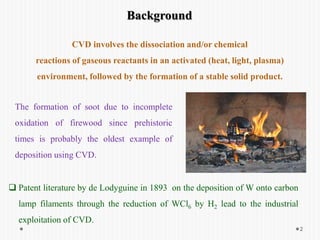
The formation of soot due to incomplete
oxidation of firewood since prehistoric
times is probably the oldest example of
deposition using CVD.
 Patent literature by de Lodyguine in 1893 on the deposition of W onto carbon
lamp filaments through the reduction of WCl6 by H2 lead to the industrial
exploitation of CVD.
CVD involves the dissociation and/or chemical
reactions of gaseous reactants in an activated (heat, light, plasma)
environment, followed by the formation of a stable solid product.
2
3
What is CVD?
Chemical vapor deposition (CVD) is a process whereby a solid
material is deposited from a vapor by a chemical reaction
occurring on or in the vicinity of a normally heated substrate
surface.
The solid material is obtained as a coating, a powder, or as single
crystals.
By varying the experimental conditions—substrate material,
substrate temperature, composition of the reaction gas mixture,
total pressure gas flows, etc.—materials with different properties
can be grown.
CVD is an example for Solid-Vapor Reaction.
Main Components of CVD Equipment
The role of this component is to generate vapour precursors and
then deliver to the reactor.
The design of the CVD reactor depends on whether the starting
material is solid, liquid or gas.
The sublimation of a solid precursor depends on surface area of the
solid and contact time.
Liquid sources often use a bubbler to vaporise the reactants, and a
carrier gas (reactive gases such as H2 or inert gases such as Ar) to
transport the vaporised reactants into the reactor.
4
1. Chemical vapour precursor supply system
2. CVD reactors
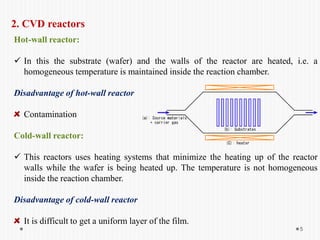
Hot-wall reactor:
 In this the substrate (wafer) and the walls of the reactor are heated, i.e. a
homogeneous temperature is maintained inside the reaction chamber.
Disadvantage of hot-wall reactor
Contamination
Cold-wall reactor:
 This reactors uses heating systems that minimize the heating up of the reactor
walls while the wafer is being heated up. The temperature is not homogeneous
inside the reaction chamber.
Disadvantage of cold-wall reactor
It is difficult to get a uniform layer of the film.
5
3. The effluent gas handling system
This component consists of a neutralizing part for the exhaust
gases, and/or a vacuum system to provide the required reduced
pressure for the CVD process that performs at low pressure or high
vacuum during deposition.
The unreacted precursors and corrosive by-products such as HCl
are neutralised or trapped using a liquid nitrogen trap.
Inflammable gases such as hydrogen are burned off.
Unreacted expensive precursors may be collected at the outlet and
recycled.
6
7
CVD Equipment
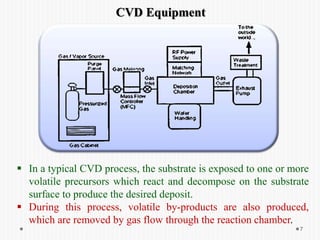
 In a typical CVD process, the substrate is exposed to one or more
volatile precursors which react and decompose on the substrate
surface to produce the desired deposit.
 During this process, volatile by-products are also produced,
which are removed by gas flow through the reaction chamber.
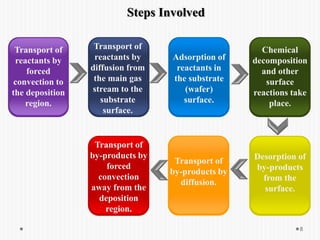
Steps Involved
8
Transport of
reactants by
forced
convection to
the deposition
region.
Desorption of
by-products
from the
surface.
Transport of
by-products by
diffusion.
Transport of
by-products by
forced
convection
away from the
deposition
region.
Transport of
reactants by
diffusion from
the main gas
stream to the
substrate
surface.
Adsorption of
reactants in
the substrate
(wafer)
surface.
Chemical
decomposition
and other
surface
reactions take
place.
9
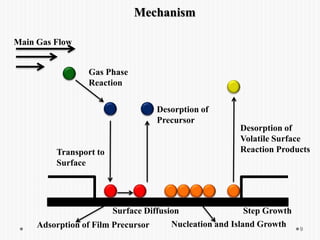
Mechanism
Main Gas Flow
Gas Phase
Reaction
Transport to
Surface
Surface Diffusion
Adsorption of Film Precursor
Step Growth
Nucleation and Island Growth
Desorption of
Precursor
Desorption of
Volatile Surface
Reaction Products
10
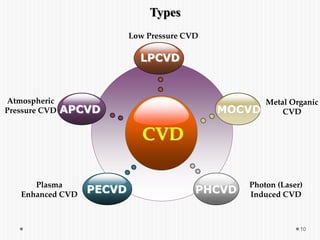
Types
CVD
LPCVD
PECVD
MOCVD
PHCVD
APCVD
Atmospheric
Pressure CVD
Low Pressure CVD
Metal Organic
CVD
Plasma
Enhanced CVD
Photon (Laser)
Induced CVD
11
Atmospheric pressure chemical vapour deposition (APCVD)
 It works at atmospheric pressure.
 It is used to deposit a layer of material typically several
micrometers thick onto a wafer or other type of substrate.
 It is also used as a surface finishing process for items such as tools
and turbine blades to improve lifetime and performance.
 Since a vacuum system is not required, APCVD systems have a
relatively low operating cost.
 APCVD has inherently poor utilization.
 APCVD is extremely susceptible to oxidation due to the greater
gas density and residence times.
12
 LPCVD coatings exhibit excellent uniformity, high purity, and
good step coverage.
 It works at sub-atmospheric pressures. Reduced pressures tend
to reduce unwanted gas-phase reactions and improve film
uniformity across the wafer.
 The lower pressure increases the precursor diffusion through the
gas and the mass transfer rate of the gaseous reactants becomes
higher than the surface-reaction rate.
 The pressure for LPCVD is usually around 10-1000 Pa while
standard atmospheric pressure is 101,325 Pa.
Low pressure chemical vapour deposition (LPCVD)
Metal-organic chemical vapour deposition (MOCVD)
 Metal-organic compounds are used as molecular precursors to
deposit, a wide variety of thin film materials for new industrial
applications.
 The great advantage of MOCVD precursors are their high
volatility at moderate to low temperatures, therefore reaction
temperatures are lower (750 to 1100 K) than conventional CVD.
 The main disadvantages are the precursors tend to be very
expensive and are very volatile. When reactive liquids are used
they require accurate pressure control and are difficult to purify.
13
14
Laser chemical vapour deposition (LCVD)
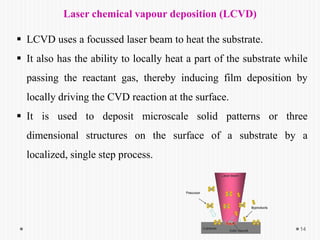
 LCVD uses a focussed laser beam to heat the substrate.
 It also has the ability to locally heat a part of the substrate while
passing the reactant gas, thereby inducing film deposition by
locally driving the CVD reaction at the surface.
 It is used to deposit microscale solid patterns or three
dimensional structures on the surface of a substrate by a
localized, single step process.
Plasma-enhanced chemical vapour deposition (PECVD)
 PECVD is used to deposit SiO2, Si3N4 (SixNy), SixOyNz and
amorphous Si films.
 Plasma can be used to decompose a molecule that will not
decompose at a reasonable elevated temperature.
 It can be used to decompose a thermally unstable molecule but
at a much lower temperature.
 In plasma CVD substrates that cannot tolerate high
temperatures, such as polymers, can be used, where substrate
temperatures range from 100 to 500°C.
15
16
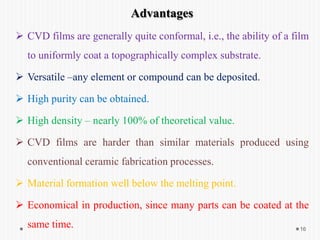
Advantages
 CVD films are generally quite conformal, i.e., the ability of a film
to uniformly coat a topographically complex substrate.
 Versatile –any element or compound can be deposited.
 High purity can be obtained.
 High density – nearly 100% of theoretical value.
 CVD films are harder than similar materials produced using
conventional ceramic fabrication processes.
 Material formation well below the melting point.
 Economical in production, since many parts can be coated at the
same time.
17
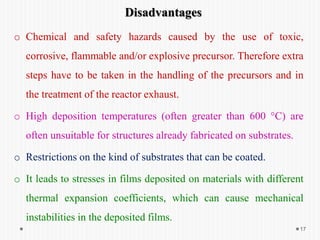
Disadvantages
o Chemical and safety hazards caused by the use of toxic,
corrosive, flammable and/or explosive precursor. Therefore extra
steps have to be taken in the handling of the precursors and in
the treatment of the reactor exhaust.
o High deposition temperatures (often greater than 600 °C) are
often unsuitable for structures already fabricated on substrates.
o Restrictions on the kind of substrates that can be coated.
o It leads to stresses in films deposited on materials with different
thermal expansion coefficients, which can cause mechanical
instabilities in the deposited films.
18
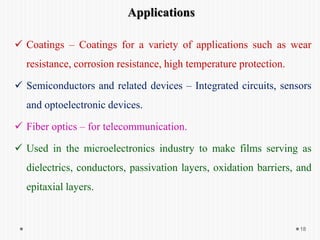
Applications
 Coatings – Coatings for a variety of applications such as wear
resistance, corrosion resistance, high temperature protection.
 Semiconductors and related devices – Integrated circuits, sensors
and optoelectronic devices.
 Fiber optics – for telecommunication.
 Used in the microelectronics industry to make films serving as
dielectrics, conductors, passivation layers, oxidation barriers, and
epitaxial layers.
19

Ed_ppt .pdf

  • 1.
  • 2.
    Background The formation ofsoot due to incomplete oxidation of firewood since prehistoric times is probably the oldest example of deposition using CVD.  Patent literature by de Lodyguine in 1893 on the deposition of W onto carbon lamp filaments through the reduction of WCl6 by H2 lead to the industrial exploitation of CVD. CVD involves the dissociation and/or chemical reactions of gaseous reactants in an activated (heat, light, plasma) environment, followed by the formation of a stable solid product. 2
  • 3.
    3 What is CVD? Chemicalvapor deposition (CVD) is a process whereby a solid material is deposited from a vapor by a chemical reaction occurring on or in the vicinity of a normally heated substrate surface. The solid material is obtained as a coating, a powder, or as single crystals. By varying the experimental conditions—substrate material, substrate temperature, composition of the reaction gas mixture, total pressure gas flows, etc.—materials with different properties can be grown. CVD is an example for Solid-Vapor Reaction.
  • 4.
    Main Components ofCVD Equipment The role of this component is to generate vapour precursors and then deliver to the reactor. The design of the CVD reactor depends on whether the starting material is solid, liquid or gas. The sublimation of a solid precursor depends on surface area of the solid and contact time. Liquid sources often use a bubbler to vaporise the reactants, and a carrier gas (reactive gases such as H2 or inert gases such as Ar) to transport the vaporised reactants into the reactor. 4 1. Chemical vapour precursor supply system
  • 5.
    2. CVD reactors Hot-wallreactor:  In this the substrate (wafer) and the walls of the reactor are heated, i.e. a homogeneous temperature is maintained inside the reaction chamber. Disadvantage of hot-wall reactor Contamination Cold-wall reactor:  This reactors uses heating systems that minimize the heating up of the reactor walls while the wafer is being heated up. The temperature is not homogeneous inside the reaction chamber. Disadvantage of cold-wall reactor It is difficult to get a uniform layer of the film. 5
  • 6.
    3. The effluentgas handling system This component consists of a neutralizing part for the exhaust gases, and/or a vacuum system to provide the required reduced pressure for the CVD process that performs at low pressure or high vacuum during deposition. The unreacted precursors and corrosive by-products such as HCl are neutralised or trapped using a liquid nitrogen trap. Inflammable gases such as hydrogen are burned off. Unreacted expensive precursors may be collected at the outlet and recycled. 6
  • 7.
    7 CVD Equipment  Ina typical CVD process, the substrate is exposed to one or more volatile precursors which react and decompose on the substrate surface to produce the desired deposit.  During this process, volatile by-products are also produced, which are removed by gas flow through the reaction chamber.
  • 8.
    Steps Involved 8 Transport of reactantsby forced convection to the deposition region. Desorption of by-products from the surface. Transport of by-products by diffusion. Transport of by-products by forced convection away from the deposition region. Transport of reactants by diffusion from the main gas stream to the substrate surface. Adsorption of reactants in the substrate (wafer) surface. Chemical decomposition and other surface reactions take place.
  • 9.
    9 Mechanism Main Gas Flow GasPhase Reaction Transport to Surface Surface Diffusion Adsorption of Film Precursor Step Growth Nucleation and Island Growth Desorption of Precursor Desorption of Volatile Surface Reaction Products
  • 10.
    10 Types CVD LPCVD PECVD MOCVD PHCVD APCVD Atmospheric Pressure CVD Low PressureCVD Metal Organic CVD Plasma Enhanced CVD Photon (Laser) Induced CVD
  • 11.
    11 Atmospheric pressure chemicalvapour deposition (APCVD)  It works at atmospheric pressure.  It is used to deposit a layer of material typically several micrometers thick onto a wafer or other type of substrate.  It is also used as a surface finishing process for items such as tools and turbine blades to improve lifetime and performance.  Since a vacuum system is not required, APCVD systems have a relatively low operating cost.  APCVD has inherently poor utilization.  APCVD is extremely susceptible to oxidation due to the greater gas density and residence times.
  • 12.
    12  LPCVD coatingsexhibit excellent uniformity, high purity, and good step coverage.  It works at sub-atmospheric pressures. Reduced pressures tend to reduce unwanted gas-phase reactions and improve film uniformity across the wafer.  The lower pressure increases the precursor diffusion through the gas and the mass transfer rate of the gaseous reactants becomes higher than the surface-reaction rate.  The pressure for LPCVD is usually around 10-1000 Pa while standard atmospheric pressure is 101,325 Pa. Low pressure chemical vapour deposition (LPCVD)
  • 13.
    Metal-organic chemical vapourdeposition (MOCVD)  Metal-organic compounds are used as molecular precursors to deposit, a wide variety of thin film materials for new industrial applications.  The great advantage of MOCVD precursors are their high volatility at moderate to low temperatures, therefore reaction temperatures are lower (750 to 1100 K) than conventional CVD.  The main disadvantages are the precursors tend to be very expensive and are very volatile. When reactive liquids are used they require accurate pressure control and are difficult to purify. 13
  • 14.
    14 Laser chemical vapourdeposition (LCVD)  LCVD uses a focussed laser beam to heat the substrate.  It also has the ability to locally heat a part of the substrate while passing the reactant gas, thereby inducing film deposition by locally driving the CVD reaction at the surface.  It is used to deposit microscale solid patterns or three dimensional structures on the surface of a substrate by a localized, single step process.
  • 15.
    Plasma-enhanced chemical vapourdeposition (PECVD)  PECVD is used to deposit SiO2, Si3N4 (SixNy), SixOyNz and amorphous Si films.  Plasma can be used to decompose a molecule that will not decompose at a reasonable elevated temperature.  It can be used to decompose a thermally unstable molecule but at a much lower temperature.  In plasma CVD substrates that cannot tolerate high temperatures, such as polymers, can be used, where substrate temperatures range from 100 to 500°C. 15
  • 16.
    16 Advantages  CVD filmsare generally quite conformal, i.e., the ability of a film to uniformly coat a topographically complex substrate.  Versatile –any element or compound can be deposited.  High purity can be obtained.  High density – nearly 100% of theoretical value.  CVD films are harder than similar materials produced using conventional ceramic fabrication processes.  Material formation well below the melting point.  Economical in production, since many parts can be coated at the same time.
  • 17.
    17 Disadvantages o Chemical andsafety hazards caused by the use of toxic, corrosive, flammable and/or explosive precursor. Therefore extra steps have to be taken in the handling of the precursors and in the treatment of the reactor exhaust. o High deposition temperatures (often greater than 600 °C) are often unsuitable for structures already fabricated on substrates. o Restrictions on the kind of substrates that can be coated. o It leads to stresses in films deposited on materials with different thermal expansion coefficients, which can cause mechanical instabilities in the deposited films.
  • 18.
    18 Applications  Coatings –Coatings for a variety of applications such as wear resistance, corrosion resistance, high temperature protection.  Semiconductors and related devices – Integrated circuits, sensors and optoelectronic devices.  Fiber optics – for telecommunication.  Used in the microelectronics industry to make films serving as dielectrics, conductors, passivation layers, oxidation barriers, and epitaxial layers.
  • 19.