Learning vs. Experience
Understanding Game Genres
          IT 7220
         May 27, 2010
Agenda

 Designing for Learning
 Leaner Experience and Genre


 Game Exercise


 A Look at some Example Games for


  Learning
 Lab
Learning Basics
   Individual learning is about:
    
        Engaging in activity
    
        Encountering a problem
    
        Reflection to create an abstract conception
    
        Testing the conception
Instructional Cycle

    Designing instruction means adding examples of
    performance and feedback
Cognitivist Views
Cognitivist Views
• Cognitive apprenticeship
  • Demonstrate behaviors
  • Practice/Scaffolding (support is gradually
      removed)
  •   Reflection and feedback on performance
Cognitivist Views
• Cognitive apprenticeship
  • Demonstrate behaviors
  • Practice/Scaffolding (support is gradually
       removed)
     • Reflection and feedback on performance
•   Scenario-based learning
     • Development of low-level knowledge skills
       through discovery of resources internal and
       external to learning situation--not by explicit
       instruction
Constructivist Views

• Learners must develop their own understanding
Constructivist Views

• Learners must develop their own understanding
• Learners need to be active in engaging with
 problems and developing hypotheses; require
 feedback to refine models
Constructivist Views

• Learners must develop their own understanding
• Learners need to be active in engaging with
    problems and developing hypotheses; require
    feedback to refine models
•   Emphasis on social nature of learning through
    dialogue between learners; between learners and
    mentors; between learners and environment
Constructivist Views

• Learners must develop their own understanding
• Learners need to be active in engaging with
    problems and developing hypotheses; require
    feedback to refine models
•   Emphasis on social nature of learning through
    dialogue between learners; between learners and
    mentors; between learners and environment
•   Zone of Proximal Development: space between
    competency and tasks learner can accomplish with
    help (scaffolding) is the zone where learning occurs
Basic ID Model

• Elements for developing a learning experience:
  • Objective
  • Introduction
  • Concept
  • Examples
  • Practice
  • Summary
Instructional Frameworks
   Bloom
      Taxonomy of knowledge we have and use
   Gagné
      Events of learning to achieve successful learning outcomes
   Mager
      Interventions couched in learning objectives
   Reigeluth
      Elaboration of complexity and comprehensiveness until
       knowledge or skill is fully elaborated and exercised
   Keller
      ARCS Model (attention, relevance, confidence, and satisfaction
       to address affective elements and knowledge components
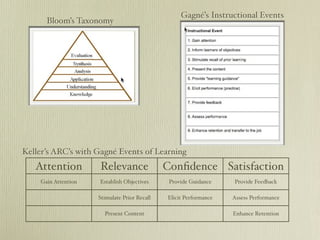
Gagné’s Instructional Events
      Bloom’s Taxonomy


Keller’s ARC’s with Gagné Events of Learning
   Attention         Relevance                Confidence Satisfaction
    Gain Attention   Establish Objectives      Provide Guidance    Provide Feedback

                     Stimulate Prior Recall   Elicit Performance   Assess Performance

                       Present Content                             Enhance Retention
Elements for Successful
            Learning
•   Contextualized
•   Clear goal
•   Appropriate challenge
•   Anchored
•   Relevant
•   Exploratory
•   Active manipulation
•   Appropriate feedback
•   Attention getting
Enhanced ID Model
• Elements
  • Objective
  • Dramatic Introduction
  • Multiply represented context
  • Annotated examples
  • Scaffolded practice
  • Guided Reflection
Enhanced ID Model (Quinn)
Learner Experience and
           Genre

• Influence of Content
• Game Genres
• Compelling Experience through Games
• Human Computer Interface (HCI) Design
• Designing Engaging Experiences
Influence of Content
• Linear Content
   • Movies, television shows and books are all linear
   • Modern DVD’s represent the purist extension of linear content
       today
   •   Linear content is the province of the creator, and thus the least
       valuable of the three content types
Influence of Content
• Linear Content
   • Movies, television shows and books are all linear
   • Modern DVD’s represent the purist extension of linear content
       today
     • Linear content is the province of the creator, and thus the least
       valuable of the three content types
•   Cyclical (non-Linear) Content
     • Interface: the DNA of most computer computer games
     • Mapped to a real activity
Influence of Content
• Linear Content
   • Movies, television shows and books are all linear
   • Modern DVD’s represent the purist extension of linear content
       today
     • Linear content is the province of the creator, and thus the least
       valuable of the three content types
•   Cyclical (non-Linear) Content
     • Interface: the DNA of most computer computer games
     • Mapped to a real activity
•   Open-ended Content
     • Learners participate in the experience
     • Focus on developing strategies, building environments, and taking
       ownership
     • Essential for transfer
Game Platforms

• Arcade games (e.g., Asteroids; PacMan)
• Home computers (i.e., Dungeons and Dragons)
• Consoles (including handheld e.g., GameBoy)
• PC
• MMOLRPG via the Web
Sims and Games
Games are a type of
       Simulation

• Interactive Spreadsheet
• Virtual Labs/Virtual Products
• Branching Story
• Game-based models
Interactive Spreadsheet

An interactive spreadsheet is an educational
simulation in which students typically try to
impact 3-4 critical metrics (primary
variables) indirectly by allocating finite
resources (money, time, good will) among
competing categories over a series or turns
or intervals.
Virtual Lab/Virtual Product
• Virtual products are an educational simulation
 genre in which a collection of simulation elements
 creates a high-fidelity virtual model of a real-world
 item. Participants can play around with these
 items or test hypotheses regarding their behavior.
Virtual Lab/Virtual Product
• Virtual products are an educational simulation
 genre in which a collection of simulation elements
 creates a high-fidelity virtual model of a real-world
 item. Participants can play around with these
 items or test hypotheses regarding their behavior.
• Virtual labs are the educational simulation genre
 where participants engage a virtual product in an
 experience structured by tasks and goals to learn
 about some real-world item to solve problem or
 complete products (rather than just explore what
 it does).
Branching Story


Branching stories are an educational
simulation in which students make a series
of decisions through a series of multiple
choices to progress through an event (or
story) that develops in different ways
according to the choices each student makes.
Game-Based Models
Typically referred to as Frame games (i.e.,
exogenous games using external factors)

  • Puzzle games
  • Solitaire
  • Memory games
  • Word games
  • Board games
Game Genres

• Action - original category; builds coordination and
    reflexes
•   Fighting - version of action game; characters in
    martial arts or combat
•   Driving or flying - often in competition; start out as
    simulation and becomes a game because challenge
    and fantasy are appealing (e.g., Microsoft Flight
    Simulator)
•   Sports - mimic popular individual or team sports;
    develop mental skills involved in those sports
More Game Genres
• 3D Shooter - first-person viewpoint; requires
  navigational capabilities
• Card or board - electronic versions of familiar games
  like solitaire and chess; may include strategic
  components
• Strategy - story line requires prioritizing and allocating
  resources to grow and conquer; may require
  negotiation and navigation skills, and planning
• Fantasy role playing - players control character or team
  that combat and gain skills over time; can have
  embedded puzzles
Still More Game Genres
• Adventure - character explores and must figure out
    to overcome puzzles to advance
•   Multiplayer - have developed capabilities to allow
    players to play against one another
•   Combinations - combine element of rpg’s with
    adventure or that mix driving with 3D shooter
•   Couple of thoughts about genres...
     • Different genres work for different experiences;
       aren’t necessarily interchangeable
     • Mods are available; tend to be genre specific
Properties of Games
Properties of Games
• Game skills
  • Physical dexterity
  • Intellectual skills
  • Role playing
Properties of Games
• Game skills
  • Physical dexterity
  • Intellectual skills
  • Role playing
• Game elements
  • Competition
  • Implements
  • Territory
  • Inventory
  • Rules
Experience: Flow

• Occurs when one is engaged in self-controlled,
 goal-related, meaningful actions

• Management of challenge: above normal
 requirements, but within capabilities

• Includes feedback tied to a goal
• Use of narrative; management of tension while
 grounding action in a meaningful story
Experience: Fun
• Challenge
   • Requires reasonable level of difficulty
• Fantasy
   • Compelling setting for game action; temporary
    suspension of reality
• Curiosity
  • Random events so that play is not completely
    deterministic
• Control
  • Learners are confronted with choices
HCI Insights for Games
• Responsiveness - feedback from computer
• Benchmarks - indicators of outcomes and
    progress
•   Acceptable uncertainty - proceeding without
    complete understanding is ok
•   Safe conduct - ability to make errors without
    affecting the real world (fail-safe zone)
•   Learning by doing - exploration and discovery
•   Control - learner as an agent of action
Designing Engaging
            Experiences
•   Thematic coherence
•   Clear goal
•   Balanced challenge
•   Relevance: action to domain
•   Relevance: problem to learner
•   Choices of action
•   Direct manipulation
•   Action coupling
•   Novel information or events
Exercise
• Play Games2train’s solitaire game
 <http://www.games2train.com/site/html/products/
 solitaire.html>

• Does it meet the criteria for the “enhanced ID
 model”?

• Does it meet the criteria for a ‘fun’ experience?
 (challenge, fantasy, curiosity, control)

• NOTE: These are criteria that may be applied
 in the Game Critique Assignment Paper
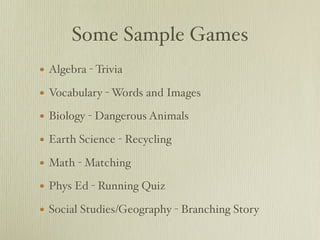
Some Sample Games
•   Algebra - Trivia

•   Vocabulary - Words and Images

•   Biology - Dangerous Animals

•   Earth Science - Recycling

•   Math - Matching

•   Phys Ed - Running Quiz

•   Social Studies/Geography - Branching Story
Lab
• Chap 1: Hello World!
  • Flash environment overview (.fla, .as, .swf,
      projects)
    • AS 3.0 programming foundations
•   Chap 2: Interactive Story Book
    • Interactive objects
    • Working with symbol library
    • Flash drawing tools
    • Creating buttons

Learning Verses Experience

  • 1.
    Learning vs. Experience UnderstandingGame Genres IT 7220 May 27, 2010
  • 2.
    Agenda  Designing forLearning  Leaner Experience and Genre  Game Exercise  A Look at some Example Games for Learning  Lab
  • 3.
    Learning Basics  Individual learning is about:  Engaging in activity  Encountering a problem  Reflection to create an abstract conception  Testing the conception
  • 4.
    Instructional Cycle  Designing instruction means adding examples of performance and feedback
  • 5.
  • 6.
    Cognitivist Views • Cognitiveapprenticeship • Demonstrate behaviors • Practice/Scaffolding (support is gradually removed) • Reflection and feedback on performance
  • 7.
    Cognitivist Views • Cognitiveapprenticeship • Demonstrate behaviors • Practice/Scaffolding (support is gradually removed) • Reflection and feedback on performance • Scenario-based learning • Development of low-level knowledge skills through discovery of resources internal and external to learning situation--not by explicit instruction
  • 8.
  • 9.
    Constructivist Views • Learnersmust develop their own understanding
  • 10.
    Constructivist Views • Learnersmust develop their own understanding • Learners need to be active in engaging with problems and developing hypotheses; require feedback to refine models
  • 11.
    Constructivist Views • Learnersmust develop their own understanding • Learners need to be active in engaging with problems and developing hypotheses; require feedback to refine models • Emphasis on social nature of learning through dialogue between learners; between learners and mentors; between learners and environment
  • 12.
    Constructivist Views • Learnersmust develop their own understanding • Learners need to be active in engaging with problems and developing hypotheses; require feedback to refine models • Emphasis on social nature of learning through dialogue between learners; between learners and mentors; between learners and environment • Zone of Proximal Development: space between competency and tasks learner can accomplish with help (scaffolding) is the zone where learning occurs
  • 13.
    Basic ID Model •Elements for developing a learning experience: • Objective • Introduction • Concept • Examples • Practice • Summary
  • 14.
    Instructional Frameworks  Bloom  Taxonomy of knowledge we have and use  Gagné  Events of learning to achieve successful learning outcomes  Mager  Interventions couched in learning objectives  Reigeluth  Elaboration of complexity and comprehensiveness until knowledge or skill is fully elaborated and exercised  Keller  ARCS Model (attention, relevance, confidence, and satisfaction to address affective elements and knowledge components
  • 15.
    Gagné’s Instructional Events Bloom’s Taxonomy Keller’s ARC’s with Gagné Events of Learning Attention Relevance Confidence Satisfaction Gain Attention Establish Objectives Provide Guidance Provide Feedback Stimulate Prior Recall Elicit Performance Assess Performance Present Content Enhance Retention
  • 16.
    Elements for Successful Learning • Contextualized • Clear goal • Appropriate challenge • Anchored • Relevant • Exploratory • Active manipulation • Appropriate feedback • Attention getting
  • 17.
    Enhanced ID Model •Elements • Objective • Dramatic Introduction • Multiply represented context • Annotated examples • Scaffolded practice • Guided Reflection
  • 18.
  • 19.
    Learner Experience and Genre • Influence of Content • Game Genres • Compelling Experience through Games • Human Computer Interface (HCI) Design • Designing Engaging Experiences
  • 20.
  • 21.
    Influence of Content •Linear Content • Movies, television shows and books are all linear • Modern DVD’s represent the purist extension of linear content today • Linear content is the province of the creator, and thus the least valuable of the three content types
  • 22.
    Influence of Content •Linear Content • Movies, television shows and books are all linear • Modern DVD’s represent the purist extension of linear content today • Linear content is the province of the creator, and thus the least valuable of the three content types • Cyclical (non-Linear) Content • Interface: the DNA of most computer computer games • Mapped to a real activity
  • 23.
    Influence of Content •Linear Content • Movies, television shows and books are all linear • Modern DVD’s represent the purist extension of linear content today • Linear content is the province of the creator, and thus the least valuable of the three content types • Cyclical (non-Linear) Content • Interface: the DNA of most computer computer games • Mapped to a real activity • Open-ended Content • Learners participate in the experience • Focus on developing strategies, building environments, and taking ownership • Essential for transfer
  • 24.
    Game Platforms • Arcadegames (e.g., Asteroids; PacMan) • Home computers (i.e., Dungeons and Dragons) • Consoles (including handheld e.g., GameBoy) • PC • MMOLRPG via the Web
  • 25.
  • 26.
    Games are atype of Simulation • Interactive Spreadsheet • Virtual Labs/Virtual Products • Branching Story • Game-based models
  • 27.
    Interactive Spreadsheet An interactivespreadsheet is an educational simulation in which students typically try to impact 3-4 critical metrics (primary variables) indirectly by allocating finite resources (money, time, good will) among competing categories over a series or turns or intervals.
  • 28.
  • 29.
    Virtual Lab/Virtual Product •Virtual products are an educational simulation genre in which a collection of simulation elements creates a high-fidelity virtual model of a real-world item. Participants can play around with these items or test hypotheses regarding their behavior.
  • 30.
    Virtual Lab/Virtual Product •Virtual products are an educational simulation genre in which a collection of simulation elements creates a high-fidelity virtual model of a real-world item. Participants can play around with these items or test hypotheses regarding their behavior. • Virtual labs are the educational simulation genre where participants engage a virtual product in an experience structured by tasks and goals to learn about some real-world item to solve problem or complete products (rather than just explore what it does).
  • 31.
    Branching Story Branching storiesare an educational simulation in which students make a series of decisions through a series of multiple choices to progress through an event (or story) that develops in different ways according to the choices each student makes.
  • 32.
    Game-Based Models Typically referredto as Frame games (i.e., exogenous games using external factors) • Puzzle games • Solitaire • Memory games • Word games • Board games
  • 33.
    Game Genres • Action- original category; builds coordination and reflexes • Fighting - version of action game; characters in martial arts or combat • Driving or flying - often in competition; start out as simulation and becomes a game because challenge and fantasy are appealing (e.g., Microsoft Flight Simulator) • Sports - mimic popular individual or team sports; develop mental skills involved in those sports
  • 34.
    More Game Genres •3D Shooter - first-person viewpoint; requires navigational capabilities • Card or board - electronic versions of familiar games like solitaire and chess; may include strategic components • Strategy - story line requires prioritizing and allocating resources to grow and conquer; may require negotiation and navigation skills, and planning • Fantasy role playing - players control character or team that combat and gain skills over time; can have embedded puzzles
  • 35.
    Still More GameGenres • Adventure - character explores and must figure out to overcome puzzles to advance • Multiplayer - have developed capabilities to allow players to play against one another • Combinations - combine element of rpg’s with adventure or that mix driving with 3D shooter • Couple of thoughts about genres... • Different genres work for different experiences; aren’t necessarily interchangeable • Mods are available; tend to be genre specific
  • 36.
  • 37.
    Properties of Games •Game skills • Physical dexterity • Intellectual skills • Role playing
  • 38.
    Properties of Games •Game skills • Physical dexterity • Intellectual skills • Role playing • Game elements • Competition • Implements • Territory • Inventory • Rules
  • 39.
    Experience: Flow • Occurswhen one is engaged in self-controlled, goal-related, meaningful actions • Management of challenge: above normal requirements, but within capabilities • Includes feedback tied to a goal • Use of narrative; management of tension while grounding action in a meaningful story
  • 40.
    Experience: Fun • Challenge • Requires reasonable level of difficulty • Fantasy • Compelling setting for game action; temporary suspension of reality • Curiosity • Random events so that play is not completely deterministic • Control • Learners are confronted with choices
  • 41.
    HCI Insights forGames • Responsiveness - feedback from computer • Benchmarks - indicators of outcomes and progress • Acceptable uncertainty - proceeding without complete understanding is ok • Safe conduct - ability to make errors without affecting the real world (fail-safe zone) • Learning by doing - exploration and discovery • Control - learner as an agent of action
  • 42.
    Designing Engaging Experiences • Thematic coherence • Clear goal • Balanced challenge • Relevance: action to domain • Relevance: problem to learner • Choices of action • Direct manipulation • Action coupling • Novel information or events
  • 43.
    Exercise • Play Games2train’ssolitaire game <http://www.games2train.com/site/html/products/ solitaire.html> • Does it meet the criteria for the “enhanced ID model”? • Does it meet the criteria for a ‘fun’ experience? (challenge, fantasy, curiosity, control) • NOTE: These are criteria that may be applied in the Game Critique Assignment Paper
  • 44.
    Some Sample Games • Algebra - Trivia • Vocabulary - Words and Images • Biology - Dangerous Animals • Earth Science - Recycling • Math - Matching • Phys Ed - Running Quiz • Social Studies/Geography - Branching Story
  • 45.
    Lab • Chap 1:Hello World! • Flash environment overview (.fla, .as, .swf, projects) • AS 3.0 programming foundations • Chap 2: Interactive Story Book • Interactive objects • Working with symbol library • Flash drawing tools • Creating buttons

Editor's Notes

  • #12 See Quinn page 28
  • #13 The model for instructional design is elaborated on using instructional frameworks
  • #14 Convergence of instructional models in designing instructional experiences
  • #15 See Quinn page 36-37
  • #16 See Quinn page 34-35
  • #17 Quinn page 35.
  • #19 Engaging learning is about creating the experience, not the content. Type of content and learning objectives may influence selection of genre. Creating the experience knowing how to blend different types of content.
  • #20 Engaging learning is about creating the experience, not the content. Type of content and learning objectives may influence selection of genre. Creating the experience knowing how to blend different types of content.
  • #21 Engaging learning is about creating the experience, not the content. Type of content and learning objectives may influence selection of genre. Creating the experience knowing how to blend different types of content.
  • #23 Serious games make up the genre category of immersive learning simulations. They increase awareness of real-world topics and can be used both for entertainment and in learning programs.
  • #24 According to Adrich (2005) There is a fair amount of ambiguity in this grouping and indeed there may be game elements in each genre After tonight, our focus will be on applying game-based models
  • #25 Covered in chap 3 of Aldrich. Used extensively in B school, interactive spreadsheets are a good choice for higher-level management training; Not very effective for less experienced, less motivated students who may become confused or bored with the simulation.
  • #26 Examples of virtual products and virtual labs are provided in Aldrich&amp;#x2019;s discussion in chapter 5. Very effective for training, in particular when: Importance is placed on users being able to operate the device correctly Organizations can&amp;#x2019;t send practice devices out to all users Organizations can&amp;#x2019;t send trainers out for all users
  • #27 Examples of virtual products and virtual labs are provided in Aldrich&amp;#x2019;s discussion in chapter 5. Very effective for training, in particular when: Importance is placed on users being able to operate the device correctly Organizations can&amp;#x2019;t send practice devices out to all users Organizations can&amp;#x2019;t send trainers out for all users
  • #28 Adrich discusses branching stories in chapter 2 May include coaching and feedback. Format can be Q&amp;A or include ich media with video Typical length is anywhere from 10 minutes up to two hours
  • #29 Easily developed and modifiable in Flash.
  • #30 We use genres to build familiarity by using experiences that people are already familiar with. Across all media, most content settles into genres. TV genres include sit-coms, news programs, reality TV, and sports. Music genres include rock and roll, classical, opera, hip hop, and rap. Genres matter tremendously. Mystery books follow a different frameworks than cookbooks. Even a comic book is a meta-genre, with overlapping sub-genres that include superheros, supernatural phenomena, children&amp;#x2019;s cartoons and social dynamics. Each genre has its common set of styles, including rules and expectations.
  • #35 Experiences are tied to peak performance...feeling of being in the zone. Designing for learner experience--intrinsic motivation--to want to play the game Designing for instructional impact--&amp;#x201D;Learning to Do,&amp;#x201D;, Not Just &amp;#x201C;Learning to Know&amp;#x201D;
  • #36 Elements that make computer games fun to play. (Malone, 1981)
  • #37 HCI - Human Computer Interface Research
  • #38 See Quinn pages 48-49