EUA consideration on interoperability - Clare Phelan (EUA)
1.
EUA considerations oninteroperability
EADTU-EU SUMMIT 2025
14 May 2025
Clare Phelan
Membership & Project Coordinator
European University Association (EUA)
2.
2
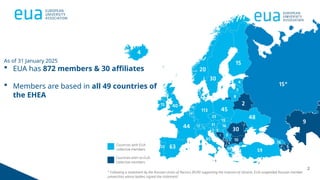
As of 31January 2025
EUA has 872 members & 30 affiliates
Members are based in all 49 countries of
the EHEA
3.
3
EUA.. In a
nutshell...
Establishedin 2001
Nongovernmental membership organisation
Independent voice of Europe’s university
sector
Forum for peer learning and exchange
among members
4.
What does
interoperability
mean inthe
context of
university co-
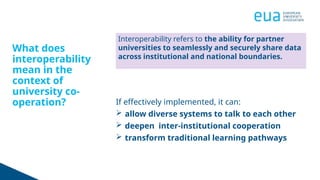
operation? If effectively implemented, it can:
allow diverse systems to talk to each other
deepen inter-institutional cooperation
transform traditional learning pathways
Interoperability refers to the ability for partner
universities to seamlessly and securely share data
across institutional and national boundaries.
5.
EUA briefing onin
teroperability
[November 2024]
Developing common learning opportunities through
interoperability – The status and outlook for European
higher education:
looks beyond the technical elements
highlights converging political factors
outlines key obstacles to advancement
explores three possible outlooks for the evolution of
interoperability
6.
EUA briefing on
interoperability
Outlook– what futures for
interoperability?
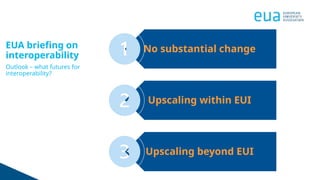
Three possible outlooks
not necessarily probable
address deep political questions
might seem far-fetched but….
….current obstacles
do not set the long-term limits for interoperability.
should not preclude future-orientated discussion.
Important to
consider…
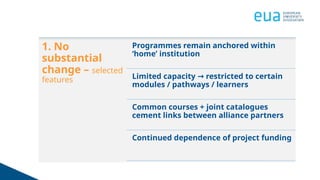
1. No
substantial
change –selected
features
Programmes remain anchored within
‘home’ institution
Limited capacity restricted to certain
→
modules / pathways / learners
Common courses + joint catalogues
cement links between alliance partners
Continued dependence of project funding
9.
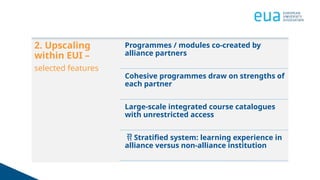
2. Upscaling
within EUI–
selected features
Programmes / modules co-created by
alliance partners
Cohesive programmes draw on strengths of
each partner
Large-scale integrated course catalogues
with unrestricted access
Stratified system: learning experience in
alliance versus non-alliance institution
10.
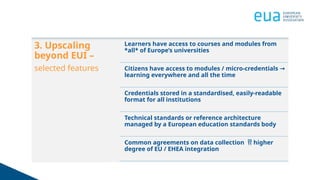
3. Upscaling
beyond EUI–
selected features
Learners have access to courses and modules from
*all* of Europe’s universities
Citizens have access to modules / micro-credentials →
learning everywhere and all the time
Credentials stored in a standardised, easily-readable
format for all institutions
Technical standards or reference architecture
managed by a European education standards body
Common agreements on data collection higher
degree of EU / EHEA integration
11.
11
Some
lingering
questions...
Effort and demand:is the investment in
interoperability proportionate with appetite for
mobility?
Scalability: is coherence at national level a pre-
requisite for scaling up European initiatives?
The ‘home’ institution: how might perceptions–
and responsibilities – of the ‘home’ institution be
altered?
#1 Slide 1
Clare Phelan
Membership & Project Officer at EUA
Invited here today to present an overview of a paper EUA published on Interoperability late last year
Thank you and a pleasure to be here.
#2 Slide 2
For those of you not familiar with EUA:
Membership organisation representing almost 900 member institutions spread across the four corners of Europe
This visual gives an idea of our coverage – not absolutely up-to-date, but still accurate impression of the spread.
#3 Slide 3
So, what does EUA do? Or maybe more accurately, why does it exist?
Established in 2001 as a merger of two organisations: 1) representing individual institutions 2) representing national university associations
EUA advocates on behalf its members, and in the interest of the higher ed and research sectors in Europe
Importantly, EUA provides a fora for discussion on topical and pressing issues our members face.
And one that has come to the fore recently is, of course, interoperability.
#4 Slide 4
Debate around interoperability stretches far beyond higher education, of course.
And at the risk of telling you what you already know, here is how we understand the benefits – or indeed, the potential benefits – in the university context:
Interoperability enables universities to seamlessly and securely share data across institutional and national boundaries; thereby:
allowing diverse systems to talk to each other
deepening inter-institutional cooperation
transforming traditional learning pathways
#5 Slide 5
So, with the understanding that these benefits were most often explored, and indeed realised, among European University alliances, we set about learning more about what was happening on the ground.
Process was straightforward: we conducted a series of interviews with practitioners whose everyday reality centred around mobility and exchange of information among alliance partners.
As is almost always the case, the conversations we have with practitioners working at the coal face are illuminating, especially for people sitting in a Brussels office!
After some labour, the outcomes of these conversations - and indeed other insights gathered in the course of exchange with more Brussels-centred stakeholders - were collated in a briefing paper:
Developing common learning opportunities through interoperability – The status and outlook for European higher education was published in November last year.
The paper, of course, recognises that technical infrastructure provides the building blocks for interoperability. And that this in itself presents challenges.
But without much technical expertise to contribute, we thought it best not to encroach on these specific conversations!
Instead, the paper takes a more future-oriented angle, it:
looks beyond the technical elements
highlights converging political factors
outlines key obstacles to advancement
explores three possible outlooks for the evolution of interoperability
#6 Slide 6
Before walking you through each of these three outlooks, I will provide some context for the three scenarios described in the paper: it is important to bear in mind that they:
are not necessarily probable
address deep political questions, and at first glance…
might seem far-fetched
But in considering how the pursuit of interoperability might evolve, it’s also important to understand that the obstacles that exist today, although they might be very real:
do not set the long-term limits for interoperability.
should not preclude future-orientated discussion.
#7 Slide 7
As we know, the current vision for interoperability focusses on mobility (physical and virtual) but in terms of how this might progress, we could imagine three scenarios – some perhaps more conceivable than others but all worthy of investigation:
There is no dramatic change in the vision, and things continue along the current trajectory
There is scope to scale up within EUI, which is not altogether unimaginable
Upscaling beyond EUI, and this is where we consider the more transformative potential of interoperability
#8 Slide 8 [No substantial change]
In such a scenario:
Programmes remain anchored in the home institution
Limited capacity both in terms of the number of learners partaking of a mobility experience and the number of options they might have within that
PLUS: cement the links between institutions within an alliance,
MINUS: small-scale initiatives could risk continuing the present situation of unclear governance and possibly perpetuate the problems that come with a dependence on project funding
#9 Slide 9 [Upscaling within EUI]
Programmes / modules co-created by alliance partners
Cohesive programmes draw on strengths of each partner
PLUS Large-scale integrated course catalogues with unrestricted access
MINUS: Stratified system: learning experience in alliance versus non-alliance institution
A pre-requisite for this approach to work would be a strong coordination of quality assurance, digital services and learning and teaching strategies across the alliance
#10 Slide 10
This is where things can get really quite interesting. The future presented is highly speculative but this doesn’t mean it shouldn’t be thoroughly explored…
Based on the concept of a united open European course catalogue,
This could imply a level of flexibility might well undermine the EUI.
Notion of: learning everywhere and all the time.
But this raises huge political and practical questions:
How would costs be shared for maintaining such a system?
How could we ensure that it is equitable and accessible, and facilitates meaningful learning for all?
This of course would require a system of easy credit recognition that allows for flexible and stackable micro-credentials; the technical and cultural considerations that underpin this would have to thoroughly thrashed out.
To conclude:
These three sketches of possible futures show that interoperability merits more than a discussion on technical or management aspects. It hints to interoperability as a potentially transformative development that touches upon the visions for the European higher education system as a whole.
This, of course, is only the beginning of a much larger discussion about the digital transformation of higher education and society at large.
#11 Slide 11
Certainly, EUA foresees being part of that ongoing discussion. Maybe with a view to sparking some further reflection or debate, I will raise some of the questions that tend to persist:
Effort and demand: is the investment in interoperability proportionate with appetite for mobility?
Scalability: is coherence at national level a pre-requisite for scaling up initiatives?
From EUA’s point of view, this is possibly the crux of the issue
The ‘home institution’: how might perceptions– and responsibilities – of the ‘home institution’ be altered?
Traditional understanding of a university is changing and of course, institutions need to adapt and evolve all the time but interested in hearing your views on how perceptions of the ‘home institution’ might potentially change assuming interoperability is scaled up.


![EUA briefing on in
teroperability
[November 2024]
Developing common learning opportunities through
interoperability – The status and outlook for European
higher education:
looks beyond the technical elements
highlights converging political factors
outlines key obstacles to advancement
explores three possible outlooks for the evolution of
interoperability](https://image.slidesharecdn.com/20250514interoperabilityeadtucp-250515134537-90813395/85/EUA-consideration-on-interoperability-Clare-Phelan-EUA-5-320.jpg)




![[EADTU-ENQA PLA] Anaylisis of questionnaires](https://cdn.slidesharecdn.com/ss_thumbnails/anaylisisofquestionnairesplajonrosewell-170925083917-thumbnail.jpg?width=640&height=640&fit=bounds)


