



Integrating Emerging Technologies
and Learning Theories


   Heng Luo, Jing Lei.
   IDD&E, Syracuse University
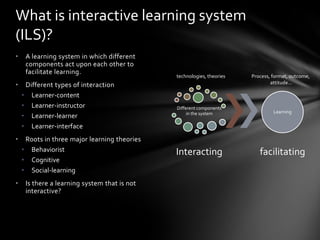
What is interactive learning system
(ILS)?
•    A learning system in which different
     components act upon each other to
     facilitate learning.
                                              technologies, theories   Process, format, outcome,
                                                                               attitude…
•    Different types of interaction
    • Learner-content
    • Learner-instructor                      Different components
                                                   in the system                Learning
    • Learner-learner
    • Learner-interface
•    Roots in three major learning theories
    • Behaviorist                             Interacting                 facilitating
    • Cognitive
    • Social-learning
•    Is there a learning system that is not
     interactive?
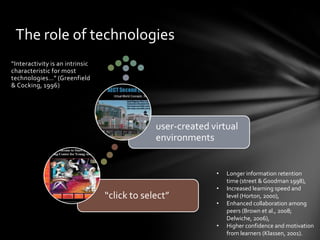
The role of technologies
“Interactivity is an intrinsic
characteristic for most
technologies…” (Greenfield
& Cocking, 1996)


                                              user-created virtual
                                              environments


                                                            •   Longer information retention
                                                                time (street & Goodman 1998),
                                                            •   Increased learning speed and
                                 “click to select”              level (Horton, 2000),
                                                            •   Enhanced collaboration among
                                                                peers (Brown et al., 2008;
                                                                Delwiche, 2006),
                                                            •   Higher confidence and motivation
                                                                from learners (Klassen, 2001).
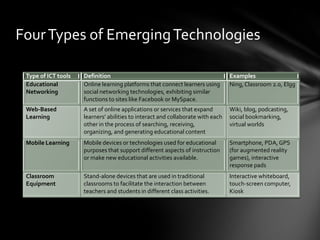
Four Types of Emerging Technologies

 Type of ICT tools   Definition                                                  Examples
 Educational         Online learning platforms that connect learners using       Ning, Classroom 2.0, Elgg
 Networking          social networking technologies, exhibiting similar
                     functions to sites like Facebook or MySpace.
 Web-Based           A set of online applications or services that expand        Wiki, blog, podcasting,
 Learning            learners’ abilities to interact and collaborate with each   social bookmarking,
                     other in the process of searching, receiving,               virtual worlds
                     organizing, and generating educational content
 Mobile Learning     Mobile devices or technologies used for educational         Smartphone, PDA, GPS
                     purposes that support different aspects of instruction      (for augmented reality
                     or make new educational activities available.               games), interactive
                                                                                 response pads
 Classroom           Stand-alone devices that are used in traditional            Interactive whiteboard,
 Equipment           classrooms to facilitate the interaction between            touch-screen computer,
                     teachers and students in different class activities.        Kiosk
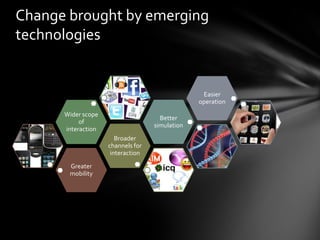
Change brought by emerging
technologies


                                                 Easier
                                                operation
      Wider scope
                                     Better
           of
                                   simulation
      interaction
                       Broader
                    channels for
                     interaction
       Greater
       mobility
A shifting Paradigm in educational
technology research
Problems                                                 New Trend
The proliferation of studies on cutting-edge             More and more studies were conducted to
technology applications often fails to be built upon     explore the relationship between ICT and
the existing theories and scholarship in the field of    learning theories, seeking to design learning
instructional design, ignoring both well-established     systems based on robust theoretical foundation
principles of learning and findings from basic           (Jonassen, Peck, & Wilson, 1999; Vrasidas, 2000;
educational psychology research. (Ross, Morrison &       Mandell, Sorge, & Russell, 2002; Kirschner et.
Lowther, 2010)                                           al, 2004; Wang, & Woo, 2007)

Technologies are often used infrequently and
inconsistently in educational settings and have little                              Media
conclusive effect (Christensen et al., 2008; Brown &                             comparison
                                                                                  and effect
Green, 2008; Selwyn, 2011). Teachers often use
                                                                                    study
computers as a minor supplement to enhance their
teaching (Aslan & Reigeluth, 2011), and the use of
emerging technologies is often limited to merely
supporting the traditional standardized and
                                                                    Design
centralized educational model (Cuban, 2001).                    research and
                                                                  formative
                                                                   research
A few good examples from research
Technology Tools used in ILS                   Instructional Theory used in ILS
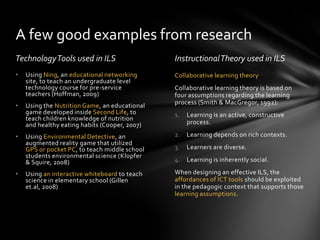
•   Using Ning, an educational networking      Collaborative learning theory
    site, to teach an undergraduate level
    technology course for pre-service          Collaborative learning theory is based on
    teachers (Hoffman, 2009)                   four assumptions regarding the learning
                                               process (Smith & MacGregor, 1992):
•   Using the Nutrition Game, an educational
    game developed inside Second Life, to      1.   Learning is an active, constructive
    teach children knowledge of nutrition
    and healthy eating habits (Cooper, 2007)        process.

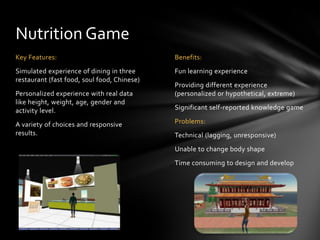
•   Using Environmental Detective, an          2.   Learning depends on rich contexts.
    augmented reality game that utilized
    GPS or pocket PC, to teach middle school   3.   Learners are diverse.
    students environmental science (Klopfer
    & Squire, 2008)                            4. Learning is inherently social.

•   Using an interactive whiteboard to teach   When designing an effective ILS, the
    science in elementary school (Gillen       affordances of ICT tools should be exploited
    et.al, 2008)                               in the pedagogic context that supports those
                                               learning assumptions.
Ning
Key Features                            Benefits:
Customizable design features            Positive learning experience
Widgets include blogs, discussion       A sense of community and personal
board, individualized profiles, file    connection
sharing, synchronous and asynchronous
messaging, and grouping and sub-        Higher motivation, engagement and
grouping of its members.                satisfaction.

Friends-making mechanism                Problems:
                                        Occasional dysfunction
                                        Entry level computer skill requirement
                                        Privacy concerns
Nutrition Game
Key Features:                                Benefits:
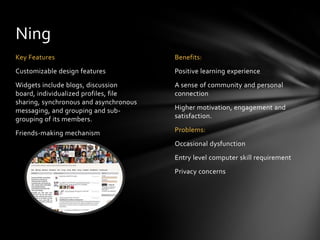
Simulated experience of dining in three      Fun learning experience
restaurant (fast food, soul food, Chinese)
                                             Providing different experience
Personalized experience with real data       (personalized or hypothetical, extreme)
like height, weight, age, gender and
activity level.                              Significant self-reported knowledge game

A variety of choices and responsive          Problems:
results.                                     Technical (lagging, unresponsive)
                                             Unable to change body shape
                                             Time consuming to design and develop
Environmental Detective
Key Features                              Benefits
Combination of fantasy and reality        Highly engaging and active learning
                                          experience
A problem-based learning experience
                                          Scientific inquiry skills
Supported by internal scaffolding and
online data base                          higher-order learning
open-ended, with multiple paths to task   Collaborative learning experience
completion
                                          Problems
                                          Not reported
Interactive Whiteboard
Key Features                              Benefits (additional)
All features of a touch-screen computer   Better learner-learner, learner-instructor
                                          interaction. (work on the same task
Multiple presentation                     simultaneously)
(video, audio, animation)
                                          Make the process visible (using cognitive
Integrated scaffolding tools like         tools)
annotations, visual clues…
                                          Easier to prepare a lesson with IWB
Shared work place (collaborative class
project)                                  Students are engaged and motivated
                                          Problems:
                                          High demand on hardware and software
                                          Teacher training needed
                                          Too much attention to the IWB instead of
                                          content.
Assumption No. 1: Learning is an
active, constructive process.
ICT tools should actively engage learners
in meaningful learning activities which
offer them an opportunity to apply newly
acquired information and ideas in their
constructive inquiries, such as theory
testing, model development, and problem
solving.
Example: The Nutrition Game.
The game did not provide direct lectures
about the healthy eating habit, but rather
offered learners a chance to explore
different food choices and learn their
impact on health.
Assumption No. 1: Learning is an
active, constructive process.
ICT should also provide various cognitive
tools to guide such constructive
processes, offering instructional scaffolds
along the way.
Example: Environmental Detective (ED).
Learners were required to solve a
simulated toxin spill problem by
themselves, they received guidance by
interacting with virtual avatars, searching
online, and accessing the resource
database.
Assumption No. 2: Learning depends
on rich contexts.
In contrast to most lecture-based
teaching, ICT tools should establish a
learning context that is learner-
centered, allowing for constant exchange of
ideas, frequent reflection, and multimodal
presentation.
Example: Interactive Whiteboard (IWB)
The IWB case describes a learning context
where teachers used the affordances of the
IWB to present the concept of evaporation in
different forms
(lecture, video, image, text, and diagrams)
and facilitate learners’ discussion and
reflection using highlights, annotation, and
prompts.
The other three cases also indicate that rich
contexts are not confined to the classroom
setting, and can also occur in virtual and
outdoor learning environments.
Assumption No. 3: Learners are diverse.
ICT tools should be used to accommodate
learner differences in background
knowledge and skills, learning styles, or
aspirations, by offering interactive
features that give learners’ control over
the learning process and allow them to
customize their own learning
pace, sequence, and preference.
Example: Ning and Environmental
Detective
The Ning’s asynchronous messaging
system and the open-ended game design
in ED are interactive features that support
such adaptations.
Assumption No. 4: Learning is
inherently social.
To enhance the social aspect of learning
requires a learning system that can
maximize the intellectual synergy through
simultaneous engagement of learners.
ICT tools can aid in this process by
facilitating interpersonal communications
with peers and instructors and by
supporting learners’ contribution to the
learning resources, strategies, and body
of knowledge.
Example: Ning
Social interactions between learners that
were enhanced through
personalization, such as adding profile
pictures or sharing personal information.
Learners are more likely to contribute
when they feel personally connected.
Guidelines for designing ILS based on
the collaborative learning theory
Through the lens of collaborative learning theory, this paper proposes that
the following features should be considered when designing effective
interactive learning systems:
•   Actively engage learners in meaningful learning activities
•   Allow learners to customize their own learning pace, sequence and preference
•   Provide prompt feedback and opportunities for reflection
•   Facilitate interpersonal communication with peers and instructors/experts
•   Encourage learners to contribute to the learning resources, strategies, and body of
    knowledge
•   Integrate various cognitive tools to support learning process
“Within a particular design, the medium
enables and constrains the method; the
method draws on and instantiates the
capabilities of the medium... a good design
will integrate them” ------ Kozma, 1991

Changing Paradigm in Interactive Learning System Design

  • 1.
    Integrating Emerging Technologies andLearning Theories Heng Luo, Jing Lei. IDD&E, Syracuse University
  • 2.
    What is interactivelearning system (ILS)? • A learning system in which different components act upon each other to facilitate learning. technologies, theories Process, format, outcome, attitude… • Different types of interaction • Learner-content • Learner-instructor Different components in the system Learning • Learner-learner • Learner-interface • Roots in three major learning theories • Behaviorist Interacting facilitating • Cognitive • Social-learning • Is there a learning system that is not interactive?
  • 3.
    The role oftechnologies “Interactivity is an intrinsic characteristic for most technologies…” (Greenfield & Cocking, 1996) user-created virtual environments • Longer information retention time (street & Goodman 1998), • Increased learning speed and “click to select” level (Horton, 2000), • Enhanced collaboration among peers (Brown et al., 2008; Delwiche, 2006), • Higher confidence and motivation from learners (Klassen, 2001).
  • 4.
    Four Types ofEmerging Technologies Type of ICT tools Definition Examples Educational Online learning platforms that connect learners using Ning, Classroom 2.0, Elgg Networking social networking technologies, exhibiting similar functions to sites like Facebook or MySpace. Web-Based A set of online applications or services that expand Wiki, blog, podcasting, Learning learners’ abilities to interact and collaborate with each social bookmarking, other in the process of searching, receiving, virtual worlds organizing, and generating educational content Mobile Learning Mobile devices or technologies used for educational Smartphone, PDA, GPS purposes that support different aspects of instruction (for augmented reality or make new educational activities available. games), interactive response pads Classroom Stand-alone devices that are used in traditional Interactive whiteboard, Equipment classrooms to facilitate the interaction between touch-screen computer, teachers and students in different class activities. Kiosk
  • 5.
    Change brought byemerging technologies Easier operation Wider scope Better of simulation interaction Broader channels for interaction Greater mobility
  • 6.
    A shifting Paradigmin educational technology research Problems New Trend The proliferation of studies on cutting-edge More and more studies were conducted to technology applications often fails to be built upon explore the relationship between ICT and the existing theories and scholarship in the field of learning theories, seeking to design learning instructional design, ignoring both well-established systems based on robust theoretical foundation principles of learning and findings from basic (Jonassen, Peck, & Wilson, 1999; Vrasidas, 2000; educational psychology research. (Ross, Morrison & Mandell, Sorge, & Russell, 2002; Kirschner et. Lowther, 2010) al, 2004; Wang, & Woo, 2007) Technologies are often used infrequently and inconsistently in educational settings and have little Media conclusive effect (Christensen et al., 2008; Brown & comparison and effect Green, 2008; Selwyn, 2011). Teachers often use study computers as a minor supplement to enhance their teaching (Aslan & Reigeluth, 2011), and the use of emerging technologies is often limited to merely supporting the traditional standardized and Design centralized educational model (Cuban, 2001). research and formative research
  • 7.
    A few goodexamples from research Technology Tools used in ILS Instructional Theory used in ILS • Using Ning, an educational networking Collaborative learning theory site, to teach an undergraduate level technology course for pre-service Collaborative learning theory is based on teachers (Hoffman, 2009) four assumptions regarding the learning process (Smith & MacGregor, 1992): • Using the Nutrition Game, an educational game developed inside Second Life, to 1. Learning is an active, constructive teach children knowledge of nutrition and healthy eating habits (Cooper, 2007) process. • Using Environmental Detective, an 2. Learning depends on rich contexts. augmented reality game that utilized GPS or pocket PC, to teach middle school 3. Learners are diverse. students environmental science (Klopfer & Squire, 2008) 4. Learning is inherently social. • Using an interactive whiteboard to teach When designing an effective ILS, the science in elementary school (Gillen affordances of ICT tools should be exploited et.al, 2008) in the pedagogic context that supports those learning assumptions.
  • 8.
    Ning Key Features Benefits: Customizable design features Positive learning experience Widgets include blogs, discussion A sense of community and personal board, individualized profiles, file connection sharing, synchronous and asynchronous messaging, and grouping and sub- Higher motivation, engagement and grouping of its members. satisfaction. Friends-making mechanism Problems: Occasional dysfunction Entry level computer skill requirement Privacy concerns
  • 9.
    Nutrition Game Key Features: Benefits: Simulated experience of dining in three Fun learning experience restaurant (fast food, soul food, Chinese) Providing different experience Personalized experience with real data (personalized or hypothetical, extreme) like height, weight, age, gender and activity level. Significant self-reported knowledge game A variety of choices and responsive Problems: results. Technical (lagging, unresponsive) Unable to change body shape Time consuming to design and develop
  • 10.
    Environmental Detective Key Features Benefits Combination of fantasy and reality Highly engaging and active learning experience A problem-based learning experience Scientific inquiry skills Supported by internal scaffolding and online data base higher-order learning open-ended, with multiple paths to task Collaborative learning experience completion Problems Not reported
  • 11.
    Interactive Whiteboard Key Features Benefits (additional) All features of a touch-screen computer Better learner-learner, learner-instructor interaction. (work on the same task Multiple presentation simultaneously) (video, audio, animation) Make the process visible (using cognitive Integrated scaffolding tools like tools) annotations, visual clues… Easier to prepare a lesson with IWB Shared work place (collaborative class project) Students are engaged and motivated Problems: High demand on hardware and software Teacher training needed Too much attention to the IWB instead of content.
  • 12.
    Assumption No. 1:Learning is an active, constructive process. ICT tools should actively engage learners in meaningful learning activities which offer them an opportunity to apply newly acquired information and ideas in their constructive inquiries, such as theory testing, model development, and problem solving. Example: The Nutrition Game. The game did not provide direct lectures about the healthy eating habit, but rather offered learners a chance to explore different food choices and learn their impact on health.
  • 13.
    Assumption No. 1:Learning is an active, constructive process. ICT should also provide various cognitive tools to guide such constructive processes, offering instructional scaffolds along the way. Example: Environmental Detective (ED). Learners were required to solve a simulated toxin spill problem by themselves, they received guidance by interacting with virtual avatars, searching online, and accessing the resource database.
  • 14.
    Assumption No. 2:Learning depends on rich contexts. In contrast to most lecture-based teaching, ICT tools should establish a learning context that is learner- centered, allowing for constant exchange of ideas, frequent reflection, and multimodal presentation. Example: Interactive Whiteboard (IWB) The IWB case describes a learning context where teachers used the affordances of the IWB to present the concept of evaporation in different forms (lecture, video, image, text, and diagrams) and facilitate learners’ discussion and reflection using highlights, annotation, and prompts. The other three cases also indicate that rich contexts are not confined to the classroom setting, and can also occur in virtual and outdoor learning environments.
  • 15.
    Assumption No. 3:Learners are diverse. ICT tools should be used to accommodate learner differences in background knowledge and skills, learning styles, or aspirations, by offering interactive features that give learners’ control over the learning process and allow them to customize their own learning pace, sequence, and preference. Example: Ning and Environmental Detective The Ning’s asynchronous messaging system and the open-ended game design in ED are interactive features that support such adaptations.
  • 16.
    Assumption No. 4:Learning is inherently social. To enhance the social aspect of learning requires a learning system that can maximize the intellectual synergy through simultaneous engagement of learners. ICT tools can aid in this process by facilitating interpersonal communications with peers and instructors and by supporting learners’ contribution to the learning resources, strategies, and body of knowledge. Example: Ning Social interactions between learners that were enhanced through personalization, such as adding profile pictures or sharing personal information. Learners are more likely to contribute when they feel personally connected.
  • 17.
    Guidelines for designingILS based on the collaborative learning theory Through the lens of collaborative learning theory, this paper proposes that the following features should be considered when designing effective interactive learning systems: • Actively engage learners in meaningful learning activities • Allow learners to customize their own learning pace, sequence and preference • Provide prompt feedback and opportunities for reflection • Facilitate interpersonal communication with peers and instructors/experts • Encourage learners to contribute to the learning resources, strategies, and body of knowledge • Integrate various cognitive tools to support learning process
  • 18.
    “Within a particulardesign, the medium enables and constrains the method; the method draws on and instantiates the capabilities of the medium... a good design will integrate them” ------ Kozma, 1991