avatars & the young how technology is  redefining creativity  in the modern classroom 
presentation  outline Digital revolution and the impact on education What has and has not changed Our education system’s response to the challenges posed by web 2.0 The gaps that need to be filled Some attempts at bridging the gaps
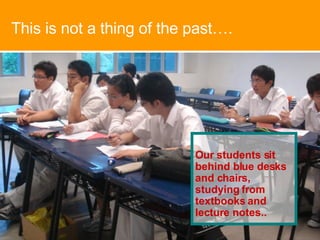
Our students sit behind blue desks and chairs, studying from textbooks and lecture notes.. This is not a thing of the past….
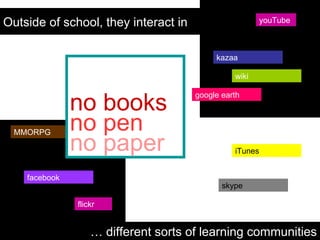
yahoo eBay  mySpace  Outside of school, they interact in  iTunes   skype wiki  google earth  kazaa MMORPG facebook flickr friendster youTube …  different sorts of learning communities no books   no pen   no paper
BUY PROPERTY, BUILD A HOUSE DESIGN OWN VEHICLE TRAVEL ANY WAY THEY WANT HANG OUT & CHAT …  they …  in  SECOND  LIFE
…  they …  in  SIM  CITY POOL TOGETHER RESOURCES AND STRATEGISE TO BUILD A SUCCESSFUL CITY…
…  they …  in  CITY OF HEROES TAKE ON ROLES OF SUPERHEROES TO FIGHT VILLAINS AND ENSURE GOOD TRIUMPHS OVER EVIL  IN MASSIVELY MULTIPLAYER ONLINE ROLE-PLAYING GAMES LIKE  …. OTJ training! no lectures no textbooks no instructors no age-groups no entry requirements
… in Sep 2008, they will go on to  construct civilisations
A Global Imperative: The Report of the 21st Century Literacy Summit, New Media Consortium Confronting the Challenges of Participatory Cutlure: Media Education for the 21st Century, Henry Jenkins Got Game: How the Gamer Generation is Changing Business Forever, Beck & Wade  “ Don’t Bother Me Mom – I’m Learning”, Marc Prensky …  ongoing work of MacArthur Foundation, John Seely Brown, James Paul Gee, Futurelab (UK), Learning Sciences Lab (Singapore) etc… no  experts…
  “ The strategic conversation has shifted:  from 21st Century literacy for students to 21st Century literacy for teachers….” -  21st Century Literacy Summit “A Global Imperative” The New Media Consortium San Jose, California 2005 There is a disjuncture between what  and how students are learning  outside of the classroom and how they are learning in the classroom
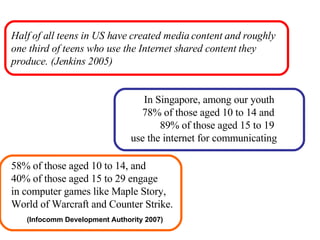
Half of all teens in US have created media content and roughly one third of teens who use the Internet shared content they produce. (Jenkins 2005) In Singapore, among our youth  78% of those aged 10 to 14 and  89% of those aged 15 to 19  use the internet for communicating 58% of those aged 10 to 14, and 40% of those aged 15 to 29 engage  in computer games like Maple Story,  World of Warcraft and Counter Strike. (Infocomm Development Authority 2007)
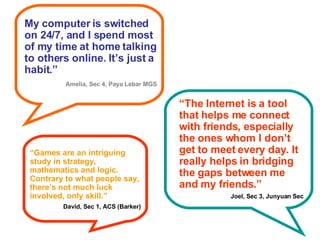
My computer is switched on 24/7, and I spend most of my time at home talking to others online. It’s just a habit.” Amelia, Sec 4, Paya Lebar MGS “ The Internet is a tool that helps me connect with friends, especially the ones whom I don’t get to meet every day. It really helps in bridging the gaps between me and my friends.” Joel, Sec 3, Junyuan Sec “ Games are an intriguing study in strategy, mathematics and logic. Contrary to what people say, there’s not much luck involved, only skill.” David, Sec 1, ACS (Barker)
our students  are… parallel processing connected active used to twitch speed attuned to random access  prefer graphics first like teaching themselves move easily between world of fantasy and the real accept multiple truths are comfortable with multiple identities used to cultural diversity used to networking know how to improvise and get round the rules
And it’s not all about technology…. ?
Minus the technology, what has changed for our students? They are communicating differently : interest-based, no social dividers, age-independent. They are sharing differently: they don’t keep their feelings locked up in a diary; they share all sorts of things, images, music, opinions with all sorts of people.
They buy and sell differently: have access to new wealth, niche markets, collectibles. They create differently: by teaching themselves, by combining media, and coming up with new products (“modding”) They learn differently: searching, evaluating, analyzing and reporting from multiple sources and from different sorts of people using different media. Minus the technology, what has changed for our students?
Their identities are constructed differently
Singapore, IT Masterplan (1996), mp2 (2003)   We still give students a standard body of knowledge, from authorised sources – textbooks We imagine we have a binary relationship with them. We still test them the same way – pen & paper. We expect them to hand in work in the same way. We expect one solution to every problem we give them. We focus on content instead of context. We don’t realise that what’s happening with web 2.0 goes beyond the hardware, and software. But something has not changed for many of our teachers…
Trends arising from web 2.0 that will have an impact on education
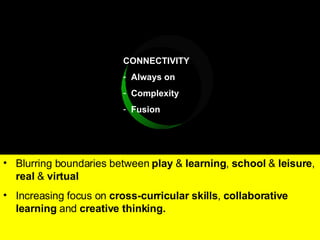
CONNECTIVITY Always on Complexity Fusion Blurring boundaries between  play  &  learning ,  school  &  leisure ,  real  &  virtual Increasing focus on  cross-curricular skills ,  collaborative learning  and  creative thinking.
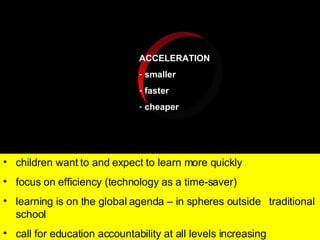
ACCELERATION smaller faster cheaper children want to and expect to learn more quickly focus on efficiency (technology as a time-saver) learning is on the global agenda – in spheres outside  traditional school call for education accountability at all levels increasing
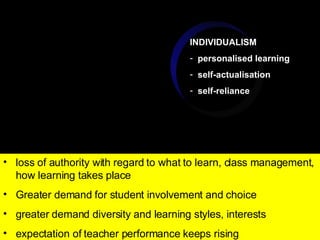
INDIVIDUALISM personalised learning self-actualisation self-reliance loss of authority with regard to what to learn, class management, how learning takes place Greater demand for student involvement and choice  greater demand diversity and learning styles, interests expectation of teacher performance keeps rising
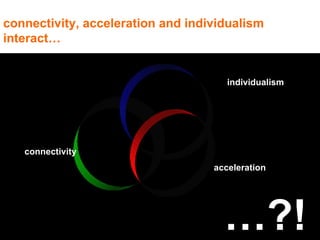
connectivity, acceleration and individualism interact… acceleration individualism connectivity … ?!
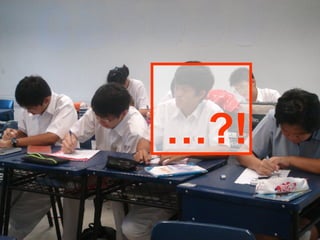
… ?!
Beyond gadgets & devices Learning 2.0 is about… Co-creation Participation Option Creation Pattern Recognition Sense Making Social Learning
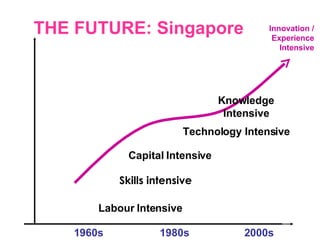
THE FUTURE: Singapore 1960s 2000s 1980s Labour Intensive Capital Intensive Technology Intensive Skills intensive Knowledge Intensive Innovation / Experience Intensive
The world is looking for people who are able to: find solutions to new/fuzzy problems fit into many (new) careers provide more than one answer to a problem work with a diverse range of people & cultures Be left and right-directed – “stories, play, androgyny” (Pink) … and we are not producing them in the numbers that Singapore/ the world needs. WHAT LINDEN LAB WANTED….
For Education 2.0 to happen, we need Generation 2.0 Teachers
From analog to digital – to engage learners in new and powerful ways
From knowing to creating context for learning – simulations, immersive environments, games-based learning
From what to learn, to how to learn
From moralising to ethical reasoning
Hougang Pri – mixed reality and RFID  technology to teach science (collaboration with IDM Lab at NUS) Innova JC – Second Life/GP project  (collaboration with NIE) Hwa Chong Institution & River Valley High – teaching science using IMAX and stereoscopic technology (collaboration with Advanced Design & Modelling Lab at NTU) Temasek JC - THINK Cycle to teach Science (Collaboration with Learning Sciences Lab at NIE) Tao Nan Sch – social science project at the zoo (collaboration with HP, IDA & CPDD) Nan Hua High – games-based learning for Humanities (collaboration with Futurelab and IDA) lead@ICT schools  & such
5 futureschools@sg Virtual classrooms Virtual worlds Classroom of the future
A  Curriculum  for the Future Hierarchy of subjects Time allocated Integration or compacting some subjects School-based curriculum and assessment More white space RETHINK
Curriculum Design To incorporate elements of co-design and collaboration (mosh pits and mash ups) example of   LEGO RETHINK 
Pedagogy  – how we teach…. RETHINK
A  STORY … when CPDD, Cedar Pri, LEGO (Denmark) and The Idea Factory got together….
How should we be teaching this generation of students differently to prepare them for the 21 st  century world? big  question
Trend scan: Research into 12 important aspects of a future society:  Citizenship, Inclusivity, Pop Culture, Virtual Worlds, Education, Social Trends, Identity, Bioethics, Literacy, Morality, Work Places and Economy Brainstorm skills that students will need to master in the future from the trends.
Alpha Thoughts Team was asked to identify aspects of teaching and learning that will provide a deeper experience for students. e.g. Improvisation Imagination Interaction Resilience Risk Seeking Navigation
Concept Trails Team went on to brainstorm pedagogical strategies that related to each of the alpha ideas: e.g. Focus-based, dream-driven pedagogy Immersive Defeat-driven Justice or ethics driven Critical Experimental …and how these would look like in the classroom
Insight Quest: Ethnography  –  3 teachers, 6 students  –  how they live and learn and what their aspirations are.
Beta Ideas 10 ideas were picked and in groups, team members brainstormed examples of lessons centred on the key idea behind the pedagogy. e.g.  Inspiration-driven pedagogy Moshing Defeat-driven etc…
Idea.Lab: What Cedar did….  Prototype pedagogical elements such as Emotional– engagement, human feelings Dialogical – learnable moments Praxis – theory to action Justice – purposefully inclusive Spontaneity – flexibility to capture teachable moment Real world – relevant (playing with Lego bricks)
Idea.Lab: What CPDD did…. Prototype the creation process in a school that was trying to find an answer to their BIG Question (How do we make Project Work as a subject relevant and engaging for our students?) … .we also some of the pedagogical strategies.
For each pedagogy, we discussed… Why the need? How it would be done? What would the result be? What qualities and/or resources would teachers need?
Futuring a pedagogy centred on contents of the future
Pattern-breaking A pedagogy centred on de-education Identity-searching A pedagogy centred on deep self-awareness
Chaos Navigation A pedagogy centred on sense-making Option Creation A pedagogy centred on choices Inspire to Aspire A pedagogy centred on dialogues for inspiration
Responsible Rebellion A pedagogy centred on championing a cause Circle of Life A pedagogy focused on the concept of ecological systems
Defeat-driven Pedagogy A pedagogy that exploits the merits of defeat or failure Moshing A pedagogy centred on collaboration and co-creation of knowledge
Spin-a-Tale A pedagogy centred on story-telling Soak-it-In A pedagogy centred on immersive environments
Idea.Lab:   What LEGO did…. Look into teacher development and assessment instrument for teacher competencies.
Teacher traits… Facilitation Questioning Navigation Connectivity (ability to synthesise) Communication Improvisation
What The Idea Factory did…. Facilitate the process.
A four-party, cross cultural collaboration … way to go?  Don’t know for sure….but it mirrors our students’ experience in web 2.0

Avatars & The Young Conference

  • 1.
    avatars & theyoung how technology is redefining creativity in the modern classroom 
  • 2.
    presentation outlineDigital revolution and the impact on education What has and has not changed Our education system’s response to the challenges posed by web 2.0 The gaps that need to be filled Some attempts at bridging the gaps
  • 3.
    Our students sitbehind blue desks and chairs, studying from textbooks and lecture notes.. This is not a thing of the past….
  • 4.
    yahoo eBay mySpace Outside of school, they interact in iTunes skype wiki google earth kazaa MMORPG facebook flickr friendster youTube … different sorts of learning communities no books no pen no paper
  • 5.
    BUY PROPERTY, BUILDA HOUSE DESIGN OWN VEHICLE TRAVEL ANY WAY THEY WANT HANG OUT & CHAT … they … in SECOND LIFE
  • 6.
    … they… in SIM CITY POOL TOGETHER RESOURCES AND STRATEGISE TO BUILD A SUCCESSFUL CITY…
  • 7.
    … they… in CITY OF HEROES TAKE ON ROLES OF SUPERHEROES TO FIGHT VILLAINS AND ENSURE GOOD TRIUMPHS OVER EVIL IN MASSIVELY MULTIPLAYER ONLINE ROLE-PLAYING GAMES LIKE …. OTJ training! no lectures no textbooks no instructors no age-groups no entry requirements
  • 8.
    … in Sep2008, they will go on to construct civilisations
  • 9.
    A Global Imperative:The Report of the 21st Century Literacy Summit, New Media Consortium Confronting the Challenges of Participatory Cutlure: Media Education for the 21st Century, Henry Jenkins Got Game: How the Gamer Generation is Changing Business Forever, Beck & Wade “ Don’t Bother Me Mom – I’m Learning”, Marc Prensky … ongoing work of MacArthur Foundation, John Seely Brown, James Paul Gee, Futurelab (UK), Learning Sciences Lab (Singapore) etc… no experts…
  • 10.
    The strategic conversation has shifted: from 21st Century literacy for students to 21st Century literacy for teachers….” - 21st Century Literacy Summit “A Global Imperative” The New Media Consortium San Jose, California 2005 There is a disjuncture between what and how students are learning outside of the classroom and how they are learning in the classroom
  • 11.
    Half of allteens in US have created media content and roughly one third of teens who use the Internet shared content they produce. (Jenkins 2005) In Singapore, among our youth 78% of those aged 10 to 14 and 89% of those aged 15 to 19 use the internet for communicating 58% of those aged 10 to 14, and 40% of those aged 15 to 29 engage in computer games like Maple Story, World of Warcraft and Counter Strike. (Infocomm Development Authority 2007)
  • 12.
    My computer isswitched on 24/7, and I spend most of my time at home talking to others online. It’s just a habit.” Amelia, Sec 4, Paya Lebar MGS “ The Internet is a tool that helps me connect with friends, especially the ones whom I don’t get to meet every day. It really helps in bridging the gaps between me and my friends.” Joel, Sec 3, Junyuan Sec “ Games are an intriguing study in strategy, mathematics and logic. Contrary to what people say, there’s not much luck involved, only skill.” David, Sec 1, ACS (Barker)
  • 13.
    our students are… parallel processing connected active used to twitch speed attuned to random access prefer graphics first like teaching themselves move easily between world of fantasy and the real accept multiple truths are comfortable with multiple identities used to cultural diversity used to networking know how to improvise and get round the rules
  • 14.
    And it’s notall about technology…. ?
  • 15.
    Minus the technology,what has changed for our students? They are communicating differently : interest-based, no social dividers, age-independent. They are sharing differently: they don’t keep their feelings locked up in a diary; they share all sorts of things, images, music, opinions with all sorts of people.
  • 16.
    They buy andsell differently: have access to new wealth, niche markets, collectibles. They create differently: by teaching themselves, by combining media, and coming up with new products (“modding”) They learn differently: searching, evaluating, analyzing and reporting from multiple sources and from different sorts of people using different media. Minus the technology, what has changed for our students?
  • 17.
    Their identities areconstructed differently
  • 18.
    Singapore, IT Masterplan(1996), mp2 (2003) We still give students a standard body of knowledge, from authorised sources – textbooks We imagine we have a binary relationship with them. We still test them the same way – pen & paper. We expect them to hand in work in the same way. We expect one solution to every problem we give them. We focus on content instead of context. We don’t realise that what’s happening with web 2.0 goes beyond the hardware, and software. But something has not changed for many of our teachers…
  • 19.
    Trends arising fromweb 2.0 that will have an impact on education
  • 20.
    CONNECTIVITY Always onComplexity Fusion Blurring boundaries between play & learning , school & leisure , real & virtual Increasing focus on cross-curricular skills , collaborative learning and creative thinking.
  • 21.
    ACCELERATION smaller fastercheaper children want to and expect to learn more quickly focus on efficiency (technology as a time-saver) learning is on the global agenda – in spheres outside traditional school call for education accountability at all levels increasing
  • 22.
    INDIVIDUALISM personalised learningself-actualisation self-reliance loss of authority with regard to what to learn, class management, how learning takes place Greater demand for student involvement and choice greater demand diversity and learning styles, interests expectation of teacher performance keeps rising
  • 23.
    connectivity, acceleration andindividualism interact… acceleration individualism connectivity … ?!
  • 24.
  • 25.
    Beyond gadgets &devices Learning 2.0 is about… Co-creation Participation Option Creation Pattern Recognition Sense Making Social Learning
  • 26.
    THE FUTURE: Singapore1960s 2000s 1980s Labour Intensive Capital Intensive Technology Intensive Skills intensive Knowledge Intensive Innovation / Experience Intensive
  • 27.
    The world islooking for people who are able to: find solutions to new/fuzzy problems fit into many (new) careers provide more than one answer to a problem work with a diverse range of people & cultures Be left and right-directed – “stories, play, androgyny” (Pink) … and we are not producing them in the numbers that Singapore/ the world needs. WHAT LINDEN LAB WANTED….
  • 28.
    For Education 2.0to happen, we need Generation 2.0 Teachers
  • 29.
    From analog todigital – to engage learners in new and powerful ways
  • 30.
    From knowing tocreating context for learning – simulations, immersive environments, games-based learning
  • 31.
    From what tolearn, to how to learn
  • 32.
    From moralising toethical reasoning
  • 33.
    Hougang Pri –mixed reality and RFID technology to teach science (collaboration with IDM Lab at NUS) Innova JC – Second Life/GP project (collaboration with NIE) Hwa Chong Institution & River Valley High – teaching science using IMAX and stereoscopic technology (collaboration with Advanced Design & Modelling Lab at NTU) Temasek JC - THINK Cycle to teach Science (Collaboration with Learning Sciences Lab at NIE) Tao Nan Sch – social science project at the zoo (collaboration with HP, IDA & CPDD) Nan Hua High – games-based learning for Humanities (collaboration with Futurelab and IDA) lead@ICT schools & such
  • 34.
    5 futureschools@sg Virtualclassrooms Virtual worlds Classroom of the future
  • 35.
    A Curriculum for the Future Hierarchy of subjects Time allocated Integration or compacting some subjects School-based curriculum and assessment More white space RETHINK
  • 36.
    Curriculum Design Toincorporate elements of co-design and collaboration (mosh pits and mash ups) example of LEGO RETHINK 
  • 37.
    Pedagogy –how we teach…. RETHINK
  • 38.
    A STORY… when CPDD, Cedar Pri, LEGO (Denmark) and The Idea Factory got together….
  • 39.
    How should webe teaching this generation of students differently to prepare them for the 21 st century world? big question
  • 40.
    Trend scan: Researchinto 12 important aspects of a future society: Citizenship, Inclusivity, Pop Culture, Virtual Worlds, Education, Social Trends, Identity, Bioethics, Literacy, Morality, Work Places and Economy Brainstorm skills that students will need to master in the future from the trends.
  • 41.
    Alpha Thoughts Teamwas asked to identify aspects of teaching and learning that will provide a deeper experience for students. e.g. Improvisation Imagination Interaction Resilience Risk Seeking Navigation
  • 42.
    Concept Trails Teamwent on to brainstorm pedagogical strategies that related to each of the alpha ideas: e.g. Focus-based, dream-driven pedagogy Immersive Defeat-driven Justice or ethics driven Critical Experimental …and how these would look like in the classroom
  • 43.
    Insight Quest: Ethnography – 3 teachers, 6 students – how they live and learn and what their aspirations are.
  • 44.
    Beta Ideas 10ideas were picked and in groups, team members brainstormed examples of lessons centred on the key idea behind the pedagogy. e.g. Inspiration-driven pedagogy Moshing Defeat-driven etc…
  • 45.
    Idea.Lab: What Cedardid…. Prototype pedagogical elements such as Emotional– engagement, human feelings Dialogical – learnable moments Praxis – theory to action Justice – purposefully inclusive Spontaneity – flexibility to capture teachable moment Real world – relevant (playing with Lego bricks)
  • 46.
    Idea.Lab: What CPDDdid…. Prototype the creation process in a school that was trying to find an answer to their BIG Question (How do we make Project Work as a subject relevant and engaging for our students?) … .we also some of the pedagogical strategies.
  • 47.
    For each pedagogy,we discussed… Why the need? How it would be done? What would the result be? What qualities and/or resources would teachers need?
  • 48.
    Futuring a pedagogycentred on contents of the future
  • 49.
    Pattern-breaking A pedagogycentred on de-education Identity-searching A pedagogy centred on deep self-awareness
  • 50.
    Chaos Navigation Apedagogy centred on sense-making Option Creation A pedagogy centred on choices Inspire to Aspire A pedagogy centred on dialogues for inspiration
  • 51.
    Responsible Rebellion Apedagogy centred on championing a cause Circle of Life A pedagogy focused on the concept of ecological systems
  • 52.
    Defeat-driven Pedagogy Apedagogy that exploits the merits of defeat or failure Moshing A pedagogy centred on collaboration and co-creation of knowledge
  • 53.
    Spin-a-Tale A pedagogycentred on story-telling Soak-it-In A pedagogy centred on immersive environments
  • 54.
    Idea.Lab: What LEGO did…. Look into teacher development and assessment instrument for teacher competencies.
  • 55.
    Teacher traits… FacilitationQuestioning Navigation Connectivity (ability to synthesise) Communication Improvisation
  • 56.
    What The IdeaFactory did…. Facilitate the process.
  • 57.
    A four-party, crosscultural collaboration … way to go? Don’t know for sure….but it mirrors our students’ experience in web 2.0