


Mobility Management
Approaches for Mobile IP Networks
PERFORMANCE COMPARISON AND USE RECOMMENDATIONS
RESEARCHED BY : NADJIA KARA | PRESENTED BY : ABIMARAN K
Agenda
 Terminologies
 Introduction to different MIPs
 Functionality Comparison
 Analytical Model
 Results of the Analysis
 Recommendation
2
Terminologies
 Home Address
 Care of Address (CoA)
 Home Agent (HA)
 Foreign Agent (FA)
 Gateway Foreign Agent (GFA)
 IETF
3
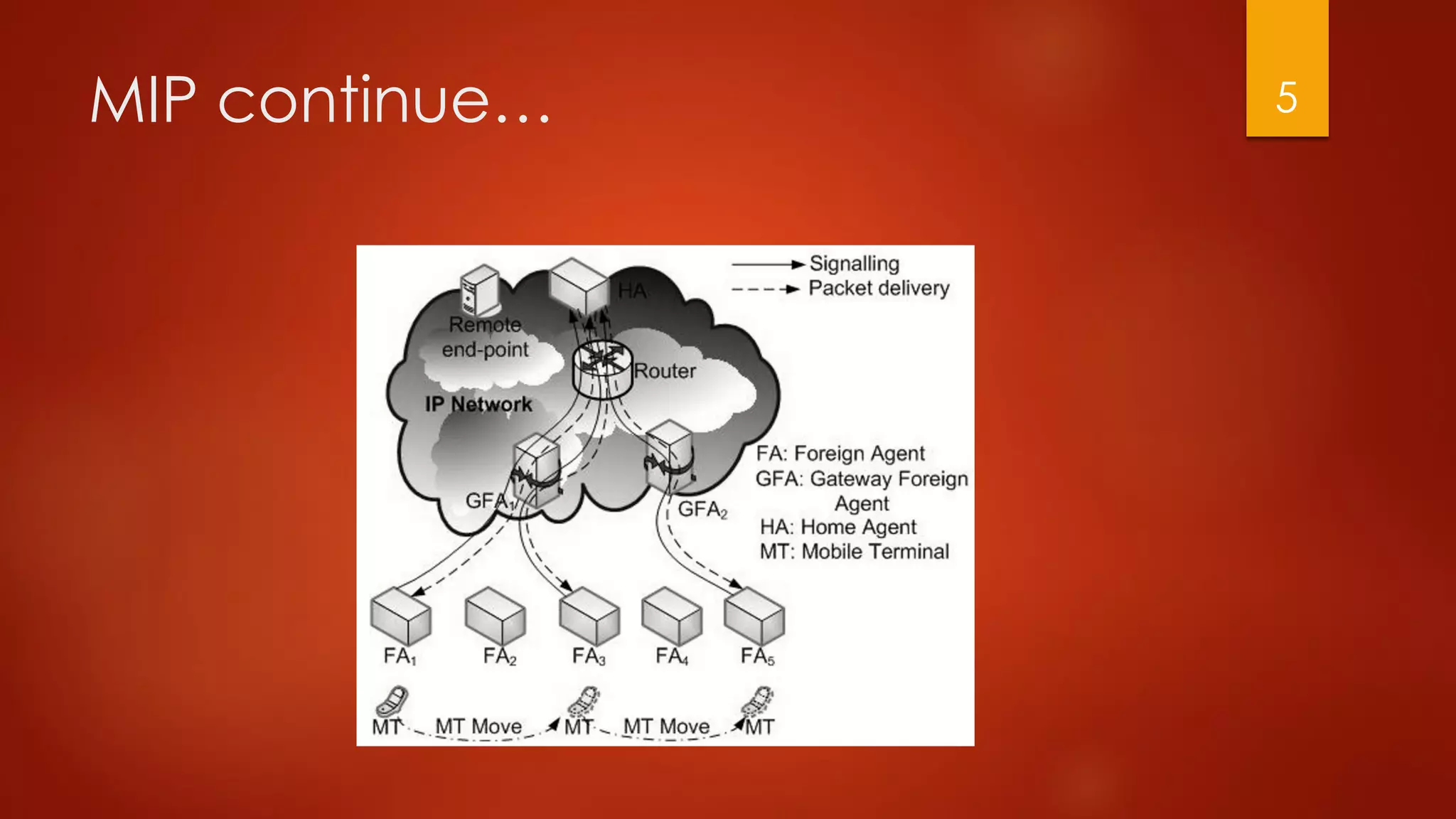
Introduction to MIP
 Proposed by IETF to provide global mobility in IP networks
 MT registers with its home network and gets a permanent address
 Stored in Home Agent (HA), used for identification and routing
 When MT moves outside of home n/w, it obtains a foreign address(CoA)
from Foreign Agent (FA)
 MT has to inform HA of its current location
 HA delivers data packets by tunneling them to MT’s current attachment
 Location update may be high, yields to signal delay
4
MIP continue… 5
Hierarchical Mobile IP (HMIP)
 Proposed to reduce the number of location update and signal
latency
 FAs and GFAs are organized on hierarchy
 If MT changes FA within same regional n/w, it updates its CoA to
regional GFA
 When MT moves to another n/w, it update HA using publicly
routable GFA
 High traffic load on GFA and frequent movement between regional
n/w degrades the performance
6
Hierarchical Distributed Dynamic Mobile IP
(HDDMIP)
 Each FA can act as either FA and GFA
 Number of FA attached to GFA adjusted for each MT
 Regional n/w boundary is adjusted for MT
 Calculated based mobility variation and packet arrival rate
 Add processing load to MT to estimate packet arrival rate and subnet resident
time
 GFA failure only affect the packet routing to MT belongs to this GFA
 System infrastructure and MTs cost could be high
7
Dynamic Hierarchical Mobile IP
(DHMIP)
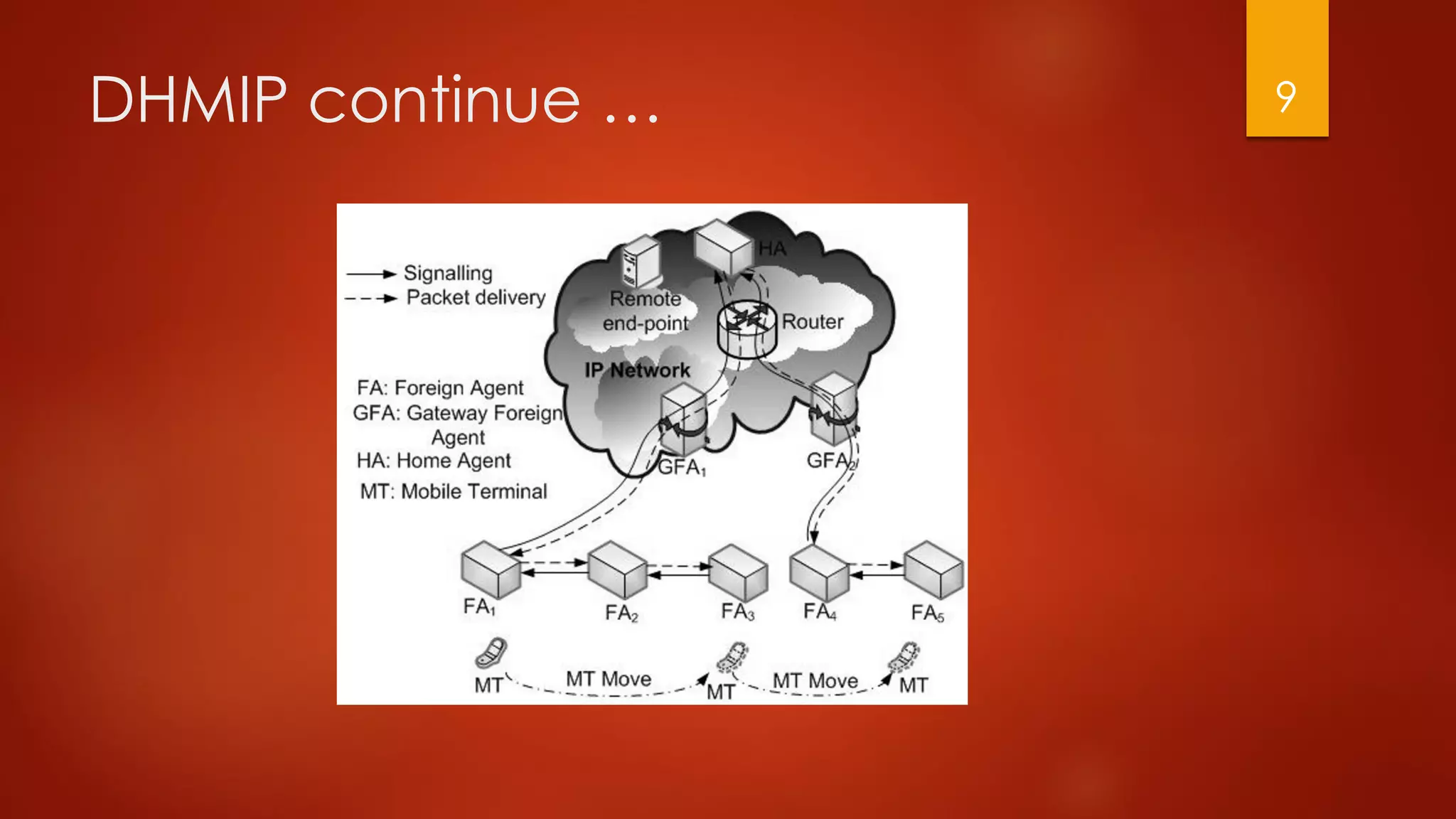
 Proposed to reduce location update to HA
 Registering the new CoA to previous FA and building FA hierarchy
 When hierarchy level no reached to threshold, MT set up new hierarchy
 Location update to previous FA is less costly compare to HA update
 DHMIP outperform compared to HMIP and HDDMIP
 Increases n/w resources used for packet delivery
8
DHMIP continue … 9
Multicast-Based Mobility Approaches
 Reduce signaling load and signaling delay
 Suitable for 3GPP, 3GPP2 and LTE networks where small radio cells and high
mobility of MTs
 Resource usage not greater than DHMIP
 Different Mobile IP multicast protocols are proposed
10
Multicast Hierarchical Mobile IP
(MHMIP)
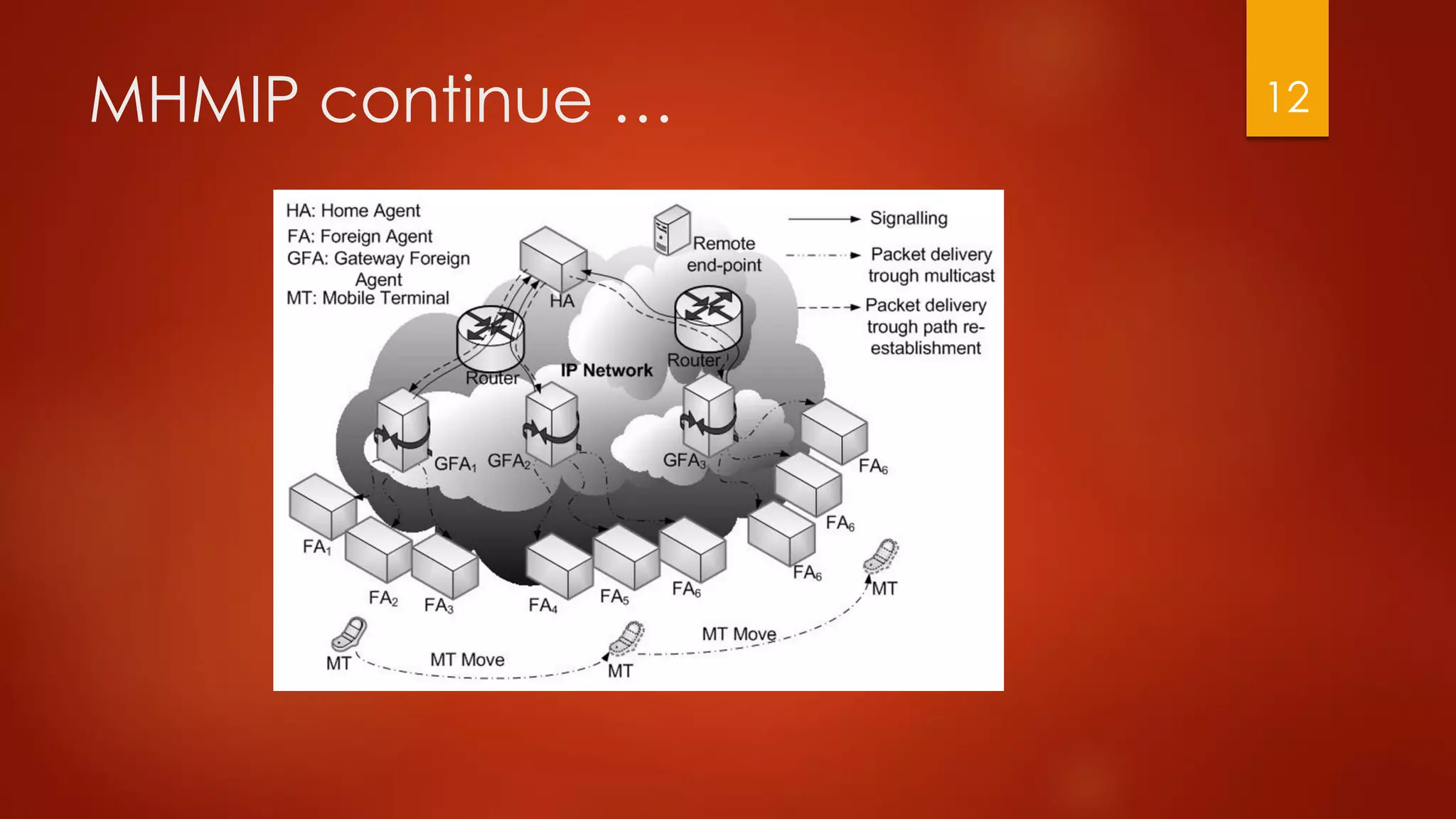
 Hierarchical multicast groups, FAs are connected to each other through a GFA
 Set of GFAs are connected to an HA
 When MT moves through FAs belongs to same group, GFA multicast packets
 When MT moves outside of the group, new CoA registered with GFA of new group
 GFA send CoA to HA
 Reduces frequency of the location update to HA
 Group is static
 Reduces mobility signaling delay compared to HMIP and DHMIP specially for high
mobility MTs
11
MHMIP continue … 12
Functionality Comparisons
 Bandwidth used by MHMIP signaling is smaller than MIP and DHMIP
 In MHMIP path reestablishment only between GFA and HA
 Bandwidth used for packet delivery is high, since several connection used
 Total bandwidth is higher
 For MT with high mobility, multicast resource are reused
 MHMIP mean bandwidth per call with high mobility is less than DHMIP and other
MIP approaches
13
Analytic Model
 Each handoff require path reestablishment
 CoA update with HA
 New path from HA to FA for DHMIP and MIP
 From HA to GFA for MHMIP
 User data traffic transfer from previous path to new path
 Previous path discard
14
Results Analysis
 MHMIP mean bandwidth per call is smaller than DHMIP
 MHMIP allows cost reduction in terms of resource usage
 DHMIP involves high mean bandwidth per call
 MHMIP mean delay is smaller than DHMIP and MIP
15
Recommendation
 If inter-GFAs handoffs aren’t frequent, use MHMIP which provides
best mean handoff delay and mean bandwidth per call for voice
and data
 If inter-GFA handoff frequent,
 If mean bandwidth per call is important and number of links involved in
MHMIP path reestablishment is high
 Use DHMIP
 Else use MHMIP
 In all most all cases, MHMIP gives lower mean handoff delay, and
mean bandwidth
16
Q/A
THANK YOU
17

Mobility Management Approaches for Mobile IP Networks

  • 1.
    Mobility Management Approaches forMobile IP Networks PERFORMANCE COMPARISON AND USE RECOMMENDATIONS RESEARCHED BY : NADJIA KARA | PRESENTED BY : ABIMARAN K
  • 2.
    Agenda  Terminologies  Introductionto different MIPs  Functionality Comparison  Analytical Model  Results of the Analysis  Recommendation 2
  • 3.
    Terminologies  Home Address Care of Address (CoA)  Home Agent (HA)  Foreign Agent (FA)  Gateway Foreign Agent (GFA)  IETF 3
  • 4.
    Introduction to MIP Proposed by IETF to provide global mobility in IP networks  MT registers with its home network and gets a permanent address  Stored in Home Agent (HA), used for identification and routing  When MT moves outside of home n/w, it obtains a foreign address(CoA) from Foreign Agent (FA)  MT has to inform HA of its current location  HA delivers data packets by tunneling them to MT’s current attachment  Location update may be high, yields to signal delay 4
  • 5.
  • 6.
    Hierarchical Mobile IP(HMIP)  Proposed to reduce the number of location update and signal latency  FAs and GFAs are organized on hierarchy  If MT changes FA within same regional n/w, it updates its CoA to regional GFA  When MT moves to another n/w, it update HA using publicly routable GFA  High traffic load on GFA and frequent movement between regional n/w degrades the performance 6
  • 7.
    Hierarchical Distributed DynamicMobile IP (HDDMIP)  Each FA can act as either FA and GFA  Number of FA attached to GFA adjusted for each MT  Regional n/w boundary is adjusted for MT  Calculated based mobility variation and packet arrival rate  Add processing load to MT to estimate packet arrival rate and subnet resident time  GFA failure only affect the packet routing to MT belongs to this GFA  System infrastructure and MTs cost could be high 7
  • 8.
    Dynamic Hierarchical MobileIP (DHMIP)  Proposed to reduce location update to HA  Registering the new CoA to previous FA and building FA hierarchy  When hierarchy level no reached to threshold, MT set up new hierarchy  Location update to previous FA is less costly compare to HA update  DHMIP outperform compared to HMIP and HDDMIP  Increases n/w resources used for packet delivery 8
  • 9.
  • 10.
    Multicast-Based Mobility Approaches Reduce signaling load and signaling delay  Suitable for 3GPP, 3GPP2 and LTE networks where small radio cells and high mobility of MTs  Resource usage not greater than DHMIP  Different Mobile IP multicast protocols are proposed 10
  • 11.
    Multicast Hierarchical MobileIP (MHMIP)  Hierarchical multicast groups, FAs are connected to each other through a GFA  Set of GFAs are connected to an HA  When MT moves through FAs belongs to same group, GFA multicast packets  When MT moves outside of the group, new CoA registered with GFA of new group  GFA send CoA to HA  Reduces frequency of the location update to HA  Group is static  Reduces mobility signaling delay compared to HMIP and DHMIP specially for high mobility MTs 11
  • 12.
  • 13.
    Functionality Comparisons  Bandwidthused by MHMIP signaling is smaller than MIP and DHMIP  In MHMIP path reestablishment only between GFA and HA  Bandwidth used for packet delivery is high, since several connection used  Total bandwidth is higher  For MT with high mobility, multicast resource are reused  MHMIP mean bandwidth per call with high mobility is less than DHMIP and other MIP approaches 13
  • 14.
    Analytic Model  Eachhandoff require path reestablishment  CoA update with HA  New path from HA to FA for DHMIP and MIP  From HA to GFA for MHMIP  User data traffic transfer from previous path to new path  Previous path discard 14
  • 15.
    Results Analysis  MHMIPmean bandwidth per call is smaller than DHMIP  MHMIP allows cost reduction in terms of resource usage  DHMIP involves high mean bandwidth per call  MHMIP mean delay is smaller than DHMIP and MIP 15
  • 16.
    Recommendation  If inter-GFAshandoffs aren’t frequent, use MHMIP which provides best mean handoff delay and mean bandwidth per call for voice and data  If inter-GFA handoff frequent,  If mean bandwidth per call is important and number of links involved in MHMIP path reestablishment is high  Use DHMIP  Else use MHMIP  In all most all cases, MHMIP gives lower mean handoff delay, and mean bandwidth 16
  • 17.