Mobility management in 
Adhoc Network 
Aman Saurabh
Introduction- Mobile Ad-hoc Networks (MANET) are multi-hop temporary 
communication network of mobile nodes that can communicate with one another without 
the requirement of any centralized point. MANET is particularly vulnerable due to its 
fundamental characteristics, such as open medium, dynamic topology, distributed 
cooperation, and constrained capability. Routing plays an important role in the security of 
the entire network. 
A mobile ad hoc network (MANET) is a self-configuring network that is formed 
spontaneously by a group of mobile devices via wireless communication channels. Nodes 
in such a network cooperate by forwarding packets for each other. MANETs do not have 
centralised administration or fixed network infrastructure. They are often deployed in 
situations where there is no fixed network infrastructure. Applications, such as military 
mobile networks, disaster relief and mine site operations, benefit from this type of 
networking. Owing to the characteristics of MANETs, such as lack of infrastructural 
support, dynamically changing network topologies, open and bandwidth constrained 
channels and heterogeneous devices.
MOBILITY 
MANAGEMENT 
Need of Mobility Management- The mobility management provides the delivery of the 
packet to the specified destination without any kind of delay. One of the basic requirements 
of the mobility management is the routing protocols. There are two types of scheme in 
mobility management which include location management and handoff management. 
Location management routing protocol use the location of nodes for enhancing the 
performance of routing protocols while Handoff management focuses on rerouting 
concept. Node mobility has impact on the position of nodes and on neighbourhood 
information which is necessary for communication. There are three types of mobile host 
node movements, they are movement by nodes in a route, movement by subnet bridging 
node and concurrent node movement. Also, it can be easily addressed through multi-hop 
routing discovery. 
Mobility models in ad-hoc networks exhibit the mobile user movement pattern as well as 
the change in their location, velocity, speed, direction and acceleration over time. There is 
direct communication between nodes in these kinds of network. In these networks, mobile 
nodes communicate directly with each other. Two nodes are required to be in same 
transmission for an effective communication. Intermediate nodes with routing are the 
solution of this problem. Mobility models must be evaluated with respect to end to end 
delay and efficient data transmission.
Mobility models are required to focus on individual movement patterns due to point to 
point communication in cellular networks whereas ad-hoc networks are designed for 
group communication. Such models are suggested to maintain movement, and efficient 
transmission among nodes in real life applications. Mobility models can be categorized 
based on the following criteria which is based on dimension, scale of mobility, 
randomness, geographical constraints, destination oriented and by changing 
parameters. There are two types of mobility models (i) Trace based mobility models 
and (ii) Synthetic mobility models. Trace models provide mobility patterns based on 
deterministic approach whereas synthetic models presents movements of mobile nodes 
in realistic manner.
TRACE BASED MODEL - For predicting stability of the nodes, movement patterns 
history and monitoring on periodic movements is required. Movement pattern of 
nodes provide path of mobile node which maintains degree of stability in the 
network. 
SYNTHETIC BASED MODEL- These models are very close to real life situations. 
There are two types of synthetic mobility models in ad-hoc networks. These models 
are categorized in two types (i) Entity based group mobility model and (ii) Group 
based mobility model. 
Entity and group mobility movements: These models maintain mobile’s 
traversing pattern from one place to another in a given interval of time. Each type 
of models can be constrained based or statistical based mobility model. Constrained 
topology based mobility models and Statistical based mobility model: In 
Constrained topology based mobility models, mobile nodes have only partial 
randomness where the movement of nodes is restricted by obstacles, pathways and 
speed etc. In statistical mobility model, mobile nodes have total randomness where 
nodes are allowed to move anywhere in the area and the speed and direction are 
allowed to choose.
Entity and group mobility movements: These models maintain mobile’s 
traversing pattern from one place to another in a given interval of time. Each type 
of models can be constrained based or statistical based mobility model. Constrained 
topology based mobility models and Statistical based mobility model: In 
Constrained topology based mobility models, mobile nodes have only partial 
randomness where the movement of nodes is restricted by obstacles, pathways and 
speed etc. In statistical mobility model, mobile nodes have total randomness where 
nodes are allowed to move anywhere in the area and the speed and direction are 
allowed to choose.
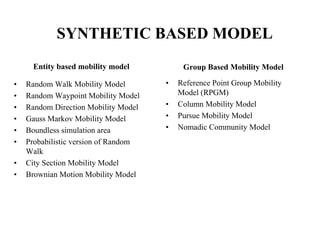
SYNTHETIC BASED MODEL 
Entity based mobility model 
• Random Walk Mobility Model 
• Random Waypoint Mobility Model 
• Random Direction Mobility Model 
• Gauss Markov Mobility Model 
• Boundless simulation area 
• Probabilistic version of Random 
Walk 
• City Section Mobility Model 
• Brownian Motion Mobility Model 
Group Based Mobility Model 
• Reference Point Group Mobility 
Model (RPGM) 
• Column Mobility Model 
• Pursue Mobility Model 
• Nomadic Community Model
Conclusion 
Mobility in ad-hoc networks is still a issue due to the dynamic 
movement of the mobile nodes. The mobile ad-hoc networks 
should deal with the mobility along with the power consumption.

Mobility management in adhoc network

  • 1.
    Mobility management in Adhoc Network Aman Saurabh
  • 2.
    Introduction- Mobile Ad-hocNetworks (MANET) are multi-hop temporary communication network of mobile nodes that can communicate with one another without the requirement of any centralized point. MANET is particularly vulnerable due to its fundamental characteristics, such as open medium, dynamic topology, distributed cooperation, and constrained capability. Routing plays an important role in the security of the entire network. A mobile ad hoc network (MANET) is a self-configuring network that is formed spontaneously by a group of mobile devices via wireless communication channels. Nodes in such a network cooperate by forwarding packets for each other. MANETs do not have centralised administration or fixed network infrastructure. They are often deployed in situations where there is no fixed network infrastructure. Applications, such as military mobile networks, disaster relief and mine site operations, benefit from this type of networking. Owing to the characteristics of MANETs, such as lack of infrastructural support, dynamically changing network topologies, open and bandwidth constrained channels and heterogeneous devices.
  • 3.
    MOBILITY MANAGEMENT Needof Mobility Management- The mobility management provides the delivery of the packet to the specified destination without any kind of delay. One of the basic requirements of the mobility management is the routing protocols. There are two types of scheme in mobility management which include location management and handoff management. Location management routing protocol use the location of nodes for enhancing the performance of routing protocols while Handoff management focuses on rerouting concept. Node mobility has impact on the position of nodes and on neighbourhood information which is necessary for communication. There are three types of mobile host node movements, they are movement by nodes in a route, movement by subnet bridging node and concurrent node movement. Also, it can be easily addressed through multi-hop routing discovery. Mobility models in ad-hoc networks exhibit the mobile user movement pattern as well as the change in their location, velocity, speed, direction and acceleration over time. There is direct communication between nodes in these kinds of network. In these networks, mobile nodes communicate directly with each other. Two nodes are required to be in same transmission for an effective communication. Intermediate nodes with routing are the solution of this problem. Mobility models must be evaluated with respect to end to end delay and efficient data transmission.
  • 4.
    Mobility models arerequired to focus on individual movement patterns due to point to point communication in cellular networks whereas ad-hoc networks are designed for group communication. Such models are suggested to maintain movement, and efficient transmission among nodes in real life applications. Mobility models can be categorized based on the following criteria which is based on dimension, scale of mobility, randomness, geographical constraints, destination oriented and by changing parameters. There are two types of mobility models (i) Trace based mobility models and (ii) Synthetic mobility models. Trace models provide mobility patterns based on deterministic approach whereas synthetic models presents movements of mobile nodes in realistic manner.
  • 5.
    TRACE BASED MODEL- For predicting stability of the nodes, movement patterns history and monitoring on periodic movements is required. Movement pattern of nodes provide path of mobile node which maintains degree of stability in the network. SYNTHETIC BASED MODEL- These models are very close to real life situations. There are two types of synthetic mobility models in ad-hoc networks. These models are categorized in two types (i) Entity based group mobility model and (ii) Group based mobility model. Entity and group mobility movements: These models maintain mobile’s traversing pattern from one place to another in a given interval of time. Each type of models can be constrained based or statistical based mobility model. Constrained topology based mobility models and Statistical based mobility model: In Constrained topology based mobility models, mobile nodes have only partial randomness where the movement of nodes is restricted by obstacles, pathways and speed etc. In statistical mobility model, mobile nodes have total randomness where nodes are allowed to move anywhere in the area and the speed and direction are allowed to choose.
  • 6.
    Entity and groupmobility movements: These models maintain mobile’s traversing pattern from one place to another in a given interval of time. Each type of models can be constrained based or statistical based mobility model. Constrained topology based mobility models and Statistical based mobility model: In Constrained topology based mobility models, mobile nodes have only partial randomness where the movement of nodes is restricted by obstacles, pathways and speed etc. In statistical mobility model, mobile nodes have total randomness where nodes are allowed to move anywhere in the area and the speed and direction are allowed to choose.
  • 7.
    SYNTHETIC BASED MODEL Entity based mobility model • Random Walk Mobility Model • Random Waypoint Mobility Model • Random Direction Mobility Model • Gauss Markov Mobility Model • Boundless simulation area • Probabilistic version of Random Walk • City Section Mobility Model • Brownian Motion Mobility Model Group Based Mobility Model • Reference Point Group Mobility Model (RPGM) • Column Mobility Model • Pursue Mobility Model • Nomadic Community Model
  • 8.
    Conclusion Mobility inad-hoc networks is still a issue due to the dynamic movement of the mobile nodes. The mobile ad-hoc networks should deal with the mobility along with the power consumption.