
synergies between IP, mobile
  and telephony networks
  evolution towards NGN

                          AJAL.A.J
             Assistant Professor –Dept of ECE,
 Federal Institute of Science And Technology (FISAT) TM
                MAIL: ec2reach@gmail.com
Target NGN
•   IP services and network current state,
•   control plane architecture,
•   VoIP,
•   Mobility and nomadism ,
•   QoS support,
•   IPv6 migration,
Network topography & terminology


       NA

    Concentrating    Local switching   Long haul switching
    Multiplexing     or forwarding     or forwarding

       Access           Edge               Core

                    Local
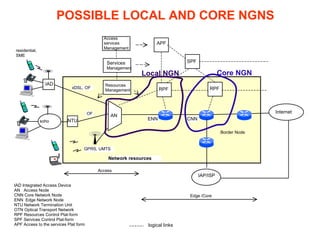
POSSIBLE LOCAL AND CORE NGNS
                                              Access
                                              services              APF
                                              Management
residential,
SME
                                               Services                        SPF
                                               Management
                                                             Local NGN                         Core NGN
                 IAD                           Resources
                             xDSL, OF                                RPF                 RPF
                                               Management


                                       OF                                                                    Internet
                                                 AN
               soho        NTU                                 ENN             CNN
                                                                               CNN
                                                                                               Border Node


                                   GPRS, UMTS

                                                Network resources

                                            Access
                                                                                     IAP/ISP

IAD Integrated Access Device
AN Access Node
CNN Core Network Node                                                          Edge /Core
ENN Edge Network Node
NTU Network Termination Unit
OTN Optical Transport Network
RPF Resources Control Plat-form
SPF Services Control Plat-form
APF Access to the services Plat form                           logical links
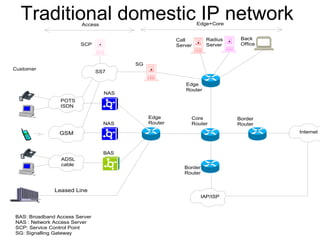
Traditional domestic IP network
                        Access                                Edge+Core


                                                     Call        Radius    Back
                        SCP                          Server      Server    Office


                                       SG
Customer
                               SS7

                                                        Edge
                                                        Router
                                 NAS
                POTS
                ISDN

                                            Edge          Core            Border
                                 NAS        Router        Router          Router
                GSM                                                                 Internet


                                 BAS
                ADSL
                cable
                                                        Border
                                                        Router


              Leased Line
                                                               IAP/ISP


BAS: Broadband Access Server
NAS : Network Access Server
SCP: Service Control Point
SG: Signalling Gateway
Services

•  Two main services are supported:
1. aggregation services that consist in collecting
   the traffic of not-always connected users
   through Access Servers such as NAS and BAS
   and delivering it to IAPs/ISPs,
2. transport services that convey the traffic of
   always connected users between sites directly
   attached to the IP network and towards
   Internet.
VoIP (H.323 and SIP) general architecture

                                                   Management

                                                            SCP/IP           Application
                        SCP
Service Plane                                                                  server

                                                 INAP/IP                   API

                                     Signaling
                                     gateway                               Gatekeepers
            CCF
                                                                           or Proxy SIP

                        SS7
                                       Sigtran


                                                                     H.323
                              PSTN
                                                           IP
                  CAA                 Media gateway                  SIP
Concerning service development,
 there are two major possibilities:
1. Using an INAP/IP interface, IN existing
   services could be used. It seems to be a
   good way in order to offer classical IN
   services,
2. Using an API or proprietary protocols,
   application server could be used in order
   to develop new multimedia services.
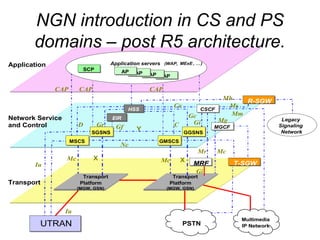
NGN introduction in CS and PS
       domains – post R5 architecture.
Application                          Application servers (WAP, MExE , … )
                         SCP
                         SCP             AP
                                         AP   AP
                                              AP    AP
                                                    AP   AP
                                                         AP

              CAP      CAP                          CAP
                                                                                 Mh
                                                                                      R-SGW
                                                                                      R-SGW
                                                              Cx                   Ms
                                            HSS
                                            HSS                          CSCF
                                                                         CSCF
                                                                      Gc           Mm
Network Service                      EIR
                                     EIR                                        Mg                  Legacy
and Control            D       Gr                             C        Gi                          Signaling
                                       Gf      Y                             MGCF
                                                                             MGCF
                            SGSNS
                            SGSNS                                  GGSNS
                                                                   GGSNS                            Network
                    MSCS
                    MSCS                                 GMSCS
                                                         GMSCS
                                        Nc
                                                                        Mr      Mc
                  Mc         X                           Mc       X
       Iu                                                              MRF
                                                                       MRF           T-SGW
                                                                                     T-SGW
                                                                       Gi
                         Transport                           Transport
Transport               Platform                            Platform
                       (MGW, GSN)                         (MGW, GSN)


                  Iu
                                                                                      Multimedia
         UTRAN
         UTRA                                                      PSTN               IP Network
Mobile IP architecture and
                       principles.
                                                                  HA
                                     IP Network
NC
                     DATA


 Sub Network                                                       Home Sub Network
                                  FA
                                                       Register


                   Visited Sub Network

                                                  NM
QoS support

• QoS-enabled applications,
• QoS policy management and enforcement,
• QoS control through static, dynamic or
  scheduled procedures,
• QoS monitoring at the network and customer
  levels,
• per-QoS class accounting and charging,
• inter-domain QoS support,
• QoS economic model between peers.
IPv6 migration
• IPv6 supports a number of enhanced features, such as:

1.  larger unicast and multicast address space,
2.  anycast address,
3.  aggregatable addressing for hierarchical routing,
4.  host address auto configuration,
5.  easy site renumbering,
6.  flow identification for QoS support,
7.  streamlined packet formats for improved forwarding
    performance,
8. multicast support (explicit scope),
9. extension headers used for supplementary capabilities,
10. security providing packet authentication and encryption,
11. mobility improvement through auto configuration, security,
    anycast address and destination options.
References
1.    "A Next generation architecture for the public network " ISS2000
2.    TINA-C Network Resource Architecture, version 3.0 – Feb. 1997
3.    TIPHON Network Architecture & reference configurations, DTS 02003 v0.0.1 – ETSI – March
      1999
4.    Multiservice Switching Forum Architecture, MSF99.074 – March 1999
5.    Megaco Protocol Proposal Working draft, draft-IETF- megaco-protocol-01.txt – April 1999
6.    Draft ITU-T Recommendation Q.BICC, Bearer Independent Call Control protocol definition
7.    RFC 2543 SIP : Session Initiation Protocol
8.    RFC 3015 Megaco Protocol v1.0
9.    RFC 2002 IP mobility Support (for Ipv4)
10.   Universal Mobile Telecommunications System (UMTS); Virtual Home Environment (VHE) in
      the Integrated Services Digital Network, Evolved UMTS core network, ETSI EG 201 717.
11.   Universal Mobile Telecommunications System (UMTS); Service aspects; Virtual Home
      Environment (VHE), ETSI TR122 970, 3G TR 22.970.
12.   Eurescom Project P920, UMTS Network Aspects (
      http://www.eurescom.de/public/projects/P900-series/p920/P920.htm
13.   RFC 1633 Integrated Services in the Internet Architecture: an Overview
14.   RFC 2475: An Architecture for Differentiated Services
15.   RFC 3031: Multiprotocol Label Switching Architecture
16.   draft-ietf-mpls-diff-te-reqts-00: Requirements for support of Diff-Serv-aware MPLS Traffic
      Engineering
17.   RFC 1883: Internet Protocol Version 6 (IPv6)
evolution towards NGN

evolution towards NGN

  • 1.
    synergies between IP,mobile and telephony networks evolution towards NGN AJAL.A.J Assistant Professor –Dept of ECE, Federal Institute of Science And Technology (FISAT) TM MAIL: ec2reach@gmail.com
  • 2.
    Target NGN • IP services and network current state, • control plane architecture, • VoIP, • Mobility and nomadism , • QoS support, • IPv6 migration,
  • 3.
    Network topography &terminology NA Concentrating Local switching Long haul switching Multiplexing or forwarding or forwarding Access Edge Core Local
  • 4.
    POSSIBLE LOCAL ANDCORE NGNS Access services APF Management residential, SME Services SPF Management Local NGN Core NGN IAD Resources xDSL, OF RPF RPF Management OF Internet AN soho NTU ENN CNN CNN Border Node GPRS, UMTS Network resources Access IAP/ISP IAD Integrated Access Device AN Access Node CNN Core Network Node Edge /Core ENN Edge Network Node NTU Network Termination Unit OTN Optical Transport Network RPF Resources Control Plat-form SPF Services Control Plat-form APF Access to the services Plat form logical links
  • 5.
    Traditional domestic IPnetwork Access Edge+Core Call Radius Back SCP Server Server Office SG Customer SS7 Edge Router NAS POTS ISDN Edge Core Border NAS Router Router Router GSM Internet BAS ADSL cable Border Router Leased Line IAP/ISP BAS: Broadband Access Server NAS : Network Access Server SCP: Service Control Point SG: Signalling Gateway
  • 6.
    Services • Twomain services are supported: 1. aggregation services that consist in collecting the traffic of not-always connected users through Access Servers such as NAS and BAS and delivering it to IAPs/ISPs, 2. transport services that convey the traffic of always connected users between sites directly attached to the IP network and towards Internet.
  • 7.
    VoIP (H.323 andSIP) general architecture Management SCP/IP Application SCP Service Plane server INAP/IP API Signaling gateway Gatekeepers CCF or Proxy SIP SS7 Sigtran H.323 PSTN IP CAA Media gateway SIP
  • 8.
    Concerning service development, there are two major possibilities: 1. Using an INAP/IP interface, IN existing services could be used. It seems to be a good way in order to offer classical IN services, 2. Using an API or proprietary protocols, application server could be used in order to develop new multimedia services.
  • 9.
    NGN introduction inCS and PS domains – post R5 architecture. Application Application servers (WAP, MExE , … ) SCP SCP AP AP AP AP AP AP AP AP CAP CAP CAP Mh R-SGW R-SGW Cx Ms HSS HSS CSCF CSCF Gc Mm Network Service EIR EIR Mg Legacy and Control D Gr C Gi Signaling Gf Y MGCF MGCF SGSNS SGSNS GGSNS GGSNS Network MSCS MSCS GMSCS GMSCS Nc Mr Mc Mc X Mc X Iu MRF MRF T-SGW T-SGW Gi Transport Transport Transport Platform Platform (MGW, GSN) (MGW, GSN) Iu Multimedia UTRAN UTRA PSTN IP Network
  • 10.
    Mobile IP architectureand principles. HA IP Network NC DATA Sub Network Home Sub Network FA Register Visited Sub Network NM
  • 11.
    QoS support • QoS-enabledapplications, • QoS policy management and enforcement, • QoS control through static, dynamic or scheduled procedures, • QoS monitoring at the network and customer levels, • per-QoS class accounting and charging, • inter-domain QoS support, • QoS economic model between peers.
  • 12.
    IPv6 migration • IPv6supports a number of enhanced features, such as: 1. larger unicast and multicast address space, 2. anycast address, 3. aggregatable addressing for hierarchical routing, 4. host address auto configuration, 5. easy site renumbering, 6. flow identification for QoS support, 7. streamlined packet formats for improved forwarding performance, 8. multicast support (explicit scope), 9. extension headers used for supplementary capabilities, 10. security providing packet authentication and encryption, 11. mobility improvement through auto configuration, security, anycast address and destination options.
  • 13.
    References 1. "A Next generation architecture for the public network " ISS2000 2. TINA-C Network Resource Architecture, version 3.0 – Feb. 1997 3. TIPHON Network Architecture & reference configurations, DTS 02003 v0.0.1 – ETSI – March 1999 4. Multiservice Switching Forum Architecture, MSF99.074 – March 1999 5. Megaco Protocol Proposal Working draft, draft-IETF- megaco-protocol-01.txt – April 1999 6. Draft ITU-T Recommendation Q.BICC, Bearer Independent Call Control protocol definition 7. RFC 2543 SIP : Session Initiation Protocol 8. RFC 3015 Megaco Protocol v1.0 9. RFC 2002 IP mobility Support (for Ipv4) 10. Universal Mobile Telecommunications System (UMTS); Virtual Home Environment (VHE) in the Integrated Services Digital Network, Evolved UMTS core network, ETSI EG 201 717. 11. Universal Mobile Telecommunications System (UMTS); Service aspects; Virtual Home Environment (VHE), ETSI TR122 970, 3G TR 22.970. 12. Eurescom Project P920, UMTS Network Aspects ( http://www.eurescom.de/public/projects/P900-series/p920/P920.htm 13. RFC 1633 Integrated Services in the Internet Architecture: an Overview 14. RFC 2475: An Architecture for Differentiated Services 15. RFC 3031: Multiprotocol Label Switching Architecture 16. draft-ietf-mpls-diff-te-reqts-00: Requirements for support of Diff-Serv-aware MPLS Traffic Engineering 17. RFC 1883: Internet Protocol Version 6 (IPv6)