25 th Faculty Development Programme


08 October 2012


Department of Computer Applications
Vidya Academy of Science & Technology
Thrissur – 680501, INDIA
Agenda


History of Mobile Communication
Fundamental Principles of Mobile Communication
Cellular Mobile Communication
GSM- Global System for Mobile Communication
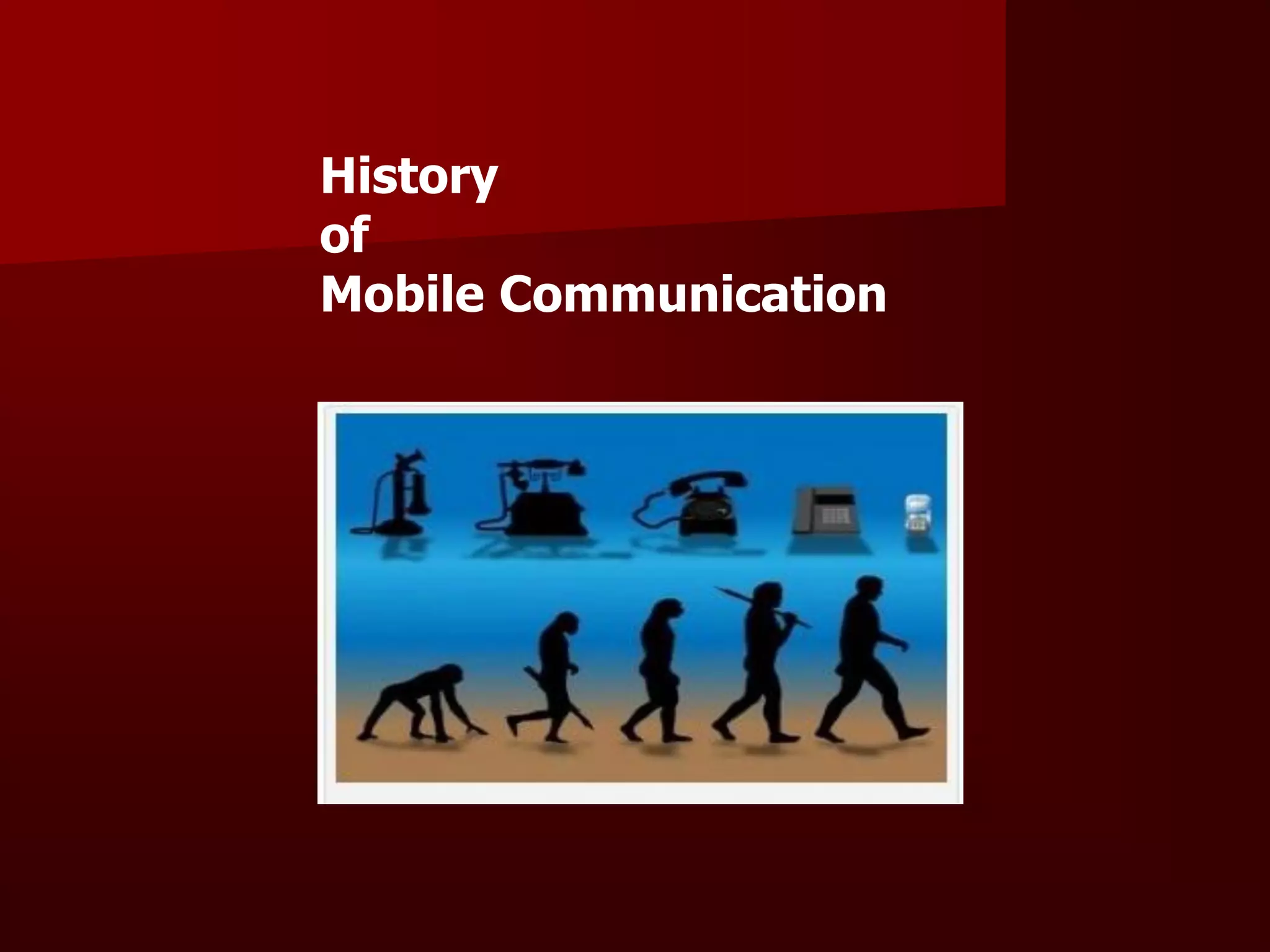
History
of
Mobile Communication
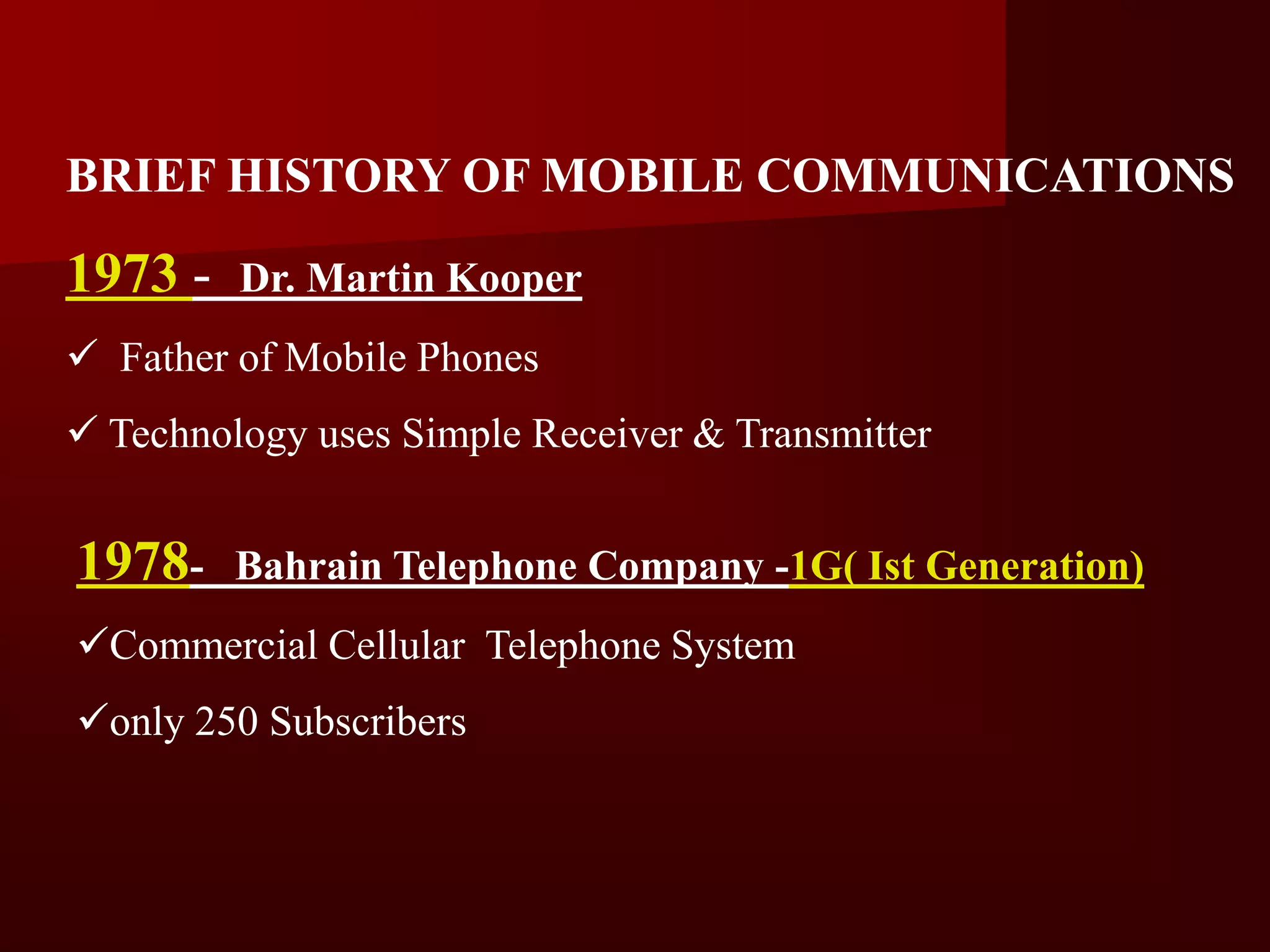
BRIEF HISTORY OF MOBILE COMMUNICATIONS

1973 -   Dr. Martin Kooper
 Father of Mobile Phones
 Technology uses Simple Receiver & Transmitter


1978-    Bahrain Telephone Company -1G( Ist Generation)
Commercial Cellular Telephone System
only 250 Subscribers
1980- NTT-Nippon Telegraph & Telephone
Company ( Ist Generation(1G))
      New Cellular Technology in Japan

1981-   Nordic Mobile Phone ( Ist Generation(1G))
      Used in Northern European Countries
      Offers Speech only


First Generation (1G) mobile systems were designed to
offer a single service, i.e., speech.
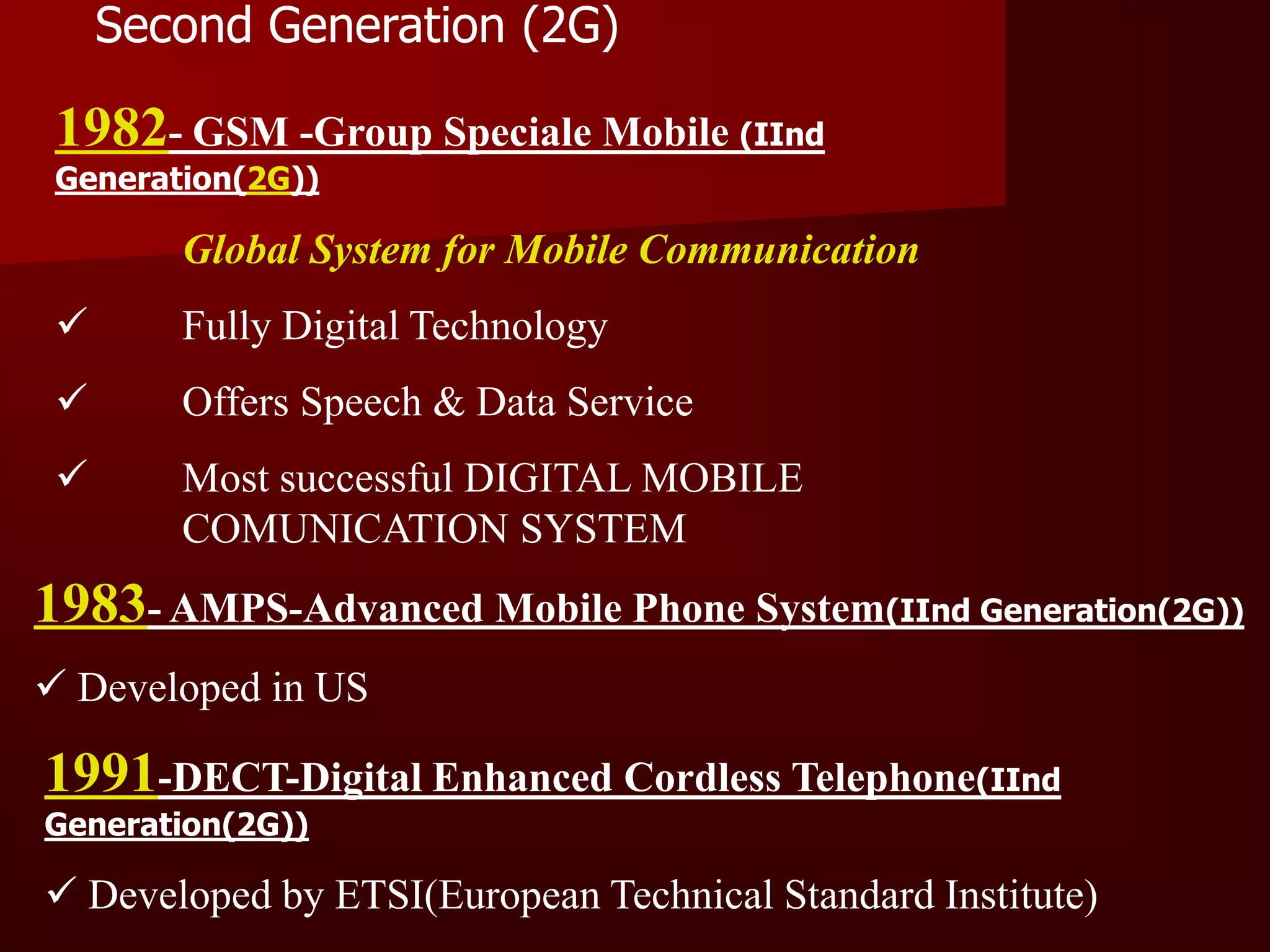
Second Generation (2G)

 1982- GSM -Group Speciale Mobile (IInd
 Generation(2G))

        Global System for Mobile Communication
       Fully Digital Technology
       Offers Speech & Data Service
       Most successful DIGITAL MOBILE
        COMUNICATION SYSTEM
1983- AMPS-Advanced Mobile Phone System(IInd Generation(2G))
 Developed in US

1991-DECT-Digital Enhanced Cordless Telephone(IInd
Generation(2G))

 Developed by ETSI(European Technical Standard Institute)
Second Generation (2G) mobile systems were also
designed primarily to offer speech with a limited capability to
offer data at low rates.(max 9.6kbits/s)
GSM (Global System for Mobile comm)can only offer a data
rate of 9.6 kbps

2.5G-GPRS General packet Radio Service
 GPRS allows simultaneous voice and data communication
Increase data transmission speeds from the current 9.6 Kbps to over 100
Kbps
2.75G- EDGE -Enhanced Data rates for GSM Evolution
     Supports High-speed data applications such as video services

     384 kbps data transfer rate
THIRD GENERATION(3G)
 1998-Satellite Mobile Communication System
       Using in Europe
   2 Satellite systems are used
       1. Iridium-66 satellites
       2.Globalstar-less than 35

 System is now called UMTS
       Universal Mobile Telephone System

2001-3G Mobile Systems
      IMTS -International Mobile Telecomm. System
Third Generation (3G) mobile systems are expected to
offer high-quality multi-media services and operate in different
environments

3G systems are referred to as Universal Mobile
Telecommunications System (UMTS) in Europe and
International Mobile Telecommunications 2000
(IMT2000) worldwide.
Frequency   band 1.8 -2.5 GHz
2Mbps   data transfer rate.
                  4G SYSTEMS
         Frequency band (2 – 8 GHz)
         Expecting- 20 Mbps-100Mbps Data
         Transfer Rate
11
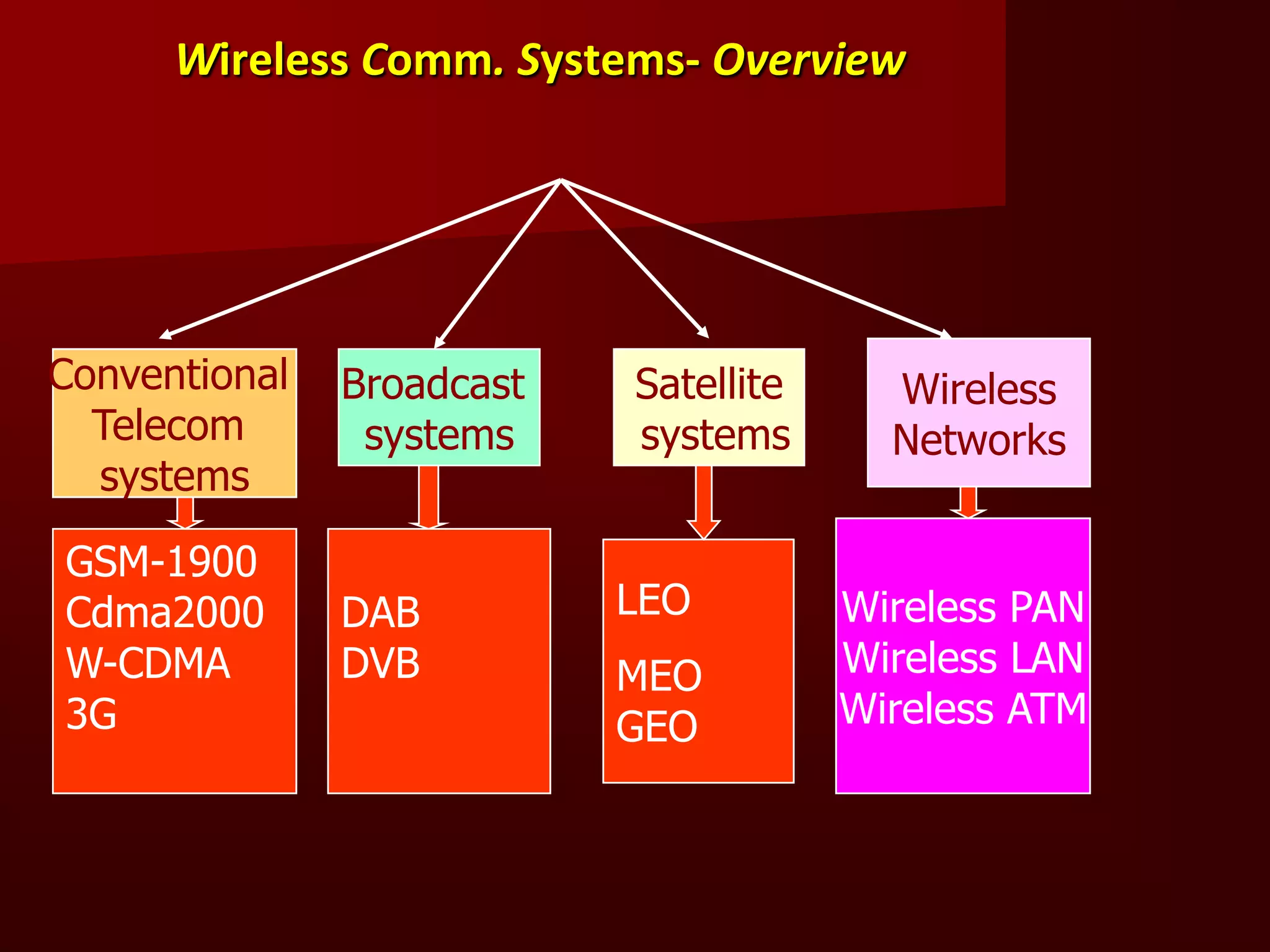
Wireless Comm. Systems- Overview


Conventional   Broadcast   Satellite     Wireless
  Telecom       systems    systems       Networks
  systems

GSM-1900
Cdma2000       DAB         LEO         Wireless PAN
W-CDMA         DVB         MEO         Wireless LAN
3G                         GEO         Wireless ATM
Fundamental Principles
         of
Mobile Communication
Defining Mobility ..

        From the Latin word “Mobilis” = “to
        move” able to move freely or easily


 Properties
      Reachability (anywhere)


      Accessibility (any device)


      Service portability
2 Different Kinds of Mobility

User Mobility
User accessing the telecomm. services at different
  places.
ie the User can be mobile and services will follow
   him…..
Device Portability
      Communication Device Moves(with or without a
  user)
eg. Mobile phone system
2 types of Voice & Data Communication

1. Wired Communication


2. Wireless Communication
Wired Communication
                                R4
   R1


                 Base Station


    R2                          R3
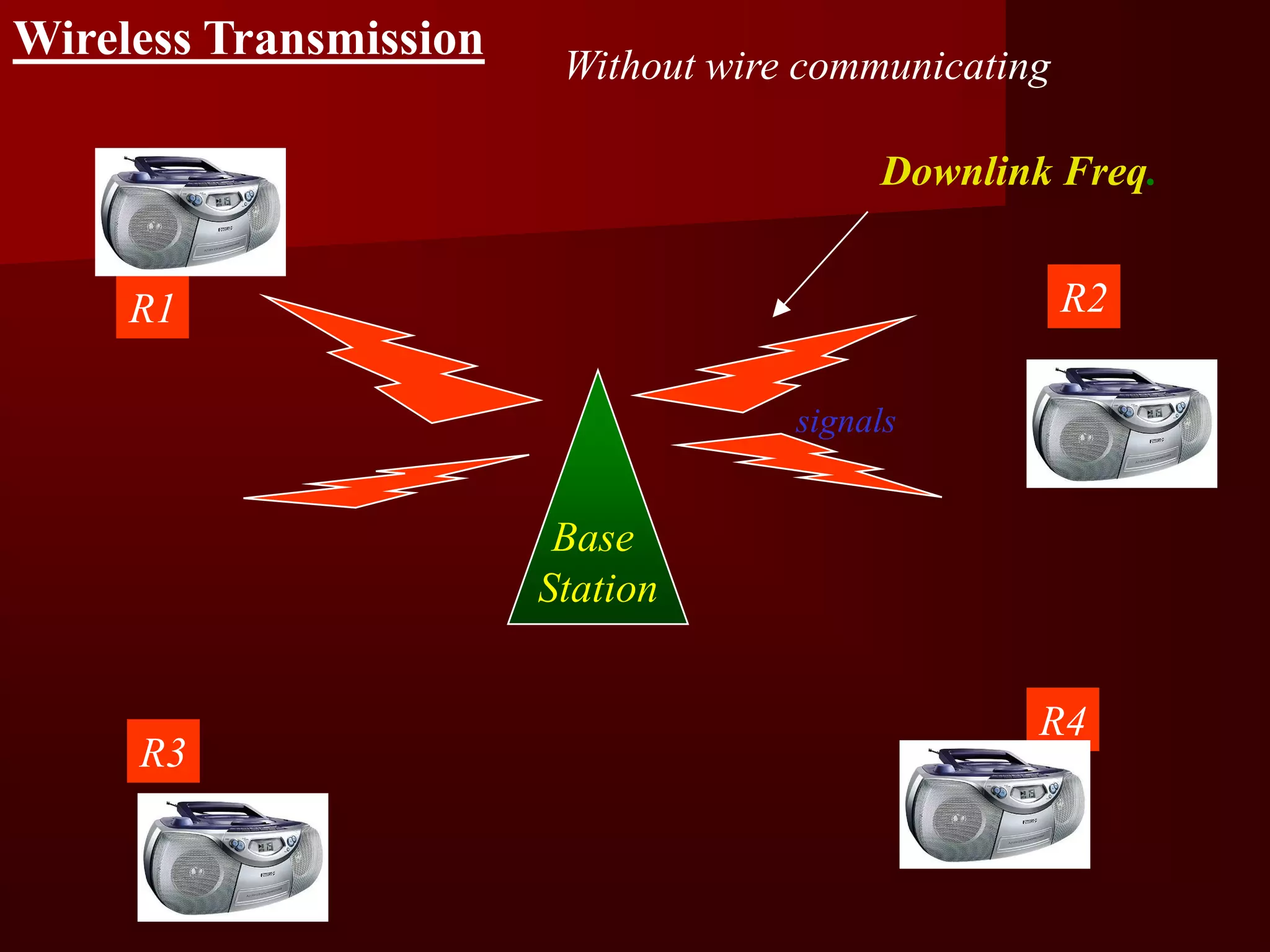
Wireless Transmission
                         Without wire communicating

                                          Downlink Freq.


     R1                                               R2

                                     signals


                         Base
                        Station


                                                  R4
     R3
In Mobile communication
                                        Downlink Freq.


   R1                                            R2

                                   signals


                                                R4
    R3
                    Uplink Freq.
Uplink Freq - From Receiver to Base station


Downlink Freq- From Base station To Receiver


GSM Mobile Communication Frequency range in
India
      890-915 MHz- Uplink Freq
      935-960 MHz - Downlink Freq.
Signal propagation ranges

 Transmission range
   – communication possible
   – low error rate
 Detection range
   – detection of the signal        sender
      possible
   – no communication             transmission
      possible                                   distance
 Interference range               detection

   – signal may not be            interference
      detected
   – signal adds to the
      background noise
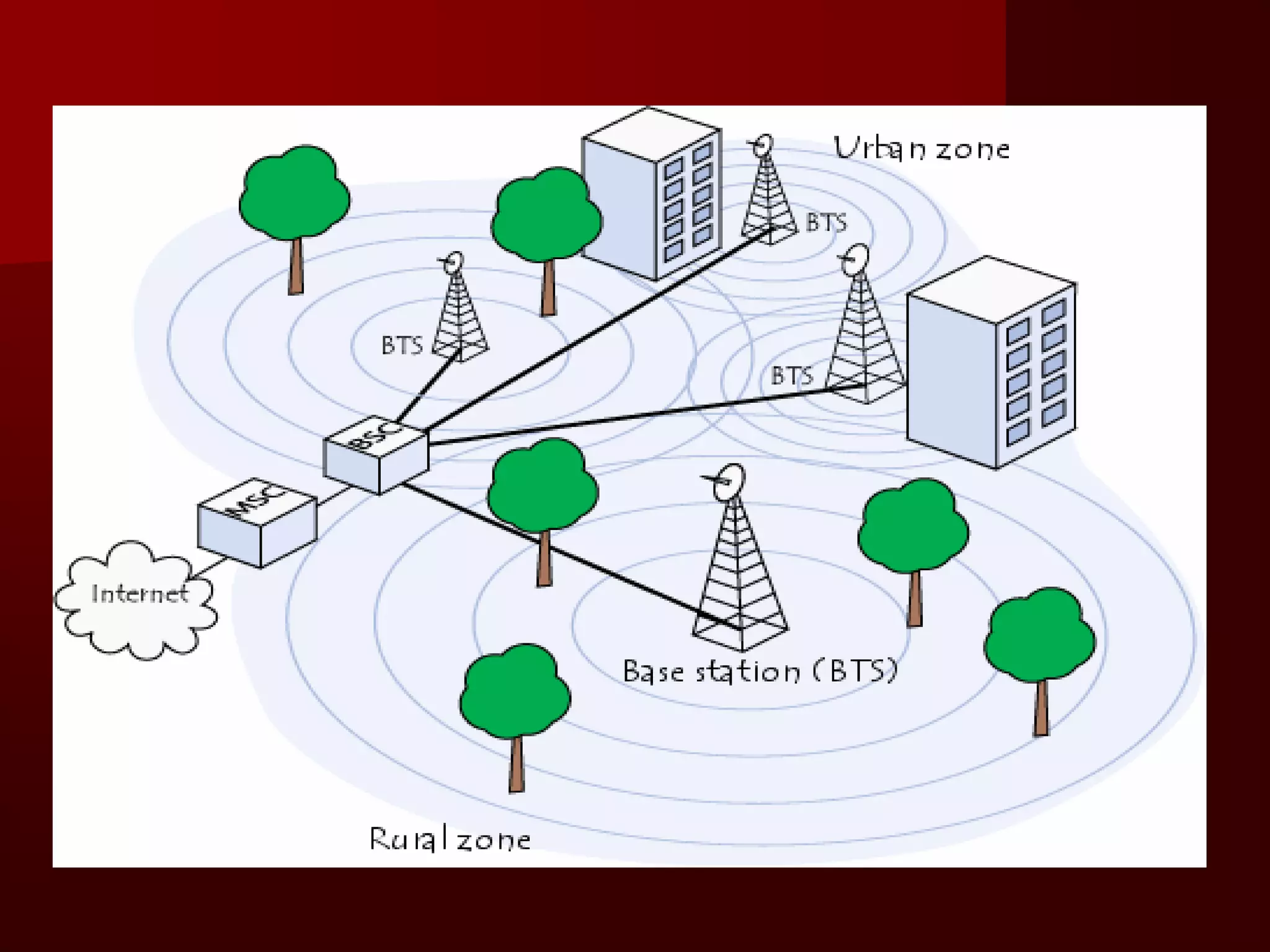
BTS -Base Transceiver Station


These transmitting stations or Base stations are called Antennas

In Mobile comm. They are called BTS -Base Transceiver Station
CELLULAR
MOBILE COMMUNICATION
Each Base Station covers a certain area called a CELL


               For Each BTS only one cell


   Cell-A basic geographic unit of a cellular system
Maximum Cell Radii is
               100 of metres in cities
               35 kms in Open space


 Radio stations use powerful transmitters with huge cells
Mobile Base stations generate very small cells why?
890-915 MHz- Uplink Freq
935-960 MHz - Downlink Freq.
                                                   f3
                                              f5        f2
          1. Frequency Reuse
                                         f4        f6        f5
                                              f1        f4
                                         f3        f7        f1
                                              f2
           2. Less Transmission power


            3. Local Interference only
Components in Cellular System Architecture
    1. Cell-A basic geographic unit of a cellular system


     2. Cluster(Cell Site) -Group of Cells


                     f5
               f4           f6
                     f1
               f3           f7
                     f2
Cells with the same no. have the same set of
                     frequencies
          f3
                             7 cells in one cluster
     f5        f2
f4        f6        f5
     f1        f4            Coverage area of Cells are called
f3        f7        f1       FOOTPRINT
     f2
               No Channels are reused within a cluster
3. Cell Splitting
       Cities contain large number of low power BTS


         Produce large no. of cells


         Handle heavy traffic & Less Interference
3. Cell Splitting
       Rural areas contain only one high power BTS


         Produce only one cell


         Covers more area,
         Interference will be very high
Some Figures


No. of Cells in one cluster or cellsite = 3


Subscribers supported per cell = 596


Total No. of Subscribers /Cluster or cellsite =1788
POPULAR TECHNOLOGY
      USED IN
     MOBILE
  COMMUNICATION
GSM
  Global system for
Mobile communication
GSM - Group speciale Mobile
    Global system for Mobile Communication
    2nd Generation system
    Formed in 1982
    Initially Implemented in Europe
    Using 10 billion People in 212 countries
    Technology that widely used in India-700
     million customers
    9.6 Kbits/sec DTR(Data Transf. Rate)
Major Companies dealing GSM Technology in
India
Primary Objective of GSM


 GSM phone is compatible with
    Fixed Landline Networks
GSM Mile Stones

 Year       Mile Stone
 1982     GSM Formed
  1986    Field Test
 1987     Access Methods Chosen
 1988     MOU Signed
 1989     Validation of GSM System
 1990     Preoperation System

 1989     Validation of GSM System

 1991     Commercial System Startup
  1993    Coverage of Main Roads/Cities
 1995    Coverage of Rural areas
GSM in 3 Frequencies
 GSM -900 MHz
                                     Used In
      890-915 MHz- Uplink Freq       India
      935-960 MHz - Downlink Freq.


GSM 1800 MHz
     1710-1785 MHz -Uplink Freq.     DCS-1800
     1930-1990 MHz- Downlink Freq    Digital
                                     Comm.
                                     Service
GSM 1900 MHz
     1850-1910MHz- Uplink Freq       PCS-1900

     1930-1990MHz- Downlink Freq     Personal Comm.
                                     Service
Cellular growth in India(2009-2014)
GSM
 NETWORK
ARCHITECTURE
Major Ingredients in a
      GSM network
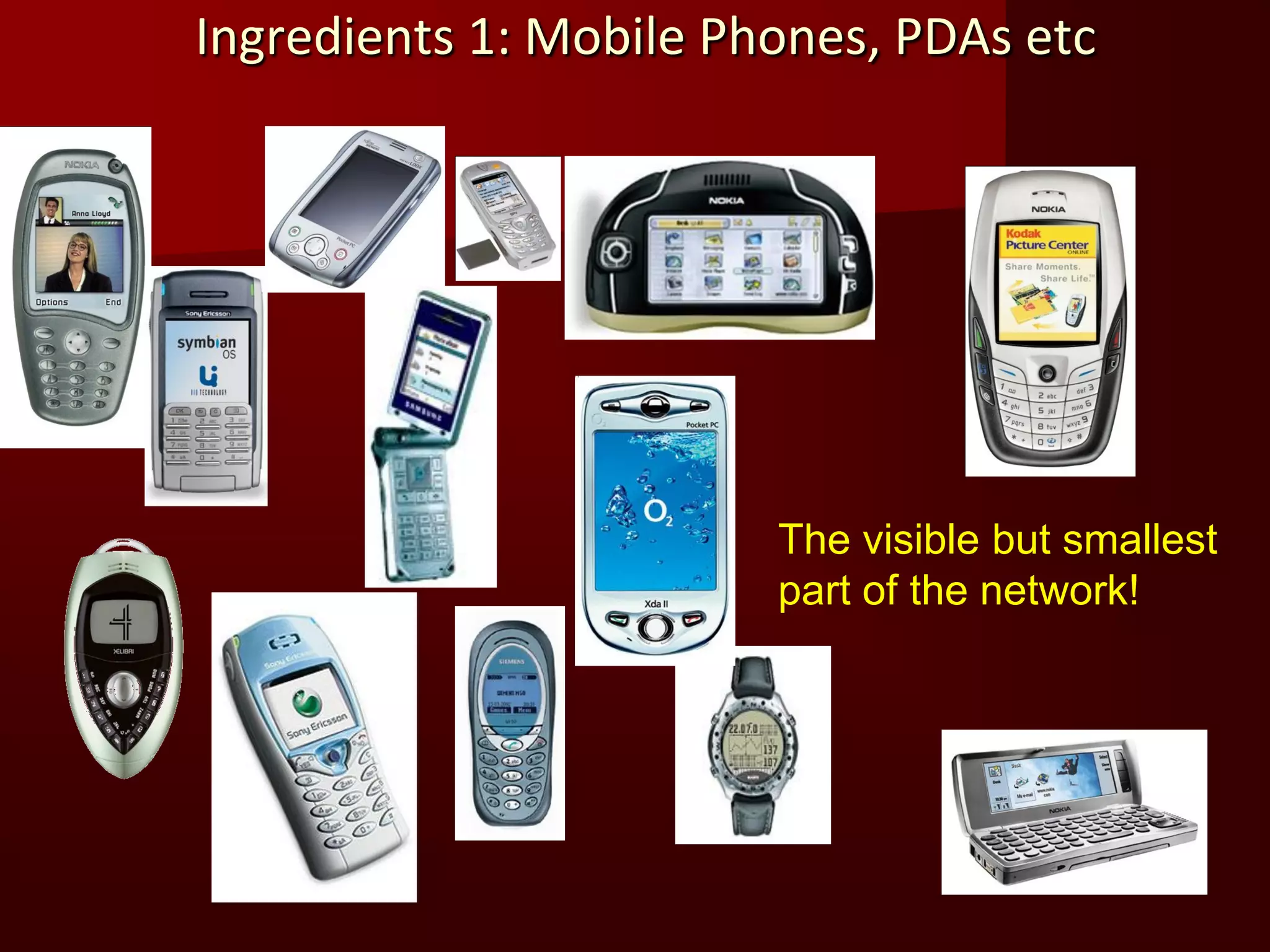
Ingredients 1: Mobile Phones, PDAs etc


                        The visible but smallest
                        part of the network!
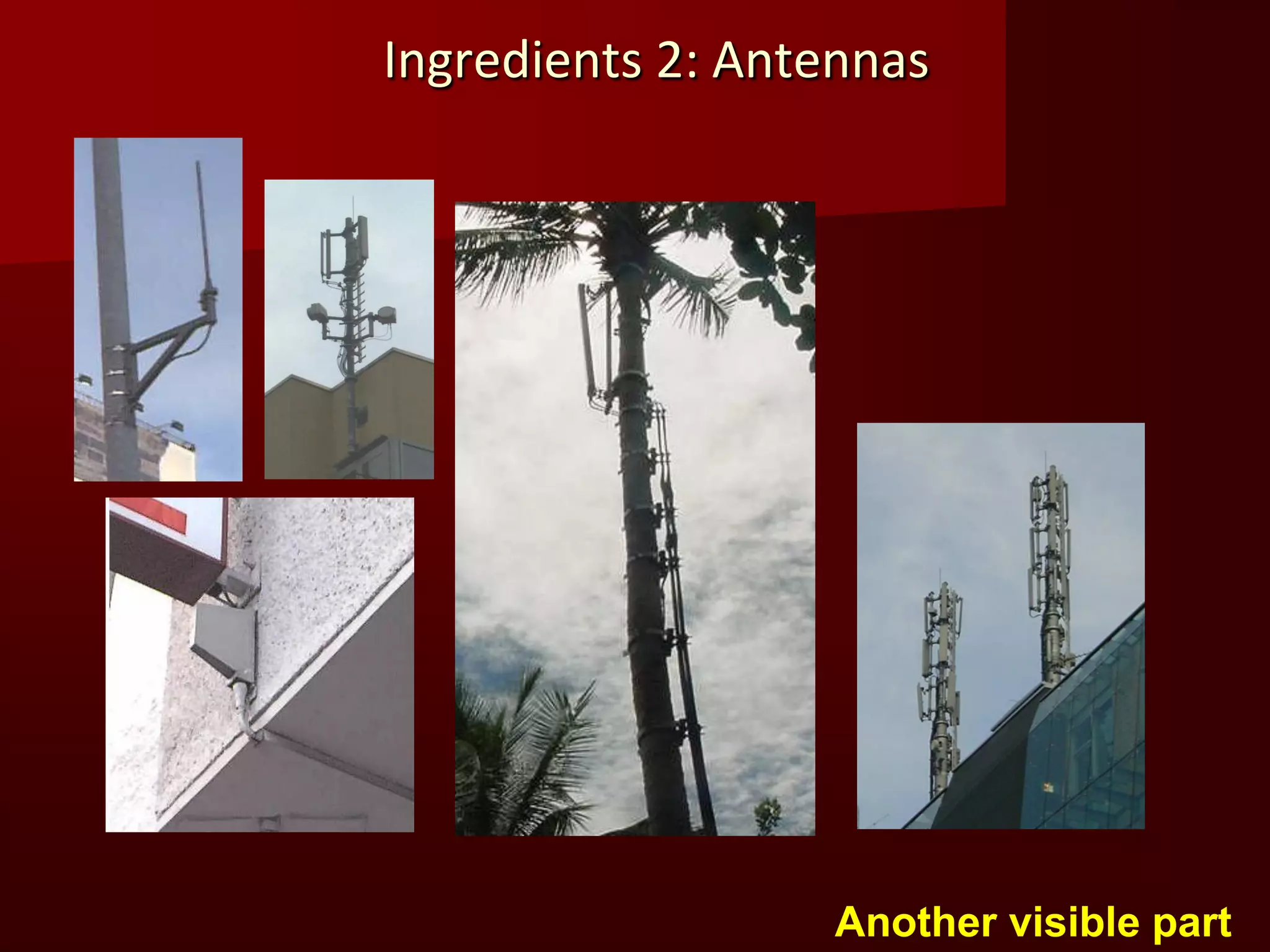
Ingredients 2: Antennas


                   Another visible part
Ingredients 3: Infrastructure 1


                     Cabling


   Microwave links
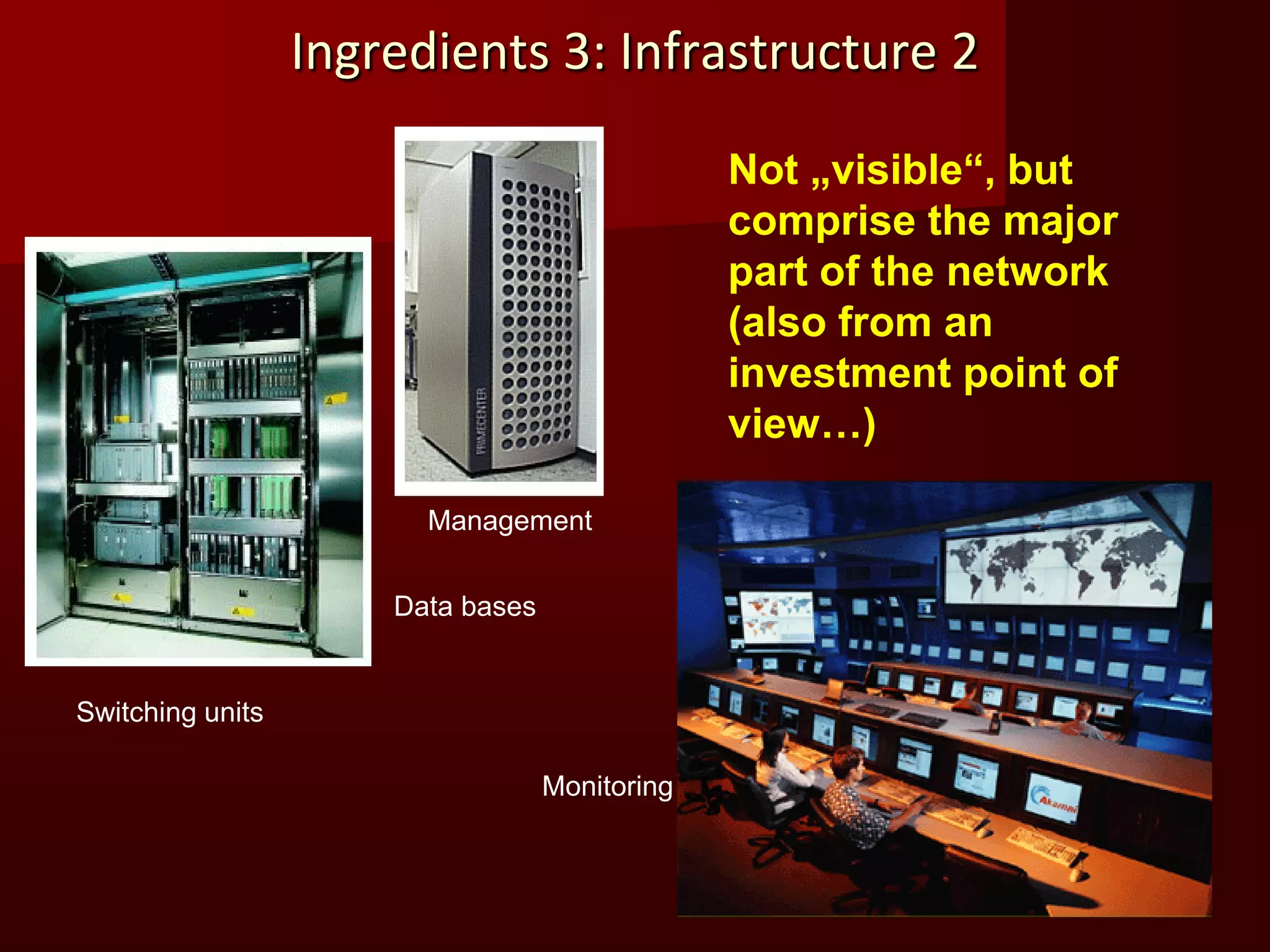
Ingredients 3: Infrastructure 2

                                                Not „visible“, but
                                                comprise the major
                                                part of the network
                                                (also from an
                                                investment point of
                                                view…)

                        Management


                      Data bases


Switching units

                                   Monitoring
GSM network is mainly divided in to 3 Major Systems


   1. Switching System (SS)


   2. Base Station System(BSS)


   3. Operation & Support System(OSS)
PSTN
                 AUC    VLR
                              Switching
                              system
                        HLR
PLMN
         GMSC                     EIR
                                          Operation &
                        MSC               Support
Other    GIWU
                                          System


        Base Station                             OSS
                       BSC
        System


                       BTS                          Mobile
                                                    Station
1. Switching System(SS)
              Heart of GSM
              Performs Call Processing and Subscriber related functions


   Functional Units in SS

          1. MSC- Mobile Service Switching Centre
                 High Performance Digital Switch
                 Fixed Backbone
                 Complete Connection Setup & Release
                 IWF - Connects to other Networks
2. HLR - Home Location Register
     Most Important Database
     Stores Permanent Data about the subscriber
     Location Information
     MSIN no. ,IMSI no. MSRN no.
Eg:-IMSI(MCC+MNC+MSIN)
3. VLR- Visitor Location Register
      Database
      Stores temporary data about subscriber

 4. AUC- Authentication Centre
      Provides Security
      User Authentication & Data Encryption
5. EIR- Equipment Identity Register
      Database contains the information about the identity of mobile
       equipment- Unique identity number for mobile devices
      IMEI- International Mobile Equipment Identity NO.


*#06# -Shows a 17 digit No.
In Nokia Phones
#92702689# Shows
Slno
Mfg date
Purchase date……..
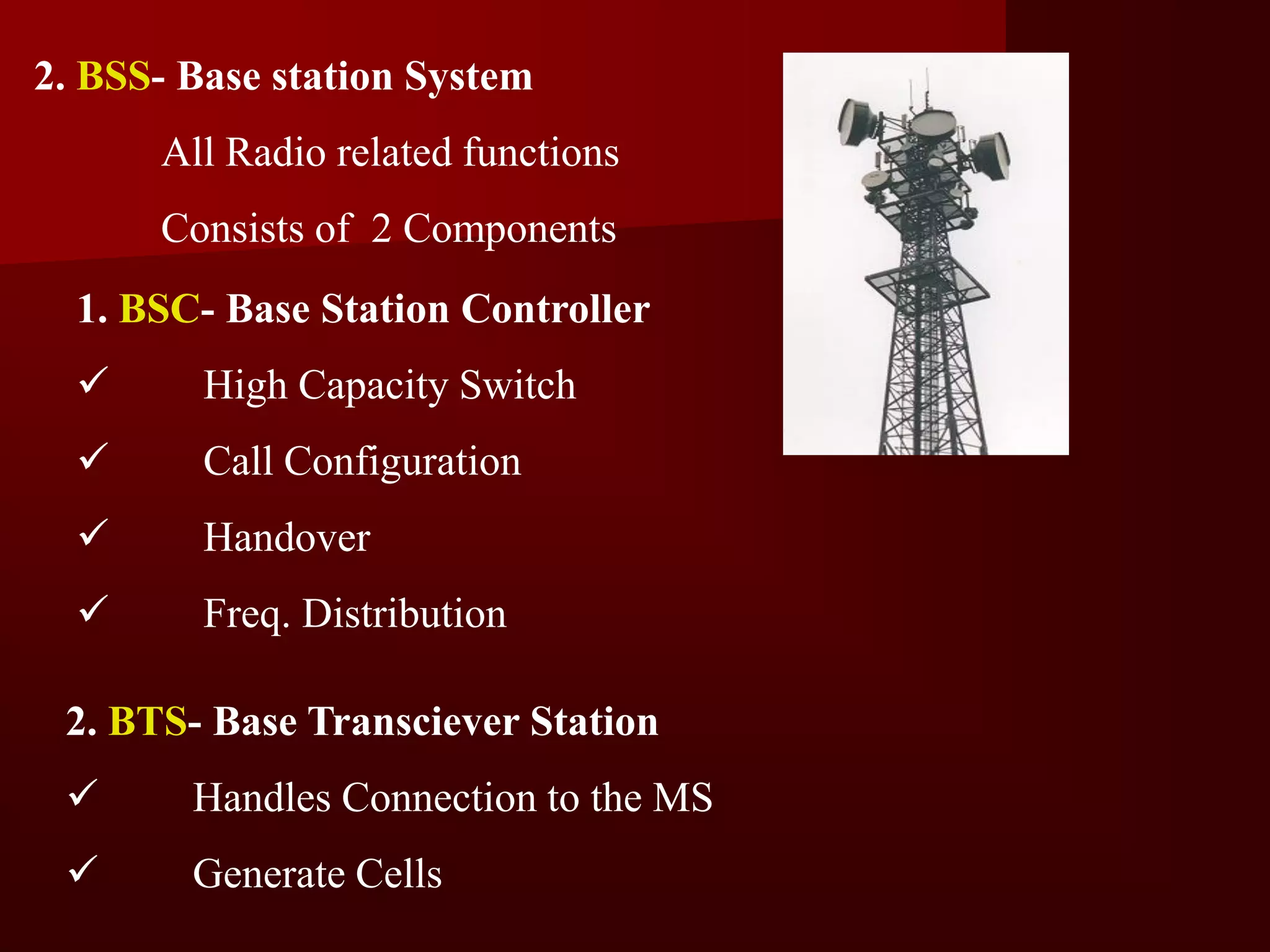
2. BSS- Base station System
      All Radio related functions
      Consists of 2 Components
  1. BSC- Base Station Controller
        High Capacity Switch
        Call Configuration
        Handover
        Freq. Distribution

 2. BTS- Base Transciever Station
       Handles Connection to the MS
       Generate Cells
3. OSS- Operation & Support System
           Functions for network operations & Management
           Consists of one important functional unit


    OMC-Operation & Maintenance Center
              Monitor & Controls the System
              A/C & Billing
              Subscriber & Security Management
Additional Functional Elements
      1. MXE -Message Center
             Provides SMS, Voicemail,Fax, E-mail etc

      2. MSN -Mobile Service Node
            Provides Intelligent Network Services

      3. GMSC- Gateway Mobile Service Switching Centre
                 A gateway that interconnects two networks:
      the cellular network and the PSTN.
GSM Services
1. SMS - Short Message Service -160 alphanumeric characters
2.EMS- Extended Message Service -760 alphanumeric characters
3.MMS-Multimedia Message Service
4. Cell Broadcast
5. Call forwarding
6.Barring of Incoming Calls
7. Barring of Outgoing Calls
8.AOC- Advice of Charge
9. Call hold
10. Call waiting
11. CLIP- Call Line Identification Presentation
12. CUG - Closed user Group
Evolution Path for GSM

                                 IMT-2000
                              Capable Systems


                                                     3G

GSM           GPRS        EDGE


                              Existing        New
                             spectrum         spectrum

   2G       evolved 2G                   3G
14.4 kbps   64–115 kbps   115–384 kbps    0.384–2 mbps
Key Feature of GSM
      SIM- Subscriber Identity Module
            Detachable Smart Card
            User Subscribed Information
            Phone Book
            PIN- Personal Ident. No.
      Size-16KB,64 KB,512 KB
2 Types of Calling In GSM


   1. Calling to Mobile (Mobile Terminated Call)


   2. Mobile to Fixed Telephone Network (Mobile Originated Call)
Mobile Terminated Call
 1: calling a GSM subscriber
 2: forwarding call to GMSC                                    GSM
 3: signal call setup to HLR                                   4
                                                         HLR          VLR
 4, 5: request MSRN from
                                                                5
                                                                      8 9
                                                         3 6
  VLR                                                                14 15
                           calling                              7
 6: forward responsible station     1
                                         PSTN
                                                2
                                                     GMSC             MSC

     MSC to GMSC                                           10       10 13    10
                                                                       16
 7: forward call to                            BSS                 BSS            BSS

    current MSC                                    11               11           11

 8, 9: get current status of                                       11 12
                                                                       17
  MS                                                                 MS
 10, 11: paging of MS
 12, 13: MS answers
 14, 15: security checks
 16, 17: set up connection
Mobile Originated Call
 1, 2: connection       
  request
 3, 4: security check                              VLR

 5-8: check resources                              3 4
  (free circuit)             PSTN
                                    6
                                        GMSC
                                                5
                                                    MSC
 9-10: set up call                 7           8
                                                    2 9
                                               1
                                        MS          BSS
                                               10
Advantages of GSM

Less signal deterioration inside buildings.

Ability to use repeaters


The availability of Subscriber Identity Module allows users to switch
networks and handsets.


GSM covers virtually all parts of the world so international roaming is not
a problem.


The much bigger number of subscribers globally creates a better
network effect for GSM handset makers, carriers and end users.
Thanks
Mobile Communications Sajay K R

Mobile Communications Sajay K R

  • 2.
    25 th FacultyDevelopment Programme 08 October 2012 Department of Computer Applications Vidya Academy of Science & Technology Thrissur – 680501, INDIA
  • 3.
    Agenda History of MobileCommunication Fundamental Principles of Mobile Communication Cellular Mobile Communication GSM- Global System for Mobile Communication
  • 4.
  • 5.
    BRIEF HISTORY OFMOBILE COMMUNICATIONS 1973 - Dr. Martin Kooper  Father of Mobile Phones  Technology uses Simple Receiver & Transmitter 1978- Bahrain Telephone Company -1G( Ist Generation) Commercial Cellular Telephone System only 250 Subscribers
  • 6.
    1980- NTT-Nippon Telegraph& Telephone Company ( Ist Generation(1G))  New Cellular Technology in Japan 1981- Nordic Mobile Phone ( Ist Generation(1G))  Used in Northern European Countries  Offers Speech only First Generation (1G) mobile systems were designed to offer a single service, i.e., speech.
  • 7.
    Second Generation (2G) 1982- GSM -Group Speciale Mobile (IInd Generation(2G)) Global System for Mobile Communication  Fully Digital Technology  Offers Speech & Data Service  Most successful DIGITAL MOBILE COMUNICATION SYSTEM 1983- AMPS-Advanced Mobile Phone System(IInd Generation(2G))  Developed in US 1991-DECT-Digital Enhanced Cordless Telephone(IInd Generation(2G))  Developed by ETSI(European Technical Standard Institute)
  • 8.
    Second Generation (2G)mobile systems were also designed primarily to offer speech with a limited capability to offer data at low rates.(max 9.6kbits/s) GSM (Global System for Mobile comm)can only offer a data rate of 9.6 kbps 2.5G-GPRS General packet Radio Service GPRS allows simultaneous voice and data communication Increase data transmission speeds from the current 9.6 Kbps to over 100 Kbps 2.75G- EDGE -Enhanced Data rates for GSM Evolution Supports High-speed data applications such as video services 384 kbps data transfer rate
  • 9.
    THIRD GENERATION(3G) 1998-SatelliteMobile Communication System Using in Europe 2 Satellite systems are used 1. Iridium-66 satellites 2.Globalstar-less than 35 System is now called UMTS Universal Mobile Telephone System 2001-3G Mobile Systems IMTS -International Mobile Telecomm. System
  • 10.
    Third Generation (3G)mobile systems are expected to offer high-quality multi-media services and operate in different environments 3G systems are referred to as Universal Mobile Telecommunications System (UMTS) in Europe and International Mobile Telecommunications 2000 (IMT2000) worldwide. Frequency band 1.8 -2.5 GHz 2Mbps data transfer rate. 4G SYSTEMS Frequency band (2 – 8 GHz) Expecting- 20 Mbps-100Mbps Data Transfer Rate
  • 11.
  • 12.
    Wireless Comm. Systems-Overview Conventional Broadcast Satellite Wireless Telecom systems systems Networks systems GSM-1900 Cdma2000 DAB LEO Wireless PAN W-CDMA DVB MEO Wireless LAN 3G GEO Wireless ATM
  • 13.
    Fundamental Principles of Mobile Communication
  • 14.
    Defining Mobility .. From the Latin word “Mobilis” = “to move” able to move freely or easily Properties Reachability (anywhere) Accessibility (any device) Service portability
  • 15.
    2 Different Kindsof Mobility User Mobility User accessing the telecomm. services at different places. ie the User can be mobile and services will follow him….. Device Portability Communication Device Moves(with or without a user) eg. Mobile phone system
  • 16.
    2 types ofVoice & Data Communication 1. Wired Communication 2. Wireless Communication
  • 17.
    Wired Communication R4 R1 Base Station R2 R3
  • 18.
    Wireless Transmission Without wire communicating Downlink Freq. R1 R2 signals Base Station R4 R3
  • 19.
    In Mobile communication Downlink Freq. R1 R2 signals R4 R3 Uplink Freq.
  • 20.
    Uplink Freq -From Receiver to Base station Downlink Freq- From Base station To Receiver GSM Mobile Communication Frequency range in India 890-915 MHz- Uplink Freq 935-960 MHz - Downlink Freq.
  • 21.
    Signal propagation ranges Transmission range – communication possible – low error rate  Detection range – detection of the signal sender possible – no communication transmission possible distance  Interference range detection – signal may not be interference detected – signal adds to the background noise
  • 22.
    BTS -Base TransceiverStation These transmitting stations or Base stations are called Antennas In Mobile comm. They are called BTS -Base Transceiver Station
  • 23.
  • 24.
    Each Base Stationcovers a certain area called a CELL For Each BTS only one cell Cell-A basic geographic unit of a cellular system
  • 25.
    Maximum Cell Radiiis 100 of metres in cities 35 kms in Open space  Radio stations use powerful transmitters with huge cells
  • 26.
    Mobile Base stationsgenerate very small cells why? 890-915 MHz- Uplink Freq 935-960 MHz - Downlink Freq. f3 f5 f2 1. Frequency Reuse f4 f6 f5 f1 f4 f3 f7 f1 f2 2. Less Transmission power 3. Local Interference only
  • 27.
    Components in CellularSystem Architecture 1. Cell-A basic geographic unit of a cellular system 2. Cluster(Cell Site) -Group of Cells f5 f4 f6 f1 f3 f7 f2
  • 28.
    Cells with thesame no. have the same set of frequencies f3 7 cells in one cluster f5 f2 f4 f6 f5 f1 f4 Coverage area of Cells are called f3 f7 f1 FOOTPRINT f2 No Channels are reused within a cluster
  • 29.
    3. Cell Splitting Cities contain large number of low power BTS Produce large no. of cells Handle heavy traffic & Less Interference
  • 30.
    3. Cell Splitting Rural areas contain only one high power BTS Produce only one cell Covers more area, Interference will be very high
  • 31.
    Some Figures No. ofCells in one cluster or cellsite = 3 Subscribers supported per cell = 596 Total No. of Subscribers /Cluster or cellsite =1788
  • 33.
    POPULAR TECHNOLOGY USED IN MOBILE COMMUNICATION
  • 34.
    GSM Globalsystem for Mobile communication
  • 35.
    GSM - Groupspeciale Mobile  Global system for Mobile Communication  2nd Generation system  Formed in 1982  Initially Implemented in Europe  Using 10 billion People in 212 countries  Technology that widely used in India-700 million customers  9.6 Kbits/sec DTR(Data Transf. Rate)
  • 36.
    Major Companies dealingGSM Technology in India
  • 37.
    Primary Objective ofGSM GSM phone is compatible with Fixed Landline Networks
  • 38.
    GSM Mile Stones Year Mile Stone 1982 GSM Formed 1986 Field Test 1987 Access Methods Chosen 1988 MOU Signed 1989 Validation of GSM System 1990 Preoperation System 1989 Validation of GSM System 1991 Commercial System Startup 1993 Coverage of Main Roads/Cities 1995 Coverage of Rural areas
  • 39.
    GSM in 3Frequencies GSM -900 MHz Used In 890-915 MHz- Uplink Freq India 935-960 MHz - Downlink Freq. GSM 1800 MHz 1710-1785 MHz -Uplink Freq. DCS-1800 1930-1990 MHz- Downlink Freq Digital Comm. Service GSM 1900 MHz 1850-1910MHz- Uplink Freq PCS-1900 1930-1990MHz- Downlink Freq Personal Comm. Service
  • 40.
    Cellular growth inIndia(2009-2014)
  • 41.
  • 42.
    Major Ingredients ina GSM network
  • 43.
    Ingredients 1: MobilePhones, PDAs etc The visible but smallest part of the network!
  • 44.
    Ingredients 2: Antennas Another visible part
  • 45.
    Ingredients 3: Infrastructure1 Cabling Microwave links
  • 46.
    Ingredients 3: Infrastructure2 Not „visible“, but comprise the major part of the network (also from an investment point of view…) Management Data bases Switching units Monitoring
  • 47.
    GSM network ismainly divided in to 3 Major Systems 1. Switching System (SS) 2. Base Station System(BSS) 3. Operation & Support System(OSS)
  • 48.
    PSTN AUC VLR Switching system HLR PLMN GMSC EIR Operation & MSC Support Other GIWU System Base Station OSS BSC System BTS Mobile Station
  • 49.
    1. Switching System(SS) Heart of GSM Performs Call Processing and Subscriber related functions Functional Units in SS 1. MSC- Mobile Service Switching Centre  High Performance Digital Switch  Fixed Backbone  Complete Connection Setup & Release  IWF - Connects to other Networks
  • 50.
    2. HLR -Home Location Register  Most Important Database  Stores Permanent Data about the subscriber  Location Information  MSIN no. ,IMSI no. MSRN no. Eg:-IMSI(MCC+MNC+MSIN) 3. VLR- Visitor Location Register  Database  Stores temporary data about subscriber 4. AUC- Authentication Centre  Provides Security  User Authentication & Data Encryption
  • 51.
    5. EIR- EquipmentIdentity Register  Database contains the information about the identity of mobile equipment- Unique identity number for mobile devices  IMEI- International Mobile Equipment Identity NO. *#06# -Shows a 17 digit No. In Nokia Phones #92702689# Shows Slno Mfg date Purchase date……..
  • 52.
    2. BSS- Basestation System All Radio related functions Consists of 2 Components 1. BSC- Base Station Controller  High Capacity Switch  Call Configuration  Handover  Freq. Distribution 2. BTS- Base Transciever Station  Handles Connection to the MS  Generate Cells
  • 53.
    3. OSS- Operation& Support System  Functions for network operations & Management  Consists of one important functional unit OMC-Operation & Maintenance Center  Monitor & Controls the System  A/C & Billing  Subscriber & Security Management
  • 54.
    Additional Functional Elements 1. MXE -Message Center Provides SMS, Voicemail,Fax, E-mail etc 2. MSN -Mobile Service Node Provides Intelligent Network Services 3. GMSC- Gateway Mobile Service Switching Centre A gateway that interconnects two networks: the cellular network and the PSTN.
  • 55.
    GSM Services 1. SMS- Short Message Service -160 alphanumeric characters 2.EMS- Extended Message Service -760 alphanumeric characters 3.MMS-Multimedia Message Service 4. Cell Broadcast 5. Call forwarding 6.Barring of Incoming Calls 7. Barring of Outgoing Calls 8.AOC- Advice of Charge 9. Call hold 10. Call waiting
  • 56.
    11. CLIP- CallLine Identification Presentation 12. CUG - Closed user Group
  • 57.
    Evolution Path forGSM IMT-2000 Capable Systems 3G GSM GPRS EDGE Existing New spectrum spectrum 2G evolved 2G 3G 14.4 kbps 64–115 kbps 115–384 kbps 0.384–2 mbps
  • 58.
    Key Feature ofGSM SIM- Subscriber Identity Module Detachable Smart Card User Subscribed Information Phone Book PIN- Personal Ident. No. Size-16KB,64 KB,512 KB
  • 59.
    2 Types ofCalling In GSM 1. Calling to Mobile (Mobile Terminated Call) 2. Mobile to Fixed Telephone Network (Mobile Originated Call)
  • 60.
    Mobile Terminated Call 1: calling a GSM subscriber  2: forwarding call to GMSC GSM  3: signal call setup to HLR 4 HLR VLR  4, 5: request MSRN from 5 8 9 3 6 VLR 14 15 calling 7  6: forward responsible station 1 PSTN 2 GMSC MSC MSC to GMSC 10 10 13 10 16  7: forward call to BSS BSS BSS  current MSC 11 11 11  8, 9: get current status of 11 12 17 MS MS  10, 11: paging of MS  12, 13: MS answers  14, 15: security checks  16, 17: set up connection
  • 61.
    Mobile Originated Call 1, 2: connection  request  3, 4: security check VLR  5-8: check resources 3 4 (free circuit) PSTN 6 GMSC 5 MSC  9-10: set up call 7 8 2 9 1 MS BSS 10
  • 62.
    Advantages of GSM Lesssignal deterioration inside buildings. Ability to use repeaters The availability of Subscriber Identity Module allows users to switch networks and handsets. GSM covers virtually all parts of the world so international roaming is not a problem. The much bigger number of subscribers globally creates a better network effect for GSM handset makers, carriers and end users.
  • 64.