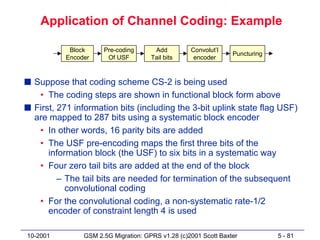
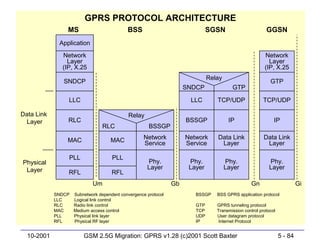
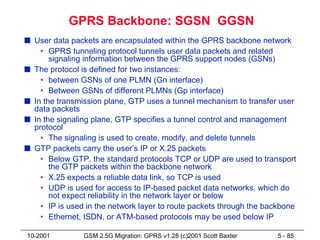
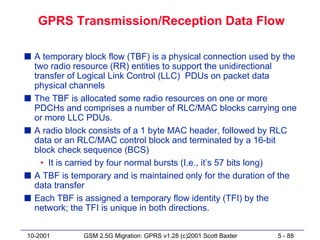
Course 335


          GSM 2.5G Migration:
          GSM 2.5G Migration:
    General Packet Radio Service GPRS
    General Packet Radio Service GPRS


10-2001    GSM 2.5G Migration: GPRS v1.28 (c)2001 Scott Baxter   5-1
What’s GPRS All About? How Does It Fit In?

s GSM: Global System for Mobile Communication
   • The world’s most widely used wireless phone technology
       – Over 500,000,000 users worldwide!
       – TDMA-based radio interface, 200 kHz.-wide signals
   • But very limited data capability
       – 9,600 or 14,400 bps maximum in circuit-switched mode
s WCDMA / UMTS: The Long-Term 3G Data Solution
   • Uses spread-spectrum CDMA techniques, 4-MHz.-wide signals
   • Provides both voice and high speed packet data access
   • But not widely deployed and available until 2003 or later
s GPRS: General Packet Radio Service
   • A packet-switched IP-capable way of using GSM radio infrastructure
   • Defined in 1996, wide deployment beginning in 2001
   • Provides both interim pre-WCDMA and long-term packet access


10-2001        GSM 2.5G Migration: GPRS v1.28 (c)2001 Scott Baxter   5-2
Communications Technology Family History
           A Story of Births, Weddings and Funerals

s    Commercial telegraphy gave birth to telephony, then died
s    Telephony and Land Mobile Radio married, giving IMTS & Cellular
s    IP networks developed, their usage and bandwidth are increasing
s    The wedding of IP and Wireless is happening now in 3G!

                                          Land Mobile Radio                                         Extinction?
                                           HF, VHF, UHF, Trunked


                                                                                  IP Networks
                                                                              The Internet Voice over IP


                                                         Wireless Voice and IP Data
                                                         IMTS-Cellular-GSM-GPRS-WCDMA


                         Commercial Switched Telephony                                              Extinction?
                                                              Digital Switching


 Commercial Telegraphy                     Extinction!


50   60   70   80   90     10   20   30   40    50       60     70     80     90      10     20    30      40     50
       1800s                                   1900s                                                2000s
10-2001              GSM 2.5G Migration: GPRS v1.28 (c)2001 Scott Baxter                                           5-3
GSM and GPRS


 Background: GSM Technology
 Background: GSM Technology
          The Foundation of GPRS
          The Foundation of GPRS


10-2001    GSM 2.5G Migration: GPRS v1.28 (c)2001 Scott Baxter   5-4
The Beginnings of GSM

s 1980’s: Europe used variety of first generation analog cellular
  systems: TACS, ETACS, NMT450, NMT900, Netz, etc.
    • Operation was limited to various national boundaries
    • Poor roaming capabilities, poor economies of scale in mfg.
s In 1982, CEPT the Conference of European Posts and Telegraphs
  created a group to study and define a 2G Pan-European system
    • Group Spécial Mobile (GSM)
    • In 1989, administration of GSM was transferred to the
      European Telecommunications Standards Institute (ETSI)
    • In 1990, the GSM specification, Phase I, was published
s GSM has become very popular due to many positive factors
    • Non-proprietary: anyone can manufacture networks/handsets
    • Thorough/integrated standard: well-defined RF air interface,
      network architecture, call delivery and roaming features

10-2001       GSM 2.5G Migration: GPRS v1.28 (c)2001 Scott Baxter   5-5
GSM World Acceptance


s GSM commercial deployment began
  in 1991
s By 1993, there were 36 GSM
  networks in 22 countries
s In 2000, there were over 200 GSM
  networks in over 110 countries
  around the world
    • Operation in 900 MHz., 1800
      MHz., and 1900 MHz. bands
s The wide acceptance of GSM has provided tremendous
  economies of scale in network, handset, and test equipment
  manufacturing and distribution
s Worldwide in 2001, GSM users have passed the 500 million mark
    • One in 12 human beings uses a GSM phone!
s The global dominance of GSM provides a large market for the
  2.5G and 3G enhancements GPRS and UMTS WCDMA
10-2001      GSM 2.5G Migration: GPRS v1.28 (c)2001 Scott Baxter   5-6
GSM vs. North American Standards

 s Two different approaches to wireless technology development!
    • Americans: Invent cool new stuff driven by market forces, write
      standards if it works and the market accepts it
    • Europeans: Study, Plan, build Standards, build Consensus, Plan,
      Review, build more Consensus, finally Deploy
 s The differences are visible in the resulting standards
    • American: multiple interim standards necessary to define functionality
    • Europeans: single integrated standard covers all functionality

                           North American CDMA                           GSM

Other Features           IS-637   IS-683   IS-707   Etc.
                          SMS      OTA      Data
Intersystem Roaming,                                          The GSM Standard
                                  IS-41C, D, P
Call Delivery, Handoff                                       One coordinated, uniformly
                                                           structured family of documents
Network Architecture         IS-634 A-interface

Air Interface
                           IS-95/J-Std 008 CDMA
RF Architecture
  10-2001          GSM 2.5G Migration: GPRS v1.28 (c)2001 Scott Baxter                5-7
GSM Terminology

                          s Some terms have different
                            meanings when used in GSM
       Sector               or North American practice!                           Cell
         α                                                                         α

        CELL                                                               Cell BTS Cell
   Sector   Sector
     γ        β                                                             γ        β


    It’s a Sector!                                                          It’s a Cell!


   Sector   Sector                                                         Cell          Cell
     γ        β                                                             γ             β


That was a Handoff!                                                   That was a Handover!
The frequencies used                                                  The frequencies used
 by each sector are                                                     by each cell are
  its channel set.                                                       its allocation.

  10-2001            GSM 2.5G Migration: GPRS v1.28 (c)2001 Scott Baxter                 5-8
Structure of a GSM Signal

s GSM carriers are spaced 200 kHz.
  apart
s In the BTS downlink signal, different          8    Slots
                                                                  Required
                                                                                      1
                                                                                          2
                                                                 C/I ≅ 9-12 dB
  timeslots belong to different users -                                               4
                                                                                          3
  a mobile listens only to its recurring
  timeslots                                     200 kHz
                                                                Typical Frequency Reuse N=4
    • During unused timeslots, a
       mobile can measure the signal
       strength of surrounding BTSs to
       guide the handover process
s The mobile on its uplink transmits
  only during its assigned timeslots
    • Mobiles transmit only during                BTS
       their own timeslots
    • Mobile transmit timeslots occur
       three timeslots after the
       corresponding BTS transmit
       timeslot
          – This avoids simultaneous
            mobile TX/RX and the need
            for duplexer at the mobile
10-2001          GSM 2.5G Migration: GPRS v1.28 (c)2001 Scott Baxter               5-9
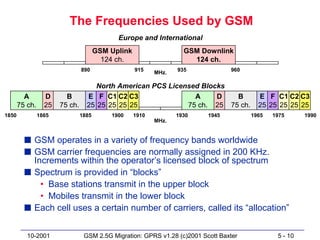
The Frequencies Used by GSM
                                             Europe and International
                                       GSM Uplink                   GSM Downlink
                                         124 ch.                      124 ch.
                                890                 915    MHz.   935            960


                                     North American PCS Licensed Blocks
         A        D      B        E F C1 C2 C3                 A     D   B               E F C1 C2 C3
       75 ch.     25   75 ch.     25 25 25 25 25             75 ch. 25 75 ch.            25 25 25 25 25
1850            1865            1885       1900     1910          1930    1945         1965   1975      1990
                                                           MHz.


         s GSM operates in a variety of frequency bands worldwide
         s GSM carrier frequencies are normally assigned in 200 KHz.
           Increments within the operator’s licensed block of spectrum
         s Spectrum is provided in “blocks”
             • Base stations transmit in the upper block
             • Mobiles transmit in the lower block
         s Each cell uses a certain number of carriers, called its “allocation”


          10-2001                GSM 2.5G Migration: GPRS v1.28 (c)2001 Scott Baxter           5 - 10
Multiple Carriers in a GSM Cell
                                         Time
      Frequency 6      TS1     TS2     TS3      TS4    TS5     TS6        TS7   TS8
      Frequency 5      TS1     TS2     TS3      TS4    TS5     TS6        TS7   TS8
      Frequency 4      TS1     TS2     TS3      TS4    TS5     TS6        TS7   TS8
      Frequency 3      TS1     TS2     TS3      TS4    TS5     TS6        TS7   TS8
      Frequency 2      TS1     TS2     TS3      TS4    TS5     TS6        TS7   TS8
      Frequency 1      TS1     TS2     TS3      TS4    TS5    TS6         TS7   TS8
                                                 1 timeslot 577 µs
                                          1 frame 4.515 ms
s A GSM base station transceiver makes a signal ~240 kHz. wide
s The signal is time-divided into a repeating pattern of frames
   • Each frame is 60/13 = 4.515 ms long, there are ~221.5 frames per second
s Each frame is further subdivided into 8 timeslots, each 15/26 ms = 577 µs long
   • A timeslot can hold the bits of a channel of information
        – One user’s voice signal, or a signaling/administrative channel
s One GSM base station can have several transceivers, each one producing a
  GSM signal on a different frequency - six carriers in the example above
   • Various repeating patterns of information can use the timeslots to carry
     channels of information
  10-2001           GSM 2.5G Migration: GPRS v1.28 (c)2001 Scott Baxter               5 - 11
Channels in GSM: Repeating Patterns

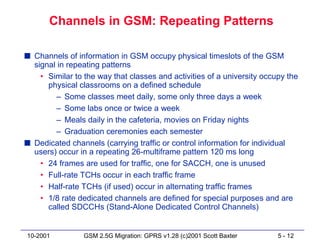
s Channels of information in GSM occupy physical timeslots of the GSM
  signal in repeating patterns
    • Similar to the way that classes and activities of a university occupy the
      physical classrooms on a defined schedule
        – Some classes meet daily, some only three days a week
        – Some labs once or twice a week
        – Meals daily in the cafeteria, movies on Friday nights
        – Graduation ceremonies each semester
s Dedicated channels (carrying traffic or control information for individual
  users) occur in a repeating 26-multiframe pattern 120 ms long
    • 24 frames are used for traffic, one for SACCH, one is unused
    • Full-rate TCHs occur in each traffic frame
    • Half-rate TCHs (if used) occur in alternating traffic frames
    • 1/8 rate dedicated channels are defined for special purposes and are
      called SDCCHs (Stand-Alone Dedicated Control Channels)


10-2001          GSM 2.5G Migration: GPRS v1.28 (c)2001 Scott Baxter     5 - 12
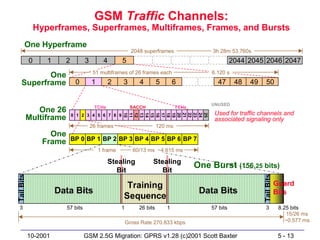
GSM Traffic Channels:
                Hyperframes, Superframes, Multiframes, Frames, and Bursts
       One Hyperframe
                                                            2048 superframes                  3h 28m 53.760s
            0      1     2          3         4       5                                                2044 2045 2046 2047
                                         51 multiframes of 26 frames each                    6.120 s
          One
   Superframe                 0         1         2   3        4         5       6             47       48   49    50


                                                                                             UNUSED
                                         TCHs              SACCH                  TCHs
               One 26                                                                         Used for traffic channels and
                                                      10
                                                      11
                                                      12
                                                      13
                                                      14
                                                      15
                                                      16
                                                      17
                                                      18
                                                      19
                                                      20
                                                      21
                                                      22
                                                      23
                                                      24
                                                      25
                             0 1 2 3 4 5 6 7 8 9
            Multiframe                                                                        associated signaling only
                                        26 frames                        120 ms
                    One
                             BP 0 BP 1 BP 2 BP 3 BP 4 BP 5 BP 6 BP 7
                  Frame
                                            1 frame          60/13 ms ~4.615 ms

                                                Stealing             Stealing
                                                                                         One Burst (156.25 bits)
                                                   Bit                  Bit
Tail Bits


                                                                                                                  Tail Bits
                                                       Training                                                               Guard
                       Data Bits                                                          Data Bits                           Bits
                                                      Sequence
 3                        57 bits                     1        26 bits       1               57 bits               3           8.25 bits
                                                                                                                                   15/26 ms
                                                          Gross Rate 270.833 kbps                                                 ~0.577 ms

            10-2001                 GSM 2.5G Migration: GPRS v1.28 (c)2001 Scott Baxter                                        5 - 13
GSM Control Channels:
                   Hyperframes, Superframes, Multiframes, Frames, and Bursts
          One Hyperframe
                                                                2048 superframes                          3h 28m 53.760s
               0      1      2         3          4       5                                                         2044 2045 2046 2047
                                           26 multiframes of 51frames each                                6.120 s
             One
      Superframe                    0                 1             2                 3                             24          25


                                                                                                                                                             not used
                    BCCH 1
                    BCCH 2
                    BCCH 3
                    BCCH 4


                                 CCCH0 or
                     FCCH


                                           FCCH


                                                                        FCCH


                                                                                                   FCCH


                                                                                                                              FCCH
                                 SYS_INFO                                      CCCH3 or CCCH4 or          CCCH5 or CCCH5 or          CCCH6 or CCCH7 or
                      SCH


                                            SCH


                                                                         SCH


                                                                                                    SCH


                                                                                                                               SCH
                                   7&8            CCCH 1 CCCH 2                 SDCCH SDCCH                SDCCH SDCCH                SACCH SACCH
 One 51 0
                                           10
                                           11
                                           12
                                           13
                                           14
                                           15
                                           16
                                           17
                                           18
                                           19
                                           20
                                           21
                                           22
                                           23
                                           24
                                           25
                                           26
                                           27
                                           28
                                           29
                                           30
                                           31
                                           32
                                           33
                                           34
                                           35
                                           36
                                           37
                                           38
                                           39
                                           40
                                           41
                                           42
                                           43
                                           44
                                           45
                                           46
                                           47
                                           48
                                           49
                                           50
                      1 2 3 4 5 6 7 8 9
Multiframe
                                                      51 frames                                            235.38 ms
                                                                                                             Used for control channels only
                       One       BP 0 BP 1 BP 2 BP 3 BP 4 BP 5 BP 6 BP 7
                     Frame                  1 frame              60/13 ms ~4.615 ms

                                                  Stealing                Stealing
                                                                                             One Burst (156.25 bits)
                                                     Bit                     Bit
   Tail Bits


                                                                                                                                     Tail Bits
                                                           Training                                                                              Guard
                          Data Bits                                                            Data Bits                                         Bits
                                                          Sequence
    3                        57 bits                      1        26 bits        1                       57 bits                     3           8.25 bits
                                                                                                                                                      15/26 ms
                                                              Gross Rate 270.833 kbps                                                                ~0.577 ms

               10-2001                 GSM 2.5G Migration: GPRS v1.28 (c)2001 Scott Baxter                                                        5 - 14
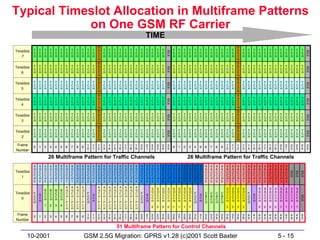
Typical Timeslot Allocation in Multiframe Patterns
            on One GSM RF Carrier
                                                                                                 TIME
                                                            S                                                                                                           S
TimeSlot   T T     T   T   T   T   T   T T     T    T   T   A   T T     T    T   T   T   T   T T     T   T   T          T   T   T   T   T   T   T   T   T   T   T   T   A   T   T   T   T   T   T   T   T   T   T      T      T


                                                                                                                 IDLE


                                                                                                                                                                                                                                     IDLE
           C C     C   C   C   C   C   C C     C    C   C   C   C C     C    C   C   C   C   C C     C   C   C          C   C   C   C   C   C   C   C   C   C   C   C   C   C   C   C   C   C   C   C   C   C   C      C      C
   7       H H     H   H   H   H   H   H H     H    H   H   C   H H     H    H   H   H   H   H H     H   H   H          H   H   H   H   H   H   H   H   H   H   H   H   C   H   H   H   H   H   H   H   H   H   H      H      H
                                                            H                                                                                                           H
                                                            S                                                                                                           S
TimeSlot   T   T   T   T   T   T   T   T T     T    T   T   A   T   T   T    T   T   T   T   T T     T   T   T          T   T   T   T   T   T   T   T   T   T   T   T   A   T   T   T   T   T   T   T   T   T   T      T      T


                                                                                                                 IDLE


                                                                                                                                                                                                                                     IDLE
           C   C   C   C   C   C   C   C C     C    C   C   C   C   C   C    C   C   C   C   C C     C   C   C          C   C   C   C   C   C   C   C   C   C   C   C   C   C   C   C   C   C   C   C   C   C   C      C      C
   6       H   H   H   H   H   H   H   H H     H    H   H   C   H   H   H    H   H   H   H   H H     H   H   H          H   H   H   H   H   H   H   H   H   H   H   H   C   H   H   H   H   H   H   H   H   H   H      H      H
                                                            H                                                                                                           H
                                                            S                                                                                                           S
TimeSlot   T   T   T   T   T   T   T   T T     T    T   T   A   T   T   T    T   T   T   T   T T     T   T   T          T   T   T   T   T   T   T   T   T   T   T   T   A   T   T   T   T   T   T   T   T   T   T      T      T


                                                                                                                 IDLE


                                                                                                                                                                                                                                     IDLE
           C   C   C   C   C   C   C   C C     C    C   C   C   C   C   C    C   C   C   C   C C     C   C   C          C   C   C   C   C   C   C   C   C   C   C   C   C   C   C   C   C   C   C   C   C   C   C      C      C
   5       H   H   H   H   H   H   H   H H     H    H   H   C   H   H   H    H   H   H   H   H H     H   H   H          H   H   H   H   H   H   H   H   H   H   H   H   C   H   H   H   H   H   H   H   H   H   H      H      H
                                                            H                                                                                                           H
                                                            S                                                                                                           S
TimeSlot   T   T   T   T   T   T   T   T T     T    T   T   A   T   T   T    T   T   T   T   T T     T   T   T          T   T   T   T   T   T   T   T T     T   T   T   A   T   T   T   T   T   T   T   T   T   T      T      T


                                                                                                                 IDLE


                                                                                                                                                                                                                                     IDLE
           C   C   C   C   C   C   C   C C     C    C   C   C   C   C   C    C   C   C   C   C C     C   C   C          C   C   C   C   C   C   C   C C     C   C   C   C   C   C   C   C   C   C   C   C   C   C      C      C
   4       H   H   H   H   H   H   H   H H     H    H   H   C   H   H   H    H   H   H   H   H H     H   H   H          H   H   H   H   H   H   H   H H     H   H   H   C   H   H   H   H   H   H   H   H   H   H      H      H
                                                            H                                                                                                           H
                                                            S                                                                                                           S
TimeSlot   T   T   T   T   T   T   T   T   T   T    T   T   A   T   T   T    T   T   T   T   T T     T   T   T          T   T   T   T   T   T   T   T   T   T   T   T   A   T   T   T   T   T   T   T   T   T   T      T      T


                                                                                                                 IDLE


                                                                                                                                                                                                                                     IDLE
           C   C   C   C   C   C   C   C   C   C    C   C   C   C   C   C    C   C   C   C   C C     C   C   C          C   C   C   C   C   C   C   C   C   C   C   C   C   C   C   C   C   C   C   C   C   C   C      C      C
   3       H   H   H   H   H   H   H   H   H   H    H   H   C   H   H   H    H   H   H   H   H H     H   H   H          H   H   H   H   H   H   H   H   H   H   H   H   C   H   H   H   H   H   H   H   H   H   H      H      H
                                                            H                                                                                                           H
                                                            S                                                                                                           S
TimeSlot   T   T   T   T   T   T   T   T   T   T    T   T   A   T   T   T    T   T   T   T   T T     T   T   T          T   T   T   T   T   T   T   T   T   T   T   T   A   T   T   T   T   T   T   T   T   T   T      T      T


                                                                                                                 IDLE


                                                                                                                                                                                                                                     IDLE
           C   C   C   C   C   C   C   C   C   C    C   C   C   C   C   C    C   C   C   C   C C     C   C   C          C   C   C   C   C   C   C   C   C   C   C   C   C   C   C   C   C   C   C   C   C   C   C      C      C
   2       H   H   H   H   H   H   H   H   H   H    H   H   C   H   H   H    H   H   H   H   H H     H   H   H          H   H   H   H   H   H   H   H   H   H   H   H   C   H   H   H   H   H   H   H   H   H   H      H      H
                                                            H                                                                                                           H
Frame                                               1   1   1   1   1   1    1   1   1   1   2   2   2   2   2   2                                              1   1   1   1   1   1   1   1   1   1   2   2   2      2      2      2
           0   1   2   3   4   5   6   7   8   9    0   1   2   3   4   5    6   7   8   9   0       2   3   4   5      0   1   2   3   4   5   6   7   8   9   0   1   2   3   4   5   6   7   8   9   0   1   2      3      4      5
                                                                                                 1
Number

                       26 Multiframe Pattern for Traffic Channels                                                                   26 Multiframe Pattern for Traffic Channels
           S   S   S   S   S   S   S   S   S   S    S   S   S   S   S   S    S   S   S   S   S   S   S   S   S   S      S   S   S   S   S   S   S   S   S   S   S   S   S   S   S   S   S   S   S   S   S   S
           D   D   D   D   D   D   D   D   D   D    D   D   D   D   D   D    D   D   D   D   D   D   D   D   D   D      D   D   D   D   D   D   A   A   A   A   A   A   A   A   A   A   A   A   A   A   A   A
TimeSlot   C


                                                                                                                                                                                                                IDLE
                                                                                                                                                                                                                       IDLE
                                                                                                                                                                                                                              IDLE
               C   C   C   C   C   C   C   C   C    C   C   C   C   C   C    C   C   C   C   C   C   C   C   C   C      C   C   C   C   C   C   C   C   C   C   C   C   C   C   C   C   C   C   C   C   C   C
           C   C   C   C   C   C   C   C   C   C    C   C   C   C   C   C    C   C   C   C   C   C   C   C   C   C      C   C   C   C   C   C   C   C   C   C   C   C   C   C   C   C   C   C   C   C   C   C
   1       H   H   H   H   H   H   H   H   H   H    H   H   H   H   H   H    H   H   H   H   H   H   H   H   H   H      H   H   H   H   H   H   H   H   H   H   H   H   H   H   H   H   H   H   H   H   H   H
           0   0   0   0   1   1   1   1   2   2    2   2   3   3   3   3    4   4   4   4   5   5   5   5   6   6      6   6   7   7   7   7   0   0   0   0   1   1   1   1   2   2   2   2   3   3   3   3
                                   A   A   A   A            A   A   A   A    A   A   A   A         S     S   S   S      S   S   S   S                           S   S   S   S           S   S   S   S   S   S   S      S
                   B   B   B   B   G   G   G   G            G   G   G   G    G   G   G   G
TimeSlot   F       C   C   C   C   C   C   C   C    F       C   C   C   C    C   C   C   C   F     D     D   D   D      D   D   D   D   F       C   C   C   C   D   D   D   D   F       A   A   A   A   A   A   A      A
           C   S   C                                    S                                        S C     C   C   C      C   C   C   C       S                   C   C   C   C       S   C   C   C   C   C   C   C      C


                                                                                                                                                                                                                              IDLE
               C       C   C   C   H   H   H   H    C   C   H   H   H   H    H   H   H   H   C   C C     C   C   C      C   C   C   C   C   C   B   B   B   B   C   C   C   C   C   C   C   C   C   C   C   C   C      C
   0       C       H   H   H   H   /   /   /   /    C       /   /   /   /    /   /   /   /   C                                          C       C   C   C   C                   C
           H   H                                        H                                        H H     H   H   H      H   H   H   H       H                   H   H   H   H       H   H   H   H   H   H   H   H      H
                                   P   P   P   P    H       P   P   P   P    P   P   P   P   H                                          H       H   H   H   H                   H
                   1   2   3   4   C   C   C   C            C   C   C   C    C   C   C   C           0   0   0   0      1   1   1   1                           3   3   3   3           0   0   0   0   1   1   1      1
                                   H   H   H   H            H   H   H   H    H   H   H   H

Frame                                               1   1   1   1   1   1    1   1   1   1   2   2   2   2   2   2      2   2   2   2   3   3   3   3   3   3   3   3   3   3   4   4   4   4   4   4   4   4   4      4      5
           0   1   2   3   4   5   6   7   8   9    0   1   2   3   4   5    6   7   8   9   0   1   2   3   4   5      6   7   8   9   0   1   2   3   4   5   6   7   8   9   0   1   2   3   4   5   6   7   8      9      0
Number

                                                                            51 Multiframe Pattern for Control Channels
      10-2001                                      GSM 2.5G Migration: GPRS v1.28 (c)2001 Scott Baxter                                                                                                  5 - 15
A GSM Uplink Normal Burst


s GSM is a TDMA system and a mobile’s transmission bursts are carefully
  constructed not to overlap with bursts from other mobiles
s Different propagation delays of mobiles near and far mobiles the BTS are
  compensated by automatically advancing mobile transmit timing
s Special training sequences are included in each uplink burst and downlink
  timeslot to facilitate demodulation
s During unused timeslots, a mobile measures the strength of surrounding
  base stations to guide the handover process (this is called MAHO, Mobile
  Assisted Hand Over)

10-2001         GSM 2.5G Migration: GPRS v1.28 (c)2001 Scott Baxter   5 - 16
GSM Bursts on the Uplink: 4 Types

    Frequency Correction Burst or Dummy Burst
                                                                                                                    Guard
Tail


                                                                                                            Tail
                                        Fixed ‘0’ or Fill-in Bits
                                                                                                                     Bits
3                                                        142 bits                                           3       8.25 bits

    Synchronization Burst
                                                                                                                    Guard
Tail


                                                                                                            Tail
           Data Bits                           Training Bits                             Data Bits                   Bits
3                39 bits                                     64 bits                            39 bits     3       8.25 bits

    Access Burst


                                                                       Tail
Tail                                                                          Guard
Bits
             Training Bits                         Data Bits                   Bits
       8             41 bits                       36 bits             3                 68.25 bits
                                           Stealing                Stealing
    Normal Burst                              Bit                    Bit
                                                                                                                    Guard
Tail


                                                                                                             Tail
                   Data Bits                   Training Bits                          Data Bits                      Bits
3                          57 bits             1        26 bits          1                57 bits           3       8.25 bits
       10-2001                  GSM 2.5G Migration: GPRS v1.28 (c)2001 Scott Baxter                       5 - 17
GSM Channels
     DOWNLINK CHANNELS                                                                      UPLINK CHANNELS
                            BTS identity, channel allocation,
            BCCH             frequency hopping sequences
                                                                Slotted aloha channel used to
            FCCH             Provides frequency reference
                                                                   request network access            RACH
                            Defines burst period boundaries
            SCH                 and time slot numbering
                               Carries pages to mobiles,
            PCH                alerting of incoming calls
                                                                   Stand Alone Dedicated
            AGCH
                             Allocates SDCCH to mobile to
                                                                      Control Channel               SDCCH
                             obtain dedicated channel after
                                 a request on the RACH
                                                                       Traffic Channel                TCH
                                                                  Fast Associated Control
  BTS                                                                    Channel                    FACCH
                                                                  Slow Associated Control
                                                                         Channel                    SACCH

0 to many   F-TRAFFIC
                                Stand Alone Dedicated
            SDCCH                  Control Channel

                                    Traffic Channel
            TCH
                            Fast Associated Control Channel
            FACCH
                            Slow Associated Control Channel
            SACCH

       10-2001          GSM 2.5G Migration: GPRS v1.28 (c)2001 Scott Baxter                            5 - 18
The GPRS Timeslot Allocation
s In conventional GSM, a channel is permanently allocated for a particular
  user during the entire call period (whether speaking or silent, whether
  transmitting data or not)
    • In GPRS, the channels are only allocated when data packets are
       transmitted or received, and they are released after the transmission
    • For bursty traffic this results in much more efficient use of the scarce
       radio resources
    • Multiple users can share one channel
s GPRS allows a single mobile to
  transmit and/or receive on multiple
  timeslots of the same frame (this is
  called multislot operation)
    • This provides “bandwidth on              BTS
      demand” in a very flexible
      scheme
    • One to eight timeslots per frame
      can be allocated to a mobile
    • Uplink and downlink allocations               •This GPRS mobile is in “3+1” timeslot mode
                                                           •3 timeslots assigned on downlink
      can be allocated separately,                         •1 timeslot assigned on uplink
      which efficiently supports
      asymmetric data traffic (suitable
      for web browsing, for example)
 10-2001            GSM 2.5G Migration: GPRS v1.28 (c)2001 Scott Baxter             5 - 19
Allocation of GPRS Channels

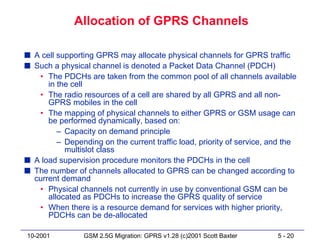
s A cell supporting GPRS may allocate physical channels for GPRS traffic
s Such a physical channel is denoted a Packet Data Channel (PDCH)
   • The PDCHs are taken from the common pool of all channels available
      in the cell
   • The radio resources of a cell are shared by all GPRS and all non-
      GPRS mobiles in the cell
   • The mapping of physical channels to either GPRS or GSM usage can
      be performed dynamically, based on:
         – Capacity on demand principle
         – Depending on the current traffic load, priority of service, and the
           multislot class
s A load supervision procedure monitors the PDCHs in the cell
s The number of channels allocated to GPRS can be changed according to
  current demand
   • Physical channels not currently in use by conventional GSM can be
      allocated as PDCHs to increase the GPRS quality of service
   • When there is a resource demand for services with higher priority,
      PDCHs can be de-allocated

10-2001          GSM 2.5G Migration: GPRS v1.28 (c)2001 Scott Baxter    5 - 20
GSM, GPRS and WCDMA / UMTS


          GSM, GPRS, WCDMA
          GSM, GPRS, WCDMA
 Coordinated Network Architecture
 Coordinated Network Architecture


10-2001   GSM 2.5G Migration: GPRS v1.28 (c)2001 Scott Baxter   5 - 21
3 Steps to 3G: The GSM Transition
                                       GSM TODAY
PLMN         Core Network                                                       SIM
PSTN                             MSC                BSC           BTS          Mobile
                        VLR                         Base          Base
              Gateway            Mobile                                        Station
 ISDN                                              Station      Transceiver
                                Switching         Controller     Stations
               MSC                                                             Mobile
                        HLR      Center
                                                                              Equipment
Internet
                                  2.5G: GSM + GPRS
             Core Network
                        VLR      MSC
PLMN                             Mobile                                         SIM
PSTN          Gateway           Switching                                      Mobile
               MSC               Center
                                                    BSC           BTS
                        HLR                       Base            Base
                                                                               Station
 ISDN         Gateway            Serving         Station        Transceiver    Mobile
              GPRS               GPRS       PCU Controller       Stations     Equipment
              Support            Support
Internet       node               node


                                   3G: UMTS, UTRA
             Core Network        MSC         UTRAN
                                                RNC            Node B           UMTS
PLMN                    VLR      Mobile
PSTN          Gateway           Switching       Radio                            SIM
                                               Network
               MSC               Center        Controller      Node B           User
 ISDN                   HLR                                                   Equipment
              Gateway            Serving         RNC
              GPRS               GPRS           Radio          Node B          Mobile
Internet      Support            Support       Network                        Equipment
               node               node         Controller      Node B

  10-2001       GSM 2.5G Migration: GPRS v1.28 (c)2001 Scott Baxter            5 - 22
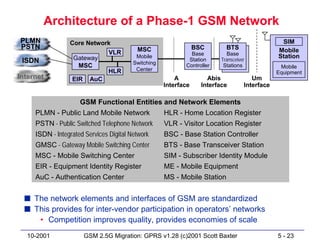
Architecture of a Phase-1 GSM Network
PLMN             Core Network                                                                    SIM
PSTN                                      MSC                    BSC        BTS                 Mobile
                            VLR                               Base          Base
                  Gateway                 Mobile                                                Station
 ISDN                                                        Station      Transceiver
                                         Switching          Controller     Stations
                    MSC                                                                          Mobile
                            HLR           Center
                                                                                                Equipment
Internet          EIR AuC                                A           Abis              Um
                                                     Interface     Interface        Interface

                     GSM Functional Entities and Network Elements
     PLMN - Public Land Mobile Network               HLR - Home Location Register
     PSTN - Public Switched Telephone Network        VLR - Visitor Location Register
     ISDN - Integrated Services Digital Network      BSC - Base Station Controller
     GMSC - Gateway Mobile Switching Center          BTS - Base Transceiver Station
     MSC - Mobile Switching Center                   SIM - Subscriber Identity Module
     EIR - Equipment Identity Register               ME - Mobile Equipment
     AuC - Authentication Center                     MS - Mobile Station


  s The network elements and interfaces of GSM are standardized
  s This provides for inter-vendor participation in operators’ networks
     • Competition improves quality, provides economies of scale
  10-2001             GSM 2.5G Migration: GPRS v1.28 (c)2001 Scott Baxter                       5 - 23
GSM Network Evolution and History
                                        GSM TODAY
PLMN          Core Network                                                     SIM
PSTN                              MSC                BSC          BTS         Mobile
                         VLR                         Base         Base
               Gateway            Mobile                                      Station
 ISDN                                               Station     Transceiver
                                 Switching         Controller    Stations
                MSC                                                            Mobile
                         HLR      Center
                                                                              Equipment
Internet


  s The present GSM network architecture emerged from work of the
    ETSI in the late 1980s
  s The GSM network can be divided into three main domains
     • The Network Switching Subsystem (GMSC, VLR, HLR, MSC)
     • The Operations and Support Subsystem (not shown, includes
       OMC-R)
     • The Base Station Subsystem BSS (includes BSCs, BTSs)


  10-2001        GSM 2.5G Migration: GPRS v1.28 (c)2001 Scott Baxter          5 - 24
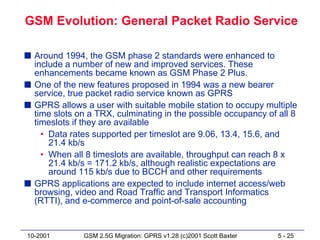
GSM Evolution: General Packet Radio Service

s Around 1994, the GSM phase 2 standards were enhanced to
  include a number of new and improved services. These
  enhancements became known as GSM Phase 2 Plus.
s One of the new features proposed in 1994 was a new bearer
  service, true packet radio service known as GPRS
s GPRS allows a user with suitable mobile station to occupy multiple
  time slots on a TRX, culminating in the possible occupancy of all 8
  timeslots if they are available
    • Data rates supported per timeslot are 9.06, 13.4, 15.6, and
      21.4 kb/s
    • When all 8 timeslots are available, throughput can reach 8 x
      21.4 kb/s = 171.2 kb/s, although realistic expectations are
      around 115 kb/s due to BCCH and other requirements
s GPRS applications are expected to include internet access/web
  browsing, video and Road Traffic and Transport Informatics
  (RTTI), and e-commerce and point-of-sale accounting


10-2001        GSM 2.5G Migration: GPRS v1.28 (c)2001 Scott Baxter   5 - 25
GPRS Network Architecture
                                       VLR                                LEGEND
            PLMN
            PSTN                      MSC
                                                             Existing GSM Core Network elements
            ISDN                                       A     New GPRS elements and interfaces
                                                                       User data & signaling
                                           Gs                          Signaling only
 SGSN
   of a              HLR        EIR             SMSC
different                                                                                                  SIM
 PLMN        Gp                                                    Ater                                   Mobile
                    Gc     Gr         Gf                    TCU             BSC                BTS        Station
                                                Gd                           Base Abis Base
                                                                            Station   Transceiver         Mobile
                                                                           Controller  Station            Eqpm’t
PSPDN                                                      PCUSN
                   GGSN     Gn        SGSN           Gb            Agprs
             Gi
                                                                                                     Um
                                                                                                  Interface
 s The GSM network architecture was modified to add packet services, through the
   addition of the new network elements GGSN and SGSN
    • GGSN Gateway GPRS Support Node
          – Responsible for routing data packets entering and leaving the radio
            network; also as a router for packets within the network
    • SGSN Serving GPRS Support Node
          – responsible for packet delivery to mobiles in its area
          – a type of packet switch with capability to interrogate the GSM
            databases HLR and VLR for location and service profiles of mobiles
 s Data is “tunneled” from the GGSN to the SGSN using GTP, GPRS Tunneling
   Protocol, encapsulating packets de-encapsulating on delivery

  10-2001            GSM 2.5G Migration: GPRS v1.28 (c)2001 Scott Baxter                              5 - 26
Understanding the Backbone Networks
                                        VLR                                LEGEND
            PLMN
            PSTN                       MSC
                                                              Existing GSM Core Network elements
            ISDN                                        A     New GPRS elements and interfaces
                                                                        User data & signaling
                                            Gs                          Signaling only
 SGSN
   of a              HLR         EIR             SMSC
different                                                                                                   SIM
 PLMN        Gp                                                     Ater                                   Mobile
                    Gc     Gr          Gf                    TCU             BSC                BTS        Station
                                                 Gd                           Base Abis Base
                                                                             Station   Transceiver         Mobile
                                                                            Controller  Station            Eqpm’t
PSPDN                                                       PCUSN
                   GGSN     Gn         SGSN           Gb            Agprs
             Gi
                                                   FRAME RELAY                                        Um
                    IP or X.25                                                                     Interface


 s   Gb between SGSN-PCUSN uses Frame Relay protocols
 s   Gn between SGSN-GGSN uses IP routing, GPRS Tunnel Protocol
 s   Gr between SGSN-HLR is an extension of MAP
 s   Gi between GGSN and PDNs uses IP and X.25
 s   Gd between SGSN-SMSC delivers SMS messages using MAP
 s   Gc between GGSN-HLR is optional, uses MAP
 s   Gs between SGSN-MSC/VLR is optional, uses BSSMAP

  10-2001            GSM 2.5G Migration: GPRS v1.28 (c)2001 Scott Baxter                               5 - 27
GPRS Backbone Networks
s Two kinds of GPRS
  backbones:
    • Intra-PLMN among
      GSNs of same PLMN
      (private, IP-based)
    • Inter-PLMN among
      GSNs of different
      PLMNs (roaming
      agreements)
s Gateways between the
  PLMNs and the external
  inter-PLMN backbone are
  called Border Gateways
    • Border Gateways perform security functions to prevent unauthorized
      access and attacks
s The Gn and GP interfaces are also defined between two SGSNs
    • This allows exchange of user profiles as mobiles move around
s The Gf interface allows a SGSN to query the IMEI of a registering mobile
s The Gi interface connects the PLMN to external public or private PDNs
    • Interfaces to IPv4, IPv6, and X.25 networks are supported
s The Gr interface allows an SGSN to communicate with an HLR
10-2001         GSM 2.5G Migration: GPRS v1.28 (c)2001 Scott Baxter   5 - 28
GPRS-GSM Coordination

s The MSC/VLR may be
  extended with functions
  and register entries for
  efficient coordination
  between GPRS packet
  switched and GSM
  circuit-switch services
    • Combined GPRS
      and non-GPRS
      location updates
s Paging requests for circuit-switched GSM calls can be performed via
  the SGSN
    • The Gs interface connects the databases of SGSN and MSC/VLR
s The Gd interface allows short message exchanges via GPRS
    • Gd interconnects the SMS gateway MSC (SMS-GMSC) with the
      SGSN
  10-2001       GSM 2.5G Migration: GPRS v1.28 (c)2001 Scott Baxter   5 - 29
GPRS Services

s GPRS bearer services provide end-to-end packet-switched data transfer.
  There are two kinds:
s PTP Point-to-Point Service, available now, has two modes:
   • PTP Connectionless Network Service (PTP-CLNS) for IP
   • PTP Connection-oriented network Service (PTP-CONS) for X.25
s PTM Point-to-Multipoint Service (available in future releases)
   • PTM-M Multicast Services broadcasts packets in certain geographical
     areas; a group identified indicates whether the packets are intended
     for all users or for a group
   • PTM-G Group Call Service addresses packets to a group of users
     (PTM group) and are sent out in geographical areas where the group
     members are currently located
s SMS Short Message Services
s Supplemental Call Services:
   • CFU Call Forwarding Unconditional, CFNRc Call Forwarding
     Subscriber Not Reachable, CUG Closed User group
s Non-Standard Services may be offered at GPRS service providers
   • Database access, messaging, e-transactions, monitoring, telemetry

10-2001        GSM 2.5G Migration: GPRS v1.28 (c)2001 Scott Baxter   5 - 30
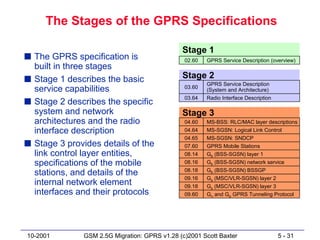
The Stages of the GPRS Specifications

                                               Stage 1
s The GPRS specification is                     02.60   GPRS Service Description (overview)
  built in three stages
s Stage 1 describes the basic                  Stage 2
                                                        GPRS Service Description
  service capabilities                          03.60
                                                        (System and Architecture)
                                                03.64   Radio Interface Description
s Stage 2 describes the specific
  system and network                           Stage 3
  architectures and the radio                   04.60   MS-BSS: RLC/MAC layer descriptions
  interface description                         04.64   MS-SGSN: Logical Link Control
                                                04.65   MS-SGSN: SNDCP
s Stage 3 provides details of the               07.60   GPRS Mobile Stations
  link control layer entities,                  08.14   Gb (BSS-SGSN) layer 1
  specifications of the mobile                  08.16   Gb (BSS-SGSN) network service
                                                08.18   Gb (BSS-SGSN) BSSGP
  stations, and details of the
                                                09.16   Gs (MSC/VLR-SGSN) layer 2
  internal network element                      09.18   Gs (MSC/VLR-SGSN) layer 3
  interfaces and their protocols                09.60   Gn and Gp GPRS Tunneling Protocol


10-2001        GSM 2.5G Migration: GPRS v1.28 (c)2001 Scott Baxter                    5 - 31
GPRS Initial Release Features

s All network manufacturers are expected to support IP and
  interworking with both internet and intranet in their first product
  release
    • To support this functionality, some form of server functionality
      must be provided
        – Domain Name Server (DNS) is required to translate
          between domain names and IP addresses
        – Dynamic Host Configuration Protocol (DHCP) is required to
          allow automatic reassignment of addresses for mobile
          hosts
s In early networks, a single SGSN will probably be sufficient due to
  the gradual growth of users and traffic as mobiles become
  available
s The connection between the GGSN and the MSC/VLR, HLR, and
  SMSC will require a gateway using SS7/IP or SIG to link the IP
  backbone with the interfaces to these network elements


10-2001        GSM 2.5G Migration: GPRS v1.28 (c)2001 Scott Baxter   5 - 32
GPRS


       A Closer View of the GPRS
       A Closer View of the GPRS
   Internal Interfaces and Elements
    Internal Interfaces and Elements


10-2001   GSM 2.5G Migration: GPRS v1.28 (c)2001 Scott Baxter   5 - 33
Serving GPRS Support Node (SGSN) Functions

s The Serving GPRS Support Node
  (SGSN) is responsible for the following
  to and from the mobile stations in its
  service area:
    • Packet Routing and Transfer
    • Mobility management (attach/detach
      and location management)
    • Logical Link management
    • Authentication and charging
      functions, encryption
    • Compression (optional)
    • Location register of SGSN stores
      location (cell, vlr) and user profiles
s A typical PLMN network will start with
  only one SGSN
s Each BSC has a Packet
  Communications Unit, PCU                               Several models of the
                                                         Nortel Passport Switch
    • Similar hardware provides the                  for SGSN and PCUSN service
      PCUSN function
 10-2001         GSM 2.5G Migration: GPRS v1.28 (c)2001 Scott Baxter      5 - 34
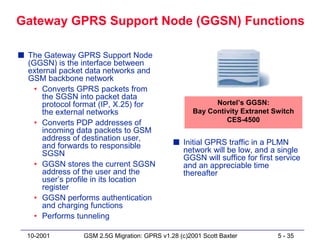
Gateway GPRS Support Node (GGSN) Functions

s The Gateway GPRS Support Node
  (GGSN) is the interface between
  external packet data networks and
  GSM backbone network
    • Converts GPRS packets from
      the SGSN into packet data
      protocol format (IP, X.25) for                       Nortel’s GGSN:
      the external networks                          Bay Contivity Extranet Switch
    • Converts PDP addresses of                               CES-4500
      incoming data packets to GSM
      address of destination user,
      and forwards to responsible             s Initial GPRS traffic in a PLMN
      SGSN                                      network will be low, and a single
                                                GGSN will suffice for first service
    • GGSN stores the current SGSN              and an appreciable time
      address of the user and the               thereafter
      user’s profile in its location
      register
    • GGSN performs authentication
      and charging functions
    • Performs tunneling

  10-2001        GSM 2.5G Migration: GPRS v1.28 (c)2001 Scott Baxter         5 - 35
GSM BTS Changes Required to Support GPRS
                                       Three Possible GPRS BSS Configurations
s Since GPRS uses new coding               Um                                             Gb
  schemes, a Channel Codec              Interface                                      Interface

  Unit (CCU) is required                            CCU     BTS                BSC
                                                            PCU
    • The CCU can normally be                       CCU
                                                                                                    SGSN

      implemented within BTS
      software                                                    PCU in BTS
                                                          Advantage: short Round Trip Delay

s Timeslot allocation for GPRS                                       Abis
  is handled by a new Packet                                      Interface
  Controller Unit (PCU) which                       CCU                        BSC
  also implements frame relay                       CCU
                                                          BTS                  PCU                  SGSN

  connection with the GPRS
  network                                                                                     PCU in BSC
    • The PCU function can be                                                                     Gb
      physically implemented in                                                                Interface
      the BTS, BSC, or at the                       CCU                        BSC
      SGSN, but is conceptually                     CCU
                                                          BTS                                 PCU    SGSN
      part of the BSS
                                                                PCU at SGSN
                                            Advantage: Leverage -- 1 PCUSN can manage multiple BSCs


 10-2001       GSM 2.5G Migration: GPRS v1.28 (c)2001 Scott Baxter                              5 - 36
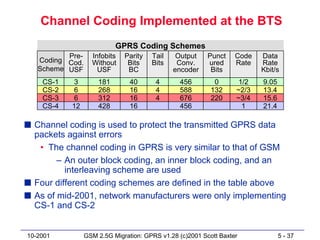
Channel Coding Implemented at the BTS
                           GPRS Coding Schemes
          Pre-     Infobits   Parity   Tail    Output     Punct    Code   Data
   Coding Cod.     Without     Bits    Bits    Conv.      ured     Rate   Rate
   Scheme USF        USF       BC             encoder      Bits           Kbit/s
    CS-1    3        181        40      4       456         0       1/2   9.05
    CS-2    6        268        16      4       588        132     ~2/3   13.4
    CS-3    6        312        16      4       676        220     ~3/4   15.6
    CS-4   12        428        16              456                  1    21.4

s Channel coding is used to protect the transmitted GPRS data
  packets against errors
   • The channel coding in GPRS is very similar to that of GSM
        – An outer block coding, an inner block coding, and an
          interleaving scheme are used
s Four different coding schemes are defined in the table above
s As of mid-2001, network manufacturers were only implementing
  CS-1 and CS-2


10-2001          GSM 2.5G Migration: GPRS v1.28 (c)2001 Scott Baxter             5 - 37
The MS-SGSN Interface

s Packet Controller functions are provided by
  the PCU, which is implemented in a
                                                             Physical BSC            A    VLR
  physical PCUSN in the BSS                                                  TCU
                                                                  Ater                    MSC
    • The PCUSN handles the GPRS-
      specific packet processing using frame                                        Gb
      relay protocols                                        BSC            PCUSN         SGSN
                                                                    Agprs
    • The PCUSN connects to the BSC with
      network manufacturers’ proprietary Agprs
                                                            BTS
      interfaces
    • The PCUSN connects to the SGSN via
      the standard-defined Gb interface                MS
s Although a PCUSN can optionally serve
  more than one BSC, all channels from one                PCUSN and PCU Distinction
                                                       •A PCUSN (Packet Controller Unit Serving
  BSC must pass through the same PCUSN                 Node) is the hardware unit which implements
s TRAU frames from the mobile pass through             the PCU (Packet Controller Unit) function

  the BTS to the BSC and on into the PCUSN


10-2001         GSM 2.5G Migration: GPRS v1.28 (c)2001 Scott Baxter                  5 - 38
MS-SGSN Logical Link Control (LLC)
            GMM SNDCP SMS                                      GMM SNDCP SMS

                 LLC                                                 LLC
                                          Relay
                 RLC           RLC                BSSGP             BSSGP

                 MAC              MAC        Network Svc        Network Service
                GSM/RF           GSM RF           L1                  L1

                  MS        Um          BSS               Gb       SGSN

s LLC provides the reliable link between MS and SGSN
s LLC supports these layer-3 Protocols:
   • SNDCP Sub-Network Dependent Convergence Protocol
   • GMM/SM GPRS Mobility & Session Management
   • SMS Short Message Service
s Protocols supported by the LLC provide:
   • Data ciphering for security
   • Flow control; sequential order of delivery; error detection/recovery
   • Acknowledged and Unacknowledged data transfer modes
s The LLC provides transparency - the lower level radio link protocols are
  not involved and do not affect the GPRS applications running above

10-2001         GSM 2.5G Migration: GPRS v1.28 (c)2001 Scott Baxter               5 - 39
MS-SGN Service Access Points (SAP) for LLC

s The LLC provides six service access points (SAP) to the upper
  layers
    • Each SAP has its own Service Access Point Identity (SAPI)
s The SAPs include:
    • GMM/SM - Service for Signaling for Session/Mobility
      Management
    • SMS - Short Message Service
    • QoS1 Packet Transmission SNDCP access
    • QoS2 Packet Transmission SNDCP access
    • QoS3 Packet Transmission SNDCP access
    • QoS4 Packet Transmission SNDCP access
s Frames are assembled/disassembled using a multiplex procedure
    • A logical link management entity (LLME) manages resources


10-2001      GSM 2.5G Migration: GPRS v1.28 (c)2001 Scott Baxter   5 - 40
The Gb Interface: PCU-SGSN
                                                                SMS-GMSC                OTHER
                                                                SMS-IWMSC             GPRS PLMN
s The SGSN and the PCUSNs of each BSC                                     Gd         Gp    GG
                                                                                           SN
  are linked by a backbone network using                                     SG
  Frame Relay protocol over the Gb interface           BTS       BSC
                                                                        Gb   SN
                                                                                      GG Gi
    • Data rate can be up to 2 Mbps                                Gf           Gn    SN
                                                          BTS           Gs Gr              PDN
    • Frame relay protocol implementation is
      actually simpler than X.25                                                     Gc
                                                                 EIR
s Layers at each node of the Gb :                    MS
                                                                       MSC D         HLR
    • Physical Layer                                                   VLR

    • Network Service Layer (NS)
    • Base Station Subsystem GPRS
      Protocol (BSSGP)
    • Network Management (NM)
         – GPRS Mobility Management
           (GMM)
         – LLC/Relay


10-2001         GSM 2.5G Migration: GPRS v1.28 (c)2001 Scott Baxter                   5 - 41
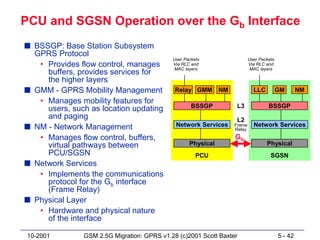
PCU and SGSN Operation over the Gb Interface
s BSSGP: Base Station Subsystem
  GPRS Protocol
                                            User Packets                 User Packets
   • Provides flow control, manages         Via RLC and                  Via RLC and
     buffers, provides services for
                                             MAC layers                   MAC layers

     the higher layers
s GMM - GPRS Mobility Management             Relay GMM NM                  LLC          GM       NM
   • Manages mobility features for
     users, such as location updating               BSSGP         L3              BSSGP
     and paging                                                   L2
s NM - Network Management                    Network Services    Frame
                                                                 Relay
                                                                           Network Services

   • Manages flow control, buffers,                              Gb
     virtual pathways between                      Physical                      Physical
     PCU/SGSN                                         PCU                          SGSN
s Network Services
   • Implements the communications
     protocol for the Gb interface
     (Frame Relay)
s Physical Layer
   • Hardware and physical nature
     of the interface

 10-2001       GSM 2.5G Migration: GPRS v1.28 (c)2001 Scott Baxter                      5 - 42
The Gn Interface: SGSN-GGSN
                                                              SMS-GMSC             OTHER
                                                              SMS-IWMSC          GPRS PLMN
s The SGSN and GGSN are linked by a                                    Gd       Gp    GG
                                                                                      SN
  GPRS backbone using IP routing                                           SG
                                                     BTS       BSC
s The Gn interface creates and operates                               Gb   SN
                                                                            GG Gi
  through secure tunnels, using the                              Gf      G SN
                                                                       Gr n
  GPRS Tunneling Protocol (GTP)                         BTS         Gs           PDN

s The GTP packet headers include                               EIR
                                                                                Gc

    • Tunnel endpoint and group identity           MS
                                                                     MSC D      HLR

    • PDU type                                                       VLR

    • QoS parameters
    • Routing protocol identification
        – Static, RIP2, OSPF
s Beneath IP, any transport architecture
  can be used
    • Ethernet, Token-Ring, FDDI, ISDN,
      ATM


10-2001       GSM 2.5G Migration: GPRS v1.28 (c)2001 Scott Baxter                5 - 43
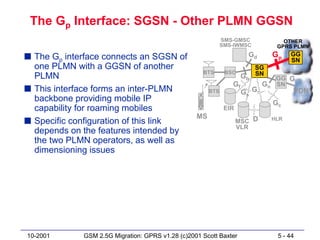
The Gp Interface: SGSN - Other PLMN GGSN
                                                             SMS-GMSC                OTHER
                                                             SMS-IWMSC             GPRS PLMN

s The Gp interface connects an SGSN of                                 Gd         Gp    GG
                                                                                        SN
  one PLMN with a GGSN of another                                         SG
                                                    BTS       BSC
  PLMN                                                               Gb   SN
                                                                                   GG Gi
                                                                Gf           Gn    SN
s This interface forms an inter-PLMN                   BTS           Gs Gr              PDN
  backbone providing mobile IP                                                    Gc
  capability for roaming mobiles                              EIR
                                                  MS
s Specific configuration of this link                               MSC D         HLR
                                                                    VLR
  depends on the features intended by
  the two PLMN operators, as well as
  dimensioning issues


10-2001      GSM 2.5G Migration: GPRS v1.28 (c)2001 Scott Baxter                   5 - 44
More About GPRS Tunneling on Gn and Gp
    GPRS TUNNELING PROTOCOL (GTP)                               SMS-GMSC                OTHER
                                                                SMS-IWMSC             GPRS PLMN
           PROTOCOL STACK
                                                                          Gd         Gp    GG
                               IP                                                          SN
GMM/SM SNDCP   GTP            GTP                                            SG
                                           IP          BTS       BSC         SN
     LLC     UDP/TCP Gn, Gp UDP/TCP                                     Gb            GG Gi
   BSSGP        IP             IP                                  Gf           Gn    SN
     NS         L2             L2          L2             BTS           Gs Gr              PDN
   L1B1s        L1             L1          L1                                        Gc
                                                                 EIR
        SGSN                        GGSN
                                                     MS
                                                                       MSC D         HLR
                                                                       VLR
s GPRS Tunneling Protocol (GTP) is used to carry user packets
  between nodes
   • GTP allows various protocols and is adaptable to both inter-
     and intra-PLMN GGSN interfaces
       – UDP/IP if reliable link is not required, TCP/IP if required


  10-2001       GSM 2.5G Migration: GPRS v1.28 (c)2001 Scott Baxter                   5 - 45
The Gn Interface: SGSN-GGSN
                                                              SMS-GMSC             OTHER
                                                              SMS-IWMSC          GPRS PLMN
s The SGSN and GGSN are linked by a                                    Gd       Gp    GG
                                                                                      SN
  GPRS backbone using IP routing                                           SG
                                                     BTS       BSC
s The Gn interface creates and operates                               Gb   SN
                                                                            GG Gi
  through secure tunnels, using the                              Gf      G SN
                                                                       Gr n
  GPRS Tunneling Protocol (GTP)                         BTS         Gs           PDN

s The GTP packet headers include                               EIR
                                                                                Gc

    • Tunnel endpoint and group identity           MS
                                                                     MSC D      HLR

    • PDU type                                                       VLR

    • QoS parameters
    • Routing protocol identification
        – Static, RIP2, OSPF
s Beneath IP, any transport architecture
  can be used
    • Ethernet, Token-Ring, FDDI, ISDN,
      ATM


10-2001       GSM 2.5G Migration: GPRS v1.28 (c)2001 Scott Baxter                5 - 46
The Gi Interface: GGSN-PDN
                                                               SMS-GMSC                OTHER
                                                               SMS-IWMSC             GPRS PLMN
s If the Gi interface is implemented via a                               Gd         Gp    GG
                                                                                          SN
  public network, IP Security Protocol                                      SG
  (IPSEC) can be used to provide link                 BTS       BSC
                                                                       Gb   SN
                                                                                     GG G
  authentication and encryption                                   Gf           Gn    SN i
    • This allows use of public networks                 BTS           Gs Gr              PDN
       such as the internet while                                                   Gc
       maintaining confidentiality of data                      EIR
                                                    MS
s The GGSN creates VPN tunnels using                                  MSC D         HLR
                                                                      VLR
  security protocols like IPSEC if needed
s Four tunneling protocols are available:
    • PPTP (client-initiated)
    • L2F, L2TP (implemented on ISP
       side)
    • IPSec (layer-3 secure protocol)
s Transparent and Non-Transparent
  modes are available


10-2001        GSM 2.5G Migration: GPRS v1.28 (c)2001 Scott Baxter                   5 - 47
The Gr Interface: SGSN-HLR
                                                              SMS-GMSC                  OTHER
                                                              SMS-IWMSC               GPRS PLMN

s The Gr interface is an extension of the                              Gd            Gp    GG
                                                                                           SN
  GSM-MAP (mobile application part)                                         SG
                                                     BTS       BSC          SN
s Most network manufacturers use an                                   Gb              GG Gi
                                                                 Gf             Gn    SN
  SS7 gateway element to provide                        BTS           GsG                  PDN
  interworking between the GPRS                                             r
                                                                                     Gc
  network and the SS7-based voice                              EIR
  network                                          MS
                                                                     MSC D           HLR
                                                                     VLR
    • This relieves the SGSN from having
      to do SS7 processing
    • The SS7 gateway can be a
      conventional server, usually with
      redundancy features on both the
      SGSN (IP) and SS7 sides


10-2001       GSM 2.5G Migration: GPRS v1.28 (c)2001 Scott Baxter                     5 - 48
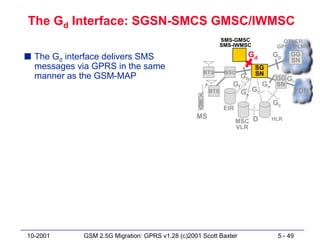
The Gd Interface: SGSN-SMCS GMSC/IWMSC
                                                             SMS-GMSC                OTHER
                                                             SMS-IWMSC             GPRS PLMN

s The Gd interface delivers SMS                                       Gd          Gp    GG
                                                                                        SN
  messages via GPRS in the same                                           SG
                                                    BTS       BSC
  manner as the GSM-MAP                                              Gb   SN
                                                                                   GG Gi
                                                                Gf           Gn    SN
                                                       BTS           Gs Gr              PDN
                                                                                  Gc
                                                              EIR
                                                  MS
                                                                    MSC D         HLR
                                                                    VLR


10-2001      GSM 2.5G Migration: GPRS v1.28 (c)2001 Scott Baxter                   5 - 49
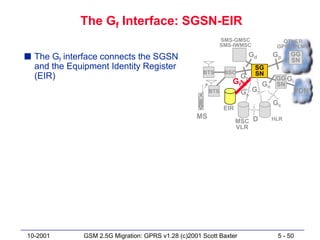
The Gf Interface: SGSN-EIR
                                                              SMS-GMSC                OTHER
                                                              SMS-IWMSC             GPRS PLMN

s The Gf interface connects the SGSN                                    Gd         Gp    GG
                                                                                         SN
  and the Equipment Identity Register                                      SG
                                                     BTS       BSC
  (EIR)                                                               Gb   SN
                                                                                    GG Gi
                                                                 Gf           Gn    SN
                                                        BTS           Gs Gr              PDN
                                                                                   Gc
                                                               EIR
                                                   MS
                                                                     MSC D         HLR
                                                                     VLR


10-2001       GSM 2.5G Migration: GPRS v1.28 (c)2001 Scott Baxter                   5 - 50
The Gs Interface: SGSN-MSC/VLR
                                                             SMS-GMSC                  OTHER
                                                             SMS-IWMSC               GPRS PLMN

s The Gs interface is optional                                           Gd         Gp    GG
                                                                                          SN
   • Provides simultaneous GPRS and                 BTS       BSC
                                                                          SG
                                                                          SN
     GSM operation between SGSN and                                  Gb              GG Gi
                                                                Gf             Gn    SN
     MSC/VLR (same as BSSMAP but                       BTS          Gs    Gr              PDN
     optional)                                                                      Gc
                                                              EIR
                                                  MS
                                                                    MSC D           HLR
                                                                    VLR


10-2001      GSM 2.5G Migration: GPRS v1.28 (c)2001 Scott Baxter                     5 - 51
The Gc Interface: GGSN-HLR
                                                              SMS-GMSC                OTHER
                                                              SMS-IWMSC             GPRS PLMN

s The Gc interface is optional                                          Gd         Gp    GG
                                                                                         SN
   • Provides the same functions as the              BTS       BSC
                                                                           SG
                                                                           SN
     MAP between GGSN and HLR                                         Gb            GG Gi
                                                                 Gf           Gn    SN
                                                        BTS           Gs Gr              PDN
                                                                                   Gc
                                                               EIR
                                                   MS
                                                                     MSC D         HLR
                                                                     VLR


10-2001       GSM 2.5G Migration: GPRS v1.28 (c)2001 Scott Baxter                   5 - 52
The D Interface: MSC/VLR - HLR
                                                              SMS-GMSC                 OTHER
                                                              SMS-IWMSC              GPRS PLMN

s The MAP-D interface is used by both                                   Gd          Gp    GG
                                                                                          SN
  GSM and GPRS networks to                                                 SG
                                                     BTS       BSC
  communicate between the HLR and                                     Gb   SN
                                                                                     GG Gi
  the VLR in the MSC                                             Gf            Gn    SN
                                                        BTS           Gs Gr               PDN
s This link is specified in the GSM-MAP                                             Gc
  and is not changed in GPRS                                   EIR
                                                   MS                      D        HLR
                                                                     MSC
                                                                     VLR


10-2001       GSM 2.5G Migration: GPRS v1.28 (c)2001 Scott Baxter                    5 - 53
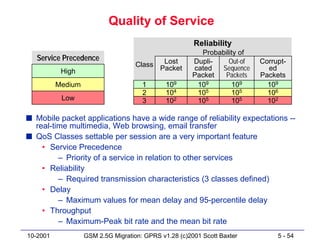
Quality of Service
                                                       Reliability
                                                         Probability of
   Service Precedence                        Lost      Dupli-    Out-of   Corrupt-
                                    Class
           High                             Packet     cated  Sequence      ed
                                                       Packet  Packets    Packets
          Medium                      1       109       109       109       109
                                      2       104       105       105       106
           Low                        3       102       105       105       102

s Mobile packet applications have a wide range of reliability expectations --
  real-time multimedia, Web browsing, email transfer
s QoS Classes settable per session are a very important feature
    • Service Precedence
         – Priority of a service in relation to other services
    • Reliability
         – Required transmission characteristics (3 classes defined)
    • Delay
         – Maximum values for mean delay and 95-percentile delay
    • Throughput
         – Maximum-Peak bit rate and the mean bit rate
10-2001            GSM 2.5G Migration: GPRS v1.28 (c)2001 Scott Baxter         5 - 54
Quality of Service: the Delay Parameter

                                      Delay
                       128 byte packet          1024 byte packet
              Class    Mean       95%           Mean       95%
                       Delay     Delay          Delay      Delay
                1      <0.5s     <1.5s           <2s        <7s
                2       <5s      <25s           <15s       <75s
                3      <50s      <250s          <75s      <375s
                4     Best Effort Best Effort Best Effort   Best Effort


s Using these QoS Classes, QoS profiles can be negotiated
  between the user and the network for each session, depending
  on QoS demand and currently available resources.
   • Billing is based on data volume, type of service, and QoS
     profile


10-2001       GSM 2.5G Migration: GPRS v1.28 (c)2001 Scott Baxter         5 - 55
Mobile Classes and Simultaneous Usage
s In a GSM network, two classes of service can run concurrently:
    • Circuit-Switched Services (speech, data, and SMS)
    • Packet-Switched Services (GPRS)
s Three Classes of Mobile Stations are defined:
    • Class A mobiles
        – Support simultaneous operation of GPRS and conventional GSM
          services, but two separate radio chains are required
    • Class B mobiles
        – Able to register with the network for both GPRS and conventional
          GSM services simultaneously, but can only use one of the two
          services at a given moment - voice can pre-empt data
    • Class C mobiles
        – Able to attach for either conventional GSM or GPRS, manually
          switched
        – Simultaneous registration (and usage) is not possible, except for
          SMS messages which can be received and sent at any time


10-2001         GSM 2.5G Migration: GPRS v1.28 (c)2001 Scott Baxter   5 - 56
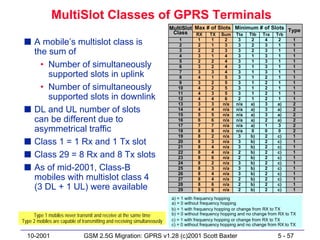
MultiSlot Classes of GPRS Terminals
                                                                          MultiSlot Max # of Slots Minimum # of Slots Type
                                                                           Class    RX   TX Sum Tta Ttb Tra Trb
 s A mobile’s multislot class is                                              1
                                                                              2
                                                                                      1
                                                                                      2
                                                                                             1
                                                                                             1
                                                                                                   2
                                                                                                   3
                                                                                                          3
                                                                                                          3
                                                                                                                2
                                                                                                                2
                                                                                                                       4
                                                                                                                       3
                                                                                                                             2
                                                                                                                             1
                                                                                                                                    1
                                                                                                                                    1
   the sum of                                                                 3
                                                                              4
                                                                                      2
                                                                                      3
                                                                                             2
                                                                                             1
                                                                                                   3
                                                                                                   4
                                                                                                          3
                                                                                                          3
                                                                                                                2
                                                                                                                1
                                                                                                                       3
                                                                                                                       3
                                                                                                                             1
                                                                                                                             1
                                                                                                                                    1
                                                                                                                                    1

     • Number of simultaneously
                                                                              5       2      2     4      3     1      3     1      1
                                                                              6       3      2     4      3     1      3     1      1
       supported slots in uplink                                              7
                                                                              8
                                                                                      3
                                                                                      4
                                                                                             3
                                                                                             1
                                                                                                   4
                                                                                                   5
                                                                                                          3
                                                                                                          3
                                                                                                                1
                                                                                                                1
                                                                                                                       3
                                                                                                                       2
                                                                                                                             1
                                                                                                                             1
                                                                                                                                    1
                                                                                                                                    1
                                                                              9       3      2     5      3     1      2     1      1
     • Number of simultaneously                                              10       4      2     5      3     1      2     1      1

       supported slots in downlink
                                                                             11       4      3     5      3     1      2     1      1
                                                                             12       4      4     6      2     1      2     1      1
                                                                             13       3      3    n/a    n/a    a)     3     a)     2
 s DL and UL number of slots                                                 14
                                                                             15
                                                                                      4
                                                                                      5
                                                                                             4
                                                                                             5
                                                                                                  n/a
                                                                                                  n/a
                                                                                                         n/a
                                                                                                         n/a
                                                                                                                a)
                                                                                                                a)
                                                                                                                       3
                                                                                                                       3
                                                                                                                             a)
                                                                                                                             a)
                                                                                                                                    2
                                                                                                                                    2
   can be different due to                                                   16       6      6    n/a    n/a    a)     2     a)     2

   asymmetrical traffic
                                                                             17       7      7    n/a    n/a    a)     1     3      2
                                                                             18       8      8    n/a    n/a    0      0     0      2
                                                                             19       8      2    n/a     3     b)     2     c)     1
 s Class 1 = 1 Rx and 1 Tx slot                                              20
                                                                             21
                                                                                      8
                                                                                      8
                                                                                             3
                                                                                             4
                                                                                                  n/a
                                                                                                  n/a
                                                                                                          3
                                                                                                          3
                                                                                                                b)
                                                                                                                b)
                                                                                                                       2
                                                                                                                       2
                                                                                                                             c)
                                                                                                                             c)
                                                                                                                                    1
                                                                                                                                    1

 s Class 29 = 8 Rx and 8 Tx slots                                            22
                                                                             23
                                                                                      8
                                                                                      8
                                                                                             4
                                                                                             6
                                                                                                  n/a
                                                                                                  n/a
                                                                                                          2
                                                                                                          2
                                                                                                                b)
                                                                                                                b)
                                                                                                                       2
                                                                                                                       2
                                                                                                                             c)
                                                                                                                             c)
                                                                                                                                    1
                                                                                                                                    1
                                                                             24       8      2    n/a     3     b)     2     c)     1
 s As of mid-2001, Class-B                                                   25       8      3    n/a     3     b)     2     c)     1

   mobiles with multislot class 4
                                                                             26       8      4    n/a     3     b)     2     c)     1
                                                                             27       8      4    n/a     2     b)     2     c)     1

   (3 DL + 1 UL) were available                                              28
                                                                             29
                                                                                      8
                                                                                      8
                                                                                             6
                                                                                             6
                                                                                                  n/a
                                                                                                  n/a
                                                                                                          2
                                                                                                          2
                                                                                                                b)
                                                                                                                b)
                                                                                                                       2
                                                                                                                       2
                                                                                                                             c)
                                                                                                                             c)
                                                                                                                                    1
                                                                                                                                    1
                                                                          a) = 1 with frequency hopping
                                                                          a) = 0 without frequency hopping
                                                                          b) = 1 with frequency hopping or change from RX to TX
     Type 1 mobiles never transmit and receive at the same time           b) = 0 without frequency hopping and no change from RX to TX
Type 2 mobiles are capable of transmitting and receiving simultaneously   c) = 1 with frequency hopping or change from RX to TX
                                                                          c) = 0 without frequency hopping and no change from RX to TX

  10-2001                      GSM 2.5G Migration: GPRS v1.28 (c)2001 Scott Baxter                                           5 - 57
GPRS

          Session Management
          Session Management
          Mobility Management
          Mobility Management
                 Routing
                 Routing


10-2001   GSM 2.5G Migration: GPRS v1.28 (c)2001 Scott Baxter   5 - 58
Attachment and Detachment Procedure

s Before a mobile station can use GPRS services, it must register
  with an SGSN of the GPRS network
   • The network checks to see if the user is authorized
   • copies the user profile from the HLR to the SGSN
   • assigns a packet temporary mobile subscriber identity (P-
      TMSI) to the user
   • This procedure is called GPRS attach
s For mobile stations with both circuit-switched and packet-switched
  services it is possible to perform combined GPRS/IMSI attach
  procedures
s Disconnection from the GPRS network is called GPRS detach
   • can be initiated by the mobile station
   • Can be initiated by the network (SGSN or HLR)


10-2001       GSM 2.5G Migration: GPRS v1.28 (c)2001 Scott Baxter   5 - 59
Session Management - PDP Context

s Suppose a mobile has successfully completed GPRS attach
s To exchange data packets with external PDNs, the mobile must apply for
  one or more addresses used in the PDN
     • An IP address in case the PDN is an IP network
     • This is called a Packet Data Protocol Address (PDP address)
s For each session, a PDP context is created describing its characteristics.
  It contains:
     • PDP type (IPv4, etc)
     • PDP address (129.187.222.10)
     • The requested QoS
     • The address of the GGSN that serves as the access point to the PDN
s The PDP context is stored in the MS, the SGSN, and the GGSN
s With an active PDP context, the mobile is “visible” to the external PDN
  and can send and receive packets
     • Mapping between the PDP and IMSI enables the GGSN to transfer
       data packets between the PDN and the MS
     • A user may have several simultaneous PDP contexts active at once

10-2001         GSM 2.5G Migration: GPRS v1.28 (c)2001 Scott Baxter    5 - 60
Allocation of PDP Addresses

s PDP address allocations can be static or dynamic
   • Static: User’s Home-PLMN network operator assigns a
     permanent PDP address to the user
   • Dynamic: A PDP address is assigned to the user upon
     activation of a PDP context
       – Can be assigned by the home PLMN (dynamic home-
          PLMN PDP address)
       – Can be assigned by the visited PLMN (dynamic visited-
          PLMN PDP address)
   • The home PLMN operator decides which alternative is used
   • In case of dynamic PDP addresses, the GGSN is responsible
     for the allocation and the activation/deactivitation of PDP
     addresses


10-2001       GSM 2.5G Migration: GPRS v1.28 (c)2001 Scott Baxter   5 - 61
PDP Context Activation Procedure
            MS                                 SGSN                              GGSN
               Activate PDP context request
               [PDP type, PDP address,
               QoS requested, access point…]

               Security functions
                                                 Create PDP context request
                                                 [PDP type, PDP address,
                                                 QoS requested, access point…]

                                                 Create PDP context response
               Activate PDP context accept       [PDP type, QoS negotiated…]
               [PDP type, PDP address,
               QoS negotiated…]


s The mobile station requests a PDP context from the SGSN
   • If dynamic PDP address assignment is requested, the parameter PDP
     address will be left empty
s Security functions (authentication) will be performed
s SGSN will ask for a PDP context from the GGSN
s The GGSN will create a new entry in its PDP context table
s GGSN sends confirmation to the SGSN including address if dynamic
s SGSN updates its PDP context table and confirms to the mobile

10-2001        GSM 2.5G Migration: GPRS v1.28 (c)2001 Scott Baxter                      5 - 62
Anonymous PDP Context Activation
             MS                               SGSN                              GGSN
              Activate PDP context request
              [PDP type, PDP address,
              QoS requested, access point…]

              Security functions
                                                Create PDP context request
                                                [PDP type, PDP address,
                                                QoS requested, access point…]

                                                Create PDP context response
              Activate PDP context accept       [PDP type, QoS negotiated…]
              [PDP type, PDP address,
              QoS negotiated…]


s GPRS also supports anonymous PDP context activation
   • In this case, security functions are skipped
   • The user (IMSI) using the PDP context is not known to the
     network
s Anonymous context activation can be used for prepaid services,
  where the user does not want to be identified
   • Only dynamic address allocation is possible in this case

10-2001       GSM 2.5G Migration: GPRS v1.28 (c)2001 Scott Baxter                      5 - 63
Routing - An Example
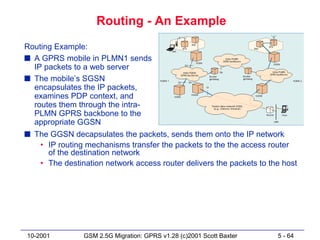
Routing Example:
s A GPRS mobile in PLMN1 sends
  IP packets to a web server
s The mobile’s SGSN
  encapsulates the IP packets,
  examines PDP context, and
  routes them through the intra-
  PLMN GPRS backbone to the
  appropriate GGSN
s The GGSN decapsulates the packets, sends them onto the IP network
   • IP routing mechanisms transfer the packets to the the access router
     of the destination network
   • The destination network access router delivers the packets to the host


10-2001         GSM 2.5G Migration: GPRS v1.28 (c)2001 Scott Baxter   5 - 64
Routing - Another Example
s Suppose the home-PLMN of
  the mobile station is PLMN2
s An IP address has been
  assigned to the mobile by the
  GGSN of PLMN2
    • Mobile’s IP address has
      same network prefix as the
      IP address of the GGSN in
      PLMN2
s The correspondent host is now sending IP packets to the MS
s Packets enter the IP network, are routed to the GGSN of PLMN2
    • This is the home-GGSN of the mobile
s The GGSN queries the HLR, finds the mobile currently in PLMN1
    • It encapsulates the incoming IP packets and tunnels them
      through the inter-PLMN GPRS backbone to the appropriate
      SGSN in PLMN1
s The SGSN decapsulates the packets and delivers them to the MS

10-2001      GSM 2.5G Migration: GPRS v1.28 (c)2001 Scott Baxter   5 - 65
Location Management

s The main task of location management is to keep track of the
  user’s current location
   • This allows incoming packets to be routed to the MS
s The MS frequently sends location update messages to its SGSN
   • If the mobile sends updates infrequently, its location is not
     known and paging is necessary for each downlink packet
     (adding considerable delay)
   • If the mobile sends updates frequently, its location is well
     known and data packets can be delivered with no paging delay
   • Location updates consume battery power and uplink radio
     capacity, so a balance is required to optimize resource usage
s To optimize the location management function in GPRS, a state
  model has been created and applied


10-2001       GSM 2.5G Migration: GPRS v1.28 (c)2001 Scott Baxter   5 - 66
The GPRS Location Management State Model

s A mobile can be in any of three states
                                                                                      IDLE
  depending on its current traffic level


                                                           STANDBY Timer Expired
    • Location update frequency is dependent                                       GPRS         GPRS
      on the MS state                                                              attach       detach

s In IDLE state, the mobile is not reachable                                         READY
s Performing a GPRS attach, the mobile
                                                                                   READY         Trans-
  enters the READY state                                                           timer         mission
                                                                                   Expired or    of a
s With a GPRS detach the mobile may                                                Forced to     packet
  disconnect from the network and fall back                                        Standby
  into the IDLE state                                                              STANDBY
    • all PDP contexts will be deleted
s The STANDBY state is reached when a MS
  does not send any packets for a long period
    • The READY timer expires


10-2001       GSM 2.5G Migration: GPRS v1.28 (c)2001 Scott Baxter                            5 - 67
Mobile Action based on GPRS Location State

s In IDLE state, no location updating is performed
    • The current location of the mobile is unknown to the network
s An MS in READY state informs its SGSN of every movement to a new cell
s A GSM Location Area is divided into several Routing Areas (RAs)
    • An RA can consist of one or several cells
s A MS in STANDBY state will inform its SGSN only when it moves into a
  new RA
    • Cell changes are not disclosed
s To find out the current cell of a MS in STANDBY, the mobile is paged
  throughout the current RA
s For MS in READY state, no paging is necessary
s Whenever a mobile moves to a new RA, it sends a “routing area update
  request” to its assigned SGSN
    • Message contains the routing area identity (RAI) of its old RA
    • The BSS adds the cell identifier of the new cell, from which the SGSN
      can derive the new RAI


10-2001         GSM 2.5G Migration: GPRS v1.28 (c)2001 Scott Baxter   5 - 68
Intra-SGSN Routing Area Updates
            MS                                   BSS                                   SGSN
              Routing area update request            Routing area update request
              [Old RAI, old P-TMSI signature,        [Old RAI, old P-TMSI signature,
              Update type]                           Update type, CI]

                                          Security functions

                                           Routing area update accept
                                           [P-TMSI, PTMSI signature)

                           Routing area update complete
                           [P-TMSI] (optional)


s The mobile has moved into an RA that is assigned to the same
  SGSN as the old RA
    • The SGSN already has the necessary user profile
    • SGSN can assign a new packet temporary mobile subscriber
      identity (P-TMSI)
s Since the routing context does not change, there is no need to
  inform other network elements, such as the GGSN or the HLR


10-2001       GSM 2.5G Migration: GPRS v1.28 (c)2001 Scott Baxter                             5 - 69
Inter-SGSN Routing Area Updates
            MS                                   BSS                                   SGSN
              Routing area update request            Routing area update request
              [Old RAI, old P-TMSI signature,        [Old RAI, old P-TMSI signature,
              Update type]                           Update type, CI]

                                          Security functions

                                           Routing area update accept
                                           [P-TMSI, PTMSI signature)

                           Routing area update complete
                           [P-TMSI] (optional)


s The new RA is administered by a different SGSN than the old RA
s The new SGSN realizes that the MS has changed to its area and
  requests the old SGSN to send the PDP contexts of the user
s The new SGSN informs the involved GGSNs of the users new
  routing context
s The HLR (and if needed, the MSC/VLR) are informed about the
  user’s new SGSN


10-2001       GSM 2.5G Migration: GPRS v1.28 (c)2001 Scott Baxter                             5 - 70
Combined RA/LA Updates

 s It is also possible to have combined Routing Area/Location Area
   updates
     • These occur when a mobile using GPRS as well as
        conventional GSM moves into a new LA
 s The MS sends a “routing area update request” to the SGSN
     • The parameter “update type” is used to indicate that an LA
        update is needed
     • This message is forwarded to the VLR, which performs the LA
        update

                     SUMMING IT ALL UP:
               MICRO vs MACRO MOBILITY MANAGEMENT
•Micro mobility management tracks the current routing area or cell of the
mobile station.
    •It’s performed by the SGSN
•Macro mobility management keeps track of the mobile station’s current
SGSN and stores it in the HLR, VLR, and GGSN
  10-2001        GSM 2.5G Migration: GPRS v1.28 (c)2001 Scott Baxter   5 - 71
GPRS


Air Interface -- Physical Layer
Air Interface Physical Layer


10-2001   GSM 2.5G Migration: GPRS v1.28 (c)2001 Scott Baxter   5 - 72
Logical Channels in GPRS

s A series of logical channels are defined on top of the physical
  channels for various purposes
   • Signaling
   • Broadcast of general system information
   • Synchronization
   • Channel assignment
   • Paging
   • Payload Transport
s These channels can be divided into two broad categories:
   • Traffic Channels
   • Signaling (control) Channels


10-2001        GSM 2.5G Migration: GPRS v1.28 (c)2001 Scott Baxter   5 - 73
GPRS Logical Channels


      DOWNLINK CHANNELS                                                UPLINK CHANNELS
                               Packet Broadcast
        PBCCH                  Control Channel
                               Packet Common         Packet Common
        PCCCH                  Control Channel       Control Channel          PCCCH
                                Packet Access        Packet Random
            PAGCH               Grant Channel        Access Channel        PRACH
                                 Packet Paging
            PPCH                   Channel
                               Packet Associated
            PACCH               Control Channel

BTS         PTCCH
                             Packet Timing Advance
                                Control Channel
                               Packet Notification
            PNCH                   Channel
                                 Packet Data          Packet Data
        PDTCH/D                 Traffic Channel      Traffic Channel        PDTCH/U


  10-2001          GSM 2.5G Migration: GPRS v1.28 (c)2001 Scott Baxter             5 - 74
Functions of the Logical Channels
s The packet data traffic channel (PDTCH) is used to transfer user data
    • Assigned to one mobile station (or multiple stations if a PTM)
    • One mobile can use several PDTCHs simultaneously
s The packet broadcast control channel (PBCCH) is a unidirectional point-
  to-multipoint signaling channel from the BSS to mobile stations
    • Used by the BSS to broadcast configuration data about the GPRS
      network to all GPRS mobile stations
    • The PBCCH also broadcasts configuration data about the GSM cell so
      a GSM/GPRS mobile does not need to listen to the BCCH
s The packet common control channel transports signaling information for
  network access management (allocation of radio resources & paging). It
  consists of four sub-channels:
    • The packet random access channel (PRACH) is used by the mobile to
      request one or more PDTCH
    • The packet access grant channel (PAGCH) is used to allocate one or
      more PDTCH to a mobile
    • The packet paging channel (PPCH) is used by the BSS to find out the
      location of a mobile (paging) prior to downlink packet transmission
    • The packet notification channel (PNCH) informs a mobile station of
      incoming PTM messages (multicast or group call)
10-2001        GSM 2.5G Migration: GPRS v1.28 (c)2001 Scott Baxter   5 - 75
More Logical Channel Detail

s The Dedicated Control Channel is a bidirectional point-to-point
  signaling channel. It contains:
    • The packet associated control channel (PACCH)
         – Always allocated in combination with one or more PDTCH
           assigned to one mobile
         – Transports power control information
    • The Packet timing advance control channel (PTCCH) is used
      for adaptive frame synchronization
s Coordination between circuit-switched and packet-switched
  channels is important
    • If the PCCCH is not available in a cell, the mobile can use the
      CCCH of conventional GSM to initiate a packet transfer
    • If the PBCCH is not available, it will listen to the broadcast
      control channel (BCCH) to get info on network configuration


10-2001        GSM 2.5G Migration: GPRS v1.28 (c)2001 Scott Baxter   5 - 76
Uplink Channel Allocation
              MS                                             BSS

                   Packet channel
                      request         PRACH or RACH
                   Packet immediate
                     assignment       PRAGCH or AGCH
                   Packet resource
                      request             PACCH
                                           (Optional)
                    Packet resource
                      assignment          PACCH
                                           (Optional)


s Mobile requests radio resources for uplink transfer by sending a
  “packet channel request” on the PRACH or RACH
s The network answers on the PAGCH or AGCH, telling the mobile
  which PDCHs it may use
s An uplink state flag is transmitted on the downlink telling the
  mobile whether the uplink is free


10-2001       GSM 2.5G Migration: GPRS v1.28 (c)2001 Scott Baxter   5 - 77
Mapping of Packet Data Logical Channels
           onto Physical Channels

s The mapping of logical channels onto physical channels has two
  components:
    • Mapping in frequency based on the TDMA frame number and the
       frequencies allocated to the BTS and the mobile station
    • Mapping in time based on the definition of complex multiframe
       structures on top of the TDMA frames
s A multiframe structure for PDCHs consisting of 52 TDMA frames is shown
  in the next slide
    • Four consecutive TDMA frames form one block (12 blocks, B011),
       Two TDMA frames are reserved for transmission of the PTCCH, and
       the remaining two frames are idle frames
s The mapping of logical channels into blocks B0-B11 of the multiframe can
  vary from block to block and is controlled by parameters broadcast on the
  PBCCH
s Besides the 52-multiframe, which can be used by all logical GPRS
  channels, a 51-multiframe structure is defined. It is used for PDCHs
  carrying only the logical channels PCCCH and PBCCH and no other
  logical channels


10-2001         GSM 2.5G Migration: GPRS v1.28 (c)2001 Scott Baxter   5 - 78
GPRS Physical Channel: 52-Multiframe
                52-multiframe
                  B0   B1   B2 T B3   B4   B5 X B6   B7   B8 T B9 B10 B11 B12 X


                                            240 ms.

                T - Frame for PICCH
                X - Idle frame

s The GPRS 52-multiframe is made up of two 26 control multiframes
  of voice mode GSM
    • Made up of 12 blocks, B0-B11 of four frames each, plus four
      additional frames
    • Length: 240 ms.
    • Packet mode control and data channels are mapped into
      different slots
s A multislot MS can be assigned up to eight slots in any frame of
  any of 12 blocks
s In a given cell up to four downlink/uplink pairs of 52-multiframes
  can be generated on four different pairs of frequencies

10-2001       GSM 2.5G Migration: GPRS v1.28 (c)2001 Scott Baxter                 5 - 79
GPRS


           Channel Coding
           Channel Coding


10-2001   GSM 2.5G Migration: GPRS v1.28 (c)2001 Scott Baxter   5 - 80
Application of Channel Coding: Example

            Block     Pre-coding       Add         Convolut’l
                                                                 Puncturing
           Encoder     Of USF         Tail bits     encoder


s Suppose that coding scheme CS-2 is being used
   • The coding steps are shown in functional block form above
s First, 271 information bits (including the 3-bit uplink state flag USF)
  are mapped to 287 bits using a systematic block encoder
   • In other words, 16 parity bits are added
   • The USF pre-encoding maps the first three bits of the
      information block (the USF) to six bits in a systematic way
   • Four zero tail bits are added at the end of the block
         – The tail bits are needed for termination of the subsequent
           convolutional coding
   • For the convolutional coding, a non-systematic rate-1/2
      encoder of constraint length 4 is used

10-2001         GSM 2.5G Migration: GPRS v1.28 (c)2001 Scott Baxter           5 - 81
Coding of the PDTCH Traffic Channel

s One of the four coding schemes is chosen for the PDTCH, depending on
  the quality of the channel
    • Under bad conditions, use CS-1 and obtain a data rate of 9.05 kbit/s
      per GSM time slot, but with very reliable coding
    • Under good conditions, we may transmit without convolutional
      encoding and achieve a data rate of 21.4 kbit/s per time slot
    • With eight time slots we would obtain a data rate of 171.4 kbit/s
    • In practice, multiple users share the time slots, and a much lower rate
      is available to the individual user
         – About 40 kbit/s per user if three users share the slots and CS-3 is
           employed
s CS-1 is used for coding the signaling channels
s After encoding, the codewords are input to a block interleaver of depth 4
    • On the receiver side, the codewords are de-interleaved
    • The decoding is performed using the well-known Viterbi Algorithm


10-2001          GSM 2.5G Migration: GPRS v1.28 (c)2001 Scott Baxter    5 - 82
GPRS


          Protocol Architecture
          Protocol Architecture


10-2001     GSM 2.5G Migration: GPRS v1.28 (c)2001 Scott Baxter   5 - 83
GPRS PROTOCOL ARCHITECTURE
                  MS                       BSS                              SGSN                       GGSN
              Application
               Network                                                                                Network
                 Layer                                                                                  Layer
               (IP, X.25                                                                              (IP, X.25
                                                                            Relay
                SNDCP                                                                                    GTP
                                                                   SNDCP              GTP

                  LLC                                               LLC        TCP/UDP                TCP/UDP

Data Link                                  Relay
 Layer            RLC                                              BSSGP             IP                    IP
                                RLC                 BSSGP

                 MAC                MAC           Network          Network     Data Link              Data Link
                                                  Service          Service      Layer                  Layer

                  PLL               PLL
Physical                                            Phy.            Phy.            Phy.                 Phy.
 Layer                                              Layer           Layer           Layer                Layer
                  RFL               RFL
                            Um                                Gb                                Gn                      Gi
            SNDCP Subnetwork dependent convergence protocol           BSSGP    BSS GPRS application protocol
            LLC   Logical link control
            RLC   Radio link control                                  GTP      GPRS tunneling protocol
            MAC   Medium access control                               TCP      Transmission control protocol
            PLL   Physical link layer                                 UDP      User datagram protocol
            RFL   Physical RF layer                                   IP        Internet Protocol


  10-2001               GSM 2.5G Migration: GPRS v1.28 (c)2001 Scott Baxter                                    5 - 84
GPRS Backbone: SGSN GGSN
s User data packets are encapsulated within the GPRS backbone network
    • GPRS tunneling protocol tunnels user data packets and related
       signaling information between the GPRS support nodes (GSNs)
s The protocol is defined for two instances:
    • between GSNs of one PLMN (Gn interface)
    • Between GSNs of different PLMNs (Gp interface)
s In the transmission plane, GTP uses a tunnel mechanism to transfer user
  data packets
s In the signaling plane, GTP specifies a tunnel control and management
  protocol
    • The signaling is used to create, modify, and delete tunnels
s GTP packets carry the user’s IP or X.25 packets
    • Below GTP, the standard protocols TCP or UDP are used to transport
       the GTP packets within the backbone network
    • X.25 expects a reliable data link, so TCP is used
    • UDP is used for access to IP-based packet data networks, which do
       not expect reliability in the network layer or below
    • IP is used in the network layer to route packets through the backbone
    • Ethernet, ISDN, or ATM-based protocols may be used below IP

10-2001         GSM 2.5G Migration: GPRS v1.28 (c)2001 Scott Baxter   5 - 85
Subnetwork Dependent Convergence Protocol

s The Subnetwork Dependent Convergence Protocol SNDCP is
  used to transfer data packets between the SGSN and MS. Its
  functionality includes:
s Multiplexing of several connections of the network layer onto one
  virtual logical connection of the underlying LLC layer
s Compression and decompression of user data and redundant
  header information


10-2001       GSM 2.5G Migration: GPRS v1.28 (c)2001 Scott Baxter   5 - 86
GPRS Downlink/Uplink Segmentation

                                PDU
LLC                                                                             LLC
                FH           Information Header              FCS
Frame                                                                           Layer


RLC
         BH Info Field BCS        BH Info Field BCS         BH Info Field BCS
Blocks                                                                          RLC/MAC
                                                                                Layer


                Normal Burst Normal Burst Normal Burst Normal Burst             Physical
                                                                                Layer


   FH: Frame Header                  BH: Block Header
   FCS: Frame Check Sequence         BCS: Block Check Sequence


    10-2001           GSM 2.5G Migration: GPRS v1.28 (c)2001 Scott Baxter       5 - 87
GPRS Transmission/Reception Data Flow

s A temporary block flow (TBF) is a physical connection used by the
  two radio resource (RR) entities to support the unidirectional
  transfer of Logical Link Control (LLC) PDUs on packet data
  physical channels
s The TBF is allocated some radio resources on one or more
  PDCHs and comprises a number of RLC/MAC blocks carrying one
  or more LLC PDUs.
s A radio block consists of a 1 byte MAC header, followed by RLC
  data or an RLC/MAC control block and terminated by a 16-bit
  block check sequence (BCS)
    • It is carried by four normal bursts (I.e., it’s 57 bits long)
s A TBF is temporary and is maintained only for the duration of the
  data transfer
s Each TBF is assigned a temporary flow identity (TFI) by the
  network; the TFI is unique in both directions.


10-2001       GSM 2.5G Migration: GPRS v1.28 (c)2001 Scott Baxter   5 - 88
GPRS Slot Assignments and Throughput

s GPRS allows a maximum of eight slots per frame to be allocated
  to the PDTCH on the downlink and uplink on all radio blocks B0-
  B11.
s On the downlink, an IP datagram of 1500 bytes to be transmitted
  as an LLC PDU must first be fragmented into 29 RLC blocks
    • These blocks can be transmitted using a total of 116
      consecutive bursts
    • During one 52-multiframe with an 8 slots/frame dynamic
      allocation scheme, 3.3 such IP datagrams can be transmitted,
      yielding a maximum rate of 165.5 kb/s for the GPRS downlink
s On the uplink, an IP datagram of 1500 bytes to be transmitted as
  an LLC PDU, is fragmented into 31 RLC blocks which can be
  transmitted in 124 slots.
    • During one 52-multiframe with an 8 slots/frame dynamic
      allocation scheme, three such IP datagrams can be
      transmitted, yielding a maximum rate of 154 kb/s for the GPRS
      uplink

10-2001       GSM 2.5G Migration: GPRS v1.28 (c)2001 Scott Baxter   5 - 89
Air Interface: Data Link Layer - LLC

s The data link layer between the MS and the network is divided into
  two sublayers
    • LLC layer (between MS-SGSN)
    • RLC/MAC layer (between MS-BSS)
s The LLC layer provides a highly reliable logical link between an
  MS and its assigned SGSN
    • Uses HDLC protocol including sequence control, in-order
      delivery, flow control, error detection, and retransmission
      (ARQ), and ciphering for confidentiality
    • Variable frame lengths are possible
    • Both acknowledged and unacknowledged modes are
      supported
    • The protocol is mainly an adapted version of LAPDm of GSM


10-2001       GSM 2.5G Migration: GPRS v1.28 (c)2001 Scott Baxter   5 - 90
Air Interface - Data Link Layer RLC/MAC

s The RLC/MAC layer includes two functions:
   • Reliable link between the MS and BSS
       – Includes segmentation and reassembly of LLC frames into
         RLC data blocks and ARQ of uncorrectable codewords
   • Medium Access Control MAC layer controls the access
     attempts of the MS on the radio channel shared by several
     MSs
       – Algorithms for contention resolution, multiuser multiplexing
         on a PDTCH, scheduling and prioritization based on the
         negotiated QoS
       – Uses Slotted Aloha principle
       – Both acknowledged and unacknowledged modes are
         supported


10-2001        GSM 2.5G Migration: GPRS v1.28 (c)2001 Scott Baxter   5 - 91
Air Interface Physical Layer

s The physical layer is divided into two sublayers:
s The Physical Link Layer PLL
   • Provides a physical channel between the MS and the BSS
   • Tasks include:
        – Channel coding, detection of errors, forward error
          correction (FEC), indication of uncorrectable codewords,
          interleaving, and detection of physical link configuration
s The Physical RF Layer RFL
   • The RFL operates below the PLL
   • Its main roles are modulation and demodulation
s BSS SGSN Interface
   • The BSS GPRS Application Protocol (BSSGP) delivers routing
     and QoS information between BSS and SGSN
   • The underlying Network Service (NS) protocol is based on the
     Frame Relay protocol

10-2001       GSM 2.5G Migration: GPRS v1.28 (c)2001 Scott Baxter   5 - 92
Signaling Plane

s The protocol architecture of the signaling plane includes protocols
  for control and support of the functions of the transmission plane:
    • GPRS attach and detach
    • PDP context activation
    • Control of routing paths
    • Allocation of network resources
s Between MS and SGSN, the GPRS Mobility Management and
  Session Management (GMM/SM) is used
s Signaling architecture between SGSN and HLR, VLR, and EIR are
  the same as used in conventional GSM with a few additions


10-2001        GSM 2.5G Migration: GPRS v1.28 (c)2001 Scott Baxter   5 - 93
Interworking with IP Networks

s GPRS supports both IPv4 and IPv6
    • The Gi interface is the interworking point with IP networks
    • From outside, the GPRS network looks like any other IP subnetwork,
      and the GGSN looks alike a usual IP router
s Each registered user who wants to exchange data packets with the IP
  network gets an IP address
    • The IP address is taken from the address space of the GPRS operator
    • In order to support a large number of mobile users, it is essential to
      use dynamic IP address allocation (in IPv4)
         – DHCP server is installed; the address resolution between IP and
           GSM is performed by the GGSN using the appropriate PDP
           context
s To protect the PLMN from unauthorized access, a firewall is installed
  between the private GPRS network and the external IP network
s With this configuration, GPRS can be seen as a wireless extension of the
  Internet all the way to a mobile station or mobile computer. The mobile
  user has direct connection to the Internet!


10-2001         GSM 2.5G Migration: GPRS v1.28 (c)2001 Scott Baxter   5 - 94
GPRS:


          Nortel Implementation
          Nortel Implementation


10-2001     GSM 2.5G Migration: GPRS v1.28 (c)2001 Scott Baxter   5 - 95
Nortel GPRS-UMTS Integration


10-2001     GSM 2.5G Migration: GPRS v1.28 (c)2001 Scott Baxter   5 - 96
Nortel Managed Packet WAN


10-2001    GSM 2.5G Migration: GPRS v1.28 (c)2001 Scott Baxter   5 - 97
Feedback from GPRS Trials in UK


                                                                   Credit RCR News,
                                                                    March 19, 2001
                                                                   www.rcrnews.com


10-2001      GSM 2.5G Migration: GPRS v1.28 (c)2001 Scott Baxter            5 - 98
GPRS PDAs: Microsoft Muscles In

s Microsoft’s smart phone
  platform is based on Windows
  CE and known as “Stinger”
s Microsoft has taken a
  partnership interest in UK
  handset manufacturer Sendo
  Holdings
s Sendo’s Z100 is a GPRS unit
    • Commercial release
      expected YE2001, early
      2002
    • supports HTML, c-HTML,
      WAP browsers


10-2001      GSM 2.5G Migration: GPRS v1.28 (c)2001 Scott Baxter   5 - 99
GPRS Enhancements:


          A Closer Look at EDGE
          A Closer Look at EDGE


10-2001     GSM 2.5G Migration: GPRS v1.28 (c)2001 Scott Baxter   5 - 100
The Vision of EDGE

s Dead or not, Edge deserves a quick look in parting
s An Evolutionary path to 3G services for GSM and TDMA operators
s Builds on General Packet Radio Service (GPRS) air interface and
  networks
s Phase 1 (Release’99 & 2002 deployment) supports best effort packet data
  at speeds up to about 384 kbps - three times faster than GPRS
s Phase 2 (Release’2000 & 2003 deployment) will add Voice over IP
  capability


10-2001        GSM 2.5G Migration: GPRS v1.28 (c)2001 Scott Baxter   5 - 101
The EDGE Air Interface

s Extends GPRS packet data with adaptive modulation/coding
s 2x spectral efficiency of GPRS for best effort data
s 8-PSK/GMSK at 271 ksps in 200 KHz RF channels supports 8.2 to 59.2
  kbps per time slot
s Supports peak rates over 384 kbps
s Requires linear amplifiers with < 3 dB peak to average power ratio using
  linearized GMSK pulses
s Initial deployment with less than 2x 1 MHz using 1/3 reuse with EDGE
  Compact as a complementary data service


10-2001         GSM 2.5G Migration: GPRS v1.28 (c)2001 Scott Baxter   5 - 102
Steps in the EDGE Evolution

s   Best effort IP packet data on EDGE
s   Voice over IP on EDGE circuit bearers
s   Voice over IP with statistical radio resource multiplexing
s   Network based intelligent resource assignment
s   Smart antennas & adaptive antennas
s   Downlink speeds at several Mbps based on wideband OFDM and/or
    multiple virtual channels


10-2001         GSM 2.5G Migration: GPRS v1.28 (c)2001 Scott Baxter   5 - 103
Edge Updates - April, 2001


                                                       Credit RCR News,
                                                         April 9, 2001
                                                       www.rcrnews.com


10-2001   GSM 2.5G Migration: GPRS v1.28 (c)2001 Scott Baxter       5 - 104
Two EDGEs: Compact and Classic

s Fundamental difference is the frequency reuse and minimum startup
  spectrum: Compact (1/3 and 2x 600 kHz) and for Classic (4/12 and 2x 2.4
  MHz)
s Classic is specified by ETSI SMG2
s Compact is specified by the PDFG of the UWCC
s Compact achieves 4/12 reuse on control channels by combining 4/4 time
  reuse with 1/3 space reuse
s Compact achieves 2x spectral efficiency of Classic on traffic channels by
  combining 1/3 reuse with partial loading


10-2001         GSM 2.5G Migration: GPRS v1.28 (c)2001 Scott Baxter   5 - 105
EDGE Modulations


    Scheme        Modulation           Maximum           Code Rate   Family
                                       rate [kb/s]
     M CS-9           8PSK                59.2                1.0      A
     M CS-8                               54.4               0.92      A
     M CS-7                               44.8               0.76      B
     M CS-6                            29.6 / 27.2           0.49      A
     M CS-5                               22.4               0.37      B
     M CS-4          GM SK                17.6                1.0      C
     M CS-3                            14.8 / 13.6           0.80      A
     M CS-2                               11.2               0.66      B
     M CS-1                                8.8               0.53      C

10-2001       GSM 2.5G Migration: GPRS v1.28 (c)2001 Scott Baxter     5 - 106
The EDGE Multi-Mode Radio Link


Scheme      Modulation    Maximum       Code Rate      Header Code       Blocks      Family
                          rate [kb/s]                     Rate          per 20 ms

M CS-9        8PSK           59.2           1.0             0.36           2             A
M CS-8                       54.4           0.92            0.36           2             A
M CS-7                       44.8           0.76            0.36           2             B
M CS-6                    29.6 / 27.2       0.49             1/3           1             A
M CS-5                       22.4           0.37             1/3           1             B
M CS-4        GM SK          17.6           1.0             0.53           1             C
M CS-3                    14.8 / 13.6       0.80            0.53           1             A
M CS-2                       11.2           0.66            0.53           1             B
M CS-1                        8.8           0.53            0.53           1             C


  10-2001         GSM 2.5G Migration: GPRS v1.28 (c)2001 Scott Baxter          5 - 107
EDGE Payload Format
                        M CS -3

          Fa mily A    37 octets       37 octets        37 octets     37 octets

                                   M CS -6

                                                    M CS -9

                        M CS -3

                      34+3 octets     34+3 octets
          Fa mily A
                                   M CS -6
          padding

                        34 octets       34 octets         34 octets    34 octets

                                                   M CS -8


                         M CS -2

          Fa mily B    28 octets        28 octets        28 octets    28 octets

                                   M CS -5

                                                    M CS -7


                        M CS -1

          Fa mily C     22 octets       22 octets

                                   M CS -4


10-2001    GSM 2.5G Migration: GPRS v1.28 (c)2001 Scott Baxter                     5 - 108
Carriers,Frames,Timeslots
          & Channels for Classic & Compact


s A GSM carrier’s time is divided into frames
s A frame is divided into 8 timeslots and each is designated a
  timeslot number, TN0 …TN7
s All timeslots of a carrier’s timeslot number are considered a single
  physical channel
s Control/Traffic logical channels map to parts of the physical
  channels


10-2001       GSM 2.5G Migration: GPRS v1.28 (c)2001 Scott Baxter   5 - 109
GSM Carriers and TDMA Frames for
             EDGE Classic and Compact


10-2001      GSM 2.5G Migration: GPRS v1.28 (c)2001 Scott Baxter   5 - 110
1/3 Frequency Re-use (EDGE Compact)

      • 3 x 200 kHz carrier, reused in every site
    • 3 x 200 kHz carrier, reused in every site
      • <1MHz x 2 initial deployment
    • <1MHz x 2 initial deployment
      • 3 sectors per site
    • 3 sectors per site


10-2001         GSM 2.5G Migration: GPRS v1.28 (c)2001 Scott Baxter   5 - 111
Reuse in Time for EDGE Compact

  TN0 TN1 TN2 TN3 TN4 TN5 TN6 TN7
                              (OFF)               (OFF)                  (OFF)
  Traffic Control Traffic               Traffic             Traffic


s Base Station Frame Synchronization - so that all base stations can be
  switched on/off synchronously to achieve reuse in time
s Modified air-interface protocols - to be able to handle the resulting
  discontinuous nature of transmissionsse is in space only
s Reuse for control and reuse for traffic channels are independent of each other
s The actual reuse employed - for traffic or control - is operator controlled and
  limited only by the available spectrum
s Typically, 4/12 is used for control and 1/3 for traffic. However, other
  combinations are also possible subject to performance requirements,
  environment and spectrum availability.


   10-2001         GSM 2.5G Migration: GPRS v1.28 (c)2001 Scott Baxter           5 - 112

GSM 2.5G Migration

  • 1.
    Course 335 GSM 2.5G Migration: GSM 2.5G Migration: General Packet Radio Service GPRS General Packet Radio Service GPRS 10-2001 GSM 2.5G Migration: GPRS v1.28 (c)2001 Scott Baxter 5-1
  • 2.
    What’s GPRS AllAbout? How Does It Fit In? s GSM: Global System for Mobile Communication • The world’s most widely used wireless phone technology – Over 500,000,000 users worldwide! – TDMA-based radio interface, 200 kHz.-wide signals • But very limited data capability – 9,600 or 14,400 bps maximum in circuit-switched mode s WCDMA / UMTS: The Long-Term 3G Data Solution • Uses spread-spectrum CDMA techniques, 4-MHz.-wide signals • Provides both voice and high speed packet data access • But not widely deployed and available until 2003 or later s GPRS: General Packet Radio Service • A packet-switched IP-capable way of using GSM radio infrastructure • Defined in 1996, wide deployment beginning in 2001 • Provides both interim pre-WCDMA and long-term packet access 10-2001 GSM 2.5G Migration: GPRS v1.28 (c)2001 Scott Baxter 5-2
  • 3.
    Communications Technology FamilyHistory A Story of Births, Weddings and Funerals s Commercial telegraphy gave birth to telephony, then died s Telephony and Land Mobile Radio married, giving IMTS & Cellular s IP networks developed, their usage and bandwidth are increasing s The wedding of IP and Wireless is happening now in 3G! Land Mobile Radio Extinction? HF, VHF, UHF, Trunked IP Networks The Internet Voice over IP Wireless Voice and IP Data IMTS-Cellular-GSM-GPRS-WCDMA Commercial Switched Telephony Extinction? Digital Switching Commercial Telegraphy Extinction! 50 60 70 80 90 10 20 30 40 50 60 70 80 90 10 20 30 40 50 1800s 1900s 2000s 10-2001 GSM 2.5G Migration: GPRS v1.28 (c)2001 Scott Baxter 5-3
  • 4.
    GSM and GPRS Background: GSM Technology Background: GSM Technology The Foundation of GPRS The Foundation of GPRS 10-2001 GSM 2.5G Migration: GPRS v1.28 (c)2001 Scott Baxter 5-4
  • 5.
    The Beginnings ofGSM s 1980’s: Europe used variety of first generation analog cellular systems: TACS, ETACS, NMT450, NMT900, Netz, etc. • Operation was limited to various national boundaries • Poor roaming capabilities, poor economies of scale in mfg. s In 1982, CEPT the Conference of European Posts and Telegraphs created a group to study and define a 2G Pan-European system • Group Spécial Mobile (GSM) • In 1989, administration of GSM was transferred to the European Telecommunications Standards Institute (ETSI) • In 1990, the GSM specification, Phase I, was published s GSM has become very popular due to many positive factors • Non-proprietary: anyone can manufacture networks/handsets • Thorough/integrated standard: well-defined RF air interface, network architecture, call delivery and roaming features 10-2001 GSM 2.5G Migration: GPRS v1.28 (c)2001 Scott Baxter 5-5
  • 6.
    GSM World Acceptance sGSM commercial deployment began in 1991 s By 1993, there were 36 GSM networks in 22 countries s In 2000, there were over 200 GSM networks in over 110 countries around the world • Operation in 900 MHz., 1800 MHz., and 1900 MHz. bands s The wide acceptance of GSM has provided tremendous economies of scale in network, handset, and test equipment manufacturing and distribution s Worldwide in 2001, GSM users have passed the 500 million mark • One in 12 human beings uses a GSM phone! s The global dominance of GSM provides a large market for the 2.5G and 3G enhancements GPRS and UMTS WCDMA 10-2001 GSM 2.5G Migration: GPRS v1.28 (c)2001 Scott Baxter 5-6
  • 7.
    GSM vs. NorthAmerican Standards s Two different approaches to wireless technology development! • Americans: Invent cool new stuff driven by market forces, write standards if it works and the market accepts it • Europeans: Study, Plan, build Standards, build Consensus, Plan, Review, build more Consensus, finally Deploy s The differences are visible in the resulting standards • American: multiple interim standards necessary to define functionality • Europeans: single integrated standard covers all functionality North American CDMA GSM Other Features IS-637 IS-683 IS-707 Etc. SMS OTA Data Intersystem Roaming, The GSM Standard IS-41C, D, P Call Delivery, Handoff One coordinated, uniformly structured family of documents Network Architecture IS-634 A-interface Air Interface IS-95/J-Std 008 CDMA RF Architecture 10-2001 GSM 2.5G Migration: GPRS v1.28 (c)2001 Scott Baxter 5-7
  • 8.
    GSM Terminology s Some terms have different meanings when used in GSM Sector or North American practice! Cell α α CELL Cell BTS Cell Sector Sector γ β γ β It’s a Sector! It’s a Cell! Sector Sector Cell Cell γ β γ β That was a Handoff! That was a Handover! The frequencies used The frequencies used by each sector are by each cell are its channel set. its allocation. 10-2001 GSM 2.5G Migration: GPRS v1.28 (c)2001 Scott Baxter 5-8
  • 9.
    Structure of aGSM Signal s GSM carriers are spaced 200 kHz. apart s In the BTS downlink signal, different 8 Slots Required 1 2 C/I ≅ 9-12 dB timeslots belong to different users - 4 3 a mobile listens only to its recurring timeslots 200 kHz Typical Frequency Reuse N=4 • During unused timeslots, a mobile can measure the signal strength of surrounding BTSs to guide the handover process s The mobile on its uplink transmits only during its assigned timeslots • Mobiles transmit only during BTS their own timeslots • Mobile transmit timeslots occur three timeslots after the corresponding BTS transmit timeslot – This avoids simultaneous mobile TX/RX and the need for duplexer at the mobile 10-2001 GSM 2.5G Migration: GPRS v1.28 (c)2001 Scott Baxter 5-9
  • 10.
    The Frequencies Usedby GSM Europe and International GSM Uplink GSM Downlink 124 ch. 124 ch. 890 915 MHz. 935 960 North American PCS Licensed Blocks A D B E F C1 C2 C3 A D B E F C1 C2 C3 75 ch. 25 75 ch. 25 25 25 25 25 75 ch. 25 75 ch. 25 25 25 25 25 1850 1865 1885 1900 1910 1930 1945 1965 1975 1990 MHz. s GSM operates in a variety of frequency bands worldwide s GSM carrier frequencies are normally assigned in 200 KHz. Increments within the operator’s licensed block of spectrum s Spectrum is provided in “blocks” • Base stations transmit in the upper block • Mobiles transmit in the lower block s Each cell uses a certain number of carriers, called its “allocation” 10-2001 GSM 2.5G Migration: GPRS v1.28 (c)2001 Scott Baxter 5 - 10
  • 11.
    Multiple Carriers ina GSM Cell Time Frequency 6 TS1 TS2 TS3 TS4 TS5 TS6 TS7 TS8 Frequency 5 TS1 TS2 TS3 TS4 TS5 TS6 TS7 TS8 Frequency 4 TS1 TS2 TS3 TS4 TS5 TS6 TS7 TS8 Frequency 3 TS1 TS2 TS3 TS4 TS5 TS6 TS7 TS8 Frequency 2 TS1 TS2 TS3 TS4 TS5 TS6 TS7 TS8 Frequency 1 TS1 TS2 TS3 TS4 TS5 TS6 TS7 TS8 1 timeslot 577 µs 1 frame 4.515 ms s A GSM base station transceiver makes a signal ~240 kHz. wide s The signal is time-divided into a repeating pattern of frames • Each frame is 60/13 = 4.515 ms long, there are ~221.5 frames per second s Each frame is further subdivided into 8 timeslots, each 15/26 ms = 577 µs long • A timeslot can hold the bits of a channel of information – One user’s voice signal, or a signaling/administrative channel s One GSM base station can have several transceivers, each one producing a GSM signal on a different frequency - six carriers in the example above • Various repeating patterns of information can use the timeslots to carry channels of information 10-2001 GSM 2.5G Migration: GPRS v1.28 (c)2001 Scott Baxter 5 - 11
  • 12.
    Channels in GSM:Repeating Patterns s Channels of information in GSM occupy physical timeslots of the GSM signal in repeating patterns • Similar to the way that classes and activities of a university occupy the physical classrooms on a defined schedule – Some classes meet daily, some only three days a week – Some labs once or twice a week – Meals daily in the cafeteria, movies on Friday nights – Graduation ceremonies each semester s Dedicated channels (carrying traffic or control information for individual users) occur in a repeating 26-multiframe pattern 120 ms long • 24 frames are used for traffic, one for SACCH, one is unused • Full-rate TCHs occur in each traffic frame • Half-rate TCHs (if used) occur in alternating traffic frames • 1/8 rate dedicated channels are defined for special purposes and are called SDCCHs (Stand-Alone Dedicated Control Channels) 10-2001 GSM 2.5G Migration: GPRS v1.28 (c)2001 Scott Baxter 5 - 12
  • 13.
    GSM Traffic Channels: Hyperframes, Superframes, Multiframes, Frames, and Bursts One Hyperframe 2048 superframes 3h 28m 53.760s 0 1 2 3 4 5 2044 2045 2046 2047 51 multiframes of 26 frames each 6.120 s One Superframe 0 1 2 3 4 5 6 47 48 49 50 UNUSED TCHs SACCH TCHs One 26 Used for traffic channels and 10 11 12 13 14 15 16 17 18 19 20 21 22 23 24 25 0 1 2 3 4 5 6 7 8 9 Multiframe associated signaling only 26 frames 120 ms One BP 0 BP 1 BP 2 BP 3 BP 4 BP 5 BP 6 BP 7 Frame 1 frame 60/13 ms ~4.615 ms Stealing Stealing One Burst (156.25 bits) Bit Bit Tail Bits Tail Bits Training Guard Data Bits Data Bits Bits Sequence 3 57 bits 1 26 bits 1 57 bits 3 8.25 bits 15/26 ms Gross Rate 270.833 kbps ~0.577 ms 10-2001 GSM 2.5G Migration: GPRS v1.28 (c)2001 Scott Baxter 5 - 13
  • 14.
    GSM Control Channels: Hyperframes, Superframes, Multiframes, Frames, and Bursts One Hyperframe 2048 superframes 3h 28m 53.760s 0 1 2 3 4 5 2044 2045 2046 2047 26 multiframes of 51frames each 6.120 s One Superframe 0 1 2 3 24 25 not used BCCH 1 BCCH 2 BCCH 3 BCCH 4 CCCH0 or FCCH FCCH FCCH FCCH FCCH SYS_INFO CCCH3 or CCCH4 or CCCH5 or CCCH5 or CCCH6 or CCCH7 or SCH SCH SCH SCH SCH 7&8 CCCH 1 CCCH 2 SDCCH SDCCH SDCCH SDCCH SACCH SACCH One 51 0 10 11 12 13 14 15 16 17 18 19 20 21 22 23 24 25 26 27 28 29 30 31 32 33 34 35 36 37 38 39 40 41 42 43 44 45 46 47 48 49 50 1 2 3 4 5 6 7 8 9 Multiframe 51 frames 235.38 ms Used for control channels only One BP 0 BP 1 BP 2 BP 3 BP 4 BP 5 BP 6 BP 7 Frame 1 frame 60/13 ms ~4.615 ms Stealing Stealing One Burst (156.25 bits) Bit Bit Tail Bits Tail Bits Training Guard Data Bits Data Bits Bits Sequence 3 57 bits 1 26 bits 1 57 bits 3 8.25 bits 15/26 ms Gross Rate 270.833 kbps ~0.577 ms 10-2001 GSM 2.5G Migration: GPRS v1.28 (c)2001 Scott Baxter 5 - 14
  • 15.
    Typical Timeslot Allocationin Multiframe Patterns on One GSM RF Carrier TIME S S TimeSlot T T T T T T T T T T T T A T T T T T T T T T T T T T T T T T T T T T T T T A T T T T T T T T T T T T IDLE IDLE C C C C C C C C C C C C C C C C C C C C C C C C C C C C C C C C C C C C C C C C C C C C C C C C C C 7 H H H H H H H H H H H H C H H H H H H H H H H H H H H H H H H H H H H H H C H H H H H H H H H H H H H H S S TimeSlot T T T T T T T T T T T T A T T T T T T T T T T T T T T T T T T T T T T T T A T T T T T T T T T T T T IDLE IDLE C C C C C C C C C C C C C C C C C C C C C C C C C C C C C C C C C C C C C C C C C C C C C C C C C C 6 H H H H H H H H H H H H C H H H H H H H H H H H H H H H H H H H H H H H H C H H H H H H H H H H H H H H S S TimeSlot T T T T T T T T T T T T A T T T T T T T T T T T T T T T T T T T T T T T T A T T T T T T T T T T T T IDLE IDLE C C C C C C C C C C C C C C C C C C C C C C C C C C C C C C C C C C C C C C C C C C C C C C C C C C 5 H H H H H H H H H H H H C H H H H H H H H H H H H H H H H H H H H H H H H C H H H H H H H H H H H H H H S S TimeSlot T T T T T T T T T T T T A T T T T T T T T T T T T T T T T T T T T T T T T A T T T T T T T T T T T T IDLE IDLE C C C C C C C C C C C C C C C C C C C C C C C C C C C C C C C C C C C C C C C C C C C C C C C C C C 4 H H H H H H H H H H H H C H H H H H H H H H H H H H H H H H H H H H H H H C H H H H H H H H H H H H H H S S TimeSlot T T T T T T T T T T T T A T T T T T T T T T T T T T T T T T T T T T T T T A T T T T T T T T T T T T IDLE IDLE C C C C C C C C C C C C C C C C C C C C C C C C C C C C C C C C C C C C C C C C C C C C C C C C C C 3 H H H H H H H H H H H H C H H H H H H H H H H H H H H H H H H H H H H H H C H H H H H H H H H H H H H H S S TimeSlot T T T T T T T T T T T T A T T T T T T T T T T T T T T T T T T T T T T T T A T T T T T T T T T T T T IDLE IDLE C C C C C C C C C C C C C C C C C C C C C C C C C C C C C C C C C C C C C C C C C C C C C C C C C C 2 H H H H H H H H H H H H C H H H H H H H H H H H H H H H H H H H H H H H H C H H H H H H H H H H H H H H Frame 1 1 1 1 1 1 1 1 1 1 2 2 2 2 2 2 1 1 1 1 1 1 1 1 1 1 2 2 2 2 2 2 0 1 2 3 4 5 6 7 8 9 0 1 2 3 4 5 6 7 8 9 0 2 3 4 5 0 1 2 3 4 5 6 7 8 9 0 1 2 3 4 5 6 7 8 9 0 1 2 3 4 5 1 Number 26 Multiframe Pattern for Traffic Channels 26 Multiframe Pattern for Traffic Channels S S S S S S S S S S S S S S S S S S S S S S S S S S S S S S S S S S S S S S S S S S S S S S S S D D D D D D D D D D D D D D D D D D D D D D D D D D D D D D D D A A A A A A A A A A A A A A A A TimeSlot C IDLE IDLE IDLE C C C C C C C C C C C C C C C C C C C C C C C C C C C C C C C C C C C C C C C C C C C C C C C C C C C C C C C C C C C C C C C C C C C C C C C C C C C C C C C C C C C C C C C C C C C C C C C 1 H H H H H H H H H H H H H H H H H H H H H H H H H H H H H H H H H H H H H H H H H H H H H H H H 0 0 0 0 1 1 1 1 2 2 2 2 3 3 3 3 4 4 4 4 5 5 5 5 6 6 6 6 7 7 7 7 0 0 0 0 1 1 1 1 2 2 2 2 3 3 3 3 A A A A A A A A A A A A S S S S S S S S S S S S S S S S S S S S B B B B G G G G G G G G G G G G TimeSlot F C C C C C C C C F C C C C C C C C F D D D D D D D D F C C C C D D D D F A A A A A A A A C S C S S C C C C C C C C S C C C C S C C C C C C C C IDLE C C C C H H H H C C H H H H H H H H C C C C C C C C C C C C B B B B C C C C C C C C C C C C C C 0 C H H H H / / / / C / / / / / / / / C C C C C C C H H H H H H H H H H H H H H H H H H H H H H H H H H P P P P H P P P P P P P P H H H H H H H 1 2 3 4 C C C C C C C C C C C C 0 0 0 0 1 1 1 1 3 3 3 3 0 0 0 0 1 1 1 1 H H H H H H H H H H H H Frame 1 1 1 1 1 1 1 1 1 1 2 2 2 2 2 2 2 2 2 2 3 3 3 3 3 3 3 3 3 3 4 4 4 4 4 4 4 4 4 4 5 0 1 2 3 4 5 6 7 8 9 0 1 2 3 4 5 6 7 8 9 0 1 2 3 4 5 6 7 8 9 0 1 2 3 4 5 6 7 8 9 0 1 2 3 4 5 6 7 8 9 0 Number 51 Multiframe Pattern for Control Channels 10-2001 GSM 2.5G Migration: GPRS v1.28 (c)2001 Scott Baxter 5 - 15
  • 16.
    A GSM UplinkNormal Burst s GSM is a TDMA system and a mobile’s transmission bursts are carefully constructed not to overlap with bursts from other mobiles s Different propagation delays of mobiles near and far mobiles the BTS are compensated by automatically advancing mobile transmit timing s Special training sequences are included in each uplink burst and downlink timeslot to facilitate demodulation s During unused timeslots, a mobile measures the strength of surrounding base stations to guide the handover process (this is called MAHO, Mobile Assisted Hand Over) 10-2001 GSM 2.5G Migration: GPRS v1.28 (c)2001 Scott Baxter 5 - 16
  • 17.
    GSM Bursts onthe Uplink: 4 Types Frequency Correction Burst or Dummy Burst Guard Tail Tail Fixed ‘0’ or Fill-in Bits Bits 3 142 bits 3 8.25 bits Synchronization Burst Guard Tail Tail Data Bits Training Bits Data Bits Bits 3 39 bits 64 bits 39 bits 3 8.25 bits Access Burst Tail Tail Guard Bits Training Bits Data Bits Bits 8 41 bits 36 bits 3 68.25 bits Stealing Stealing Normal Burst Bit Bit Guard Tail Tail Data Bits Training Bits Data Bits Bits 3 57 bits 1 26 bits 1 57 bits 3 8.25 bits 10-2001 GSM 2.5G Migration: GPRS v1.28 (c)2001 Scott Baxter 5 - 17
  • 18.
    GSM Channels DOWNLINK CHANNELS UPLINK CHANNELS BTS identity, channel allocation, BCCH frequency hopping sequences Slotted aloha channel used to FCCH Provides frequency reference request network access RACH Defines burst period boundaries SCH and time slot numbering Carries pages to mobiles, PCH alerting of incoming calls Stand Alone Dedicated AGCH Allocates SDCCH to mobile to Control Channel SDCCH obtain dedicated channel after a request on the RACH Traffic Channel TCH Fast Associated Control BTS Channel FACCH Slow Associated Control Channel SACCH 0 to many F-TRAFFIC Stand Alone Dedicated SDCCH Control Channel Traffic Channel TCH Fast Associated Control Channel FACCH Slow Associated Control Channel SACCH 10-2001 GSM 2.5G Migration: GPRS v1.28 (c)2001 Scott Baxter 5 - 18
  • 19.
    The GPRS TimeslotAllocation s In conventional GSM, a channel is permanently allocated for a particular user during the entire call period (whether speaking or silent, whether transmitting data or not) • In GPRS, the channels are only allocated when data packets are transmitted or received, and they are released after the transmission • For bursty traffic this results in much more efficient use of the scarce radio resources • Multiple users can share one channel s GPRS allows a single mobile to transmit and/or receive on multiple timeslots of the same frame (this is called multislot operation) • This provides “bandwidth on BTS demand” in a very flexible scheme • One to eight timeslots per frame can be allocated to a mobile • Uplink and downlink allocations •This GPRS mobile is in “3+1” timeslot mode •3 timeslots assigned on downlink can be allocated separately, •1 timeslot assigned on uplink which efficiently supports asymmetric data traffic (suitable for web browsing, for example) 10-2001 GSM 2.5G Migration: GPRS v1.28 (c)2001 Scott Baxter 5 - 19
  • 20.
    Allocation of GPRSChannels s A cell supporting GPRS may allocate physical channels for GPRS traffic s Such a physical channel is denoted a Packet Data Channel (PDCH) • The PDCHs are taken from the common pool of all channels available in the cell • The radio resources of a cell are shared by all GPRS and all non- GPRS mobiles in the cell • The mapping of physical channels to either GPRS or GSM usage can be performed dynamically, based on: – Capacity on demand principle – Depending on the current traffic load, priority of service, and the multislot class s A load supervision procedure monitors the PDCHs in the cell s The number of channels allocated to GPRS can be changed according to current demand • Physical channels not currently in use by conventional GSM can be allocated as PDCHs to increase the GPRS quality of service • When there is a resource demand for services with higher priority, PDCHs can be de-allocated 10-2001 GSM 2.5G Migration: GPRS v1.28 (c)2001 Scott Baxter 5 - 20
  • 21.
    GSM, GPRS andWCDMA / UMTS GSM, GPRS, WCDMA GSM, GPRS, WCDMA Coordinated Network Architecture Coordinated Network Architecture 10-2001 GSM 2.5G Migration: GPRS v1.28 (c)2001 Scott Baxter 5 - 21
  • 22.
    3 Steps to3G: The GSM Transition GSM TODAY PLMN Core Network SIM PSTN MSC BSC BTS Mobile VLR Base Base Gateway Mobile Station ISDN Station Transceiver Switching Controller Stations MSC Mobile HLR Center Equipment Internet 2.5G: GSM + GPRS Core Network VLR MSC PLMN Mobile SIM PSTN Gateway Switching Mobile MSC Center BSC BTS HLR Base Base Station ISDN Gateway Serving Station Transceiver Mobile GPRS GPRS PCU Controller Stations Equipment Support Support Internet node node 3G: UMTS, UTRA Core Network MSC UTRAN RNC Node B UMTS PLMN VLR Mobile PSTN Gateway Switching Radio SIM Network MSC Center Controller Node B User ISDN HLR Equipment Gateway Serving RNC GPRS GPRS Radio Node B Mobile Internet Support Support Network Equipment node node Controller Node B 10-2001 GSM 2.5G Migration: GPRS v1.28 (c)2001 Scott Baxter 5 - 22
  • 23.
    Architecture of aPhase-1 GSM Network PLMN Core Network SIM PSTN MSC BSC BTS Mobile VLR Base Base Gateway Mobile Station ISDN Station Transceiver Switching Controller Stations MSC Mobile HLR Center Equipment Internet EIR AuC A Abis Um Interface Interface Interface GSM Functional Entities and Network Elements PLMN - Public Land Mobile Network HLR - Home Location Register PSTN - Public Switched Telephone Network VLR - Visitor Location Register ISDN - Integrated Services Digital Network BSC - Base Station Controller GMSC - Gateway Mobile Switching Center BTS - Base Transceiver Station MSC - Mobile Switching Center SIM - Subscriber Identity Module EIR - Equipment Identity Register ME - Mobile Equipment AuC - Authentication Center MS - Mobile Station s The network elements and interfaces of GSM are standardized s This provides for inter-vendor participation in operators’ networks • Competition improves quality, provides economies of scale 10-2001 GSM 2.5G Migration: GPRS v1.28 (c)2001 Scott Baxter 5 - 23
  • 24.
    GSM Network Evolutionand History GSM TODAY PLMN Core Network SIM PSTN MSC BSC BTS Mobile VLR Base Base Gateway Mobile Station ISDN Station Transceiver Switching Controller Stations MSC Mobile HLR Center Equipment Internet s The present GSM network architecture emerged from work of the ETSI in the late 1980s s The GSM network can be divided into three main domains • The Network Switching Subsystem (GMSC, VLR, HLR, MSC) • The Operations and Support Subsystem (not shown, includes OMC-R) • The Base Station Subsystem BSS (includes BSCs, BTSs) 10-2001 GSM 2.5G Migration: GPRS v1.28 (c)2001 Scott Baxter 5 - 24
  • 25.
    GSM Evolution: GeneralPacket Radio Service s Around 1994, the GSM phase 2 standards were enhanced to include a number of new and improved services. These enhancements became known as GSM Phase 2 Plus. s One of the new features proposed in 1994 was a new bearer service, true packet radio service known as GPRS s GPRS allows a user with suitable mobile station to occupy multiple time slots on a TRX, culminating in the possible occupancy of all 8 timeslots if they are available • Data rates supported per timeslot are 9.06, 13.4, 15.6, and 21.4 kb/s • When all 8 timeslots are available, throughput can reach 8 x 21.4 kb/s = 171.2 kb/s, although realistic expectations are around 115 kb/s due to BCCH and other requirements s GPRS applications are expected to include internet access/web browsing, video and Road Traffic and Transport Informatics (RTTI), and e-commerce and point-of-sale accounting 10-2001 GSM 2.5G Migration: GPRS v1.28 (c)2001 Scott Baxter 5 - 25
  • 26.
    GPRS Network Architecture VLR LEGEND PLMN PSTN MSC Existing GSM Core Network elements ISDN A New GPRS elements and interfaces User data & signaling Gs Signaling only SGSN of a HLR EIR SMSC different SIM PLMN Gp Ater Mobile Gc Gr Gf TCU BSC BTS Station Gd Base Abis Base Station Transceiver Mobile Controller Station Eqpm’t PSPDN PCUSN GGSN Gn SGSN Gb Agprs Gi Um Interface s The GSM network architecture was modified to add packet services, through the addition of the new network elements GGSN and SGSN • GGSN Gateway GPRS Support Node – Responsible for routing data packets entering and leaving the radio network; also as a router for packets within the network • SGSN Serving GPRS Support Node – responsible for packet delivery to mobiles in its area – a type of packet switch with capability to interrogate the GSM databases HLR and VLR for location and service profiles of mobiles s Data is “tunneled” from the GGSN to the SGSN using GTP, GPRS Tunneling Protocol, encapsulating packets de-encapsulating on delivery 10-2001 GSM 2.5G Migration: GPRS v1.28 (c)2001 Scott Baxter 5 - 26
  • 27.
    Understanding the BackboneNetworks VLR LEGEND PLMN PSTN MSC Existing GSM Core Network elements ISDN A New GPRS elements and interfaces User data & signaling Gs Signaling only SGSN of a HLR EIR SMSC different SIM PLMN Gp Ater Mobile Gc Gr Gf TCU BSC BTS Station Gd Base Abis Base Station Transceiver Mobile Controller Station Eqpm’t PSPDN PCUSN GGSN Gn SGSN Gb Agprs Gi FRAME RELAY Um IP or X.25 Interface s Gb between SGSN-PCUSN uses Frame Relay protocols s Gn between SGSN-GGSN uses IP routing, GPRS Tunnel Protocol s Gr between SGSN-HLR is an extension of MAP s Gi between GGSN and PDNs uses IP and X.25 s Gd between SGSN-SMSC delivers SMS messages using MAP s Gc between GGSN-HLR is optional, uses MAP s Gs between SGSN-MSC/VLR is optional, uses BSSMAP 10-2001 GSM 2.5G Migration: GPRS v1.28 (c)2001 Scott Baxter 5 - 27
  • 28.
    GPRS Backbone Networks sTwo kinds of GPRS backbones: • Intra-PLMN among GSNs of same PLMN (private, IP-based) • Inter-PLMN among GSNs of different PLMNs (roaming agreements) s Gateways between the PLMNs and the external inter-PLMN backbone are called Border Gateways • Border Gateways perform security functions to prevent unauthorized access and attacks s The Gn and GP interfaces are also defined between two SGSNs • This allows exchange of user profiles as mobiles move around s The Gf interface allows a SGSN to query the IMEI of a registering mobile s The Gi interface connects the PLMN to external public or private PDNs • Interfaces to IPv4, IPv6, and X.25 networks are supported s The Gr interface allows an SGSN to communicate with an HLR 10-2001 GSM 2.5G Migration: GPRS v1.28 (c)2001 Scott Baxter 5 - 28
  • 29.
    GPRS-GSM Coordination s TheMSC/VLR may be extended with functions and register entries for efficient coordination between GPRS packet switched and GSM circuit-switch services • Combined GPRS and non-GPRS location updates s Paging requests for circuit-switched GSM calls can be performed via the SGSN • The Gs interface connects the databases of SGSN and MSC/VLR s The Gd interface allows short message exchanges via GPRS • Gd interconnects the SMS gateway MSC (SMS-GMSC) with the SGSN 10-2001 GSM 2.5G Migration: GPRS v1.28 (c)2001 Scott Baxter 5 - 29
  • 30.
    GPRS Services s GPRSbearer services provide end-to-end packet-switched data transfer. There are two kinds: s PTP Point-to-Point Service, available now, has two modes: • PTP Connectionless Network Service (PTP-CLNS) for IP • PTP Connection-oriented network Service (PTP-CONS) for X.25 s PTM Point-to-Multipoint Service (available in future releases) • PTM-M Multicast Services broadcasts packets in certain geographical areas; a group identified indicates whether the packets are intended for all users or for a group • PTM-G Group Call Service addresses packets to a group of users (PTM group) and are sent out in geographical areas where the group members are currently located s SMS Short Message Services s Supplemental Call Services: • CFU Call Forwarding Unconditional, CFNRc Call Forwarding Subscriber Not Reachable, CUG Closed User group s Non-Standard Services may be offered at GPRS service providers • Database access, messaging, e-transactions, monitoring, telemetry 10-2001 GSM 2.5G Migration: GPRS v1.28 (c)2001 Scott Baxter 5 - 30
  • 31.
    The Stages ofthe GPRS Specifications Stage 1 s The GPRS specification is 02.60 GPRS Service Description (overview) built in three stages s Stage 1 describes the basic Stage 2 GPRS Service Description service capabilities 03.60 (System and Architecture) 03.64 Radio Interface Description s Stage 2 describes the specific system and network Stage 3 architectures and the radio 04.60 MS-BSS: RLC/MAC layer descriptions interface description 04.64 MS-SGSN: Logical Link Control 04.65 MS-SGSN: SNDCP s Stage 3 provides details of the 07.60 GPRS Mobile Stations link control layer entities, 08.14 Gb (BSS-SGSN) layer 1 specifications of the mobile 08.16 Gb (BSS-SGSN) network service 08.18 Gb (BSS-SGSN) BSSGP stations, and details of the 09.16 Gs (MSC/VLR-SGSN) layer 2 internal network element 09.18 Gs (MSC/VLR-SGSN) layer 3 interfaces and their protocols 09.60 Gn and Gp GPRS Tunneling Protocol 10-2001 GSM 2.5G Migration: GPRS v1.28 (c)2001 Scott Baxter 5 - 31
  • 32.
    GPRS Initial ReleaseFeatures s All network manufacturers are expected to support IP and interworking with both internet and intranet in their first product release • To support this functionality, some form of server functionality must be provided – Domain Name Server (DNS) is required to translate between domain names and IP addresses – Dynamic Host Configuration Protocol (DHCP) is required to allow automatic reassignment of addresses for mobile hosts s In early networks, a single SGSN will probably be sufficient due to the gradual growth of users and traffic as mobiles become available s The connection between the GGSN and the MSC/VLR, HLR, and SMSC will require a gateway using SS7/IP or SIG to link the IP backbone with the interfaces to these network elements 10-2001 GSM 2.5G Migration: GPRS v1.28 (c)2001 Scott Baxter 5 - 32
  • 33.
    GPRS A Closer View of the GPRS A Closer View of the GPRS Internal Interfaces and Elements Internal Interfaces and Elements 10-2001 GSM 2.5G Migration: GPRS v1.28 (c)2001 Scott Baxter 5 - 33
  • 34.
    Serving GPRS SupportNode (SGSN) Functions s The Serving GPRS Support Node (SGSN) is responsible for the following to and from the mobile stations in its service area: • Packet Routing and Transfer • Mobility management (attach/detach and location management) • Logical Link management • Authentication and charging functions, encryption • Compression (optional) • Location register of SGSN stores location (cell, vlr) and user profiles s A typical PLMN network will start with only one SGSN s Each BSC has a Packet Communications Unit, PCU Several models of the Nortel Passport Switch • Similar hardware provides the for SGSN and PCUSN service PCUSN function 10-2001 GSM 2.5G Migration: GPRS v1.28 (c)2001 Scott Baxter 5 - 34
  • 35.
    Gateway GPRS SupportNode (GGSN) Functions s The Gateway GPRS Support Node (GGSN) is the interface between external packet data networks and GSM backbone network • Converts GPRS packets from the SGSN into packet data protocol format (IP, X.25) for Nortel’s GGSN: the external networks Bay Contivity Extranet Switch • Converts PDP addresses of CES-4500 incoming data packets to GSM address of destination user, and forwards to responsible s Initial GPRS traffic in a PLMN SGSN network will be low, and a single GGSN will suffice for first service • GGSN stores the current SGSN and an appreciable time address of the user and the thereafter user’s profile in its location register • GGSN performs authentication and charging functions • Performs tunneling 10-2001 GSM 2.5G Migration: GPRS v1.28 (c)2001 Scott Baxter 5 - 35
  • 36.
    GSM BTS ChangesRequired to Support GPRS Three Possible GPRS BSS Configurations s Since GPRS uses new coding Um Gb schemes, a Channel Codec Interface Interface Unit (CCU) is required CCU BTS BSC PCU • The CCU can normally be CCU SGSN implemented within BTS software PCU in BTS Advantage: short Round Trip Delay s Timeslot allocation for GPRS Abis is handled by a new Packet Interface Controller Unit (PCU) which CCU BSC also implements frame relay CCU BTS PCU SGSN connection with the GPRS network PCU in BSC • The PCU function can be Gb physically implemented in Interface the BTS, BSC, or at the CCU BSC SGSN, but is conceptually CCU BTS PCU SGSN part of the BSS PCU at SGSN Advantage: Leverage -- 1 PCUSN can manage multiple BSCs 10-2001 GSM 2.5G Migration: GPRS v1.28 (c)2001 Scott Baxter 5 - 36
  • 37.
    Channel Coding Implementedat the BTS GPRS Coding Schemes Pre- Infobits Parity Tail Output Punct Code Data Coding Cod. Without Bits Bits Conv. ured Rate Rate Scheme USF USF BC encoder Bits Kbit/s CS-1 3 181 40 4 456 0 1/2 9.05 CS-2 6 268 16 4 588 132 ~2/3 13.4 CS-3 6 312 16 4 676 220 ~3/4 15.6 CS-4 12 428 16 456 1 21.4 s Channel coding is used to protect the transmitted GPRS data packets against errors • The channel coding in GPRS is very similar to that of GSM – An outer block coding, an inner block coding, and an interleaving scheme are used s Four different coding schemes are defined in the table above s As of mid-2001, network manufacturers were only implementing CS-1 and CS-2 10-2001 GSM 2.5G Migration: GPRS v1.28 (c)2001 Scott Baxter 5 - 37
  • 38.
    The MS-SGSN Interface sPacket Controller functions are provided by the PCU, which is implemented in a Physical BSC A VLR physical PCUSN in the BSS TCU Ater MSC • The PCUSN handles the GPRS- specific packet processing using frame Gb relay protocols BSC PCUSN SGSN Agprs • The PCUSN connects to the BSC with network manufacturers’ proprietary Agprs BTS interfaces • The PCUSN connects to the SGSN via the standard-defined Gb interface MS s Although a PCUSN can optionally serve more than one BSC, all channels from one PCUSN and PCU Distinction •A PCUSN (Packet Controller Unit Serving BSC must pass through the same PCUSN Node) is the hardware unit which implements s TRAU frames from the mobile pass through the PCU (Packet Controller Unit) function the BTS to the BSC and on into the PCUSN 10-2001 GSM 2.5G Migration: GPRS v1.28 (c)2001 Scott Baxter 5 - 38
  • 39.
    MS-SGSN Logical LinkControl (LLC) GMM SNDCP SMS GMM SNDCP SMS LLC LLC Relay RLC RLC BSSGP BSSGP MAC MAC Network Svc Network Service GSM/RF GSM RF L1 L1 MS Um BSS Gb SGSN s LLC provides the reliable link between MS and SGSN s LLC supports these layer-3 Protocols: • SNDCP Sub-Network Dependent Convergence Protocol • GMM/SM GPRS Mobility & Session Management • SMS Short Message Service s Protocols supported by the LLC provide: • Data ciphering for security • Flow control; sequential order of delivery; error detection/recovery • Acknowledged and Unacknowledged data transfer modes s The LLC provides transparency - the lower level radio link protocols are not involved and do not affect the GPRS applications running above 10-2001 GSM 2.5G Migration: GPRS v1.28 (c)2001 Scott Baxter 5 - 39
  • 40.
    MS-SGN Service AccessPoints (SAP) for LLC s The LLC provides six service access points (SAP) to the upper layers • Each SAP has its own Service Access Point Identity (SAPI) s The SAPs include: • GMM/SM - Service for Signaling for Session/Mobility Management • SMS - Short Message Service • QoS1 Packet Transmission SNDCP access • QoS2 Packet Transmission SNDCP access • QoS3 Packet Transmission SNDCP access • QoS4 Packet Transmission SNDCP access s Frames are assembled/disassembled using a multiplex procedure • A logical link management entity (LLME) manages resources 10-2001 GSM 2.5G Migration: GPRS v1.28 (c)2001 Scott Baxter 5 - 40
  • 41.
    The Gb Interface:PCU-SGSN SMS-GMSC OTHER SMS-IWMSC GPRS PLMN s The SGSN and the PCUSNs of each BSC Gd Gp GG SN are linked by a backbone network using SG Frame Relay protocol over the Gb interface BTS BSC Gb SN GG Gi • Data rate can be up to 2 Mbps Gf Gn SN BTS Gs Gr PDN • Frame relay protocol implementation is actually simpler than X.25 Gc EIR s Layers at each node of the Gb : MS MSC D HLR • Physical Layer VLR • Network Service Layer (NS) • Base Station Subsystem GPRS Protocol (BSSGP) • Network Management (NM) – GPRS Mobility Management (GMM) – LLC/Relay 10-2001 GSM 2.5G Migration: GPRS v1.28 (c)2001 Scott Baxter 5 - 41
  • 42.
    PCU and SGSNOperation over the Gb Interface s BSSGP: Base Station Subsystem GPRS Protocol User Packets User Packets • Provides flow control, manages Via RLC and Via RLC and buffers, provides services for MAC layers MAC layers the higher layers s GMM - GPRS Mobility Management Relay GMM NM LLC GM NM • Manages mobility features for users, such as location updating BSSGP L3 BSSGP and paging L2 s NM - Network Management Network Services Frame Relay Network Services • Manages flow control, buffers, Gb virtual pathways between Physical Physical PCU/SGSN PCU SGSN s Network Services • Implements the communications protocol for the Gb interface (Frame Relay) s Physical Layer • Hardware and physical nature of the interface 10-2001 GSM 2.5G Migration: GPRS v1.28 (c)2001 Scott Baxter 5 - 42
  • 43.
    The Gn Interface:SGSN-GGSN SMS-GMSC OTHER SMS-IWMSC GPRS PLMN s The SGSN and GGSN are linked by a Gd Gp GG SN GPRS backbone using IP routing SG BTS BSC s The Gn interface creates and operates Gb SN GG Gi through secure tunnels, using the Gf G SN Gr n GPRS Tunneling Protocol (GTP) BTS Gs PDN s The GTP packet headers include EIR Gc • Tunnel endpoint and group identity MS MSC D HLR • PDU type VLR • QoS parameters • Routing protocol identification – Static, RIP2, OSPF s Beneath IP, any transport architecture can be used • Ethernet, Token-Ring, FDDI, ISDN, ATM 10-2001 GSM 2.5G Migration: GPRS v1.28 (c)2001 Scott Baxter 5 - 43
  • 44.
    The Gp Interface:SGSN - Other PLMN GGSN SMS-GMSC OTHER SMS-IWMSC GPRS PLMN s The Gp interface connects an SGSN of Gd Gp GG SN one PLMN with a GGSN of another SG BTS BSC PLMN Gb SN GG Gi Gf Gn SN s This interface forms an inter-PLMN BTS Gs Gr PDN backbone providing mobile IP Gc capability for roaming mobiles EIR MS s Specific configuration of this link MSC D HLR VLR depends on the features intended by the two PLMN operators, as well as dimensioning issues 10-2001 GSM 2.5G Migration: GPRS v1.28 (c)2001 Scott Baxter 5 - 44
  • 45.
    More About GPRSTunneling on Gn and Gp GPRS TUNNELING PROTOCOL (GTP) SMS-GMSC OTHER SMS-IWMSC GPRS PLMN PROTOCOL STACK Gd Gp GG IP SN GMM/SM SNDCP GTP GTP SG IP BTS BSC SN LLC UDP/TCP Gn, Gp UDP/TCP Gb GG Gi BSSGP IP IP Gf Gn SN NS L2 L2 L2 BTS Gs Gr PDN L1B1s L1 L1 L1 Gc EIR SGSN GGSN MS MSC D HLR VLR s GPRS Tunneling Protocol (GTP) is used to carry user packets between nodes • GTP allows various protocols and is adaptable to both inter- and intra-PLMN GGSN interfaces – UDP/IP if reliable link is not required, TCP/IP if required 10-2001 GSM 2.5G Migration: GPRS v1.28 (c)2001 Scott Baxter 5 - 45
  • 46.
    The Gn Interface:SGSN-GGSN SMS-GMSC OTHER SMS-IWMSC GPRS PLMN s The SGSN and GGSN are linked by a Gd Gp GG SN GPRS backbone using IP routing SG BTS BSC s The Gn interface creates and operates Gb SN GG Gi through secure tunnels, using the Gf G SN Gr n GPRS Tunneling Protocol (GTP) BTS Gs PDN s The GTP packet headers include EIR Gc • Tunnel endpoint and group identity MS MSC D HLR • PDU type VLR • QoS parameters • Routing protocol identification – Static, RIP2, OSPF s Beneath IP, any transport architecture can be used • Ethernet, Token-Ring, FDDI, ISDN, ATM 10-2001 GSM 2.5G Migration: GPRS v1.28 (c)2001 Scott Baxter 5 - 46
  • 47.
    The Gi Interface:GGSN-PDN SMS-GMSC OTHER SMS-IWMSC GPRS PLMN s If the Gi interface is implemented via a Gd Gp GG SN public network, IP Security Protocol SG (IPSEC) can be used to provide link BTS BSC Gb SN GG G authentication and encryption Gf Gn SN i • This allows use of public networks BTS Gs Gr PDN such as the internet while Gc maintaining confidentiality of data EIR MS s The GGSN creates VPN tunnels using MSC D HLR VLR security protocols like IPSEC if needed s Four tunneling protocols are available: • PPTP (client-initiated) • L2F, L2TP (implemented on ISP side) • IPSec (layer-3 secure protocol) s Transparent and Non-Transparent modes are available 10-2001 GSM 2.5G Migration: GPRS v1.28 (c)2001 Scott Baxter 5 - 47
  • 48.
    The Gr Interface:SGSN-HLR SMS-GMSC OTHER SMS-IWMSC GPRS PLMN s The Gr interface is an extension of the Gd Gp GG SN GSM-MAP (mobile application part) SG BTS BSC SN s Most network manufacturers use an Gb GG Gi Gf Gn SN SS7 gateway element to provide BTS GsG PDN interworking between the GPRS r Gc network and the SS7-based voice EIR network MS MSC D HLR VLR • This relieves the SGSN from having to do SS7 processing • The SS7 gateway can be a conventional server, usually with redundancy features on both the SGSN (IP) and SS7 sides 10-2001 GSM 2.5G Migration: GPRS v1.28 (c)2001 Scott Baxter 5 - 48
  • 49.
    The Gd Interface:SGSN-SMCS GMSC/IWMSC SMS-GMSC OTHER SMS-IWMSC GPRS PLMN s The Gd interface delivers SMS Gd Gp GG SN messages via GPRS in the same SG BTS BSC manner as the GSM-MAP Gb SN GG Gi Gf Gn SN BTS Gs Gr PDN Gc EIR MS MSC D HLR VLR 10-2001 GSM 2.5G Migration: GPRS v1.28 (c)2001 Scott Baxter 5 - 49
  • 50.
    The Gf Interface:SGSN-EIR SMS-GMSC OTHER SMS-IWMSC GPRS PLMN s The Gf interface connects the SGSN Gd Gp GG SN and the Equipment Identity Register SG BTS BSC (EIR) Gb SN GG Gi Gf Gn SN BTS Gs Gr PDN Gc EIR MS MSC D HLR VLR 10-2001 GSM 2.5G Migration: GPRS v1.28 (c)2001 Scott Baxter 5 - 50
  • 51.
    The Gs Interface:SGSN-MSC/VLR SMS-GMSC OTHER SMS-IWMSC GPRS PLMN s The Gs interface is optional Gd Gp GG SN • Provides simultaneous GPRS and BTS BSC SG SN GSM operation between SGSN and Gb GG Gi Gf Gn SN MSC/VLR (same as BSSMAP but BTS Gs Gr PDN optional) Gc EIR MS MSC D HLR VLR 10-2001 GSM 2.5G Migration: GPRS v1.28 (c)2001 Scott Baxter 5 - 51
  • 52.
    The Gc Interface:GGSN-HLR SMS-GMSC OTHER SMS-IWMSC GPRS PLMN s The Gc interface is optional Gd Gp GG SN • Provides the same functions as the BTS BSC SG SN MAP between GGSN and HLR Gb GG Gi Gf Gn SN BTS Gs Gr PDN Gc EIR MS MSC D HLR VLR 10-2001 GSM 2.5G Migration: GPRS v1.28 (c)2001 Scott Baxter 5 - 52
  • 53.
    The D Interface:MSC/VLR - HLR SMS-GMSC OTHER SMS-IWMSC GPRS PLMN s The MAP-D interface is used by both Gd Gp GG SN GSM and GPRS networks to SG BTS BSC communicate between the HLR and Gb SN GG Gi the VLR in the MSC Gf Gn SN BTS Gs Gr PDN s This link is specified in the GSM-MAP Gc and is not changed in GPRS EIR MS D HLR MSC VLR 10-2001 GSM 2.5G Migration: GPRS v1.28 (c)2001 Scott Baxter 5 - 53
  • 54.
    Quality of Service Reliability Probability of Service Precedence Lost Dupli- Out-of Corrupt- Class High Packet cated Sequence ed Packet Packets Packets Medium 1 109 109 109 109 2 104 105 105 106 Low 3 102 105 105 102 s Mobile packet applications have a wide range of reliability expectations -- real-time multimedia, Web browsing, email transfer s QoS Classes settable per session are a very important feature • Service Precedence – Priority of a service in relation to other services • Reliability – Required transmission characteristics (3 classes defined) • Delay – Maximum values for mean delay and 95-percentile delay • Throughput – Maximum-Peak bit rate and the mean bit rate 10-2001 GSM 2.5G Migration: GPRS v1.28 (c)2001 Scott Baxter 5 - 54
  • 55.
    Quality of Service:the Delay Parameter Delay 128 byte packet 1024 byte packet Class Mean 95% Mean 95% Delay Delay Delay Delay 1 <0.5s <1.5s <2s <7s 2 <5s <25s <15s <75s 3 <50s <250s <75s <375s 4 Best Effort Best Effort Best Effort Best Effort s Using these QoS Classes, QoS profiles can be negotiated between the user and the network for each session, depending on QoS demand and currently available resources. • Billing is based on data volume, type of service, and QoS profile 10-2001 GSM 2.5G Migration: GPRS v1.28 (c)2001 Scott Baxter 5 - 55
  • 56.
    Mobile Classes andSimultaneous Usage s In a GSM network, two classes of service can run concurrently: • Circuit-Switched Services (speech, data, and SMS) • Packet-Switched Services (GPRS) s Three Classes of Mobile Stations are defined: • Class A mobiles – Support simultaneous operation of GPRS and conventional GSM services, but two separate radio chains are required • Class B mobiles – Able to register with the network for both GPRS and conventional GSM services simultaneously, but can only use one of the two services at a given moment - voice can pre-empt data • Class C mobiles – Able to attach for either conventional GSM or GPRS, manually switched – Simultaneous registration (and usage) is not possible, except for SMS messages which can be received and sent at any time 10-2001 GSM 2.5G Migration: GPRS v1.28 (c)2001 Scott Baxter 5 - 56
  • 57.
    MultiSlot Classes ofGPRS Terminals MultiSlot Max # of Slots Minimum # of Slots Type Class RX TX Sum Tta Ttb Tra Trb s A mobile’s multislot class is 1 2 1 2 1 1 2 3 3 3 2 2 4 3 2 1 1 1 the sum of 3 4 2 3 2 1 3 4 3 3 2 1 3 3 1 1 1 1 • Number of simultaneously 5 2 2 4 3 1 3 1 1 6 3 2 4 3 1 3 1 1 supported slots in uplink 7 8 3 4 3 1 4 5 3 3 1 1 3 2 1 1 1 1 9 3 2 5 3 1 2 1 1 • Number of simultaneously 10 4 2 5 3 1 2 1 1 supported slots in downlink 11 4 3 5 3 1 2 1 1 12 4 4 6 2 1 2 1 1 13 3 3 n/a n/a a) 3 a) 2 s DL and UL number of slots 14 15 4 5 4 5 n/a n/a n/a n/a a) a) 3 3 a) a) 2 2 can be different due to 16 6 6 n/a n/a a) 2 a) 2 asymmetrical traffic 17 7 7 n/a n/a a) 1 3 2 18 8 8 n/a n/a 0 0 0 2 19 8 2 n/a 3 b) 2 c) 1 s Class 1 = 1 Rx and 1 Tx slot 20 21 8 8 3 4 n/a n/a 3 3 b) b) 2 2 c) c) 1 1 s Class 29 = 8 Rx and 8 Tx slots 22 23 8 8 4 6 n/a n/a 2 2 b) b) 2 2 c) c) 1 1 24 8 2 n/a 3 b) 2 c) 1 s As of mid-2001, Class-B 25 8 3 n/a 3 b) 2 c) 1 mobiles with multislot class 4 26 8 4 n/a 3 b) 2 c) 1 27 8 4 n/a 2 b) 2 c) 1 (3 DL + 1 UL) were available 28 29 8 8 6 6 n/a n/a 2 2 b) b) 2 2 c) c) 1 1 a) = 1 with frequency hopping a) = 0 without frequency hopping b) = 1 with frequency hopping or change from RX to TX Type 1 mobiles never transmit and receive at the same time b) = 0 without frequency hopping and no change from RX to TX Type 2 mobiles are capable of transmitting and receiving simultaneously c) = 1 with frequency hopping or change from RX to TX c) = 0 without frequency hopping and no change from RX to TX 10-2001 GSM 2.5G Migration: GPRS v1.28 (c)2001 Scott Baxter 5 - 57
  • 58.
    GPRS Session Management Session Management Mobility Management Mobility Management Routing Routing 10-2001 GSM 2.5G Migration: GPRS v1.28 (c)2001 Scott Baxter 5 - 58
  • 59.
    Attachment and DetachmentProcedure s Before a mobile station can use GPRS services, it must register with an SGSN of the GPRS network • The network checks to see if the user is authorized • copies the user profile from the HLR to the SGSN • assigns a packet temporary mobile subscriber identity (P- TMSI) to the user • This procedure is called GPRS attach s For mobile stations with both circuit-switched and packet-switched services it is possible to perform combined GPRS/IMSI attach procedures s Disconnection from the GPRS network is called GPRS detach • can be initiated by the mobile station • Can be initiated by the network (SGSN or HLR) 10-2001 GSM 2.5G Migration: GPRS v1.28 (c)2001 Scott Baxter 5 - 59
  • 60.
    Session Management -PDP Context s Suppose a mobile has successfully completed GPRS attach s To exchange data packets with external PDNs, the mobile must apply for one or more addresses used in the PDN • An IP address in case the PDN is an IP network • This is called a Packet Data Protocol Address (PDP address) s For each session, a PDP context is created describing its characteristics. It contains: • PDP type (IPv4, etc) • PDP address (129.187.222.10) • The requested QoS • The address of the GGSN that serves as the access point to the PDN s The PDP context is stored in the MS, the SGSN, and the GGSN s With an active PDP context, the mobile is “visible” to the external PDN and can send and receive packets • Mapping between the PDP and IMSI enables the GGSN to transfer data packets between the PDN and the MS • A user may have several simultaneous PDP contexts active at once 10-2001 GSM 2.5G Migration: GPRS v1.28 (c)2001 Scott Baxter 5 - 60
  • 61.
    Allocation of PDPAddresses s PDP address allocations can be static or dynamic • Static: User’s Home-PLMN network operator assigns a permanent PDP address to the user • Dynamic: A PDP address is assigned to the user upon activation of a PDP context – Can be assigned by the home PLMN (dynamic home- PLMN PDP address) – Can be assigned by the visited PLMN (dynamic visited- PLMN PDP address) • The home PLMN operator decides which alternative is used • In case of dynamic PDP addresses, the GGSN is responsible for the allocation and the activation/deactivitation of PDP addresses 10-2001 GSM 2.5G Migration: GPRS v1.28 (c)2001 Scott Baxter 5 - 61
  • 62.
    PDP Context ActivationProcedure MS SGSN GGSN Activate PDP context request [PDP type, PDP address, QoS requested, access point…] Security functions Create PDP context request [PDP type, PDP address, QoS requested, access point…] Create PDP context response Activate PDP context accept [PDP type, QoS negotiated…] [PDP type, PDP address, QoS negotiated…] s The mobile station requests a PDP context from the SGSN • If dynamic PDP address assignment is requested, the parameter PDP address will be left empty s Security functions (authentication) will be performed s SGSN will ask for a PDP context from the GGSN s The GGSN will create a new entry in its PDP context table s GGSN sends confirmation to the SGSN including address if dynamic s SGSN updates its PDP context table and confirms to the mobile 10-2001 GSM 2.5G Migration: GPRS v1.28 (c)2001 Scott Baxter 5 - 62
  • 63.
    Anonymous PDP ContextActivation MS SGSN GGSN Activate PDP context request [PDP type, PDP address, QoS requested, access point…] Security functions Create PDP context request [PDP type, PDP address, QoS requested, access point…] Create PDP context response Activate PDP context accept [PDP type, QoS negotiated…] [PDP type, PDP address, QoS negotiated…] s GPRS also supports anonymous PDP context activation • In this case, security functions are skipped • The user (IMSI) using the PDP context is not known to the network s Anonymous context activation can be used for prepaid services, where the user does not want to be identified • Only dynamic address allocation is possible in this case 10-2001 GSM 2.5G Migration: GPRS v1.28 (c)2001 Scott Baxter 5 - 63
  • 64.
    Routing - AnExample Routing Example: s A GPRS mobile in PLMN1 sends IP packets to a web server s The mobile’s SGSN encapsulates the IP packets, examines PDP context, and routes them through the intra- PLMN GPRS backbone to the appropriate GGSN s The GGSN decapsulates the packets, sends them onto the IP network • IP routing mechanisms transfer the packets to the the access router of the destination network • The destination network access router delivers the packets to the host 10-2001 GSM 2.5G Migration: GPRS v1.28 (c)2001 Scott Baxter 5 - 64
  • 65.
    Routing - AnotherExample s Suppose the home-PLMN of the mobile station is PLMN2 s An IP address has been assigned to the mobile by the GGSN of PLMN2 • Mobile’s IP address has same network prefix as the IP address of the GGSN in PLMN2 s The correspondent host is now sending IP packets to the MS s Packets enter the IP network, are routed to the GGSN of PLMN2 • This is the home-GGSN of the mobile s The GGSN queries the HLR, finds the mobile currently in PLMN1 • It encapsulates the incoming IP packets and tunnels them through the inter-PLMN GPRS backbone to the appropriate SGSN in PLMN1 s The SGSN decapsulates the packets and delivers them to the MS 10-2001 GSM 2.5G Migration: GPRS v1.28 (c)2001 Scott Baxter 5 - 65
  • 66.
    Location Management s Themain task of location management is to keep track of the user’s current location • This allows incoming packets to be routed to the MS s The MS frequently sends location update messages to its SGSN • If the mobile sends updates infrequently, its location is not known and paging is necessary for each downlink packet (adding considerable delay) • If the mobile sends updates frequently, its location is well known and data packets can be delivered with no paging delay • Location updates consume battery power and uplink radio capacity, so a balance is required to optimize resource usage s To optimize the location management function in GPRS, a state model has been created and applied 10-2001 GSM 2.5G Migration: GPRS v1.28 (c)2001 Scott Baxter 5 - 66
  • 67.
    The GPRS LocationManagement State Model s A mobile can be in any of three states IDLE depending on its current traffic level STANDBY Timer Expired • Location update frequency is dependent GPRS GPRS on the MS state attach detach s In IDLE state, the mobile is not reachable READY s Performing a GPRS attach, the mobile READY Trans- enters the READY state timer mission Expired or of a s With a GPRS detach the mobile may Forced to packet disconnect from the network and fall back Standby into the IDLE state STANDBY • all PDP contexts will be deleted s The STANDBY state is reached when a MS does not send any packets for a long period • The READY timer expires 10-2001 GSM 2.5G Migration: GPRS v1.28 (c)2001 Scott Baxter 5 - 67
  • 68.
    Mobile Action basedon GPRS Location State s In IDLE state, no location updating is performed • The current location of the mobile is unknown to the network s An MS in READY state informs its SGSN of every movement to a new cell s A GSM Location Area is divided into several Routing Areas (RAs) • An RA can consist of one or several cells s A MS in STANDBY state will inform its SGSN only when it moves into a new RA • Cell changes are not disclosed s To find out the current cell of a MS in STANDBY, the mobile is paged throughout the current RA s For MS in READY state, no paging is necessary s Whenever a mobile moves to a new RA, it sends a “routing area update request” to its assigned SGSN • Message contains the routing area identity (RAI) of its old RA • The BSS adds the cell identifier of the new cell, from which the SGSN can derive the new RAI 10-2001 GSM 2.5G Migration: GPRS v1.28 (c)2001 Scott Baxter 5 - 68
  • 69.
    Intra-SGSN Routing AreaUpdates MS BSS SGSN Routing area update request Routing area update request [Old RAI, old P-TMSI signature, [Old RAI, old P-TMSI signature, Update type] Update type, CI] Security functions Routing area update accept [P-TMSI, PTMSI signature) Routing area update complete [P-TMSI] (optional) s The mobile has moved into an RA that is assigned to the same SGSN as the old RA • The SGSN already has the necessary user profile • SGSN can assign a new packet temporary mobile subscriber identity (P-TMSI) s Since the routing context does not change, there is no need to inform other network elements, such as the GGSN or the HLR 10-2001 GSM 2.5G Migration: GPRS v1.28 (c)2001 Scott Baxter 5 - 69
  • 70.
    Inter-SGSN Routing AreaUpdates MS BSS SGSN Routing area update request Routing area update request [Old RAI, old P-TMSI signature, [Old RAI, old P-TMSI signature, Update type] Update type, CI] Security functions Routing area update accept [P-TMSI, PTMSI signature) Routing area update complete [P-TMSI] (optional) s The new RA is administered by a different SGSN than the old RA s The new SGSN realizes that the MS has changed to its area and requests the old SGSN to send the PDP contexts of the user s The new SGSN informs the involved GGSNs of the users new routing context s The HLR (and if needed, the MSC/VLR) are informed about the user’s new SGSN 10-2001 GSM 2.5G Migration: GPRS v1.28 (c)2001 Scott Baxter 5 - 70
  • 71.
    Combined RA/LA Updates s It is also possible to have combined Routing Area/Location Area updates • These occur when a mobile using GPRS as well as conventional GSM moves into a new LA s The MS sends a “routing area update request” to the SGSN • The parameter “update type” is used to indicate that an LA update is needed • This message is forwarded to the VLR, which performs the LA update SUMMING IT ALL UP: MICRO vs MACRO MOBILITY MANAGEMENT •Micro mobility management tracks the current routing area or cell of the mobile station. •It’s performed by the SGSN •Macro mobility management keeps track of the mobile station’s current SGSN and stores it in the HLR, VLR, and GGSN 10-2001 GSM 2.5G Migration: GPRS v1.28 (c)2001 Scott Baxter 5 - 71
  • 72.
    GPRS Air Interface --Physical Layer Air Interface Physical Layer 10-2001 GSM 2.5G Migration: GPRS v1.28 (c)2001 Scott Baxter 5 - 72
  • 73.
    Logical Channels inGPRS s A series of logical channels are defined on top of the physical channels for various purposes • Signaling • Broadcast of general system information • Synchronization • Channel assignment • Paging • Payload Transport s These channels can be divided into two broad categories: • Traffic Channels • Signaling (control) Channels 10-2001 GSM 2.5G Migration: GPRS v1.28 (c)2001 Scott Baxter 5 - 73
  • 74.
    GPRS Logical Channels DOWNLINK CHANNELS UPLINK CHANNELS Packet Broadcast PBCCH Control Channel Packet Common Packet Common PCCCH Control Channel Control Channel PCCCH Packet Access Packet Random PAGCH Grant Channel Access Channel PRACH Packet Paging PPCH Channel Packet Associated PACCH Control Channel BTS PTCCH Packet Timing Advance Control Channel Packet Notification PNCH Channel Packet Data Packet Data PDTCH/D Traffic Channel Traffic Channel PDTCH/U 10-2001 GSM 2.5G Migration: GPRS v1.28 (c)2001 Scott Baxter 5 - 74
  • 75.
    Functions of theLogical Channels s The packet data traffic channel (PDTCH) is used to transfer user data • Assigned to one mobile station (or multiple stations if a PTM) • One mobile can use several PDTCHs simultaneously s The packet broadcast control channel (PBCCH) is a unidirectional point- to-multipoint signaling channel from the BSS to mobile stations • Used by the BSS to broadcast configuration data about the GPRS network to all GPRS mobile stations • The PBCCH also broadcasts configuration data about the GSM cell so a GSM/GPRS mobile does not need to listen to the BCCH s The packet common control channel transports signaling information for network access management (allocation of radio resources & paging). It consists of four sub-channels: • The packet random access channel (PRACH) is used by the mobile to request one or more PDTCH • The packet access grant channel (PAGCH) is used to allocate one or more PDTCH to a mobile • The packet paging channel (PPCH) is used by the BSS to find out the location of a mobile (paging) prior to downlink packet transmission • The packet notification channel (PNCH) informs a mobile station of incoming PTM messages (multicast or group call) 10-2001 GSM 2.5G Migration: GPRS v1.28 (c)2001 Scott Baxter 5 - 75
  • 76.
    More Logical ChannelDetail s The Dedicated Control Channel is a bidirectional point-to-point signaling channel. It contains: • The packet associated control channel (PACCH) – Always allocated in combination with one or more PDTCH assigned to one mobile – Transports power control information • The Packet timing advance control channel (PTCCH) is used for adaptive frame synchronization s Coordination between circuit-switched and packet-switched channels is important • If the PCCCH is not available in a cell, the mobile can use the CCCH of conventional GSM to initiate a packet transfer • If the PBCCH is not available, it will listen to the broadcast control channel (BCCH) to get info on network configuration 10-2001 GSM 2.5G Migration: GPRS v1.28 (c)2001 Scott Baxter 5 - 76
  • 77.
    Uplink Channel Allocation MS BSS Packet channel request PRACH or RACH Packet immediate assignment PRAGCH or AGCH Packet resource request PACCH (Optional) Packet resource assignment PACCH (Optional) s Mobile requests radio resources for uplink transfer by sending a “packet channel request” on the PRACH or RACH s The network answers on the PAGCH or AGCH, telling the mobile which PDCHs it may use s An uplink state flag is transmitted on the downlink telling the mobile whether the uplink is free 10-2001 GSM 2.5G Migration: GPRS v1.28 (c)2001 Scott Baxter 5 - 77
  • 78.
    Mapping of PacketData Logical Channels onto Physical Channels s The mapping of logical channels onto physical channels has two components: • Mapping in frequency based on the TDMA frame number and the frequencies allocated to the BTS and the mobile station • Mapping in time based on the definition of complex multiframe structures on top of the TDMA frames s A multiframe structure for PDCHs consisting of 52 TDMA frames is shown in the next slide • Four consecutive TDMA frames form one block (12 blocks, B011), Two TDMA frames are reserved for transmission of the PTCCH, and the remaining two frames are idle frames s The mapping of logical channels into blocks B0-B11 of the multiframe can vary from block to block and is controlled by parameters broadcast on the PBCCH s Besides the 52-multiframe, which can be used by all logical GPRS channels, a 51-multiframe structure is defined. It is used for PDCHs carrying only the logical channels PCCCH and PBCCH and no other logical channels 10-2001 GSM 2.5G Migration: GPRS v1.28 (c)2001 Scott Baxter 5 - 78
  • 79.
    GPRS Physical Channel:52-Multiframe 52-multiframe B0 B1 B2 T B3 B4 B5 X B6 B7 B8 T B9 B10 B11 B12 X 240 ms. T - Frame for PICCH X - Idle frame s The GPRS 52-multiframe is made up of two 26 control multiframes of voice mode GSM • Made up of 12 blocks, B0-B11 of four frames each, plus four additional frames • Length: 240 ms. • Packet mode control and data channels are mapped into different slots s A multislot MS can be assigned up to eight slots in any frame of any of 12 blocks s In a given cell up to four downlink/uplink pairs of 52-multiframes can be generated on four different pairs of frequencies 10-2001 GSM 2.5G Migration: GPRS v1.28 (c)2001 Scott Baxter 5 - 79
  • 80.
    GPRS Channel Coding Channel Coding 10-2001 GSM 2.5G Migration: GPRS v1.28 (c)2001 Scott Baxter 5 - 80
  • 81.
    Application of ChannelCoding: Example Block Pre-coding Add Convolut’l Puncturing Encoder Of USF Tail bits encoder s Suppose that coding scheme CS-2 is being used • The coding steps are shown in functional block form above s First, 271 information bits (including the 3-bit uplink state flag USF) are mapped to 287 bits using a systematic block encoder • In other words, 16 parity bits are added • The USF pre-encoding maps the first three bits of the information block (the USF) to six bits in a systematic way • Four zero tail bits are added at the end of the block – The tail bits are needed for termination of the subsequent convolutional coding • For the convolutional coding, a non-systematic rate-1/2 encoder of constraint length 4 is used 10-2001 GSM 2.5G Migration: GPRS v1.28 (c)2001 Scott Baxter 5 - 81
  • 82.
    Coding of thePDTCH Traffic Channel s One of the four coding schemes is chosen for the PDTCH, depending on the quality of the channel • Under bad conditions, use CS-1 and obtain a data rate of 9.05 kbit/s per GSM time slot, but with very reliable coding • Under good conditions, we may transmit without convolutional encoding and achieve a data rate of 21.4 kbit/s per time slot • With eight time slots we would obtain a data rate of 171.4 kbit/s • In practice, multiple users share the time slots, and a much lower rate is available to the individual user – About 40 kbit/s per user if three users share the slots and CS-3 is employed s CS-1 is used for coding the signaling channels s After encoding, the codewords are input to a block interleaver of depth 4 • On the receiver side, the codewords are de-interleaved • The decoding is performed using the well-known Viterbi Algorithm 10-2001 GSM 2.5G Migration: GPRS v1.28 (c)2001 Scott Baxter 5 - 82
  • 83.
    GPRS Protocol Architecture Protocol Architecture 10-2001 GSM 2.5G Migration: GPRS v1.28 (c)2001 Scott Baxter 5 - 83
  • 84.
    GPRS PROTOCOL ARCHITECTURE MS BSS SGSN GGSN Application Network Network Layer Layer (IP, X.25 (IP, X.25 Relay SNDCP GTP SNDCP GTP LLC LLC TCP/UDP TCP/UDP Data Link Relay Layer RLC BSSGP IP IP RLC BSSGP MAC MAC Network Network Data Link Data Link Service Service Layer Layer PLL PLL Physical Phy. Phy. Phy. Phy. Layer Layer Layer Layer Layer RFL RFL Um Gb Gn Gi SNDCP Subnetwork dependent convergence protocol BSSGP BSS GPRS application protocol LLC Logical link control RLC Radio link control GTP GPRS tunneling protocol MAC Medium access control TCP Transmission control protocol PLL Physical link layer UDP User datagram protocol RFL Physical RF layer IP Internet Protocol 10-2001 GSM 2.5G Migration: GPRS v1.28 (c)2001 Scott Baxter 5 - 84
  • 85.
    GPRS Backbone: SGSNGGSN s User data packets are encapsulated within the GPRS backbone network • GPRS tunneling protocol tunnels user data packets and related signaling information between the GPRS support nodes (GSNs) s The protocol is defined for two instances: • between GSNs of one PLMN (Gn interface) • Between GSNs of different PLMNs (Gp interface) s In the transmission plane, GTP uses a tunnel mechanism to transfer user data packets s In the signaling plane, GTP specifies a tunnel control and management protocol • The signaling is used to create, modify, and delete tunnels s GTP packets carry the user’s IP or X.25 packets • Below GTP, the standard protocols TCP or UDP are used to transport the GTP packets within the backbone network • X.25 expects a reliable data link, so TCP is used • UDP is used for access to IP-based packet data networks, which do not expect reliability in the network layer or below • IP is used in the network layer to route packets through the backbone • Ethernet, ISDN, or ATM-based protocols may be used below IP 10-2001 GSM 2.5G Migration: GPRS v1.28 (c)2001 Scott Baxter 5 - 85
  • 86.
    Subnetwork Dependent ConvergenceProtocol s The Subnetwork Dependent Convergence Protocol SNDCP is used to transfer data packets between the SGSN and MS. Its functionality includes: s Multiplexing of several connections of the network layer onto one virtual logical connection of the underlying LLC layer s Compression and decompression of user data and redundant header information 10-2001 GSM 2.5G Migration: GPRS v1.28 (c)2001 Scott Baxter 5 - 86
  • 87.
    GPRS Downlink/Uplink Segmentation PDU LLC LLC FH Information Header FCS Frame Layer RLC BH Info Field BCS BH Info Field BCS BH Info Field BCS Blocks RLC/MAC Layer Normal Burst Normal Burst Normal Burst Normal Burst Physical Layer FH: Frame Header BH: Block Header FCS: Frame Check Sequence BCS: Block Check Sequence 10-2001 GSM 2.5G Migration: GPRS v1.28 (c)2001 Scott Baxter 5 - 87
  • 88.
    GPRS Transmission/Reception DataFlow s A temporary block flow (TBF) is a physical connection used by the two radio resource (RR) entities to support the unidirectional transfer of Logical Link Control (LLC) PDUs on packet data physical channels s The TBF is allocated some radio resources on one or more PDCHs and comprises a number of RLC/MAC blocks carrying one or more LLC PDUs. s A radio block consists of a 1 byte MAC header, followed by RLC data or an RLC/MAC control block and terminated by a 16-bit block check sequence (BCS) • It is carried by four normal bursts (I.e., it’s 57 bits long) s A TBF is temporary and is maintained only for the duration of the data transfer s Each TBF is assigned a temporary flow identity (TFI) by the network; the TFI is unique in both directions. 10-2001 GSM 2.5G Migration: GPRS v1.28 (c)2001 Scott Baxter 5 - 88
  • 89.
    GPRS Slot Assignmentsand Throughput s GPRS allows a maximum of eight slots per frame to be allocated to the PDTCH on the downlink and uplink on all radio blocks B0- B11. s On the downlink, an IP datagram of 1500 bytes to be transmitted as an LLC PDU must first be fragmented into 29 RLC blocks • These blocks can be transmitted using a total of 116 consecutive bursts • During one 52-multiframe with an 8 slots/frame dynamic allocation scheme, 3.3 such IP datagrams can be transmitted, yielding a maximum rate of 165.5 kb/s for the GPRS downlink s On the uplink, an IP datagram of 1500 bytes to be transmitted as an LLC PDU, is fragmented into 31 RLC blocks which can be transmitted in 124 slots. • During one 52-multiframe with an 8 slots/frame dynamic allocation scheme, three such IP datagrams can be transmitted, yielding a maximum rate of 154 kb/s for the GPRS uplink 10-2001 GSM 2.5G Migration: GPRS v1.28 (c)2001 Scott Baxter 5 - 89
  • 90.
    Air Interface: DataLink Layer - LLC s The data link layer between the MS and the network is divided into two sublayers • LLC layer (between MS-SGSN) • RLC/MAC layer (between MS-BSS) s The LLC layer provides a highly reliable logical link between an MS and its assigned SGSN • Uses HDLC protocol including sequence control, in-order delivery, flow control, error detection, and retransmission (ARQ), and ciphering for confidentiality • Variable frame lengths are possible • Both acknowledged and unacknowledged modes are supported • The protocol is mainly an adapted version of LAPDm of GSM 10-2001 GSM 2.5G Migration: GPRS v1.28 (c)2001 Scott Baxter 5 - 90
  • 91.
    Air Interface -Data Link Layer RLC/MAC s The RLC/MAC layer includes two functions: • Reliable link between the MS and BSS – Includes segmentation and reassembly of LLC frames into RLC data blocks and ARQ of uncorrectable codewords • Medium Access Control MAC layer controls the access attempts of the MS on the radio channel shared by several MSs – Algorithms for contention resolution, multiuser multiplexing on a PDTCH, scheduling and prioritization based on the negotiated QoS – Uses Slotted Aloha principle – Both acknowledged and unacknowledged modes are supported 10-2001 GSM 2.5G Migration: GPRS v1.28 (c)2001 Scott Baxter 5 - 91
  • 92.
    Air Interface PhysicalLayer s The physical layer is divided into two sublayers: s The Physical Link Layer PLL • Provides a physical channel between the MS and the BSS • Tasks include: – Channel coding, detection of errors, forward error correction (FEC), indication of uncorrectable codewords, interleaving, and detection of physical link configuration s The Physical RF Layer RFL • The RFL operates below the PLL • Its main roles are modulation and demodulation s BSS SGSN Interface • The BSS GPRS Application Protocol (BSSGP) delivers routing and QoS information between BSS and SGSN • The underlying Network Service (NS) protocol is based on the Frame Relay protocol 10-2001 GSM 2.5G Migration: GPRS v1.28 (c)2001 Scott Baxter 5 - 92
  • 93.
    Signaling Plane s Theprotocol architecture of the signaling plane includes protocols for control and support of the functions of the transmission plane: • GPRS attach and detach • PDP context activation • Control of routing paths • Allocation of network resources s Between MS and SGSN, the GPRS Mobility Management and Session Management (GMM/SM) is used s Signaling architecture between SGSN and HLR, VLR, and EIR are the same as used in conventional GSM with a few additions 10-2001 GSM 2.5G Migration: GPRS v1.28 (c)2001 Scott Baxter 5 - 93
  • 94.
    Interworking with IPNetworks s GPRS supports both IPv4 and IPv6 • The Gi interface is the interworking point with IP networks • From outside, the GPRS network looks like any other IP subnetwork, and the GGSN looks alike a usual IP router s Each registered user who wants to exchange data packets with the IP network gets an IP address • The IP address is taken from the address space of the GPRS operator • In order to support a large number of mobile users, it is essential to use dynamic IP address allocation (in IPv4) – DHCP server is installed; the address resolution between IP and GSM is performed by the GGSN using the appropriate PDP context s To protect the PLMN from unauthorized access, a firewall is installed between the private GPRS network and the external IP network s With this configuration, GPRS can be seen as a wireless extension of the Internet all the way to a mobile station or mobile computer. The mobile user has direct connection to the Internet! 10-2001 GSM 2.5G Migration: GPRS v1.28 (c)2001 Scott Baxter 5 - 94
  • 95.
    GPRS: Nortel Implementation Nortel Implementation 10-2001 GSM 2.5G Migration: GPRS v1.28 (c)2001 Scott Baxter 5 - 95
  • 96.
    Nortel GPRS-UMTS Integration 10-2001 GSM 2.5G Migration: GPRS v1.28 (c)2001 Scott Baxter 5 - 96
  • 97.
    Nortel Managed PacketWAN 10-2001 GSM 2.5G Migration: GPRS v1.28 (c)2001 Scott Baxter 5 - 97
  • 98.
    Feedback from GPRSTrials in UK Credit RCR News, March 19, 2001 www.rcrnews.com 10-2001 GSM 2.5G Migration: GPRS v1.28 (c)2001 Scott Baxter 5 - 98
  • 99.
    GPRS PDAs: MicrosoftMuscles In s Microsoft’s smart phone platform is based on Windows CE and known as “Stinger” s Microsoft has taken a partnership interest in UK handset manufacturer Sendo Holdings s Sendo’s Z100 is a GPRS unit • Commercial release expected YE2001, early 2002 • supports HTML, c-HTML, WAP browsers 10-2001 GSM 2.5G Migration: GPRS v1.28 (c)2001 Scott Baxter 5 - 99
  • 100.
    GPRS Enhancements: A Closer Look at EDGE A Closer Look at EDGE 10-2001 GSM 2.5G Migration: GPRS v1.28 (c)2001 Scott Baxter 5 - 100
  • 101.
    The Vision ofEDGE s Dead or not, Edge deserves a quick look in parting s An Evolutionary path to 3G services for GSM and TDMA operators s Builds on General Packet Radio Service (GPRS) air interface and networks s Phase 1 (Release’99 & 2002 deployment) supports best effort packet data at speeds up to about 384 kbps - three times faster than GPRS s Phase 2 (Release’2000 & 2003 deployment) will add Voice over IP capability 10-2001 GSM 2.5G Migration: GPRS v1.28 (c)2001 Scott Baxter 5 - 101
  • 102.
    The EDGE AirInterface s Extends GPRS packet data with adaptive modulation/coding s 2x spectral efficiency of GPRS for best effort data s 8-PSK/GMSK at 271 ksps in 200 KHz RF channels supports 8.2 to 59.2 kbps per time slot s Supports peak rates over 384 kbps s Requires linear amplifiers with < 3 dB peak to average power ratio using linearized GMSK pulses s Initial deployment with less than 2x 1 MHz using 1/3 reuse with EDGE Compact as a complementary data service 10-2001 GSM 2.5G Migration: GPRS v1.28 (c)2001 Scott Baxter 5 - 102
  • 103.
    Steps in theEDGE Evolution s Best effort IP packet data on EDGE s Voice over IP on EDGE circuit bearers s Voice over IP with statistical radio resource multiplexing s Network based intelligent resource assignment s Smart antennas & adaptive antennas s Downlink speeds at several Mbps based on wideband OFDM and/or multiple virtual channels 10-2001 GSM 2.5G Migration: GPRS v1.28 (c)2001 Scott Baxter 5 - 103
  • 104.
    Edge Updates -April, 2001 Credit RCR News, April 9, 2001 www.rcrnews.com 10-2001 GSM 2.5G Migration: GPRS v1.28 (c)2001 Scott Baxter 5 - 104
  • 105.
    Two EDGEs: Compactand Classic s Fundamental difference is the frequency reuse and minimum startup spectrum: Compact (1/3 and 2x 600 kHz) and for Classic (4/12 and 2x 2.4 MHz) s Classic is specified by ETSI SMG2 s Compact is specified by the PDFG of the UWCC s Compact achieves 4/12 reuse on control channels by combining 4/4 time reuse with 1/3 space reuse s Compact achieves 2x spectral efficiency of Classic on traffic channels by combining 1/3 reuse with partial loading 10-2001 GSM 2.5G Migration: GPRS v1.28 (c)2001 Scott Baxter 5 - 105
  • 106.
    EDGE Modulations Scheme Modulation Maximum Code Rate Family rate [kb/s] M CS-9 8PSK 59.2 1.0 A M CS-8 54.4 0.92 A M CS-7 44.8 0.76 B M CS-6 29.6 / 27.2 0.49 A M CS-5 22.4 0.37 B M CS-4 GM SK 17.6 1.0 C M CS-3 14.8 / 13.6 0.80 A M CS-2 11.2 0.66 B M CS-1 8.8 0.53 C 10-2001 GSM 2.5G Migration: GPRS v1.28 (c)2001 Scott Baxter 5 - 106
  • 107.
    The EDGE Multi-ModeRadio Link Scheme Modulation Maximum Code Rate Header Code Blocks Family rate [kb/s] Rate per 20 ms M CS-9 8PSK 59.2 1.0 0.36 2 A M CS-8 54.4 0.92 0.36 2 A M CS-7 44.8 0.76 0.36 2 B M CS-6 29.6 / 27.2 0.49 1/3 1 A M CS-5 22.4 0.37 1/3 1 B M CS-4 GM SK 17.6 1.0 0.53 1 C M CS-3 14.8 / 13.6 0.80 0.53 1 A M CS-2 11.2 0.66 0.53 1 B M CS-1 8.8 0.53 0.53 1 C 10-2001 GSM 2.5G Migration: GPRS v1.28 (c)2001 Scott Baxter 5 - 107
  • 108.
    EDGE Payload Format M CS -3 Fa mily A 37 octets 37 octets 37 octets 37 octets M CS -6 M CS -9 M CS -3 34+3 octets 34+3 octets Fa mily A M CS -6 padding 34 octets 34 octets 34 octets 34 octets M CS -8 M CS -2 Fa mily B 28 octets 28 octets 28 octets 28 octets M CS -5 M CS -7 M CS -1 Fa mily C 22 octets 22 octets M CS -4 10-2001 GSM 2.5G Migration: GPRS v1.28 (c)2001 Scott Baxter 5 - 108
  • 109.
    Carriers,Frames,Timeslots & Channels for Classic & Compact s A GSM carrier’s time is divided into frames s A frame is divided into 8 timeslots and each is designated a timeslot number, TN0 …TN7 s All timeslots of a carrier’s timeslot number are considered a single physical channel s Control/Traffic logical channels map to parts of the physical channels 10-2001 GSM 2.5G Migration: GPRS v1.28 (c)2001 Scott Baxter 5 - 109
  • 110.
    GSM Carriers andTDMA Frames for EDGE Classic and Compact 10-2001 GSM 2.5G Migration: GPRS v1.28 (c)2001 Scott Baxter 5 - 110
  • 111.
    1/3 Frequency Re-use(EDGE Compact) • 3 x 200 kHz carrier, reused in every site • 3 x 200 kHz carrier, reused in every site • <1MHz x 2 initial deployment • <1MHz x 2 initial deployment • 3 sectors per site • 3 sectors per site 10-2001 GSM 2.5G Migration: GPRS v1.28 (c)2001 Scott Baxter 5 - 111
  • 112.
    Reuse in Timefor EDGE Compact TN0 TN1 TN2 TN3 TN4 TN5 TN6 TN7 (OFF) (OFF) (OFF) Traffic Control Traffic Traffic Traffic s Base Station Frame Synchronization - so that all base stations can be switched on/off synchronously to achieve reuse in time s Modified air-interface protocols - to be able to handle the resulting discontinuous nature of transmissionsse is in space only s Reuse for control and reuse for traffic channels are independent of each other s The actual reuse employed - for traffic or control - is operator controlled and limited only by the available spectrum s Typically, 4/12 is used for control and 1/3 for traffic. However, other combinations are also possible subject to performance requirements, environment and spectrum availability. 10-2001 GSM 2.5G Migration: GPRS v1.28 (c)2001 Scott Baxter 5 - 112