Mnemonics
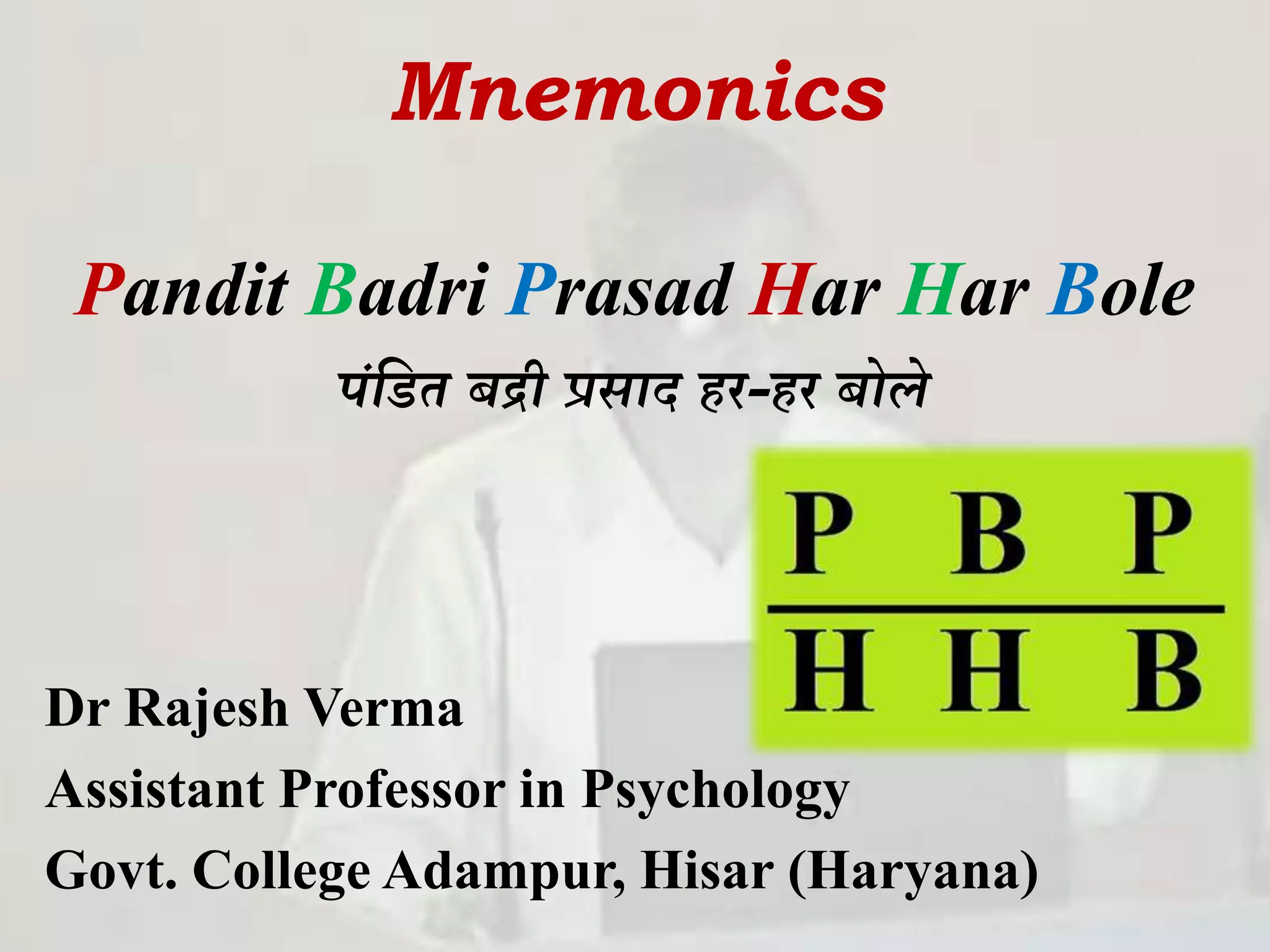
Pandit Badri Prasad Har Har Bole
पंडित बद्री प्रसाद हर-हर बोले
Dr Rajesh Verma
Assistant Professor in Psychology
Govt. College Adampur, Hisar (Haryana)
Meaning
Pronunciation of ‘Mnemonics’ – /nɪˈmɒnɪks/
(निमोनिक्स)
Literary meaning – The study and development of
systems for improving and assisting the memory.
Meaning in psychological parlance – A technique that
aids in retention
and recall of
information.
Definition
“It is a technique or device, such as a rhyme or an image,
that uses familiar associations to enhance the storage and
recall of information” (Solso, 2006).
“A technique of associating
mother information with known
external or internal devices [cues,
images, sound etc.] for retaining
and [correct] recalling learned
material”.
Introduction
Mnemonics is a technique to make forgettable
information memorable. They ensure learning in such a
way that makes recall easy. These techniques are
sometimes called as devices that help in storing and
recalling the information [complex] in the same
sequence with greater accuracy. Mnemonic are
systematic procedure
which encode the
information
effectively that
helps in recall
and retrieval.
Important Types of Mnemonics
(i) Sentence mnemonics that helps in preventing
spelling errors.
(ii) Acronyms mnemonics helps in remembering the
information in sequence.
(iii) Musical mnemonics makes learning better.
(iv) Model mnemonics such as
graphs, charts, diagrams, mind
maps etc.
(v) Phrase mnemonics My
Very Excellent Mother Just
Served Us (Nine planets).
(vi) Image mnemonics.
Characteristics of Mnemonics
1. Mnemonics are memory assistants.
2. Mnemonics circumvent the forgetting.
3. They utilizes the cognitive space optimally.
4. They can be in the form of image, touch, sound,
taste or smell. In other words they can belong to one or
more sensory systems.
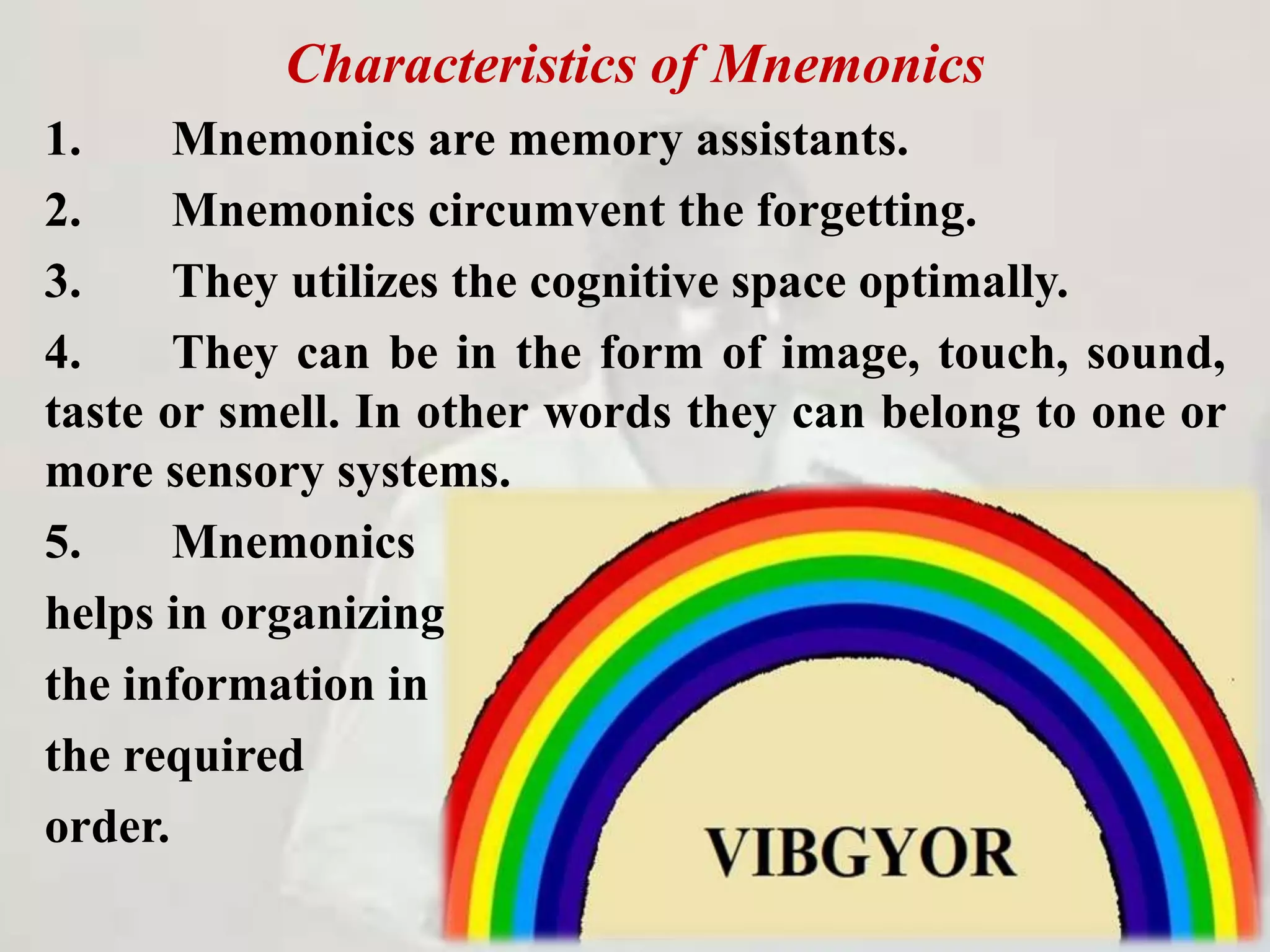
5. Mnemonics
helps in organizing
the information in
the required
order.
Methods of Mnemonics
Forgetting is not caused by an individual factor
rather it is the handiwork of collective effort of several
factors.
(i) Method of Loci,
(ii) Peg Word System,
(iii) Key Word Method,
(iv) Organizational
Schemes, &
(v) Acronym & Acrostic.
(i) Method of Loci – Loci means places. In this
method the material to be remembered is
visualized on familiar places or landmarks.
Information is placed at the cornerstones of
imaginary journey.
Create a memory
palace and place
the information
at various
locations.
(ii) Peg Word System – In peg word system
new words or concepts are associated with list of
already known words. In the peg word system
already known information (such as numbers or
the alphabet) is ordered with the information
that is to be learnt. For example, learn a rhyme
one-sun,
two-pooh,
three-curry,
four-door etc.
Now if we want to remember names of
Indian scientists PC Ray, S Ramanujan, CV
Raman, S N Bose etc. according to their year of
birth. Just use peg words in this way PC Ray
shown like sun, S Ramanujan like to play with
pooh, CV Raman ate full plate of curry etc.
(iii) Key Word Method – The keyword method is
used to memorize the meaning of words through
visualization especially useful in learning foreign
language. It is the system of linking two different
types of information. It’s a kind of elaborative
rehearsal and achieved in two steps.
(a) Choose a key word that sounds like the word
that is similar
to the stimulus
word.
(b) Visualize the association in the form of an image
between the keyword and stimulus word.
Ex. If you are asked to learn word ‘Alacrity’.
Choose a similar sounding Hindi keyword i.e. कृ नि. Now
associate these two words by a sentence such as भगवाि िे
कृ नि को
जोशीला व सुंदर बिाया
है। This way we can
remember the meaning
of Alacrity as ‘liveliness
and eagerness’.
(iv) Organizational Schemes – In this scheme the
information is organized into semantic categories which
are then used cues for recall. Chunking is one of the
best examples of organizational schemes. To learn
unrelated information organize it into similar
categories. For example if we are required to remember
these words:
Pond Mango Pen
Eraser Ocean Ladoo
Bread River Sharpener
Organize these words into
categories i.e. Stationary, Eatables and Water bodies
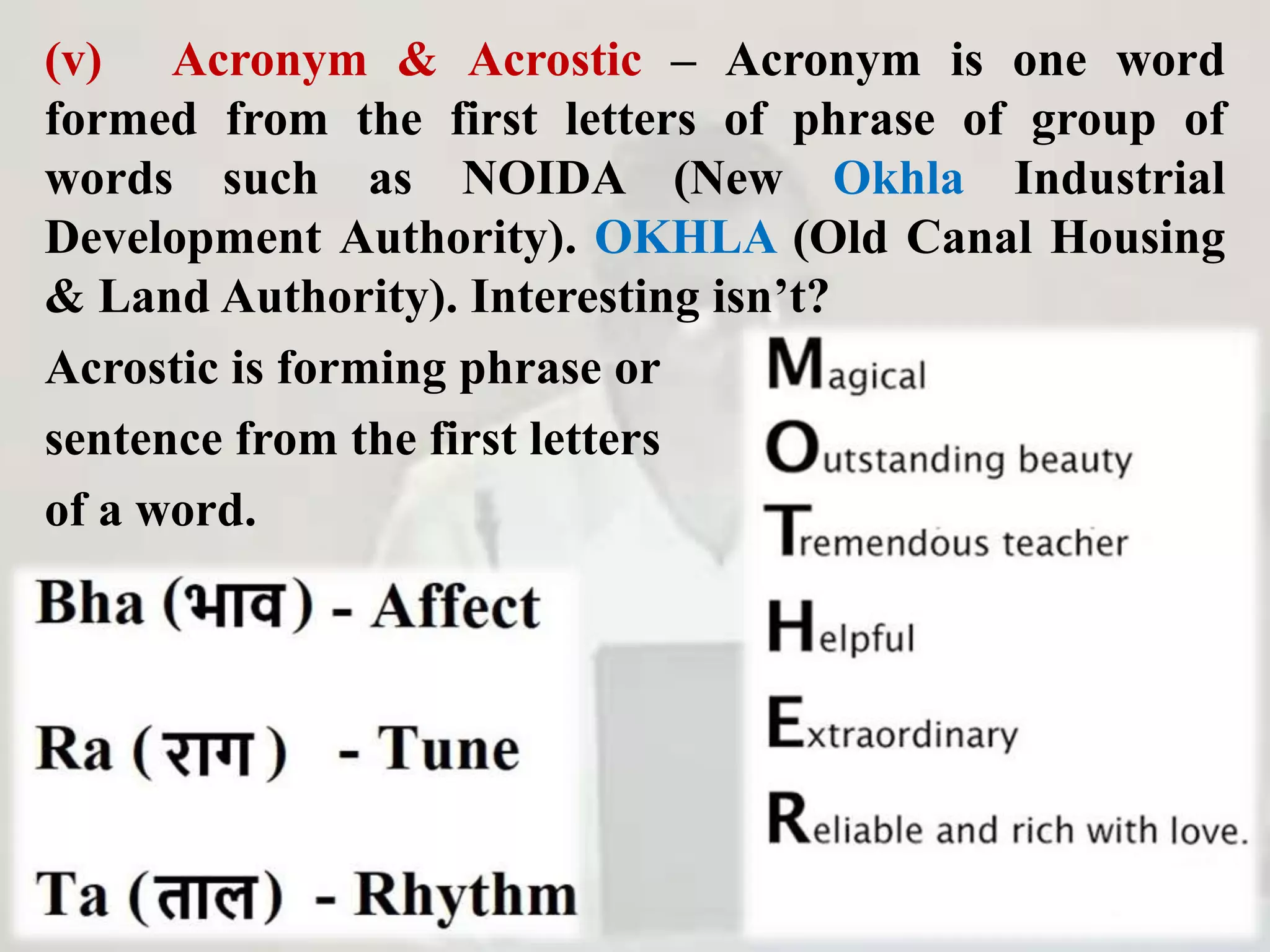
(v) Acronym & Acrostic – Acronym is one word
formed from the first letters of phrase of group of
words such as NOIDA (New Okhla Industrial
Development Authority). OKHLA (Old Canal Housing
& Land Authority). Interesting isn’t?
Acrostic is forming phrase or
sentence from the first letters
of a word.
Uses of Mnemonics
1. Mnemonics are found to be helpful in
improving academic achievements.
2. Used as teaching aids in classroom.
3. For students with learning problems.
4. Improving
memory.
5. Learning
foreign language.
6. Devising
learning strategies.
References:
1. NCERT, XI Psychology
Text book.
2. Solso, R. S . (2006).
Cognitive Psychology,
New Delhi: Pearson.
vermasujit@yahoo.com
Next Discussion
Problem Solving An
Introduction

mnemonics in English

  • 1.
    Mnemonics Pandit Badri PrasadHar Har Bole पंडित बद्री प्रसाद हर-हर बोले Dr Rajesh Verma Assistant Professor in Psychology Govt. College Adampur, Hisar (Haryana)
  • 2.
    Meaning Pronunciation of ‘Mnemonics’– /nɪˈmɒnɪks/ (निमोनिक्स) Literary meaning – The study and development of systems for improving and assisting the memory. Meaning in psychological parlance – A technique that aids in retention and recall of information.
  • 3.
    Definition “It is atechnique or device, such as a rhyme or an image, that uses familiar associations to enhance the storage and recall of information” (Solso, 2006). “A technique of associating mother information with known external or internal devices [cues, images, sound etc.] for retaining and [correct] recalling learned material”.
  • 4.
    Introduction Mnemonics is atechnique to make forgettable information memorable. They ensure learning in such a way that makes recall easy. These techniques are sometimes called as devices that help in storing and recalling the information [complex] in the same sequence with greater accuracy. Mnemonic are systematic procedure which encode the information effectively that helps in recall and retrieval.
  • 5.
    Important Types ofMnemonics (i) Sentence mnemonics that helps in preventing spelling errors. (ii) Acronyms mnemonics helps in remembering the information in sequence. (iii) Musical mnemonics makes learning better. (iv) Model mnemonics such as graphs, charts, diagrams, mind maps etc. (v) Phrase mnemonics My Very Excellent Mother Just Served Us (Nine planets). (vi) Image mnemonics.
  • 6.
    Characteristics of Mnemonics 1.Mnemonics are memory assistants. 2. Mnemonics circumvent the forgetting. 3. They utilizes the cognitive space optimally. 4. They can be in the form of image, touch, sound, taste or smell. In other words they can belong to one or more sensory systems. 5. Mnemonics helps in organizing the information in the required order.
  • 7.
    Methods of Mnemonics Forgettingis not caused by an individual factor rather it is the handiwork of collective effort of several factors. (i) Method of Loci, (ii) Peg Word System, (iii) Key Word Method, (iv) Organizational Schemes, & (v) Acronym & Acrostic.
  • 8.
    (i) Method ofLoci – Loci means places. In this method the material to be remembered is visualized on familiar places or landmarks. Information is placed at the cornerstones of imaginary journey. Create a memory palace and place the information at various locations.
  • 9.
    (ii) Peg WordSystem – In peg word system new words or concepts are associated with list of already known words. In the peg word system already known information (such as numbers or the alphabet) is ordered with the information that is to be learnt. For example, learn a rhyme one-sun, two-pooh, three-curry, four-door etc.
  • 10.
    Now if wewant to remember names of Indian scientists PC Ray, S Ramanujan, CV Raman, S N Bose etc. according to their year of birth. Just use peg words in this way PC Ray shown like sun, S Ramanujan like to play with pooh, CV Raman ate full plate of curry etc.
  • 11.
    (iii) Key WordMethod – The keyword method is used to memorize the meaning of words through visualization especially useful in learning foreign language. It is the system of linking two different types of information. It’s a kind of elaborative rehearsal and achieved in two steps. (a) Choose a key word that sounds like the word that is similar to the stimulus word.
  • 12.
    (b) Visualize theassociation in the form of an image between the keyword and stimulus word. Ex. If you are asked to learn word ‘Alacrity’. Choose a similar sounding Hindi keyword i.e. कृ नि. Now associate these two words by a sentence such as भगवाि िे कृ नि को जोशीला व सुंदर बिाया है। This way we can remember the meaning of Alacrity as ‘liveliness and eagerness’.
  • 13.
    (iv) Organizational Schemes– In this scheme the information is organized into semantic categories which are then used cues for recall. Chunking is one of the best examples of organizational schemes. To learn unrelated information organize it into similar categories. For example if we are required to remember these words: Pond Mango Pen Eraser Ocean Ladoo Bread River Sharpener Organize these words into categories i.e. Stationary, Eatables and Water bodies
  • 14.
    (v) Acronym &Acrostic – Acronym is one word formed from the first letters of phrase of group of words such as NOIDA (New Okhla Industrial Development Authority). OKHLA (Old Canal Housing & Land Authority). Interesting isn’t? Acrostic is forming phrase or sentence from the first letters of a word.
  • 15.
    Uses of Mnemonics 1.Mnemonics are found to be helpful in improving academic achievements. 2. Used as teaching aids in classroom. 3. For students with learning problems. 4. Improving memory. 5. Learning foreign language. 6. Devising learning strategies.
  • 16.
    References: 1. NCERT, XIPsychology Text book. 2. Solso, R. S . (2006). Cognitive Psychology, New Delhi: Pearson.
  • 17.