Miss Huma Javed
• Names Roll No
• Sana Khan 17-228
• Aliha Shehzadi 17-154
• Khadija Noor 17-158
• Hira Younas 17-108
• Mubeen Rasheed 17-244
• Ayesha Rauf 17-102
• Komal Arif 17-174
• Ghayyora Habib 17-130
• The word "mnemonic" is derived from the Ancient Greek
word (mnemonikos), meaning "of memory, or relating to
memory"
• Mnemonic devices are techniques a person can use to
help them improve their ability to remember something.
• In other words, it’s a memory technique to help your brain
better encode and recall important information.
• A mnemonic is a tool to help remember a large amount
of information.
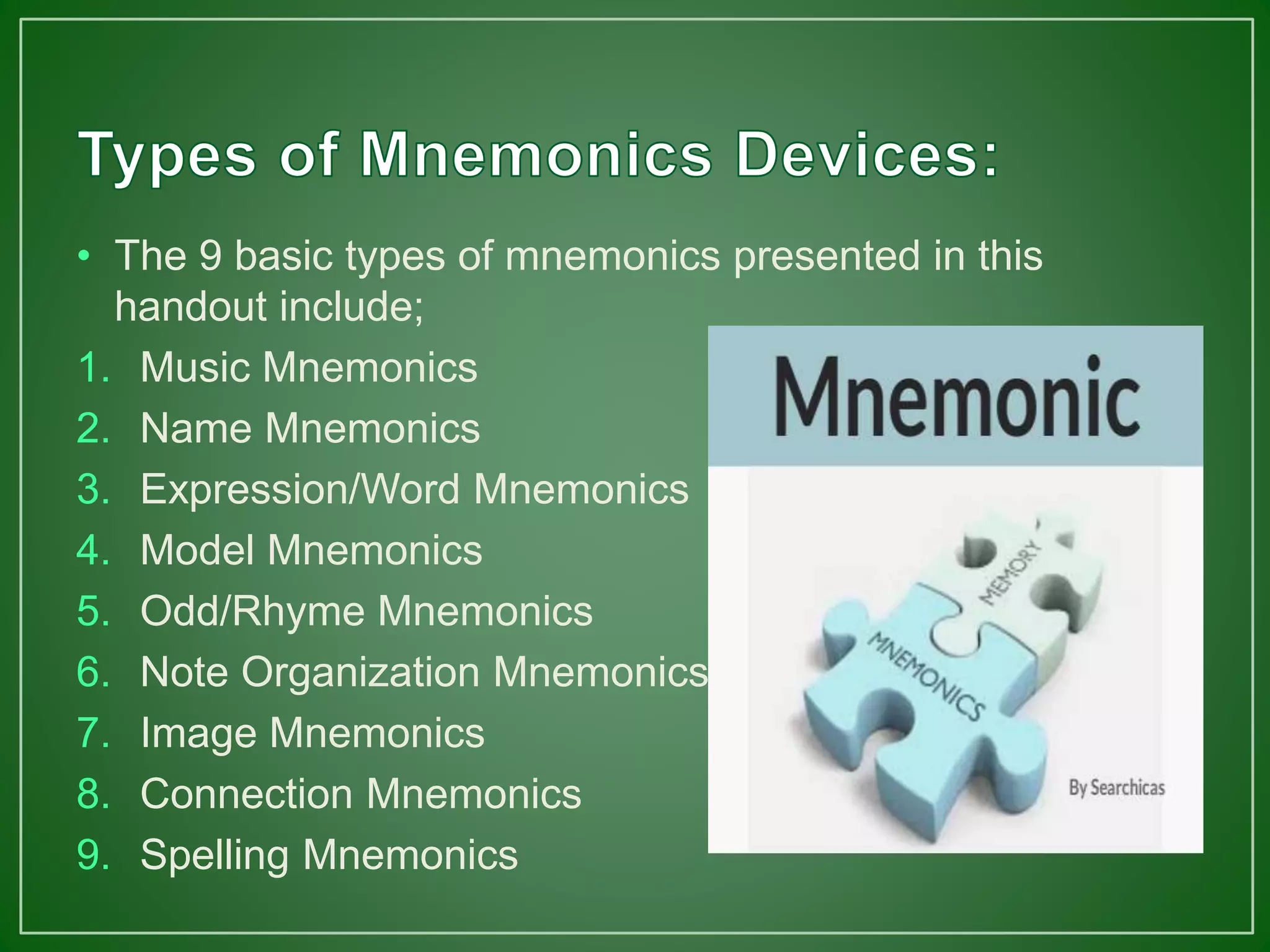
• The 9 basic types of mnemonics presented in this
handout include;
1. Music Mnemonics
2. Name Mnemonics
3. Expression/Word Mnemonics
4. Model Mnemonics
5. Odd/Rhyme Mnemonics
6. Note Organization Mnemonics
7. Image Mnemonics
8. Connection Mnemonics
9. Spelling Mnemonics
• In a Name Mnemonic, the 1st letter of each word in a list
of items is used to make a name of a person or thing.
• Name Mnemonic, helps break large pieces of information
into smaller chunks that we can remember.
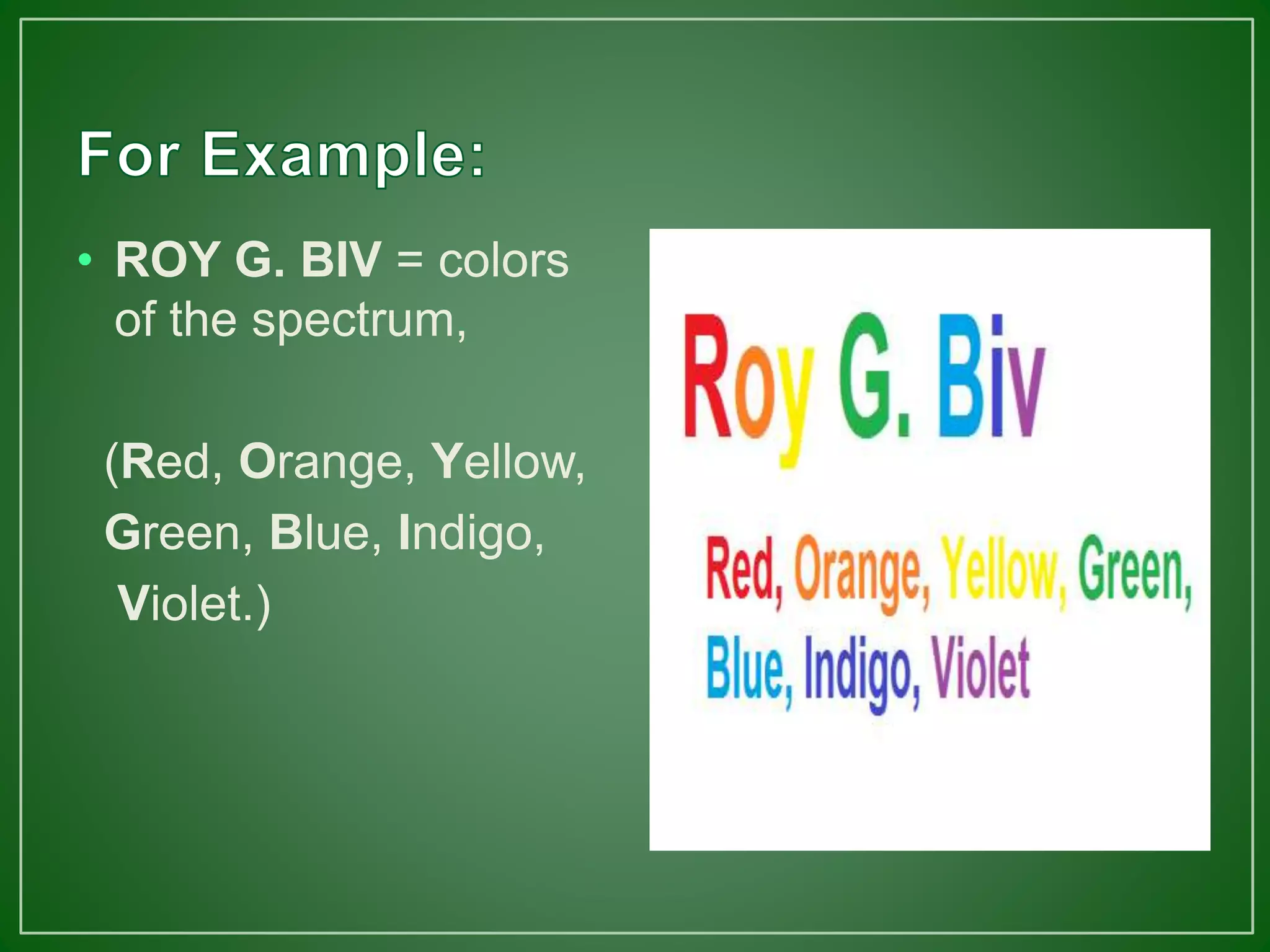
• ROY G. BIV = colors
of the spectrum,
(Red, Orange, Yellow,
Green, Blue, Indigo,
Violet.)
• One way to successfully encode the information into your
brain is to use music.
• Music Mnemonic, can be used by teachers in school to
help students remember and lists, words, concepts that
otherwise difficult to remember and recall.
• For example, some
children learn the
ABC's by singing the
"ABC" song.
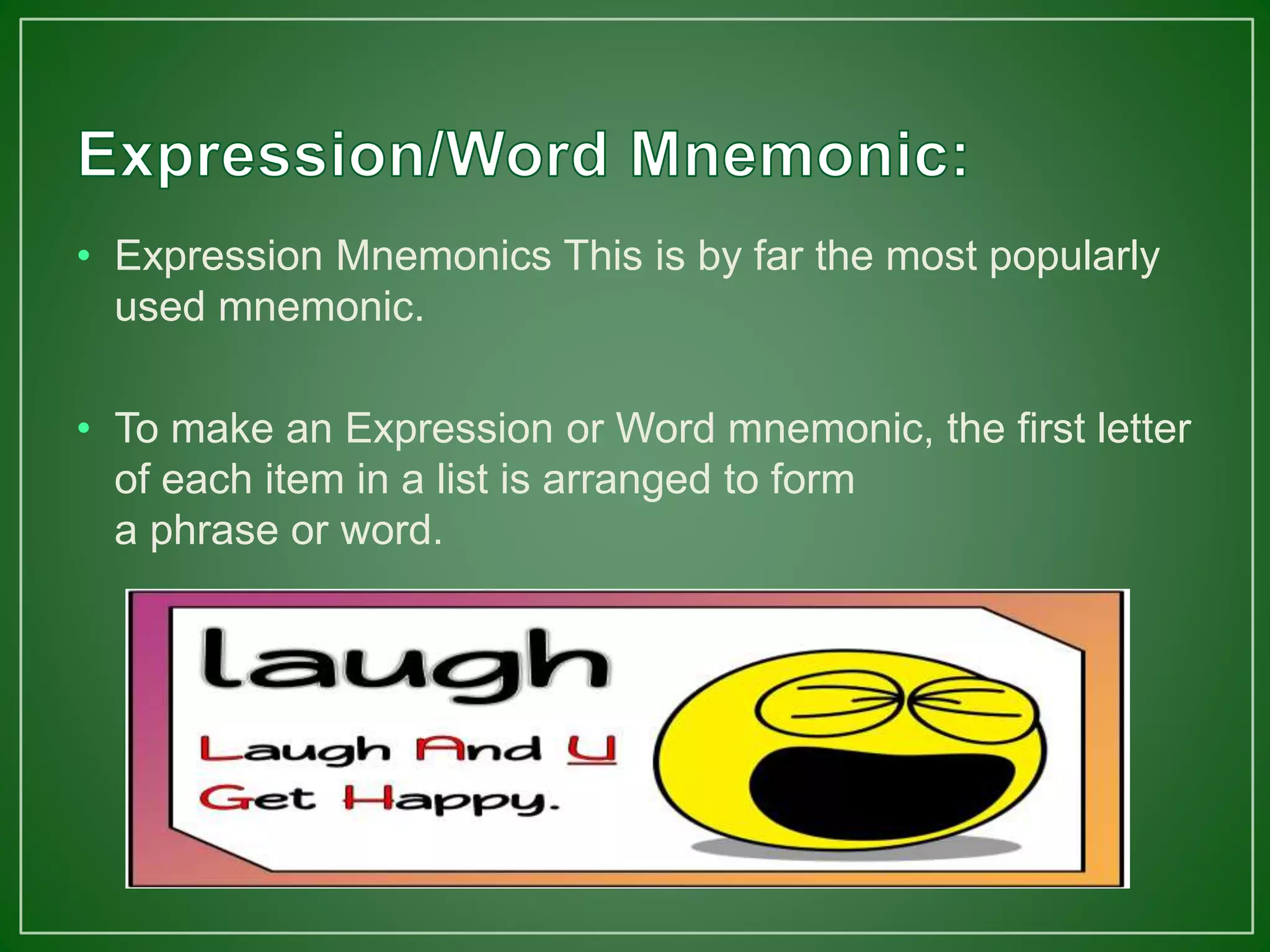
• Expression Mnemonics This is by far the most popularly
used mnemonic.
• To make an Expression or Word mnemonic, the first letter
of each item in a list is arranged to form
a phrase or word.
• In English, the 7
coordinating
conjunctions are;
• For, And, Not, But,
Or, Yet, So= FANB
OYS.
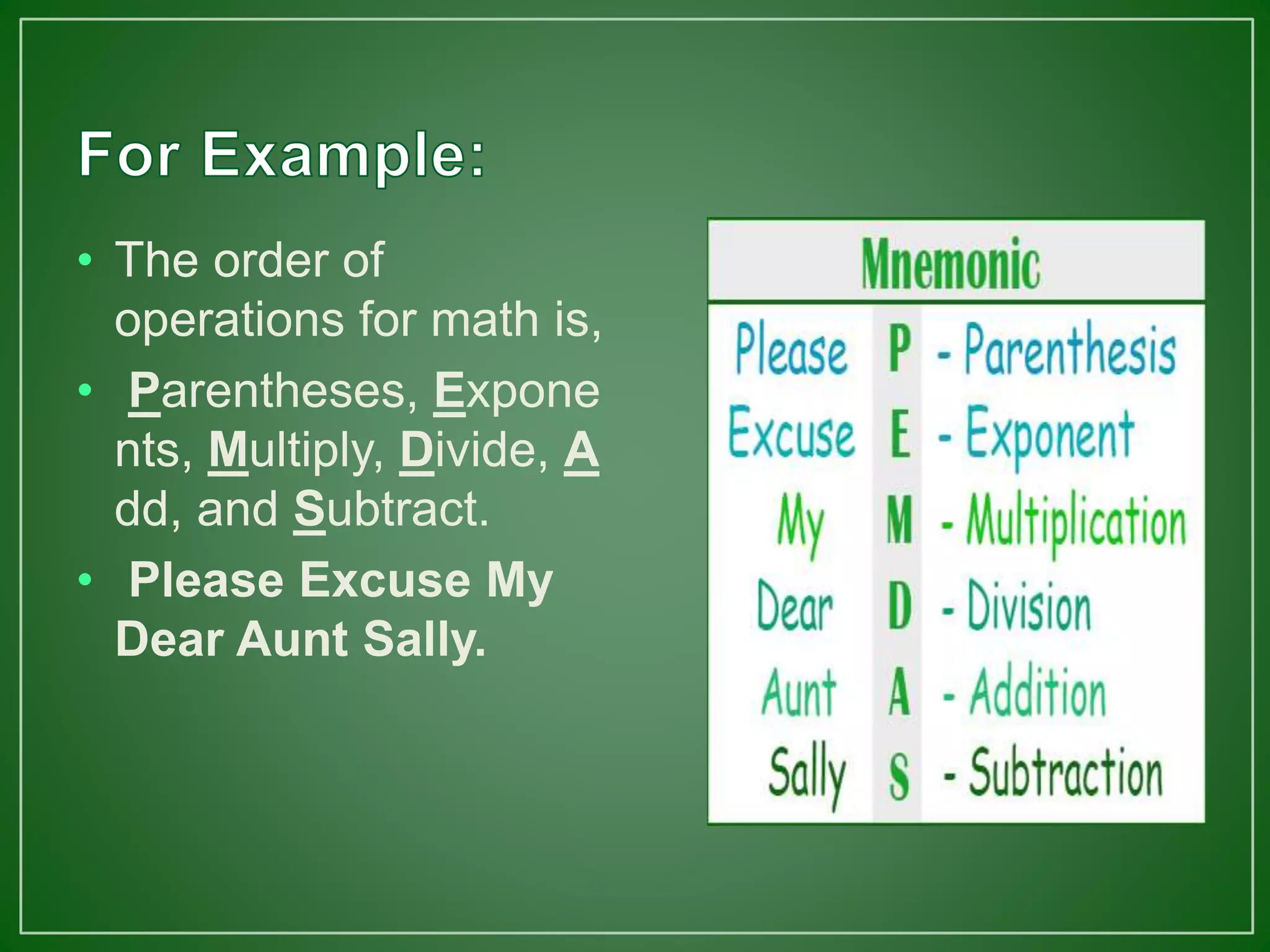
• The order of
operations for math is,
• Parentheses, Expone
nts, Multiply, Divide, A
dd, and Subtract.
• Please Excuse My
Dear Aunt Sally.
• The categories in the
classification of life
are;
• kingdom,
Phylum, Class, Order,
• Family, Genus, Specie
s,
• Kings Phillip Came
Over For Good
Soup.
• The method of note organization can be used as a
memorization technique.
• The way textbook and lecture notes are organized can
inhibit learning and recall or promote it.
• In the sense that the organization of note can promote
recall , it is a memory device.
• Three examples of organizing note formats that promote
recall are follows:
a) Notecard:
Notecard are an easy way to organize main ideas
and relevant detail to be recall . notecard can give learners
practice in seeing questions and recalling answers as they
must do on exams.
b) Outline :
Outline clearly separate main ideas from detail .
this helps organize the information in the mind making it
easier to remember.
c) Cornell system:
A vertical line is drawn 3 inches from the
lift margin of notebook paper . Main ideas or questions from
them are placed to the left of the line and detail or answers
placed to the right.
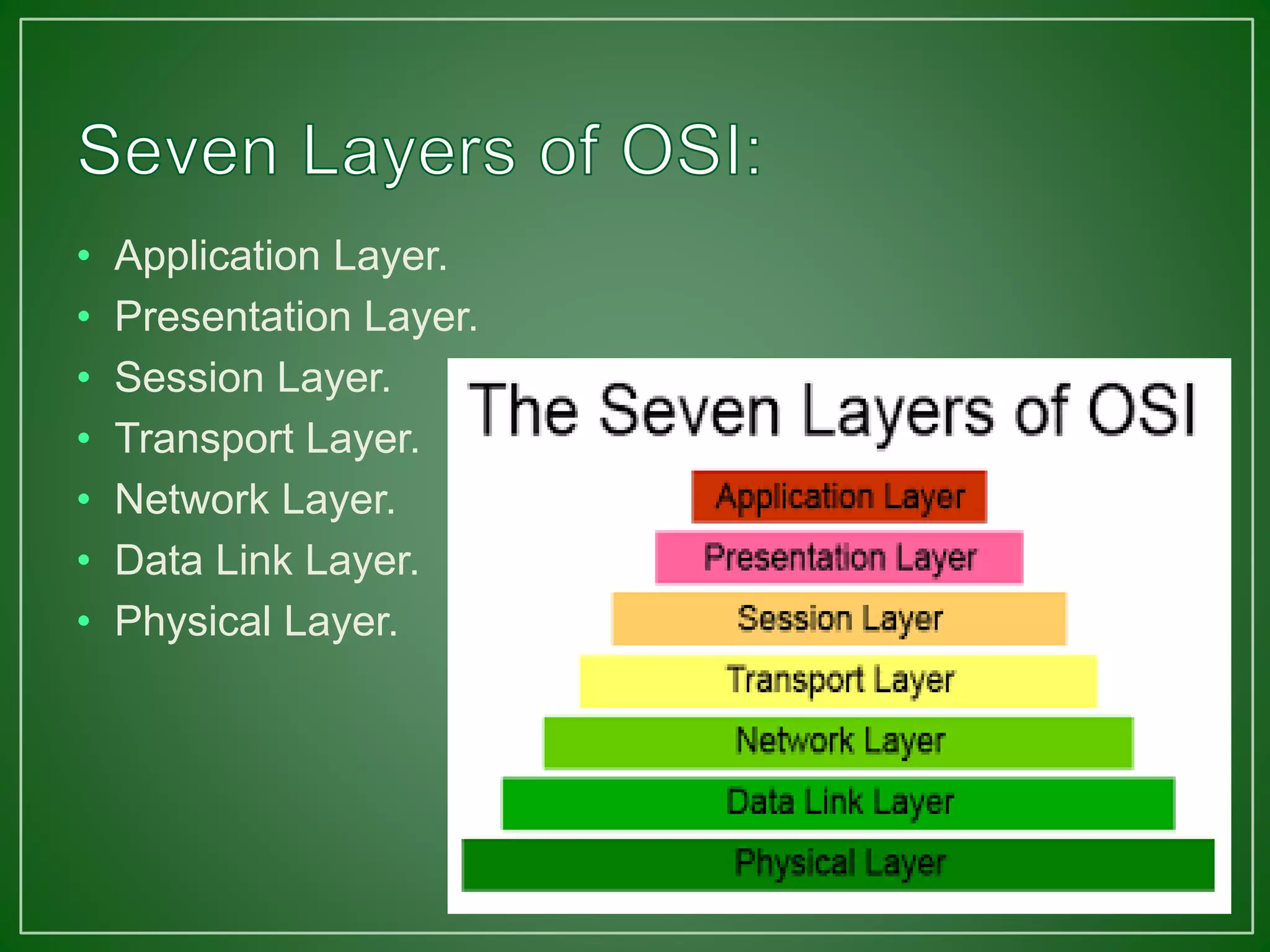
• Application Layer.
• Presentation Layer.
• Session Layer.
• Transport Layer.
• Network Layer.
• Data Link Layer.
• Physical Layer.
• Application.
• Presentation.
• Session.
• Transport.
• Network.
• Data Link
• Physical.
• All; Away.
• People; Pizza.
• Seem: Sausage.
• To; Throw.
• Need: Not.
• Data: Do.
• Processing: Please.
• Application:
Defines interface; Provides services.
• Presentation:
Masks Difference of data formats between dissimilar
types.
• Session:
Manages User Session and Dialogues.
• Transport:
Manages end-to-end Message delivering in Network.
• Network:
Determines Procedure for Operating the Communication
Link.
• Data Link:
Defined Procedure for Operating the Communication
Link:
• Physical:
Carry Bits; Hardware; defines physical means of sending
data.
o An Ode or Rhyme Mnemonic puts information to be
recalled in the form of a poem.
o A rhyme is a saying that has similar terminal sounds at
the end of each line. Rhymes are easier to remember
because they can be stored by acoustic encoding in our
brains
• a. A commonly used Rhyme Mnemonic for the number of
days in each month is: i. 30 days hath September, April,
June, and November. All the rest have 31, Fine! February
28 except when 29.
• b. Here is an easy way to remember the nerves:
• olfactory, optic, oculomotor, trochlear, trigeminal,
abducens, facial, acoustic, glassopharyngeal, vagus,
spinal accessory and hypoglossal.
• On Old Olympus’ Towering Tops, A Finn And German
Viewed Some Hops.
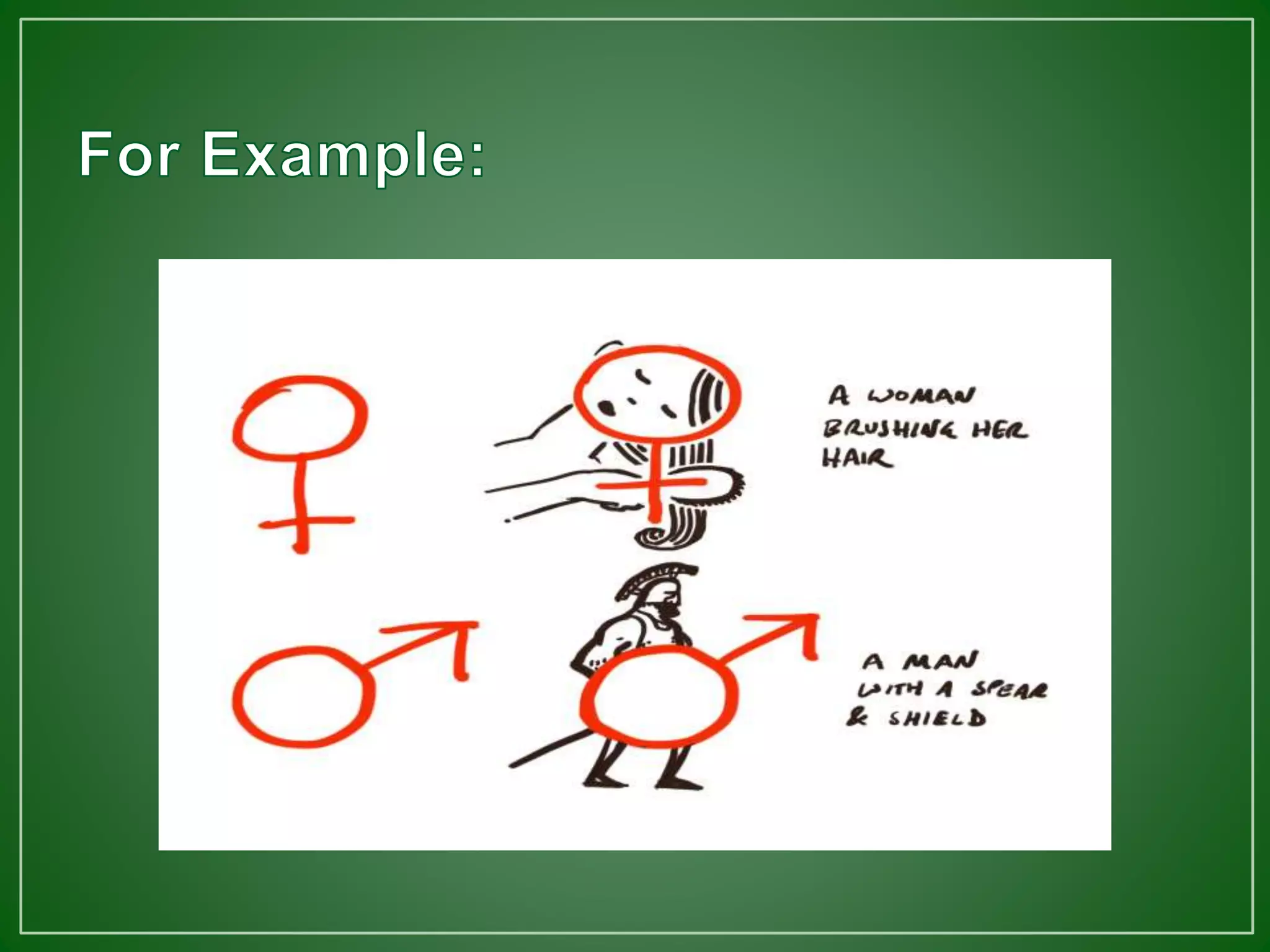
• The information in an Image Mnemonic is constructed in
the form of a picture that promotes recall of information
when you need it.
• The sillier the Image Mnemonic is, the easier it is to recall
the related information.
• These images may be mental or sketched into text and
lecture notes. Don't worry about your artistic ability. As
long as you know what your sketch means, Image
Mnemonics will help you learn and remember.
• In this type of mnemonic, the information to be
remembered is connected to something already
known.
• This allows you to remember sequences of
unrelated items un the appropriate order.
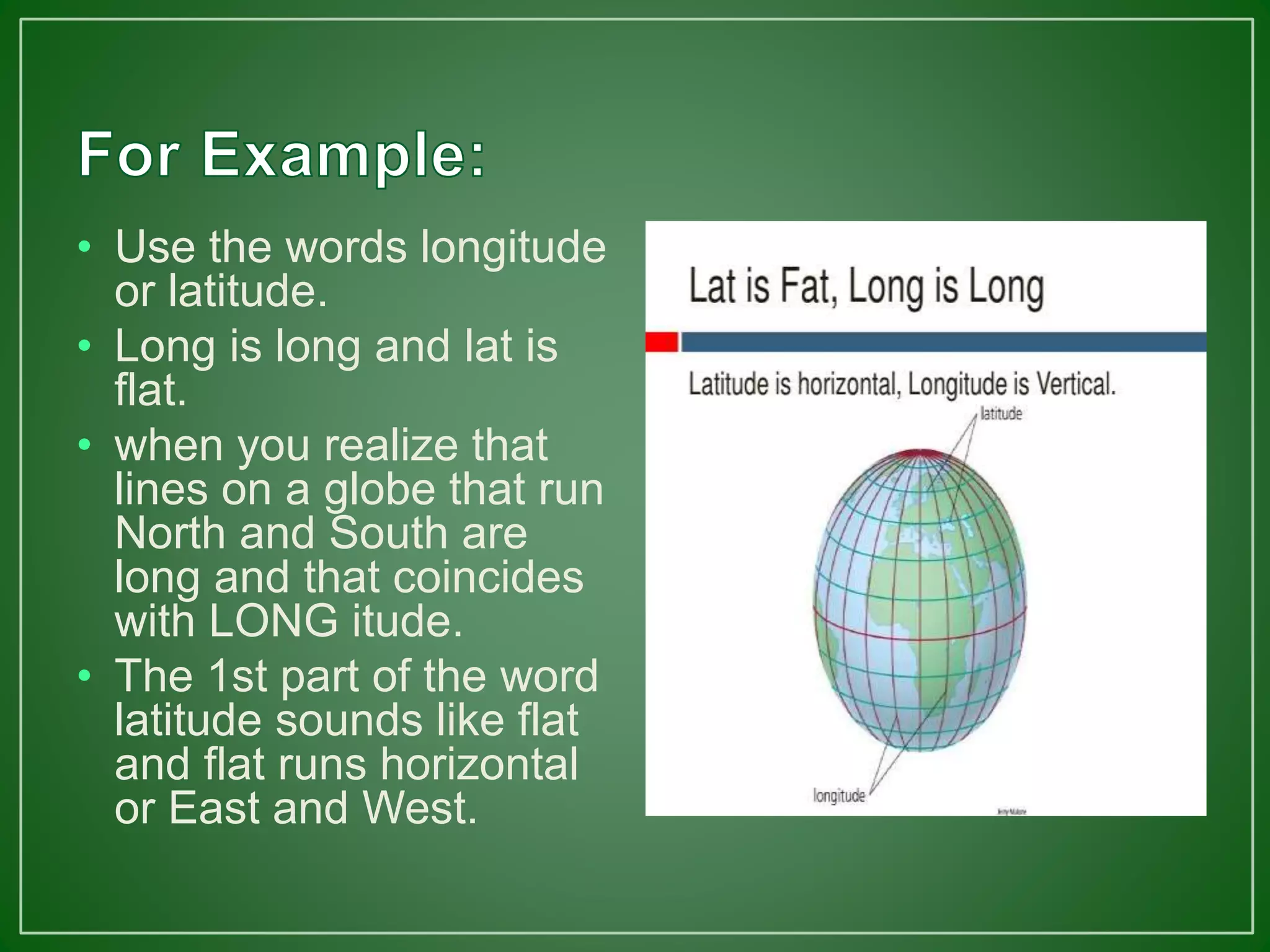
• Use the words longitude
or latitude.
• Long is long and lat is
flat.
• when you realize that
lines on a globe that run
North and South are
long and that coincides
with LONG itude.
• The 1st part of the word
latitude sounds like flat
and flat runs horizontal
or East and West.
“It’s a memory technique to
help your brain better
encode and recall important
information. It’s a simple
shortcut that helps us associate the information we
want to remember with an image, a sentence, or a
word.”
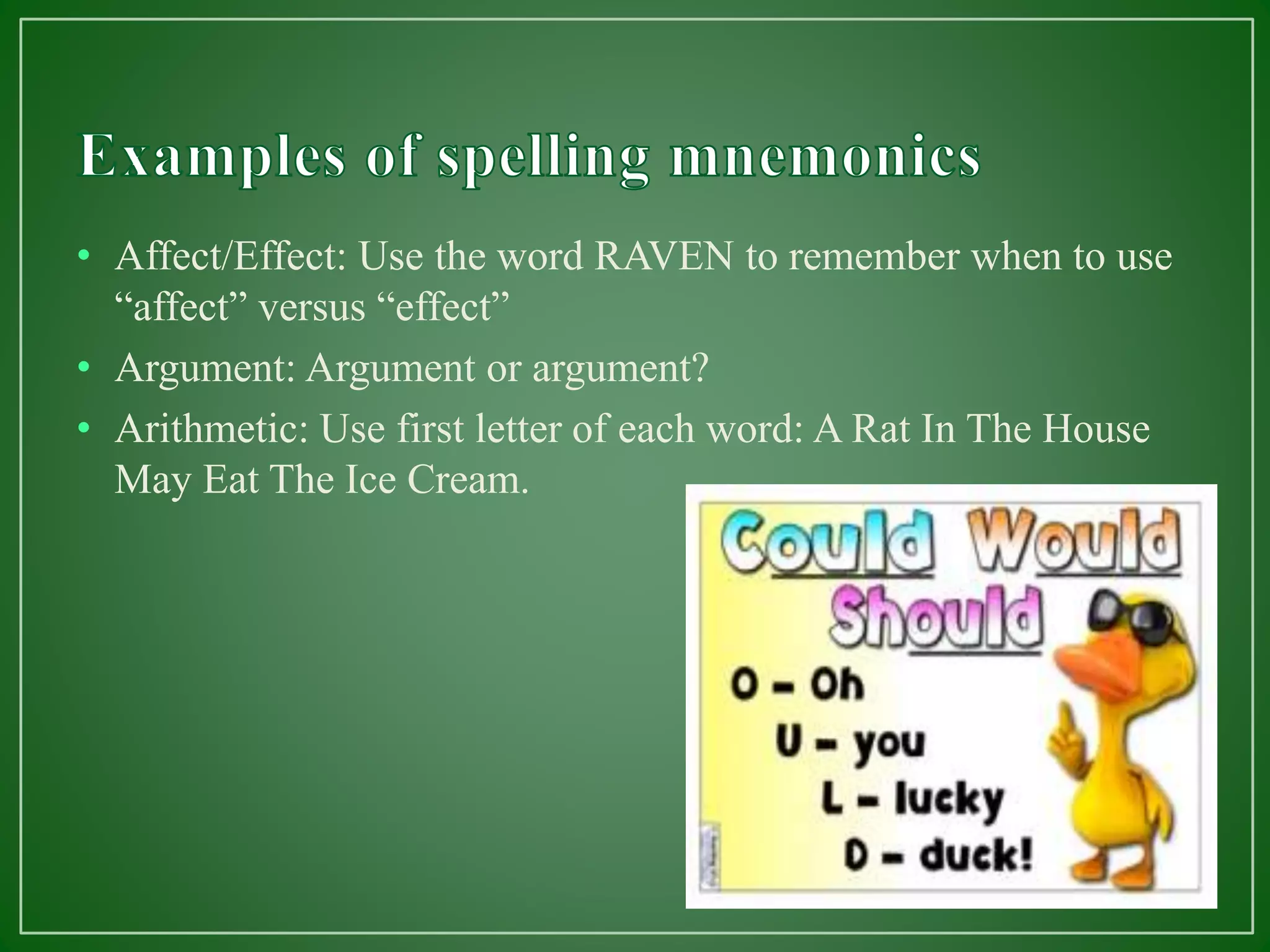
• Affect/Effect: Use the word RAVEN to remember when to use
“affect” versus “effect”
• Argument: Argument or argument?
• Arithmetic: Use first letter of each word: A Rat In The House
May Eat The Ice Cream.
Mnemonics

Mnemonics

  • 4.
  • 5.
    • Names RollNo • Sana Khan 17-228 • Aliha Shehzadi 17-154 • Khadija Noor 17-158 • Hira Younas 17-108 • Mubeen Rasheed 17-244 • Ayesha Rauf 17-102 • Komal Arif 17-174 • Ghayyora Habib 17-130
  • 7.
    • The word"mnemonic" is derived from the Ancient Greek word (mnemonikos), meaning "of memory, or relating to memory" • Mnemonic devices are techniques a person can use to help them improve their ability to remember something. • In other words, it’s a memory technique to help your brain better encode and recall important information. • A mnemonic is a tool to help remember a large amount of information.
  • 10.
    • The 9basic types of mnemonics presented in this handout include; 1. Music Mnemonics 2. Name Mnemonics 3. Expression/Word Mnemonics 4. Model Mnemonics 5. Odd/Rhyme Mnemonics 6. Note Organization Mnemonics 7. Image Mnemonics 8. Connection Mnemonics 9. Spelling Mnemonics
  • 12.
    • In aName Mnemonic, the 1st letter of each word in a list of items is used to make a name of a person or thing. • Name Mnemonic, helps break large pieces of information into smaller chunks that we can remember.
  • 13.
    • ROY G.BIV = colors of the spectrum, (Red, Orange, Yellow, Green, Blue, Indigo, Violet.)
  • 15.
    • One wayto successfully encode the information into your brain is to use music. • Music Mnemonic, can be used by teachers in school to help students remember and lists, words, concepts that otherwise difficult to remember and recall.
  • 16.
    • For example,some children learn the ABC's by singing the "ABC" song.
  • 18.
    • Expression MnemonicsThis is by far the most popularly used mnemonic. • To make an Expression or Word mnemonic, the first letter of each item in a list is arranged to form a phrase or word.
  • 19.
    • In English,the 7 coordinating conjunctions are; • For, And, Not, But, Or, Yet, So= FANB OYS.
  • 20.
    • The orderof operations for math is, • Parentheses, Expone nts, Multiply, Divide, A dd, and Subtract. • Please Excuse My Dear Aunt Sally.
  • 21.
    • The categoriesin the classification of life are; • kingdom, Phylum, Class, Order, • Family, Genus, Specie s, • Kings Phillip Came Over For Good Soup.
  • 23.
    • The methodof note organization can be used as a memorization technique. • The way textbook and lecture notes are organized can inhibit learning and recall or promote it. • In the sense that the organization of note can promote recall , it is a memory device.
  • 24.
    • Three examplesof organizing note formats that promote recall are follows: a) Notecard: Notecard are an easy way to organize main ideas and relevant detail to be recall . notecard can give learners practice in seeing questions and recalling answers as they must do on exams. b) Outline : Outline clearly separate main ideas from detail . this helps organize the information in the mind making it easier to remember.
  • 25.
    c) Cornell system: Avertical line is drawn 3 inches from the lift margin of notebook paper . Main ideas or questions from them are placed to the left of the line and detail or answers placed to the right.
  • 27.
    • Application Layer. •Presentation Layer. • Session Layer. • Transport Layer. • Network Layer. • Data Link Layer. • Physical Layer.
  • 28.
    • Application. • Presentation. •Session. • Transport. • Network. • Data Link • Physical. • All; Away. • People; Pizza. • Seem: Sausage. • To; Throw. • Need: Not. • Data: Do. • Processing: Please.
  • 29.
    • Application: Defines interface;Provides services. • Presentation: Masks Difference of data formats between dissimilar types. • Session: Manages User Session and Dialogues. • Transport: Manages end-to-end Message delivering in Network.
  • 30.
    • Network: Determines Procedurefor Operating the Communication Link. • Data Link: Defined Procedure for Operating the Communication Link: • Physical: Carry Bits; Hardware; defines physical means of sending data.
  • 32.
    o An Odeor Rhyme Mnemonic puts information to be recalled in the form of a poem. o A rhyme is a saying that has similar terminal sounds at the end of each line. Rhymes are easier to remember because they can be stored by acoustic encoding in our brains
  • 33.
    • a. Acommonly used Rhyme Mnemonic for the number of days in each month is: i. 30 days hath September, April, June, and November. All the rest have 31, Fine! February 28 except when 29. • b. Here is an easy way to remember the nerves: • olfactory, optic, oculomotor, trochlear, trigeminal, abducens, facial, acoustic, glassopharyngeal, vagus, spinal accessory and hypoglossal. • On Old Olympus’ Towering Tops, A Finn And German Viewed Some Hops.
  • 35.
    • The informationin an Image Mnemonic is constructed in the form of a picture that promotes recall of information when you need it. • The sillier the Image Mnemonic is, the easier it is to recall the related information. • These images may be mental or sketched into text and lecture notes. Don't worry about your artistic ability. As long as you know what your sketch means, Image Mnemonics will help you learn and remember.
  • 39.
    • In thistype of mnemonic, the information to be remembered is connected to something already known. • This allows you to remember sequences of unrelated items un the appropriate order.
  • 40.
    • Use thewords longitude or latitude. • Long is long and lat is flat. • when you realize that lines on a globe that run North and South are long and that coincides with LONG itude. • The 1st part of the word latitude sounds like flat and flat runs horizontal or East and West.
  • 42.
    “It’s a memorytechnique to help your brain better encode and recall important information. It’s a simple shortcut that helps us associate the information we want to remember with an image, a sentence, or a word.”
  • 43.
    • Affect/Effect: Usethe word RAVEN to remember when to use “affect” versus “effect” • Argument: Argument or argument? • Arithmetic: Use first letter of each word: A Rat In The House May Eat The Ice Cream.