A Practical Guide to Creative Memory
Techniques
.
 What is Memory?
Memory is history recorded in our brain.
Memory is the images of past brought into the
present. But more than that, it is “recalling the
right information at right time”.
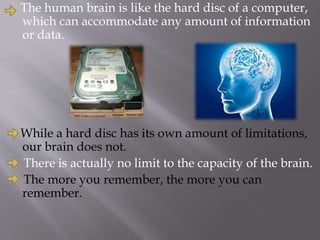
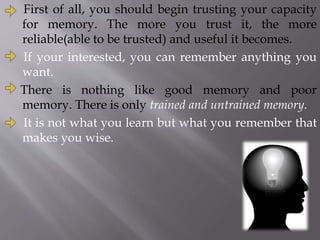
The human brain is like the hard disc of a computer,
which can accommodate any amount of information
or data.
While a hard disc has its own amount of limitations,
our brain does not.
There is actually no limit to the capacity of the brain.
The more you remember, the more you can
remember.
Whatever you have experienced is retained in your
memory system.
There is no such thing as ultimate forgetting.
Ex: Take a glass of water and add salt to it. It gets
dissolved in course of time. Though it is not visible,
its impact will be there.
That is exactly the case with all our experiences.
The capacity for memory differs from person to
person.
This depends on how well we exercise it. As we
exercise our muscles and limbs, memory can also be
exercised through similar training.
First of all, you should begin trusting your capacity
for memory. The more you trust it, the more
reliable(able to be trusted) and useful it becomes.
If your interested, you can remember anything you
want.
There is nothing like good memory and poor
memory. There is only trained and untrained memory.
It is not what you learn but what you remember that
makes you wise.
 This is also called as…………..
 Judicious Method is the method of remembering by
understanding.
 This procedure works well for technical subjects where
understanding of the procedure or the process
becomes very important.
The 5 W’s and 1 H method.
 The five W’s stands for
1.
2.
3.
4.
5.
 The H stands for……………………..
 It is said that the answers to any question falls only under
these six headings.
 Hence, after reading the matter once, try to understand
what you’ve read by asking these questions.
 Example: If you want to learn about Jawaharlal Nehru, ask
the following questions.
 Who is Jawaharlal Nehru?
 Where and when was he born?
 Why is Jawaharlal Nehru’s birthday celebrated as
Children’s Day?
 How did he become such a great man?
 What are the books he wrote / What great things did he
achieved?
 For how long he was the Prime Minister of India?
 I am sure once you have answers for the above questions,
it will become easy to write about Nehru.
 Similarly, regarding your studies ask the following
questions.
 What are my problems regarding studies?
 When should I start preparing for my examinations?
 Why I tensed up about studies and examinations?
 How can I overcome my tension and stress regarding
studies?
 From where should I start studying?
 Whose help should I take or whom should I consult
regarding my studies?
 Answering these questions will help you resolve
your problems regarding studies and tensions about
examinations.
 Mnemonics (pronounced “ni-monics”) are the
devices such as rhymes, code words, or other letter
and word arrangements used to assist remembering.
 The Greeks discovered that human memory is
largely an association process that works by
linking things together.
 For example: Think of a pineapple. The moment your
brain registers the word ‘pineapple’, it recalls the
shape, colour, taste, texture and smell of the fruit.
 All these things are associated in your memory with
word `pineapple’.
 The main focus while making a mnemonics is for it
to be illogical and humorous as this is easily
remembered.
 The method is to note down all the key ideas or
points of the chapter or any question, make a
memorable sentence or a word by taking all the first
letters of each words.
 Examples:
1. How we remember the different colours in rainbow.
A. we use a code: VIBGYOR for violet, indigo, blue, green,
yellow, orange, red.
2. Some Old Horses Can Always Hear Their Owner’s
Arrival.
A. Sin = Opposite/Hypotenuse.
Cos = Adjacent/Hypotenuse.
Tan = Opposite/Adjacent
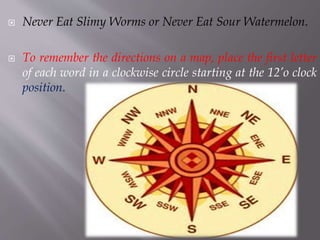
 Never Eat Slimy Worms or Never Eat Sour Watermelon.
 To remember the directions on a map, place the first letter
of each word in a clockwise circle starting at the 12’o clock
position.
N
W E
S
 Acronyms are a method in which you form
acronyms by using the first letters from a group of
words to form a new word.
 Examples:
1. AIDS – Acquired Immune Deficiency Syndrome.
2. LASER – Light Amplification by Stimulated
Emission of Radiation.
3 . CREAMY CHIPS:
This is a great way to remember the names of diseases.
C – Cold.
R – Rabies.
E – Elephantiasis.
A – AIDS.
M – Measles.
Y – Yellow Fever.
C – Chickenpox.
H – Hepatitis.
I – Influenza.
M – Mumps.
P - Polio.
S – Smallpox.

Train your brain

  • 1.
    A Practical Guideto Creative Memory Techniques .
  • 2.
     What isMemory? Memory is history recorded in our brain. Memory is the images of past brought into the present. But more than that, it is “recalling the right information at right time”.
  • 3.
    The human brainis like the hard disc of a computer, which can accommodate any amount of information or data. While a hard disc has its own amount of limitations, our brain does not. There is actually no limit to the capacity of the brain. The more you remember, the more you can remember.
  • 4.
    Whatever you haveexperienced is retained in your memory system. There is no such thing as ultimate forgetting. Ex: Take a glass of water and add salt to it. It gets dissolved in course of time. Though it is not visible, its impact will be there. That is exactly the case with all our experiences.
  • 5.
    The capacity formemory differs from person to person. This depends on how well we exercise it. As we exercise our muscles and limbs, memory can also be exercised through similar training.
  • 6.
    First of all,you should begin trusting your capacity for memory. The more you trust it, the more reliable(able to be trusted) and useful it becomes. If your interested, you can remember anything you want. There is nothing like good memory and poor memory. There is only trained and untrained memory. It is not what you learn but what you remember that makes you wise.
  • 7.
     This isalso called as…………..  Judicious Method is the method of remembering by understanding.  This procedure works well for technical subjects where understanding of the procedure or the process becomes very important. The 5 W’s and 1 H method.
  • 8.
     The fiveW’s stands for 1.
  • 9.
  • 10.
  • 11.
  • 12.
  • 13.
     The Hstands for……………………..
  • 14.
     It issaid that the answers to any question falls only under these six headings.  Hence, after reading the matter once, try to understand what you’ve read by asking these questions.  Example: If you want to learn about Jawaharlal Nehru, ask the following questions.
  • 15.
     Who isJawaharlal Nehru?  Where and when was he born?  Why is Jawaharlal Nehru’s birthday celebrated as Children’s Day?  How did he become such a great man?  What are the books he wrote / What great things did he achieved?  For how long he was the Prime Minister of India?  I am sure once you have answers for the above questions, it will become easy to write about Nehru.
  • 16.
     Similarly, regardingyour studies ask the following questions.  What are my problems regarding studies?  When should I start preparing for my examinations?  Why I tensed up about studies and examinations?  How can I overcome my tension and stress regarding studies?  From where should I start studying?  Whose help should I take or whom should I consult regarding my studies?  Answering these questions will help you resolve your problems regarding studies and tensions about examinations.
  • 17.
     Mnemonics (pronounced“ni-monics”) are the devices such as rhymes, code words, or other letter and word arrangements used to assist remembering.  The Greeks discovered that human memory is largely an association process that works by linking things together.
  • 18.
     For example:Think of a pineapple. The moment your brain registers the word ‘pineapple’, it recalls the shape, colour, taste, texture and smell of the fruit.  All these things are associated in your memory with word `pineapple’.  The main focus while making a mnemonics is for it to be illogical and humorous as this is easily remembered.  The method is to note down all the key ideas or points of the chapter or any question, make a memorable sentence or a word by taking all the first letters of each words.
  • 19.
     Examples: 1. Howwe remember the different colours in rainbow. A. we use a code: VIBGYOR for violet, indigo, blue, green, yellow, orange, red. 2. Some Old Horses Can Always Hear Their Owner’s Arrival. A. Sin = Opposite/Hypotenuse. Cos = Adjacent/Hypotenuse. Tan = Opposite/Adjacent
  • 20.
     Never EatSlimy Worms or Never Eat Sour Watermelon.  To remember the directions on a map, place the first letter of each word in a clockwise circle starting at the 12’o clock position. N W E S
  • 21.
     Acronyms area method in which you form acronyms by using the first letters from a group of words to form a new word.  Examples: 1. AIDS – Acquired Immune Deficiency Syndrome. 2. LASER – Light Amplification by Stimulated Emission of Radiation.
  • 22.
    3 . CREAMYCHIPS: This is a great way to remember the names of diseases. C – Cold. R – Rabies. E – Elephantiasis. A – AIDS. M – Measles. Y – Yellow Fever. C – Chickenpox. H – Hepatitis. I – Influenza. M – Mumps. P - Polio. S – Smallpox.