The Art of Remembering
1
Maghan Das
 A weird word that means “memory tool”.
Mnemonics are methods for remembering
information that is otherwise difficult to
recall. Mnemonics use as many of the best
functions of your brain as possible to store
information.
2
 Colors
 Smells
 Tastes
 Touch
 Feelings
 Shapes
3
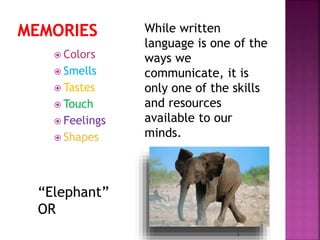
While written
language is one of the
ways we
communicate, it is
only one of the skills
and resources
available to our
minds.
“Elephant”
OR
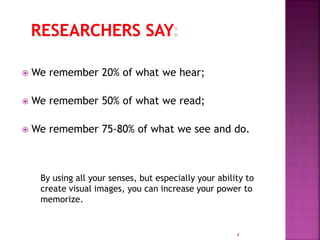
 We remember 20% of what we hear;
 We remember 50% of what we read;
 We remember 75-80% of what we see and do.
4
By using all your senses, but especially your ability to
create visual images, you can increase your power to
memorize.
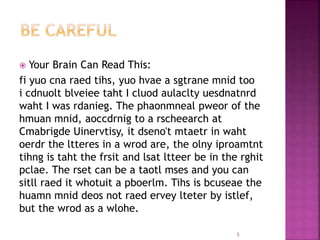
 Your Brain Can Read This:
fi yuo cna raed tihs, yuo hvae a sgtrane mnid too
i cdnuolt blveiee taht I cluod aulaclty uesdnatnrd
waht I was rdanieg. The phaonmneal pweor of the
hmuan mnid, aoccdrnig to a rscheearch at
Cmabrigde Uinervtisy, it dseno't mtaetr in waht
oerdr the ltteres in a wrod are, the olny iproamtnt
tihng is taht the frsit and lsat ltteer be in the rghit
pclae. The rset can be a taotl mses and you can
sitll raed it whotuit a pboerlm. Tihs is bcuseae the
huamn mnid deos not raed ervey lteter by istlef,
but the wrod as a wlohe.
5
 “I before e, except after c”
 HOMES
 S-U-C-C-E-S-S
 “30 days hath September….”
 Tying a string around your finger
6
Now you can start
making up your own
mnemonic devices
Recommended: Breakthrough Learning (1995) by Scott
Bornstein
• Use positive pleasant
images
• Use vivid colorful silly
images
• Use three-dimensional
images
• Exaggerate the size of
the images
• Use humor
• Use symbols (traffic
lights, pointing finger)
7
1.The Similar Traits Technique
2. Peg Systems
3. Forming Sentences from the 1st
letters of the words
4.The Link & Story Method
8
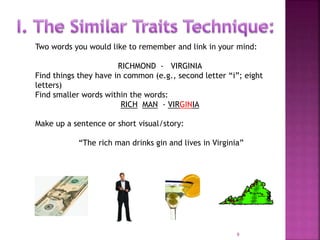
Two words you would like to remember and link in your mind:
RICHMOND - VIRGINIA
Find things they have in common (e.g., second letter “i”; eight
letters)
Find smaller words within the words:
RICH MAN - VIRGINIA
Make up a sentence or short visual/story:
“The rich man drinks gin and lives in Virginia”
9
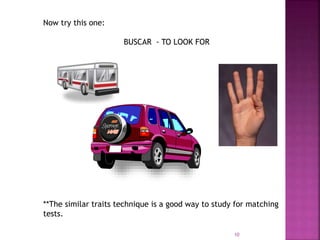
Now try this one:
BUSCAR - TO LOOK FOR
**The similar traits technique is a good way to study for matching
tests.
10
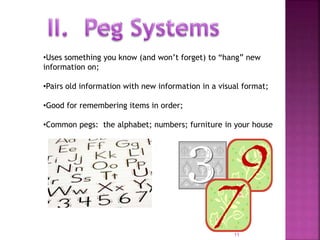
•Uses something you know (and won’t forget) to “hang” new
information on;
•Pairs old information with new information in a visual format;
•Good for remembering items in order;
•Common pegs: the alphabet; numbers; furniture in your house
11
12
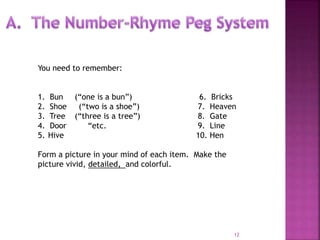
You need to remember:
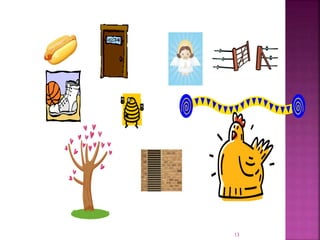
1. Bun (“one is a bun”) 6. Bricks
2. Shoe (“two is a shoe”) 7. Heaven
3. Tree (“three is a tree”) 8. Gate
4. Door “etc. 9. Line
5. Hive 10. Hen
Form a picture in your mind of each item. Make the
picture vivid, detailed, and colorful.
13
14
Now, write down a list of things to remember, such as a shopping list
(used here). It could be a list of body parts for Anatomy class, a list of
scientists, or a list of the chemicals in the periodic table of the elements
(any list).
1. Coke
2. Laundry Detergent
3. Tomatoes
4. Chicken
5. Hamburger
6. Paper Towels
7. Kleenex
8. Cookies
9. Bread
10.Lean Cuisine
15
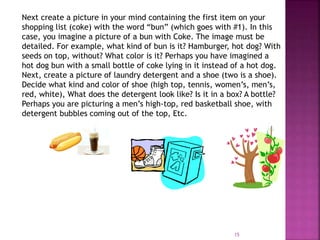
Next create a picture in your mind containing the first item on your
shopping list (coke) with the word “bun” (which goes with #1). In this
case, you imagine a picture of a bun with Coke. The image must be
detailed. For example, what kind of bun is it? Hamburger, hot dog? With
seeds on top, without? What color is it? Perhaps you have imagined a
hot dog bun with a small bottle of coke lying in it instead of a hot dog.
Next, create a picture of laundry detergent and a shoe (two is a shoe).
Decide what kind and color of shoe (high top, tennis, women’s, men’s,
red, white), What does the detergent look like? Is it in a box? A bottle?
Perhaps you are picturing a men’s high-top, red basketball shoe, with
detergent bubbles coming out of the top, Etc.
16
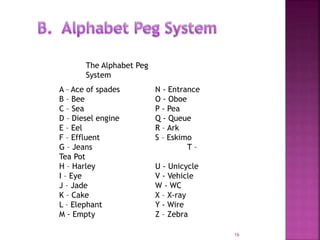
A – Ace of spades N - Entrance
B – Bee O - Oboe
C – Sea P - Pea
D – Diesel engine Q - Queue
E – Eel R – Ark
F – Effluent S – Eskimo
G – Jeans T –
Tea Pot
H – Harley U - Unicycle
I – Eye V - Vehicle
J – Jade W - WC
K – Cake X – X-ray
L – Elephant Y - Wire
M - Empty Z – Zebra
The Alphabet Peg
System
17
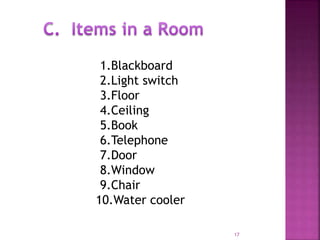
1.Blackboard
2.Light switch
3.Floor
4.Ceiling
5.Book
6.Telephone
7.Door
8.Window
9.Chair
10.Water cooler
18
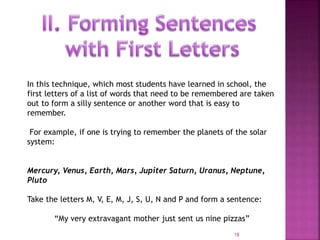
In this technique, which most students have learned in school, the
first letters of a list of words that need to be remembered are taken
out to form a silly sentence or another word that is easy to
remember.
For example, if one is trying to remember the planets of the solar
system:
Mercury, Venus, Earth, Mars, Jupiter Saturn, Uranus, Neptune,
Pluto
Take the letters M, V, E, M, J, S, U, N and P and form a sentence:
“My very extravagant mother just sent us nine pizzas”
19
The Great Lakes: Huron, Ontario, Michigan, Eerie, Superior
= H O M E S
20
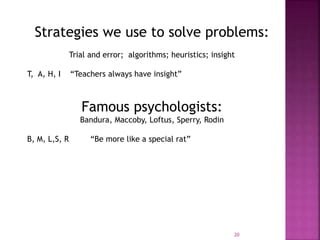
Strategies we use to solve problems:
Trial and error; algorithms; heuristics; insight
T, A, H, I “Teachers always have insight”
Famous psychologists:
Bandura, Maccoby, Loftus, Sperry, Rodin
B, M, L,S, R “Be more like a special rat”
 Mnemonics means “memory tool”;
 Using visual images paired with items to
remember is a powerful tool;
 Some mnemonics techniques include:
1. Similar traits
2. Peg systems
3. Forming sentences and words
4. Link & story method
 Make visual images funny, colorful, 3-D,
“cartoonish”
21

Mnemonics by maghan das

  • 1.
    The Art ofRemembering 1 Maghan Das
  • 2.
     A weirdword that means “memory tool”. Mnemonics are methods for remembering information that is otherwise difficult to recall. Mnemonics use as many of the best functions of your brain as possible to store information. 2
  • 3.
     Colors  Smells Tastes  Touch  Feelings  Shapes 3 While written language is one of the ways we communicate, it is only one of the skills and resources available to our minds. “Elephant” OR
  • 4.
     We remember20% of what we hear;  We remember 50% of what we read;  We remember 75-80% of what we see and do. 4 By using all your senses, but especially your ability to create visual images, you can increase your power to memorize.
  • 5.
     Your BrainCan Read This: fi yuo cna raed tihs, yuo hvae a sgtrane mnid too i cdnuolt blveiee taht I cluod aulaclty uesdnatnrd waht I was rdanieg. The phaonmneal pweor of the hmuan mnid, aoccdrnig to a rscheearch at Cmabrigde Uinervtisy, it dseno't mtaetr in waht oerdr the ltteres in a wrod are, the olny iproamtnt tihng is taht the frsit and lsat ltteer be in the rghit pclae. The rset can be a taotl mses and you can sitll raed it whotuit a pboerlm. Tihs is bcuseae the huamn mnid deos not raed ervey lteter by istlef, but the wrod as a wlohe. 5
  • 6.
     “I beforee, except after c”  HOMES  S-U-C-C-E-S-S  “30 days hath September….”  Tying a string around your finger 6
  • 7.
    Now you canstart making up your own mnemonic devices Recommended: Breakthrough Learning (1995) by Scott Bornstein • Use positive pleasant images • Use vivid colorful silly images • Use three-dimensional images • Exaggerate the size of the images • Use humor • Use symbols (traffic lights, pointing finger) 7
  • 8.
    1.The Similar TraitsTechnique 2. Peg Systems 3. Forming Sentences from the 1st letters of the words 4.The Link & Story Method 8
  • 9.
    Two words youwould like to remember and link in your mind: RICHMOND - VIRGINIA Find things they have in common (e.g., second letter “i”; eight letters) Find smaller words within the words: RICH MAN - VIRGINIA Make up a sentence or short visual/story: “The rich man drinks gin and lives in Virginia” 9
  • 10.
    Now try thisone: BUSCAR - TO LOOK FOR **The similar traits technique is a good way to study for matching tests. 10
  • 11.
    •Uses something youknow (and won’t forget) to “hang” new information on; •Pairs old information with new information in a visual format; •Good for remembering items in order; •Common pegs: the alphabet; numbers; furniture in your house 11
  • 12.
    12 You need toremember: 1. Bun (“one is a bun”) 6. Bricks 2. Shoe (“two is a shoe”) 7. Heaven 3. Tree (“three is a tree”) 8. Gate 4. Door “etc. 9. Line 5. Hive 10. Hen Form a picture in your mind of each item. Make the picture vivid, detailed, and colorful.
  • 13.
  • 14.
    14 Now, write downa list of things to remember, such as a shopping list (used here). It could be a list of body parts for Anatomy class, a list of scientists, or a list of the chemicals in the periodic table of the elements (any list). 1. Coke 2. Laundry Detergent 3. Tomatoes 4. Chicken 5. Hamburger 6. Paper Towels 7. Kleenex 8. Cookies 9. Bread 10.Lean Cuisine
  • 15.
    15 Next create apicture in your mind containing the first item on your shopping list (coke) with the word “bun” (which goes with #1). In this case, you imagine a picture of a bun with Coke. The image must be detailed. For example, what kind of bun is it? Hamburger, hot dog? With seeds on top, without? What color is it? Perhaps you have imagined a hot dog bun with a small bottle of coke lying in it instead of a hot dog. Next, create a picture of laundry detergent and a shoe (two is a shoe). Decide what kind and color of shoe (high top, tennis, women’s, men’s, red, white), What does the detergent look like? Is it in a box? A bottle? Perhaps you are picturing a men’s high-top, red basketball shoe, with detergent bubbles coming out of the top, Etc.
  • 16.
    16 A – Aceof spades N - Entrance B – Bee O - Oboe C – Sea P - Pea D – Diesel engine Q - Queue E – Eel R – Ark F – Effluent S – Eskimo G – Jeans T – Tea Pot H – Harley U - Unicycle I – Eye V - Vehicle J – Jade W - WC K – Cake X – X-ray L – Elephant Y - Wire M - Empty Z – Zebra The Alphabet Peg System
  • 17.
  • 18.
    18 In this technique,which most students have learned in school, the first letters of a list of words that need to be remembered are taken out to form a silly sentence or another word that is easy to remember. For example, if one is trying to remember the planets of the solar system: Mercury, Venus, Earth, Mars, Jupiter Saturn, Uranus, Neptune, Pluto Take the letters M, V, E, M, J, S, U, N and P and form a sentence: “My very extravagant mother just sent us nine pizzas”
  • 19.
    19 The Great Lakes:Huron, Ontario, Michigan, Eerie, Superior = H O M E S
  • 20.
    20 Strategies we useto solve problems: Trial and error; algorithms; heuristics; insight T, A, H, I “Teachers always have insight” Famous psychologists: Bandura, Maccoby, Loftus, Sperry, Rodin B, M, L,S, R “Be more like a special rat”
  • 21.
     Mnemonics means“memory tool”;  Using visual images paired with items to remember is a powerful tool;  Some mnemonics techniques include: 1. Similar traits 2. Peg systems 3. Forming sentences and words 4. Link & story method  Make visual images funny, colorful, 3-D, “cartoonish” 21