MNEMONIC
TECHNIQUE
01
E V E NTS M A N A G E ME N T - 9
Owing to the unavailability of devices to
store massive quantities of information,
ancient humans invented and developed a
system of mnemonics that persisted into
present society. The mnemonics,
furthermore referred as the Ancient Art of
Memory, were first distinguished in 447 BC
by the Greek poet Simonides. Cicero,
Quintilian, and Pliny provided adequate
descriptions of the mnemonics.
02
INTRODUCTION
Mnemonic
Technique
Historical Context
Did you know?
03
What is
Mneumonic
Learning?
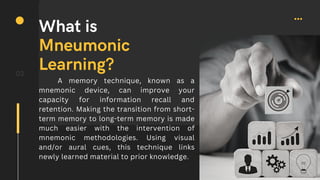
A memory technique, known as a
mnemonic device, can improve your
capacity for information recall and
retention. Making the transition from short-
term memory to long-term memory is made
much easier with the intervention of
mnemonic methodologies. Using visual
and/or aural cues, this technique links
newly learned material to prior knowledge.
04
Building
Connections
VARIOUS INFORMATIONAL SECTIONS
Integrating new information
with something you are familiar
with or know helps you
encapsulate it using a mnemonic
methodology. This gives it
purpose and makes it simpler to
vaguely remember. Making
connections is a kind of
elaborate rehearsal that can be
used with virtually any subject
or genre of statistics.
INTERCONNECTION
Variety of
Mnemonic
Techniques
V A R IOUS I N F O R M AT I O N A L S E C T I O N S
05
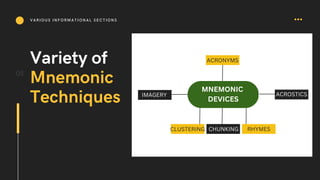
CHUNKING
MNEMONIC
DEVICES
ACRONYMS
CLUSTERING
IMAGERY
RHYMES
ACROSTICS
06
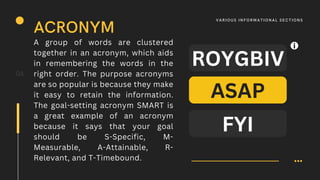
ACRONYM
V A R IOUS I N F O R M AT I O N A L S E C T I O N S
A group of words are clustered
together in an acronym, which aids
in remembering the words in the
right order. The purpose acronyms
are so popular is because they make
it easy to retain the information.
The goal-setting acronym SMART is
a great example of an acronym
because it says that your goal
should be S-Specific, M-
Measurable, A-Attainable, R-
Relevant, and T-Timebound.
ROYGBIV
ASAP
FYI
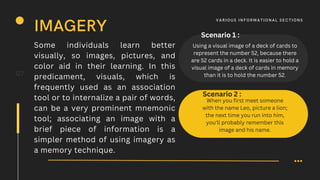
Some individuals learn better
visually, so images, pictures, and
color aid in their learning. In this
predicament, visuals, which is
frequently used as an association
tool or to internalize a pair of words,
can be a very prominent mnemonic
tool; associating an image with a
brief piece of information is a
simpler method of using imagery as
a memory technique.
07
IMAGERY
V A R IOUS I N F O R M AT I O N A L S E C T I O N S
Using a visual image of a deck of cards to
represent the number 52, because there
are 52 cards in a deck. It is easier to hold a
visual image of a deck of cards in memory
than it is to hold the number 52.
Scenario 1 :
Scenario 2 :
When you first meet someone
with the name Leo, picture a lion;
the next time you run into him,
you'll probably remember this
image and his name.
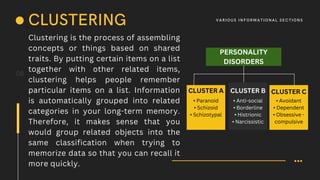
Clustering is the process of assembling
concepts or things based on shared
traits. By putting certain items on a list
together with other related items,
clustering helps people remember
particular items on a list. Information
is automatically grouped into related
categories in your long-term memory.
Therefore, it makes sense that you
would group related objects into the
same classification when trying to
memorize data so that you can recall it
more quickly.
08
CLUSTERING V A R IOUS I N F O R M AT I O N A L S E C T I O N S
PERSONALITY
DISORDERS
CLUSTER A CLUSTER B CLUSTER C
• Paranoid
• Schizoid
• Schizotypal
• Anti-social
• Borderline
• Histrionic
• Narcissistic
• Avoidant
• Dependent
• Obsessive -
compulsive
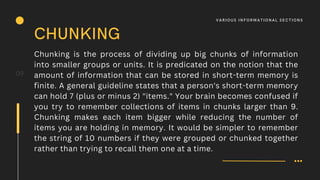
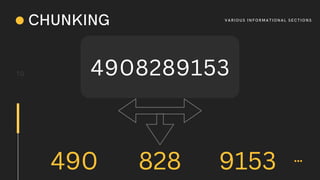
Chunking is the process of dividing up big chunks of information
into smaller groups or units. It is predicated on the notion that the
amount of information that can be stored in short-term memory is
finite. A general guideline states that a person's short-term memory
can hold 7 (plus or minus 2) "items." Your brain becomes confused if
you try to remember collections of items in chunks larger than 9.
Chunking makes each item bigger while reducing the number of
items you are holding in memory. It would be simpler to remember
the string of 10 numbers if they were grouped or chunked together
rather than trying to recall them one at a time.
09
CHUNKING
V A R IOUS I N F O R M AT I O N A L S E C T I O N S
10
CHUNKING
490
VARIOUS INFORMATIONAL SECTIONS
4908289153
828 9153
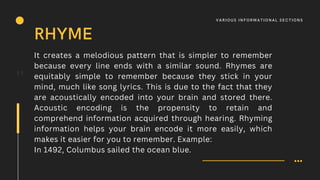
It creates a melodious pattern that is simpler to remember
because every line ends with a similar sound. Rhymes are
equitably simple to remember because they stick in your
mind, much like song lyrics. This is due to the fact that they
are acoustically encoded into your brain and stored there.
Acoustic encoding is the propensity to retain and
comprehend information acquired through hearing. Rhyming
information helps your brain encode it more easily, which
makes it easier for you to remember. Example:
In 1492, Columbus sailed the ocean blue.
11
RHYME
V A R IOUS I N F O R M AT I O N A L S E C T I O N S
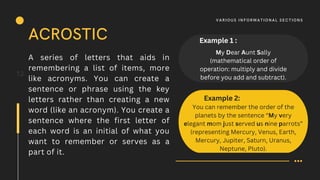
A series of letters that aids in
remembering a list of items, more
like acronyms. You can create a
sentence or phrase using the key
letters rather than creating a new
word (like an acronym). You create a
sentence where the first letter of
each word is an initial of what you
want to remember or serves as a
part of it.
12
ACROSTIC
V A R IOUS I N F O R M AT I O N A L S E C T I O N S
My Dear Aunt Sally
(mathematical order of
operation: multiply and divide
before you add and subtract).
Example 1 :
Example 2:
You can remember the order of the
planets by the sentence “My very
elegant mom just served us nine parrots”
(representing Mercury, Venus, Earth,
Mercury, Jupiter, Saturn, Uranus,
Neptune, Pluto).
13
Key Information
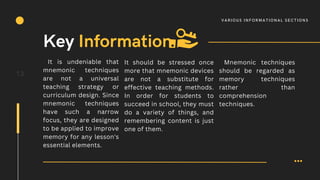
It is undeniable that
mnemonic techniques
are not a universal
teaching strategy or
curriculum design. Since
mnemonic techniques
have such a narrow
focus, they are designed
to be applied to improve
memory for any lesson's
essential elements.
VARIOUS INFORMATIONAL SECTIONS
Mnemonic techniques
should be regarded as
memory techniques
rather than
comprehension
techniques.
It should be stressed once
more that mnemonic devices
are not a substitute for
effective teaching methods.

In order for students to
succeed in school, they must
do a variety of things, and
remembering content is just
one of them.
14
Learning never exhaust
the mind.
Leonardo da Vinci

MNEMONIC TECHNIQUES USE IN MEMORIZATION/

  • 1.
    MNEMONIC TECHNIQUE 01 E V ENTS M A N A G E ME N T - 9
  • 2.
    Owing to theunavailability of devices to store massive quantities of information, ancient humans invented and developed a system of mnemonics that persisted into present society. The mnemonics, furthermore referred as the Ancient Art of Memory, were first distinguished in 447 BC by the Greek poet Simonides. Cicero, Quintilian, and Pliny provided adequate descriptions of the mnemonics. 02 INTRODUCTION Mnemonic Technique Historical Context Did you know?
  • 3.
    03 What is Mneumonic Learning? A memorytechnique, known as a mnemonic device, can improve your capacity for information recall and retention. Making the transition from short- term memory to long-term memory is made much easier with the intervention of mnemonic methodologies. Using visual and/or aural cues, this technique links newly learned material to prior knowledge.
  • 4.
    04 Building Connections VARIOUS INFORMATIONAL SECTIONS Integratingnew information with something you are familiar with or know helps you encapsulate it using a mnemonic methodology. This gives it purpose and makes it simpler to vaguely remember. Making connections is a kind of elaborate rehearsal that can be used with virtually any subject or genre of statistics. INTERCONNECTION
  • 5.
    Variety of Mnemonic Techniques V AR IOUS I N F O R M AT I O N A L S E C T I O N S 05 CHUNKING MNEMONIC DEVICES ACRONYMS CLUSTERING IMAGERY RHYMES ACROSTICS
  • 6.
    06 ACRONYM V A RIOUS I N F O R M AT I O N A L S E C T I O N S A group of words are clustered together in an acronym, which aids in remembering the words in the right order. The purpose acronyms are so popular is because they make it easy to retain the information. The goal-setting acronym SMART is a great example of an acronym because it says that your goal should be S-Specific, M- Measurable, A-Attainable, R- Relevant, and T-Timebound. ROYGBIV ASAP FYI
  • 7.
    Some individuals learnbetter visually, so images, pictures, and color aid in their learning. In this predicament, visuals, which is frequently used as an association tool or to internalize a pair of words, can be a very prominent mnemonic tool; associating an image with a brief piece of information is a simpler method of using imagery as a memory technique. 07 IMAGERY V A R IOUS I N F O R M AT I O N A L S E C T I O N S Using a visual image of a deck of cards to represent the number 52, because there are 52 cards in a deck. It is easier to hold a visual image of a deck of cards in memory than it is to hold the number 52. Scenario 1 : Scenario 2 : When you first meet someone with the name Leo, picture a lion; the next time you run into him, you'll probably remember this image and his name.
  • 8.
    Clustering is theprocess of assembling concepts or things based on shared traits. By putting certain items on a list together with other related items, clustering helps people remember particular items on a list. Information is automatically grouped into related categories in your long-term memory. Therefore, it makes sense that you would group related objects into the same classification when trying to memorize data so that you can recall it more quickly. 08 CLUSTERING V A R IOUS I N F O R M AT I O N A L S E C T I O N S PERSONALITY DISORDERS CLUSTER A CLUSTER B CLUSTER C • Paranoid • Schizoid • Schizotypal • Anti-social • Borderline • Histrionic • Narcissistic • Avoidant • Dependent • Obsessive - compulsive
  • 9.
    Chunking is theprocess of dividing up big chunks of information into smaller groups or units. It is predicated on the notion that the amount of information that can be stored in short-term memory is finite. A general guideline states that a person's short-term memory can hold 7 (plus or minus 2) "items." Your brain becomes confused if you try to remember collections of items in chunks larger than 9. Chunking makes each item bigger while reducing the number of items you are holding in memory. It would be simpler to remember the string of 10 numbers if they were grouped or chunked together rather than trying to recall them one at a time. 09 CHUNKING V A R IOUS I N F O R M AT I O N A L S E C T I O N S
  • 10.
  • 11.
    It creates amelodious pattern that is simpler to remember because every line ends with a similar sound. Rhymes are equitably simple to remember because they stick in your mind, much like song lyrics. This is due to the fact that they are acoustically encoded into your brain and stored there. Acoustic encoding is the propensity to retain and comprehend information acquired through hearing. Rhyming information helps your brain encode it more easily, which makes it easier for you to remember. Example: In 1492, Columbus sailed the ocean blue. 11 RHYME V A R IOUS I N F O R M AT I O N A L S E C T I O N S
  • 12.
    A series ofletters that aids in remembering a list of items, more like acronyms. You can create a sentence or phrase using the key letters rather than creating a new word (like an acronym). You create a sentence where the first letter of each word is an initial of what you want to remember or serves as a part of it. 12 ACROSTIC V A R IOUS I N F O R M AT I O N A L S E C T I O N S My Dear Aunt Sally (mathematical order of operation: multiply and divide before you add and subtract). Example 1 : Example 2: You can remember the order of the planets by the sentence “My very elegant mom just served us nine parrots” (representing Mercury, Venus, Earth, Mercury, Jupiter, Saturn, Uranus, Neptune, Pluto).
  • 13.
    13 Key Information It isundeniable that mnemonic techniques are not a universal teaching strategy or curriculum design. Since mnemonic techniques have such a narrow focus, they are designed to be applied to improve memory for any lesson's essential elements. VARIOUS INFORMATIONAL SECTIONS Mnemonic techniques should be regarded as memory techniques rather than comprehension techniques. It should be stressed once more that mnemonic devices are not a substitute for effective teaching methods. In order for students to succeed in school, they must do a variety of things, and remembering content is just one of them.

  • 14.
    14 Learning never exhaust themind. Leonardo da Vinci