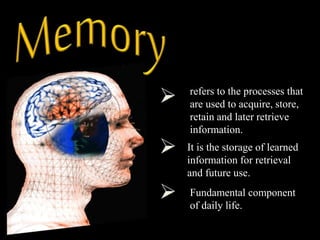
refers to the processes that
are used to acquire, store,
retain and later retrieve
information.
It is the storage of learned
information for retrieval
and future use.
Fundamental component
of daily life.
Three major processes involved in memory:
converting information into
a form that can be entered
and stored in the memory.
the process whereby
encoded information is
retained for later/future
use.
Three major processes involved in memory:
the process whereby a
stored memory is brought
into conscious awareness.
Two basic divisions of memory
Procedural memories
Declarative memories
Physically-based
motor skills.
Conducted-via the
cerebellum
Two basic divisions of memory
Are knowledge-or
incident-based (aka
Facts & Episodes)
Conducted via the
locus coeruleus.
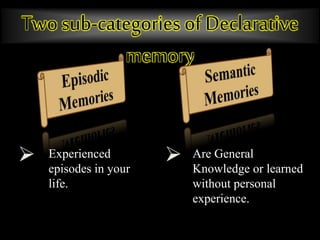
Two sub-categories of Declarative
memory
Experienced
episodes in your
life.
Are General
Knowledge or learned
without personal
experience.
Four general stages of Memory:
Initial process of
inputs through sensory
system.
Four general stages of Memory:
Attention is focused on
the stimulus which
results in it being
stored in memory area.
Four general stages of Memory:
Stored memory is
recalled from a memory
area and used by working
memory to recreate the
experience.
Four general stages of Memory:
After use by working
memory, the memory
must be stored in a
memory area or it is lost.
Sequential category levels of
memory:
Sensory memory~ Stimulus is brought to the brain
via one of any of the sensory
systems (five senses)
~ it last about half a second in
duration.
~ Exists for each sensory channel:
Iconic Memory, Echoic Memory,
and Haptic Memory.
Sequential category levels of
memory:
Iconic memory
for visual stimuli
Sequential category levels of
memory:
Echoic memory
For aural
stimuli/auditory
memory
Sequential category levels of
memory:
Haptic memory
For touch
Sequential category levels of
memory:
Short-term memory (STM)~ Typically lasts up to 30 seconds
without needing a rehearsal or
repeated sensation.
~Stores items by meaning, called
bits.
~ Capacity of STM memory is 7
bits (plus/minus 2).
~ LTP (Long-term Potentiation):
a process of elaborate rehearsal of
short-term memory to a long-term
memory.
~ also considered to be “working
memory”.
Sequential category levels of
memory:
Long-term memory
~ Perception in short-term
memory will be moved to long
term memory with enough
rehearsal.
~ have no bounds and unlimited.
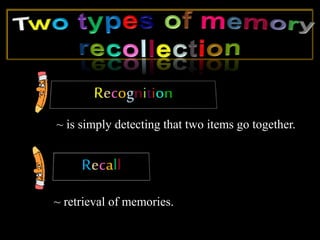
~ is simply detecting that two items go together.
~ retrieval of memories.
Physical Structure of Memory:
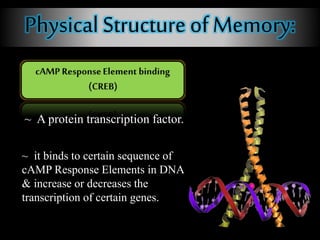
~ A protein transcription factor.
~ it binds to certain sequence of
cAMP Response Elements in DNA
& increase or decreases the
transcription of certain genes.
Physical Structure of Memory:
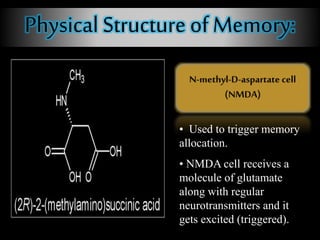
• Used to trigger memory
allocation.
• NMDA cell receives a
molecule of glutamate
along with regular
neurotransmitters and it
gets excited (triggered).
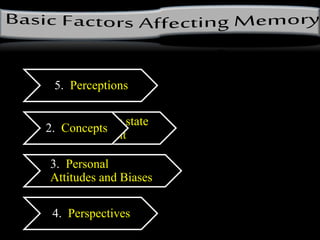
7. Memory is
context dependent
6. Memory is state
dependent
1. Attention
2. Concepts
3. Personal
Attitudes and Biases
4. Perspectives
5. Perceptions
Forgetting
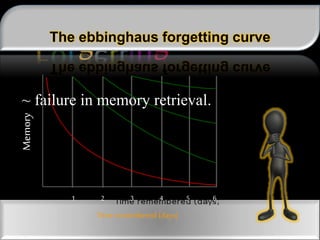
~ failure in memory retrieval.
The ebbinghaus forgetting curve
Memory
Time remembered(days)
654321
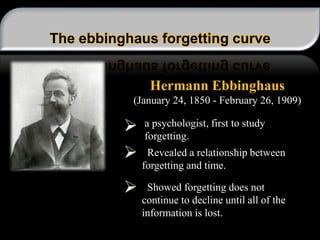
The ebbinghaus forgetting curve
Hermann Ebbinghaus
(January 24, 1850 - February 26, 1909)
a psychologist, first to study
forgetting.
Revealed a relationship between
forgetting and time.
Showed forgetting does not
continue to decline until all of the
information is lost.
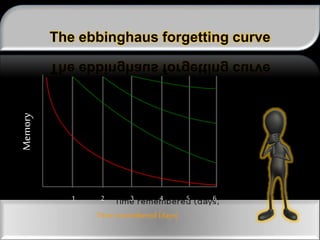
The ebbinghaus forgetting curve
Memory
Time remembered(days)
654321
- occurs in sensory and
short term memory.
- Memory trace is created every
time a new theory is formed.
- Over time, memory traces
begin to fade and disappear &
information is not retrieved &
rehearsed, it will eventually be
lost.
- Forgetting due to
memories fading over time.
four major reasons why people
forget:
1 . Retrieval Failure
- Inability to retrieve a memory.
Decay Theory
- Hindrance of new information
because of other information
learned before or after the new
information.
four major reasons why people
forget:
2 . InterferenceInterferenceTheory
- suggests that some memories compete
and interfere with other memories.
four major reasons why people
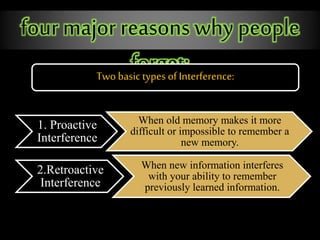
forget:Two basic types of Interference:
1. Proactive
Interference
When old memory makes it more
difficult or impossible to remember a
new memory.
2.Retroactive
Interference
When new information interferes
with your ability to remember
previously learned information.
four major reasons why people
forget:
3 . Failure to Store
- We forget information because it never
actually made it into long-term memory.
Encoding failures sometimes prevent
information from entering long-term
memory.
4 . Motivated Forgetting
four major reasons why people
forget:
- We forget memories because of
traumatic or disturbing events or
experiences.
four major reasons why people
forget:Two basic forms of motivated
forgetting:
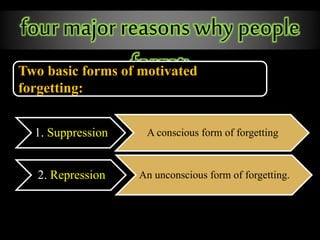
1. Suppression A conscious form of forgetting
2. Repression An unconscious form of forgetting.
MemorizationTechnique
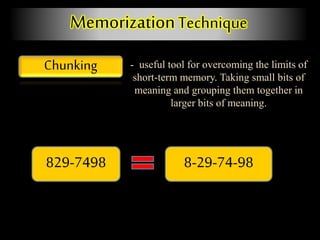
Chunking - useful tool for overcoming the limits of
short-term memory. Taking small bits of
meaning and grouping them together in
larger bits of meaning.
829-7498 8-29-74-98
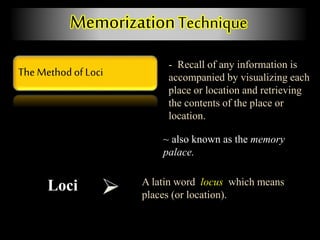
The Method of Loci
MemorizationTechnique
- Recall of any information is
accompanied by visualizing each
place or location and retrieving
the contents of the place or
location.
Loci A latin word locus which means
places (or location).
~ also known as the memory
palace.
Rote Memorization
MemorizationTechnique
- Most used memory technique. Most difficult
method for your brain to store the memory correctly.
- Learning by repetition.
MemorizationTechnique
Thinkof pictures to memorize
- Photographic memories
think in pictures.
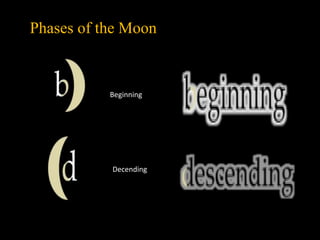
Phases of the Moon
Beginning
Decending
Mnemonics
MemorizationTechnique
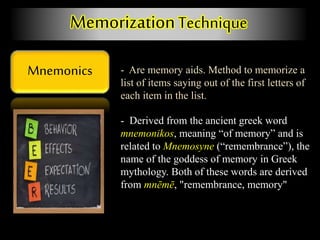
- Are memory aids. Method to memorize a
list of items saying out of the first letters of
each item in the list.
- Derived from the ancient greek word
mnemonikos, meaning “of memory” and is
related to Mnemosyne (“remembrance”), the
name of the goddess of memory in Greek
mythology. Both of these words are derived
from mnēmē, "remembrance, memory"
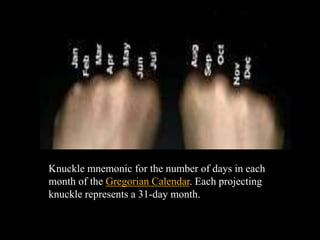
Knuckle mnemonic for the number of days in each
month of the Gregorian Calendar. Each projecting
knuckle represents a 31-day month.
Mnemonics
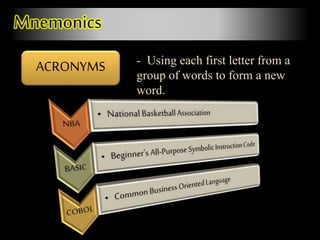
ACRONYMS - Using each first letter from a
group of words to form a new
word.
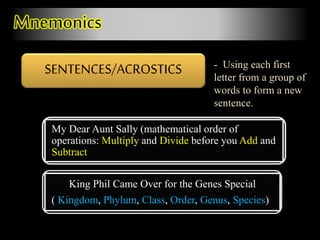
SENTENCES/ACROSTICS
Mnemonics
- Using each first
letter from a group of
words to form a new
sentence.
My Dear Aunt Sally (mathematical order of
operations: Multiply and Divide before you Add and
Subtract
King Phil Came Over for the Genes Special
( Kingdom, Phylum, Class, Order, Genus, Species)
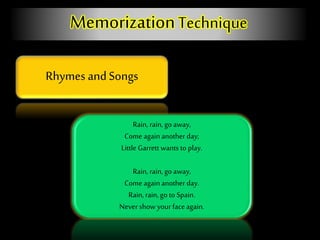
Rhymes andSongs
MemorizationTechnique
Rain, rain, go away,
Come again another day;
Little Garrett wants to play.
Rain, rain, go away,
Come again another day.
Rain, rain, go to Spain.
Never show your faceagain.

Memory and Forgetting - Psychology

  • 4.
    refers to theprocesses that are used to acquire, store, retain and later retrieve information. It is the storage of learned information for retrieval and future use. Fundamental component of daily life.
  • 5.
    Three major processesinvolved in memory: converting information into a form that can be entered and stored in the memory. the process whereby encoded information is retained for later/future use.
  • 6.
    Three major processesinvolved in memory: the process whereby a stored memory is brought into conscious awareness.
  • 7.
    Two basic divisionsof memory Procedural memories Declarative memories Physically-based motor skills. Conducted-via the cerebellum
  • 8.
    Two basic divisionsof memory Are knowledge-or incident-based (aka Facts & Episodes) Conducted via the locus coeruleus.
  • 9.
    Two sub-categories ofDeclarative memory Experienced episodes in your life. Are General Knowledge or learned without personal experience.
  • 10.
    Four general stagesof Memory: Initial process of inputs through sensory system.
  • 11.
    Four general stagesof Memory: Attention is focused on the stimulus which results in it being stored in memory area.
  • 12.
    Four general stagesof Memory: Stored memory is recalled from a memory area and used by working memory to recreate the experience.
  • 13.
    Four general stagesof Memory: After use by working memory, the memory must be stored in a memory area or it is lost.
  • 14.
    Sequential category levelsof memory: Sensory memory~ Stimulus is brought to the brain via one of any of the sensory systems (five senses) ~ it last about half a second in duration. ~ Exists for each sensory channel: Iconic Memory, Echoic Memory, and Haptic Memory.
  • 15.
    Sequential category levelsof memory: Iconic memory for visual stimuli
  • 16.
    Sequential category levelsof memory: Echoic memory For aural stimuli/auditory memory
  • 17.
    Sequential category levelsof memory: Haptic memory For touch
  • 18.
    Sequential category levelsof memory: Short-term memory (STM)~ Typically lasts up to 30 seconds without needing a rehearsal or repeated sensation. ~Stores items by meaning, called bits. ~ Capacity of STM memory is 7 bits (plus/minus 2). ~ LTP (Long-term Potentiation): a process of elaborate rehearsal of short-term memory to a long-term memory. ~ also considered to be “working memory”.
  • 19.
    Sequential category levelsof memory: Long-term memory ~ Perception in short-term memory will be moved to long term memory with enough rehearsal. ~ have no bounds and unlimited.
  • 20.
    ~ is simplydetecting that two items go together. ~ retrieval of memories.
  • 21.
    Physical Structure ofMemory: ~ A protein transcription factor. ~ it binds to certain sequence of cAMP Response Elements in DNA & increase or decreases the transcription of certain genes.
  • 22.
    Physical Structure ofMemory: • Used to trigger memory allocation. • NMDA cell receives a molecule of glutamate along with regular neurotransmitters and it gets excited (triggered).
  • 23.
    7. Memory is contextdependent 6. Memory is state dependent 1. Attention 2. Concepts 3. Personal Attitudes and Biases 4. Perspectives 5. Perceptions
  • 25.
    Forgetting ~ failure inmemory retrieval. The ebbinghaus forgetting curve Memory Time remembered(days) 654321
  • 26.
    The ebbinghaus forgettingcurve Hermann Ebbinghaus (January 24, 1850 - February 26, 1909) a psychologist, first to study forgetting. Revealed a relationship between forgetting and time. Showed forgetting does not continue to decline until all of the information is lost.
  • 27.
    The ebbinghaus forgettingcurve Memory Time remembered(days) 654321
  • 29.
    - occurs insensory and short term memory. - Memory trace is created every time a new theory is formed. - Over time, memory traces begin to fade and disappear & information is not retrieved & rehearsed, it will eventually be lost. - Forgetting due to memories fading over time. four major reasons why people forget: 1 . Retrieval Failure - Inability to retrieve a memory. Decay Theory
  • 30.
    - Hindrance ofnew information because of other information learned before or after the new information. four major reasons why people forget: 2 . InterferenceInterferenceTheory - suggests that some memories compete and interfere with other memories.
  • 31.
    four major reasonswhy people forget:Two basic types of Interference: 1. Proactive Interference When old memory makes it more difficult or impossible to remember a new memory. 2.Retroactive Interference When new information interferes with your ability to remember previously learned information.
  • 32.
    four major reasonswhy people forget: 3 . Failure to Store - We forget information because it never actually made it into long-term memory. Encoding failures sometimes prevent information from entering long-term memory.
  • 33.
    4 . MotivatedForgetting four major reasons why people forget: - We forget memories because of traumatic or disturbing events or experiences.
  • 34.
    four major reasonswhy people forget:Two basic forms of motivated forgetting: 1. Suppression A conscious form of forgetting 2. Repression An unconscious form of forgetting.
  • 35.
    MemorizationTechnique Chunking - usefultool for overcoming the limits of short-term memory. Taking small bits of meaning and grouping them together in larger bits of meaning. 829-7498 8-29-74-98
  • 36.
    The Method ofLoci MemorizationTechnique - Recall of any information is accompanied by visualizing each place or location and retrieving the contents of the place or location. Loci A latin word locus which means places (or location). ~ also known as the memory palace.
  • 37.
    Rote Memorization MemorizationTechnique - Mostused memory technique. Most difficult method for your brain to store the memory correctly. - Learning by repetition.
  • 38.
    MemorizationTechnique Thinkof pictures tomemorize - Photographic memories think in pictures.
  • 39.
    Phases of theMoon Beginning Decending
  • 40.
    Mnemonics MemorizationTechnique - Are memoryaids. Method to memorize a list of items saying out of the first letters of each item in the list. - Derived from the ancient greek word mnemonikos, meaning “of memory” and is related to Mnemosyne (“remembrance”), the name of the goddess of memory in Greek mythology. Both of these words are derived from mnēmē, "remembrance, memory"
  • 41.
    Knuckle mnemonic forthe number of days in each month of the Gregorian Calendar. Each projecting knuckle represents a 31-day month.
  • 42.
    Mnemonics ACRONYMS - Usingeach first letter from a group of words to form a new word.
  • 43.
    SENTENCES/ACROSTICS Mnemonics - Using eachfirst letter from a group of words to form a new sentence. My Dear Aunt Sally (mathematical order of operations: Multiply and Divide before you Add and Subtract King Phil Came Over for the Genes Special ( Kingdom, Phylum, Class, Order, Genus, Species)
  • 44.
    Rhymes andSongs MemorizationTechnique Rain, rain,go away, Come again another day; Little Garrett wants to play. Rain, rain, go away, Come again another day. Rain, rain, go to Spain. Never show your faceagain.
Editor's Notes

  • #6 Encoding – Converting information into a form that can be entered and stored in the memory. Storage - process by which information is stored in the memory and that information can be used in later/future use.
  • #7 Retrieval – the process whereby a stored memory is brought into conscious awareness.
  • #8 Procedural & Declarative memories -
  • #9 Declarative Memories – knowledge or incident based
  • #11 Encoding – inputs are processed through sensory system. i.e. ears, eyes, nose, touch, taste (when the stimulus is sensed it is translated into a form that the brain can understand.
  • #26 “I hear and I forget. I see and I remember. I do and I understand.” – Confucius
  • #30 Four major reasons why people forget: According to Susan Loftus the 4 major reasons why people forget are: retrieval failure, interference, failure to store & motivated forgetting.
  • #31 Interference:
  • #32 2 basic types of interference: Proactive interference Retroactive interference