Mnemonics
PREPARED BY: RUPAM KUMARI
MNEMONICS:
Meaning:
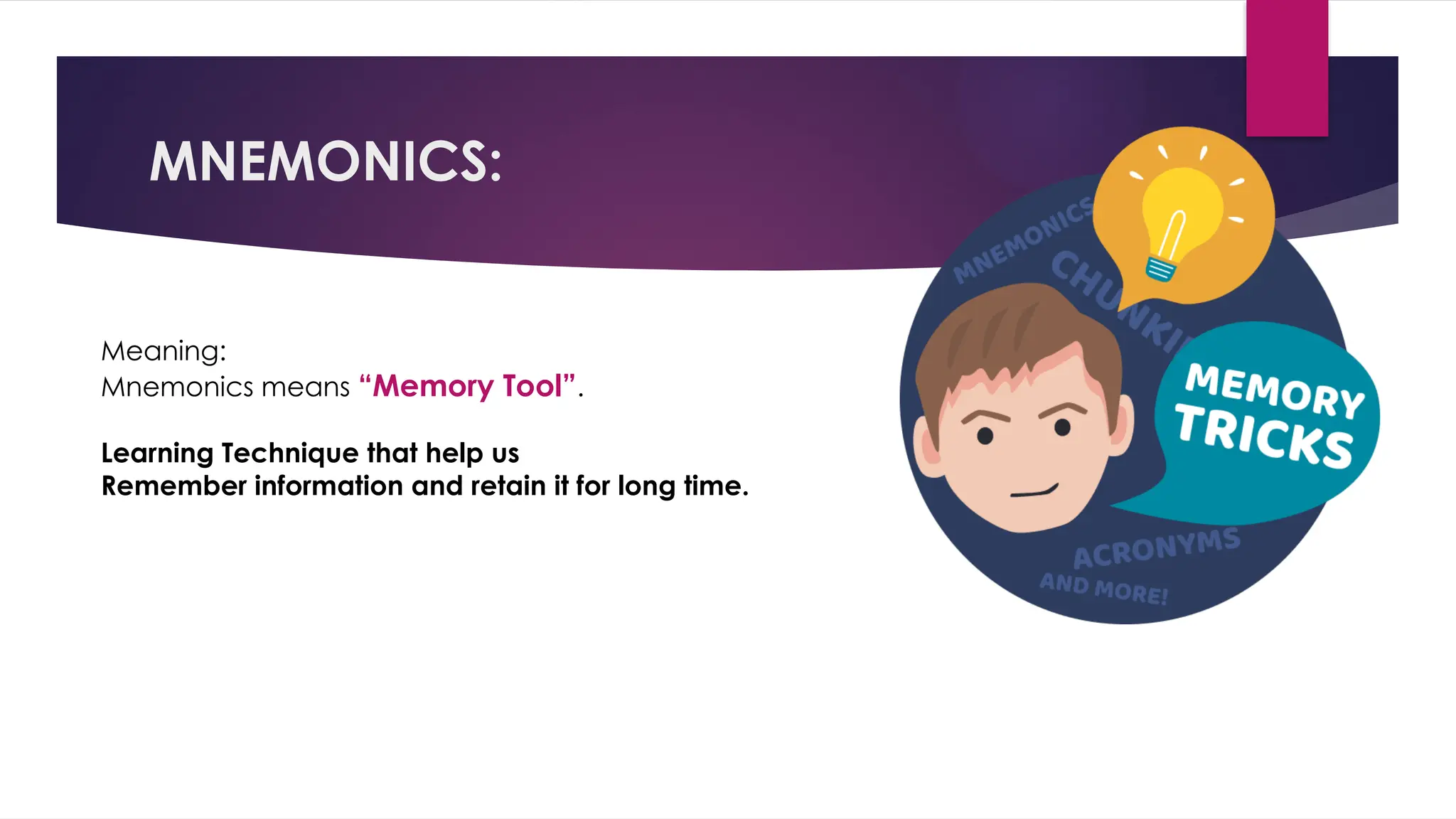
Mnemonics means “Memory Tool”.
Learning Technique that help us
Remember information and retain it for long time.
Why Use Mnemonics?
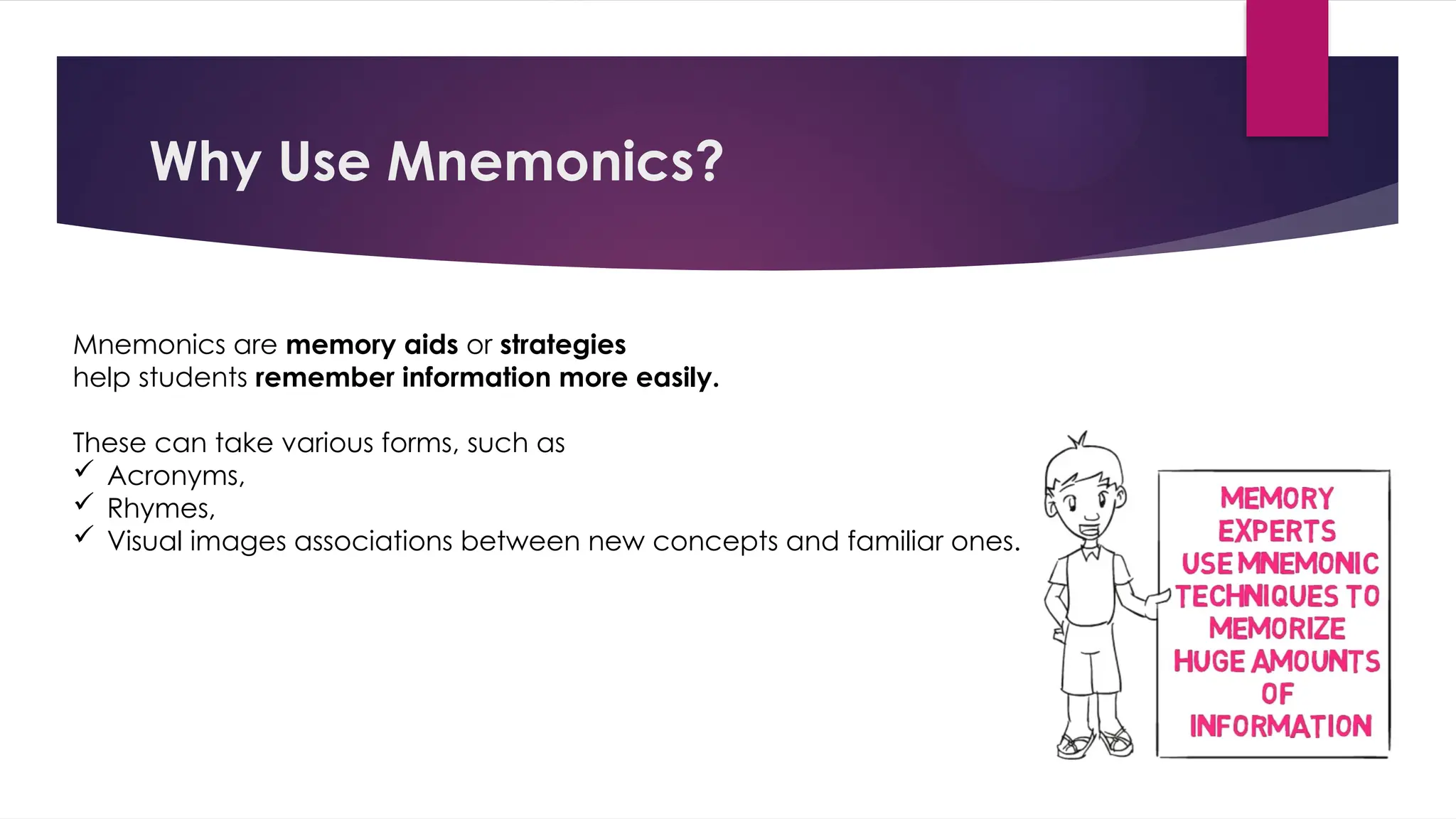
Mnemonics are memory aids or strategies
help students remember information more easily.
These can take various forms, such as
 Acronyms,
 Rhymes,
 Visual images associations between new concepts and familiar ones.
Types of Mnemonics:
Acronyms
Acrostics
Rhymes & Songs
Visualization & Imagery
Chunking
Method of Loci
Acronyms
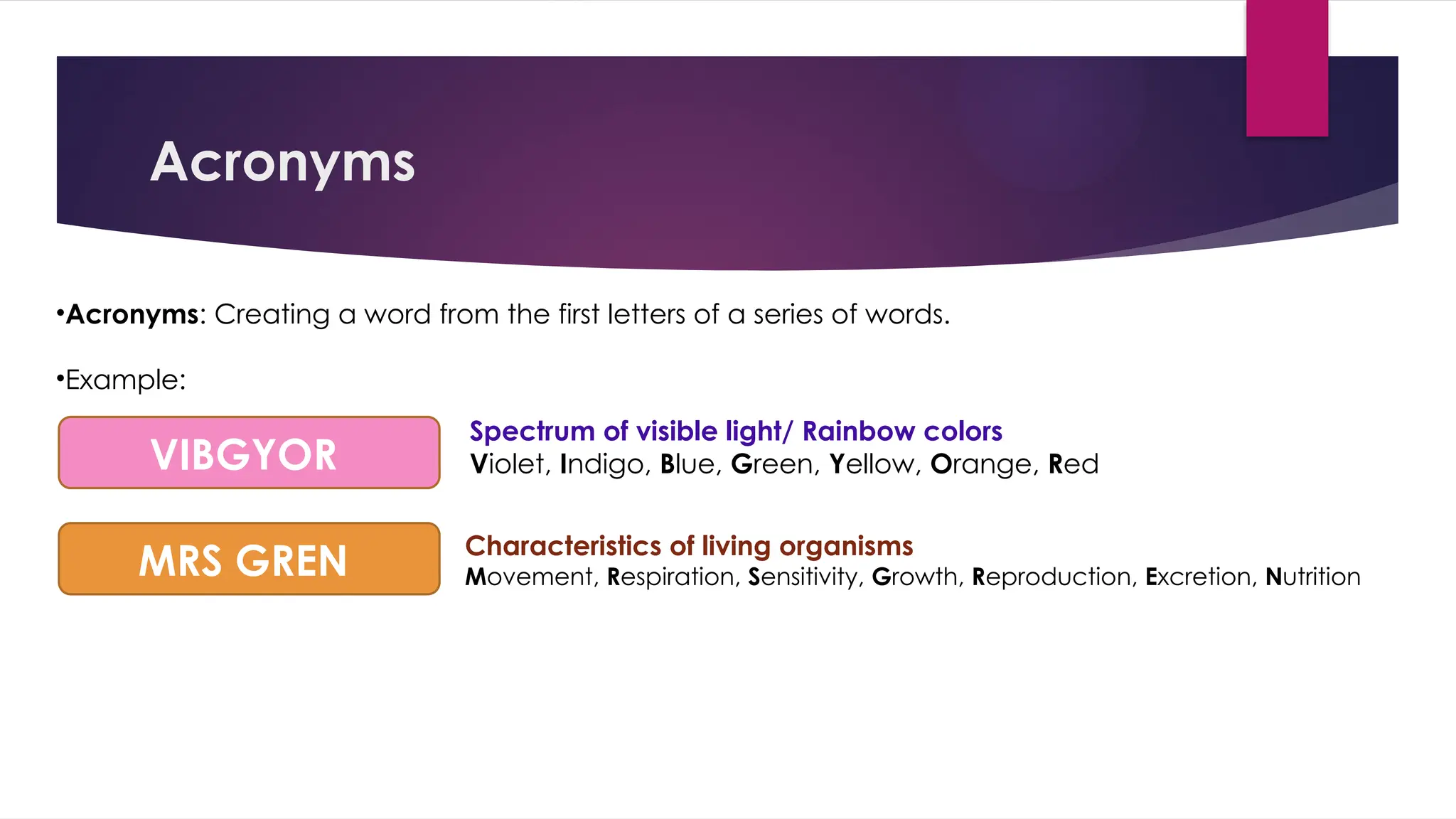
•Acronyms: Creating a word from the first letters of a series of words.
•Example:
VIBGYOR
MRS GREN Characteristics of living organisms
Movement, Respiration, Sensitivity, Growth, Reproduction, Excretion, Nutrition
Spectrum of visible light/ Rainbow colors
Violet, Indigo, Blue, Green, Yellow, Orange, Red
Acrostics
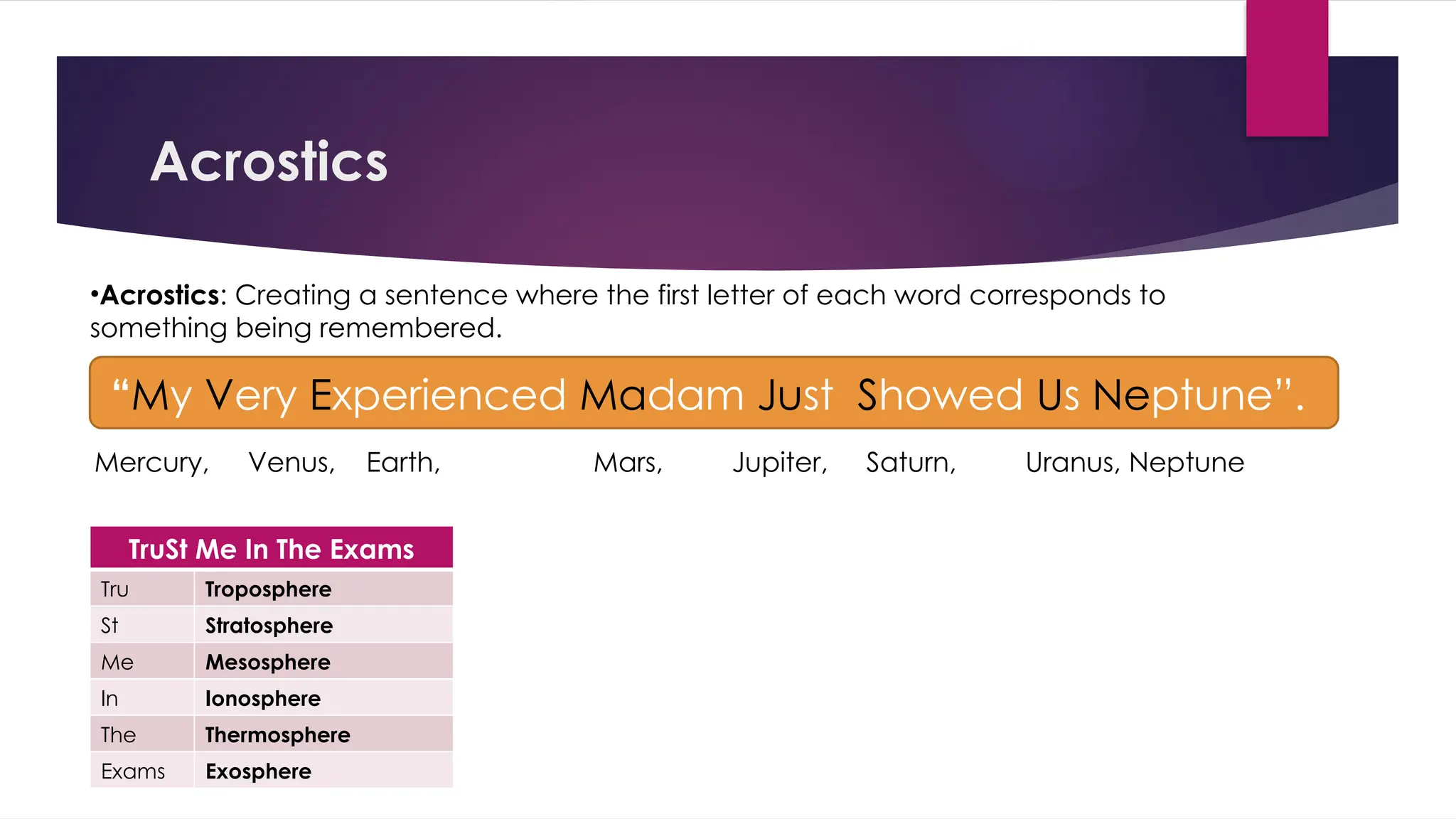
•Acrostics: Creating a sentence where the first letter of each word corresponds to
something being remembered.
“My Very Experienced Madam Just Showed Us Neptune”.
TruSt Me In The Exams
Tru Troposphere
St Stratosphere
Me Mesosphere
In Ionosphere
The Thermosphere
Exams Exosphere
Mercury, Venus, Earth, Mars, Jupiter, Saturn, Uranus, Neptune
Rhymes & Songs
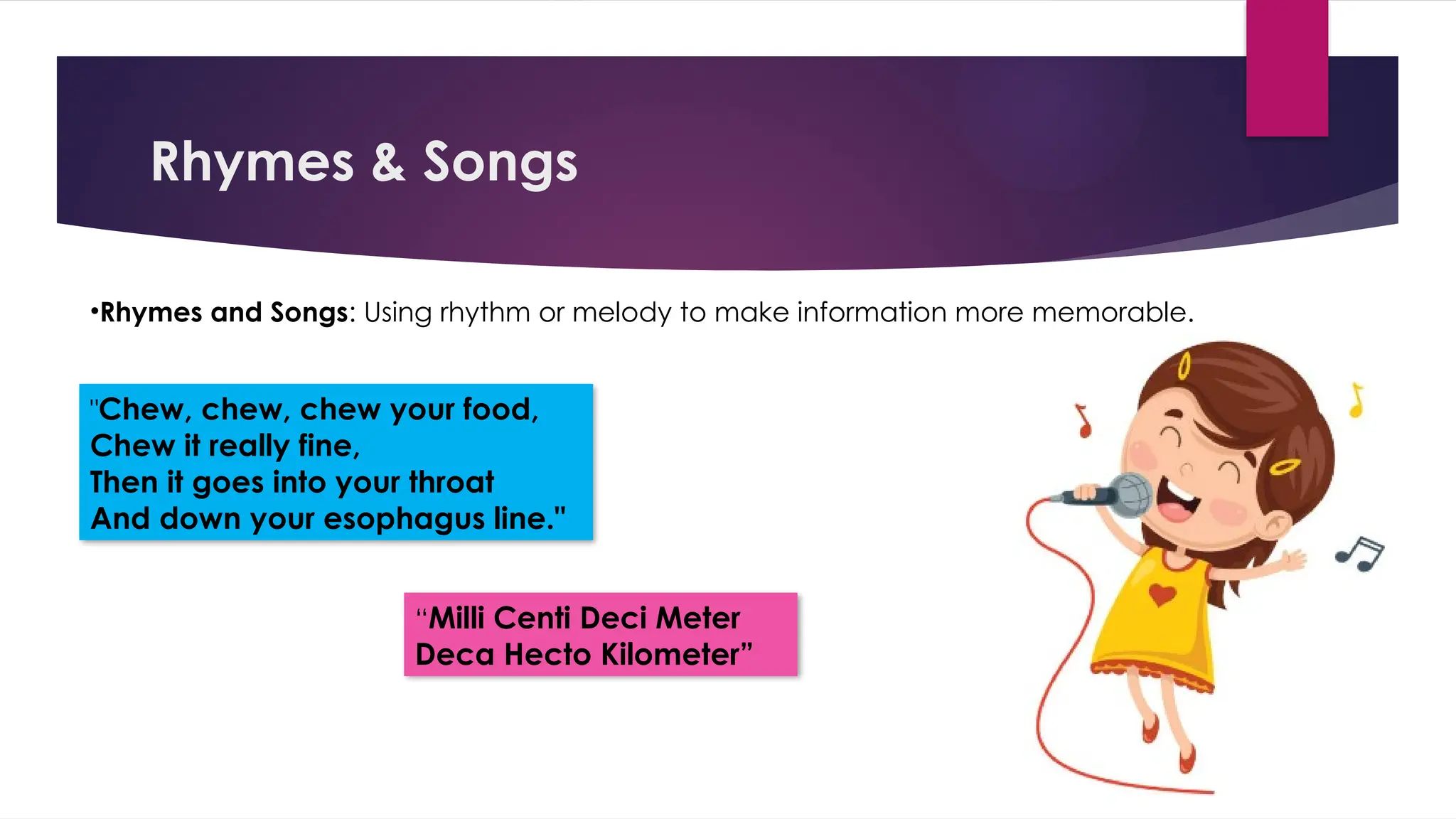
•Rhymes and Songs: Using rhythm or melody to make information more memorable.
"Chew, chew, chew your food,
Chew it really fine,
Then it goes into your throat
And down your esophagus line."
“Milli Centi Deci Meter
Deca Hecto Kilometer”
Visualization and Imagery
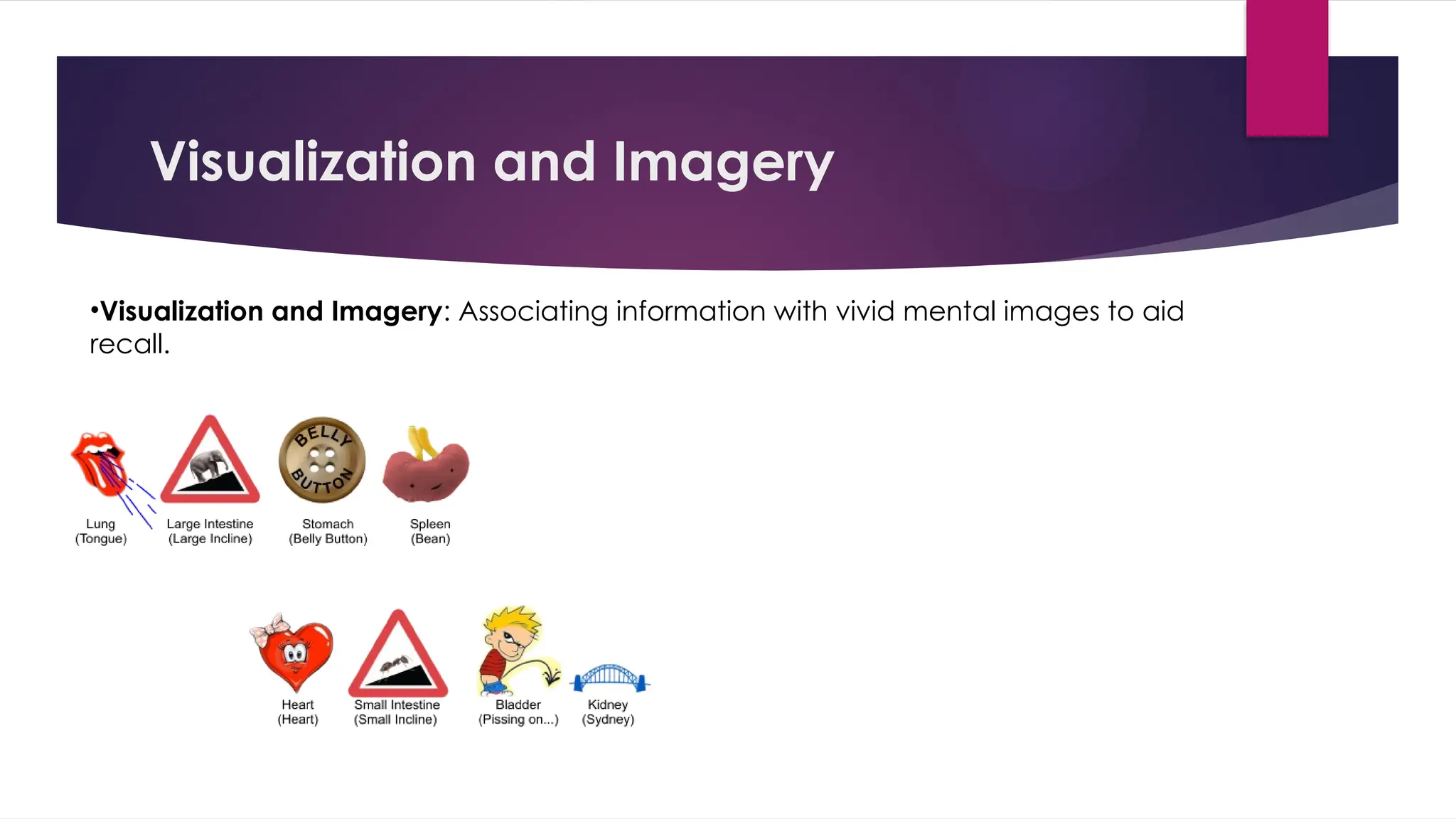
•Visualization and Imagery: Associating information with vivid mental images to aid
recall.
Chunking
•Chunking: Breaking information into smaller, manageable units.
Splitting long numbers or terms into smaller groups,
Remembering
Mobile number in segments:
988-222-1980
Spellings in segment:
En-vi-ron-ment
In-de-pen-dence
Loci Method
•Method of Loci: Associating information with physical locations, such as rooms in a
house, to create a "mental map" of information.
Human Body Systems:
Use different rooms in your house to represent each of the main systems of the human body:
•Digestive System: In the kitchen, visualize the food processing starting with chewing at the sink
(teeth), moving through your throat (hallway) to the stomach (a cooking pot).
•Circulatory System: In the living room, imagine a large heart pumping blood through tubes
(arteries/veins) that connect to every piece of furniture.
•Respiratory System: In the bedroom, there's a fan blowing air (lungs) into a pillow, representing the
exchange of gases.
•Nervous System: In the studyroom, a computer with wires running through the room represents the
brain and nerves controlling the entire body.
•Skeletal System: In the garage, imagine bones stacked up in the form of a car's frame, supporting
the entire structure.
Mnemonics - MEMORY TOOL. Understanding Mnemonics and its uses.

Mnemonics - MEMORY TOOL. Understanding Mnemonics and its uses.

  • 1.
  • 2.
    MNEMONICS: Meaning: Mnemonics means “MemoryTool”. Learning Technique that help us Remember information and retain it for long time.
  • 3.
    Why Use Mnemonics? Mnemonicsare memory aids or strategies help students remember information more easily. These can take various forms, such as  Acronyms,  Rhymes,  Visual images associations between new concepts and familiar ones.
  • 4.
    Types of Mnemonics: Acronyms Acrostics Rhymes& Songs Visualization & Imagery Chunking Method of Loci
  • 5.
    Acronyms •Acronyms: Creating aword from the first letters of a series of words. •Example: VIBGYOR MRS GREN Characteristics of living organisms Movement, Respiration, Sensitivity, Growth, Reproduction, Excretion, Nutrition Spectrum of visible light/ Rainbow colors Violet, Indigo, Blue, Green, Yellow, Orange, Red
  • 6.
    Acrostics •Acrostics: Creating asentence where the first letter of each word corresponds to something being remembered. “My Very Experienced Madam Just Showed Us Neptune”. TruSt Me In The Exams Tru Troposphere St Stratosphere Me Mesosphere In Ionosphere The Thermosphere Exams Exosphere Mercury, Venus, Earth, Mars, Jupiter, Saturn, Uranus, Neptune
  • 7.
    Rhymes & Songs •Rhymesand Songs: Using rhythm or melody to make information more memorable. "Chew, chew, chew your food, Chew it really fine, Then it goes into your throat And down your esophagus line." “Milli Centi Deci Meter Deca Hecto Kilometer”
  • 8.
    Visualization and Imagery •Visualizationand Imagery: Associating information with vivid mental images to aid recall.
  • 9.
    Chunking •Chunking: Breaking informationinto smaller, manageable units. Splitting long numbers or terms into smaller groups, Remembering Mobile number in segments: 988-222-1980 Spellings in segment: En-vi-ron-ment In-de-pen-dence
  • 10.
    Loci Method •Method ofLoci: Associating information with physical locations, such as rooms in a house, to create a "mental map" of information. Human Body Systems: Use different rooms in your house to represent each of the main systems of the human body: •Digestive System: In the kitchen, visualize the food processing starting with chewing at the sink (teeth), moving through your throat (hallway) to the stomach (a cooking pot). •Circulatory System: In the living room, imagine a large heart pumping blood through tubes (arteries/veins) that connect to every piece of furniture. •Respiratory System: In the bedroom, there's a fan blowing air (lungs) into a pillow, representing the exchange of gases. •Nervous System: In the studyroom, a computer with wires running through the room represents the brain and nerves controlling the entire body. •Skeletal System: In the garage, imagine bones stacked up in the form of a car's frame, supporting the entire structure.