Study Skills and
 Strategies for
  Academic
    Success
Jennifer Evans
English Language Fellow
Department of English
Introduction
 Jennifer   Evans

 English   Language Fellow

 EnglishDepartment Composition II and
 TEFL & ICT
Seattle, Washington
NOT WASHINGTON DC!
Overview of Workshop
Time     Management

Task     Management

Skills   Management
Activity
 You    will get a different colored paper.

 Find   your group and discuss the question
 on your paper.

 We    will then regroup with other colors to
 share information from our discussion
Time Management
 Important   Tools for Managing Time

 Pockets   for Productivity

 Mindful   Work

 Mindful   Relaxation
Activity
   A Weekly Schedule: „Where does the time
    go?‟

   Using the handout make a visual
    representation of your typical week.

   Begin with „time anchors‟ (fixed parts of your
    schedule that are regular) i.e. class or working
    hours, meal times, prayer times, sleeping
    hours, etc.
Activity
 Make   sure you block off commute time
  (longer for some of you than others!)
 Now look at your schedule & consider
  where you could create fixed study time
  every day. Create study blocks.
 Now look at where you could create
  blocks that are for relaxation, sports,
  socializing etc.
More Tips for Time
          Management
 Can  you find „pockets for productivity‟?
 Read on your commute, review notes, go
  through vocabulary flashcards, make or
  review a to-do list
 In-between class/before or after class
 10 pages a day= a novel (or more) a
  month!
 Any waiting or „dead‟ time you can find?
Mindful Work
   GET ORGANIZED: Study Space, „Systems‟
   Necessary Tools: desk/table, light, comfortable
    chair, supplies,
   Limited Distractions: The illusion of the „
   20 minutes of „real studying‟ vs. 1 hour of semi-
    studying
   Consider starting with the most difficult task
Mindful Relaxation
 Have  designated breaks
 Make sure you have drink/snack breaks
 „Reward yourself‟ after completing a task
 Get up, move around, change mindset
 Consider mixing up subjects
 Allow yourself a break and „re-attend‟ to
  the task at hand
Task Management
 To-do  list (the power of the „brain dump‟)
 Consider a Master listPriority list
 Timelines for projects
 „A journey of 1000 miles begins with one
  step‟ –Chinese Proverb
 Start a project/assignment THAT DAY!
 Break task into smaller, more do-able
  chunks
“Work Smarter, Not Harder”
Skills Management


 Academic     Reading

 Lecture   Listening and Note Taking

 Writing

 Presentations
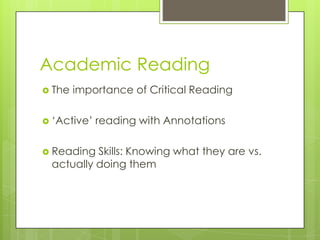
Academic Reading
 The   importance of Critical Reading

 „Active‟   reading with Annotations

 Reading Skills: Knowing what they are vs.
 actually doing them
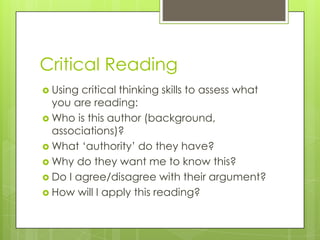
Critical Reading
 Using critical thinking skills to assess what
  you are reading:
 Who is this author (background,
  associations)?
 What „authority‟ do they have?
 Why do they want me to know this?
 Do I agree/disagree with their argument?
 How will I apply this reading?
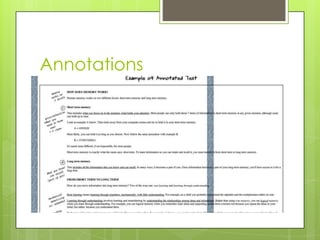
Annotations
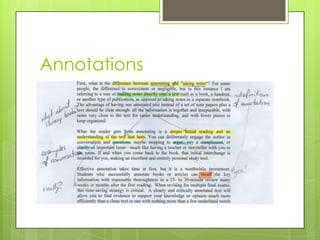
Annotations
Annotation Dos and Don‟ts
   AVOID:

   Making no marks on your reading

   Highlighting (or have a system)

   Translation (when possible)

   Understanding EVERYTHING

   Writing TOO much
Annotations Dos & Don‟ts
 TRYTO:
 Have a system that works for you
 Have a vocabulary system
 Mark sections you don‟t understand
 Mark sections you agree/disagree with
 Mark sections that make you think of
  something related
 Consider „1-2 word summaries‟ in margins
Reading Skills
 Previewing: Titles, subtitles/headings,
  captions, graphs, charts, pictures
 Reading „reflection‟ or discussion
  questions at the end of chapters first
 Reflecting and Predicting
 Summarizing/Outlining
 Annotations help with Review
 READ! READ! READ!
Lecture Listening and Note
             Taking
 Step   One: Go to Lecture

 Step   Two: Bring pen/pencil and paper!

 Step   Three: Have an organization system

 Step   Four: Be aware of GOOD lecture
 structure (Outlines, Sign Posts, Repetition)
Lecture Listening and Note
               Taking
   Step Five: Get key info: not a recording
    device (abbreviations, symbols) and

„re-attend!”

   Step Six: Fill in the gaps (classmates, prof, text)

   Step Seven: Look back/Look forward and
    begin to connect the dots (text & lecture)
Writing Skills
 Begin   an assignment on Day One

 Don‟t   wait until the „11th hour‟

 Understanding     the
 Prompt/Assignment…break it down!
Writing Skills
 PREWRITING:   The most underestimated
 writing phase

 BrainstormOutlineOrganizeWrite

 Take   Time AwayReviewRevise

 Be   aware of GLOBAL vs. LOCAL Errors
Activity
 Read the Assignment Prompt and
 Assignment Response of the student.

 What  should the student‟s first concern be
 in terms of the revision?
Presentations Skills

Beware of the
 POWERPOINT
 PRESENTATION!
Presentation Skills
 Be   organized (recognize principles of

 strong lectures) Introduction, Overview,

 Sign-Posts, Review, Reactions/Questions)

 Projection   and Stance
Presentation Skills
 Eye-Contact:     Don‟t fixate!

 Consider    the „Eye-Bounce‟

 Don‟t   be a „READER‟

 „That‟s   it‟ is NOT a presentation
 conclusion!
Success BEYOND the
             Classroom

 Be   on the lookout for OPPORTUNITIES:

 Workshops, Conferences, Events, Seek out
 scholarships, programs, grants, funding (it
 takes WORK, but it is out there)
Success BEYOND the
             Classroom
 Getinvolved with the Campus
 Community (don‟t just come to class and
 leave)

 Clubs,   Organizations, Causes

 Lookfor ways to build your Resume
 (volunteer, help with projects, give
 presentations, start clubs/organizations)
Success BEYOND the
           Classroom
 Always  be looking ahead, researching,
  setting goals, making plans to achieve
  them
 Graduate school, career, what does it
  involve to pursue these goals?
 (Often you need to be preparing well
  before it is „time‟)
Enjoy and Really LIVE this Time!
 University
          education is a privilege not
  many can enjoy

 Makethe most of this time (both
  academically, and socially)

 You   won‟t live the „student life‟ forever!
Review:

 Time     Management

 Task     Management

 Skills   Management
Questions?

 For any other questions or for a copy of
 this presentation:

 Email:   Jennifer Evans

 jennifer.june.evans@gmail.com
“Keep an Eye Out”
 More   workshops and events to come in

 the new year, so stay informed and tell

 others! (English Department notices

 window and blog)
Study skills workshop

  • 1.
    Study Skills and Strategies for Academic Success Jennifer Evans English Language Fellow Department of English
  • 2.
    Introduction  Jennifer Evans  English Language Fellow  EnglishDepartment Composition II and TEFL & ICT
  • 3.
  • 4.
  • 5.
    Overview of Workshop Time Management Task Management Skills Management
  • 6.
    Activity  You will get a different colored paper.  Find your group and discuss the question on your paper.  We will then regroup with other colors to share information from our discussion
  • 7.
    Time Management  Important Tools for Managing Time  Pockets for Productivity  Mindful Work  Mindful Relaxation
  • 8.
    Activity  A Weekly Schedule: „Where does the time go?‟  Using the handout make a visual representation of your typical week.  Begin with „time anchors‟ (fixed parts of your schedule that are regular) i.e. class or working hours, meal times, prayer times, sleeping hours, etc.
  • 9.
    Activity  Make sure you block off commute time (longer for some of you than others!)  Now look at your schedule & consider where you could create fixed study time every day. Create study blocks.  Now look at where you could create blocks that are for relaxation, sports, socializing etc.
  • 10.
    More Tips forTime Management  Can you find „pockets for productivity‟?  Read on your commute, review notes, go through vocabulary flashcards, make or review a to-do list  In-between class/before or after class  10 pages a day= a novel (or more) a month!  Any waiting or „dead‟ time you can find?
  • 11.
    Mindful Work  GET ORGANIZED: Study Space, „Systems‟  Necessary Tools: desk/table, light, comfortable chair, supplies,  Limited Distractions: The illusion of the „  20 minutes of „real studying‟ vs. 1 hour of semi- studying  Consider starting with the most difficult task
  • 12.
    Mindful Relaxation  Have designated breaks  Make sure you have drink/snack breaks  „Reward yourself‟ after completing a task  Get up, move around, change mindset  Consider mixing up subjects  Allow yourself a break and „re-attend‟ to the task at hand
  • 13.
    Task Management  To-do list (the power of the „brain dump‟)  Consider a Master listPriority list  Timelines for projects  „A journey of 1000 miles begins with one step‟ –Chinese Proverb  Start a project/assignment THAT DAY!  Break task into smaller, more do-able chunks
  • 14.
  • 15.
    Skills Management  Academic Reading  Lecture Listening and Note Taking  Writing  Presentations
  • 16.
    Academic Reading  The importance of Critical Reading  „Active‟ reading with Annotations  Reading Skills: Knowing what they are vs. actually doing them
  • 17.
    Critical Reading  Usingcritical thinking skills to assess what you are reading:  Who is this author (background, associations)?  What „authority‟ do they have?  Why do they want me to know this?  Do I agree/disagree with their argument?  How will I apply this reading?
  • 18.
  • 19.
  • 20.
    Annotation Dos andDon‟ts  AVOID:  Making no marks on your reading  Highlighting (or have a system)  Translation (when possible)  Understanding EVERYTHING  Writing TOO much
  • 21.
    Annotations Dos &Don‟ts  TRYTO:  Have a system that works for you  Have a vocabulary system  Mark sections you don‟t understand  Mark sections you agree/disagree with  Mark sections that make you think of something related  Consider „1-2 word summaries‟ in margins
  • 22.
    Reading Skills  Previewing:Titles, subtitles/headings, captions, graphs, charts, pictures  Reading „reflection‟ or discussion questions at the end of chapters first  Reflecting and Predicting  Summarizing/Outlining  Annotations help with Review  READ! READ! READ!
  • 23.
    Lecture Listening andNote Taking  Step One: Go to Lecture  Step Two: Bring pen/pencil and paper!  Step Three: Have an organization system  Step Four: Be aware of GOOD lecture structure (Outlines, Sign Posts, Repetition)
  • 24.
    Lecture Listening andNote Taking  Step Five: Get key info: not a recording device (abbreviations, symbols) and „re-attend!”  Step Six: Fill in the gaps (classmates, prof, text)  Step Seven: Look back/Look forward and begin to connect the dots (text & lecture)
  • 25.
    Writing Skills  Begin an assignment on Day One  Don‟t wait until the „11th hour‟  Understanding the Prompt/Assignment…break it down!
  • 26.
    Writing Skills  PREWRITING: The most underestimated writing phase  BrainstormOutlineOrganizeWrite  Take Time AwayReviewRevise  Be aware of GLOBAL vs. LOCAL Errors
  • 27.
    Activity  Read theAssignment Prompt and Assignment Response of the student.  What should the student‟s first concern be in terms of the revision?
  • 28.
    Presentations Skills Beware ofthe POWERPOINT PRESENTATION!
  • 29.
    Presentation Skills  Be organized (recognize principles of strong lectures) Introduction, Overview, Sign-Posts, Review, Reactions/Questions)  Projection and Stance
  • 30.
    Presentation Skills  Eye-Contact: Don‟t fixate!  Consider the „Eye-Bounce‟  Don‟t be a „READER‟  „That‟s it‟ is NOT a presentation conclusion!
  • 31.
    Success BEYOND the Classroom  Be on the lookout for OPPORTUNITIES:  Workshops, Conferences, Events, Seek out scholarships, programs, grants, funding (it takes WORK, but it is out there)
  • 32.
    Success BEYOND the Classroom  Getinvolved with the Campus Community (don‟t just come to class and leave)  Clubs, Organizations, Causes  Lookfor ways to build your Resume (volunteer, help with projects, give presentations, start clubs/organizations)
  • 33.
    Success BEYOND the Classroom  Always be looking ahead, researching, setting goals, making plans to achieve them  Graduate school, career, what does it involve to pursue these goals?  (Often you need to be preparing well before it is „time‟)
  • 34.
    Enjoy and ReallyLIVE this Time!  University education is a privilege not many can enjoy  Makethe most of this time (both academically, and socially)  You won‟t live the „student life‟ forever!
  • 35.
    Review:  Time Management  Task Management  Skills Management
  • 36.
    Questions?  For anyother questions or for a copy of this presentation:  Email: Jennifer Evans  jennifer.june.evans@gmail.com
  • 37.
    “Keep an EyeOut”  More workshops and events to come in the new year, so stay informed and tell others! (English Department notices window and blog)