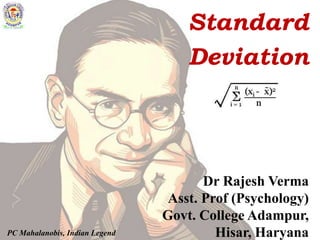
Standard
Deviation
Dr Rajesh Verma
Asst. Prof (Psychology)
Govt. College Adampur,
Hisar, HaryanaPC Mahalanobis, Indian Legend
Meaning-Cum-Definition
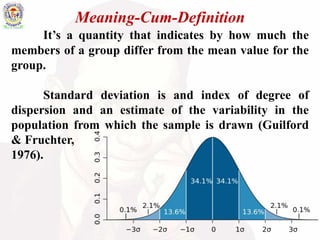
ItтАЩs a quantity that indicates by how much the
members of a group differ from the mean value for the
group.
Standard deviation is and index of degree of
dispersion and an estimate of the variability in the
population from which the sample is drawn (Guilford
& Fruchter,
1976).
Introduction
SD is also known as Coefficient of Variation (CV). ItтАЩs
a kind of special average of all the deviation from the group
mean. Special average means that SD is beyond the simple
arithmetic mean. Along with the total range, semi-
interquartile range, average deviation it is the most
commonly used single number to indicate
variability among a data set. Variability is
the scatter or spread of the separate scores
around their central tendency (Garret, 2014).
SD is the most stable index of variability
which is computed using squared deviations
that are taken from mean only i.e. neither
median nor mode.
Characteristics
(i) High value of SD means that most of the scores are
away from group mean and vice versa.
(ii) It is the index of spread of scores about the mean that
involves every observation.
(iii) Greater SD than mean indicates
that the distribution have majority of
low values.
(iv) Lower SD than mean indicates
that the distribution have majority
of high values.
(v) It can also indicate that whether
the distribution has dispersion of
extreme values or has
central tendency.
(vi) It is expressed in the same units as the data.
(vii) It is possible to calculate the combined standard
deviation of two or more groups.
(viii) The SD is considered most appropriate statistical tool
for comparing the variability of two or more groups.
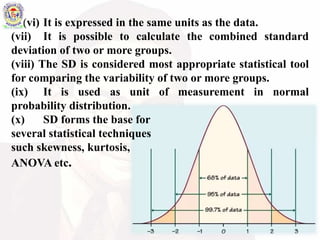
(ix) It is used as unit of measurement in normal
probability distribution.
(x) SD forms the base for
several statistical techniques
such skewness, kurtosis,
ANOVA etc.
How much SD is Good or Bad
No amount of SD is good or bad because itтАЩs just an
indicator of spread of scores. If someone is interested to see
the closeness of scores around the mean than SD тЙд 1 is good,
on the other hand if someone is interested in larger spread
than SD тЙе 1 is good. Across books and manuals it has been
accepted that SD тЙе 1 is the
indicator of high variation
among the scores and SD тЙд 1
indicates low variation. ItтАЩs a
kind of rule of thumb.
In fact it depend upon
the data set and objectives of
the researcher.
Computation of SD
For Ungrouped Data
Let us take an hypothetical data.
Ex тАУ 12, 54, 32, 51, 24, 58, 21, 43, 31, 48
Step I тАУ Calculate the mean.
Mean ( ЁЭТЩ) =
тИСЁЭТЩ
ЁЭС╡
Where, x = Score
N = total no. of score
Therefore, 12+54+32+51+24
+58+21+43+31+48 = 374
ЁЭТЩ =
ЁЭЯСЁЭЯХЁЭЯТ
ЁЭЯПЁЭЯП
= 34
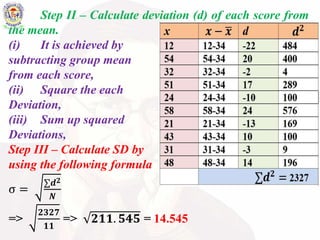
Step II тАУ Calculate deviation (d) of each score from
the mean.
(i) It is achieved by
subtracting group mean
from each score,
(ii) Square the each
Deviation,
(iii) Sum up squared
Deviations,
Step III тАУ Calculate SD by
using the following formula
╧Г =
тИСЁЭТЕ ЁЭЯР
ЁЭС╡
=>
ЁЭЯРЁЭЯСЁЭЯРЁЭЯХ
ЁЭЯПЁЭЯП
=> ЁЭЯРЁЭЯПЁЭЯП. ЁЭЯУЁЭЯТЁЭЯУ = 14.545
SD of Grouped Data
Let us take Hypothetical Data
as shown in adjacent table
Step I - Calculate the mean
For calculation of mean we must
follow the following few steps
Steps of calculating mean
(i) Find the midpoints of CI (x)
(ii) Multiply midpoints (x) with their respective
frequency (f)
(iii) Add fx
(iv) Divide it by the sum of
frequencies i.e. 50
mean =
тИСЁЭТЗ ЁЭТЩ
ЁЭС╡
=
ЁЭЯПЁЭЯФЁЭЯУЁЭЯО
ЁЭЯУЁЭЯО
= 33
Step II-Subtract mean from the mid points i.e. ЁЭТЩ тИТ ЁЭТЩ
Step III-Square these values which are denoted by (x`)
Step IV-Multiply x` with their respective frequencies (fx`)
Step V-Add fx`
Finally substitute the values in the formula
╧Г =
тИСЁЭТЗЁЭТЩ`
ЁЭС╡
=
ЁЭЯУЁЭЯУЁЭЯПЁЭЯР
ЁЭЯУЁЭЯО
= ЁЭЯПЁЭЯПЁЭЯО. ЁЭЯРЁЭЯТ
(ЁЭТФ ЁЭЯР
= 110.24)
= 10.499
References:
1. https://dictionary.apa.org/quartile-deviation.
2. Guilford, J. P. and Fruchter, B. (1978). Fundamental Statistics in
Psychology and Education, 6th ed. Tokyo: McGraw-Hill.
3. https://todayinsci.com/M/Mahalanobis_Prasanta/
MahalanobisPrasanta-Quotations.htm.
4. Garrett, H. E. (2014). Statistics in Psychology and Education. New
Delhi: Pragon International.
5. Levin, J. & Fox, J. A. (2006). Elementary Statistics.
New Delhi: Pearson.
vermasujit@yahoo.com
Next
Discussion
Concept of
Normality

standard deviation: an introduction

  • 1.
    Standard Deviation Dr Rajesh Verma Asst.Prof (Psychology) Govt. College Adampur, Hisar, HaryanaPC Mahalanobis, Indian Legend
  • 2.
    Meaning-Cum-Definition ItтАЩs a quantitythat indicates by how much the members of a group differ from the mean value for the group. Standard deviation is and index of degree of dispersion and an estimate of the variability in the population from which the sample is drawn (Guilford & Fruchter, 1976).
  • 3.
    Introduction SD is alsoknown as Coefficient of Variation (CV). ItтАЩs a kind of special average of all the deviation from the group mean. Special average means that SD is beyond the simple arithmetic mean. Along with the total range, semi- interquartile range, average deviation it is the most commonly used single number to indicate variability among a data set. Variability is the scatter or spread of the separate scores around their central tendency (Garret, 2014). SD is the most stable index of variability which is computed using squared deviations that are taken from mean only i.e. neither median nor mode.
  • 4.
    Characteristics (i) High valueof SD means that most of the scores are away from group mean and vice versa. (ii) It is the index of spread of scores about the mean that involves every observation. (iii) Greater SD than mean indicates that the distribution have majority of low values. (iv) Lower SD than mean indicates that the distribution have majority of high values. (v) It can also indicate that whether the distribution has dispersion of extreme values or has central tendency.
  • 5.
    (vi) It isexpressed in the same units as the data. (vii) It is possible to calculate the combined standard deviation of two or more groups. (viii) The SD is considered most appropriate statistical tool for comparing the variability of two or more groups. (ix) It is used as unit of measurement in normal probability distribution. (x) SD forms the base for several statistical techniques such skewness, kurtosis, ANOVA etc.
  • 6.
    How much SDis Good or Bad No amount of SD is good or bad because itтАЩs just an indicator of spread of scores. If someone is interested to see the closeness of scores around the mean than SD тЙд 1 is good, on the other hand if someone is interested in larger spread than SD тЙе 1 is good. Across books and manuals it has been accepted that SD тЙе 1 is the indicator of high variation among the scores and SD тЙд 1 indicates low variation. ItтАЩs a kind of rule of thumb. In fact it depend upon the data set and objectives of the researcher.
  • 7.
    Computation of SD ForUngrouped Data Let us take an hypothetical data. Ex тАУ 12, 54, 32, 51, 24, 58, 21, 43, 31, 48 Step I тАУ Calculate the mean. Mean ( ЁЭТЩ) = тИСЁЭТЩ ЁЭС╡ Where, x = Score N = total no. of score Therefore, 12+54+32+51+24 +58+21+43+31+48 = 374 ЁЭТЩ = ЁЭЯСЁЭЯХЁЭЯТ ЁЭЯПЁЭЯП = 34
  • 8.
    Step II тАУCalculate deviation (d) of each score from the mean. (i) It is achieved by subtracting group mean from each score, (ii) Square the each Deviation, (iii) Sum up squared Deviations, Step III тАУ Calculate SD by using the following formula ╧Г = тИСЁЭТЕ ЁЭЯР ЁЭС╡ => ЁЭЯРЁЭЯСЁЭЯРЁЭЯХ ЁЭЯПЁЭЯП => ЁЭЯРЁЭЯПЁЭЯП. ЁЭЯУЁЭЯТЁЭЯУ = 14.545
  • 9.
    SD of GroupedData Let us take Hypothetical Data as shown in adjacent table Step I - Calculate the mean For calculation of mean we must follow the following few steps
  • 10.
    Steps of calculatingmean (i) Find the midpoints of CI (x) (ii) Multiply midpoints (x) with their respective frequency (f) (iii) Add fx (iv) Divide it by the sum of frequencies i.e. 50 mean = тИСЁЭТЗ ЁЭТЩ ЁЭС╡ = ЁЭЯПЁЭЯФЁЭЯУЁЭЯО ЁЭЯУЁЭЯО = 33
  • 11.
    Step II-Subtract meanfrom the mid points i.e. ЁЭТЩ тИТ ЁЭТЩ Step III-Square these values which are denoted by (x`) Step IV-Multiply x` with their respective frequencies (fx`) Step V-Add fx` Finally substitute the values in the formula ╧Г = тИСЁЭТЗЁЭТЩ` ЁЭС╡ = ЁЭЯУЁЭЯУЁЭЯПЁЭЯР ЁЭЯУЁЭЯО = ЁЭЯПЁЭЯПЁЭЯО. ЁЭЯРЁЭЯТ (ЁЭТФ ЁЭЯР = 110.24) = 10.499
  • 12.
    References: 1. https://dictionary.apa.org/quartile-deviation. 2. Guilford,J. P. and Fruchter, B. (1978). Fundamental Statistics in Psychology and Education, 6th ed. Tokyo: McGraw-Hill. 3. https://todayinsci.com/M/Mahalanobis_Prasanta/ MahalanobisPrasanta-Quotations.htm. 4. Garrett, H. E. (2014). Statistics in Psychology and Education. New Delhi: Pragon International. 5. Levin, J. & Fox, J. A. (2006). Elementary Statistics. New Delhi: Pearson.
  • 13.