Introduction to
Aaron Davidson
July 19, 2018
Outline
ML development challenges
How MLflow tackles these
Demo
Roadmap
Machine Learning
Development is Complex
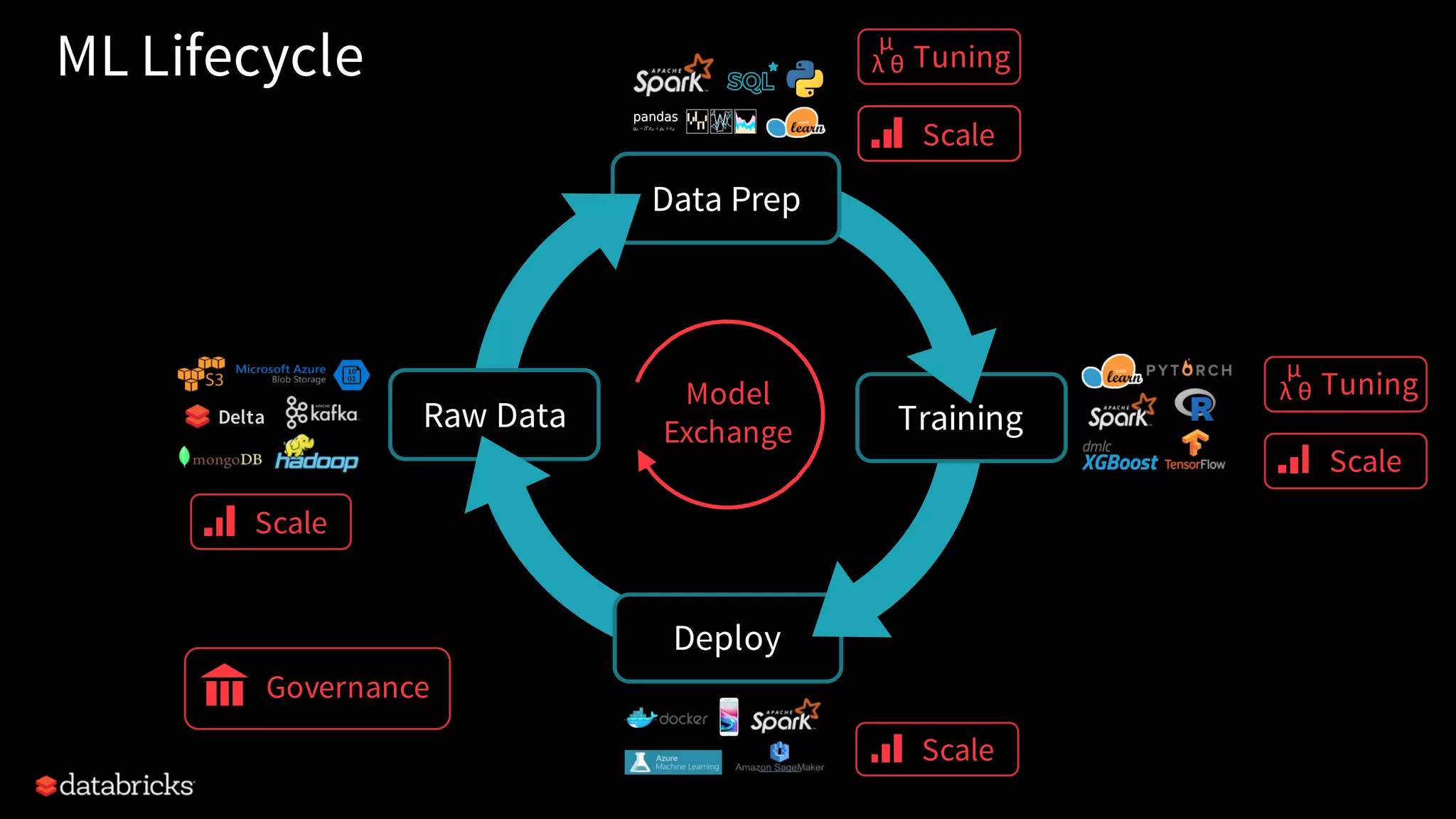
ML Lifecycle
4
Delta
Data Prep
Training
Deploy
Raw Data
μ
λ θ Tuning
Scale
μ
λ θ Tuning
Scale
Scale
Scale
Model
Exchange
Governance
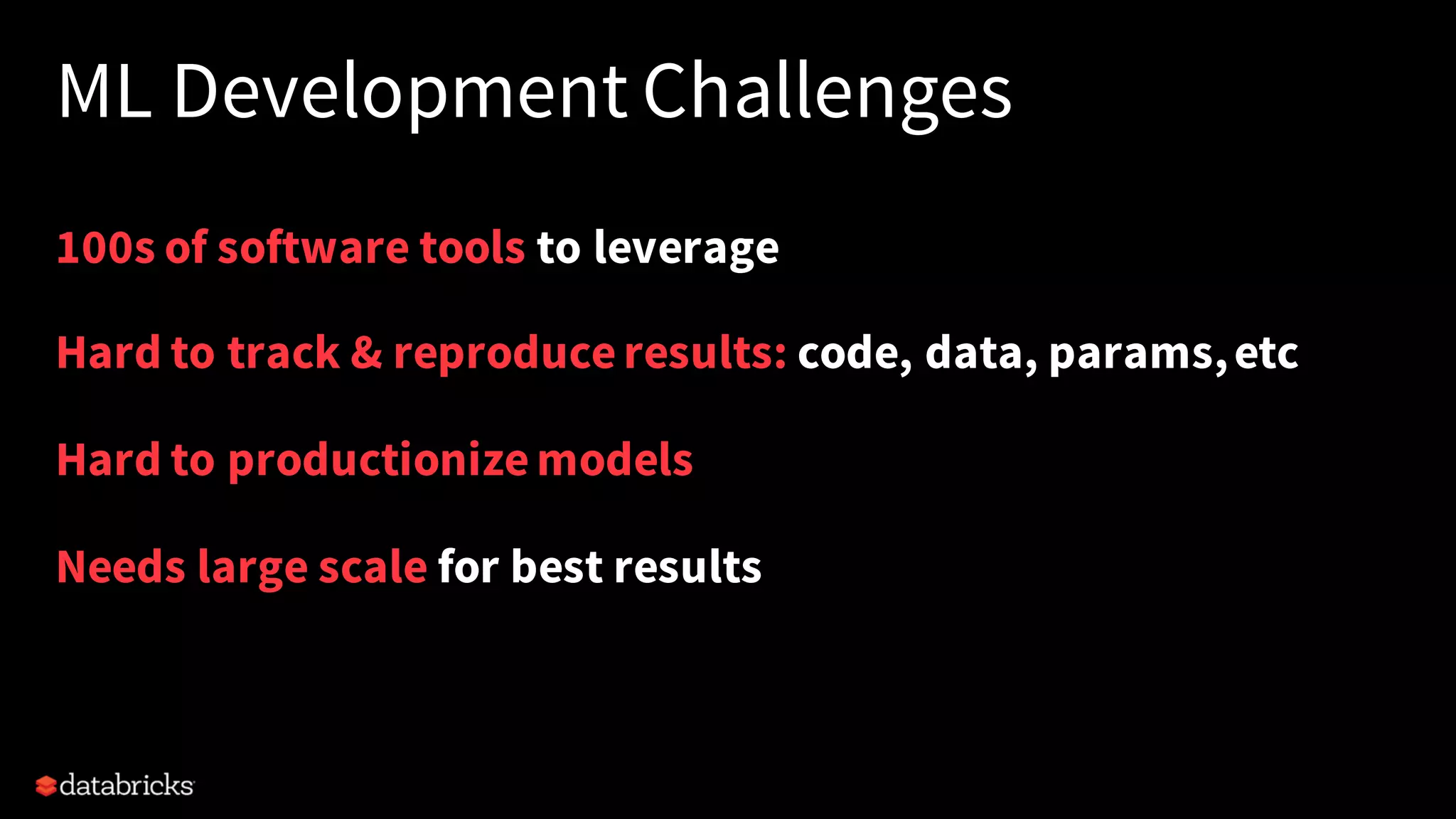
ML Development Challenges
100s of software tools to leverage
Hard to track & reproduceresults: code, data, params,etc
Hard to productionizemodels
Needs large scale for best results
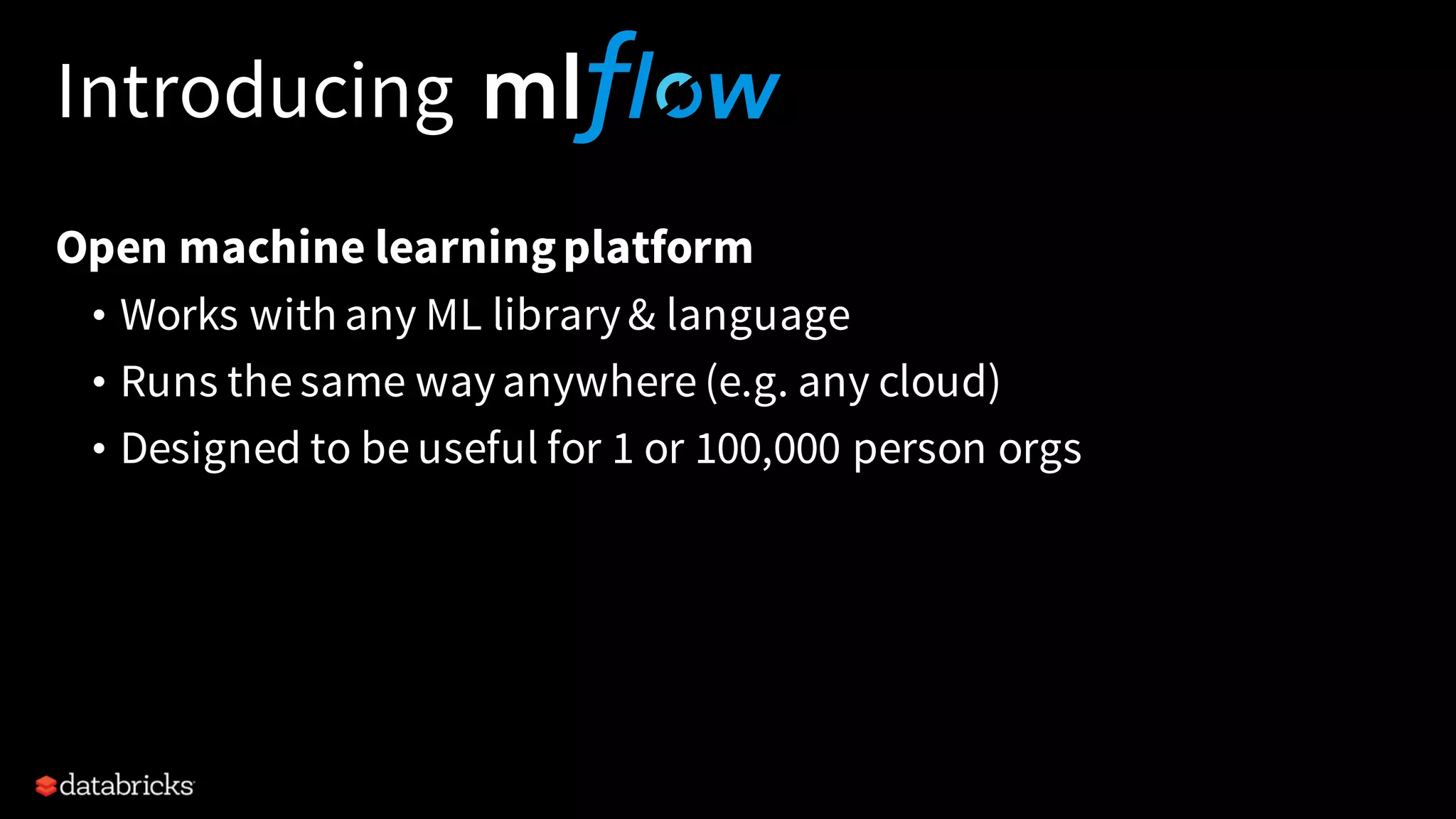
Introducing
Open machine learningplatform
• Works with any ML library& language
• Runs the same wayanywhere (e.g. any cloud)
• Designed to be useful for 1 or 100,000 person orgs
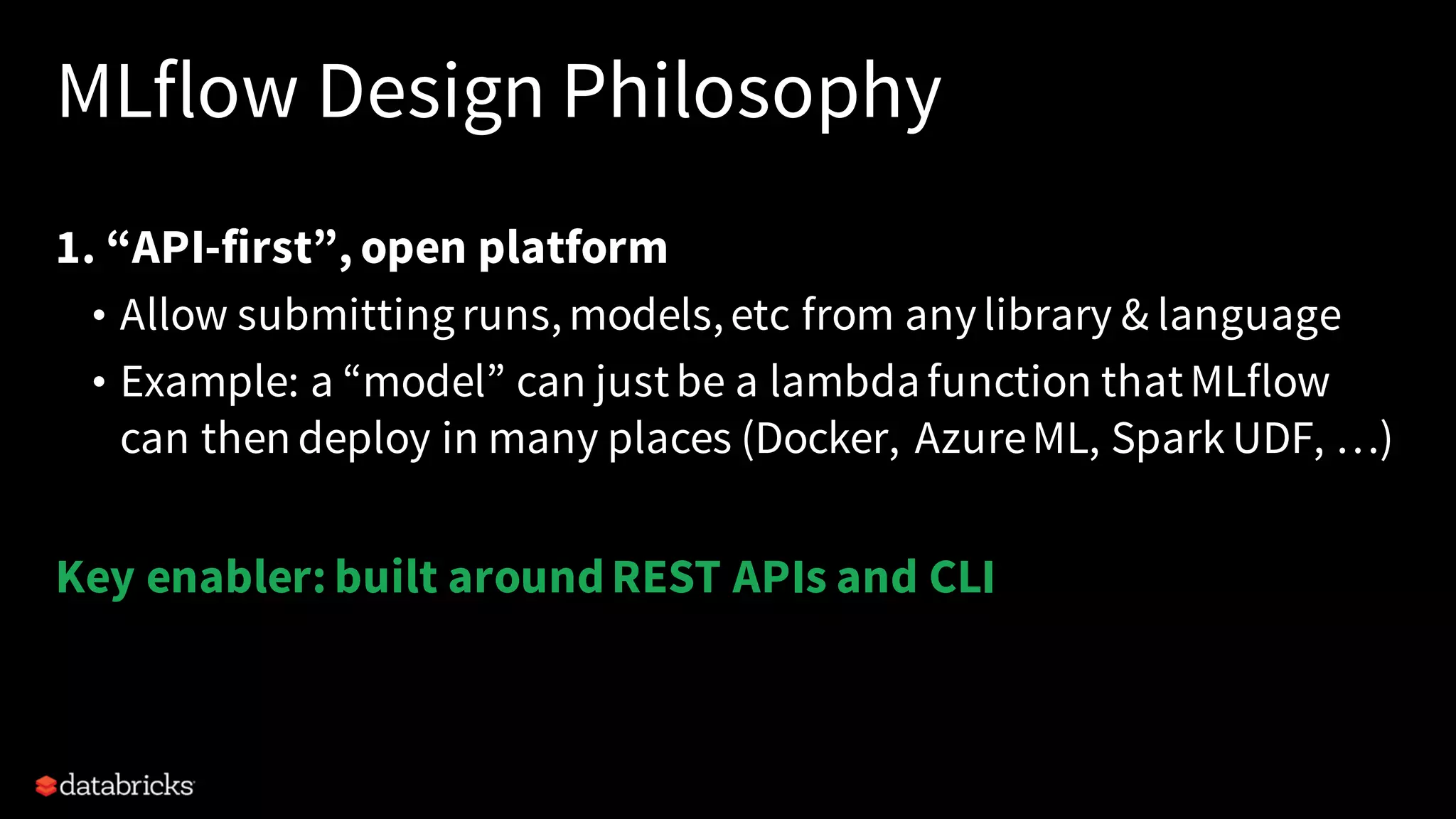
MLflow Design Philosophy
1. “API-first”, open platform
• Allow submittingruns,models,etc from anylibrary & language
• Example: a “model” can justbe a lambdafunction thatMLflow
can thendeploy in many places (Docker, AzureML, Spark UDF, …)
Key enabler: built aroundREST APIs and CLI
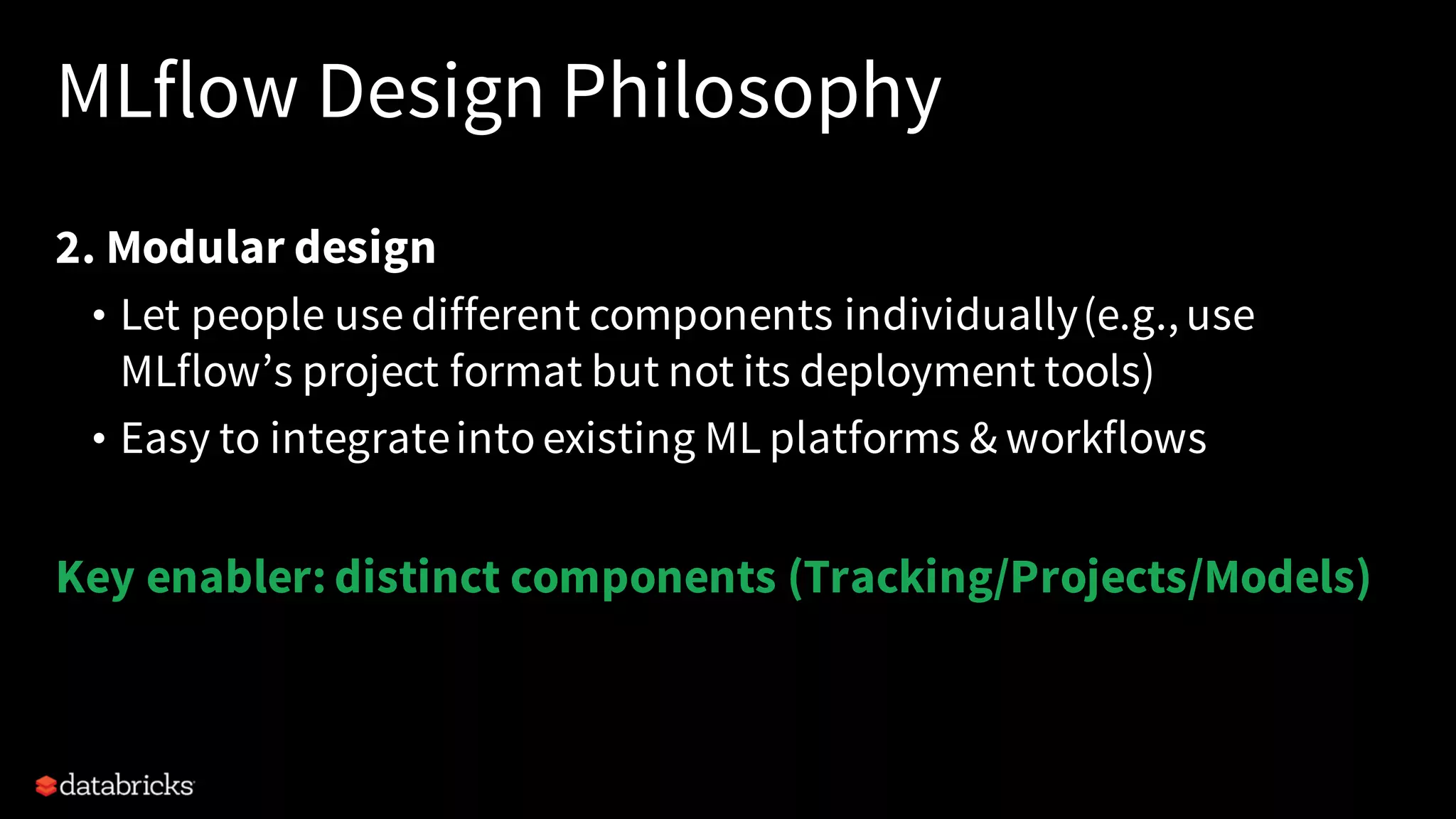
MLflow Design Philosophy
2. Modular design
• Let people use different components individually(e.g.,use
MLflow’s project format but not its deployment tools)
• Easy to integrateinto existing ML platforms & workflows
Key enabler: distinct components (Tracking/Projects/Models)
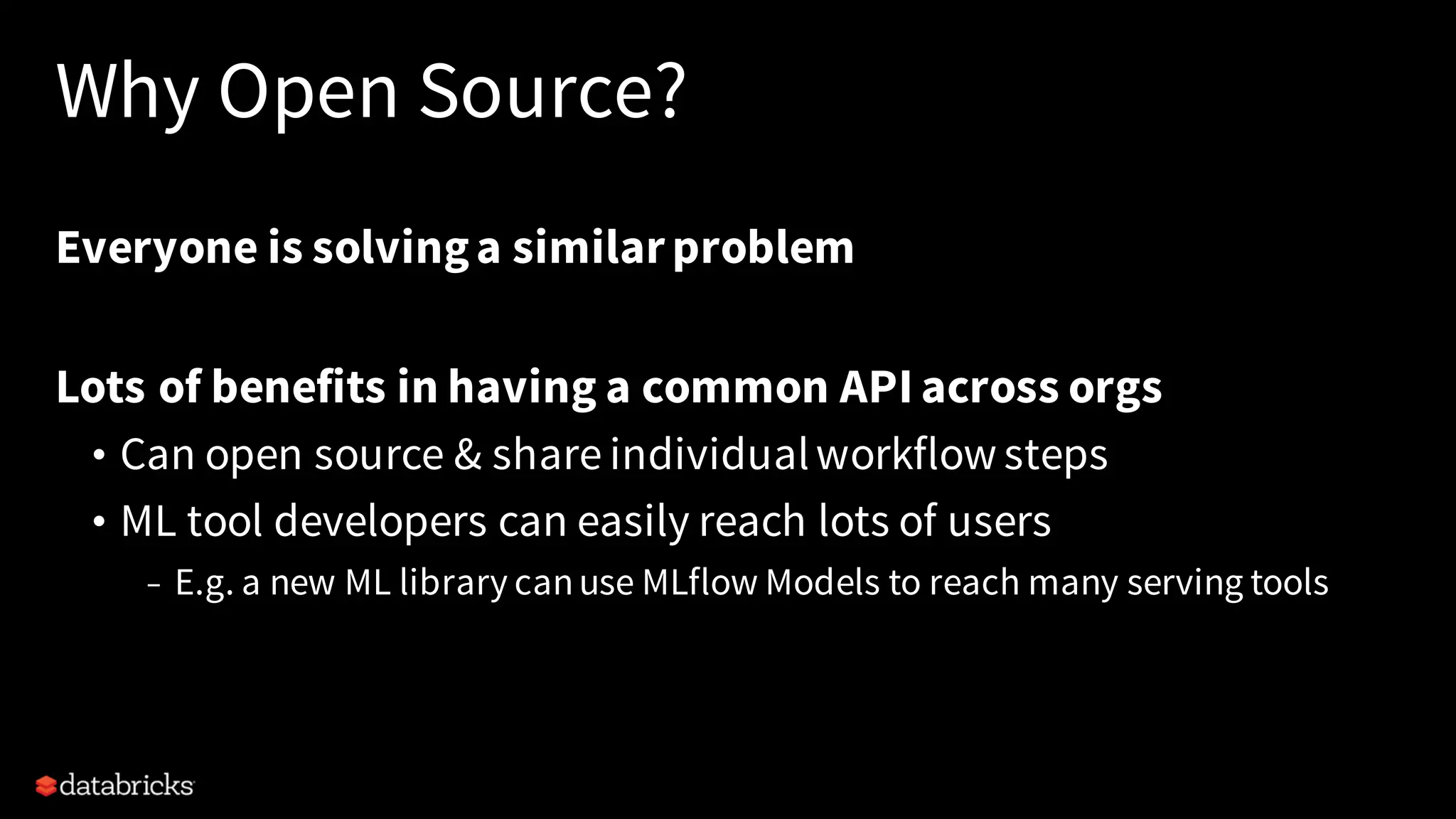
Why Open Source?
Everyone is solvinga similarproblem
Lots of benefits in having a common API across orgs
• Can open source & share individualworkflow steps
• ML tool developers can easily reach lots of users
– E.g. a new ML library canuse MLflow Models to reach many serving tools
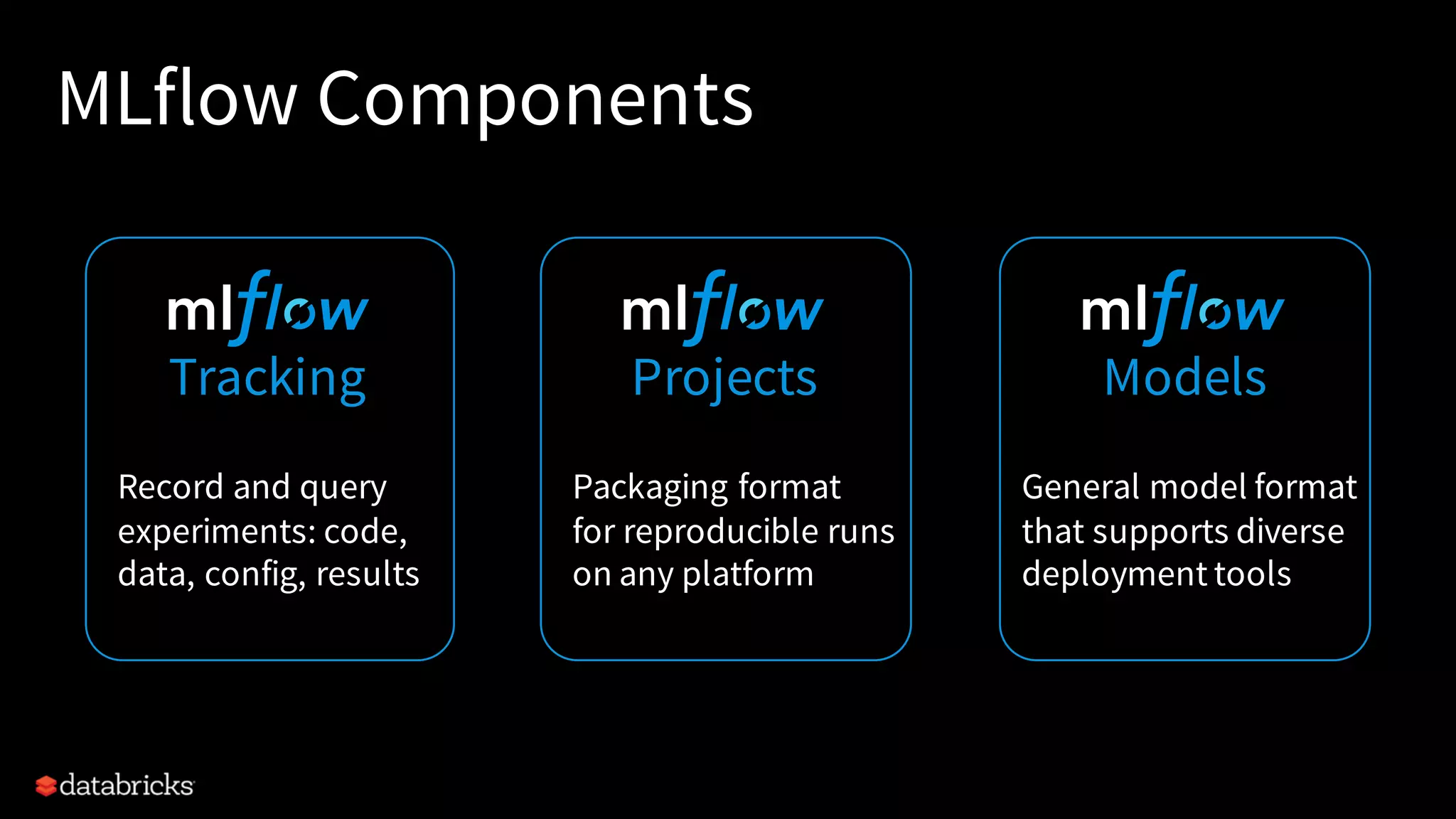
MLflow Components
10
Tracking
Record and query
experiments: code,
data, config, results
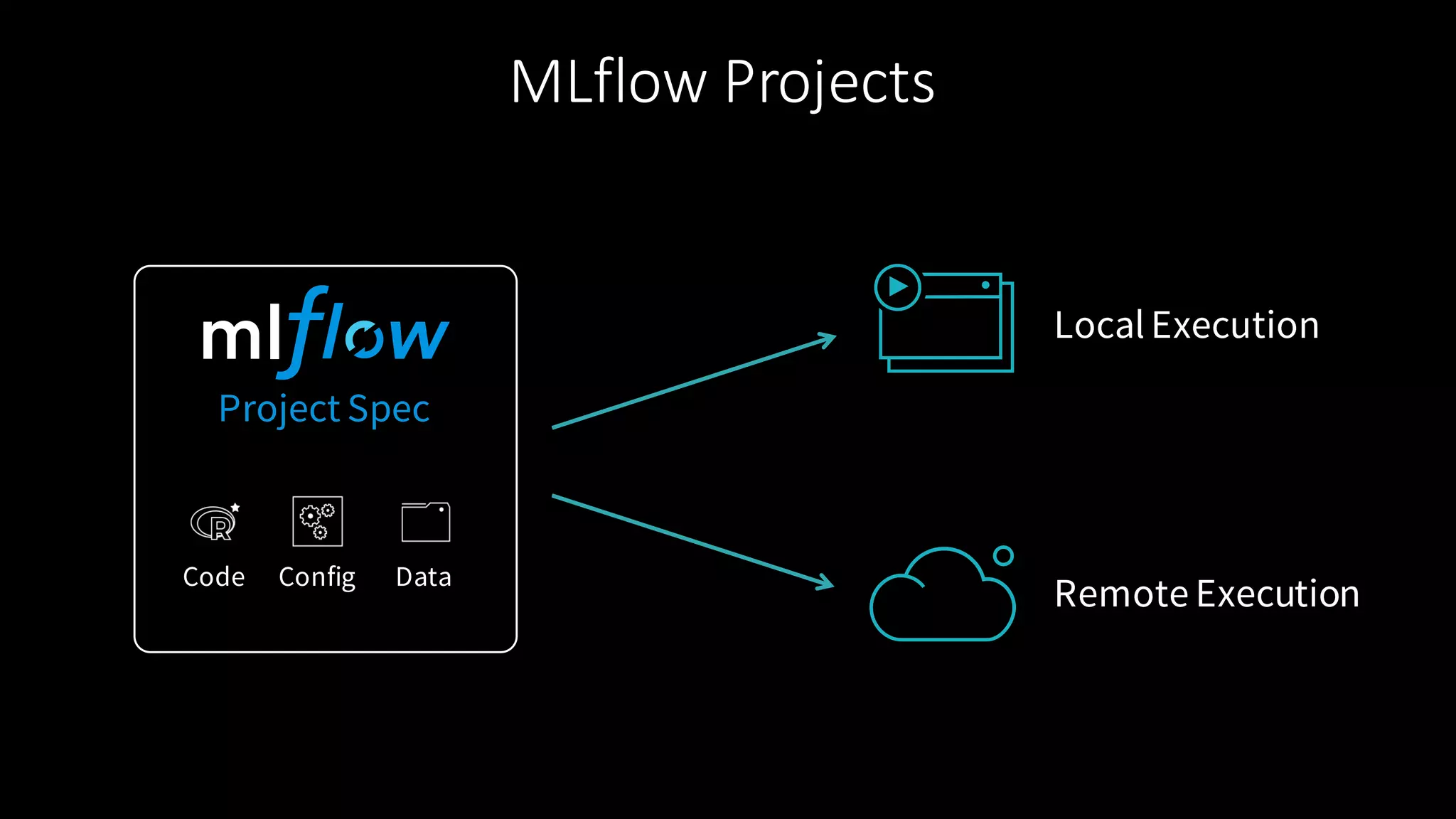
Projects
Packaging format
for reproducible runs
on any platform
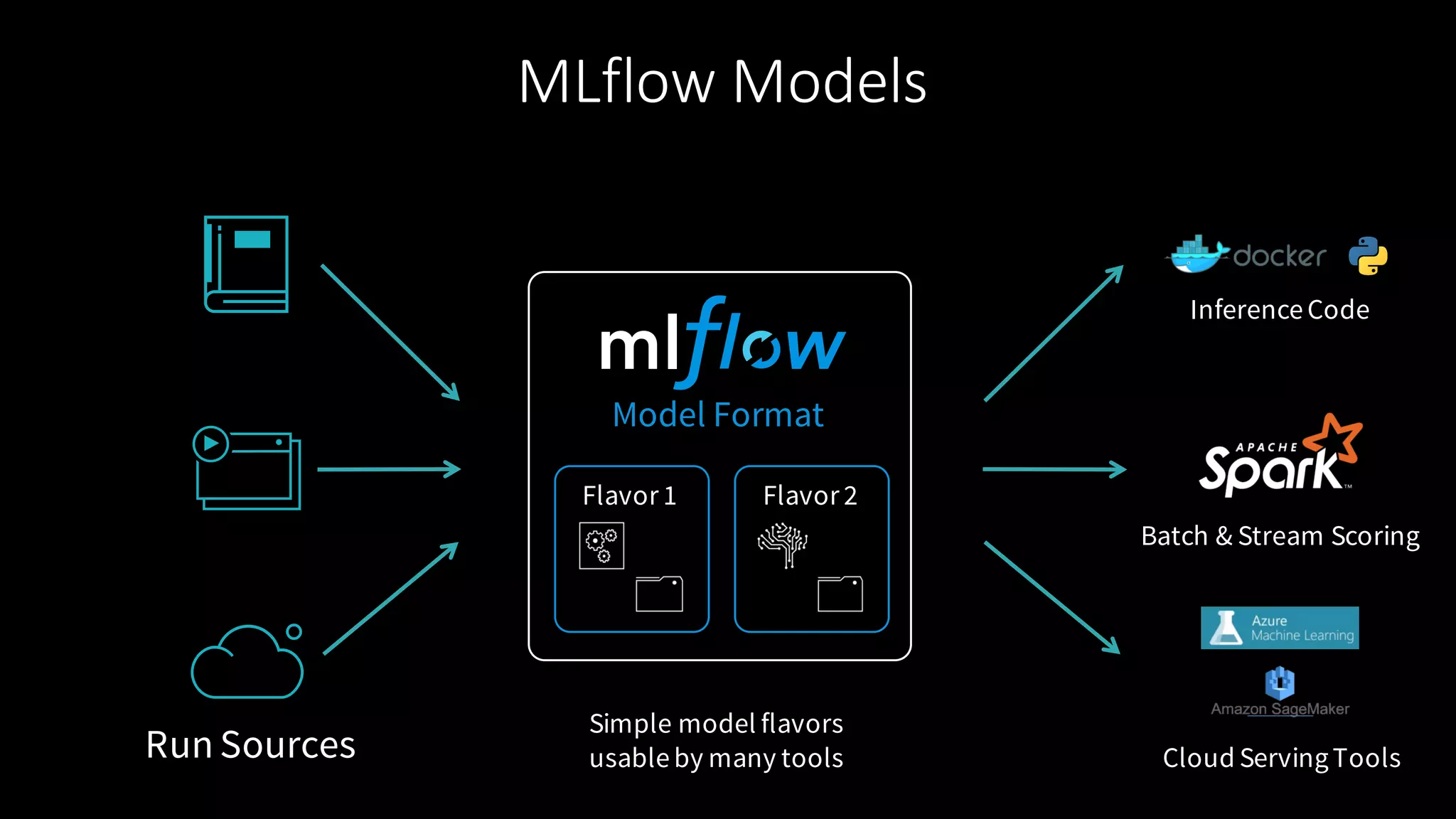
Models
General model format
that supports diverse
deployment tools
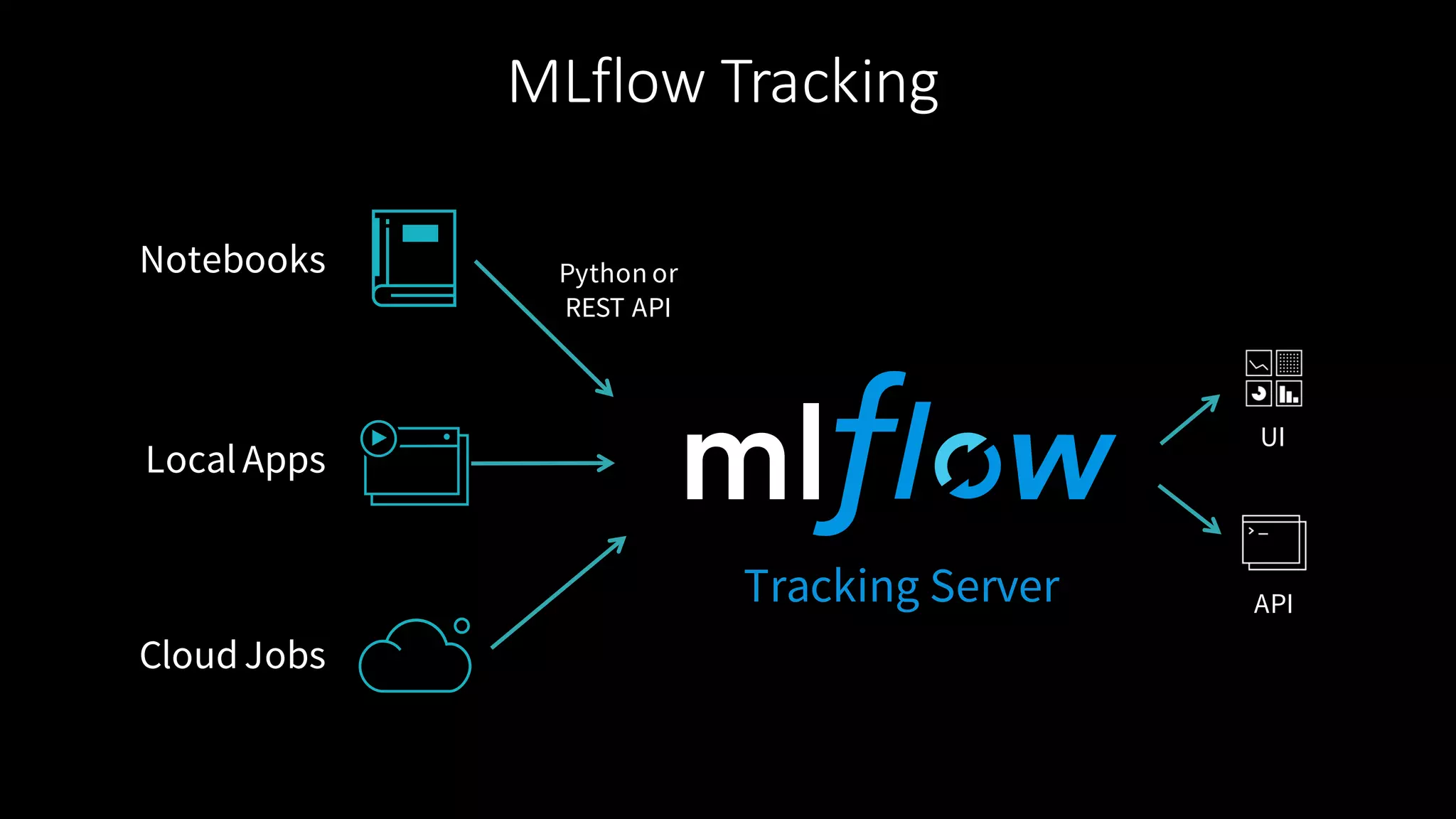
Notebooks
LocalApps
CloudJobs
Tracking Server
UI
API
MLflow	Tracking
Python or
REST API
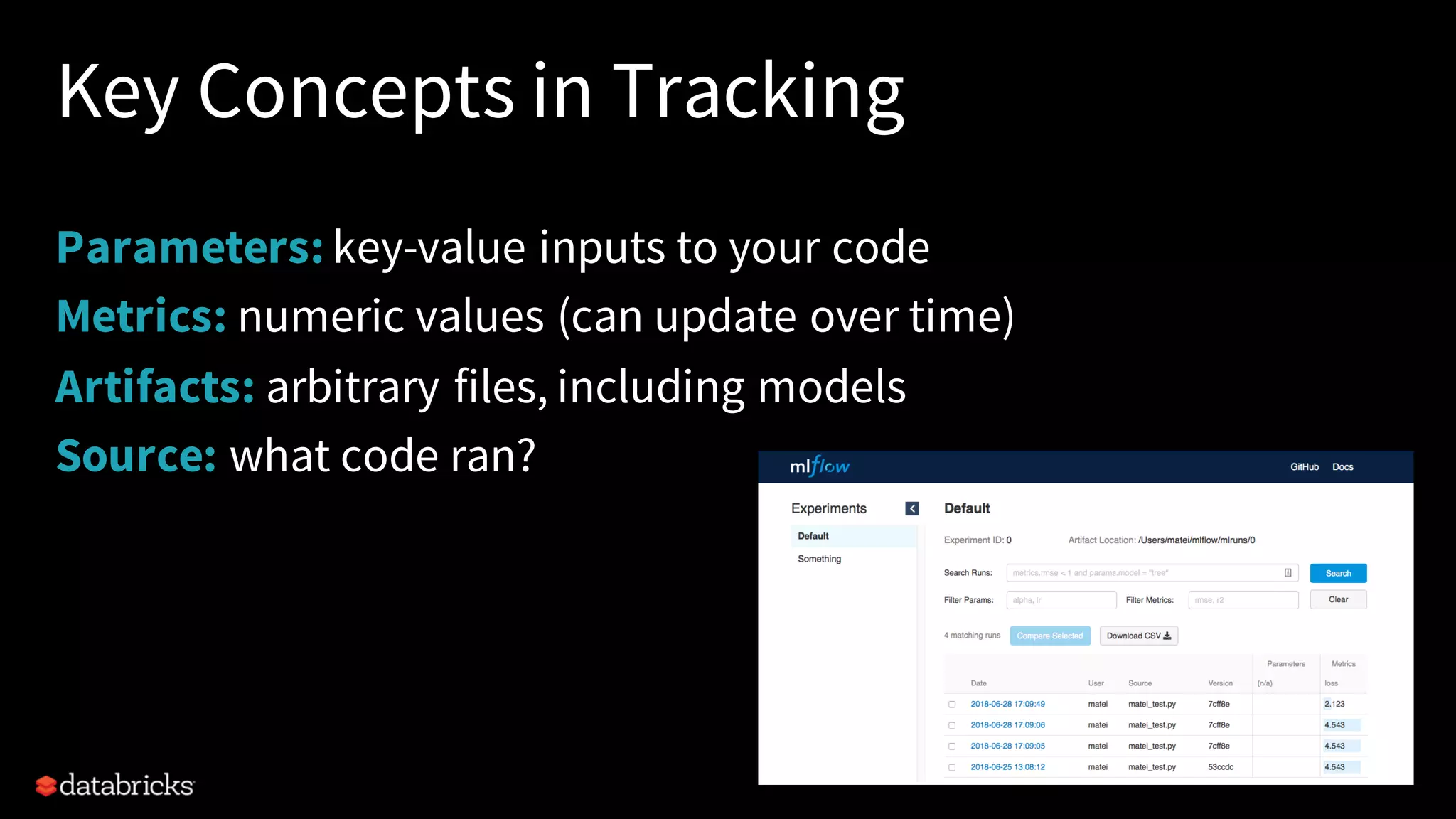
Key Concepts in Tracking
Parameters: key-value inputs to your code
Metrics: numeric values (can update over time)
Artifacts: arbitrary files, including models
Source: what code ran?
Project Spec
Code DataConfig
LocalExecution
Remote Execution
MLflow	Projects
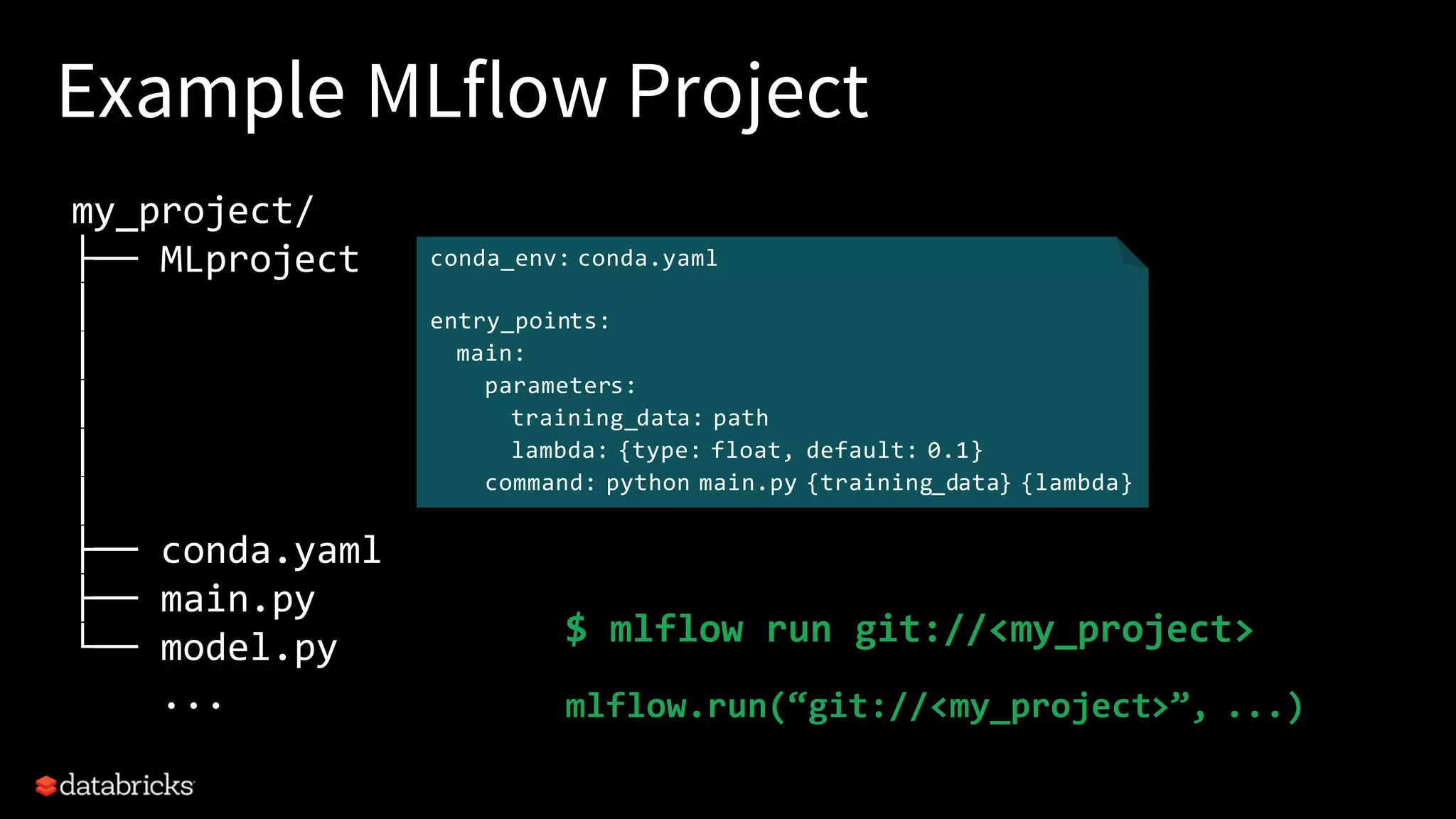
Example MLflow Project
my_project/
├── MLproject
│
│
│
│
│
├── conda.yaml
├── main.py
└── model.py
...
conda_env: conda.yaml
entry_points:
main:
parameters:
training_data: path
lambda: {type: float, default: 0.1}
command: python main.py {training_data} {lambda}
$ mlflow run git://<my_project>
mlflow.run(“git://<my_project>”, ...)
Model Format
Flavor 2Flavor 1
Run Sources
InferenceCode
Batch & Stream Scoring
Cloud ServingTools
MLflow	Models
Simple model flavors
usableby many tools
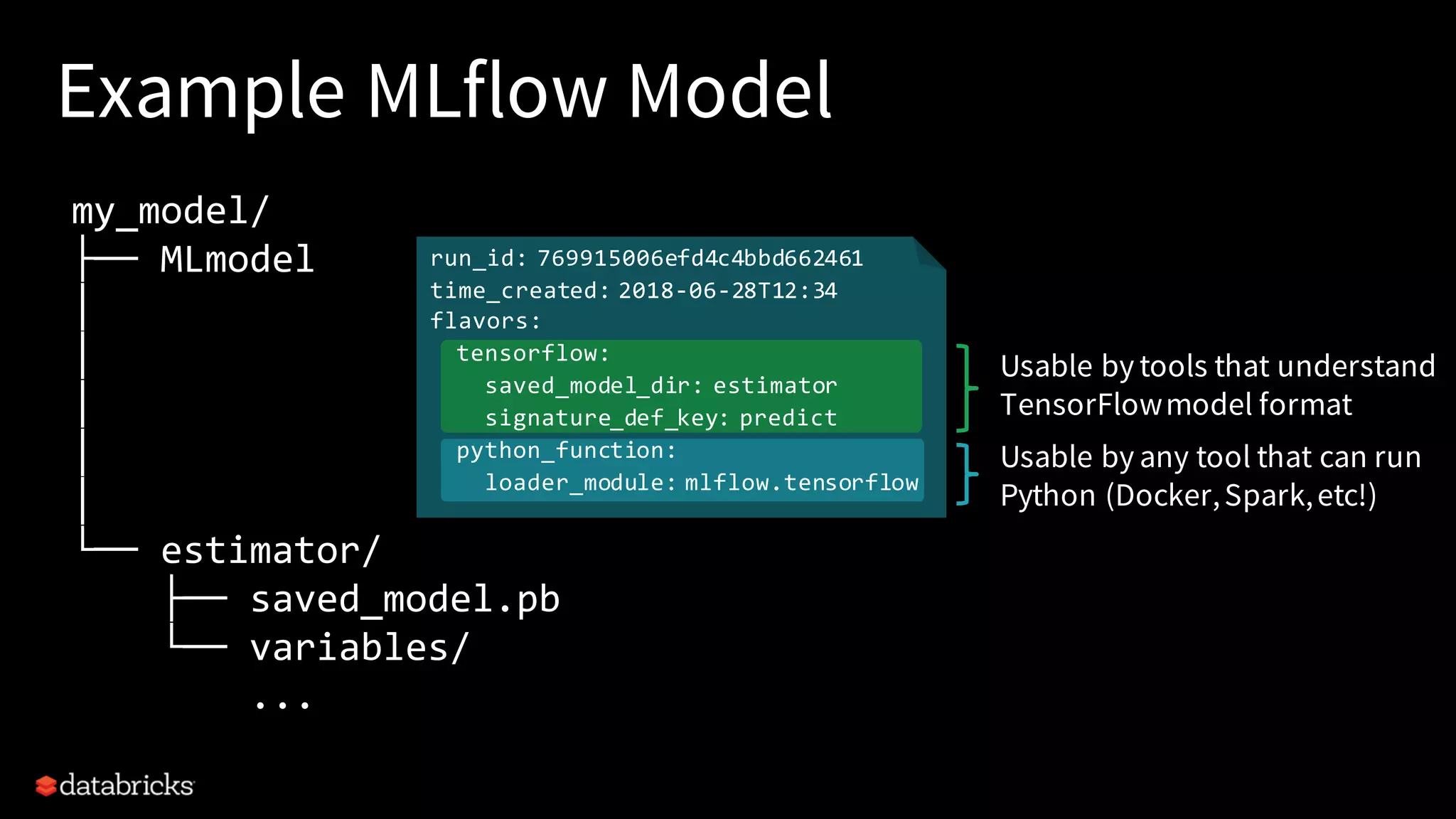
Example MLflow Model
my_model/
├── MLmodel
│
│
│
│
│
└── estimator/
├── saved_model.pb
└── variables/
...
Usable by tools that understand
TensorFlowmodel format
Usable by any tool that can run
Python (Docker,Spark,etc!)
run_id: 769915006efd4c4bbd662461
time_created: 2018-06-28T12:34
flavors:
tensorflow:
saved_model_dir: estimator
signature_def_key: predict
python_function:
loader_module: mlflow.tensorflow
Demo
Roadmap
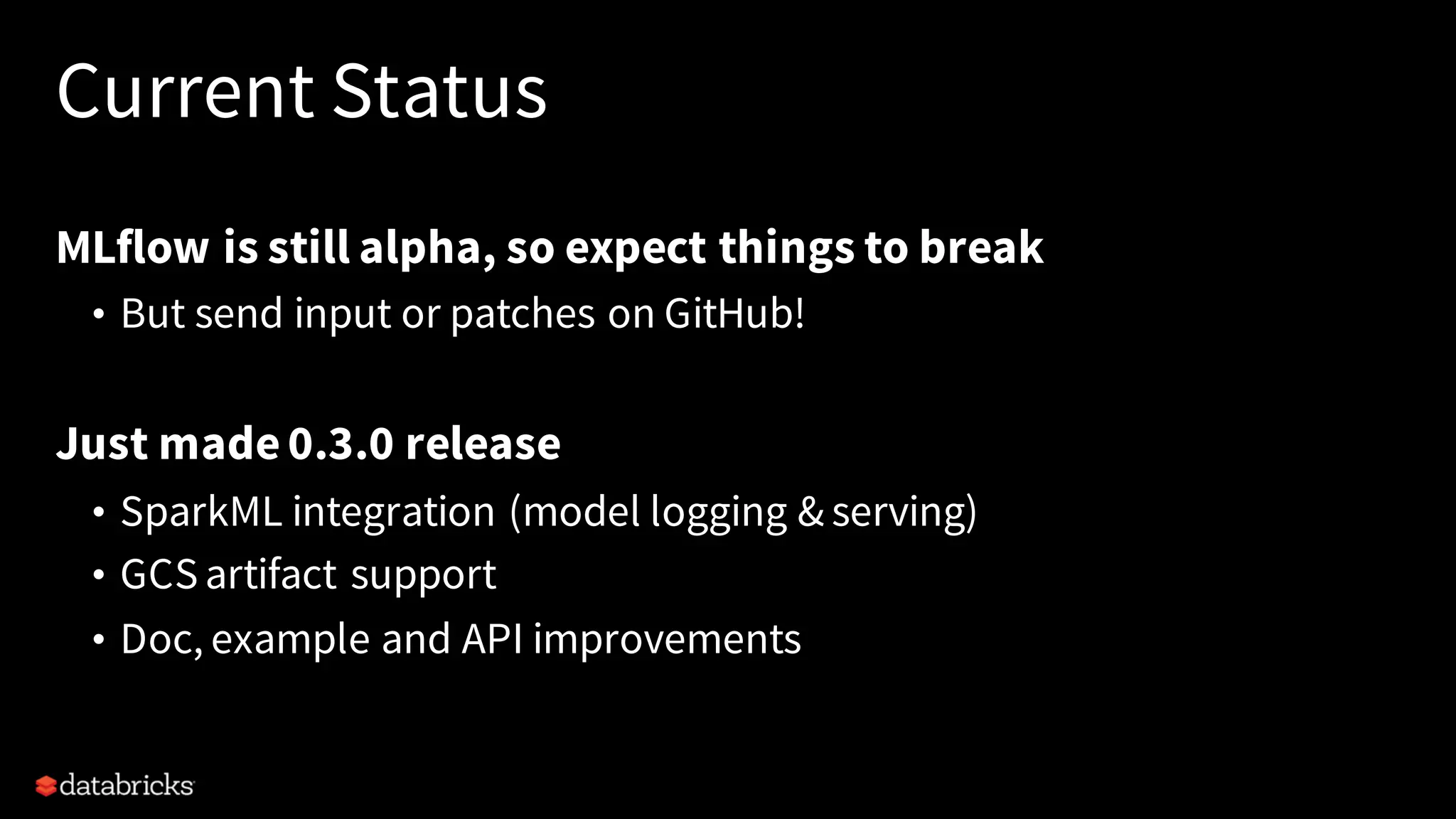
Current Status
MLflow is still alpha, so expect things to break
• But send input or patches on GitHub!
Just made0.3.0 release
• SparkML integration (model logging & serving)
• GCSartifact support
• Doc, example and API improvements
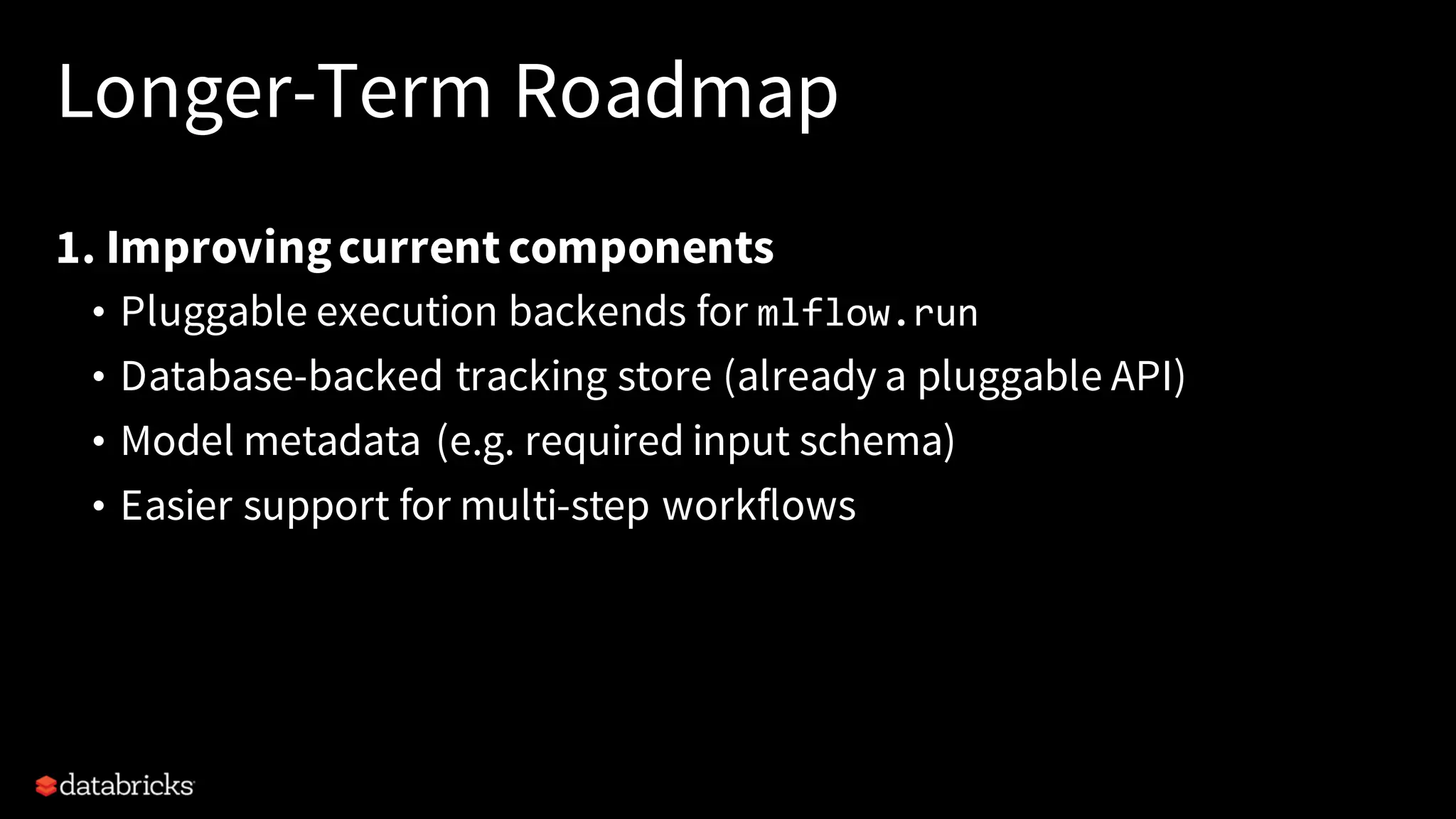
Longer-Term Roadmap
1. Improvingcurrent components
• Pluggable execution backends for mlflow.run
• Database-backed tracking store (already a pluggable API)
• Model metadata (e.g. required input schema)
• Easier support for multi-step workflows
Longer-Term Roadmap
2. MLflow Data component
• Let MLflowprojects load data from diverse formats (e.g. CSV vs
Parquet) so you don’t have to pick a format in advance
• Will build on Spark’s Data SourceAPI
Longer-Term Roadmap
3. Hyperparametertuning
• Integrate with common hyperparameter tuning libraries
• Make it easier to launch & track many runs in parallel
(already possible but kind of awkward)
Longer-Term Roadmap
4. Language and libraryintegrations
• Java and R are high on our list for APIs
• Built-in Spark MLlib and PyTorchintegrations
• Demonstrate how to use MLflow with other libraries (it’s easy)
Let us know if you have other roadmap ideas!
Contributingto MLflow
Submit issues and patches on GitHub
• We’re using it for all our development & issue tracking
• See CONTRIBUTING.rstfor how to run dev builds
Join our mailinglist: tinyurl.com/mlflow-users
Join our Slack: tinyurl.com/mlflow-slack
Conclusion
Powerful workflow tools can simplifythe ML lifecycle
• Improve usability for both data scientists and engineers
• Same way that software dev lifecycle tools simplify dev
MLflow is a lightweight, open platform that integrates easily
into existing workflows

MLflow: Infrastructure for a Complete Machine Learning Life Cycle

  • 1.
  • 2.
    Outline ML development challenges HowMLflow tackles these Demo Roadmap
  • 3.
  • 4.
    ML Lifecycle 4 Delta Data Prep Training Deploy RawData μ λ θ Tuning Scale μ λ θ Tuning Scale Scale Scale Model Exchange Governance
  • 5.
    ML Development Challenges 100sof software tools to leverage Hard to track & reproduceresults: code, data, params,etc Hard to productionizemodels Needs large scale for best results
  • 6.
    Introducing Open machine learningplatform •Works with any ML library& language • Runs the same wayanywhere (e.g. any cloud) • Designed to be useful for 1 or 100,000 person orgs
  • 7.
    MLflow Design Philosophy 1.“API-first”, open platform • Allow submittingruns,models,etc from anylibrary & language • Example: a “model” can justbe a lambdafunction thatMLflow can thendeploy in many places (Docker, AzureML, Spark UDF, …) Key enabler: built aroundREST APIs and CLI
  • 8.
    MLflow Design Philosophy 2.Modular design • Let people use different components individually(e.g.,use MLflow’s project format but not its deployment tools) • Easy to integrateinto existing ML platforms & workflows Key enabler: distinct components (Tracking/Projects/Models)
  • 9.
    Why Open Source? Everyoneis solvinga similarproblem Lots of benefits in having a common API across orgs • Can open source & share individualworkflow steps • ML tool developers can easily reach lots of users – E.g. a new ML library canuse MLflow Models to reach many serving tools
  • 10.
    MLflow Components 10 Tracking Record andquery experiments: code, data, config, results Projects Packaging format for reproducible runs on any platform Models General model format that supports diverse deployment tools
  • 11.
  • 12.
    Key Concepts inTracking Parameters: key-value inputs to your code Metrics: numeric values (can update over time) Artifacts: arbitrary files, including models Source: what code ran?
  • 13.
  • 14.
    Example MLflow Project my_project/ ├──MLproject │ │ │ │ │ ├── conda.yaml ├── main.py └── model.py ... conda_env: conda.yaml entry_points: main: parameters: training_data: path lambda: {type: float, default: 0.1} command: python main.py {training_data} {lambda} $ mlflow run git://<my_project> mlflow.run(“git://<my_project>”, ...)
  • 15.
    Model Format Flavor 2Flavor1 Run Sources InferenceCode Batch & Stream Scoring Cloud ServingTools MLflow Models Simple model flavors usableby many tools
  • 16.
    Example MLflow Model my_model/ ├──MLmodel │ │ │ │ │ └── estimator/ ├── saved_model.pb └── variables/ ... Usable by tools that understand TensorFlowmodel format Usable by any tool that can run Python (Docker,Spark,etc!) run_id: 769915006efd4c4bbd662461 time_created: 2018-06-28T12:34 flavors: tensorflow: saved_model_dir: estimator signature_def_key: predict python_function: loader_module: mlflow.tensorflow
  • 17.
  • 18.
  • 19.
    Current Status MLflow isstill alpha, so expect things to break • But send input or patches on GitHub! Just made0.3.0 release • SparkML integration (model logging & serving) • GCSartifact support • Doc, example and API improvements
  • 20.
    Longer-Term Roadmap 1. Improvingcurrentcomponents • Pluggable execution backends for mlflow.run • Database-backed tracking store (already a pluggable API) • Model metadata (e.g. required input schema) • Easier support for multi-step workflows
  • 21.
    Longer-Term Roadmap 2. MLflowData component • Let MLflowprojects load data from diverse formats (e.g. CSV vs Parquet) so you don’t have to pick a format in advance • Will build on Spark’s Data SourceAPI
  • 22.
    Longer-Term Roadmap 3. Hyperparametertuning •Integrate with common hyperparameter tuning libraries • Make it easier to launch & track many runs in parallel (already possible but kind of awkward)
  • 23.
    Longer-Term Roadmap 4. Languageand libraryintegrations • Java and R are high on our list for APIs • Built-in Spark MLlib and PyTorchintegrations • Demonstrate how to use MLflow with other libraries (it’s easy) Let us know if you have other roadmap ideas!
  • 24.
    Contributingto MLflow Submit issuesand patches on GitHub • We’re using it for all our development & issue tracking • See CONTRIBUTING.rstfor how to run dev builds Join our mailinglist: tinyurl.com/mlflow-users Join our Slack: tinyurl.com/mlflow-slack
  • 25.
    Conclusion Powerful workflow toolscan simplifythe ML lifecycle • Improve usability for both data scientists and engineers • Same way that software dev lifecycle tools simplify dev MLflow is a lightweight, open platform that integrates easily into existing workflows