Arduino Cascella
@ MLOps Paris, January 16th 2020
Agenda
• What is MLflow?
• Demo
• Questions & Answers
Deployment lifecycle of ML Models?
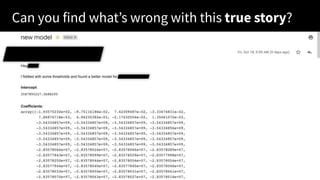
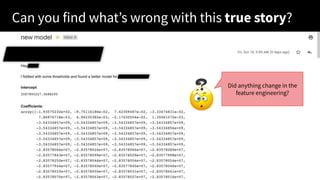
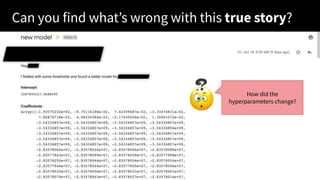
Can you find what’s wrong with this true story?
Did anything change in the
feature engineering?
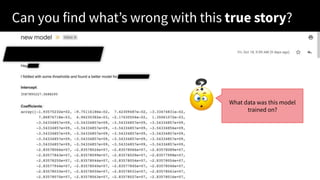
Can you find what’s wrong with this true story?
How did the
hyperparameters change?
Can you find what’s wrong with this true story?
What data was this model
trained on?
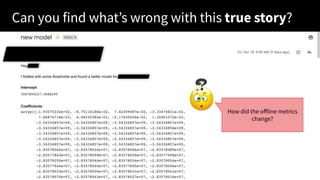
Can you find what’s wrong with this true story?
How did the offline metrics
change?
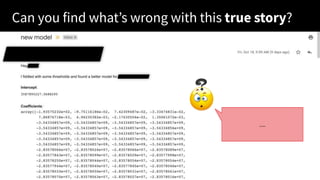
Can you find what’s wrong with this true story?
....
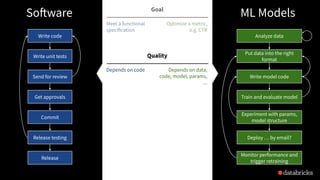
The difference between releasing Software
and deploying ML Models
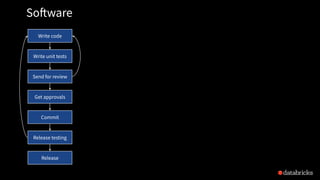
Write code
Software
Write unit tests
Send for review
Get approvals
Commit
Release testing
Release
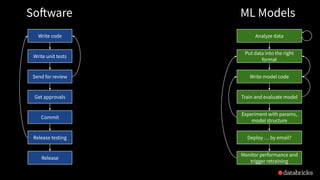
Write code
Software ML Models
Write unit tests
Send for review
Get approvals
Commit
Release testing
Release
Analyze data
Put data into the right
format
Write model code
Train and evaluate model
Experiment with params,
model structure
Deploy … by email?
Monitor performance and
trigger retraining
Write code
Software ML Models
Write unit tests
Send for review
Get approvals
Commit
Release testing
Release
Analyze data
Put data into the right
format
Write model code
Train and evaluate model
Experiment with params,
model structure
Deploy … by email?
Monitor performance and
trigger retraining
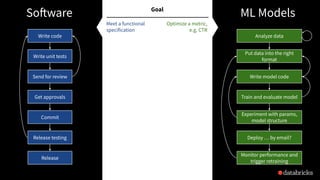
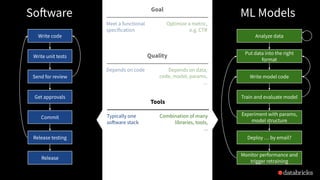
Meet a functional
specification
Optimize a metric,
e.g. CTR
Goal
Write code
Software ML Models
Write unit tests
Send for review
Get approvals
Commit
Release testing
Release
Analyze data
Put data into the right
format
Write model code
Train and evaluate model
Experiment with params,
model structure
Deploy … by email?
Monitor performance and
trigger retraining
Meet a functional
specification
Optimize a metric,
e.g. CTR
Goal
Depends on code Depends on data,
code, model, params,
...
Quality
Write code
Software ML Models
Write unit tests
Send for review
Get approvals
Commit
Release testing
Release
Analyze data
Put data into the right
format
Write model code
Train and evaluate model
Experiment with params,
model structure
Deploy … by email?
Monitor performance and
trigger retraining
Meet a functional
specification
Optimize a metric,
e.g. CTR
Goal
Depends on code Depends on data,
code, model, params,
...
Quality
Typically one
software stack
Combination of many
libraries, tools,
...
Tools
Write code
Software ML Models
Write unit tests
Send for review
Get approvals
Commit
Release testing
Release
Analyze data
Put data into the right
format
Write model code
Train and evaluate model
Experiment with params,
model structure
Deploy … by email?
Monitor performance and
trigger retraining
Meet a functional
specification
Optimize a metric,
e.g. CTR
Goal
Depends on code Depends on data,
code, model, params,
...
Quality
Typically one
software stack
Combination of many
libraries, tools,
...
Tools
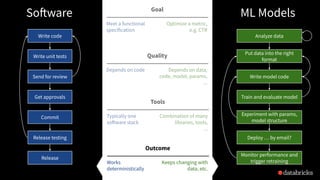
Works
deterministically
Keeps changing with
data, etc.
Outcome
In summary, deploying ML Models is hard!
: An Open Source ML Platform
18
mlflow.org github.com/mlflow twitter.com/MLflowdatabricks.com/mlflow
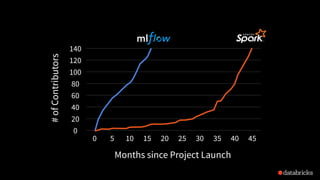
140
120
100
80
60
40
20
0
0 5 10 15 20 25 30 35 40 45
Months since Project Launch
#ofContributors
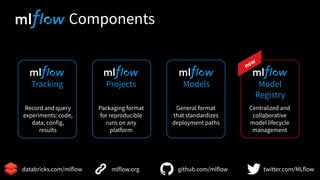
Components
Tracking
Record and query
experiments: code,
data, config,
results
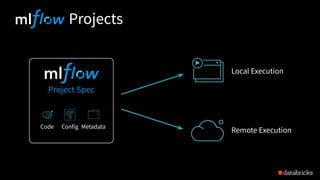
Projects
Packaging format
for reproducible
runs on any
platform
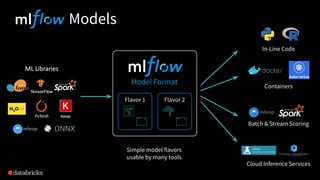
Models
General format
that standardizes
deployment paths
Model
Registry
Centralized and
collaborative
model lifecycle
management
new
20
mlflow.org github.com/mlflow twitter.com/MLflowdatabricks.com/mlflow
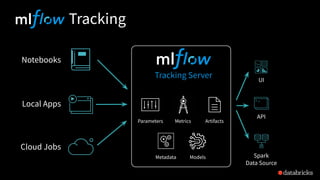
Tracking
Notebooks
Local Apps
Cloud Jobs
UI
API
Tracking Server
Parameters Metrics Artifacts
ModelsMetadata Spark
Data Source
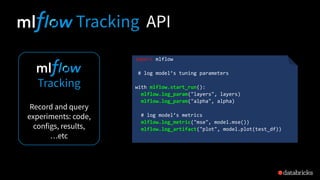
Tracking
Record and query
experiments: code,
configs, results,
…etc
import mlflow
# log model’s tuning parameters
with mlflow.start_run():
mlflow.log_param("layers", layers)
mlflow.log_param("alpha", alpha)
# log model’s metrics
mlflow.log_metric("mse", model.mse())
mlflow.log_artifact("plot", model.plot(test_df))
Tracking API
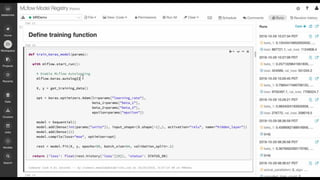
X, y = get_training_data()
opt = keras.optimizers.Adam(lr=params["learning_rate"],
beta_1=params["beta_1"],
beta_2=params["beta_2"],
epsilon=params["epsilon"])
model = Sequential()
model.add(Dense(int(params["units"]), ...)
model.add(Dense(1))
model.compile(loss="mse", optimizer=opt)
rest = model.fit(X, y, epochs=50, batch_size=64, validation_split=.2)
# Enable MLflow Autologging
mlflow.keras.autolog()
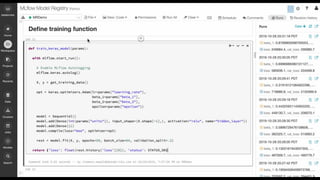
X, y = get_training_data()
opt = keras.optimizers.Adam(lr=params["learning_rate"],
beta_1=params["beta_1"],
beta_2=params["beta_2"],
epsilon=params["epsilon"])
model = Sequential()
model.add(Dense(int(params["units"]), ...)
model.add(Dense(1))
model.compile(loss="mse", optimizer=opt)
rest = model.fit(X, y, epochs=50, batch_size=64, validation_split=.2)
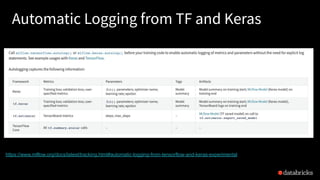
https://www.mlflow.org/docs/latest/tracking.html#automatic-logging-from-tensorflow-and-keras-experimental
Automatic Logging from TF and Keras
Projects
Project Spec
Code MetadataConfig
Local Execution
Remote Execution
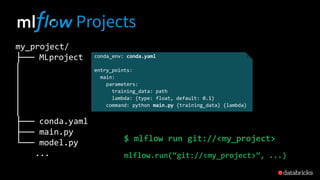
my_project/
├── MLproject
│
│
│
│
│
├── conda.yaml
├── main.py
└── model.py
...
conda_env: conda.yaml
entry_points:
main:
parameters:
training_data: path
lambda: {type: float, default: 0.1}
command: python main.py {training_data} {lambda}
$ mlflow run git://<my_project>
mlflow.run(“git://<my_project>”, ...)
Projects
Model Format
Flavor 2Flavor 1
Simple model flavors
usable by many tools
Containers
Batch & Stream Scoring
Cloud Inference Services
In-Line Code
Models
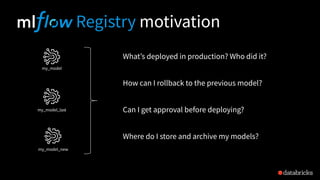
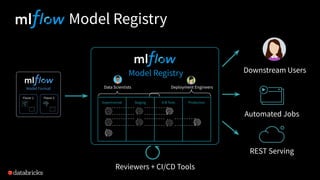
What’s deployed in production? Who did it?
How can I rollback to the previous model?
Can I get approval before deploying?
Where do I store and archive my models?
Registry motivation
my_model
my_model_last
my_model_new
Automated Jobs
REST Serving
Downstream Users
Reviewers + CI/CD Tools
Model Registry
Experimental Staging A/B Tests Production
Model Registry
Data Scientists Deployment Engineers
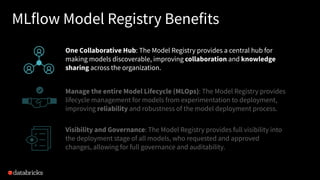
MLflow Model Registry Benefits
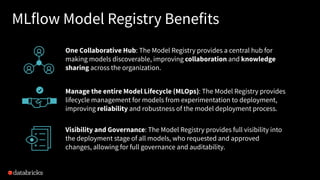
One Collaborative Hub: The Model Registry provides a central hub for
making models discoverable, improving collaboration and knowledge
sharing across the organization.
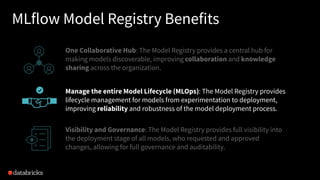
Manage the entire Model Lifecycle (MLOps): The Model Registry provides
lifecycle management for models from experimentation to deployment,
improving reliability and robustness of the model deployment process.
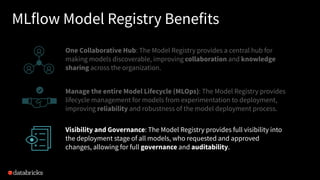
Visibility and Governance: The Model Registry provides full visibility into
the deployment stage of all models, who requested and approved
changes, allowing for full governance and auditability.
MLflow Model Registry Benefits
One Collaborative Hub: The Model Registry provides a central hub for
making models discoverable, improving collaboration and knowledge
sharing across the organization.
Manage the entire Model Lifecycle (MLOps): The Model Registry provides
lifecycle management for models from experimentation to deployment,
improving reliability and robustness of the model deployment process.
Visibility and Governance: The Model Registry provides full visibility into
the deployment stage of all models, who requested and approved
changes, allowing for full governance and auditability.
MLflow Model Registry Benefits
One Collaborative Hub: The Model Registry provides a central hub for
making models discoverable, improving collaboration and knowledge
sharing across the organization.
Manage the entire Model Lifecycle (MLOps): The Model Registry provides
lifecycle management for models from experimentation to deployment,
improving reliability and robustness of the model deployment process.
Visibility and Governance: The Model Registry provides full visibility into
the deployment stage of all models, who requested and approved
changes, allowing for full governance and auditability.
MLflow Model Registry Benefits
One Collaborative Hub: The Model Registry provides a central hub for
making models discoverable, improving collaboration and knowledge
sharing across the organization.
Manage the entire Model Lifecycle (MLOps): The Model Registry provides
lifecycle management for models from experimentation to deployment,
improving reliability and robustness of the model deployment process.
Visibility and Governance: The Model Registry provides full visibility into
the deployment stage of all models, who requested and approved
changes, allowing for full governance and auditability.
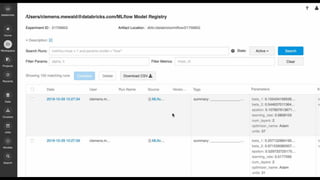
Using the latest production Model
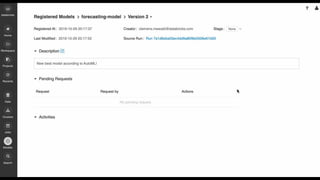
Deploying the new best Model as a new
version to the Model Registry
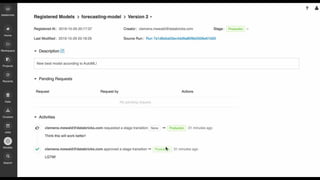
Using the new production Model
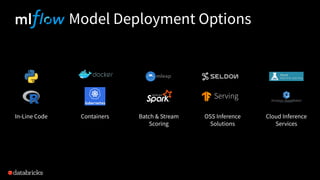
Model Deployment Options
Containers Batch & Stream
Scoring
Cloud Inference
Services
In-Line Code OSS Inference
Solutions
pip install mlflow
45
mlflow.org github.com/mlflow twitter.com/MLflowdatabricks.com/mlflow
pip install mlflow
46
mlflow.org github.com/mlflow twitter.com/MLflowdatabricks.com/mlflow
Try Managed MLflow on Databricks Community Edition!
databricks.com/try

Managing the Machine Learning Lifecycle with MLflow

  • 1.
    Arduino Cascella @ MLOpsParis, January 16th 2020
  • 2.
    Agenda • What isMLflow? • Demo • Questions & Answers
  • 3.
  • 4.
    Can you findwhat’s wrong with this true story?
  • 5.
    Can you findwhat’s wrong with this true story? Did anything change in the feature engineering?
  • 6.
    Can you findwhat’s wrong with this true story? How did the hyperparameters change?
  • 7.
    Can you findwhat’s wrong with this true story? What data was this model trained on?
  • 8.
    Can you findwhat’s wrong with this true story? How did the offline metrics change?
  • 9.
    Can you findwhat’s wrong with this true story? ....
  • 10.
    The difference betweenreleasing Software and deploying ML Models
  • 11.
    Write code Software Write unittests Send for review Get approvals Commit Release testing Release
  • 12.
    Write code Software MLModels Write unit tests Send for review Get approvals Commit Release testing Release Analyze data Put data into the right format Write model code Train and evaluate model Experiment with params, model structure Deploy … by email? Monitor performance and trigger retraining
  • 13.
    Write code Software MLModels Write unit tests Send for review Get approvals Commit Release testing Release Analyze data Put data into the right format Write model code Train and evaluate model Experiment with params, model structure Deploy … by email? Monitor performance and trigger retraining Meet a functional specification Optimize a metric, e.g. CTR Goal
  • 14.
    Write code Software MLModels Write unit tests Send for review Get approvals Commit Release testing Release Analyze data Put data into the right format Write model code Train and evaluate model Experiment with params, model structure Deploy … by email? Monitor performance and trigger retraining Meet a functional specification Optimize a metric, e.g. CTR Goal Depends on code Depends on data, code, model, params, ... Quality
  • 15.
    Write code Software MLModels Write unit tests Send for review Get approvals Commit Release testing Release Analyze data Put data into the right format Write model code Train and evaluate model Experiment with params, model structure Deploy … by email? Monitor performance and trigger retraining Meet a functional specification Optimize a metric, e.g. CTR Goal Depends on code Depends on data, code, model, params, ... Quality Typically one software stack Combination of many libraries, tools, ... Tools
  • 16.
    Write code Software MLModels Write unit tests Send for review Get approvals Commit Release testing Release Analyze data Put data into the right format Write model code Train and evaluate model Experiment with params, model structure Deploy … by email? Monitor performance and trigger retraining Meet a functional specification Optimize a metric, e.g. CTR Goal Depends on code Depends on data, code, model, params, ... Quality Typically one software stack Combination of many libraries, tools, ... Tools Works deterministically Keeps changing with data, etc. Outcome
  • 17.
    In summary, deployingML Models is hard!
  • 18.
    : An OpenSource ML Platform 18 mlflow.org github.com/mlflow twitter.com/MLflowdatabricks.com/mlflow
  • 19.
    140 120 100 80 60 40 20 0 0 5 1015 20 25 30 35 40 45 Months since Project Launch #ofContributors
  • 20.
    Components Tracking Record and query experiments:code, data, config, results Projects Packaging format for reproducible runs on any platform Models General format that standardizes deployment paths Model Registry Centralized and collaborative model lifecycle management new 20 mlflow.org github.com/mlflow twitter.com/MLflowdatabricks.com/mlflow
  • 21.
    Tracking Notebooks Local Apps Cloud Jobs UI API TrackingServer Parameters Metrics Artifacts ModelsMetadata Spark Data Source
  • 22.
    Tracking Record and query experiments:code, configs, results, …etc import mlflow # log model’s tuning parameters with mlflow.start_run(): mlflow.log_param("layers", layers) mlflow.log_param("alpha", alpha) # log model’s metrics mlflow.log_metric("mse", model.mse()) mlflow.log_artifact("plot", model.plot(test_df)) Tracking API
  • 23.
    X, y =get_training_data() opt = keras.optimizers.Adam(lr=params["learning_rate"], beta_1=params["beta_1"], beta_2=params["beta_2"], epsilon=params["epsilon"]) model = Sequential() model.add(Dense(int(params["units"]), ...) model.add(Dense(1)) model.compile(loss="mse", optimizer=opt) rest = model.fit(X, y, epochs=50, batch_size=64, validation_split=.2)
  • 24.
    # Enable MLflowAutologging mlflow.keras.autolog() X, y = get_training_data() opt = keras.optimizers.Adam(lr=params["learning_rate"], beta_1=params["beta_1"], beta_2=params["beta_2"], epsilon=params["epsilon"]) model = Sequential() model.add(Dense(int(params["units"]), ...) model.add(Dense(1)) model.compile(loss="mse", optimizer=opt) rest = model.fit(X, y, epochs=50, batch_size=64, validation_split=.2)
  • 25.
  • 28.
  • 29.
    my_project/ ├── MLproject │ │ │ │ │ ├── conda.yaml ├──main.py └── model.py ... conda_env: conda.yaml entry_points: main: parameters: training_data: path lambda: {type: float, default: 0.1} command: python main.py {training_data} {lambda} $ mlflow run git://<my_project> mlflow.run(“git://<my_project>”, ...) Projects
  • 30.
    Model Format Flavor 2Flavor1 Simple model flavors usable by many tools Containers Batch & Stream Scoring Cloud Inference Services In-Line Code Models
  • 31.
    What’s deployed inproduction? Who did it? How can I rollback to the previous model? Can I get approval before deploying? Where do I store and archive my models? Registry motivation my_model my_model_last my_model_new
  • 32.
    Automated Jobs REST Serving DownstreamUsers Reviewers + CI/CD Tools Model Registry Experimental Staging A/B Tests Production Model Registry Data Scientists Deployment Engineers
  • 33.
    MLflow Model RegistryBenefits One Collaborative Hub: The Model Registry provides a central hub for making models discoverable, improving collaboration and knowledge sharing across the organization. Manage the entire Model Lifecycle (MLOps): The Model Registry provides lifecycle management for models from experimentation to deployment, improving reliability and robustness of the model deployment process. Visibility and Governance: The Model Registry provides full visibility into the deployment stage of all models, who requested and approved changes, allowing for full governance and auditability.
  • 34.
    MLflow Model RegistryBenefits One Collaborative Hub: The Model Registry provides a central hub for making models discoverable, improving collaboration and knowledge sharing across the organization. Manage the entire Model Lifecycle (MLOps): The Model Registry provides lifecycle management for models from experimentation to deployment, improving reliability and robustness of the model deployment process. Visibility and Governance: The Model Registry provides full visibility into the deployment stage of all models, who requested and approved changes, allowing for full governance and auditability.
  • 35.
    MLflow Model RegistryBenefits One Collaborative Hub: The Model Registry provides a central hub for making models discoverable, improving collaboration and knowledge sharing across the organization. Manage the entire Model Lifecycle (MLOps): The Model Registry provides lifecycle management for models from experimentation to deployment, improving reliability and robustness of the model deployment process. Visibility and Governance: The Model Registry provides full visibility into the deployment stage of all models, who requested and approved changes, allowing for full governance and auditability.
  • 36.
    MLflow Model RegistryBenefits One Collaborative Hub: The Model Registry provides a central hub for making models discoverable, improving collaboration and knowledge sharing across the organization. Manage the entire Model Lifecycle (MLOps): The Model Registry provides lifecycle management for models from experimentation to deployment, improving reliability and robustness of the model deployment process. Visibility and Governance: The Model Registry provides full visibility into the deployment stage of all models, who requested and approved changes, allowing for full governance and auditability.
  • 37.
    Using the latestproduction Model
  • 39.
    Deploying the newbest Model as a new version to the Model Registry
  • 42.
    Using the newproduction Model
  • 44.
    Model Deployment Options ContainersBatch & Stream Scoring Cloud Inference Services In-Line Code OSS Inference Solutions
  • 45.
    pip install mlflow 45 mlflow.orggithub.com/mlflow twitter.com/MLflowdatabricks.com/mlflow
  • 46.
    pip install mlflow 46 mlflow.orggithub.com/mlflow twitter.com/MLflowdatabricks.com/mlflow Try Managed MLflow on Databricks Community Edition! databricks.com/try