ROAD NOTE METHOD NO:4 MIX DESIGN
Road note 4 method of mix design involves the process of selecting suitable ingredients of
concrete and determining their relative quantities with the purpose of producing an economical concrete
which has certain minimum properties, workability, strength and durability.
BASICS OF THE METHOD
 According to the Road Note No.4 is mainly based on the experimental investigations by
Glanville et al
 Deals with the effect of aggregate grading on the strength and workability of concrete
 It’s mandatory to note that designed concrete must be satisfactory both in the Plastic as well
Hardened state.
 Necessary the choice of Mix proportions is governed by both these conditions.
 The required W/C ratio to produce the design characteristic strength depends upon the
characteristics of the cement.
 By using same W/C ratio, different strengths are produced by Ordinary Portland, Rapid
hardening Portland and High alumina cements.
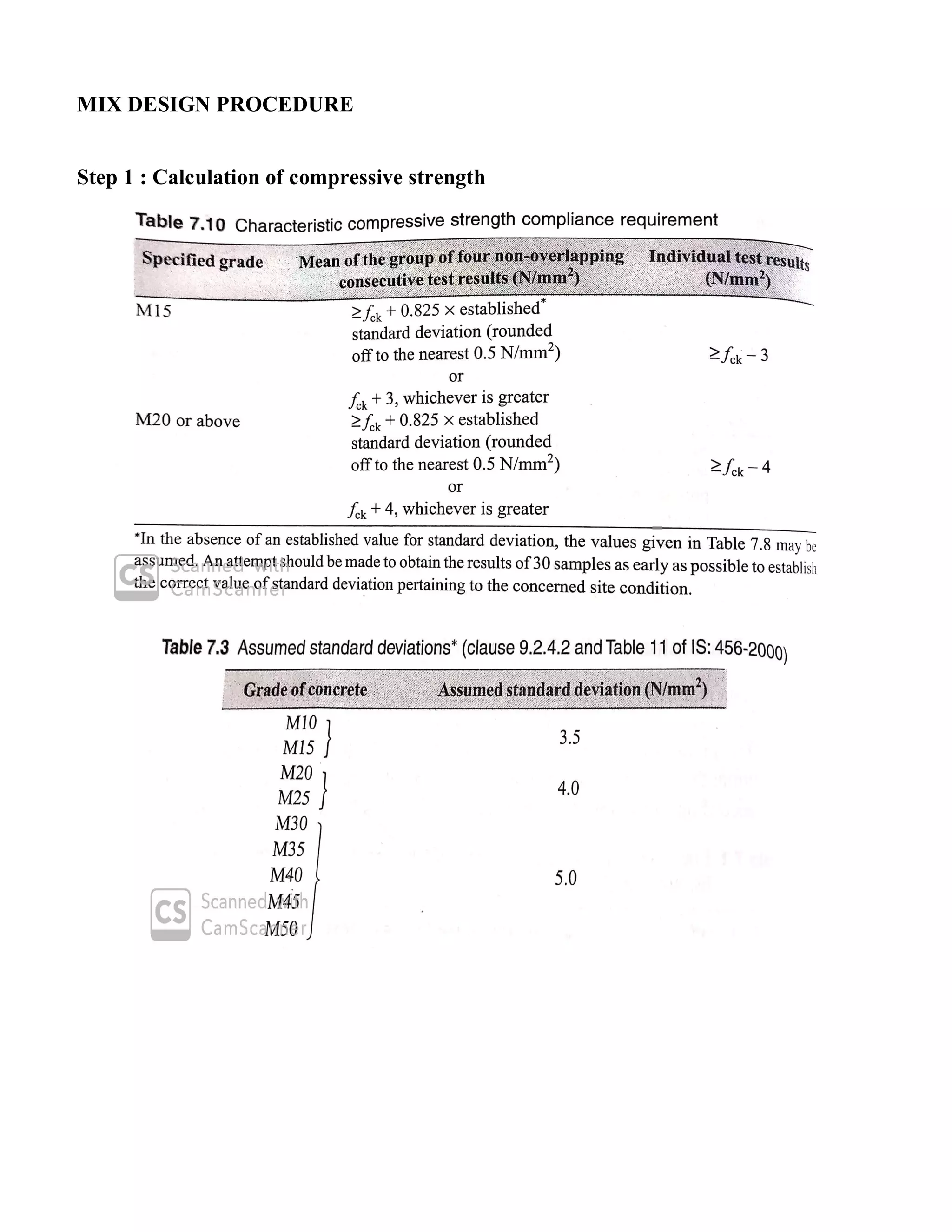
 The Road note No.4 presents a set of curves relating W/C ratio and Compressive strength at
different ages and for different types of cement.
 A rough indication of the degree of workability is obtained by the corresponding slump and
compacting factor of the concrete at the work site.
 Extensive Laboratory investigations were conducted at the ROAD RESEARCH
LABORATORY to study the relation among the various parameters such as,
1. Aggregate/Cement Ratio
2. Water/Cement Ratio
3. Degree of workability
4. Grading
5. Shape and size of aggregates
 Based on the results, design tables are presented in Road Note No.4 to select suitable
aggregate/Cement ratios for a concrete mix and filling up other parameters.
MIX DESIGN PROCEDURE
Step 1 : Calculation of compressive strength
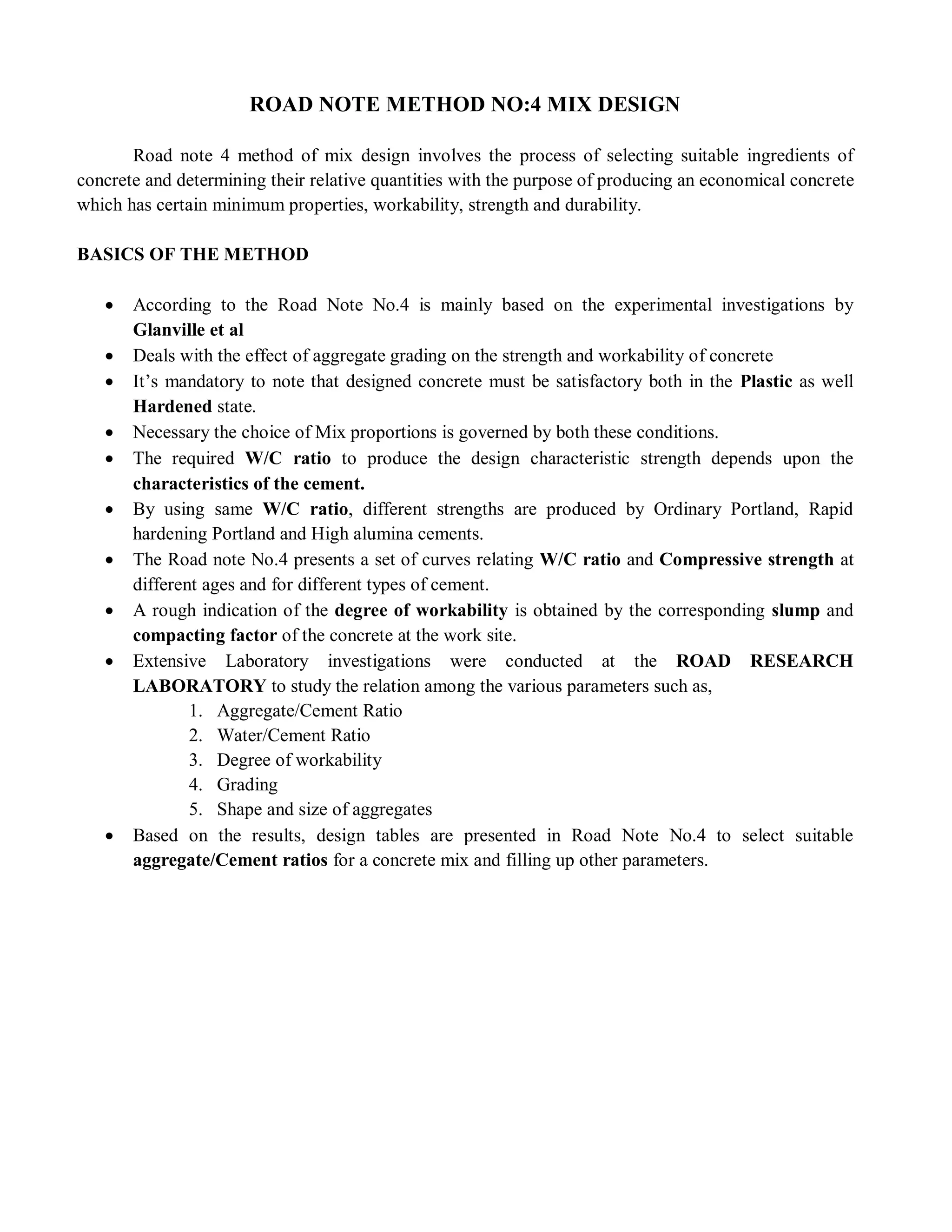
Step 2 ; Selection of W/C ratio
Step 3 : Workability selection
 The average compressive strength of the concrete mix is to be obtained by applying the control
factors to the minimum compressive strength.
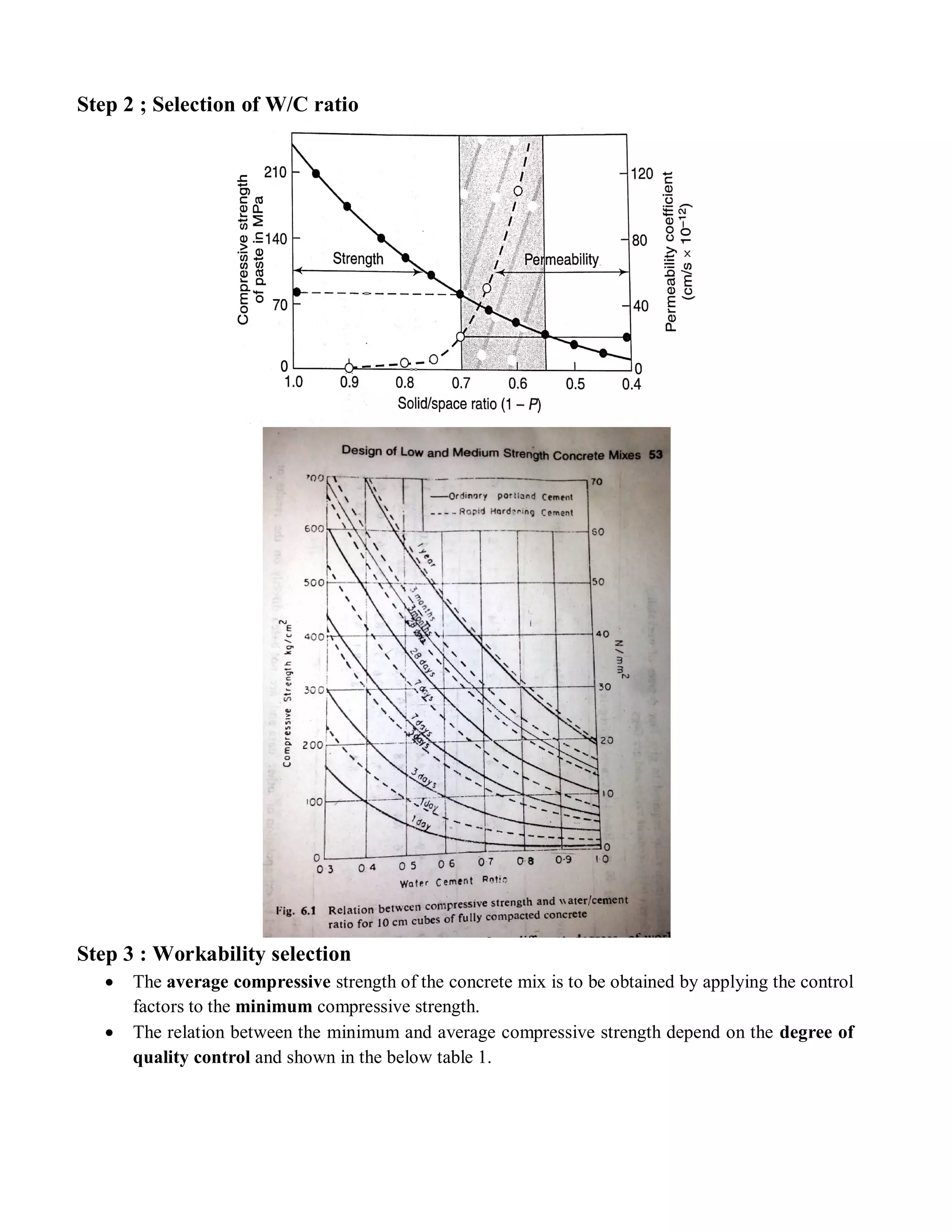
 The relation between the minimum and average compressive strength depend on the degree of
quality control and shown in the below table 1.
Table.1 estimated relation between minimum and mean compressive strengths of site cube
(road note no.4)
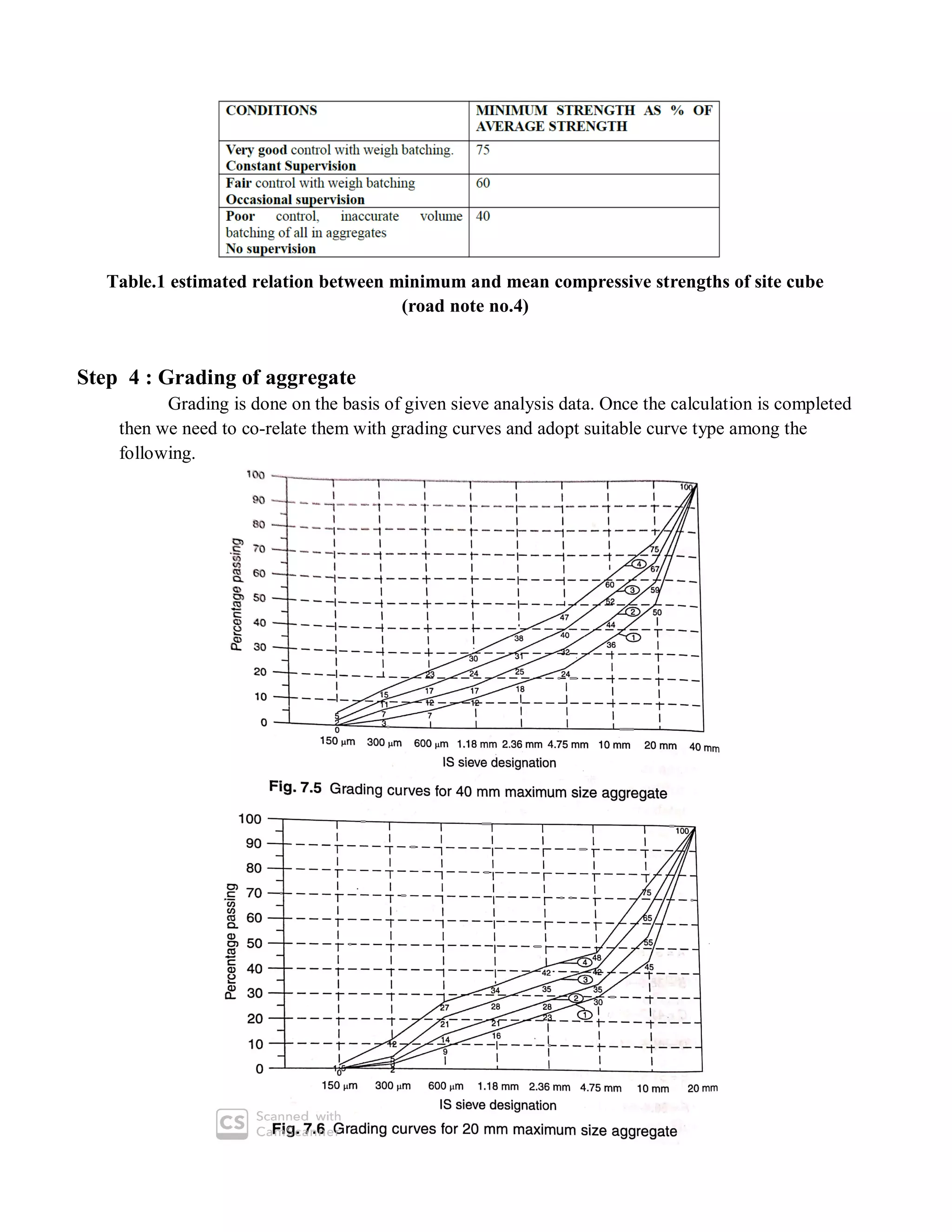
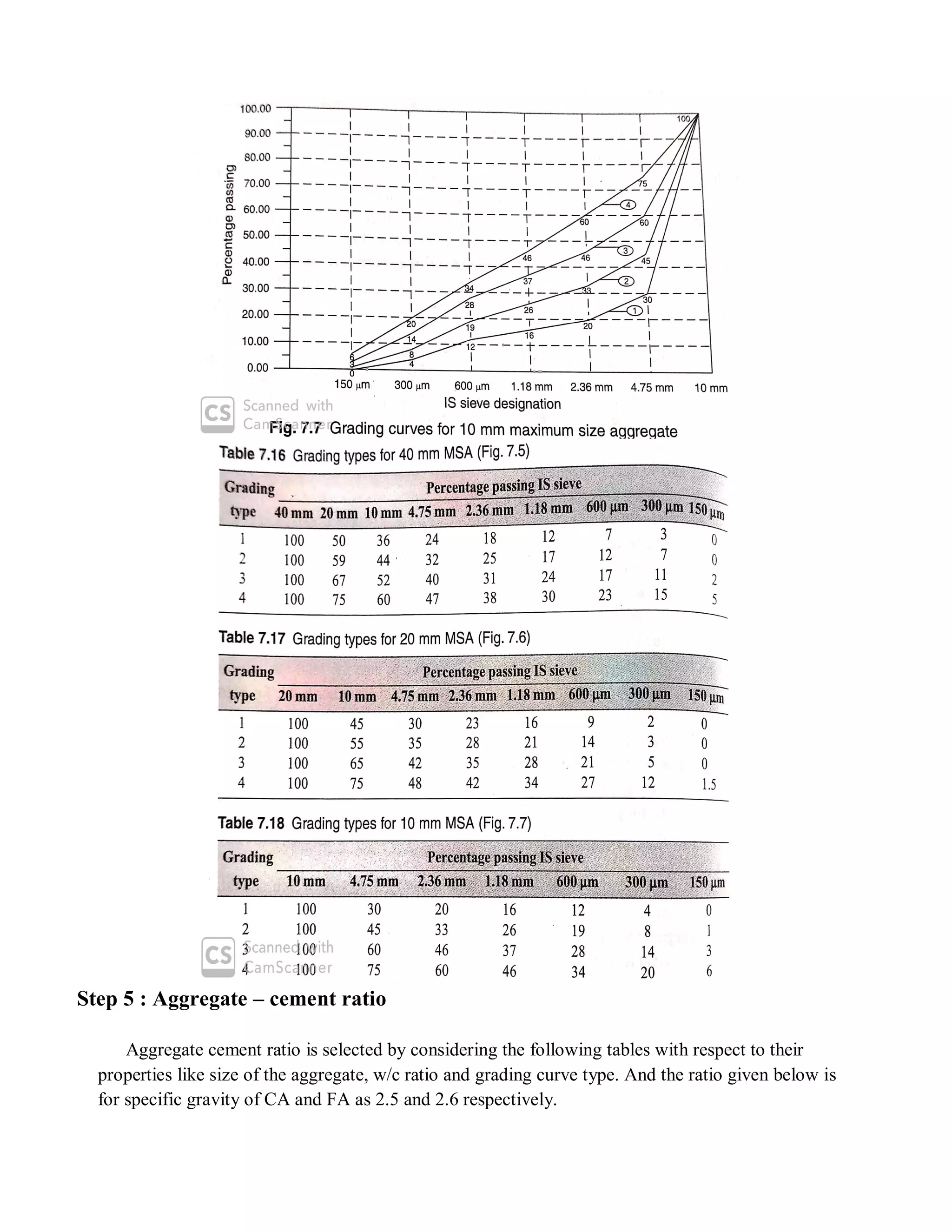
Step 4 : Grading of aggregate
Grading is done on the basis of given sieve analysis data. Once the calculation is completed
then we need to co-relate them with grading curves and adopt suitable curve type among the
following.
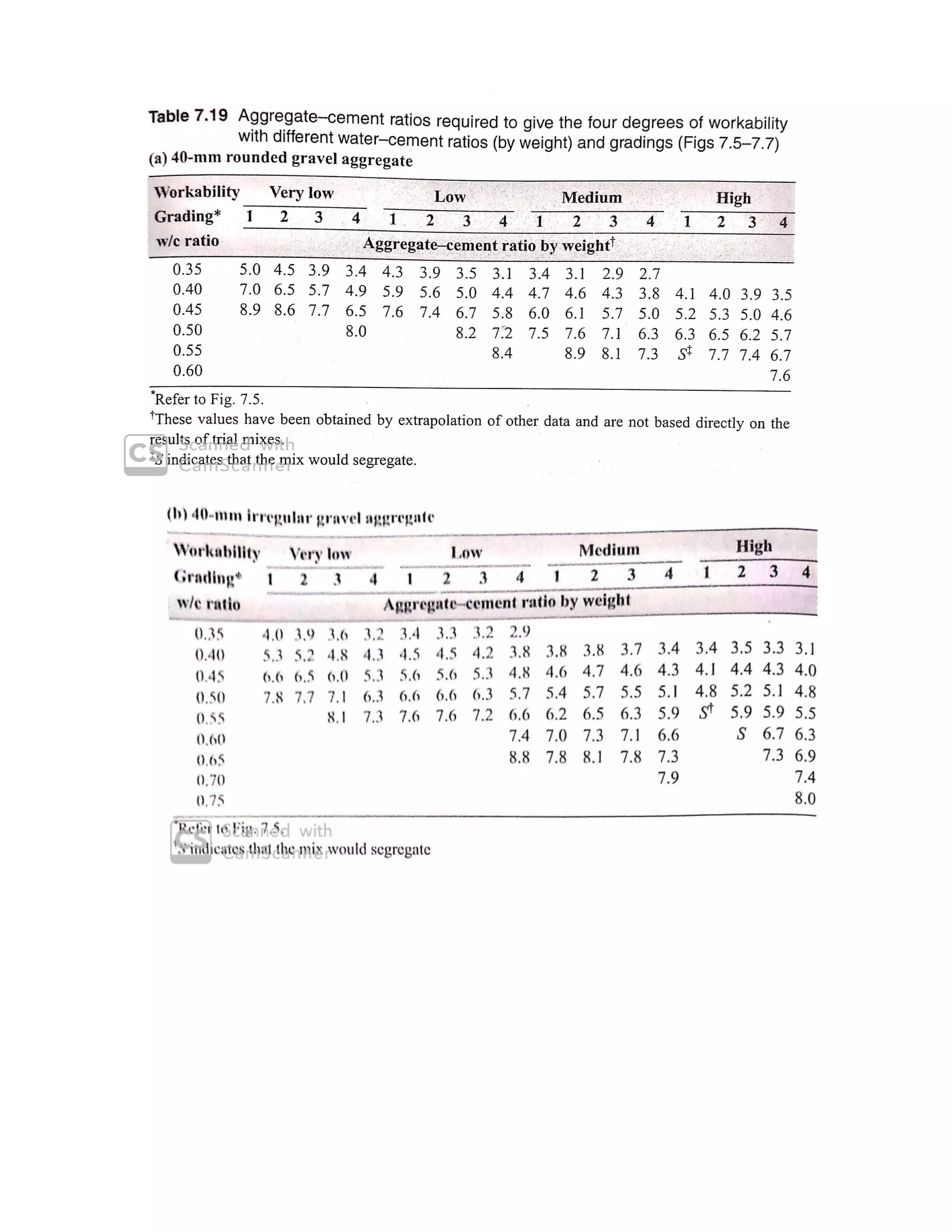
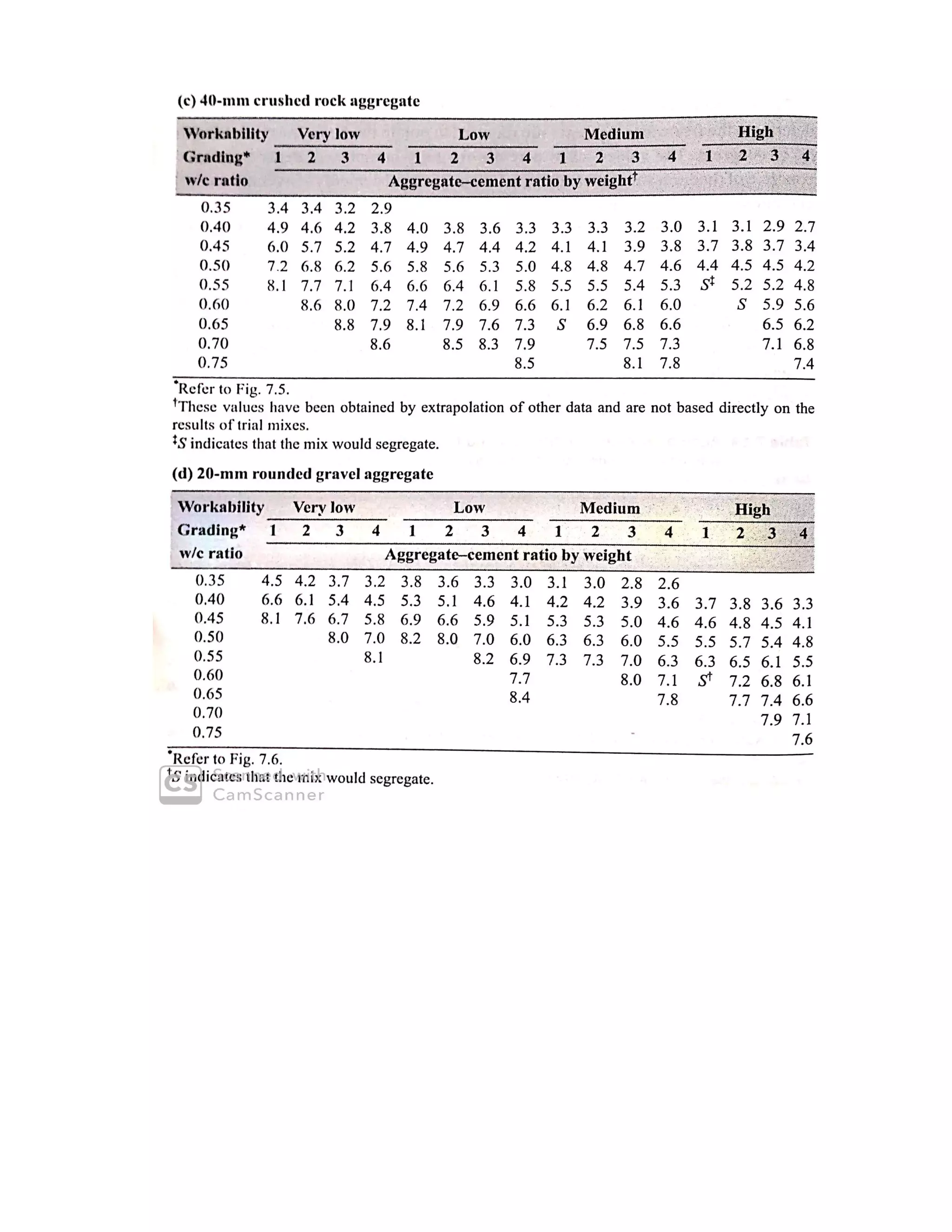
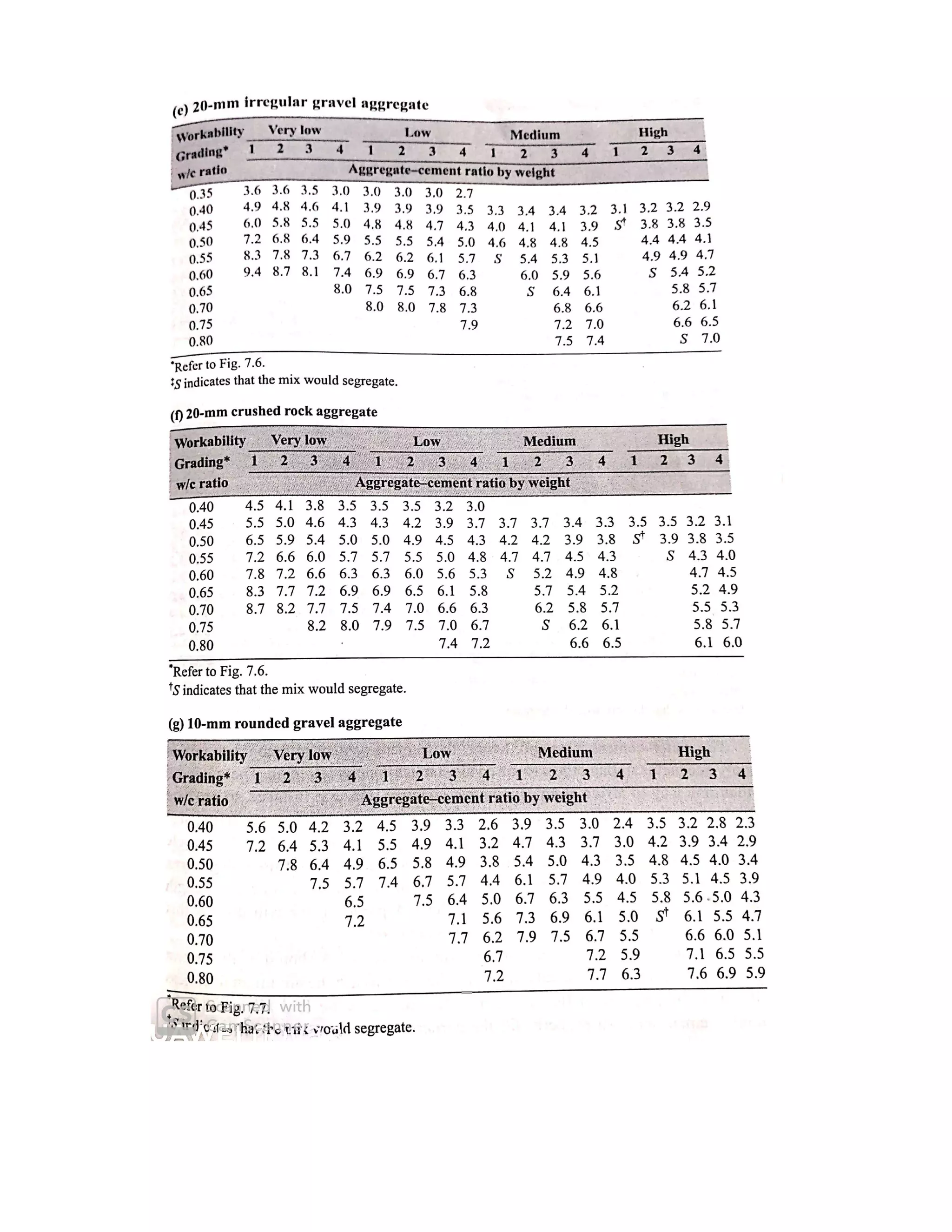
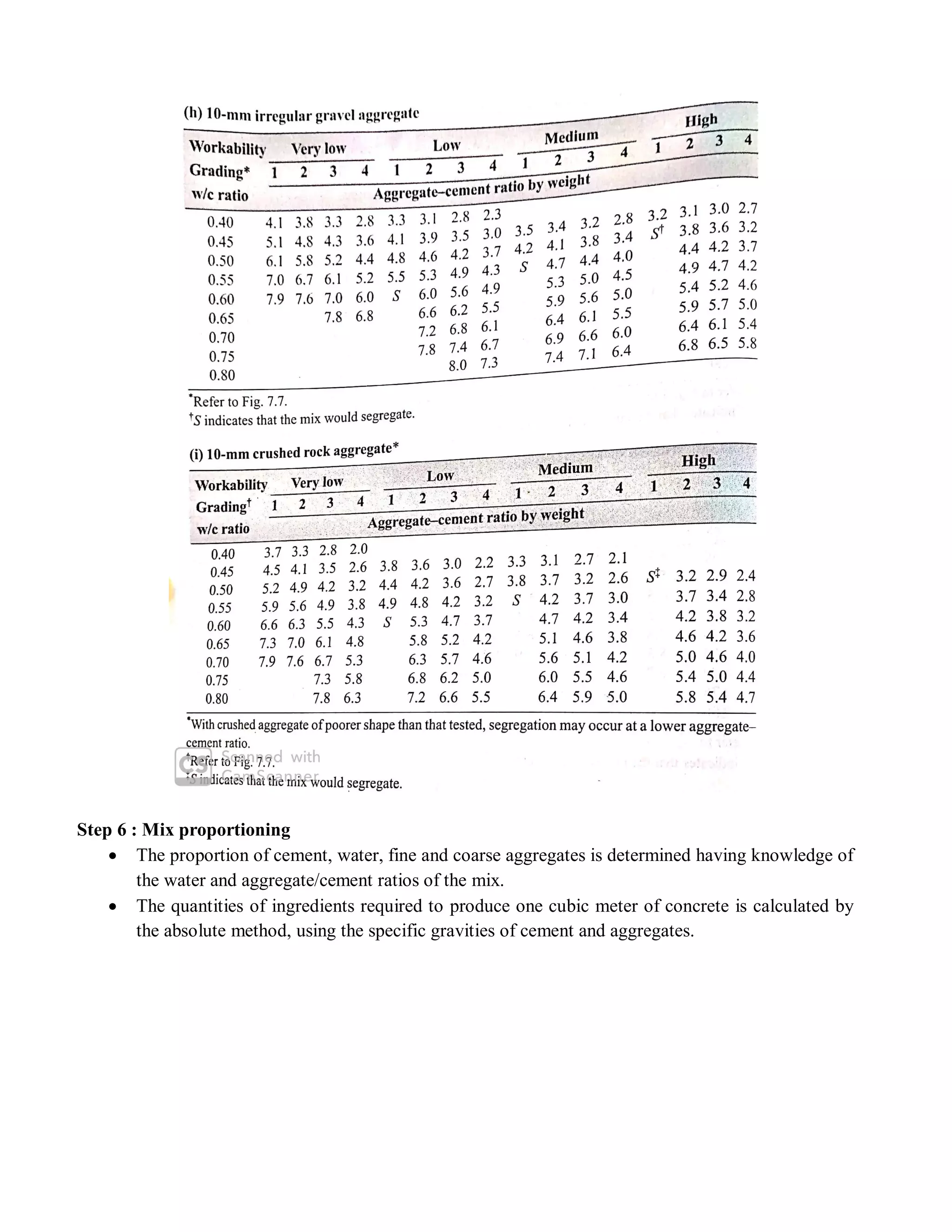
Step 5 : Aggregate – cement ratio
Aggregate cement ratio is selected by considering the following tables with respect to their
properties like size of the aggregate, w/c ratio and grading curve type. And the ratio given below is
for specific gravity of CA and FA as 2.5 and 2.6 respectively.
Step 6 : Mix proportioning
 The proportion of cement, water, fine and coarse aggregates is determined having knowledge of
the water and aggregate/cement ratios of the mix.
 The quantities of ingredients required to produce one cubic meter of concrete is calculated by
the absolute method, using the specific gravities of cement and aggregates.
Example problem
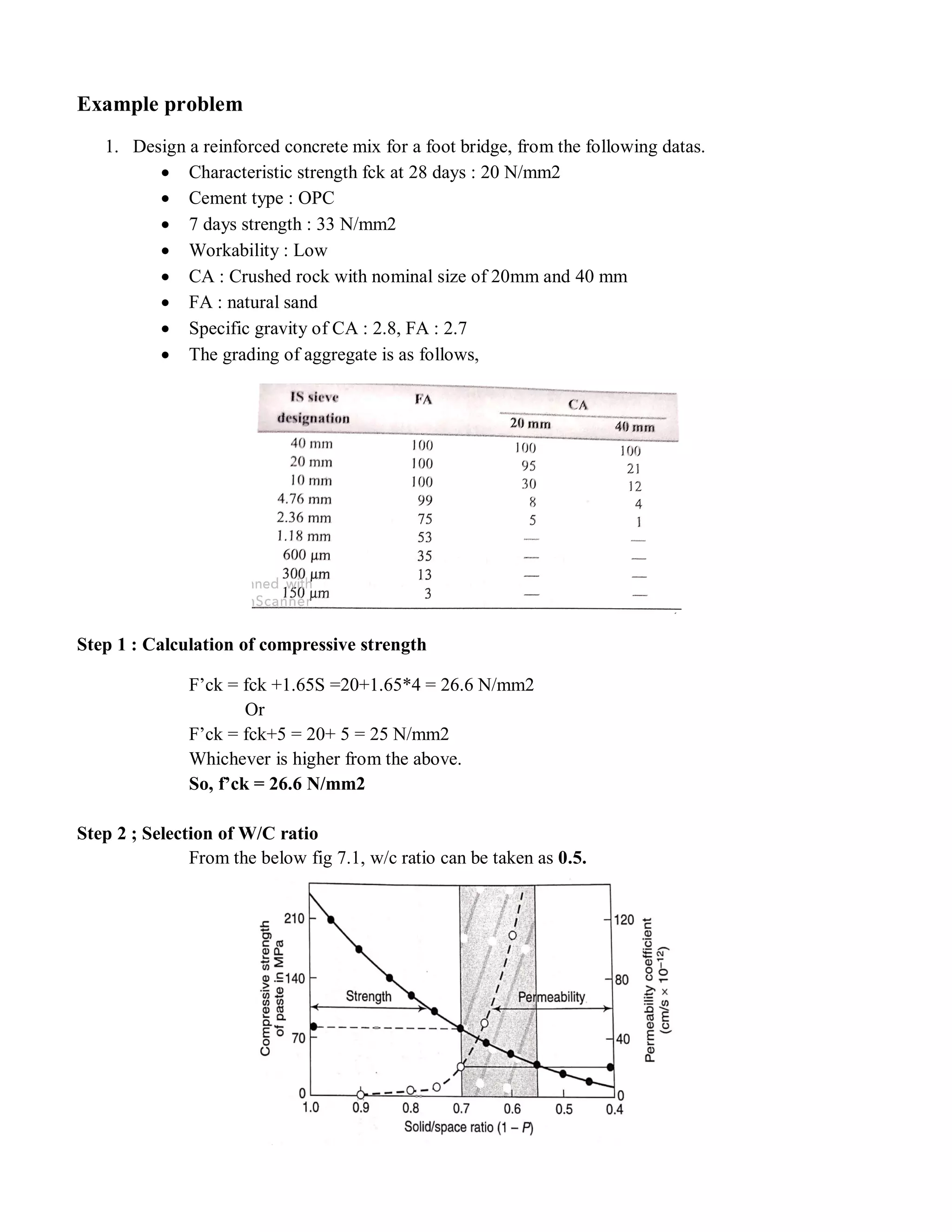
1. Design a reinforced concrete mix for a foot bridge, from the following datas.
 Characteristic strength fck at 28 days : 20 N/mm2
 Cement type : OPC
 7 days strength : 33 N/mm2
 Workability : Low
 CA : Crushed rock with nominal size of 20mm and 40 mm
 FA : natural sand
 Specific gravity of CA : 2.8, FA : 2.7
 The grading of aggregate is as follows,
Step 1 : Calculation of compressive strength
F’ck = fck +1.65S =20+1.65*4 = 26.6 N/mm2
Or
F’ck = fck+5 = 20+ 5 = 25 N/mm2
Whichever is higher from the above.
So, f’ck = 26.6 N/mm2
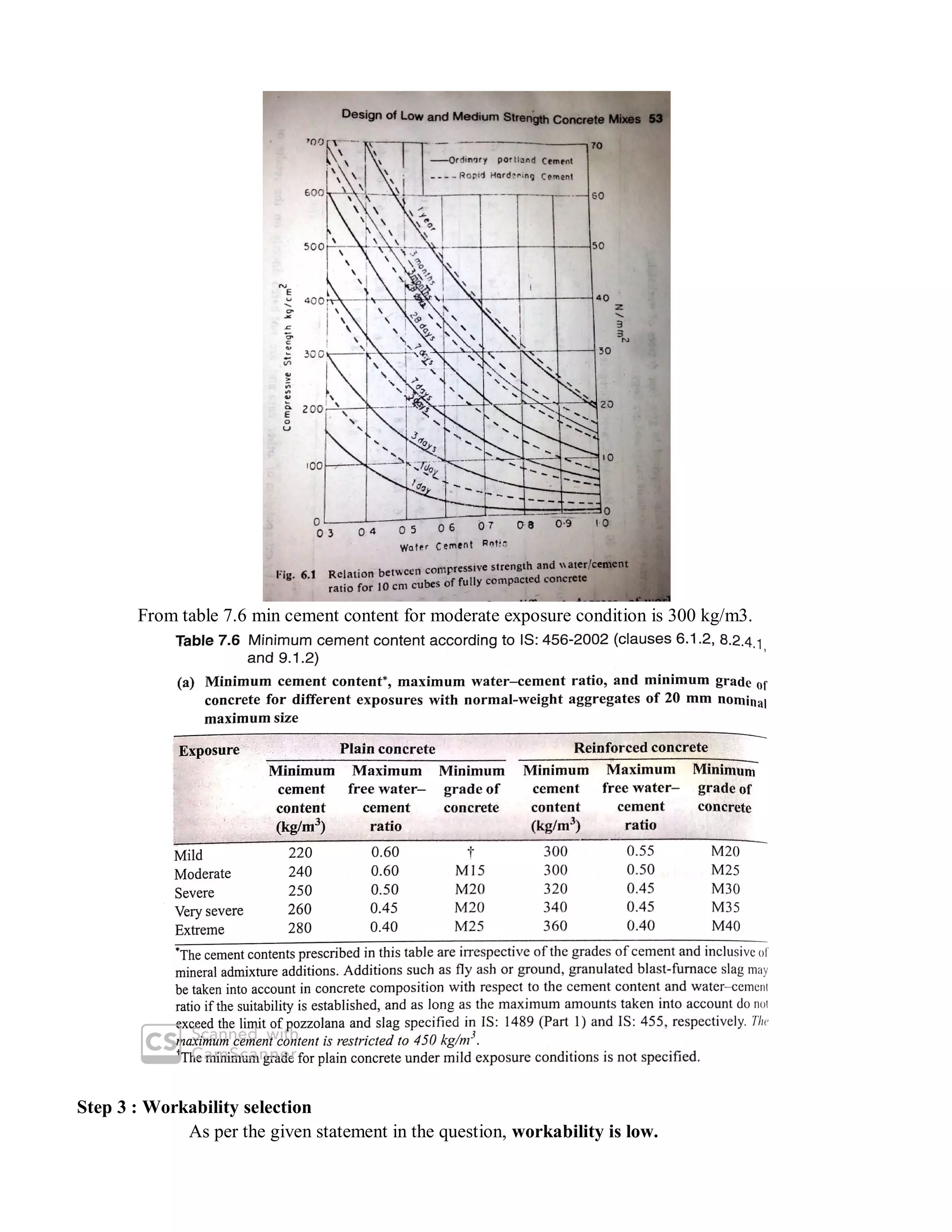
Step 2 ; Selection of W/C ratio
From the below fig 7.1, w/c ratio can be taken as 0.5.
From table 7.6 min cement content for moderate exposure condition is 300 kg/m3.
Step 3 : Workability selection
As per the given statement in the question, workability is low.
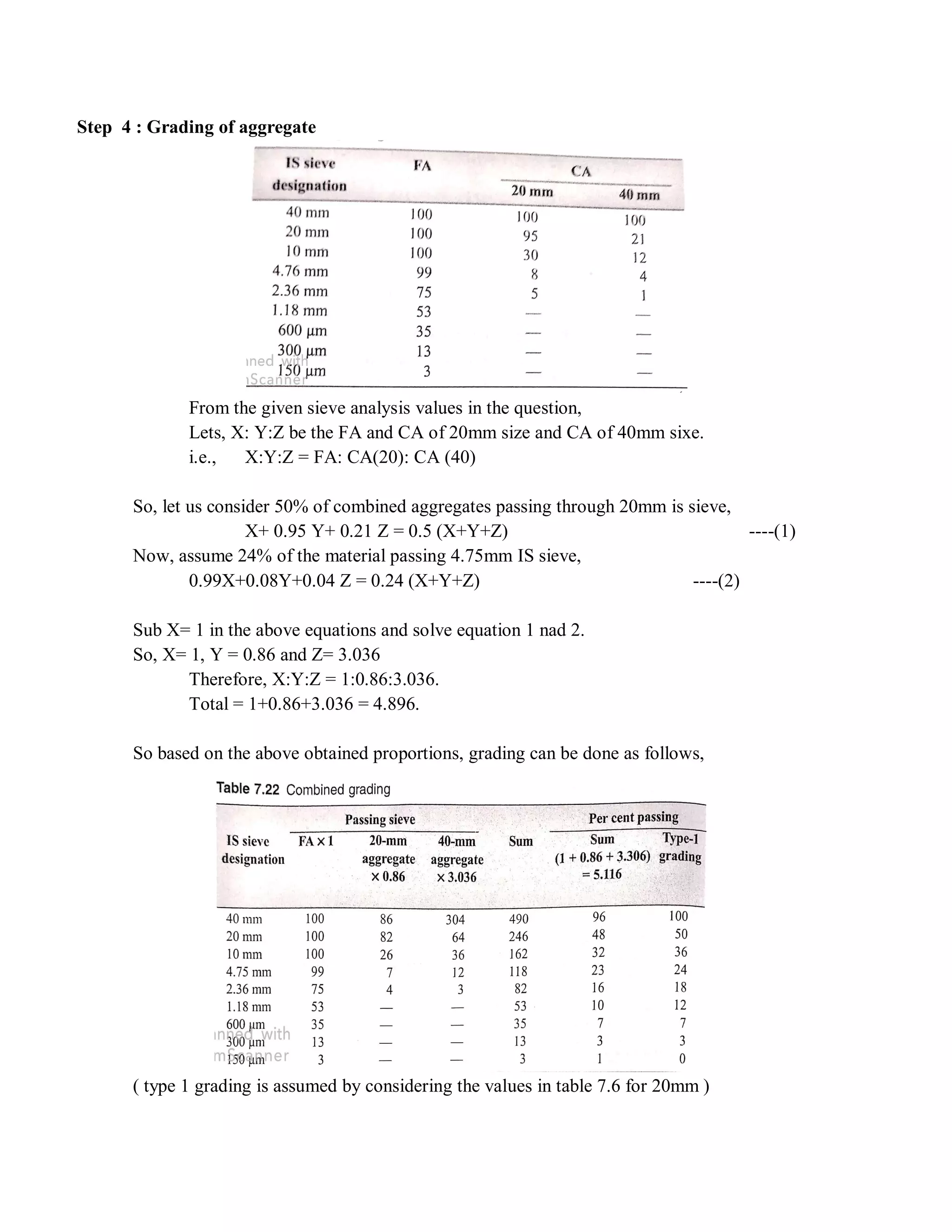
Step 4 : Grading of aggregate
From the given sieve analysis values in the question,
Lets, X: Y:Z be the FA and CA of 20mm size and CA of 40mm sixe.
i.e., X:Y:Z = FA: CA(20): CA (40)
So, let us consider 50% of combined aggregates passing through 20mm is sieve,
X+ 0.95 Y+ 0.21 Z = 0.5 (X+Y+Z) ----(1)
Now, assume 24% of the material passing 4.75mm IS sieve,
0.99X+0.08Y+0.04 Z = 0.24 (X+Y+Z) ----(2)
Sub X= 1 in the above equations and solve equation 1 nad 2.
So, X= 1, Y = 0.86 and Z= 3.036
Therefore, X:Y:Z = 1:0.86:3.036.
Total = 1+0.86+3.036 = 4.896.
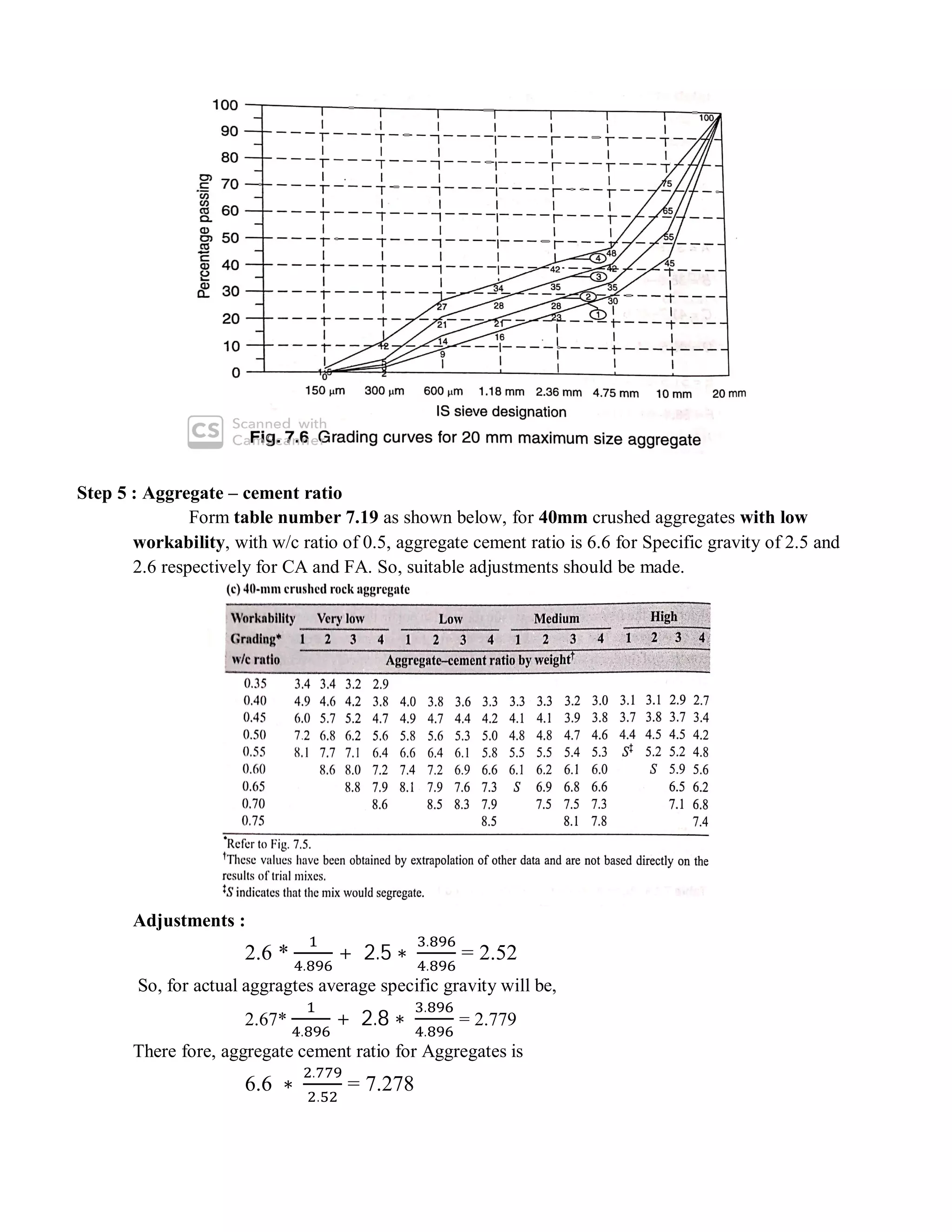
So based on the above obtained proportions, grading can be done as follows,
( type 1 grading is assumed by considering the values in table 7.6 for 20mm )
Step 5 : Aggregate – cement ratio
Form table number 7.19 as shown below, for 40mm crushed aggregates with low
workability, with w/c ratio of 0.5, aggregate cement ratio is 6.6 for Specific gravity of 2.5 and
2.6 respectively for CA and FA. So, suitable adjustments should be made.
Adjustments :
2.6 *
.
+ 	2.5 ∗	
.
.
= 2.52
So, for actual aggragtes average specific gravity will be,
2.67*
.
+ 	2.8 ∗	
.
.
= 2.779
There fore, aggregate cement ratio for Aggregates is
6.6 ∗	
.
.
= 7.278
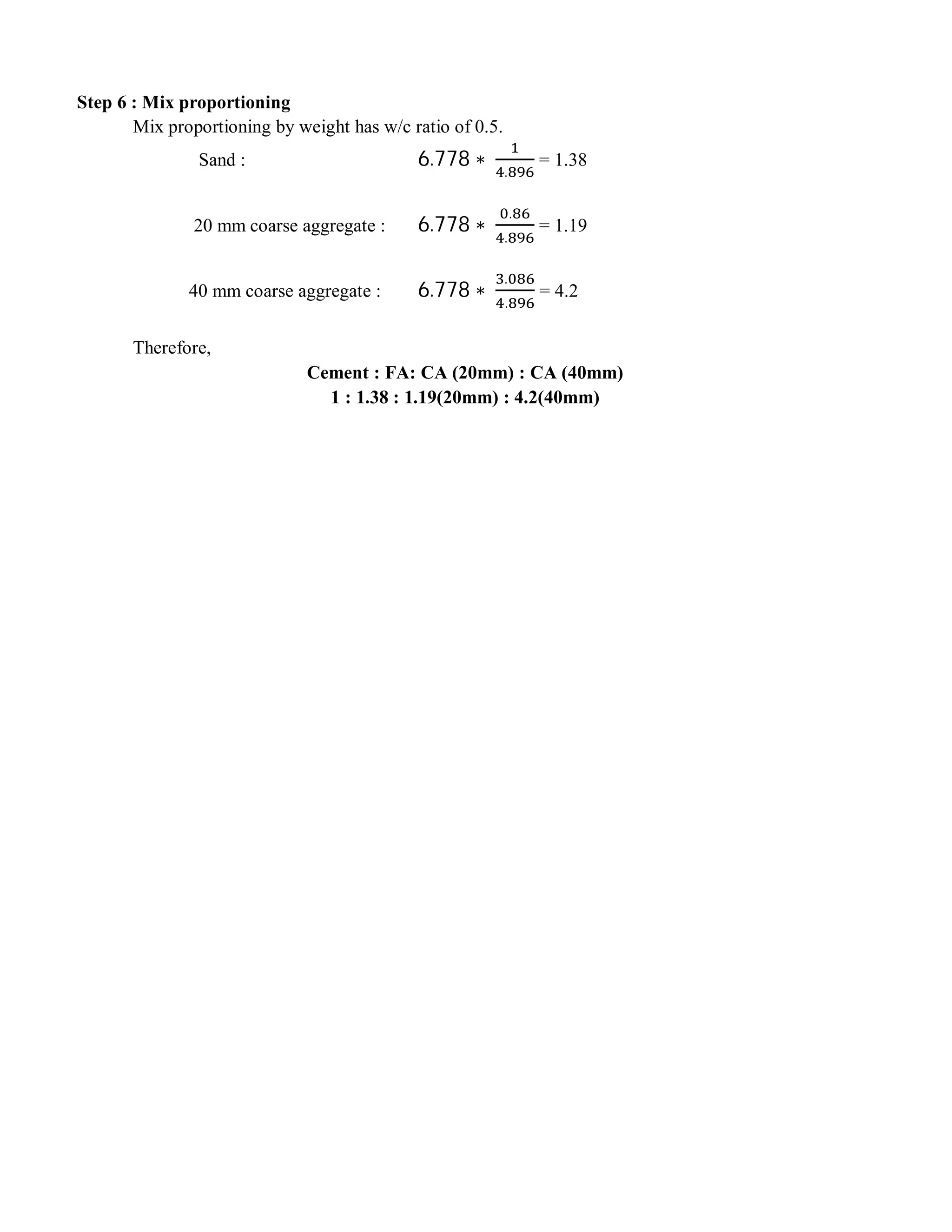
Step 6 : Mix proportioning
Mix proportioning by weight has w/c ratio of 0.5.
Sand : 	6.778 ∗	
.
= 1.38
20 mm coarse aggregate : 	6.778 ∗	
.
.
= 1.19
40 mm coarse aggregate : 	6.778 ∗	
.
.
= 4.2
Therefore,
Cement : FA: CA (20mm) : CA (40mm)
1 : 1.38 : 1.19(20mm) : 4.2(40mm)

Mix design procedure road note 4

  • 1.
    ROAD NOTE METHODNO:4 MIX DESIGN Road note 4 method of mix design involves the process of selecting suitable ingredients of concrete and determining their relative quantities with the purpose of producing an economical concrete which has certain minimum properties, workability, strength and durability. BASICS OF THE METHOD  According to the Road Note No.4 is mainly based on the experimental investigations by Glanville et al  Deals with the effect of aggregate grading on the strength and workability of concrete  It’s mandatory to note that designed concrete must be satisfactory both in the Plastic as well Hardened state.  Necessary the choice of Mix proportions is governed by both these conditions.  The required W/C ratio to produce the design characteristic strength depends upon the characteristics of the cement.  By using same W/C ratio, different strengths are produced by Ordinary Portland, Rapid hardening Portland and High alumina cements.  The Road note No.4 presents a set of curves relating W/C ratio and Compressive strength at different ages and for different types of cement.  A rough indication of the degree of workability is obtained by the corresponding slump and compacting factor of the concrete at the work site.  Extensive Laboratory investigations were conducted at the ROAD RESEARCH LABORATORY to study the relation among the various parameters such as, 1. Aggregate/Cement Ratio 2. Water/Cement Ratio 3. Degree of workability 4. Grading 5. Shape and size of aggregates  Based on the results, design tables are presented in Road Note No.4 to select suitable aggregate/Cement ratios for a concrete mix and filling up other parameters.
  • 2.
    MIX DESIGN PROCEDURE Step1 : Calculation of compressive strength
  • 3.
    Step 2 ;Selection of W/C ratio Step 3 : Workability selection  The average compressive strength of the concrete mix is to be obtained by applying the control factors to the minimum compressive strength.  The relation between the minimum and average compressive strength depend on the degree of quality control and shown in the below table 1.
  • 4.
    Table.1 estimated relationbetween minimum and mean compressive strengths of site cube (road note no.4) Step 4 : Grading of aggregate Grading is done on the basis of given sieve analysis data. Once the calculation is completed then we need to co-relate them with grading curves and adopt suitable curve type among the following.
  • 5.
    Step 5 :Aggregate – cement ratio Aggregate cement ratio is selected by considering the following tables with respect to their properties like size of the aggregate, w/c ratio and grading curve type. And the ratio given below is for specific gravity of CA and FA as 2.5 and 2.6 respectively.
  • 9.
    Step 6 :Mix proportioning  The proportion of cement, water, fine and coarse aggregates is determined having knowledge of the water and aggregate/cement ratios of the mix.  The quantities of ingredients required to produce one cubic meter of concrete is calculated by the absolute method, using the specific gravities of cement and aggregates.
  • 10.
    Example problem 1. Designa reinforced concrete mix for a foot bridge, from the following datas.  Characteristic strength fck at 28 days : 20 N/mm2  Cement type : OPC  7 days strength : 33 N/mm2  Workability : Low  CA : Crushed rock with nominal size of 20mm and 40 mm  FA : natural sand  Specific gravity of CA : 2.8, FA : 2.7  The grading of aggregate is as follows, Step 1 : Calculation of compressive strength F’ck = fck +1.65S =20+1.65*4 = 26.6 N/mm2 Or F’ck = fck+5 = 20+ 5 = 25 N/mm2 Whichever is higher from the above. So, f’ck = 26.6 N/mm2 Step 2 ; Selection of W/C ratio From the below fig 7.1, w/c ratio can be taken as 0.5.
  • 11.
    From table 7.6min cement content for moderate exposure condition is 300 kg/m3. Step 3 : Workability selection As per the given statement in the question, workability is low.
  • 12.
    Step 4 :Grading of aggregate From the given sieve analysis values in the question, Lets, X: Y:Z be the FA and CA of 20mm size and CA of 40mm sixe. i.e., X:Y:Z = FA: CA(20): CA (40) So, let us consider 50% of combined aggregates passing through 20mm is sieve, X+ 0.95 Y+ 0.21 Z = 0.5 (X+Y+Z) ----(1) Now, assume 24% of the material passing 4.75mm IS sieve, 0.99X+0.08Y+0.04 Z = 0.24 (X+Y+Z) ----(2) Sub X= 1 in the above equations and solve equation 1 nad 2. So, X= 1, Y = 0.86 and Z= 3.036 Therefore, X:Y:Z = 1:0.86:3.036. Total = 1+0.86+3.036 = 4.896. So based on the above obtained proportions, grading can be done as follows, ( type 1 grading is assumed by considering the values in table 7.6 for 20mm )
  • 13.
    Step 5 :Aggregate – cement ratio Form table number 7.19 as shown below, for 40mm crushed aggregates with low workability, with w/c ratio of 0.5, aggregate cement ratio is 6.6 for Specific gravity of 2.5 and 2.6 respectively for CA and FA. So, suitable adjustments should be made. Adjustments : 2.6 * . + 2.5 ∗ . . = 2.52 So, for actual aggragtes average specific gravity will be, 2.67* . + 2.8 ∗ . . = 2.779 There fore, aggregate cement ratio for Aggregates is 6.6 ∗ . . = 7.278
  • 14.
    Step 6 :Mix proportioning Mix proportioning by weight has w/c ratio of 0.5. Sand : 6.778 ∗ . = 1.38 20 mm coarse aggregate : 6.778 ∗ . . = 1.19 40 mm coarse aggregate : 6.778 ∗ . . = 4.2 Therefore, Cement : FA: CA (20mm) : CA (40mm) 1 : 1.38 : 1.19(20mm) : 4.2(40mm)