



Cement test can be divided into
two types
 Field Tests
 Laboratory Tests
2
 There should not be lumps and colour should
be greenish grey.
 Should give cool feeling.
 Should give smooth feeling when taken
between fingers.
 Cement particle should float for some time
before sinking
3
 Fineness Test
 Standard Consistency Test
 Setting Time Test
 Compressive Strength Test
 Soundness Test
 Tensile Strength Test
4
 Measurement of mean size of grains in
cement.
 Strength in cement depends on cement
fineness.
 Finer cement – quicker action with water –
early strength.
 Shrinkage and cracking of cement increase
with fineness of cement.
5
 Sieve Test
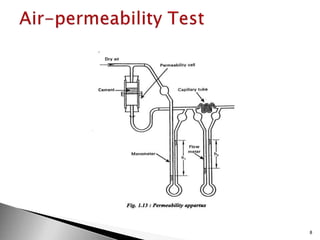
 Air-permeability Test
6
 Weigh 100 grams of cement and take it on IS
sieve No. 9 (90 micron).
 Remove the air set lumps by fingers.
 Sieve the given sample for 15 minutes.
 Weigh the residue left on sieve which should
be < 10% for ordinary cement.
7
8
 More recent method in India.
 Fineness is determined in terms specific
surface of cement.
 Specific surface expressed in cm2/gm or
m2/kg.
 Specific surface cement < 2250 cm2/gm.
9
 To determine the percentage of water
required for preparing cement paste.
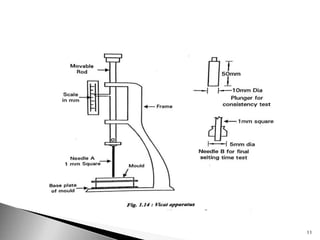
 Done by Vicat apparatus.
 Percentage of water required is 25 to 35%.
10
11
 Weigh approximately 400g of cement and mix
with weighed quantity of cement.
 Fill the paste in Vicat mould.
 Lower the plunger till it touches the cement
surface.
 Release the plunger allowing it to sink into paste.
 Repeat the procedure till the gauge shows 5mm
to 7mm.
12
 To detect the deterioration of cement due to
storage.
 Done using Vicat apparatus.
 Prepare cement paste and fill the Vicat
mould.
 Start the stop watch the moment water is
added to cement.
13
 Place the block under rod bearing the needle.
 Lower the needle so that its touches the
surface.
 Release the needle – penetrates the paste.
 Repeat the procedure till 5mm+or- 0.5mm
from the bottom of the mould.
14
 Replace the needle
 When the needle creates impression but
attachment fails to do so.
 Then cement is considered as final set.
15
 To determine the compressive strength.
 Cement (1) + sand (3) for cement mortor.
 Compressive Strength=11.5 N/mm2 (3days )
and 17.5 N/mm2 (7days )
16
 Mixture of cement and standard sand in 1:3 in China dish.
 Mix it by adding water – uniform colour.
 Place the mould over vibrating machine and held by clamps.
 Fill the mould with paste and compact using vibrating machine.
 Keep the mould in water of temerature 27±2o C for 24 hours.
 Remove cube from mould and submerge it in water.
 Test the cubes 3and 7 days (3 cubes each).
17
 To detect – uncombined lime an magnesia –
expansion of cement.
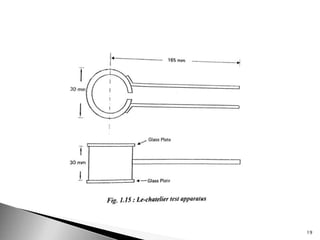
 Le-chatelier apparatus is used.
 Expansion < 10% for portland cement.

18
19
20
 Place the apparatus on the glass plate
Fill it with cement paste
Place it in water having temerature 27±2o C for 1 day
Measure the distance separating indicator(d1)
Again submerge the apparatus in same water and bring it boiling
point
Remove the mould and cool and measure the distance (d2)
(d1-d2) gives the expansion of cement.

Tests on cement

  • 2.
    Cement test canbe divided into two types  Field Tests  Laboratory Tests 2
  • 3.
     There shouldnot be lumps and colour should be greenish grey.  Should give cool feeling.  Should give smooth feeling when taken between fingers.  Cement particle should float for some time before sinking 3
  • 4.
     Fineness Test Standard Consistency Test  Setting Time Test  Compressive Strength Test  Soundness Test  Tensile Strength Test 4
  • 5.
     Measurement ofmean size of grains in cement.  Strength in cement depends on cement fineness.  Finer cement – quicker action with water – early strength.  Shrinkage and cracking of cement increase with fineness of cement. 5
  • 6.
     Sieve Test Air-permeability Test 6
  • 7.
     Weigh 100grams of cement and take it on IS sieve No. 9 (90 micron).  Remove the air set lumps by fingers.  Sieve the given sample for 15 minutes.  Weigh the residue left on sieve which should be < 10% for ordinary cement. 7
  • 8.
  • 9.
     More recentmethod in India.  Fineness is determined in terms specific surface of cement.  Specific surface expressed in cm2/gm or m2/kg.  Specific surface cement < 2250 cm2/gm. 9
  • 10.
     To determinethe percentage of water required for preparing cement paste.  Done by Vicat apparatus.  Percentage of water required is 25 to 35%. 10
  • 11.
  • 12.
     Weigh approximately400g of cement and mix with weighed quantity of cement.  Fill the paste in Vicat mould.  Lower the plunger till it touches the cement surface.  Release the plunger allowing it to sink into paste.  Repeat the procedure till the gauge shows 5mm to 7mm. 12
  • 13.
     To detectthe deterioration of cement due to storage.  Done using Vicat apparatus.  Prepare cement paste and fill the Vicat mould.  Start the stop watch the moment water is added to cement. 13
  • 14.
     Place theblock under rod bearing the needle.  Lower the needle so that its touches the surface.  Release the needle – penetrates the paste.  Repeat the procedure till 5mm+or- 0.5mm from the bottom of the mould. 14
  • 15.
     Replace theneedle  When the needle creates impression but attachment fails to do so.  Then cement is considered as final set. 15
  • 16.
     To determinethe compressive strength.  Cement (1) + sand (3) for cement mortor.  Compressive Strength=11.5 N/mm2 (3days ) and 17.5 N/mm2 (7days ) 16
  • 17.
     Mixture ofcement and standard sand in 1:3 in China dish.  Mix it by adding water – uniform colour.  Place the mould over vibrating machine and held by clamps.  Fill the mould with paste and compact using vibrating machine.  Keep the mould in water of temerature 27±2o C for 24 hours.  Remove cube from mould and submerge it in water.  Test the cubes 3and 7 days (3 cubes each). 17
  • 18.
     To detect– uncombined lime an magnesia – expansion of cement.  Le-chatelier apparatus is used.  Expansion < 10% for portland cement.  18
  • 19.
  • 20.
    20  Place theapparatus on the glass plate Fill it with cement paste Place it in water having temerature 27±2o C for 1 day Measure the distance separating indicator(d1) Again submerge the apparatus in same water and bring it boiling point Remove the mould and cool and measure the distance (d2) (d1-d2) gives the expansion of cement.