Introduction:
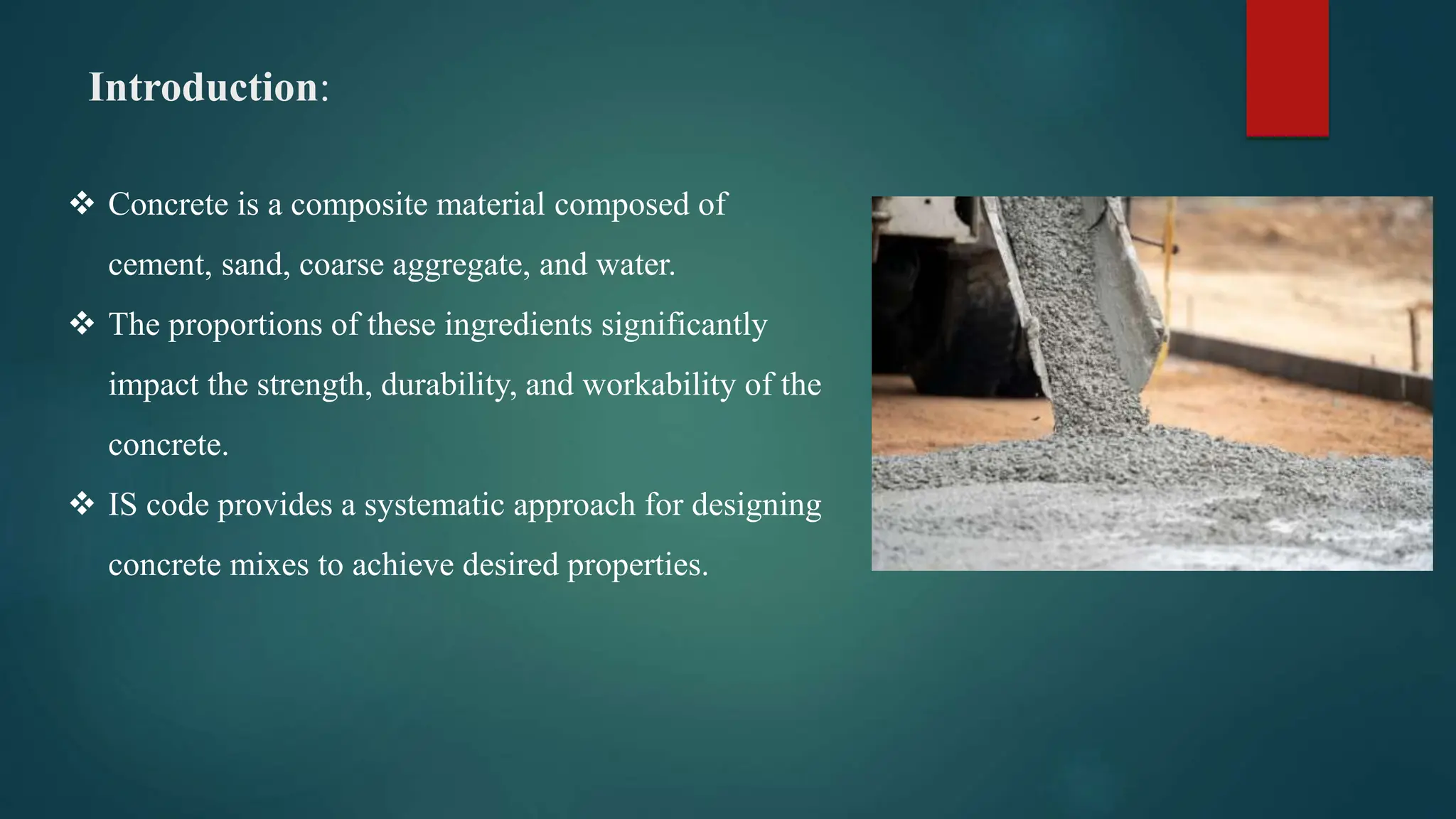
 Concrete is a composite material composed of
cement, sand, coarse aggregate, and water.
 The proportions of these ingredients significantly
impact the strength, durability, and workability of the
concrete.
 IS code provides a systematic approach for designing
concrete mixes to achieve desired properties.
Definition
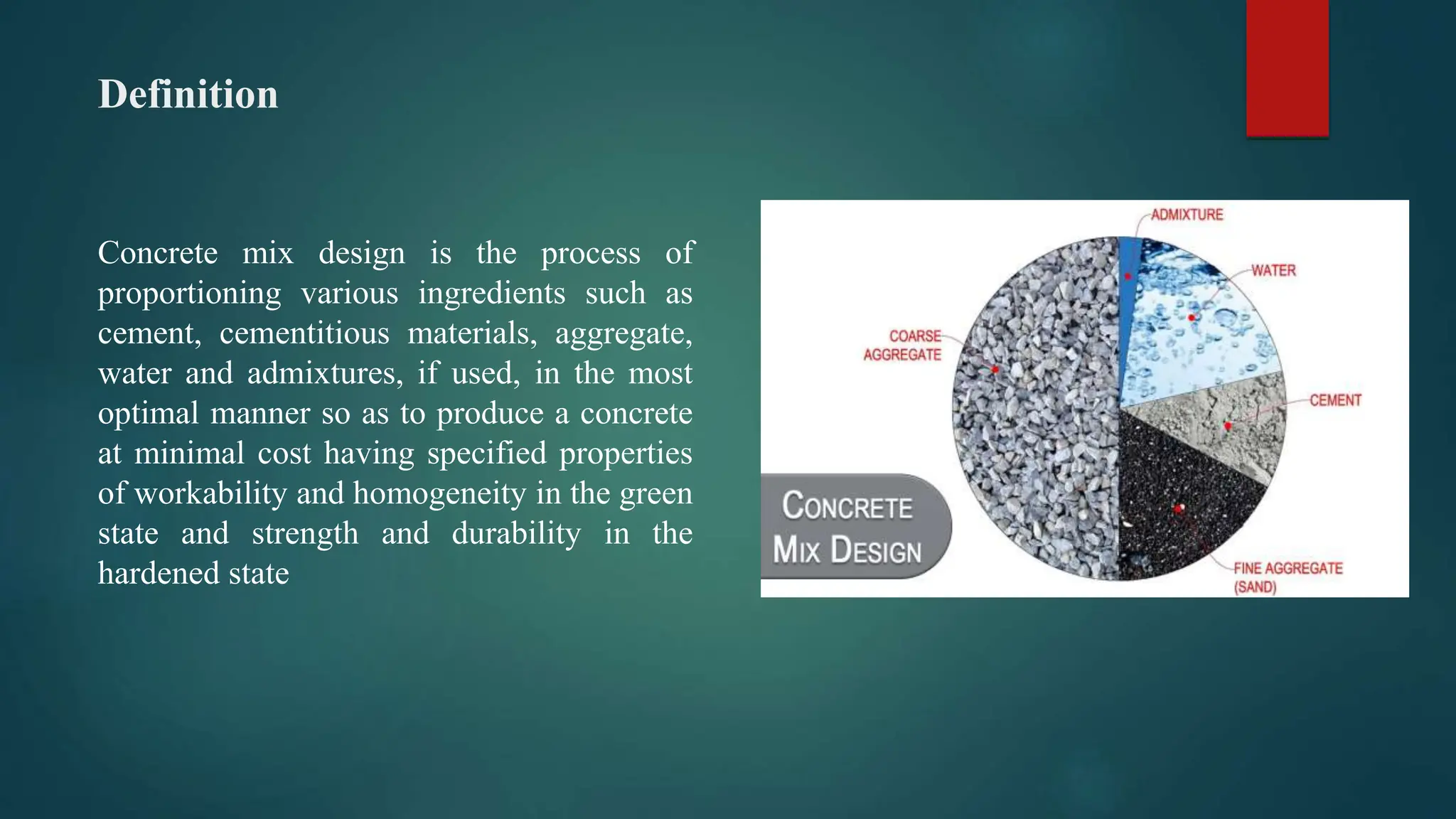
Concrete mix design is the process of
proportioning various ingredients such as
cement, cementitious materials, aggregate,
water and admixtures, if used, in the most
optimal manner so as to produce a concrete
at minimal cost having specified properties
of workability and homogeneity in the green
state and strength and durability in the
hardened state
IS Codes for Concrete Mix Design
 IS 456: 2000 - Plain and Reinforced Concrete - Code of Practice
 IS 10262: 2019 - Concrete Mix Design - Guidelines for Proportioning
 IS 456: 2000 - This code specifies the requirements for plain and reinforced concrete
structures. It includes provisions for selecting the grade of concrete based on the
design strength and exposure conditions
 IS 10262: 2019 - This code provides detailed guidelines for designing concrete
mixes to achieve the desired strength, durability, and workability. It outlines the
steps involved in the mix design process, including selecting materials, determining
the water-cement ratio, and calculating the proportions of ingredients.
Objectives of Concrete Mix Design
Objective of Concrete Mix Design is to make a concrete that:
 satisfies workability requirements in terms of slump for the placing conditions
 meets the strength requirements as measured by compressive strength
 fulfils durability requirements to resist the environment in which the structure is
expected to serve
 can be mixed, transported, placed and compacted as efficiently as possible
 has a satisfactory appearance where it is exposed to view
 will be as economical as possible
Process of Concrete Mix Design
 The process of Concrete Mix Design essentially consists of 3 stages.
i. Correct mix proportions are arrived at based on guidelines of mix
proportioning methods, past experience or published data, and information
obtained on the properties of the constituent materials that are actually
used in making the concrete.
ii. Small-scale trial mixes, usually in a laboratory are made and tested
using the materials that will be used on site.
iii. Full-scale site trials before construction begins.
It is always advisable to design the trial mixes with those materials that will
be used on the job itself so that the adjustments can be easily understood and
implemented in the field.
MIX PROPORTION CALCULATIONS AS PER IS 10262-
2009
 IS 456:2000 has recommended that minimum grade of concrete shall not
be less than M20 in reinforced concrete work. Design mix concrete is
preferred to nominal mix. If design mix concrete cannot be used for any
reason on the work for grades M20 or lower, nominal mixes may be used
with permission of engineer-in-charge, which, however is likely to involve
higher cement content. Accordingly all concrete above M20 grade for RCC
work must be of design mixes.
DATA FOR MIX PROPORTIONING:
The following basic data are required for mix proportioning of a particular grade of
concrete:
 Exposure Condition: The exposure condition of the structure under
consideration should be identified. Refer to Table 3 of IS 456-2000 for guidance
on exposure conditions.
 Grade Designation : Based on the exposure condition, determine the minimum
grade of concrete required for the structure. Refer to Tables 3 and 5 of IS 456-
2000 for guidance on grade designation. (Appendix C may also provide this
information)
 Type of Cement : Specify the type of cement to be used, such as Ordinary
Portland Cement (OPC), Portland Pozzolana Cement (PPC), Portland Slag
Cement (PSC), etc.
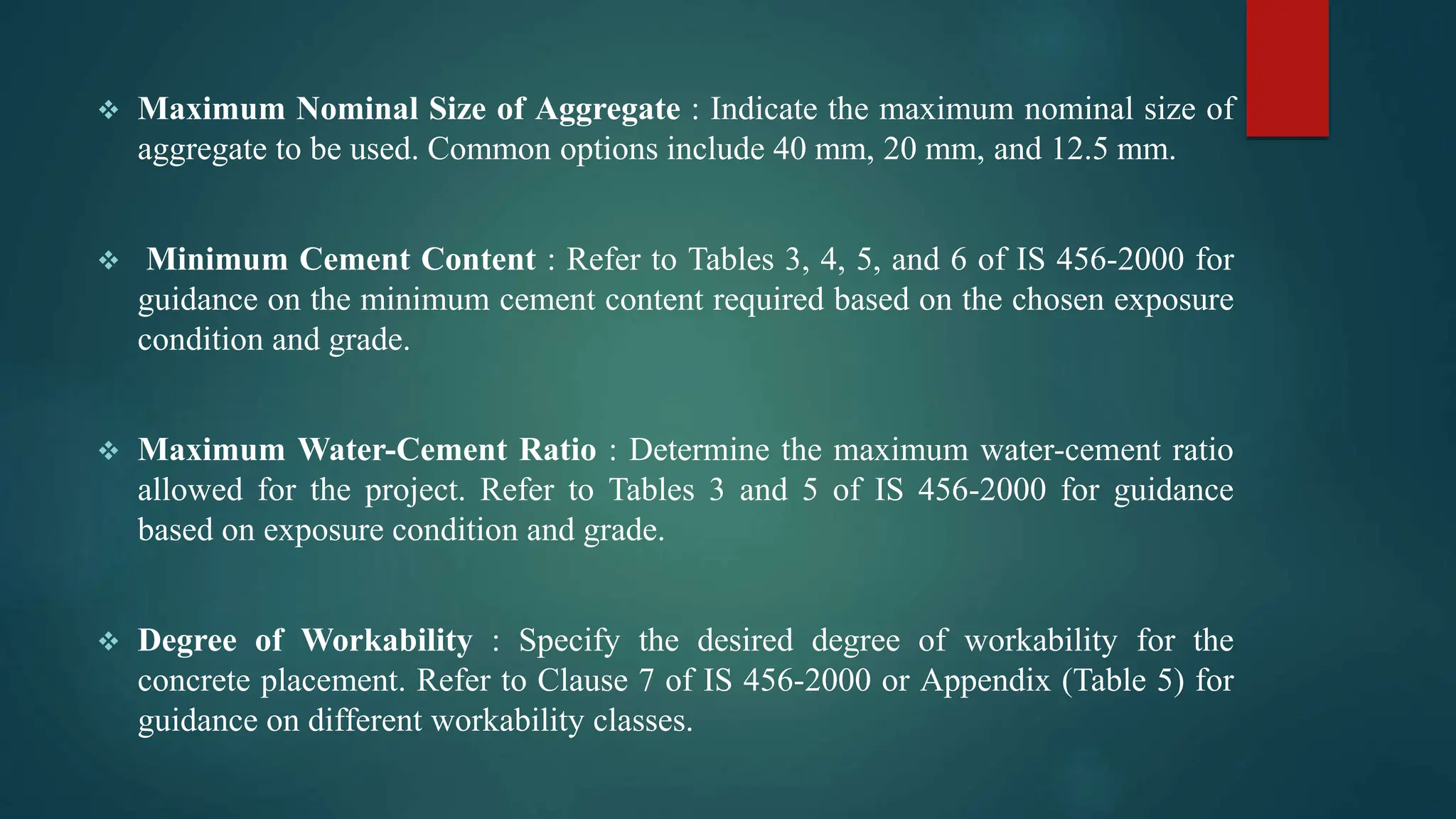
 Maximum Nominal Size of Aggregate : Indicate the maximum nominal size of
aggregate to be used. Common options include 40 mm, 20 mm, and 12.5 mm.
 Minimum Cement Content : Refer to Tables 3, 4, 5, and 6 of IS 456-2000 for
guidance on the minimum cement content required based on the chosen exposure
condition and grade.
 Maximum Water-Cement Ratio : Determine the maximum water-cement ratio
allowed for the project. Refer to Tables 3 and 5 of IS 456-2000 for guidance
based on exposure condition and grade.
 Degree of Workability : Specify the desired degree of workability for the
concrete placement. Refer to Clause 7 of IS 456-2000 or Appendix (Table 5) for
guidance on different workability classes.
 Maximum Concrete Temperature (Placement): Indicate the maximum
anticipated temperature of the concrete at the time of placing.
 Early Age Strength Requirements: Specify any early age strength requirements,
if applicable.
 Type of Aggregate: Identify the type of aggregate to be used, such as Granite,
Basalt, Natural River sand, Crushed Stone sand, etc.
 Maximum Cement Content: If applicable, specify any limitations on the
maximum cement content that can be used.
 Admixture Usage: Indicate if any admixtures are planned for use. If so, specify
the type of admixture and the conditions for its application.
The step-by-step procedure of mix proportioning is as follows:
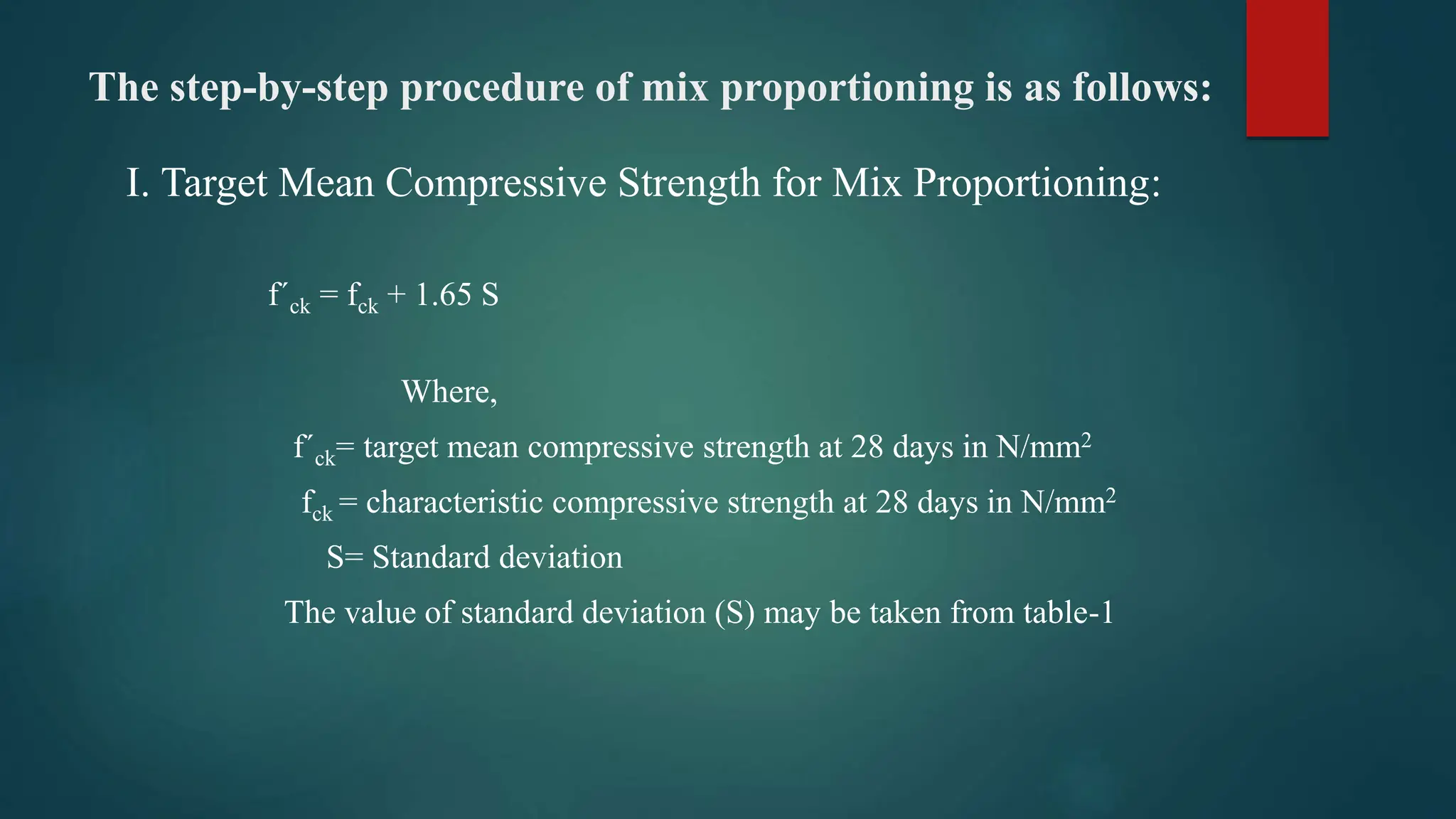
I. Target Mean Compressive Strength for Mix Proportioning:
f´ck = fck + 1.65 S
Where,
f´ck= target mean compressive strength at 28 days in N/mm2
fck = characteristic compressive strength at 28 days in N/mm2
S= Standard deviation
The value of standard deviation (S) may be taken from table-1
Sr. No. Grade Of Concrete Assume Standard Deviation N/mm²
1 M-10 3.5
2 M-15
3 M-20 4.0
4 M-25
5 M-30 5.0
6 M-35
7 M-40
8 M-45
9 M-50
10 M-55
Table No 1 : Assumed Standard Deviation
II. Selection of Water–Cement Ratio:
 Concrete made today contains more than four basic ingredients. Use of both
chemical and mineral admixtures has changed properties of concrete both in
fresh and hardened state for good. Even quality of both coarse and fine
aggregates in terms of grading, shape, size and texture has improved with the
improvement in crushing technologies.
 With all these variables playing its role, concretes produced with same water-
cement ratio may have different compressive strength. For a given set of
materials, it is preferable to establish relationship between compressive strength
and free water cement ratio.
 If such a relationship is not available, maximum water-cement ratio for various
environmental exposure conditions given in Table 5 of IS 456-2000 may be
taken as a starting point. Any water-cement ratio assumed based on the previous
experience for a particular grade of concrete should be checked against the
maximum values permitted from the point of view of durability and lower of the
two shall be adopted.
III Selection of Water Content:
 The quantity water considered per cubic metre of concrete decides the
workability of the mix.. Use of water reducing chemical admixtures in the mix
helps to achieve increased workability at lower water contents. Water content
given in Table 2 of the standard is the maximum value for a particular
maximum nominal size of aggregate(angular) which will achieve a slump in the
range of 25 mm to 50 mm. Depending on the performance of an admixture
(conforming IS 9103-19993 ) which is proposed to be used in the mix, a
minimum of 20% of water reduction shall be considered in case of
superplasticisers. Use of Poly Carboxylic Ether (PCE) based superplasticisers
results in water reduction up to 30%.
 Water content per unit volume of concrete is required to be reduced when there
is increase in aggregate size, use of rounded aggregates, reduction in water-
cement ratio and slump. Water content per unit volume of concrete is required
to be increased when there is increased temperature, cement content, fine
aggregate content, water-cement ratio.
Table No. 3 : Maximum Water Content Per Cubic Metre Of Concrete For
Nominal Size Of Aggregate [for slump 25 to 50 mm]
 Use of water reducing admixture: If use of chemical water reducing
admixture is permitted for the job in hand in proportioning of the mix,
reduction in assumed water content shall be made depending on the type of
admixture. Water reducing admixtures will usually decrease water content
by 5 to 10% and superplasticisers decrease water content by 20% and
above at appropriate dosages.
Sr. No. Nominal Maximum Size of
Aggregate (mm)
Maximum water content (kg)
1 10 208
2 20 186
3 40 165
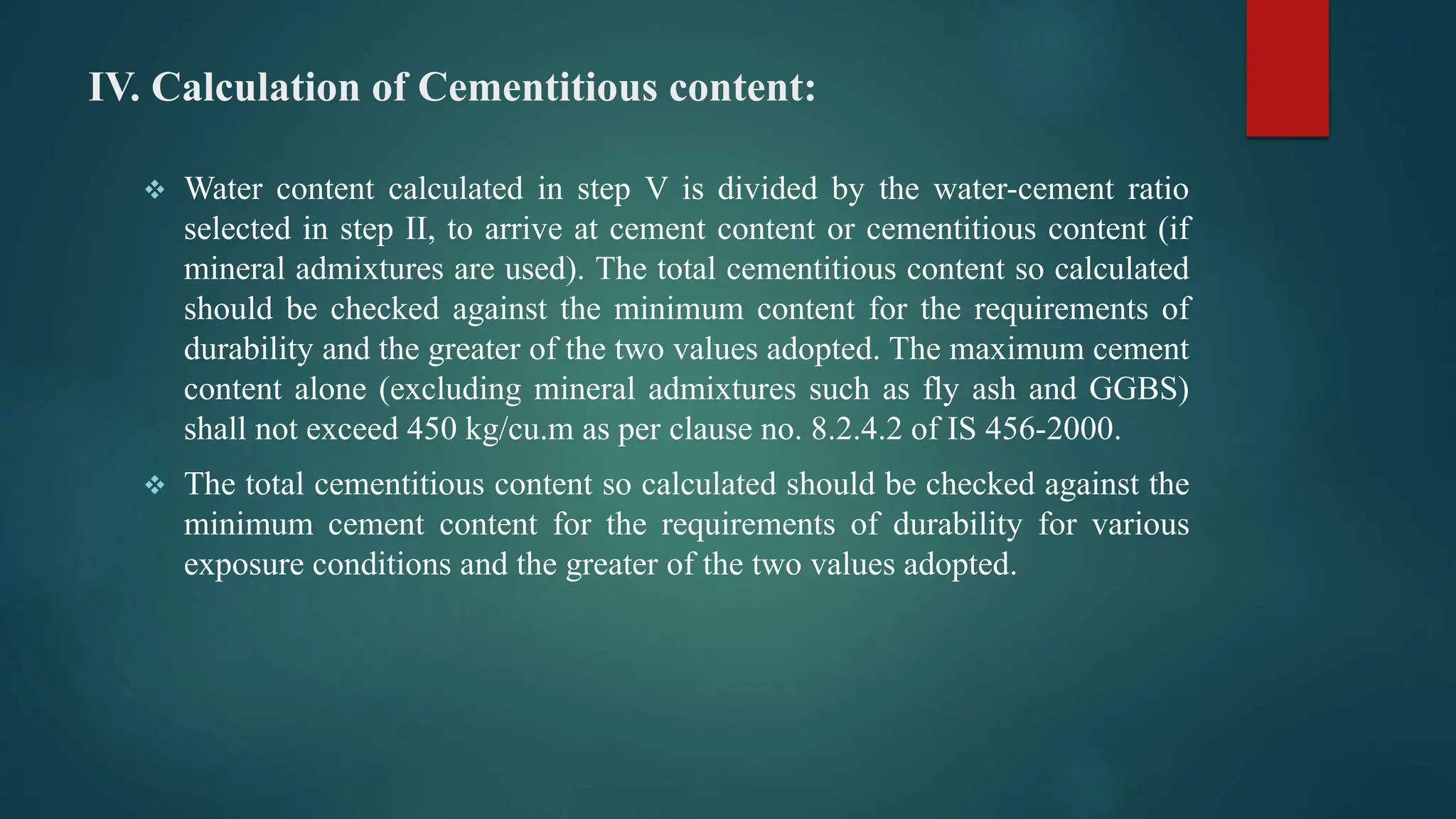
IV. Calculation of Cementitious content:
 Water content calculated in step V is divided by the water-cement ratio
selected in step II, to arrive at cement content or cementitious content (if
mineral admixtures are used). The total cementitious content so calculated
should be checked against the minimum content for the requirements of
durability and the greater of the two values adopted. The maximum cement
content alone (excluding mineral admixtures such as fly ash and GGBS)
shall not exceed 450 kg/cu.m as per clause no. 8.2.4.2 of IS 456-2000.
 The total cementitious content so calculated should be checked against the
minimum cement content for the requirements of durability for various
exposure conditions and the greater of the two values adopted.
V. Estimation of coarse aggregate proportion
 Table 3 of the standard gives volume of coarse aggregate for unit volume of
total aggregate for different zones of fine aggregate (as per IS 383-19704 ) for a
water-cement ratio of 0.5 which requires to be suitably adjusted for other water-
cement ratios. This table is based on ACI 211.1- 19915 “Standard Practice for
Selecting Proportions for Normal, Heavyweight and Mass Concrete”.
 Aggregates of essentially the same nominal maximum size, type and grading
will produce concrete of satisfactory workability when a given volume of
coarse aggregate per unit volume of total aggregate is used. It can be seen that
for equal workability, the volume of coarse aggregate in a unit volume of
concrete is dependent on nominal maximum size, water-cement ratio and
grading zone of fine aggregate.
Table no:5-Volume of course aggregate per unit volume of total
aggregate for different zones of fine aggregate
[for w/c = 0.50]
Volumes are based on Aggregates in Saturated Surface Dry condition
Note: Volume coarse aggregate per unit volume of total aggregate needs to
be changed at the rate of -/+ 0.01 for every ±0.05 change in water-cement
ratio
Sr. No. Nominal maximum
size of
aggregates(mm)
Volume of course aggregate per unit volume of total
aggregate for different zone of fine aggregate
Zone-IV Zone-III Zone-II Zone-I
1 10 0.50 0.48 0.46 0.44
2 20 0.66 0.64 0.64 0.60
3 40 0.75 0.73 0.71 0.69
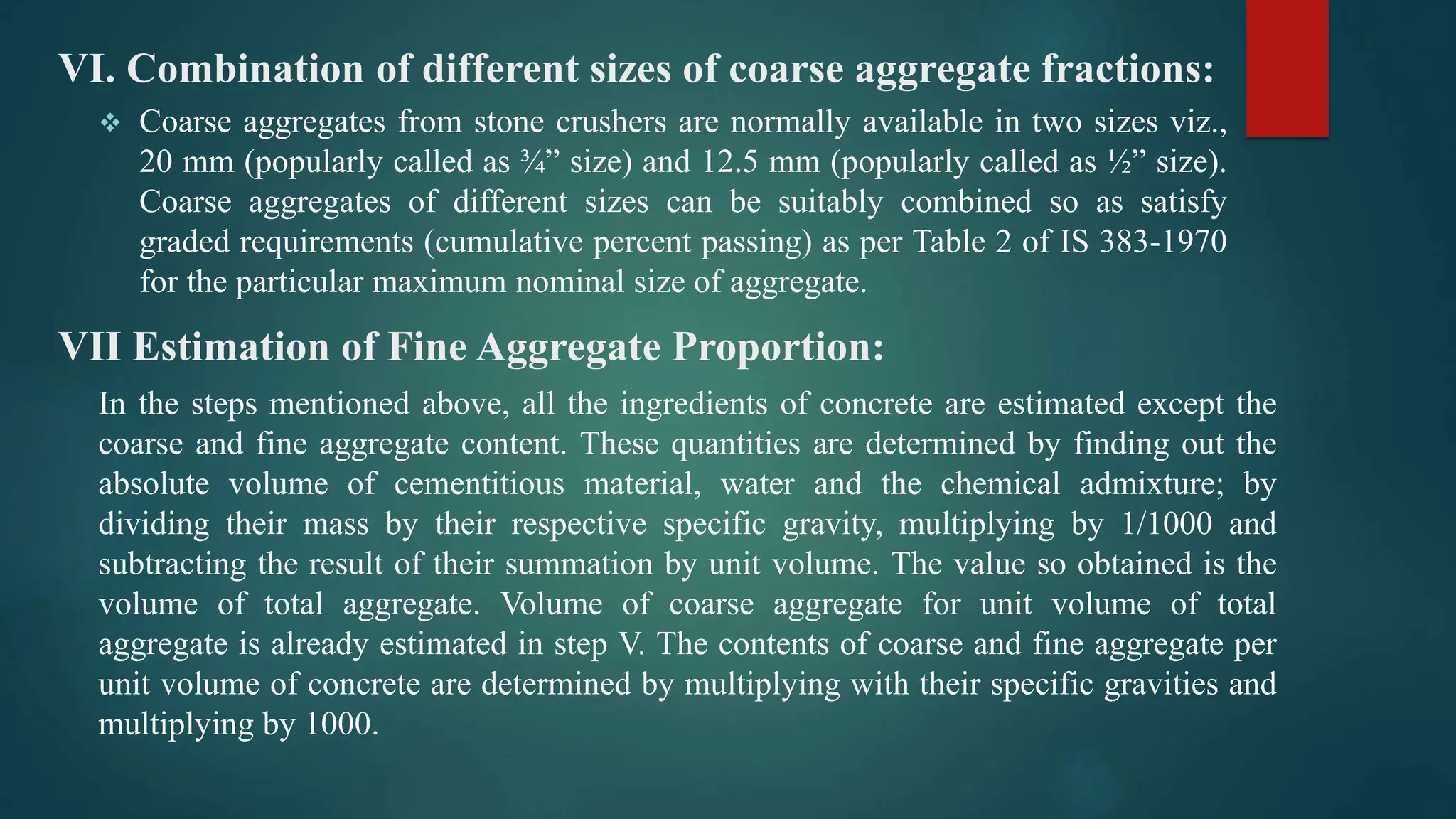
VI. Combination of different sizes of coarse aggregate fractions:
 Coarse aggregates from stone crushers are normally available in two sizes viz.,
20 mm (popularly called as ¾” size) and 12.5 mm (popularly called as ½” size).
Coarse aggregates of different sizes can be suitably combined so as satisfy
graded requirements (cumulative percent passing) as per Table 2 of IS 383-1970
for the particular maximum nominal size of aggregate.
VII Estimation of Fine Aggregate Proportion:
In the steps mentioned above, all the ingredients of concrete are estimated except the
coarse and fine aggregate content. These quantities are determined by finding out the
absolute volume of cementitious material, water and the chemical admixture; by
dividing their mass by their respective specific gravity, multiplying by 1/1000 and
subtracting the result of their summation by unit volume. The value so obtained is the
volume of total aggregate. Volume of coarse aggregate for unit volume of total
aggregate is already estimated in step V. The contents of coarse and fine aggregate per
unit volume of concrete are determined by multiplying with their specific gravities and
multiplying by 1000.
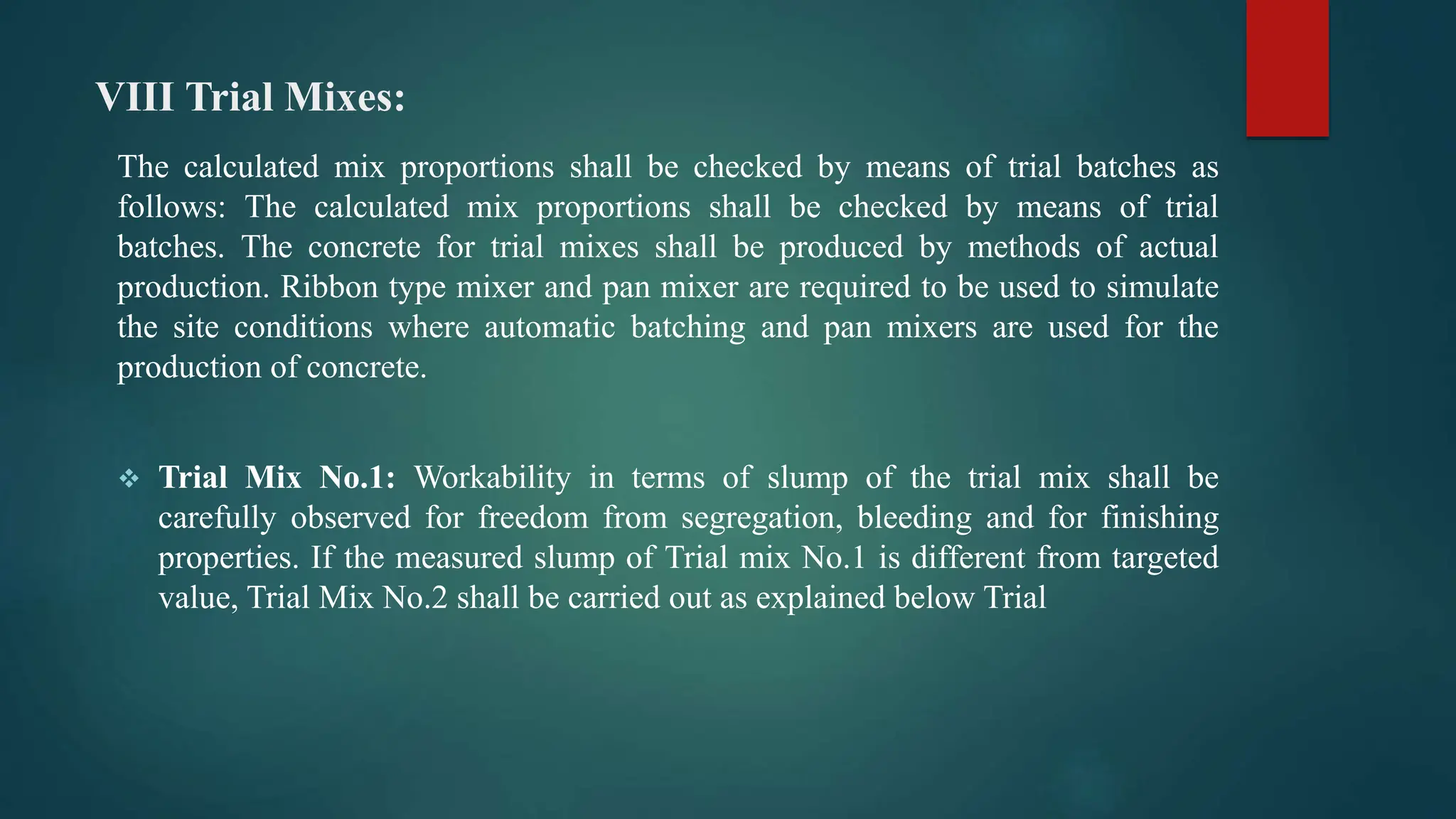
VIII Trial Mixes:
The calculated mix proportions shall be checked by means of trial batches as
follows: The calculated mix proportions shall be checked by means of trial
batches. The concrete for trial mixes shall be produced by methods of actual
production. Ribbon type mixer and pan mixer are required to be used to simulate
the site conditions where automatic batching and pan mixers are used for the
production of concrete.
 Trial Mix No.1: Workability in terms of slump of the trial mix shall be
carefully observed for freedom from segregation, bleeding and for finishing
properties. If the measured slump of Trial mix No.1 is different from targeted
value, Trial Mix No.2 shall be carried out as explained below Trial
 Trial Mix No.2 : The water and/or admixture content shall be adjusted suitably
in the Trial Mix No.1. With this adjustment, the mix proportion shall be
recalculated keeping the free water cement ratio at the pre-selected value. With
this trial more or less the stipulated value of slump will be obtained. In addition
two more Trial Mixes No.3 and 4 shall be made with water content same as
Trial Mix No.2 and varying the free w/c ratio by ±10% of the preselected
value.
After laboratory trials field trial shall be carried out.
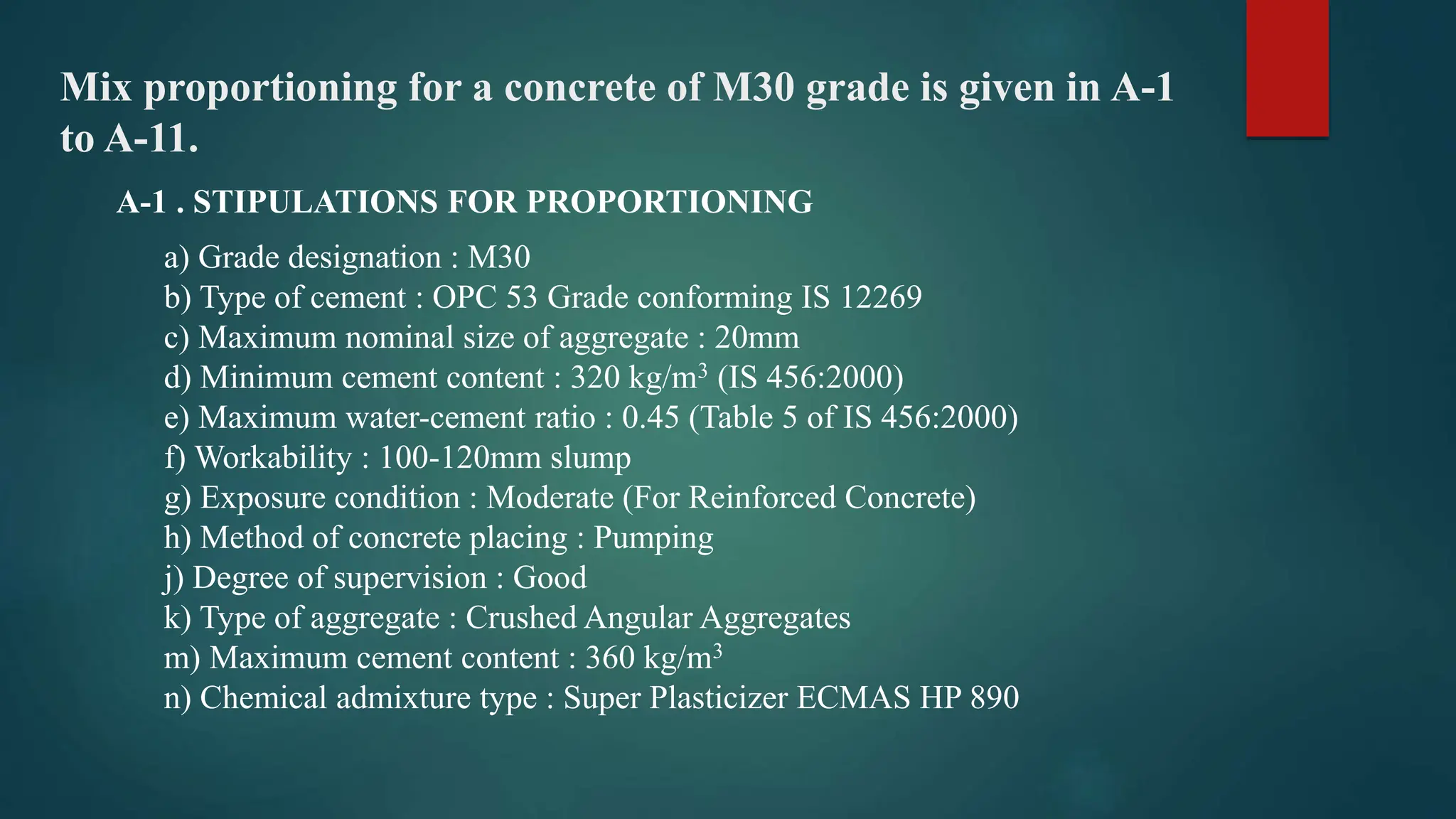
Mix proportioning for a concrete of M30 grade is given in A-1
to A-11.
A-1 . STIPULATIONS FOR PROPORTIONING
a) Grade designation : M30
b) Type of cement : OPC 53 Grade conforming IS 12269
c) Maximum nominal size of aggregate : 20mm
d) Minimum cement content : 320 kg/m3 (IS 456:2000)
e) Maximum water-cement ratio : 0.45 (Table 5 of IS 456:2000)
f) Workability : 100-120mm slump
g) Exposure condition : Moderate (For Reinforced Concrete)
h) Method of concrete placing : Pumping
j) Degree of supervision : Good
k) Type of aggregate : Crushed Angular Aggregates
m) Maximum cement content : 360 kg/m3
n) Chemical admixture type : Super Plasticizer ECMAS HP 890
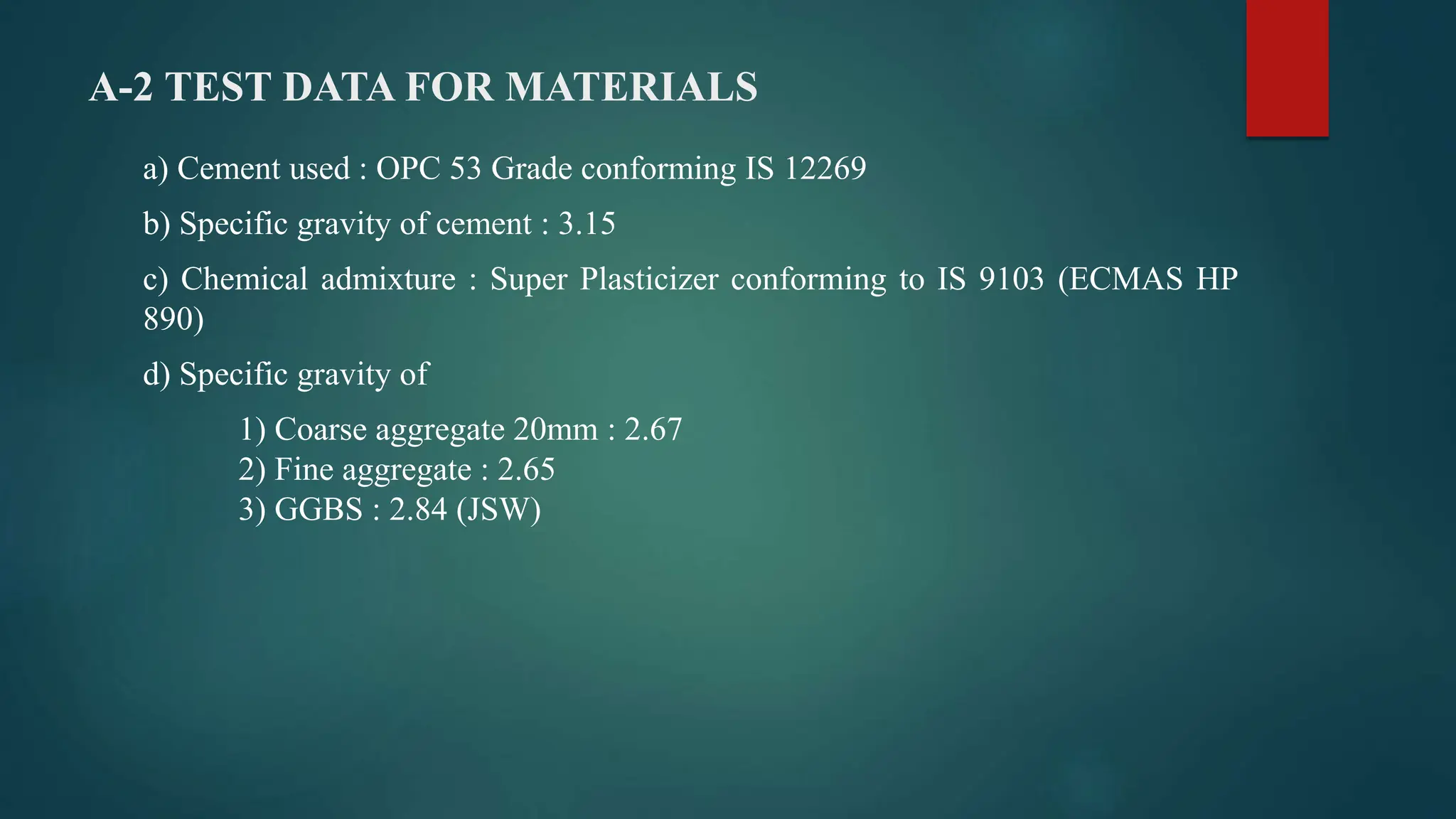
A-2 TEST DATA FOR MATERIALS
a) Cement used : OPC 53 Grade conforming IS 12269
b) Specific gravity of cement : 3.15
c) Chemical admixture : Super Plasticizer conforming to IS 9103 (ECMAS HP
890)
d) Specific gravity of
1) Coarse aggregate 20mm : 2.67
2) Fine aggregate : 2.65
3) GGBS : 2.84 (JSW)
e) Water absorption:
1) Coarse aggregate : 0.5 %
2) Fine aggregate (M. sand) : 2.5 %
f) Free (surface) moisture:
1) Coarse aggregate : Nil (Absorbed Moisture also Nil)
2) Fine aggregate : Nil
g) Sieve analysis:
1) Coarse aggregate: Conforming to all in aggregates of Table 2 of IS 383
2) Fine aggregate : Conforming to Grading Zone II of Table 4 of IS 383
A-3 TARGET STRENGTH FOR MIX PROPORTIONING
f’ck =fck + 1.65 s
where
f’ck = target average compressive strength at 28 days,
fck = characteristics compressive strength at 28 days, and
s = standard deviation.
From Table I of IS 10262:2009, Standard Deviation, s = 5 N/mm2. Therefore,
target strength = 30 + 1.65 x 5 = 38.25 N/mm2.
A-4 SELECTION OF WATER•CEMENT RATIO
Adopted maximum water-cement ratio = 0.44. From the Table 5 of IS 456 for Very
severe Exposure maximum Water Cement Ratio is 0.45 0.44 < 0.45 Hence ok.
A-5 SELECTION OF WATER CONTENT
From Table 2 of IS 10262:2009, maximum water content for 20 mm aggregate =
186 litre (for 25 to 50 mm slump range) Estimated water content for 100 mm
slump = 186+ (6/186) = 197 litre.
(Note: If Super plasticizer is used, the water content can be reduced upto 20% and
above.)
Based on trials with Super plasticizer water content reduction of 20% has been
achieved, Hence the arrived water content = 197-[197 x (20/100)] = 158 litre.
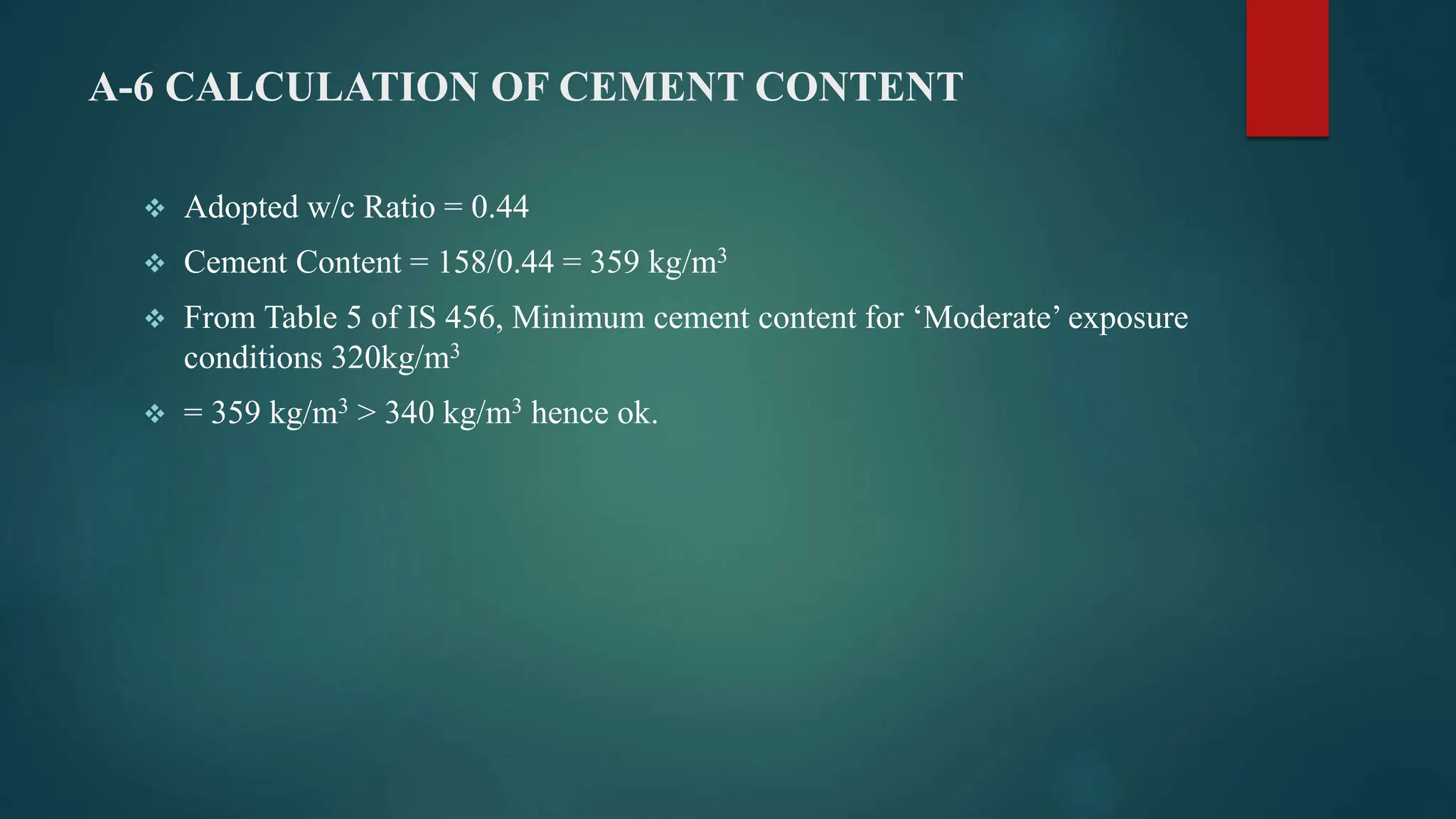
A-6 CALCULATION OF CEMENT CONTENT
 Adopted w/c Ratio = 0.44
 Cement Content = 158/0.44 = 359 kg/m3
 From Table 5 of IS 456, Minimum cement content for ‘Moderate’ exposure
conditions 320kg/m3
 = 359 kg/m3 > 340 kg/m3 hence ok.
A-7 PROPORTIO0N OF VOLUME OF COARSE
AGGREGATE AND FINE AGGREGATE CONTENT
 From Table 3 of (IS 10262:2009) Volume of coarse aggregate corresponding to 20 mm
size aggregate and fine aggregate (Zone II) for water-cement ratio of 0.50 =0.62 .
 In the present case water-cement ratio is 0.44. Therefore, volume of coarse aggregate is
required to be increased to decrease the fine aggregate content. As the water-cement
ratio is lower by 0.06. The proportion of volume of coarse aggregate is increased by
0.02 (at the rate of -/+ 0.01 for every ± 0.05 change in water-cement ratio).
 Therefore, corrected proportion of volume of coarse aggregate for the water-cement
ratio of 0.44 = 0.64
 NOTE – In case the coarse aggregate is not angular one, then also volume of coarse
aggregate may be required to be increased suitably based on experience & Site
conditions.
 For pumpable concrete these values should be reduced up to 10%. Therefore, volume
of coarse aggregate =0.64 x 0.9 =0.576.
 Volume of fine aggregate content = 1 – 0.576= 0.424.
A-8 MIX CALCULATIONS
a) Volume of concrete = 1 m3
b) Volume of cement = [Mass of cement] / {[Specific Gravity of Cement] x 1000}
= 359/{3.15 x 1000} = 0.114m3
c) Volume of water = [Mass of water] / {[Specific Gravity of water] x 1000}
= 158/{1 x 1000} = 0.158m3
d) Volume of chemical admixture = 1.75 litres/ m3 (By Trial and Error Method used
0.4% by the weight cement)
e) Volume of all in aggregate = [a-(b+c+d)] = [1-(0.114+0.158+0.004)] = 0.724m3
f) Mass of coarse aggregate= e x Volume of Coarse Aggregate x Specific Gravity of
Fine Aggregate x 1000 = 0.724x 0.576 x 2.67 x 1000 = 1113 kg/m3
g) Mass of fine aggregate= e x Volume of Fine Aggregate x Specific Gravity of Fine
Aggregate x 1000 = 0.724x 0.576x 2.60 x 1000 = 798 kg/m3
The mix calculations per unit volume of concrete shall be as follows:
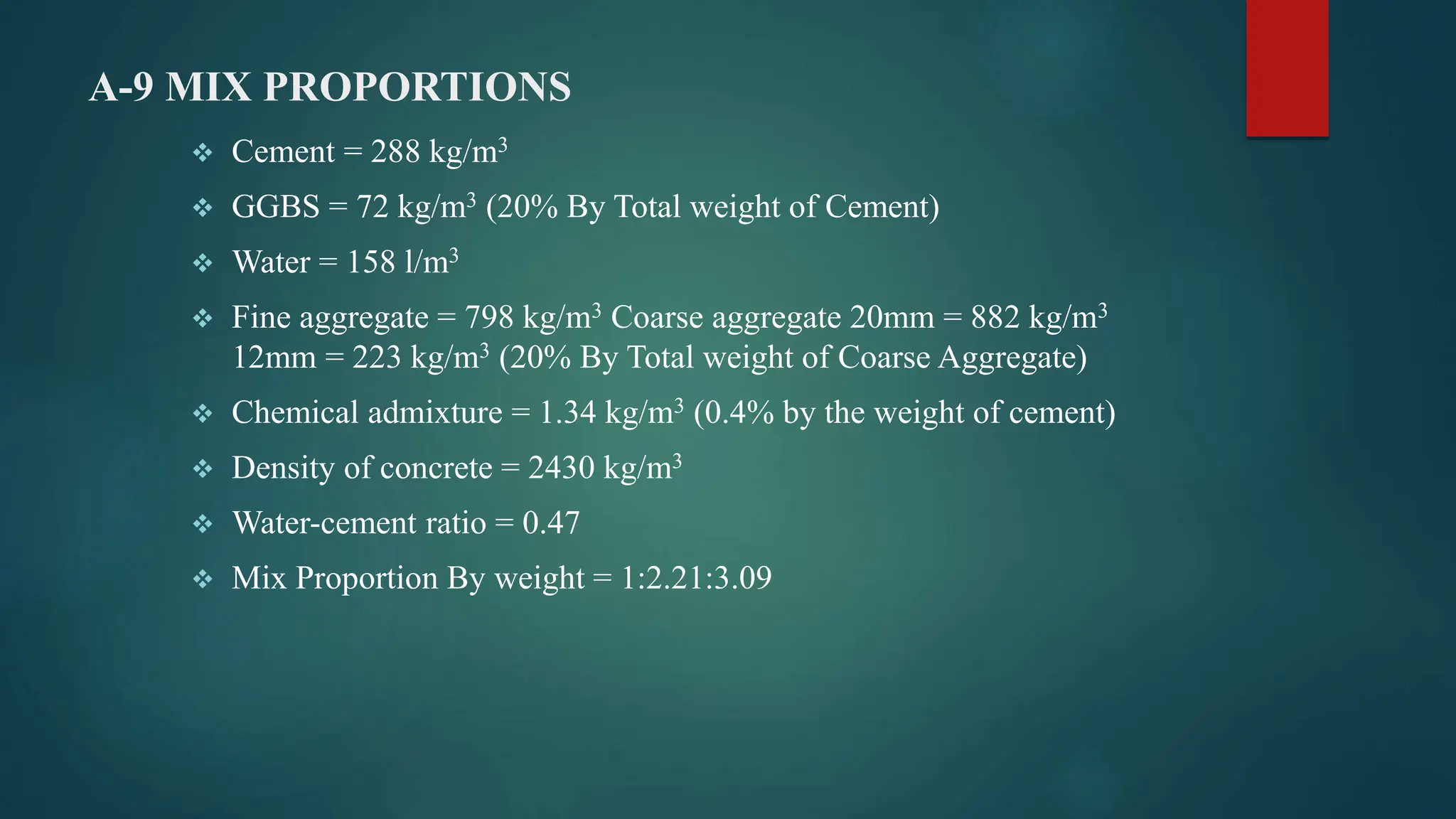
A-9 MIX PROPORTIONS
 Cement = 288 kg/m3
 GGBS = 72 kg/m3 (20% By Total weight of Cement)
 Water = 158 l/m3
 Fine aggregate = 798 kg/m3 Coarse aggregate 20mm = 882 kg/m3
12mm = 223 kg/m3 (20% By Total weight of Coarse Aggregate)
 Chemical admixture = 1.34 kg/m3 (0.4% by the weight of cement)
 Density of concrete = 2430 kg/m3
 Water-cement ratio = 0.47
 Mix Proportion By weight = 1:2.21:3.09
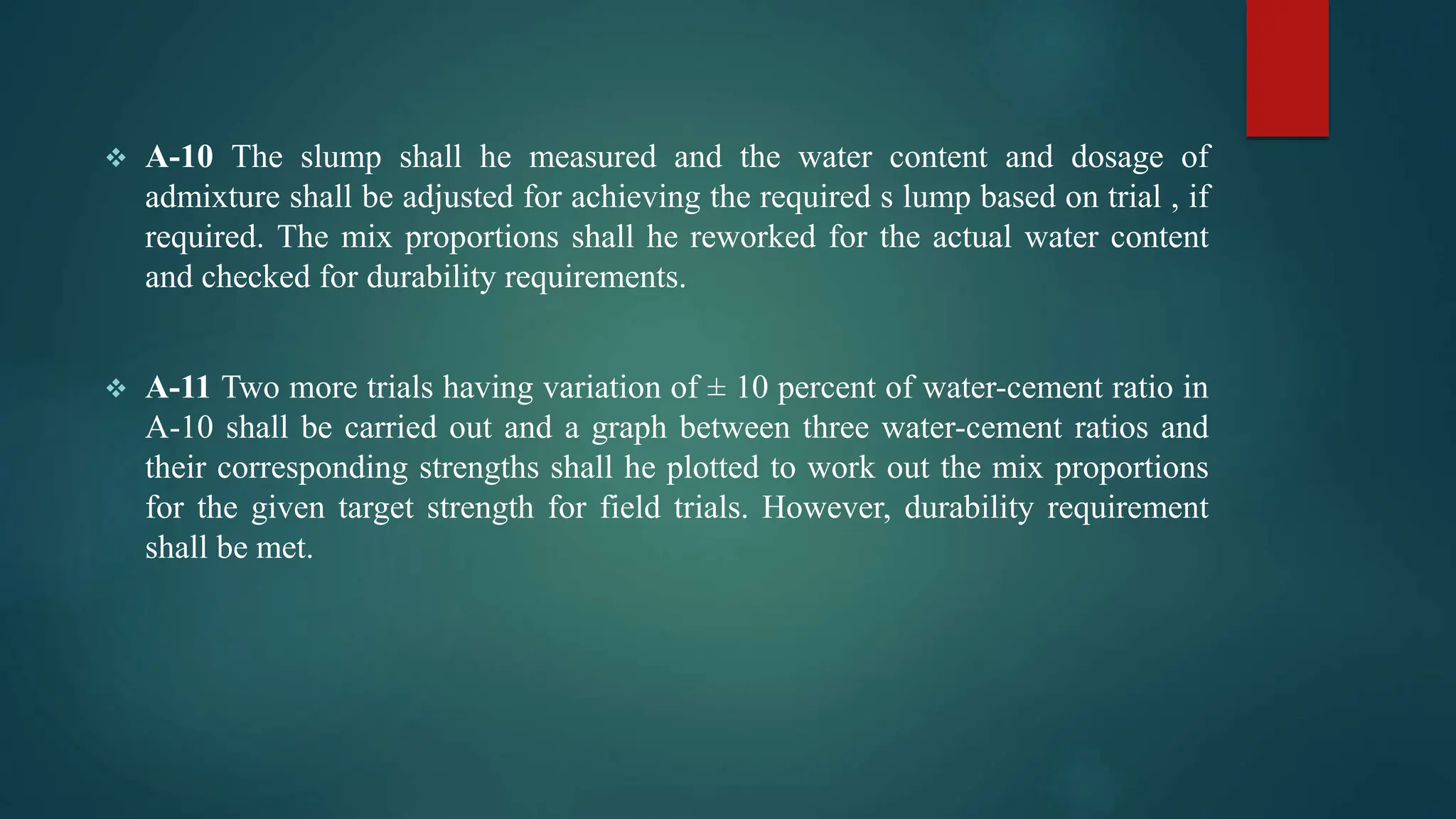
 A-10 The slump shall he measured and the water content and dosage of
admixture shall be adjusted for achieving the required s lump based on trial , if
required. The mix proportions shall he reworked for the actual water content
and checked for durability requirements.
 A-11 Two more trials having variation of ± 10 percent of water-cement ratio in
A-10 shall be carried out and a graph between three water-cement ratios and
their corresponding strengths shall he plotted to work out the mix proportions
for the given target strength for field trials. However, durability requirement
shall be met.
Thank You

Concrete Mix Design by IS Code Method is code method uplod.pptx

  • 1.
    Introduction:  Concrete isa composite material composed of cement, sand, coarse aggregate, and water.  The proportions of these ingredients significantly impact the strength, durability, and workability of the concrete.  IS code provides a systematic approach for designing concrete mixes to achieve desired properties.
  • 2.
    Definition Concrete mix designis the process of proportioning various ingredients such as cement, cementitious materials, aggregate, water and admixtures, if used, in the most optimal manner so as to produce a concrete at minimal cost having specified properties of workability and homogeneity in the green state and strength and durability in the hardened state
  • 3.
    IS Codes forConcrete Mix Design  IS 456: 2000 - Plain and Reinforced Concrete - Code of Practice  IS 10262: 2019 - Concrete Mix Design - Guidelines for Proportioning  IS 456: 2000 - This code specifies the requirements for plain and reinforced concrete structures. It includes provisions for selecting the grade of concrete based on the design strength and exposure conditions  IS 10262: 2019 - This code provides detailed guidelines for designing concrete mixes to achieve the desired strength, durability, and workability. It outlines the steps involved in the mix design process, including selecting materials, determining the water-cement ratio, and calculating the proportions of ingredients.
  • 4.
    Objectives of ConcreteMix Design Objective of Concrete Mix Design is to make a concrete that:  satisfies workability requirements in terms of slump for the placing conditions  meets the strength requirements as measured by compressive strength  fulfils durability requirements to resist the environment in which the structure is expected to serve  can be mixed, transported, placed and compacted as efficiently as possible  has a satisfactory appearance where it is exposed to view  will be as economical as possible
  • 5.
    Process of ConcreteMix Design  The process of Concrete Mix Design essentially consists of 3 stages. i. Correct mix proportions are arrived at based on guidelines of mix proportioning methods, past experience or published data, and information obtained on the properties of the constituent materials that are actually used in making the concrete. ii. Small-scale trial mixes, usually in a laboratory are made and tested using the materials that will be used on site. iii. Full-scale site trials before construction begins. It is always advisable to design the trial mixes with those materials that will be used on the job itself so that the adjustments can be easily understood and implemented in the field.
  • 6.
    MIX PROPORTION CALCULATIONSAS PER IS 10262- 2009  IS 456:2000 has recommended that minimum grade of concrete shall not be less than M20 in reinforced concrete work. Design mix concrete is preferred to nominal mix. If design mix concrete cannot be used for any reason on the work for grades M20 or lower, nominal mixes may be used with permission of engineer-in-charge, which, however is likely to involve higher cement content. Accordingly all concrete above M20 grade for RCC work must be of design mixes.
  • 7.
    DATA FOR MIXPROPORTIONING: The following basic data are required for mix proportioning of a particular grade of concrete:  Exposure Condition: The exposure condition of the structure under consideration should be identified. Refer to Table 3 of IS 456-2000 for guidance on exposure conditions.  Grade Designation : Based on the exposure condition, determine the minimum grade of concrete required for the structure. Refer to Tables 3 and 5 of IS 456- 2000 for guidance on grade designation. (Appendix C may also provide this information)  Type of Cement : Specify the type of cement to be used, such as Ordinary Portland Cement (OPC), Portland Pozzolana Cement (PPC), Portland Slag Cement (PSC), etc.
  • 8.
     Maximum NominalSize of Aggregate : Indicate the maximum nominal size of aggregate to be used. Common options include 40 mm, 20 mm, and 12.5 mm.  Minimum Cement Content : Refer to Tables 3, 4, 5, and 6 of IS 456-2000 for guidance on the minimum cement content required based on the chosen exposure condition and grade.  Maximum Water-Cement Ratio : Determine the maximum water-cement ratio allowed for the project. Refer to Tables 3 and 5 of IS 456-2000 for guidance based on exposure condition and grade.  Degree of Workability : Specify the desired degree of workability for the concrete placement. Refer to Clause 7 of IS 456-2000 or Appendix (Table 5) for guidance on different workability classes.
  • 9.
     Maximum ConcreteTemperature (Placement): Indicate the maximum anticipated temperature of the concrete at the time of placing.  Early Age Strength Requirements: Specify any early age strength requirements, if applicable.  Type of Aggregate: Identify the type of aggregate to be used, such as Granite, Basalt, Natural River sand, Crushed Stone sand, etc.  Maximum Cement Content: If applicable, specify any limitations on the maximum cement content that can be used.  Admixture Usage: Indicate if any admixtures are planned for use. If so, specify the type of admixture and the conditions for its application.
  • 10.
    The step-by-step procedureof mix proportioning is as follows: I. Target Mean Compressive Strength for Mix Proportioning: f´ck = fck + 1.65 S Where, f´ck= target mean compressive strength at 28 days in N/mm2 fck = characteristic compressive strength at 28 days in N/mm2 S= Standard deviation The value of standard deviation (S) may be taken from table-1
  • 11.
    Sr. No. GradeOf Concrete Assume Standard Deviation N/mm² 1 M-10 3.5 2 M-15 3 M-20 4.0 4 M-25 5 M-30 5.0 6 M-35 7 M-40 8 M-45 9 M-50 10 M-55 Table No 1 : Assumed Standard Deviation
  • 12.
    II. Selection ofWater–Cement Ratio:  Concrete made today contains more than four basic ingredients. Use of both chemical and mineral admixtures has changed properties of concrete both in fresh and hardened state for good. Even quality of both coarse and fine aggregates in terms of grading, shape, size and texture has improved with the improvement in crushing technologies.  With all these variables playing its role, concretes produced with same water- cement ratio may have different compressive strength. For a given set of materials, it is preferable to establish relationship between compressive strength and free water cement ratio.  If such a relationship is not available, maximum water-cement ratio for various environmental exposure conditions given in Table 5 of IS 456-2000 may be taken as a starting point. Any water-cement ratio assumed based on the previous experience for a particular grade of concrete should be checked against the maximum values permitted from the point of view of durability and lower of the two shall be adopted.
  • 13.
    III Selection ofWater Content:  The quantity water considered per cubic metre of concrete decides the workability of the mix.. Use of water reducing chemical admixtures in the mix helps to achieve increased workability at lower water contents. Water content given in Table 2 of the standard is the maximum value for a particular maximum nominal size of aggregate(angular) which will achieve a slump in the range of 25 mm to 50 mm. Depending on the performance of an admixture (conforming IS 9103-19993 ) which is proposed to be used in the mix, a minimum of 20% of water reduction shall be considered in case of superplasticisers. Use of Poly Carboxylic Ether (PCE) based superplasticisers results in water reduction up to 30%.  Water content per unit volume of concrete is required to be reduced when there is increase in aggregate size, use of rounded aggregates, reduction in water- cement ratio and slump. Water content per unit volume of concrete is required to be increased when there is increased temperature, cement content, fine aggregate content, water-cement ratio.
  • 14.
    Table No. 3: Maximum Water Content Per Cubic Metre Of Concrete For Nominal Size Of Aggregate [for slump 25 to 50 mm]  Use of water reducing admixture: If use of chemical water reducing admixture is permitted for the job in hand in proportioning of the mix, reduction in assumed water content shall be made depending on the type of admixture. Water reducing admixtures will usually decrease water content by 5 to 10% and superplasticisers decrease water content by 20% and above at appropriate dosages. Sr. No. Nominal Maximum Size of Aggregate (mm) Maximum water content (kg) 1 10 208 2 20 186 3 40 165
  • 15.
    IV. Calculation ofCementitious content:  Water content calculated in step V is divided by the water-cement ratio selected in step II, to arrive at cement content or cementitious content (if mineral admixtures are used). The total cementitious content so calculated should be checked against the minimum content for the requirements of durability and the greater of the two values adopted. The maximum cement content alone (excluding mineral admixtures such as fly ash and GGBS) shall not exceed 450 kg/cu.m as per clause no. 8.2.4.2 of IS 456-2000.  The total cementitious content so calculated should be checked against the minimum cement content for the requirements of durability for various exposure conditions and the greater of the two values adopted.
  • 16.
    V. Estimation ofcoarse aggregate proportion  Table 3 of the standard gives volume of coarse aggregate for unit volume of total aggregate for different zones of fine aggregate (as per IS 383-19704 ) for a water-cement ratio of 0.5 which requires to be suitably adjusted for other water- cement ratios. This table is based on ACI 211.1- 19915 “Standard Practice for Selecting Proportions for Normal, Heavyweight and Mass Concrete”.  Aggregates of essentially the same nominal maximum size, type and grading will produce concrete of satisfactory workability when a given volume of coarse aggregate per unit volume of total aggregate is used. It can be seen that for equal workability, the volume of coarse aggregate in a unit volume of concrete is dependent on nominal maximum size, water-cement ratio and grading zone of fine aggregate.
  • 17.
    Table no:5-Volume ofcourse aggregate per unit volume of total aggregate for different zones of fine aggregate [for w/c = 0.50] Volumes are based on Aggregates in Saturated Surface Dry condition Note: Volume coarse aggregate per unit volume of total aggregate needs to be changed at the rate of -/+ 0.01 for every ±0.05 change in water-cement ratio Sr. No. Nominal maximum size of aggregates(mm) Volume of course aggregate per unit volume of total aggregate for different zone of fine aggregate Zone-IV Zone-III Zone-II Zone-I 1 10 0.50 0.48 0.46 0.44 2 20 0.66 0.64 0.64 0.60 3 40 0.75 0.73 0.71 0.69
  • 18.
    VI. Combination ofdifferent sizes of coarse aggregate fractions:  Coarse aggregates from stone crushers are normally available in two sizes viz., 20 mm (popularly called as ¾” size) and 12.5 mm (popularly called as ½” size). Coarse aggregates of different sizes can be suitably combined so as satisfy graded requirements (cumulative percent passing) as per Table 2 of IS 383-1970 for the particular maximum nominal size of aggregate. VII Estimation of Fine Aggregate Proportion: In the steps mentioned above, all the ingredients of concrete are estimated except the coarse and fine aggregate content. These quantities are determined by finding out the absolute volume of cementitious material, water and the chemical admixture; by dividing their mass by their respective specific gravity, multiplying by 1/1000 and subtracting the result of their summation by unit volume. The value so obtained is the volume of total aggregate. Volume of coarse aggregate for unit volume of total aggregate is already estimated in step V. The contents of coarse and fine aggregate per unit volume of concrete are determined by multiplying with their specific gravities and multiplying by 1000.
  • 19.
    VIII Trial Mixes: Thecalculated mix proportions shall be checked by means of trial batches as follows: The calculated mix proportions shall be checked by means of trial batches. The concrete for trial mixes shall be produced by methods of actual production. Ribbon type mixer and pan mixer are required to be used to simulate the site conditions where automatic batching and pan mixers are used for the production of concrete.  Trial Mix No.1: Workability in terms of slump of the trial mix shall be carefully observed for freedom from segregation, bleeding and for finishing properties. If the measured slump of Trial mix No.1 is different from targeted value, Trial Mix No.2 shall be carried out as explained below Trial
  • 20.
     Trial MixNo.2 : The water and/or admixture content shall be adjusted suitably in the Trial Mix No.1. With this adjustment, the mix proportion shall be recalculated keeping the free water cement ratio at the pre-selected value. With this trial more or less the stipulated value of slump will be obtained. In addition two more Trial Mixes No.3 and 4 shall be made with water content same as Trial Mix No.2 and varying the free w/c ratio by ±10% of the preselected value. After laboratory trials field trial shall be carried out.
  • 21.
    Mix proportioning fora concrete of M30 grade is given in A-1 to A-11. A-1 . STIPULATIONS FOR PROPORTIONING a) Grade designation : M30 b) Type of cement : OPC 53 Grade conforming IS 12269 c) Maximum nominal size of aggregate : 20mm d) Minimum cement content : 320 kg/m3 (IS 456:2000) e) Maximum water-cement ratio : 0.45 (Table 5 of IS 456:2000) f) Workability : 100-120mm slump g) Exposure condition : Moderate (For Reinforced Concrete) h) Method of concrete placing : Pumping j) Degree of supervision : Good k) Type of aggregate : Crushed Angular Aggregates m) Maximum cement content : 360 kg/m3 n) Chemical admixture type : Super Plasticizer ECMAS HP 890
  • 22.
    A-2 TEST DATAFOR MATERIALS a) Cement used : OPC 53 Grade conforming IS 12269 b) Specific gravity of cement : 3.15 c) Chemical admixture : Super Plasticizer conforming to IS 9103 (ECMAS HP 890) d) Specific gravity of 1) Coarse aggregate 20mm : 2.67 2) Fine aggregate : 2.65 3) GGBS : 2.84 (JSW)
  • 23.
    e) Water absorption: 1)Coarse aggregate : 0.5 % 2) Fine aggregate (M. sand) : 2.5 % f) Free (surface) moisture: 1) Coarse aggregate : Nil (Absorbed Moisture also Nil) 2) Fine aggregate : Nil g) Sieve analysis: 1) Coarse aggregate: Conforming to all in aggregates of Table 2 of IS 383 2) Fine aggregate : Conforming to Grading Zone II of Table 4 of IS 383
  • 24.
    A-3 TARGET STRENGTHFOR MIX PROPORTIONING f’ck =fck + 1.65 s where f’ck = target average compressive strength at 28 days, fck = characteristics compressive strength at 28 days, and s = standard deviation. From Table I of IS 10262:2009, Standard Deviation, s = 5 N/mm2. Therefore, target strength = 30 + 1.65 x 5 = 38.25 N/mm2.
  • 25.
    A-4 SELECTION OFWATER•CEMENT RATIO Adopted maximum water-cement ratio = 0.44. From the Table 5 of IS 456 for Very severe Exposure maximum Water Cement Ratio is 0.45 0.44 < 0.45 Hence ok. A-5 SELECTION OF WATER CONTENT From Table 2 of IS 10262:2009, maximum water content for 20 mm aggregate = 186 litre (for 25 to 50 mm slump range) Estimated water content for 100 mm slump = 186+ (6/186) = 197 litre. (Note: If Super plasticizer is used, the water content can be reduced upto 20% and above.) Based on trials with Super plasticizer water content reduction of 20% has been achieved, Hence the arrived water content = 197-[197 x (20/100)] = 158 litre.
  • 26.
    A-6 CALCULATION OFCEMENT CONTENT  Adopted w/c Ratio = 0.44  Cement Content = 158/0.44 = 359 kg/m3  From Table 5 of IS 456, Minimum cement content for ‘Moderate’ exposure conditions 320kg/m3  = 359 kg/m3 > 340 kg/m3 hence ok.
  • 27.
    A-7 PROPORTIO0N OFVOLUME OF COARSE AGGREGATE AND FINE AGGREGATE CONTENT  From Table 3 of (IS 10262:2009) Volume of coarse aggregate corresponding to 20 mm size aggregate and fine aggregate (Zone II) for water-cement ratio of 0.50 =0.62 .  In the present case water-cement ratio is 0.44. Therefore, volume of coarse aggregate is required to be increased to decrease the fine aggregate content. As the water-cement ratio is lower by 0.06. The proportion of volume of coarse aggregate is increased by 0.02 (at the rate of -/+ 0.01 for every ± 0.05 change in water-cement ratio).  Therefore, corrected proportion of volume of coarse aggregate for the water-cement ratio of 0.44 = 0.64  NOTE – In case the coarse aggregate is not angular one, then also volume of coarse aggregate may be required to be increased suitably based on experience & Site conditions.  For pumpable concrete these values should be reduced up to 10%. Therefore, volume of coarse aggregate =0.64 x 0.9 =0.576.  Volume of fine aggregate content = 1 – 0.576= 0.424.
  • 28.
    A-8 MIX CALCULATIONS a)Volume of concrete = 1 m3 b) Volume of cement = [Mass of cement] / {[Specific Gravity of Cement] x 1000} = 359/{3.15 x 1000} = 0.114m3 c) Volume of water = [Mass of water] / {[Specific Gravity of water] x 1000} = 158/{1 x 1000} = 0.158m3 d) Volume of chemical admixture = 1.75 litres/ m3 (By Trial and Error Method used 0.4% by the weight cement) e) Volume of all in aggregate = [a-(b+c+d)] = [1-(0.114+0.158+0.004)] = 0.724m3 f) Mass of coarse aggregate= e x Volume of Coarse Aggregate x Specific Gravity of Fine Aggregate x 1000 = 0.724x 0.576 x 2.67 x 1000 = 1113 kg/m3 g) Mass of fine aggregate= e x Volume of Fine Aggregate x Specific Gravity of Fine Aggregate x 1000 = 0.724x 0.576x 2.60 x 1000 = 798 kg/m3 The mix calculations per unit volume of concrete shall be as follows:
  • 29.
    A-9 MIX PROPORTIONS Cement = 288 kg/m3  GGBS = 72 kg/m3 (20% By Total weight of Cement)  Water = 158 l/m3  Fine aggregate = 798 kg/m3 Coarse aggregate 20mm = 882 kg/m3 12mm = 223 kg/m3 (20% By Total weight of Coarse Aggregate)  Chemical admixture = 1.34 kg/m3 (0.4% by the weight of cement)  Density of concrete = 2430 kg/m3  Water-cement ratio = 0.47  Mix Proportion By weight = 1:2.21:3.09
  • 30.
     A-10 Theslump shall he measured and the water content and dosage of admixture shall be adjusted for achieving the required s lump based on trial , if required. The mix proportions shall he reworked for the actual water content and checked for durability requirements.  A-11 Two more trials having variation of ± 10 percent of water-cement ratio in A-10 shall be carried out and a graph between three water-cement ratios and their corresponding strengths shall he plotted to work out the mix proportions for the given target strength for field trials. However, durability requirement shall be met.
  • 31.