Mix design-
• Mix design is defined as the process of
selecting suitable ingredients of concrete and
determining their relative proportions with the
object of producing concrete of certain
minimum strength and durability as
economically as possible.
•Four variable factors-
1)Water cement ratio 2)cement content/cement
aggregate ratio 3) Gradation of aggregates
4) Consistency
• Methods of Mix Design-
 Arbitrary method
 Fineness modulus method
 Maximum density method
 Surface area method
 IRC 44 method
 High strength concrete mix design
 Mix design based on flexural strength
 ACI committee 211 method
 DOE method
 Mix design of pumpable concrete method.
 Indian std. recommended Method IS
10262(2009)
 Common terminologies-
Terminologies used in statistical quality control are
a) Mean strength - average strength obtained by dividing the
sum of strength of all the cubes by number of cubes.
a) Variance- This is measure of variability or difference between
any single observed data from the mean strength.
 Standard deviation-
This is the root mean square deviation off all the results.
This is denoted by S or ϭ
Where
The standard deviation is increases with increasing
variability. The characteristics of the normal distribution curve
are fixed by the average value of standard deviation. The spread
of the curve along the horizontal sale is governed by standard
deviation, while the position of the curve along the vertical scale
is fixed by mean value
• Coefficient of Varition-
It is an alternative method of expressing the
variation of results. it is non dimensional measure
of variation obtained by dividing the standard
deviation by the arthmetiv mean and expressed as
V=
V=Coefficient of variation
S= Std.Deviation.
• Using Indian standard recommended guidelines,
design a concrete mix for a reinforced concrete
structure to be subjected to the mild exposure
condition for the following requirements
A. stipulation for proportioning-
a) Grade designation:M25
b)Std. Deviation: S=4
c) Type of cement: OPC 53 Grade confirming to IS
8112.
d)Workability:75mm (slump)
e) Degree of supervision: Good
f) Type of aggregates : Angular coarse aggregates
g) Maximum cement content: 450Kg/M3
h)Size of aggregate :20mm
Test data of material-
• Specific gravity of cement-3.15
• Specific gravity of C.A-2.74
• Specific gravity of F.A-3.15
• Water Absotbtion-
• C.A=0.5%
• F.A=1.0%
• Free surface moisture-
• C.A=Nil
• F.A=Nil
Exposure Plain Concrete Reinforced Concrete
Mini.
Cement
Content
Kg/M3
Max.
free
W/C
Ratio
Min.
Grade of
Concrete
Minimu
m
Cement
Content
Maximum
water
Cement
Ratio
Content
Min.
Grade of
Concrete
Mild 220 0.60 --- 300 0.55 M 20
Moderate 240 0.60 M 15 300 0.50 M 25
Severe 250 0.50 M 20 320 0.45 M 30
Very
severe
260 0.45 M 20 340 0.45 M 35
Extreme 280 0.40 M 25 360 0.40 M 40
Cement content durability point of view
Table : -5 (As per IS 456-2000)
13
Nominal Max. size of
Aggregate
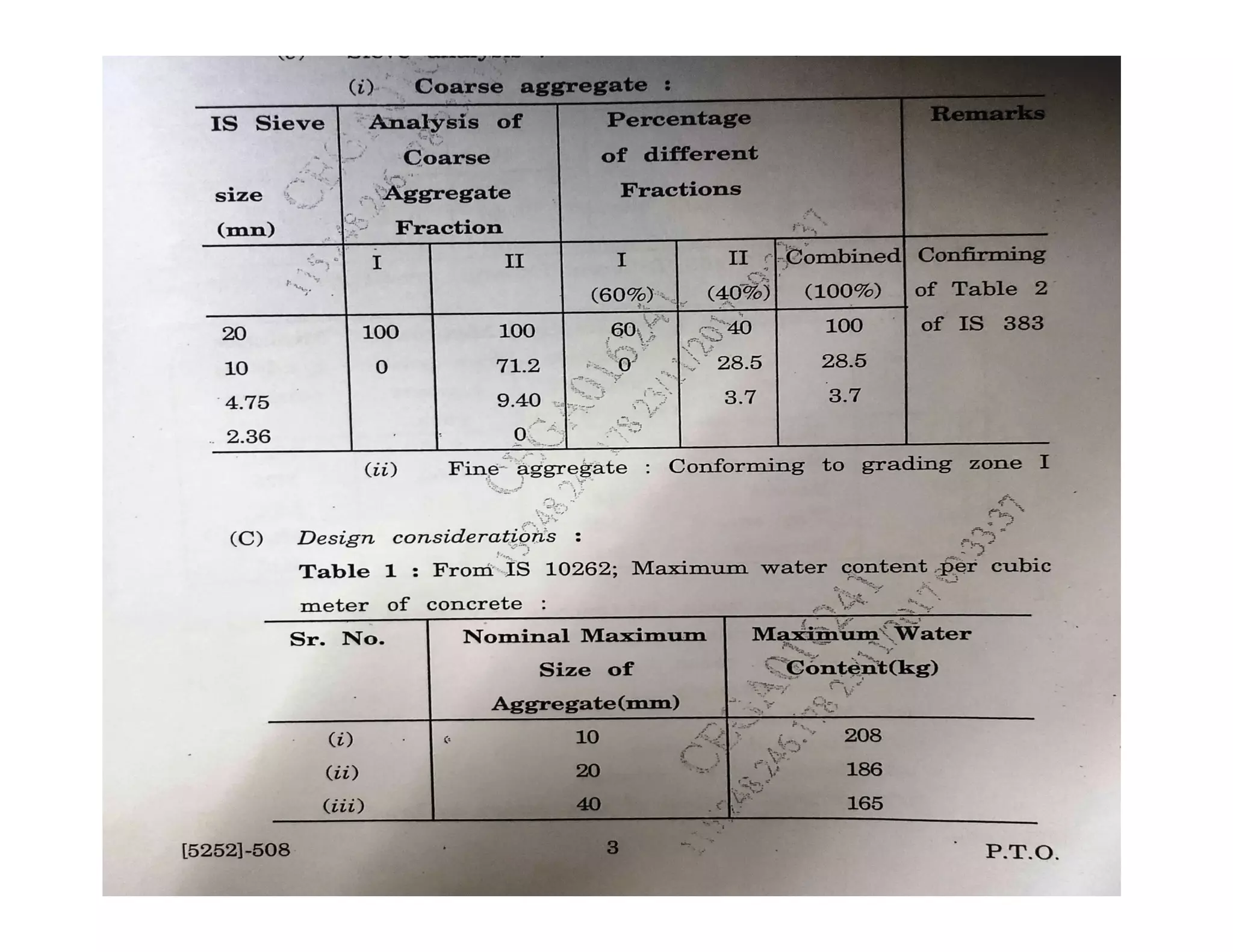
Maximum water content
10 208
20 186
40 165
Note: 1. These quantities of mixing water are for use
in computing cementations material contents for trial
batches.
2. Water content corresponding to saturated surface
dry aggregate.
• Trial 2:-If workability is not per stipulated value
adjust the water content /admixture and
calculate the other ingredient.
• Trial 3:-In next two trial keep water content
constant as of trial 2 now change the
water/cement ratio by +_ 10% and calculate other
ingredients for desired workability.
• Mix 2 to 4 provides sufficient information, including
the relationship between compressive strength and
w/c ratio.
DOE Method of Concrete Mix design:-
• This method was design was first known as Road Note
No-04. It was introduced in 1950.
• Which was later replaced by Design of Normal Concrete
Mixes in 1975 by Britesh Dept.of Enviroment.
• In 1988 the design was updated to account the changes
in then British Standards.
• The DOE method for concrete Mix design works by
calculating the Values of 8 Fundamental processes-
1. Mean Target compressive strength
2. W/C ratio
3. Water content using required slump value and aggregate
size.
4. Cement content
5. Concrete density
6. Aggregate Content
7. Proportion of FAAnd CA
8. CA content
• Problem- Design a concrete Mix for RCC work which will
be exposed to the moderate condition. The concrete is to be
designed for a min compressive strength of 30MPa at the age of
28 days. A requirement of 25 mm cover is prescribed.max size
of CA is 20mm uncrushed aggregate will be used. sieve
analysis shows that 50% passes through 600micron sieve the
bulk specific gravity of Aggregate is found to be 2.65
1) Target mean strength-It is given 30MPA at 28 Days
2) Find out W/C ratio for 30MPA concrete( refer table)
• From table Crushed aggregate Approximate Comp. Strength for
W/C ratio=0.5 is 49 Mpa.
• In fig intersection point of Comp. Strength and W/C ratio is
marked. Draw another curve parallel to near one curve to that
point now from that newly drawn curve the W/C ratio will find
out for target compressive strength.
• Compare this water cement ratio for durability point of view
and accept the lower value between comp.strngth and durability
point of view.
• Step 3- decide water content for the required workability,
expressed in terms of Slump or VB time, taking in to
consideration the size aggregate and it’s type from table (2)
Concrete mix design
Concrete mix design
Concrete mix design
Concrete mix design
Concrete mix design
Concrete mix design
Concrete mix design
Concrete mix design

Concrete mix design

  • 1.
    Mix design- • Mixdesign is defined as the process of selecting suitable ingredients of concrete and determining their relative proportions with the object of producing concrete of certain minimum strength and durability as economically as possible. •Four variable factors- 1)Water cement ratio 2)cement content/cement aggregate ratio 3) Gradation of aggregates 4) Consistency
  • 2.
    • Methods ofMix Design-  Arbitrary method  Fineness modulus method  Maximum density method  Surface area method  IRC 44 method  High strength concrete mix design  Mix design based on flexural strength  ACI committee 211 method  DOE method  Mix design of pumpable concrete method.  Indian std. recommended Method IS 10262(2009)
  • 3.
     Common terminologies- Terminologiesused in statistical quality control are a) Mean strength - average strength obtained by dividing the sum of strength of all the cubes by number of cubes. a) Variance- This is measure of variability or difference between any single observed data from the mean strength.
  • 4.
     Standard deviation- Thisis the root mean square deviation off all the results. This is denoted by S or ϭ Where The standard deviation is increases with increasing variability. The characteristics of the normal distribution curve are fixed by the average value of standard deviation. The spread of the curve along the horizontal sale is governed by standard deviation, while the position of the curve along the vertical scale is fixed by mean value
  • 5.
    • Coefficient ofVarition- It is an alternative method of expressing the variation of results. it is non dimensional measure of variation obtained by dividing the standard deviation by the arthmetiv mean and expressed as V= V=Coefficient of variation S= Std.Deviation.
  • 6.
    • Using Indianstandard recommended guidelines, design a concrete mix for a reinforced concrete structure to be subjected to the mild exposure condition for the following requirements A. stipulation for proportioning- a) Grade designation:M25 b)Std. Deviation: S=4 c) Type of cement: OPC 53 Grade confirming to IS 8112. d)Workability:75mm (slump) e) Degree of supervision: Good f) Type of aggregates : Angular coarse aggregates g) Maximum cement content: 450Kg/M3 h)Size of aggregate :20mm
  • 7.
    Test data ofmaterial- • Specific gravity of cement-3.15 • Specific gravity of C.A-2.74 • Specific gravity of F.A-3.15 • Water Absotbtion- • C.A=0.5% • F.A=1.0% • Free surface moisture- • C.A=Nil • F.A=Nil
  • 13.
    Exposure Plain ConcreteReinforced Concrete Mini. Cement Content Kg/M3 Max. free W/C Ratio Min. Grade of Concrete Minimu m Cement Content Maximum water Cement Ratio Content Min. Grade of Concrete Mild 220 0.60 --- 300 0.55 M 20 Moderate 240 0.60 M 15 300 0.50 M 25 Severe 250 0.50 M 20 320 0.45 M 30 Very severe 260 0.45 M 20 340 0.45 M 35 Extreme 280 0.40 M 25 360 0.40 M 40 Cement content durability point of view Table : -5 (As per IS 456-2000) 13
  • 14.
    Nominal Max. sizeof Aggregate Maximum water content 10 208 20 186 40 165 Note: 1. These quantities of mixing water are for use in computing cementations material contents for trial batches. 2. Water content corresponding to saturated surface dry aggregate.
  • 22.
    • Trial 2:-Ifworkability is not per stipulated value adjust the water content /admixture and calculate the other ingredient. • Trial 3:-In next two trial keep water content constant as of trial 2 now change the water/cement ratio by +_ 10% and calculate other ingredients for desired workability. • Mix 2 to 4 provides sufficient information, including the relationship between compressive strength and w/c ratio.
  • 27.
    DOE Method ofConcrete Mix design:- • This method was design was first known as Road Note No-04. It was introduced in 1950. • Which was later replaced by Design of Normal Concrete Mixes in 1975 by Britesh Dept.of Enviroment. • In 1988 the design was updated to account the changes in then British Standards.
  • 28.
    • The DOEmethod for concrete Mix design works by calculating the Values of 8 Fundamental processes- 1. Mean Target compressive strength 2. W/C ratio 3. Water content using required slump value and aggregate size. 4. Cement content 5. Concrete density 6. Aggregate Content 7. Proportion of FAAnd CA 8. CA content
  • 29.
    • Problem- Designa concrete Mix for RCC work which will be exposed to the moderate condition. The concrete is to be designed for a min compressive strength of 30MPa at the age of 28 days. A requirement of 25 mm cover is prescribed.max size of CA is 20mm uncrushed aggregate will be used. sieve analysis shows that 50% passes through 600micron sieve the bulk specific gravity of Aggregate is found to be 2.65 1) Target mean strength-It is given 30MPA at 28 Days 2) Find out W/C ratio for 30MPA concrete( refer table)
  • 32.
    • From tableCrushed aggregate Approximate Comp. Strength for W/C ratio=0.5 is 49 Mpa. • In fig intersection point of Comp. Strength and W/C ratio is marked. Draw another curve parallel to near one curve to that point now from that newly drawn curve the W/C ratio will find out for target compressive strength. • Compare this water cement ratio for durability point of view and accept the lower value between comp.strngth and durability point of view. • Step 3- decide water content for the required workability, expressed in terms of Slump or VB time, taking in to consideration the size aggregate and it’s type from table (2)