Ramya 14MST1019
Namratha 14MST1043
Vaishnavi 14MST1046
ROAD NOTE METHOD NO.4, DOE AND HIGH
STRENGTH PERFORMANCE OF CONCRETE
Ramya 14MST1019
ROAD NOTE METHOD NO 4
MIX DESIGN
The process of selecting suitable ingredients
of concrete and determining their relative
quantities
The purpose of producing an economical
concrete which has certain properties are
1.Workability,
2. Strength and
3.Durability.
BASIS OF THE METHOD
According to the Road Note No.4 is mainly based
on the experimental investigations by Glanville et
al
Deals with the effect of aggregate grading on the
strength and workability of concrete
It’s mandatory to note that designed concrete
must be satisfactory both in the Plastic as well
Hardened state
Necessary the choice of Mix proportions is
governed by both these conditions
Contd
The required W/C ratio to produce the design
characteristic strength depends upon the
characteristics of the cement
By using same W/C ratio, different strengths are
produced by Ordinary Portland, Rapid hardening
Portland and High alumina cements.
The Road note No.4 presents a set of curves
relating W/C ratio and Compressive strength at
different ages and for different types of cement.
Contd
A rough indication of the degree of workability is
obtained by the corresponding slump and compacting
factor of the concrete at the work site
 Extensive Laboratory investigations were conducted
at the ROAD RESEARCH LABORATORY to study the
relation among the various parameters such as
1. Aggregate/Cement Ratio
2. Water/Cement Ratio
3. Degree of workability
4. Grading
5. Shape and size of aggregates
Based on the results, design tables are
presented in Road Note No.4 to select suitable
Aggregate/Cement ratios for a concrete mix
and filling up other parameters.
MIX DESIGN PROCEDURE
STEP 1 :The average compressive strength of
the concrete mix is to be obtained by applying
the control factors to the minimum
compressive strength.
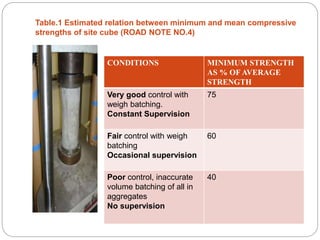
The relation between the minimum and average
compressive strength depend on the degree of
quality control and shown in the below table 1
PRESENTED BY
Ramya 14MST1019 Namratha 14MST1043 Vaishnavi
14MST1046
Table.1 Estimated relation between minimum and mean compressive
strengths of site cube (ROAD NOTE NO.4)
CONDITIONS MINIMUM STRENGTH
AS % OF AVERAGE
STRENGTH
Very good control with
weigh batching.
Constant Supervision
75
Fair control with weigh
batching
Occasional supervision
60
Poor control, inaccurate
volume batching of all in
aggregates
No supervision
40
PRESENTED BY
Ramya 14MST1019 Namratha 14MST1043 Vaishnavi
14MST1046
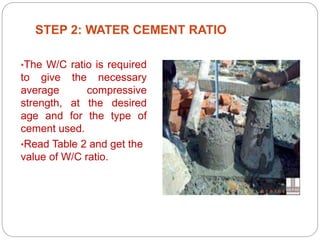
STEP 2: WATER CEMENT RATIO
•The W/C ratio is required
to give the necessary
average compressive
strength, at the desired
age and for the type of
cement used.
•Read Table 2 and get the
value of W/C ratio.
PRESENTED BY
Ramya 14MST1019 Namratha 14MST1043 Vaishnavi
14MST1046
Table.2 Relation between compressive strength and
water cement ratio for 10 cubes of fully compacted
concrete
PRESENTED BY
Ramya 14MST1019 Namratha 14MST1043 Vaishnavi
14MST1046
STEP 3 : AGREGATE CEMENT RATIO WITH DEGREE OF
WORKABILITY AND GRADING OF CURVE
•The proportion of
combine aggregate
to cement is
determined from
Table 3 & 4 for
aggregates of
maximum size 40
and 20mm
respectively.
•The tables provide
for four different
degrees of
workability detailed
in Table 5
PRESENTED BY
Ramya 14MST1019 Namratha 14MST1043 Vaishnavi
14MST1046
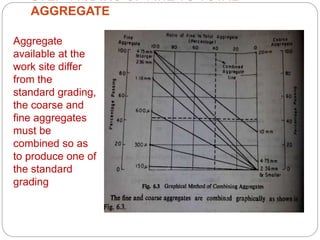
STEP 4 : RATIO OF FINE TO TOTAL
AGGREGATE
Aggregate
available at the
work site differ
from the
standard grading,
the coarse and
fine aggregates
must be
combined so as
to produce one of
the standard
grading
STEP 5: PROPORTION OF CEMENT,
WATER, FINE AND COARSE AGGREGATES
CEMENT : FINE AGGREGATE : COARSE AGGREGATE :
WATER
1 Nf Nc w
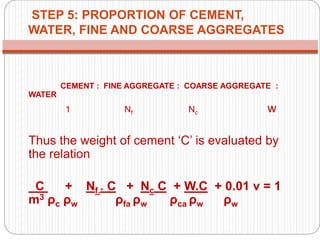
Thus the weight of cement ‘C’ is evaluated by
the relation
C + Nf.. C + Nc C + W.C + 0.01 ν = 1
m3 ρc ρw ρfa ρw ρca ρw ρw
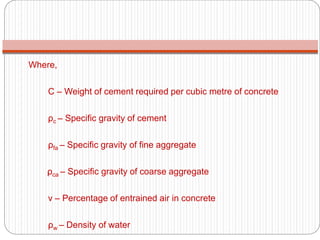
Where,
C – Weight of cement required per cubic metre of concrete
ρc – Specific gravity of cement
ρfa – Specific gravity of fine aggregate
ρca – Specific gravity of coarse aggregate
ν – Percentage of entrained air in concrete
ρw – Density of water
LIMITATIONS OF ROAD NOTE NO.4 METHOD
Design tables of aggregate/ Cement ratio
recommended in Road Note No.4 cover only three
shapes of aggregates and four type gradings
But in practice aggregates having different shapes,
sizes and properties have to use for the mixes.
This method cannot be used directly for the design
of air entrained concrete
The nominal mix designed by using the data can
be suitably adjusted for the desired air content in the
mix.
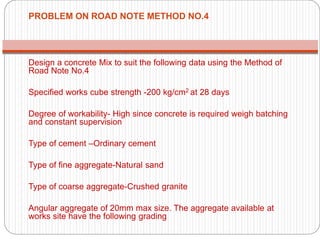
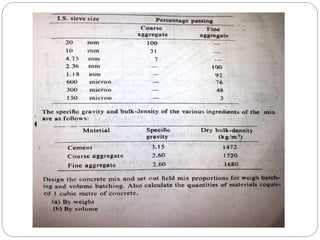
PROBLEM ON ROAD NOTE METHOD NO.4
Design a concrete Mix to suit the following data using the Method of
Road Note No.4
Specified works cube strength -200 kg/cm2 at 28 days
Degree of workability- High since concrete is required weigh batching
and constant supervision
Type of cement –Ordinary cement
Type of fine aggregate-Natural sand
Type of coarse aggregate-Crushed granite
Angular aggregate of 20mm max size. The aggregate available at
works site have the following grading
PRESENTED BY
Ramya 14MST1019 Namratha 14MST1043 Vaishnavi
14MST1046
PRESENTED BY
Ramya 14MST1019 Namratha 14MST1043 Vaishnavi
14MST1046
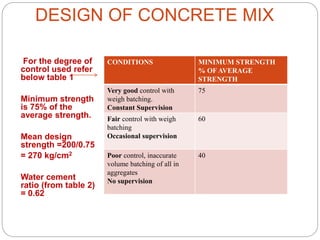
DESIGN OF CONCRETE MIX
For the degree of
control used refer
below table 1
Minimum strength
is 75% of the
average strength.
Mean design
strength =200/0.75
= 270 kg/cm2
Water cement
ratio (from table 2)
= 0.62
CONDITIONS MINIMUM STRENGTH
% OF AVERAGE
STRENGTH
Very good control with
weigh batching.
Constant Supervision
75
Fair control with weigh
batching
Occasional supervision
60
Poor control, inaccurate
volume batching of all in
aggregates
No supervision
40
PRESENTED BY
Ramya 14MST1019 Namratha 14MST1043 Vaishnavi
14MST1046
For required High
workability, refer
the table 3
Aggregate/cement
ratio (from table 3)
= 4.8
The given
aggregate do not
belong to any
particular standard
grading curve.
They should be
combined in
suitable
proportions to
corresponding to
the nearest
practical grading,
PRESENTED BY
Ramya 14MST1019 Namratha 14MST1043 Vaishnavi
14MST1046
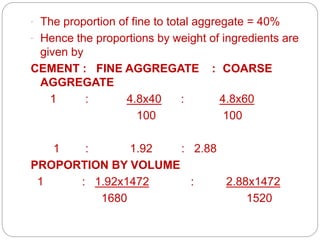
 The proportion of fine to total aggregate = 40%
 Hence the proportions by weight of ingredients are
given by
CEMENT : FINE AGGREGATE : COARSE
AGGREGATE
1 : 4.8x40 : 4.8x60
100 100
1 : 1.92 : 2.88
PROPORTION BY VOLUME
1 : 1.92x1472 : 2.88x1472
1680 1520
PRESENTED BY
Ramya 14MST1019 Namratha 14MST1043 Vaishnavi
14MST1046
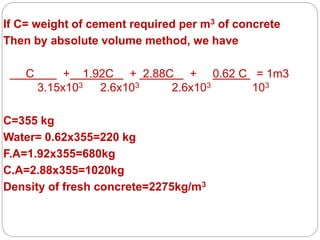
If C= weight of cement required per m3 of concrete
Then by absolute volume method, we have
C + 1.92C + 2.88C + 0.62 C = 1m3
3.15x10³ 2.6x10³ 2.6x10³ 103
C=355 kg
Water= 0.62x355=220 kg
F.A=1.92x355=680kg
C.A=2.88x355=1020kg
Density of fresh concrete=2275kg/m3

Road-Note-Method-No-4.ppt

  • 1.
    Ramya 14MST1019 Namratha 14MST1043 Vaishnavi14MST1046 ROAD NOTE METHOD NO.4, DOE AND HIGH STRENGTH PERFORMANCE OF CONCRETE
  • 2.
  • 3.
    MIX DESIGN The processof selecting suitable ingredients of concrete and determining their relative quantities The purpose of producing an economical concrete which has certain properties are 1.Workability, 2. Strength and 3.Durability.
  • 4.
    BASIS OF THEMETHOD According to the Road Note No.4 is mainly based on the experimental investigations by Glanville et al Deals with the effect of aggregate grading on the strength and workability of concrete It’s mandatory to note that designed concrete must be satisfactory both in the Plastic as well Hardened state Necessary the choice of Mix proportions is governed by both these conditions
  • 5.
    Contd The required W/Cratio to produce the design characteristic strength depends upon the characteristics of the cement By using same W/C ratio, different strengths are produced by Ordinary Portland, Rapid hardening Portland and High alumina cements. The Road note No.4 presents a set of curves relating W/C ratio and Compressive strength at different ages and for different types of cement.
  • 6.
    Contd A rough indicationof the degree of workability is obtained by the corresponding slump and compacting factor of the concrete at the work site  Extensive Laboratory investigations were conducted at the ROAD RESEARCH LABORATORY to study the relation among the various parameters such as 1. Aggregate/Cement Ratio 2. Water/Cement Ratio 3. Degree of workability 4. Grading 5. Shape and size of aggregates
  • 7.
    Based on theresults, design tables are presented in Road Note No.4 to select suitable Aggregate/Cement ratios for a concrete mix and filling up other parameters.
  • 8.
    MIX DESIGN PROCEDURE STEP1 :The average compressive strength of the concrete mix is to be obtained by applying the control factors to the minimum compressive strength. The relation between the minimum and average compressive strength depend on the degree of quality control and shown in the below table 1
  • 9.
    PRESENTED BY Ramya 14MST1019Namratha 14MST1043 Vaishnavi 14MST1046 Table.1 Estimated relation between minimum and mean compressive strengths of site cube (ROAD NOTE NO.4) CONDITIONS MINIMUM STRENGTH AS % OF AVERAGE STRENGTH Very good control with weigh batching. Constant Supervision 75 Fair control with weigh batching Occasional supervision 60 Poor control, inaccurate volume batching of all in aggregates No supervision 40
  • 10.
    PRESENTED BY Ramya 14MST1019Namratha 14MST1043 Vaishnavi 14MST1046 STEP 2: WATER CEMENT RATIO •The W/C ratio is required to give the necessary average compressive strength, at the desired age and for the type of cement used. •Read Table 2 and get the value of W/C ratio.
  • 11.
    PRESENTED BY Ramya 14MST1019Namratha 14MST1043 Vaishnavi 14MST1046 Table.2 Relation between compressive strength and water cement ratio for 10 cubes of fully compacted concrete
  • 12.
    PRESENTED BY Ramya 14MST1019Namratha 14MST1043 Vaishnavi 14MST1046 STEP 3 : AGREGATE CEMENT RATIO WITH DEGREE OF WORKABILITY AND GRADING OF CURVE •The proportion of combine aggregate to cement is determined from Table 3 & 4 for aggregates of maximum size 40 and 20mm respectively. •The tables provide for four different degrees of workability detailed in Table 5
  • 13.
    PRESENTED BY Ramya 14MST1019Namratha 14MST1043 Vaishnavi 14MST1046 STEP 4 : RATIO OF FINE TO TOTAL AGGREGATE Aggregate available at the work site differ from the standard grading, the coarse and fine aggregates must be combined so as to produce one of the standard grading
  • 14.
    STEP 5: PROPORTIONOF CEMENT, WATER, FINE AND COARSE AGGREGATES CEMENT : FINE AGGREGATE : COARSE AGGREGATE : WATER 1 Nf Nc w Thus the weight of cement ‘C’ is evaluated by the relation C + Nf.. C + Nc C + W.C + 0.01 ν = 1 m3 ρc ρw ρfa ρw ρca ρw ρw
  • 15.
    Where, C – Weightof cement required per cubic metre of concrete ρc – Specific gravity of cement ρfa – Specific gravity of fine aggregate ρca – Specific gravity of coarse aggregate ν – Percentage of entrained air in concrete ρw – Density of water
  • 16.
    LIMITATIONS OF ROADNOTE NO.4 METHOD Design tables of aggregate/ Cement ratio recommended in Road Note No.4 cover only three shapes of aggregates and four type gradings But in practice aggregates having different shapes, sizes and properties have to use for the mixes. This method cannot be used directly for the design of air entrained concrete The nominal mix designed by using the data can be suitably adjusted for the desired air content in the mix.
  • 17.
    PROBLEM ON ROADNOTE METHOD NO.4 Design a concrete Mix to suit the following data using the Method of Road Note No.4 Specified works cube strength -200 kg/cm2 at 28 days Degree of workability- High since concrete is required weigh batching and constant supervision Type of cement –Ordinary cement Type of fine aggregate-Natural sand Type of coarse aggregate-Crushed granite Angular aggregate of 20mm max size. The aggregate available at works site have the following grading
  • 18.
    PRESENTED BY Ramya 14MST1019Namratha 14MST1043 Vaishnavi 14MST1046
  • 19.
    PRESENTED BY Ramya 14MST1019Namratha 14MST1043 Vaishnavi 14MST1046 DESIGN OF CONCRETE MIX For the degree of control used refer below table 1 Minimum strength is 75% of the average strength. Mean design strength =200/0.75 = 270 kg/cm2 Water cement ratio (from table 2) = 0.62 CONDITIONS MINIMUM STRENGTH % OF AVERAGE STRENGTH Very good control with weigh batching. Constant Supervision 75 Fair control with weigh batching Occasional supervision 60 Poor control, inaccurate volume batching of all in aggregates No supervision 40
  • 20.
    PRESENTED BY Ramya 14MST1019Namratha 14MST1043 Vaishnavi 14MST1046 For required High workability, refer the table 3 Aggregate/cement ratio (from table 3) = 4.8 The given aggregate do not belong to any particular standard grading curve. They should be combined in suitable proportions to corresponding to the nearest practical grading,
  • 21.
    PRESENTED BY Ramya 14MST1019Namratha 14MST1043 Vaishnavi 14MST1046  The proportion of fine to total aggregate = 40%  Hence the proportions by weight of ingredients are given by CEMENT : FINE AGGREGATE : COARSE AGGREGATE 1 : 4.8x40 : 4.8x60 100 100 1 : 1.92 : 2.88 PROPORTION BY VOLUME 1 : 1.92x1472 : 2.88x1472 1680 1520
  • 22.
    PRESENTED BY Ramya 14MST1019Namratha 14MST1043 Vaishnavi 14MST1046 If C= weight of cement required per m3 of concrete Then by absolute volume method, we have C + 1.92C + 2.88C + 0.62 C = 1m3 3.15x10³ 2.6x10³ 2.6x10³ 103 C=355 kg Water= 0.62x355=220 kg F.A=1.92x355=680kg C.A=2.88x355=1020kg Density of fresh concrete=2275kg/m3