Unit 4: Concrete Mix Design &
Methods of Mix Design
a) Concrete mix design
b) Methods of mix design
Nominal Mix
• A ratio of all the ingredients of concrete-like cement, and
aggregates are kept fixed. The ratio of water to cement
in the nominal mix is taken by need.
• So, if the w/c ratio is not considered with care then it may
result in segregation or bleeding of concrete which
eventually affects the strength and durability of the
concrete.
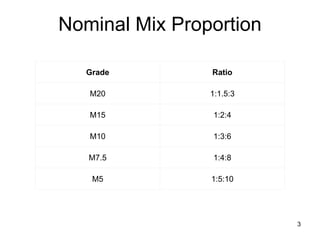
Nominal Mix Proportion
Grade Ratio
M20 1:1.5:3
M15 1:2:4
M10 1:3:6
M7.5 1:4:8
M5 1:5:10
3
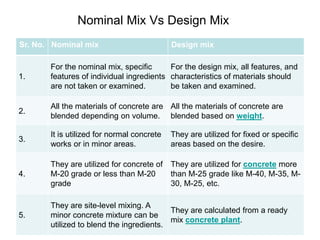
Design Mix Concrete
• Design mix may be defined as the method of making the
concrete mix in which concrete of needed strength is
acquired by
• calculating the proportion of ingredients correctly with
their relative ratio.
• Before acquiring a design mix of concrete, testing of all
the ingredients like cement, and fine and coarse
aggregate is compulsory.
4
5
Sr. No. Nominal mix Design mix
1.
For the nominal mix, specific
features of individual ingredients
are not taken or examined.
For the design mix, all features, and
characteristics of materials should
be taken and examined.
2.
All the materials of concrete are
blended depending on volume.
All the materials of concrete are
blended based on weight.
3.
It is utilized for normal concrete
works or in minor areas.
They are utilized for fixed or specific
areas based on the desire.
4.
They are utilized for concrete of
M-20 grade or less than M-20
grade
They are utilized for concrete more
than M-25 grade like M-40, M-35, M-
30, M-25, etc.
5.
They are site-level mixing. A
minor concrete mixture can be
utilized to blend the ingredients.
They are calculated from a ready
mix concrete plant.
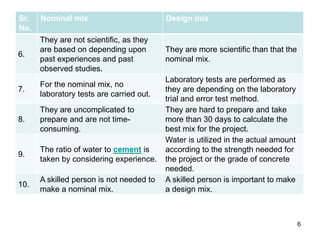
Nominal Mix Vs Design Mix
Sr.
No.
Nominal mix Design mix
6.
They are not scientific, as they
are based on depending upon
past experiences and past
observed studies.
They are more scientific than that the
nominal mix.
7.
For the nominal mix, no
laboratory tests are carried out.
Laboratory tests are performed as
they are depending on the laboratory
trial and error test method.
8.
They are uncomplicated to
prepare and are not time-
consuming.
They are hard to prepare and take
more than 30 days to calculate the
best mix for the project.
9.
The ratio of water to cement is
taken by considering experience.
Water is utilized in the actual amount
according to the strength needed for
the project or the grade of concrete
needed.
10.
A skilled person is not needed to
make a nominal mix.
A skilled person is important to make
a design mix.
6
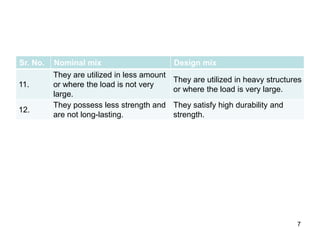
Sr. No. Nominal mix Design mix
11.
They are utilized in less amount
or where the load is not very
large.
They are utilized in heavy structures
or where the load is very large.
12.
They possess less strength and
are not long-lasting.
They satisfy high durability and
strength.
7
8
Determination of the proportion of the concrete
ingredients
i.e. Cement, Water, Fine aggregate, Coarse Aggregate
which would produce concrete possessing specified
properties such as workability, strength and durability
with maximum overall economy.
Concrete Mix Design
9
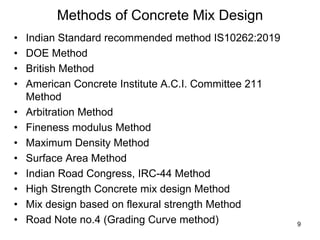
Methods of Concrete Mix Design
• Indian Standard recommended method IS10262:2019
• DOE Method
• British Method
• American Concrete Institute A.C.I. Committee 211
Method
• Arbitration Method
• Fineness modulus Method
• Maximum Density Method
• Surface Area Method
• Indian Road Congress, IRC-44 Method
• High Strength Concrete mix design Method
• Mix design based on flexural strength Method
• Road Note no.4 (Grading Curve method)
10
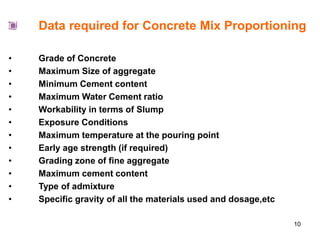
Data required for Concrete Mix Proportioning
• Grade of Concrete
• Maximum Size of aggregate
• Minimum Cement content
• Maximum Water Cement ratio
• Workability in terms of Slump
• Exposure Conditions
• Maximum temperature at the pouring point
• Early age strength (if required)
• Grading zone of fine aggregate
• Maximum cement content
• Type of admixture
• Specific gravity of all the materials used and dosage,etc
11
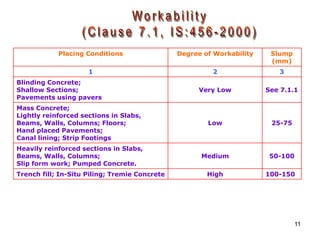
Placing Conditions Degree of Workability Slump
(mm)
1 2 3
Blinding Concrete;
Shallow Sections;
Pavements using pavers
Very Low See 7.1.1
Mass Concrete;
Lightly reinforced sections in Slabs,
Beams, Walls, Columns; Floors;
Hand placed Pavements;
Canal lining; Strip Footings
Low 25-75
Heavily reinforced sections in Slabs,
Beams, Walls, Columns;
Slip form work; Pumped Concrete.
Medium 50-100
Trench fill; In-Situ Piling; Tremie Concrete High 100-150
12
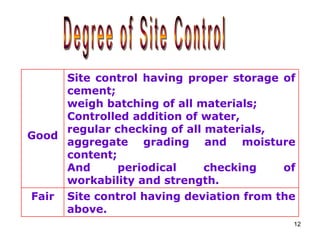
Good
Site control having proper storage of
cement;
weigh batching of all materials;
Controlled addition of water,
regular checking of all materials,
aggregate grading and moisture
content;
And periodical checking of
workability and strength.
Fair Site control having deviation from the
above.
13
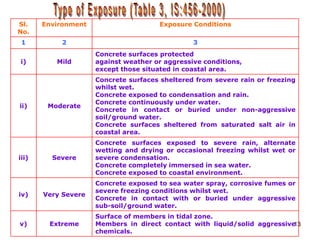
Sl.
No.
Environment Exposure Conditions
1 2 3
i) Mild
Concrete surfaces protected
against weather or aggressive conditions,
except those situated in coastal area.
ii) Moderate
Concrete surfaces sheltered from severe rain or freezing
whilst wet.
Concrete exposed to condensation and rain.
Concrete continuously under water.
Concrete in contact or buried under non-aggressive
soil/ground water.
Concrete surfaces sheltered from saturated salt air in
coastal area.
iii) Severe
Concrete surfaces exposed to severe rain, alternate
wetting and drying or occasional freezing whilst wet or
severe condensation.
Concrete completely immersed in sea water.
Concrete exposed to coastal environment.
iv) Very Severe
Concrete exposed to sea water spray, corrosive fumes or
severe freezing conditions whilst wet.
Concrete in contact with or buried under aggressive
sub-soil/ground water.
v) Extreme
Surface of members in tidal zone.
Members in direct contact with liquid/solid aggressive
chemicals.
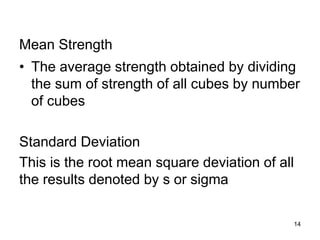
Mean Strength
• The average strength obtained by dividing
the sum of strength of all cubes by number
of cubes
Standard Deviation
This is the root mean square deviation of all
the results denoted by s or sigma
14
15
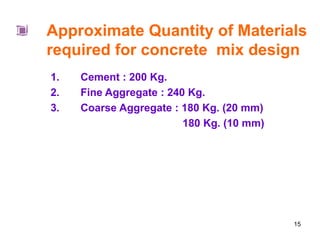
Approximate Quantity of Materials
required for concrete mix design
1. Cement : 200 Kg.
2. Fine Aggregate : 240 Kg.
3. Coarse Aggregate : 180 Kg. (20 mm)
180 Kg. (10 mm)
16
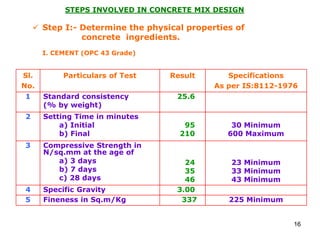
STEPS INVOLVED IN CONCRETE MIX DESIGN
 Step I:- Determine the physical properties of
concrete ingredients.
I. CEMENT (OPC 43 Grade)
Sl.
No.
Particulars of Test Result Specifications
As per IS:8112-1976
1 Standard consistency
(% by weight)
25.6
2 Setting Time in minutes
a) Initial
b) Final
95
210
30 Minimum
600 Maximum
3 Compressive Strength in
N/sq.mm at the age of
a) 3 days
b) 7 days
c) 28 days
24
35
46
23 Minimum
33 Minimum
43 Minimum
4 Specific Gravity 3.00
5 Fineness in Sq.m/Kg 337 225 Minimum
17
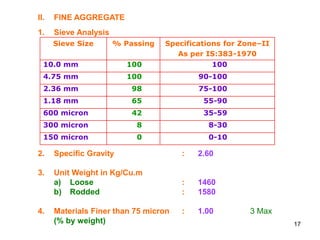
Sieve Size % Passing Specifications for Zone–II
As per IS:383-1970
10.0 mm 100 100
4.75 mm 100 90-100
2.36 mm 98 75-100
1.18 mm 65 55-90
600 micron 42 35-59
300 micron 8 8-30
150 micron 0 0-10
II. FINE AGGREGATE
1. Sieve Analysis
2. Specific Gravity : 2.60
3. Unit Weight in Kg/Cu.m
a) Loose : 1460
b) Rodded : 1580
4. Materials Finer than 75 micron : 1.00 3 Max
(% by weight)
18
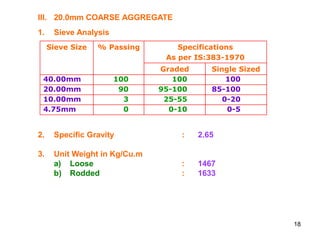
Sieve Size % Passing Specifications
As per IS:383-1970
Graded Single Sized
40.00mm 100 100 100
20.00mm 90 95-100 85-100
10.00mm 3 25-55 0-20
4.75mm 0 0-10 0-5
III. 20.0mm COARSE AGGREGATE
1. Sieve Analysis
2. Specific Gravity : 2.65
3. Unit Weight in Kg/Cu.m
a) Loose : 1467
b) Rodded : 1633
19
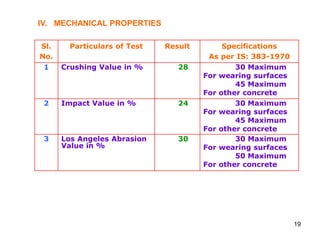
Sl.
No.
Particulars of Test Result Specifications
As per IS: 383-1970
1 Crushing Value in % 28 30 Maximum
For wearing surfaces
45 Maximum
For other concrete
2 Impact Value in % 24 30 Maximum
For wearing surfaces
45 Maximum
For other concrete
3 Los Angeles Abrasion
Value in %
30 30 Maximum
For wearing surfaces
50 Maximum
For other concrete
IV. MECHANICAL PROPERTIES
20
Sieve Size % Passing Specifications
As per IS:383-1970
Graded Single Sized
12.50mm 100 – 100
10.00mm 85 – 85-100
4.75mm 19 – 0-20
2.36mm 0 – 0-5
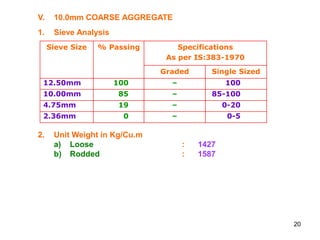
V. 10.0mm COARSE AGGREGATE
1. Sieve Analysis
2. Unit Weight in Kg/Cu.m
a) Loose : 1427
b) Rodded : 1587
21
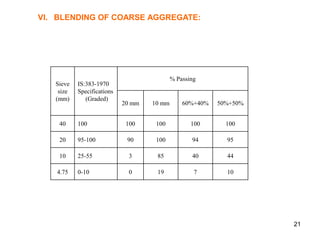
VI. BLENDING OF COARSE AGGREGATE:
Sieve
size
(mm)
IS:383-1970
Specifications
(Graded)
% Passing
20 mm 10 mm 60%+40% 50%+50%
40 100 100 100 100 100
20 95-100 90 100 94 95
10 25-55 3 85 40 44
4.75 0-10 0 19 7 10
22
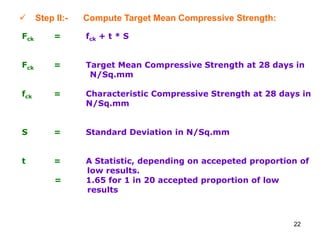
 Step II:- Compute Target Mean Compressive Strength:
Fck = fck + t * S
Fck = Target Mean Compressive Strength at 28 days in
N/Sq.mm
fck = Characteristic Compressive Strength at 28 days in
N/Sq.mm
S = Standard Deviation in N/Sq.mm
t = A Statistic, depending on accepeted proportion of
low results.
= 1.65 for 1 in 20 accepted proportion of low
results
23
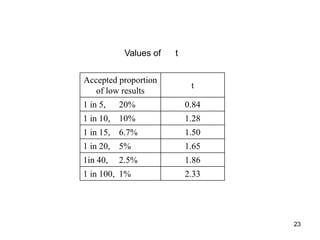
Values of t
Accepted proportion
of low results
t
1 in 5, 20% 0.84
1 in 10, 10% 1.28
1 in 15, 6.7% 1.50
1 in 20, 5% 1.65
1in 40, 2.5% 1.86
1 in 100, 1% 2.33
24
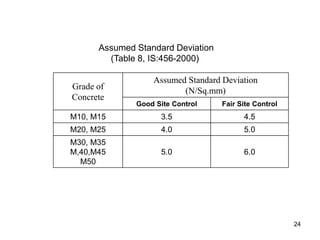
Assumed Standard Deviation
(Table 8, IS:456-2000)
Grade of
Concrete
Assumed Standard Deviation
(N/Sq.mm)
Good Site Control Fair Site Control
M10, M15 3.5 4.5
M20, M25 4.0 5.0
M30, M35
M,40,M45
M50
5.0 6.0
25
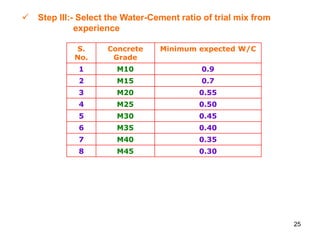
 Step III:- Select the Water-Cement ratio of trial mix from
experience
S.
No.
Concrete
Grade
Minimum expected W/C
1 M10 0.9
2 M15 0.7
3 M20 0.55
4 M25 0.50
5 M30 0.45
6 M35 0.40
7 M40 0.35
8 M45 0.30
26
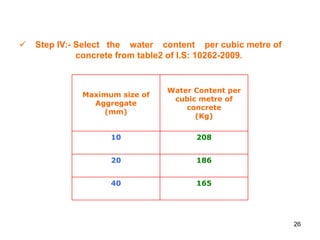
 Step IV:- Select the water content per cubic metre of
concrete from table2 of I.S: 10262-2009.
Maximum size of
Aggregate
(mm)
Water Content per
cubic metre of
concrete
(Kg)
10 208
20 186
40 165
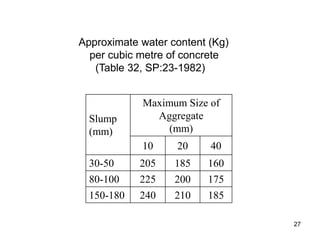
27
Approximate water content (Kg)
per cubic metre of concrete
(Table 32, SP:23-1982)
Slump
(mm)
Maximum Size of
Aggregate
(mm)
10 20 40
30-50 205 185 160
80-100 225 200 175
150-180 240 210 185
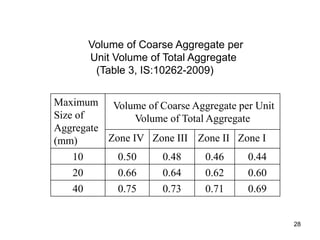
28
Volume of Coarse Aggregate per
Unit Volume of Total Aggregate
(Table 3, IS:10262-2009)
Maximum
Size of
Aggregate
(mm)
Volume of Coarse Aggregate per Unit
Volume of Total Aggregate
Zone IV Zone III Zone II Zone I
10 0.50 0.48 0.46 0.44
20 0.66 0.64 0.62 0.60
40 0.75 0.73 0.71 0.69
29
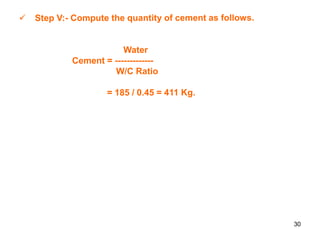
30
31
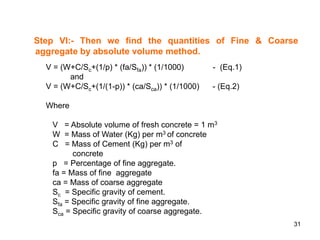
Step VI:- Then we find the quantities of Fine & Coarse
aggregate by absolute volume method.
V = (W+C/Sc+(1/p) * (fa/Sfa)) * (1/1000) - (Eq.1)
and
V = (W+C/Sc+(1/(1-p)) * (ca/Sca)) * (1/1000) - (Eq.2)
Where
V = Absolute volume of fresh concrete = 1 m3
W = Mass of Water (Kg) per m3 of concrete
C = Mass of Cement (Kg) per m3 of
concrete
p = Percentage of fine aggregate.
fa = Mass of fine aggregate
ca = Mass of coarse aggregate
Sc = Specific gravity of cement.
Sfa = Specific gravity of fine aggregate.
Sca = Specific gravity of coarse aggregate.
32
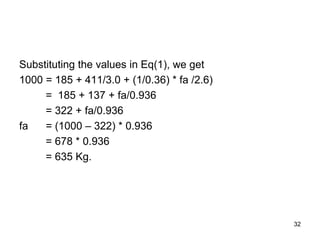
Substituting the values in Eq(1), we get
1000 = 185 + 411/3.0 + (1/0.36) * fa /2.6)
= 185 + 137 + fa/0.936
= 322 + fa/0.936
fa = (1000 – 322) * 0.936
= 678 * 0.936
= 635 Kg.
33
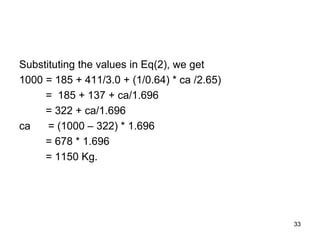
Substituting the values in Eq(2), we get
1000 = 185 + 411/3.0 + (1/0.64) * ca /2.65)
= 185 + 137 + ca/1.696
= 322 + ca/1.696
ca = (1000 – 322) * 1.696
= 678 * 1.696
= 1150 Kg.
34
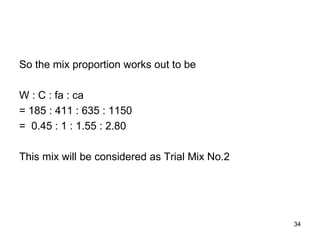
So the mix proportion works out to be
W : C : fa : ca
= 185 : 411 : 635 : 1150
= 0.45 : 1 : 1.55 : 2.80
This mix will be considered as Trial Mix No.2
35
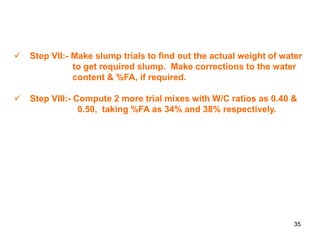
 Step VII:- Make slump trials to find out the actual weight of water
to get required slump. Make corrections to the water
content & %FA, if required.
 Step VIII:- Compute 2 more trial mixes with W/C ratios as 0.40 &
0.50, taking %FA as 34% and 38% respectively.
36
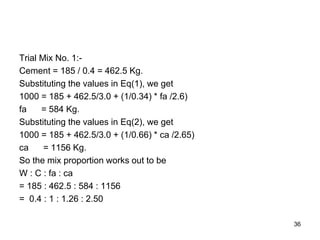
Trial Mix No. 1:-
Cement = 185 / 0.4 = 462.5 Kg.
Substituting the values in Eq(1), we get
1000 = 185 + 462.5/3.0 + (1/0.34) * fa /2.6)
fa = 584 Kg.
Substituting the values in Eq(2), we get
1000 = 185 + 462.5/3.0 + (1/0.66) * ca /2.65)
ca = 1156 Kg.
So the mix proportion works out to be
W : C : fa : ca
= 185 : 462.5 : 584 : 1156
= 0.4 : 1 : 1.26 : 2.50
37
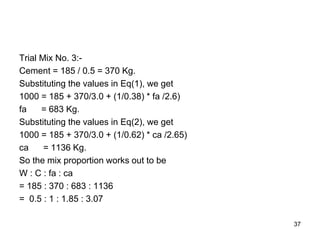
Trial Mix No. 3:-
Cement = 185 / 0.5 = 370 Kg.
Substituting the values in Eq(1), we get
1000 = 185 + 370/3.0 + (1/0.38) * fa /2.6)
fa = 683 Kg.
Substituting the values in Eq(2), we get
1000 = 185 + 370/3.0 + (1/0.62) * ca /2.65)
ca = 1136 Kg.
So the mix proportion works out to be
W : C : fa : ca
= 185 : 370 : 683 : 1136
= 0.5 : 1 : 1.85 : 3.07
38
 Step IX:- Cast atleast 3 cubes for each trial mix.
 Step X:- Test the cubes for compressive strength at 28 days.
39
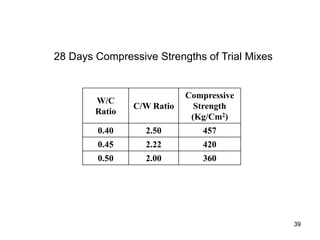
28 Days Compressive Strengths of Trial Mixes
W/C
Ratio
C/W Ratio
Compressive
Strength
(Kg/Cm2)
0.40 2.50 457
0.45 2.22 420
0.50 2.00 360
40
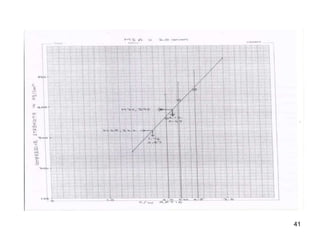
 Step XI:- Draw a graph between compressive strength Vs C/W Ratio.
41
42
 Step XII:- From the graph, find the W/C ratio for the required
target mean compressive strength.
 Step XIII:- Calculate the mix proportions corresponding to
the W/C ratio, obtained from the graph.
43
Final Mix:-
From the graph, for a target strength of 390 Kg/Cm2, W/C ratio = 0.47
Cement = 185 / 0.47 = 394 Kg.
Substituting the values in Eq(1), we get
1000 = 185 + 394/3.0 + (1/0.38) * fa /2.6)
fa = 675 Kg.
Substituting the values in Eq(2), we get
1000 = 185 + 394/3.0 + (1/0.62) * ca /2.65)
ca = 1123 Kg.
So the mix proportion works out to be
W : C : fa : ca
= 185 : 394 : 675 : 1123
= 0.47 : 1 : 1.71 : 2.85
44
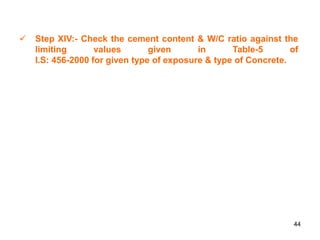
 Step XIV:- Check the cement content & W/C ratio against the
limiting values given in Table-5 of
I.S: 456-2000 for given type of exposure & type of Concrete.
45
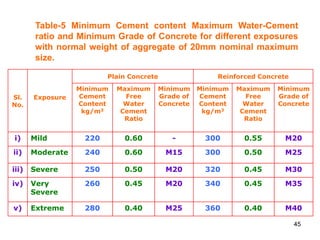
Table-5 Minimum Cement content Maximum Water-Cement
ratio and Minimum Grade of Concrete for different exposures
with normal weight of aggregate of 20mm nominal maximum
size.
Sl.
No.
Exposure
Plain Concrete Reinforced Concrete
Minimum
Cement
Content
kg/m3
Maximum
Free
Water
Cement
Ratio
Minimum
Grade of
Concrete
Minimum
Cement
Content
kg/m3
Maximum
Free
Water
Cement
Ratio
Minimum
Grade of
Concrete
i) Mild 220 0.60 - 300 0.55 M20
ii) Moderate 240 0.60 M15 300 0.50 M25
iii) Severe 250 0.50 M20 320 0.45 M30
iv) Very
Severe
260 0.45 M20 340 0.45 M35
v) Extreme 280 0.40 M25 360 0.40 M40
46
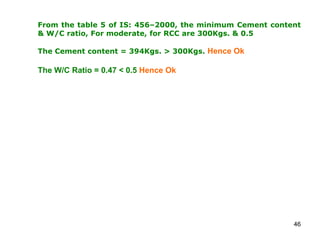
From the table 5 of IS: 456–2000, the minimum Cement content
& W/C ratio, For moderate, for RCC are 300Kgs. & 0.5
The Cement content = 394Kgs. > 300Kgs. Hence Ok
The W/C Ratio = 0.47 < 0.5 Hence Ok
47
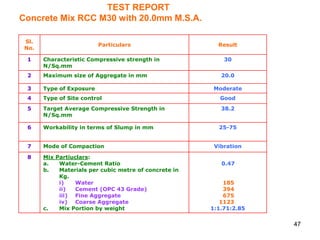
TEST REPORT
Concrete Mix RCC M30 with 20.0mm M.S.A.
Sl.
No.
Particulars Result
1 Characteristic Compressive strength in
N/Sq.mm
30
2 Maximum size of Aggregate in mm 20.0
3 Type of Exposure Moderate
4 Type of Site control Good
5 Target Average Compressive Strength in
N/Sq.mm
38.2
6 Workability in terms of Slump in mm 25-75
7 Mode of Compaction Vibration
8 Mix Partiuclars:
a. Water-Cement Ratio
b. Materials per cubic metre of concrete in
Kg.
i) Water
ii) Cement (OPC 43 Grade)
iii) Fine Aggregate
iv) Coarse Aggregate
c. Mix Portion by weight
0.47
185
394
675
1123
1:1.71:2.85
48
• Secondary Slides:
49
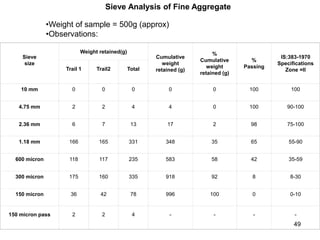
Sieve Analysis of Fine Aggregate
•Weight of sample = 500g (approx)
•Observations:
Sieve
size
Weight retained(g)
Cumulative
weight
retained (g)
%
Cumulative
weight
retained (g)
%
Passing
IS:383-1970
Specifications
Zone =II
Trail 1 Trail2 Total
10 mm 0 0 0 0 0 100 100
4.75 mm 2 2 4 4 0 100 90-100
2.36 mm 6 7 13 17 2 98 75-100
1.18 mm 166 165 331 348 35 65 55-90
600 micron 118 117 235 583 58 42 35-59
300 micron 175 160 335 918 92 8 8-30
150 micron 36 42 78 996 100 0 0-10
150 micron pass 2 2 4 - - - -
50
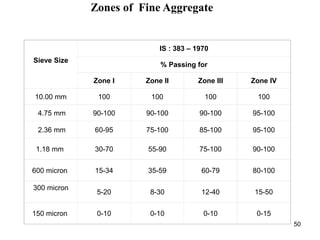
Zones of Fine Aggregate
Sieve Size
IS : 383 – 1970
% Passing for
Zone I Zone II Zone III Zone IV
10.00 mm 100 100 100 100
4.75 mm 90-100 90-100 90-100 95-100
2.36 mm 60-95 75-100 85-100 95-100
1.18 mm 30-70 55-90 75-100 90-100
600 micron 15-34 35-59 60-79 80-100
300 micron
5-20 8-30 12-40 15-50
150 micron 0-10 0-10 0-10 0-15
51
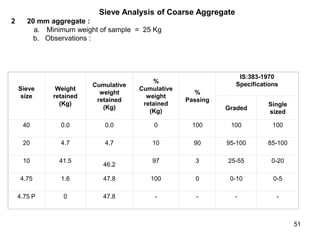
Sieve Analysis of Coarse Aggregate
2 20 mm aggregate :
a. Minimum weight of sample = 25 Kg
b. Observations :
Sieve
size
Weight
retained
(Kg)
Cumulative
weight
retained
(Kg)
%
Cumulative
weight
retained
(Kg)
%
Passing
IS:383-1970
Specifications
Graded
Single
sized
40 0.0 0.0 0 100 100 100
20 4.7 4.7 10 90 95-100 85-100
10 41.5
46.2
97 3 25-55 0-20
4.75 1.6 47.8 100 0 0-10 0-5
4.75 P 0 47.8 - - - -
52
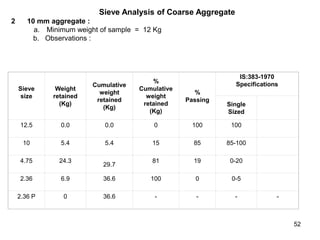
Sieve Analysis of Coarse Aggregate
2 10 mm aggregate :
a. Minimum weight of sample = 12 Kg
b. Observations :
Sieve
size
Weight
retained
(Kg)
Cumulative
weight
retained
(Kg)
%
Cumulative
weight
retained
(Kg)
%
Passing
IS:383-1970
Specifications
Single
Sized
12.5 0.0 0.0 0 100 100
10 5.4 5.4 15 85 85-100
4.75 24.3
29.7
81 19 0-20
2.36 6.9 36.6 100 0 0-5
2.36 P 0 36.6 - - - -
53
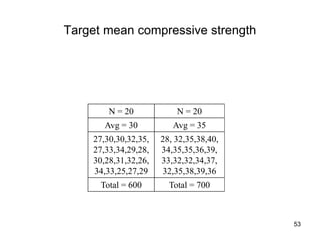
N = 20 N = 20
Avg = 30 Avg = 35
27,30,30,32,35,
27,33,34,29,28,
30,28,31,32,26,
34,33,25,27,29
28, 32,35,38,40,
34,35,35,36,39,
33,32,32,34,37,
32,35,38,39,36
Total = 600 Total = 700
Target mean compressive strength
54
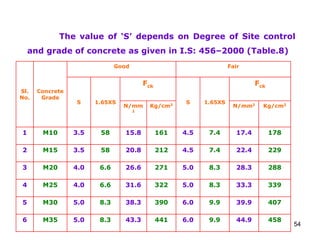
The value of ‘S’ depends on Degree of Site control
and grade of concrete as given in I.S: 456–2000 (Table.8)
Sl.
No.
Concrete
Grade
Good Fair
S 1.65XS
Fck
S 1.65XS
Fck
N/mm
2
Kg/cm2 N/mm2 Kg/cm2
1 M10 3.5 58 15.8 161 4.5 7.4 17.4 178
2 M15 3.5 58 20.8 212 4.5 7.4 22.4 229
3 M20 4.0 6.6 26.6 271 5.0 8.3 28.3 288
4 M25 4.0 6.6 31.6 322 5.0 8.3 33.3 339
5 M30 5.0 8.3 38.3 390 6.0 9.9 39.9 407
6 M35 5.0 8.3 43.3 441 6.0 9.9 44.9 458
55
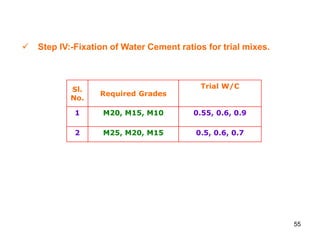
 Step IV:-Fixation of Water Cement ratios for trial mixes.
Sl.
No.
Required Grades
Trial W/C
1 M20, M15, M10 0.55, 0.6, 0.9
2 M25, M20, M15 0.5, 0.6, 0.7
56
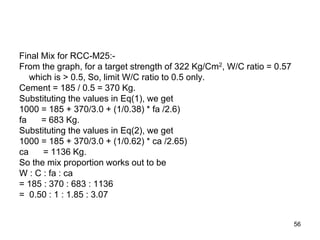
Final Mix for RCC-M25:-
From the graph, for a target strength of 322 Kg/Cm2, W/C ratio = 0.57
which is > 0.5, So, limit W/C ratio to 0.5 only.
Cement = 185 / 0.5 = 370 Kg.
Substituting the values in Eq(1), we get
1000 = 185 + 370/3.0 + (1/0.38) * fa /2.6)
fa = 683 Kg.
Substituting the values in Eq(2), we get
1000 = 185 + 370/3.0 + (1/0.62) * ca /2.65)
ca = 1136 Kg.
So the mix proportion works out to be
W : C : fa : ca
= 185 : 370 : 683 : 1136
= 0.50 : 1 : 1.85 : 3.07
57
Specific Gravity of Cement [ IS : 4031 – 1988]:
Specific gravity of cement (Sc)
(W2 - W1)
= ---------------------------- x 0.79
(W4 - W1) - (W3 - W2)
Where,
W1 = Weight of specific gravity bottle in g
W2 = Weight of specific gravity bottle with about half filled cement in g
W3 = Weight of specific gravity bottle with about half filled cement
& rest is filled with kerosene in g.
W4 = Weight of specific gravity bottle completely filled with kerosene in g
0.79 = Specific Gravity of Kerosene.
58
Specific Gravity of Fine Aggregate & Coarse Aggregate [ IS : 2386 (Part.3) -
1963]:
D
Specific gravity (Gs) = --------------
C – ( A – B)
Where,
A = Weight of Pycnometer vessel containing sample & filled with distilled water in g
B = Weight of Pycnometer completely filled with distilled water only in g
C = Weight of saturated surface dry sample in g
D = Weight of oven dried sample in g

CEMENT CONCRETE MIX DESIGN.ppt

  • 1.
    Unit 4: ConcreteMix Design & Methods of Mix Design a) Concrete mix design b) Methods of mix design
  • 2.
    Nominal Mix • Aratio of all the ingredients of concrete-like cement, and aggregates are kept fixed. The ratio of water to cement in the nominal mix is taken by need. • So, if the w/c ratio is not considered with care then it may result in segregation or bleeding of concrete which eventually affects the strength and durability of the concrete.
  • 3.
    Nominal Mix Proportion GradeRatio M20 1:1.5:3 M15 1:2:4 M10 1:3:6 M7.5 1:4:8 M5 1:5:10 3
  • 4.
    Design Mix Concrete •Design mix may be defined as the method of making the concrete mix in which concrete of needed strength is acquired by • calculating the proportion of ingredients correctly with their relative ratio. • Before acquiring a design mix of concrete, testing of all the ingredients like cement, and fine and coarse aggregate is compulsory. 4
  • 5.
    5 Sr. No. Nominalmix Design mix 1. For the nominal mix, specific features of individual ingredients are not taken or examined. For the design mix, all features, and characteristics of materials should be taken and examined. 2. All the materials of concrete are blended depending on volume. All the materials of concrete are blended based on weight. 3. It is utilized for normal concrete works or in minor areas. They are utilized for fixed or specific areas based on the desire. 4. They are utilized for concrete of M-20 grade or less than M-20 grade They are utilized for concrete more than M-25 grade like M-40, M-35, M- 30, M-25, etc. 5. They are site-level mixing. A minor concrete mixture can be utilized to blend the ingredients. They are calculated from a ready mix concrete plant. Nominal Mix Vs Design Mix
  • 6.
    Sr. No. Nominal mix Designmix 6. They are not scientific, as they are based on depending upon past experiences and past observed studies. They are more scientific than that the nominal mix. 7. For the nominal mix, no laboratory tests are carried out. Laboratory tests are performed as they are depending on the laboratory trial and error test method. 8. They are uncomplicated to prepare and are not time- consuming. They are hard to prepare and take more than 30 days to calculate the best mix for the project. 9. The ratio of water to cement is taken by considering experience. Water is utilized in the actual amount according to the strength needed for the project or the grade of concrete needed. 10. A skilled person is not needed to make a nominal mix. A skilled person is important to make a design mix. 6
  • 7.
    Sr. No. Nominalmix Design mix 11. They are utilized in less amount or where the load is not very large. They are utilized in heavy structures or where the load is very large. 12. They possess less strength and are not long-lasting. They satisfy high durability and strength. 7
  • 8.
    8 Determination of theproportion of the concrete ingredients i.e. Cement, Water, Fine aggregate, Coarse Aggregate which would produce concrete possessing specified properties such as workability, strength and durability with maximum overall economy. Concrete Mix Design
  • 9.
    9 Methods of ConcreteMix Design • Indian Standard recommended method IS10262:2019 • DOE Method • British Method • American Concrete Institute A.C.I. Committee 211 Method • Arbitration Method • Fineness modulus Method • Maximum Density Method • Surface Area Method • Indian Road Congress, IRC-44 Method • High Strength Concrete mix design Method • Mix design based on flexural strength Method • Road Note no.4 (Grading Curve method)
  • 10.
    10 Data required forConcrete Mix Proportioning • Grade of Concrete • Maximum Size of aggregate • Minimum Cement content • Maximum Water Cement ratio • Workability in terms of Slump • Exposure Conditions • Maximum temperature at the pouring point • Early age strength (if required) • Grading zone of fine aggregate • Maximum cement content • Type of admixture • Specific gravity of all the materials used and dosage,etc
  • 11.
    11 Placing Conditions Degreeof Workability Slump (mm) 1 2 3 Blinding Concrete; Shallow Sections; Pavements using pavers Very Low See 7.1.1 Mass Concrete; Lightly reinforced sections in Slabs, Beams, Walls, Columns; Floors; Hand placed Pavements; Canal lining; Strip Footings Low 25-75 Heavily reinforced sections in Slabs, Beams, Walls, Columns; Slip form work; Pumped Concrete. Medium 50-100 Trench fill; In-Situ Piling; Tremie Concrete High 100-150
  • 12.
    12 Good Site control havingproper storage of cement; weigh batching of all materials; Controlled addition of water, regular checking of all materials, aggregate grading and moisture content; And periodical checking of workability and strength. Fair Site control having deviation from the above.
  • 13.
    13 Sl. No. Environment Exposure Conditions 12 3 i) Mild Concrete surfaces protected against weather or aggressive conditions, except those situated in coastal area. ii) Moderate Concrete surfaces sheltered from severe rain or freezing whilst wet. Concrete exposed to condensation and rain. Concrete continuously under water. Concrete in contact or buried under non-aggressive soil/ground water. Concrete surfaces sheltered from saturated salt air in coastal area. iii) Severe Concrete surfaces exposed to severe rain, alternate wetting and drying or occasional freezing whilst wet or severe condensation. Concrete completely immersed in sea water. Concrete exposed to coastal environment. iv) Very Severe Concrete exposed to sea water spray, corrosive fumes or severe freezing conditions whilst wet. Concrete in contact with or buried under aggressive sub-soil/ground water. v) Extreme Surface of members in tidal zone. Members in direct contact with liquid/solid aggressive chemicals.
  • 14.
    Mean Strength • Theaverage strength obtained by dividing the sum of strength of all cubes by number of cubes Standard Deviation This is the root mean square deviation of all the results denoted by s or sigma 14
  • 15.
    15 Approximate Quantity ofMaterials required for concrete mix design 1. Cement : 200 Kg. 2. Fine Aggregate : 240 Kg. 3. Coarse Aggregate : 180 Kg. (20 mm) 180 Kg. (10 mm)
  • 16.
    16 STEPS INVOLVED INCONCRETE MIX DESIGN  Step I:- Determine the physical properties of concrete ingredients. I. CEMENT (OPC 43 Grade) Sl. No. Particulars of Test Result Specifications As per IS:8112-1976 1 Standard consistency (% by weight) 25.6 2 Setting Time in minutes a) Initial b) Final 95 210 30 Minimum 600 Maximum 3 Compressive Strength in N/sq.mm at the age of a) 3 days b) 7 days c) 28 days 24 35 46 23 Minimum 33 Minimum 43 Minimum 4 Specific Gravity 3.00 5 Fineness in Sq.m/Kg 337 225 Minimum
  • 17.
    17 Sieve Size %Passing Specifications for Zone–II As per IS:383-1970 10.0 mm 100 100 4.75 mm 100 90-100 2.36 mm 98 75-100 1.18 mm 65 55-90 600 micron 42 35-59 300 micron 8 8-30 150 micron 0 0-10 II. FINE AGGREGATE 1. Sieve Analysis 2. Specific Gravity : 2.60 3. Unit Weight in Kg/Cu.m a) Loose : 1460 b) Rodded : 1580 4. Materials Finer than 75 micron : 1.00 3 Max (% by weight)
  • 18.
    18 Sieve Size %Passing Specifications As per IS:383-1970 Graded Single Sized 40.00mm 100 100 100 20.00mm 90 95-100 85-100 10.00mm 3 25-55 0-20 4.75mm 0 0-10 0-5 III. 20.0mm COARSE AGGREGATE 1. Sieve Analysis 2. Specific Gravity : 2.65 3. Unit Weight in Kg/Cu.m a) Loose : 1467 b) Rodded : 1633
  • 19.
    19 Sl. No. Particulars of TestResult Specifications As per IS: 383-1970 1 Crushing Value in % 28 30 Maximum For wearing surfaces 45 Maximum For other concrete 2 Impact Value in % 24 30 Maximum For wearing surfaces 45 Maximum For other concrete 3 Los Angeles Abrasion Value in % 30 30 Maximum For wearing surfaces 50 Maximum For other concrete IV. MECHANICAL PROPERTIES
  • 20.
    20 Sieve Size %Passing Specifications As per IS:383-1970 Graded Single Sized 12.50mm 100 – 100 10.00mm 85 – 85-100 4.75mm 19 – 0-20 2.36mm 0 – 0-5 V. 10.0mm COARSE AGGREGATE 1. Sieve Analysis 2. Unit Weight in Kg/Cu.m a) Loose : 1427 b) Rodded : 1587
  • 21.
    21 VI. BLENDING OFCOARSE AGGREGATE: Sieve size (mm) IS:383-1970 Specifications (Graded) % Passing 20 mm 10 mm 60%+40% 50%+50% 40 100 100 100 100 100 20 95-100 90 100 94 95 10 25-55 3 85 40 44 4.75 0-10 0 19 7 10
  • 22.
    22  Step II:-Compute Target Mean Compressive Strength: Fck = fck + t * S Fck = Target Mean Compressive Strength at 28 days in N/Sq.mm fck = Characteristic Compressive Strength at 28 days in N/Sq.mm S = Standard Deviation in N/Sq.mm t = A Statistic, depending on accepeted proportion of low results. = 1.65 for 1 in 20 accepted proportion of low results
  • 23.
    23 Values of t Acceptedproportion of low results t 1 in 5, 20% 0.84 1 in 10, 10% 1.28 1 in 15, 6.7% 1.50 1 in 20, 5% 1.65 1in 40, 2.5% 1.86 1 in 100, 1% 2.33
  • 24.
    24 Assumed Standard Deviation (Table8, IS:456-2000) Grade of Concrete Assumed Standard Deviation (N/Sq.mm) Good Site Control Fair Site Control M10, M15 3.5 4.5 M20, M25 4.0 5.0 M30, M35 M,40,M45 M50 5.0 6.0
  • 25.
    25  Step III:-Select the Water-Cement ratio of trial mix from experience S. No. Concrete Grade Minimum expected W/C 1 M10 0.9 2 M15 0.7 3 M20 0.55 4 M25 0.50 5 M30 0.45 6 M35 0.40 7 M40 0.35 8 M45 0.30
  • 26.
    26  Step IV:-Select the water content per cubic metre of concrete from table2 of I.S: 10262-2009. Maximum size of Aggregate (mm) Water Content per cubic metre of concrete (Kg) 10 208 20 186 40 165
  • 27.
    27 Approximate water content(Kg) per cubic metre of concrete (Table 32, SP:23-1982) Slump (mm) Maximum Size of Aggregate (mm) 10 20 40 30-50 205 185 160 80-100 225 200 175 150-180 240 210 185
  • 28.
    28 Volume of CoarseAggregate per Unit Volume of Total Aggregate (Table 3, IS:10262-2009) Maximum Size of Aggregate (mm) Volume of Coarse Aggregate per Unit Volume of Total Aggregate Zone IV Zone III Zone II Zone I 10 0.50 0.48 0.46 0.44 20 0.66 0.64 0.62 0.60 40 0.75 0.73 0.71 0.69
  • 29.
  • 30.
  • 31.
    31 Step VI:- Thenwe find the quantities of Fine & Coarse aggregate by absolute volume method. V = (W+C/Sc+(1/p) * (fa/Sfa)) * (1/1000) - (Eq.1) and V = (W+C/Sc+(1/(1-p)) * (ca/Sca)) * (1/1000) - (Eq.2) Where V = Absolute volume of fresh concrete = 1 m3 W = Mass of Water (Kg) per m3 of concrete C = Mass of Cement (Kg) per m3 of concrete p = Percentage of fine aggregate. fa = Mass of fine aggregate ca = Mass of coarse aggregate Sc = Specific gravity of cement. Sfa = Specific gravity of fine aggregate. Sca = Specific gravity of coarse aggregate.
  • 32.
    32 Substituting the valuesin Eq(1), we get 1000 = 185 + 411/3.0 + (1/0.36) * fa /2.6) = 185 + 137 + fa/0.936 = 322 + fa/0.936 fa = (1000 – 322) * 0.936 = 678 * 0.936 = 635 Kg.
  • 33.
    33 Substituting the valuesin Eq(2), we get 1000 = 185 + 411/3.0 + (1/0.64) * ca /2.65) = 185 + 137 + ca/1.696 = 322 + ca/1.696 ca = (1000 – 322) * 1.696 = 678 * 1.696 = 1150 Kg.
  • 34.
    34 So the mixproportion works out to be W : C : fa : ca = 185 : 411 : 635 : 1150 = 0.45 : 1 : 1.55 : 2.80 This mix will be considered as Trial Mix No.2
  • 35.
    35  Step VII:-Make slump trials to find out the actual weight of water to get required slump. Make corrections to the water content & %FA, if required.  Step VIII:- Compute 2 more trial mixes with W/C ratios as 0.40 & 0.50, taking %FA as 34% and 38% respectively.
  • 36.
    36 Trial Mix No.1:- Cement = 185 / 0.4 = 462.5 Kg. Substituting the values in Eq(1), we get 1000 = 185 + 462.5/3.0 + (1/0.34) * fa /2.6) fa = 584 Kg. Substituting the values in Eq(2), we get 1000 = 185 + 462.5/3.0 + (1/0.66) * ca /2.65) ca = 1156 Kg. So the mix proportion works out to be W : C : fa : ca = 185 : 462.5 : 584 : 1156 = 0.4 : 1 : 1.26 : 2.50
  • 37.
    37 Trial Mix No.3:- Cement = 185 / 0.5 = 370 Kg. Substituting the values in Eq(1), we get 1000 = 185 + 370/3.0 + (1/0.38) * fa /2.6) fa = 683 Kg. Substituting the values in Eq(2), we get 1000 = 185 + 370/3.0 + (1/0.62) * ca /2.65) ca = 1136 Kg. So the mix proportion works out to be W : C : fa : ca = 185 : 370 : 683 : 1136 = 0.5 : 1 : 1.85 : 3.07
  • 38.
    38  Step IX:-Cast atleast 3 cubes for each trial mix.  Step X:- Test the cubes for compressive strength at 28 days.
  • 39.
    39 28 Days CompressiveStrengths of Trial Mixes W/C Ratio C/W Ratio Compressive Strength (Kg/Cm2) 0.40 2.50 457 0.45 2.22 420 0.50 2.00 360
  • 40.
    40  Step XI:-Draw a graph between compressive strength Vs C/W Ratio.
  • 41.
  • 42.
    42  Step XII:-From the graph, find the W/C ratio for the required target mean compressive strength.  Step XIII:- Calculate the mix proportions corresponding to the W/C ratio, obtained from the graph.
  • 43.
    43 Final Mix:- From thegraph, for a target strength of 390 Kg/Cm2, W/C ratio = 0.47 Cement = 185 / 0.47 = 394 Kg. Substituting the values in Eq(1), we get 1000 = 185 + 394/3.0 + (1/0.38) * fa /2.6) fa = 675 Kg. Substituting the values in Eq(2), we get 1000 = 185 + 394/3.0 + (1/0.62) * ca /2.65) ca = 1123 Kg. So the mix proportion works out to be W : C : fa : ca = 185 : 394 : 675 : 1123 = 0.47 : 1 : 1.71 : 2.85
  • 44.
    44  Step XIV:-Check the cement content & W/C ratio against the limiting values given in Table-5 of I.S: 456-2000 for given type of exposure & type of Concrete.
  • 45.
    45 Table-5 Minimum Cementcontent Maximum Water-Cement ratio and Minimum Grade of Concrete for different exposures with normal weight of aggregate of 20mm nominal maximum size. Sl. No. Exposure Plain Concrete Reinforced Concrete Minimum Cement Content kg/m3 Maximum Free Water Cement Ratio Minimum Grade of Concrete Minimum Cement Content kg/m3 Maximum Free Water Cement Ratio Minimum Grade of Concrete i) Mild 220 0.60 - 300 0.55 M20 ii) Moderate 240 0.60 M15 300 0.50 M25 iii) Severe 250 0.50 M20 320 0.45 M30 iv) Very Severe 260 0.45 M20 340 0.45 M35 v) Extreme 280 0.40 M25 360 0.40 M40
  • 46.
    46 From the table5 of IS: 456–2000, the minimum Cement content & W/C ratio, For moderate, for RCC are 300Kgs. & 0.5 The Cement content = 394Kgs. > 300Kgs. Hence Ok The W/C Ratio = 0.47 < 0.5 Hence Ok
  • 47.
    47 TEST REPORT Concrete MixRCC M30 with 20.0mm M.S.A. Sl. No. Particulars Result 1 Characteristic Compressive strength in N/Sq.mm 30 2 Maximum size of Aggregate in mm 20.0 3 Type of Exposure Moderate 4 Type of Site control Good 5 Target Average Compressive Strength in N/Sq.mm 38.2 6 Workability in terms of Slump in mm 25-75 7 Mode of Compaction Vibration 8 Mix Partiuclars: a. Water-Cement Ratio b. Materials per cubic metre of concrete in Kg. i) Water ii) Cement (OPC 43 Grade) iii) Fine Aggregate iv) Coarse Aggregate c. Mix Portion by weight 0.47 185 394 675 1123 1:1.71:2.85
  • 48.
  • 49.
    49 Sieve Analysis ofFine Aggregate •Weight of sample = 500g (approx) •Observations: Sieve size Weight retained(g) Cumulative weight retained (g) % Cumulative weight retained (g) % Passing IS:383-1970 Specifications Zone =II Trail 1 Trail2 Total 10 mm 0 0 0 0 0 100 100 4.75 mm 2 2 4 4 0 100 90-100 2.36 mm 6 7 13 17 2 98 75-100 1.18 mm 166 165 331 348 35 65 55-90 600 micron 118 117 235 583 58 42 35-59 300 micron 175 160 335 918 92 8 8-30 150 micron 36 42 78 996 100 0 0-10 150 micron pass 2 2 4 - - - -
  • 50.
    50 Zones of FineAggregate Sieve Size IS : 383 – 1970 % Passing for Zone I Zone II Zone III Zone IV 10.00 mm 100 100 100 100 4.75 mm 90-100 90-100 90-100 95-100 2.36 mm 60-95 75-100 85-100 95-100 1.18 mm 30-70 55-90 75-100 90-100 600 micron 15-34 35-59 60-79 80-100 300 micron 5-20 8-30 12-40 15-50 150 micron 0-10 0-10 0-10 0-15
  • 51.
    51 Sieve Analysis ofCoarse Aggregate 2 20 mm aggregate : a. Minimum weight of sample = 25 Kg b. Observations : Sieve size Weight retained (Kg) Cumulative weight retained (Kg) % Cumulative weight retained (Kg) % Passing IS:383-1970 Specifications Graded Single sized 40 0.0 0.0 0 100 100 100 20 4.7 4.7 10 90 95-100 85-100 10 41.5 46.2 97 3 25-55 0-20 4.75 1.6 47.8 100 0 0-10 0-5 4.75 P 0 47.8 - - - -
  • 52.
    52 Sieve Analysis ofCoarse Aggregate 2 10 mm aggregate : a. Minimum weight of sample = 12 Kg b. Observations : Sieve size Weight retained (Kg) Cumulative weight retained (Kg) % Cumulative weight retained (Kg) % Passing IS:383-1970 Specifications Single Sized 12.5 0.0 0.0 0 100 100 10 5.4 5.4 15 85 85-100 4.75 24.3 29.7 81 19 0-20 2.36 6.9 36.6 100 0 0-5 2.36 P 0 36.6 - - - -
  • 53.
    53 N = 20N = 20 Avg = 30 Avg = 35 27,30,30,32,35, 27,33,34,29,28, 30,28,31,32,26, 34,33,25,27,29 28, 32,35,38,40, 34,35,35,36,39, 33,32,32,34,37, 32,35,38,39,36 Total = 600 Total = 700 Target mean compressive strength
  • 54.
    54 The value of‘S’ depends on Degree of Site control and grade of concrete as given in I.S: 456–2000 (Table.8) Sl. No. Concrete Grade Good Fair S 1.65XS Fck S 1.65XS Fck N/mm 2 Kg/cm2 N/mm2 Kg/cm2 1 M10 3.5 58 15.8 161 4.5 7.4 17.4 178 2 M15 3.5 58 20.8 212 4.5 7.4 22.4 229 3 M20 4.0 6.6 26.6 271 5.0 8.3 28.3 288 4 M25 4.0 6.6 31.6 322 5.0 8.3 33.3 339 5 M30 5.0 8.3 38.3 390 6.0 9.9 39.9 407 6 M35 5.0 8.3 43.3 441 6.0 9.9 44.9 458
  • 55.
    55  Step IV:-Fixationof Water Cement ratios for trial mixes. Sl. No. Required Grades Trial W/C 1 M20, M15, M10 0.55, 0.6, 0.9 2 M25, M20, M15 0.5, 0.6, 0.7
  • 56.
    56 Final Mix forRCC-M25:- From the graph, for a target strength of 322 Kg/Cm2, W/C ratio = 0.57 which is > 0.5, So, limit W/C ratio to 0.5 only. Cement = 185 / 0.5 = 370 Kg. Substituting the values in Eq(1), we get 1000 = 185 + 370/3.0 + (1/0.38) * fa /2.6) fa = 683 Kg. Substituting the values in Eq(2), we get 1000 = 185 + 370/3.0 + (1/0.62) * ca /2.65) ca = 1136 Kg. So the mix proportion works out to be W : C : fa : ca = 185 : 370 : 683 : 1136 = 0.50 : 1 : 1.85 : 3.07
  • 57.
    57 Specific Gravity ofCement [ IS : 4031 – 1988]: Specific gravity of cement (Sc) (W2 - W1) = ---------------------------- x 0.79 (W4 - W1) - (W3 - W2) Where, W1 = Weight of specific gravity bottle in g W2 = Weight of specific gravity bottle with about half filled cement in g W3 = Weight of specific gravity bottle with about half filled cement & rest is filled with kerosene in g. W4 = Weight of specific gravity bottle completely filled with kerosene in g 0.79 = Specific Gravity of Kerosene.
  • 58.
    58 Specific Gravity ofFine Aggregate & Coarse Aggregate [ IS : 2386 (Part.3) - 1963]: D Specific gravity (Gs) = -------------- C – ( A – B) Where, A = Weight of Pycnometer vessel containing sample & filled with distilled water in g B = Weight of Pycnometer completely filled with distilled water only in g C = Weight of saturated surface dry sample in g D = Weight of oven dried sample in g