 The process of selecting suitable ingredients of
concrete and determining their relative amounts with
the objective of producing a concrete of the
required, strength, durability, and workability as
economically as possible, is termed the concrete mix
design.
 Concrete mix of inadequate workability may result
in a high labour cost to obtain a degree of
compaction with available equipment.
1
 From technical point of view the rich mixes may lead
to high shrinkage and cracking in the structural
concrete, and to evolution of high heat of hydration in
mass concrete which may cause cracking.
2
REQUIREMENTS OF CONCRETE Mix design
The basis of selection and proportioning of mix
ingredients are:
 The minimum compressive strength required from
structural consideration.
 The adequate workability necessary for full
compaction with the compacting equipment available.
 Maximum water-cement ratio and/or maximum
cement content to give adequate durability for the
particular site conditions.
 Maximum cement content to avoid shrinkage
cracking due to temperature cycle in mass concrete.
3
Types of mixes
 Nominal Mixes :
For concrete prescribed the proportions of cement, fine and coarse
aggregates.
These mixes of fixed cement aggregate ratio which ensures adequate
strength are termed nominal mixes
 Standard Mixes :
IS 456-2000 has designated the concrete mixes into a number of
grades as M10, M15, M20, M25, M30, M35 and M40.
In this designation the letter M refers to the mix and the number to the
specified 28 day cube strength of mix in N/mm2.
 Design Mixes :
In these mixes the performance of the concrete is specified by the
designer but the mix proportions are determined by the producer of
concrete, except that the minimum cement content can be laid down.
4
 Compressive strength: It is one of the most important
properties of concrete and influences many other
describable properties of the hardened concrete. The
mean compressive strength required at a specific age,
usually 28 days, determines the nominal water-cement
ratio of the mix
5
 Durability : The durability of concrete is its resistance
to the aggressive environmental conditions. High
strength concrete is generally more durable than low
strength concrete. In the situations when the high
strength is not necessary but the conditions of
exposure are such that high durability is vital, the
durability requirement will determine the water-
cement ratio to be used.
6
 Maximum nominal size of aggregate :
In general, larger the maximum size of aggregate, smaller
is the cement requirement for a particular water-cement
ratio, because the workability of concrete increases with
increase in maximum size of the aggregate.
 Grading and type of aggregate :
The grading of aggregate influences the mix proportions
for a specified workability and water- cement ratio.
Coarser the grading leaner will be mix which can be
used. Very lean mix is not desirable since it does not
contain enough finer material to make the concrete
cohesive
7
 Water-Slump Relationship
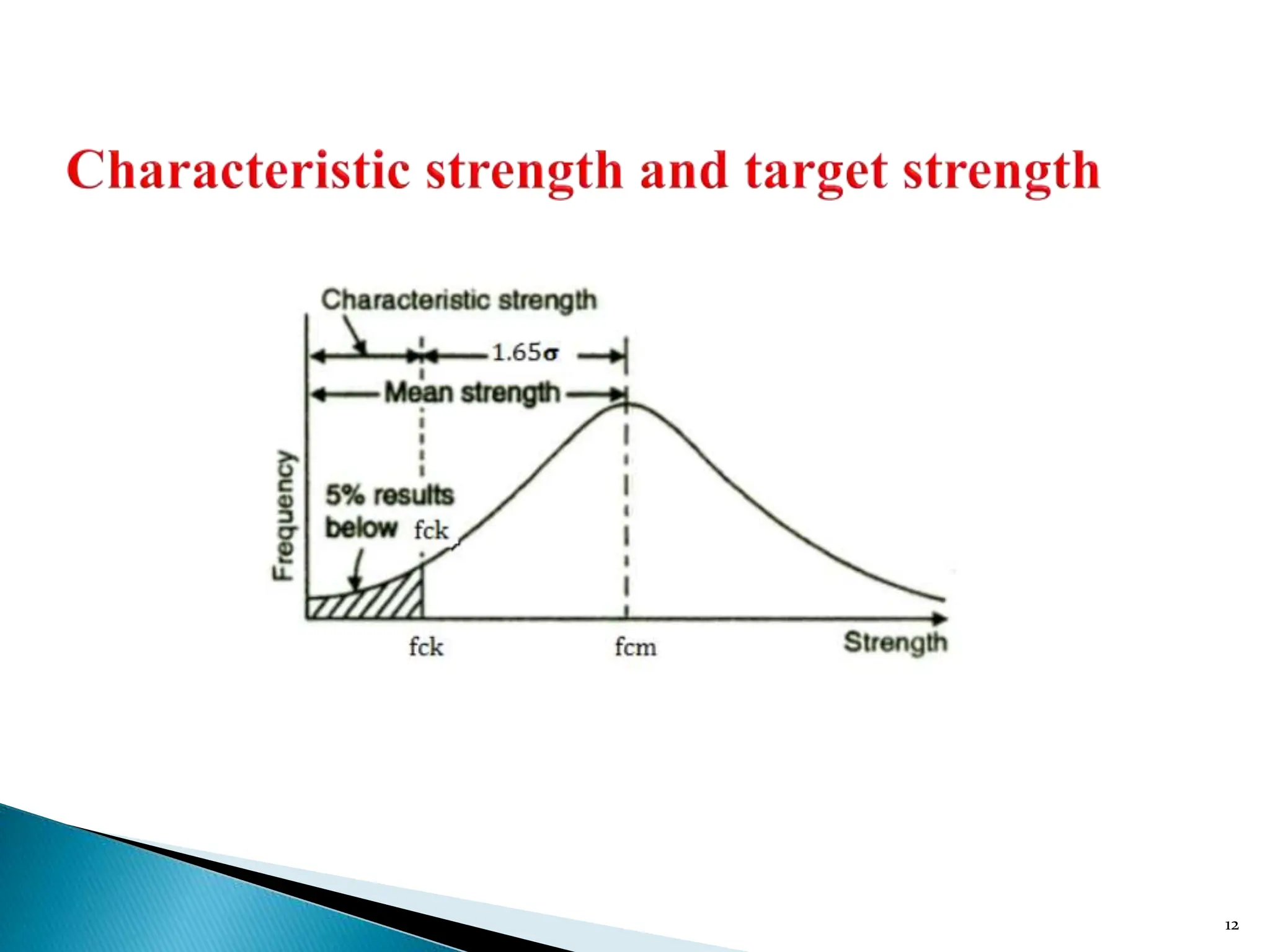
 Characteristic strength and target strength
 s/a ratio
8
9
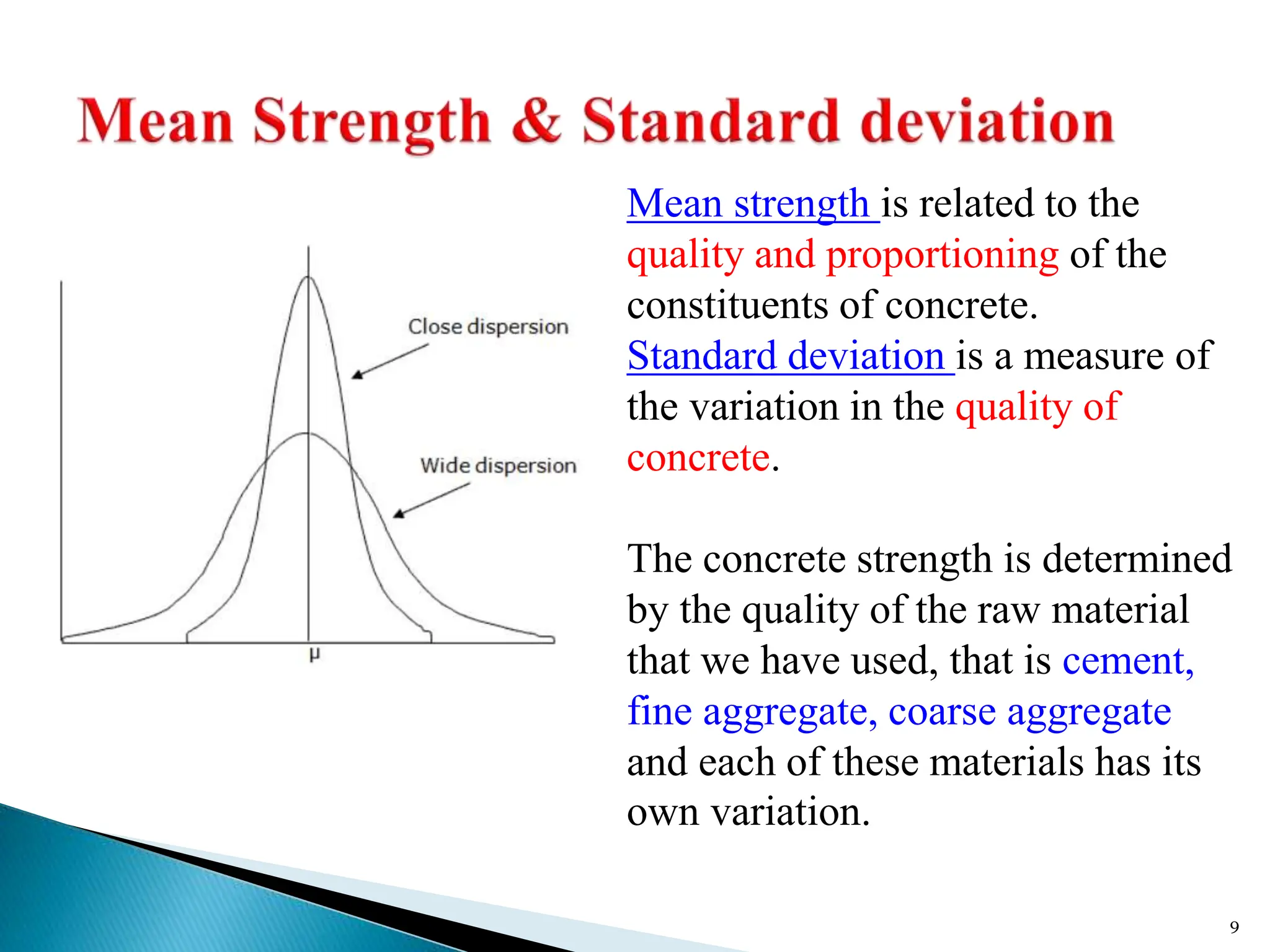
Mean strength is related to the
quality and proportioning of the
constituents of concrete.
Standard deviation is a measure of
the variation in the quality of
concrete.
The concrete strength is determined
by the quality of the raw material
that we have used, that is cement,
fine aggregate, coarse aggregate
and each of these materials has its
own variation.
Causes of variation in concrete quality
 The quality of constituent of materials
 Proportioning, which is weighing of constituent
 Mixing.
For example, the time the method, the mixer, if we mix
a certain concrete mix, let us say for one minute.
Another concrete mix for one and half minutes, it is
likely that the extent of mixing the extent of
homogeneity, which is achieved is different and that will
affect the strength of concrete.
10
 How many layers do we fill the concrete in? Whether,
we vibrate each layer, whether we vibrate the entire
specimen, the method of vibration and so on.
 All this effects the strength of concrete as determined
from that particular specimen,
 curing of specimens.
 Usually specifications require that the concrete is
stored under water, what is the temperature of that
water? specification give you certain ranges? Now,
within that range what is the actual value and so on.
 The testing of the specimen that is the rate of loading
specimen condition specimen is tested.
11
12
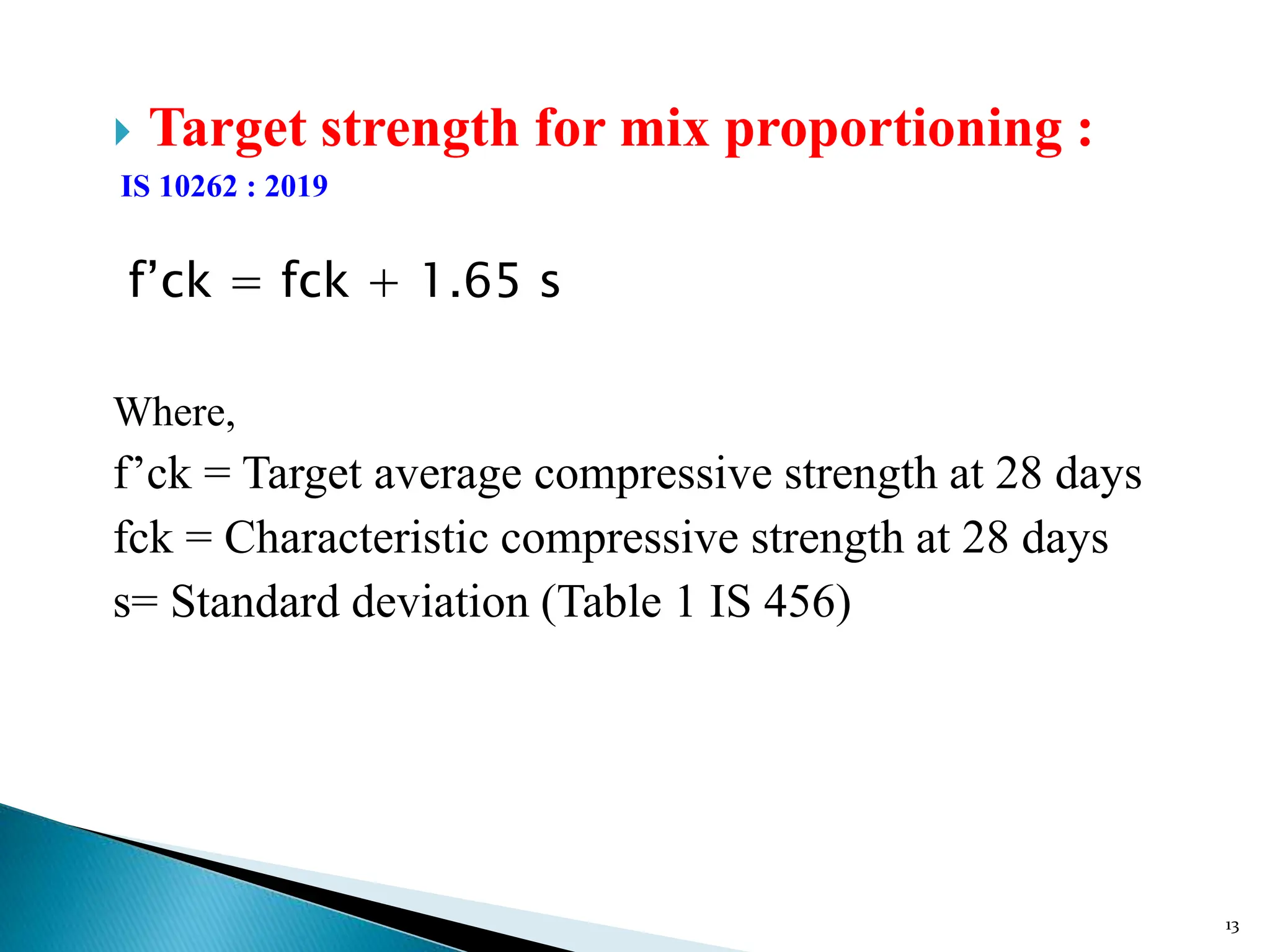
 Target strength for mix proportioning :
IS 10262 : 2019
f’ck = fck + 1.65 s
Where,
f’ck = Target average compressive strength at 28 days
fck = Characteristic compressive strength at 28 days
s= Standard deviation (Table 1 IS 456)
13
14
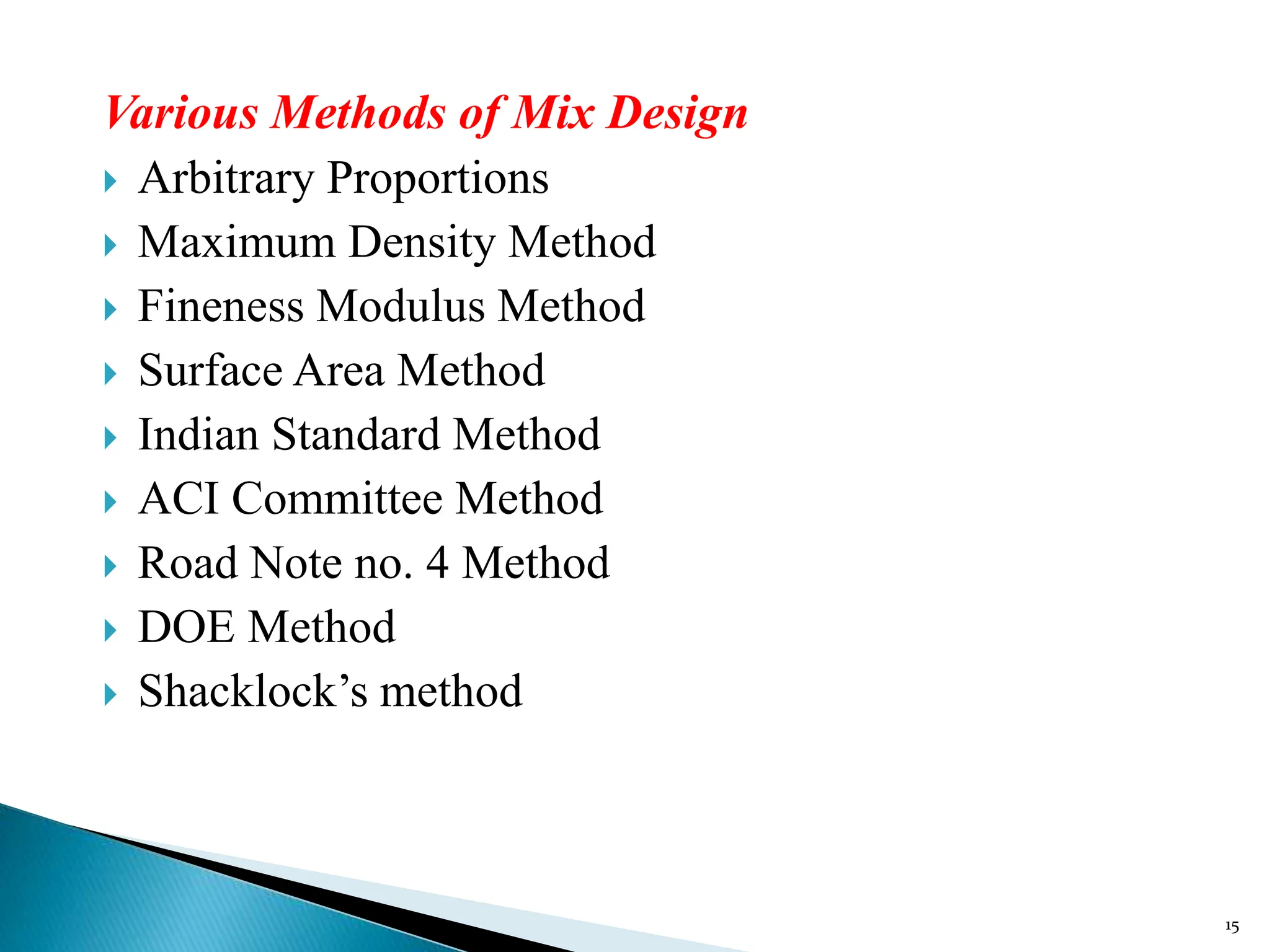
Various Methods of Mix Design
 Arbitrary Proportions
 Maximum Density Method
 Fineness Modulus Method
 Surface Area Method
 Indian Standard Method
 ACI Committee Method
 Road Note no. 4 Method
 DOE Method
 Shacklock’s method
15
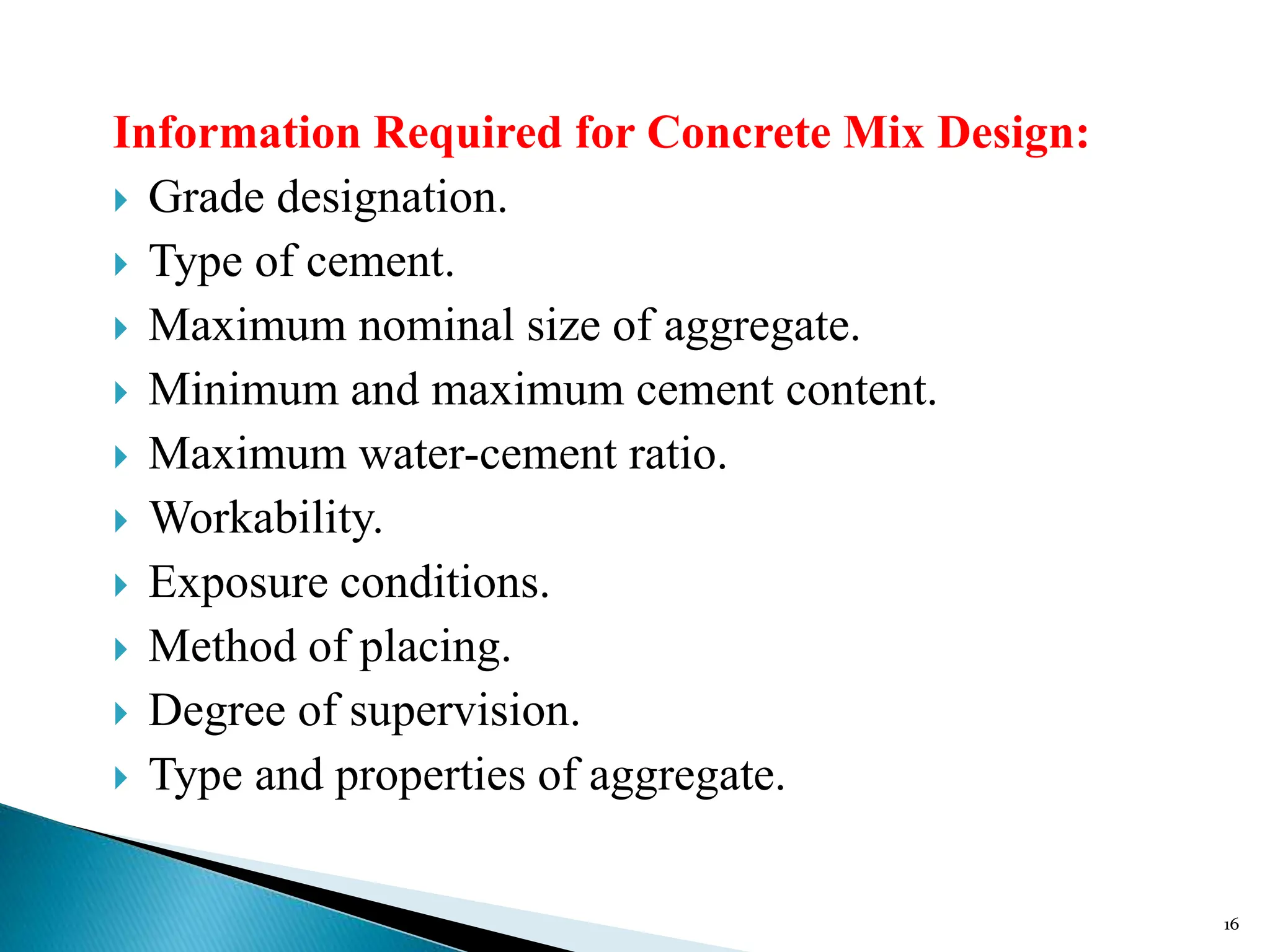
Information Required for Concrete Mix Design:
 Grade designation.
 Type of cement.
 Maximum nominal size of aggregate.
 Minimum and maximum cement content.
 Maximum water-cement ratio.
 Workability.
 Exposure conditions.
 Method of placing.
 Degree of supervision.
 Type and properties of aggregate.
16
Out of the above methods first four are not very
widely used these days but the procedures of mix
design recommended by American Concrete
Institute, Indian Standard method, DOE method
and Road Note No. 4 are widely adopted.
Shacklock’s method is mainly used for design of
high strength mixes.
17
 Problem
Illustrative examples on concrete mix
proportioning [M40 pumpable concrete with
fly ash]
Design stipulations for proportioning
 Grade designation : M40
 Type of cement : OPC 43 grade confirming to
IS 8112
 Type of mineral admixture : Fly ash
confirming to IS 3812 (Part-1)
 Maximum nominal size of aggregates : 20 mm
 Minimum cement content : 320 kg/m3
18
 Maximum water cement ratio : 0.45
 Workability : 100 mm (slump)
 Exposure condition : Severe (for reinforced
concrete)
 Method of concrete placing : Pumping
 Degree of supervision : Good
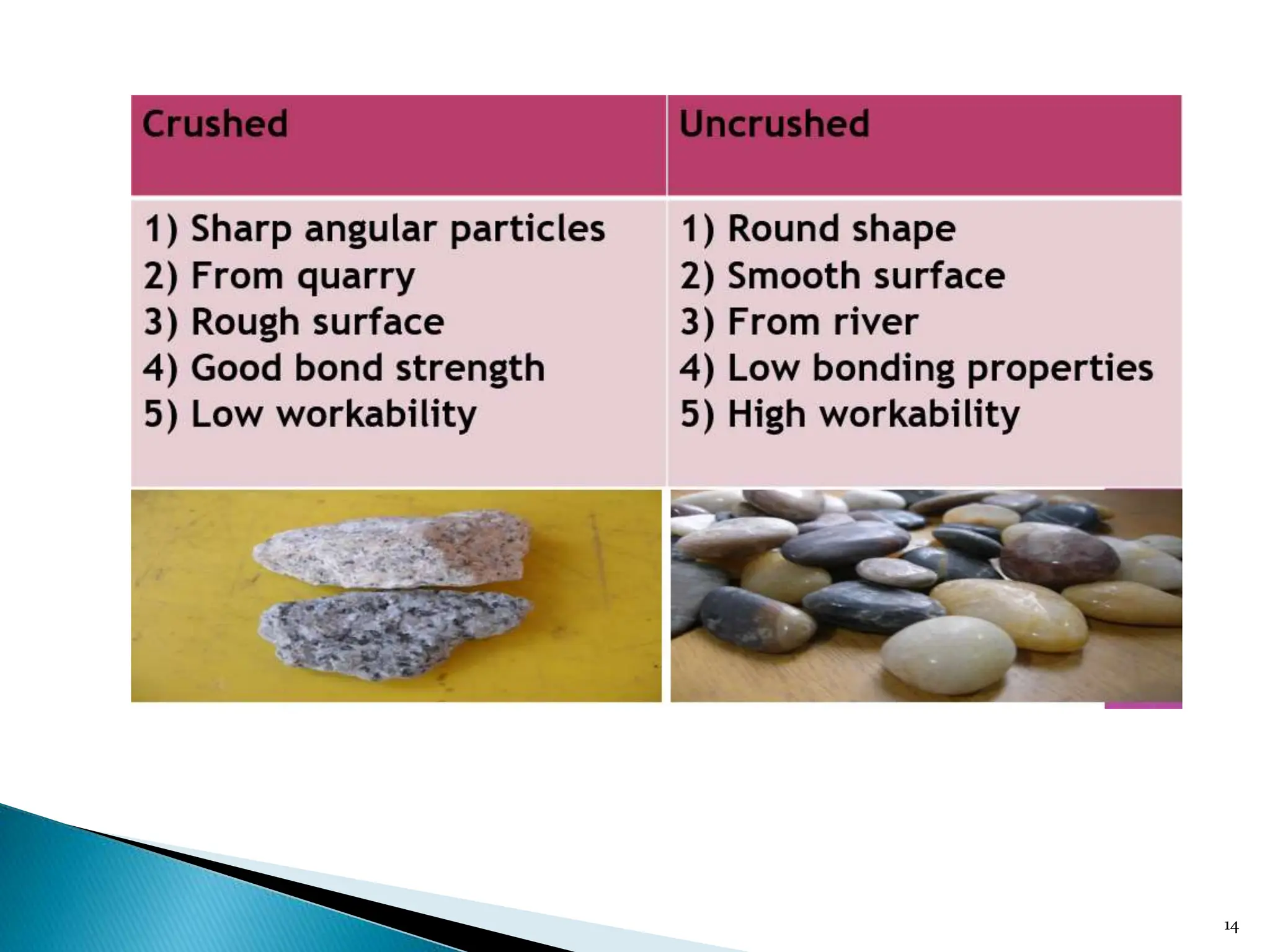
 Type of aggregate : Crushed angular
aggregate
19
 Maximum cement content : 450 kg/m3
 Chemical admixture type : Superplsticiser
TEST DATA FOR MATERIALS
 Cement used : OPC 43 grade confirming to IS
8112
 Specific gravity of cement : 3.15
 Fly ash used : Fly ash confirming to IS 3812
(Part-1)
 Specific gravity of fly ash : 2.2
 Chemical admixture : Superplasticiser
conforming to IS 9103
 Specific gravity of Coarse aggregate : 2.74
Fine aggregate : 2.74
20
 Water absorption
 Coarse aggregate : 0.5 percent
 Fine aggregate : 1.0 percent
 Free (surface) moisture
 Coarse aggregate : Nil (absorbed moisture
also nil)
 Fine aggregate : Nil
 Sieve analysis
 Coarse aggregate : Conforming to Table 2 of
IS: 383
 Fine aggregate : Conforming to Zone I of IS:
383
21
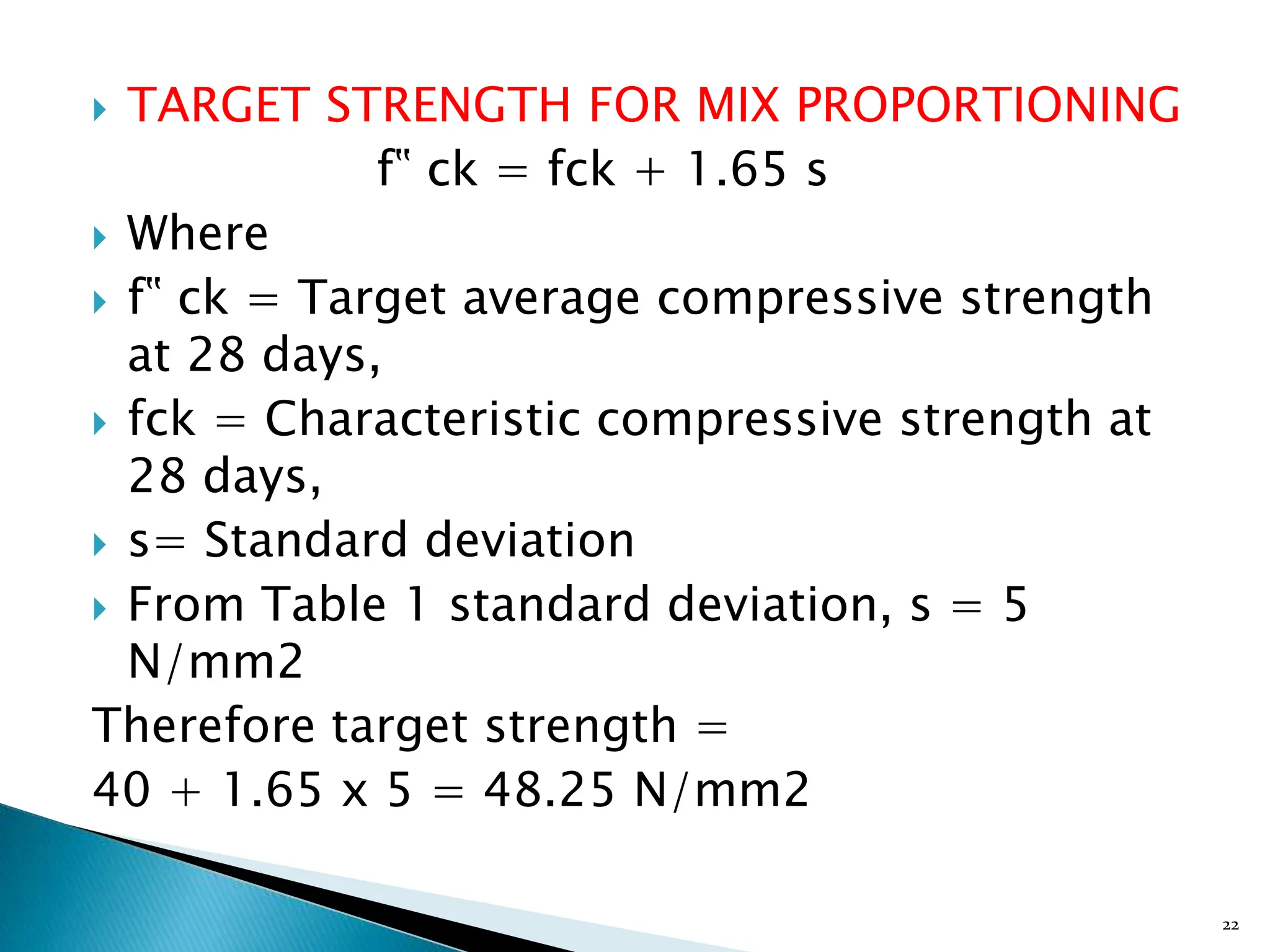
 TARGET STRENGTH FOR MIX PROPORTIONING
f‟ ck = fck + 1.65 s
 Where
 f‟ ck = Target average compressive strength
at 28 days,
 fck = Characteristic compressive strength at
28 days,
 s= Standard deviation
 From Table 1 standard deviation, s = 5
N/mm2
Therefore target strength =
40 + 1.65 x 5 = 48.25 N/mm2
22
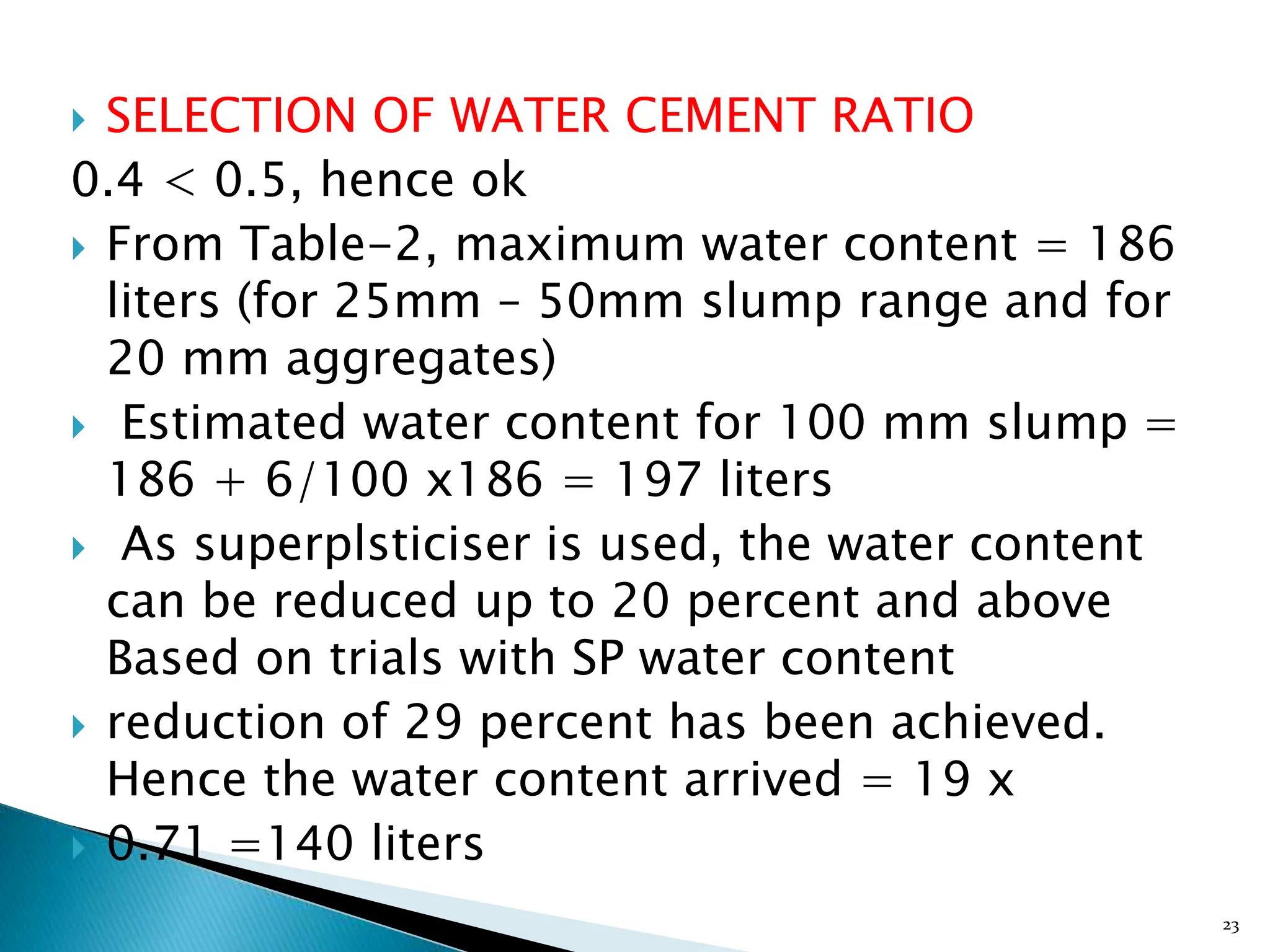
 SELECTION OF WATER CEMENT RATIO
0.4 < 0.5, hence ok
 From Table-2, maximum water content = 186
liters (for 25mm – 50mm slump range and for
20 mm aggregates)
 Estimated water content for 100 mm slump =
186 + 6/100 x186 = 197 liters
 As superplsticiser is used, the water content
can be reduced up to 20 percent and above
Based on trials with SP water content
 reduction of 29 percent has been achieved.
Hence the water content arrived = 19 x
 0.71 =140 liters
23
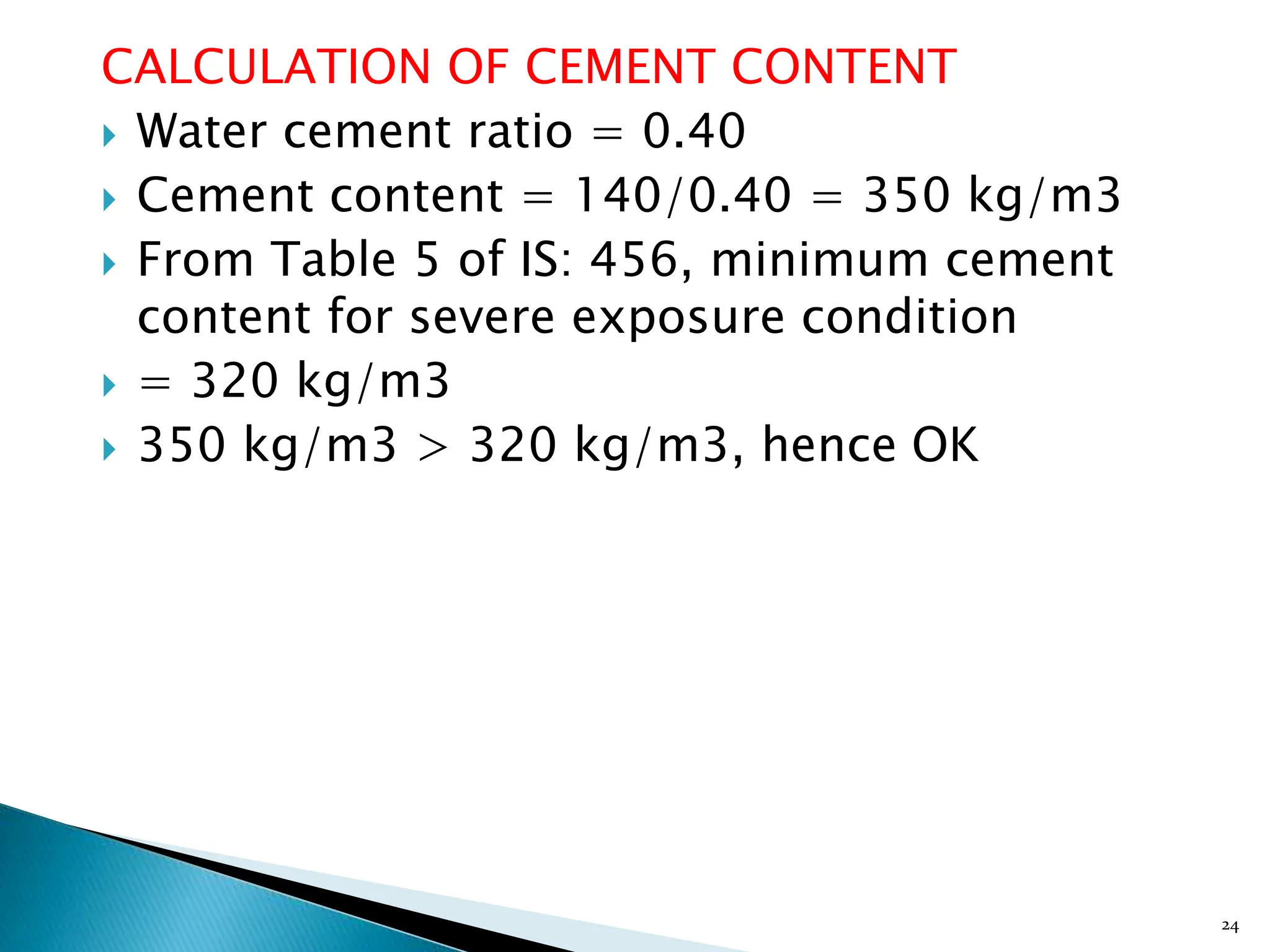
CALCULATION OF CEMENT CONTENT
 Water cement ratio = 0.40
 Cement content = 140/0.40 = 350 kg/m3
 From Table 5 of IS: 456, minimum cement
content for severe exposure condition
 = 320 kg/m3
 350 kg/m3 > 320 kg/m3, hence OK
24
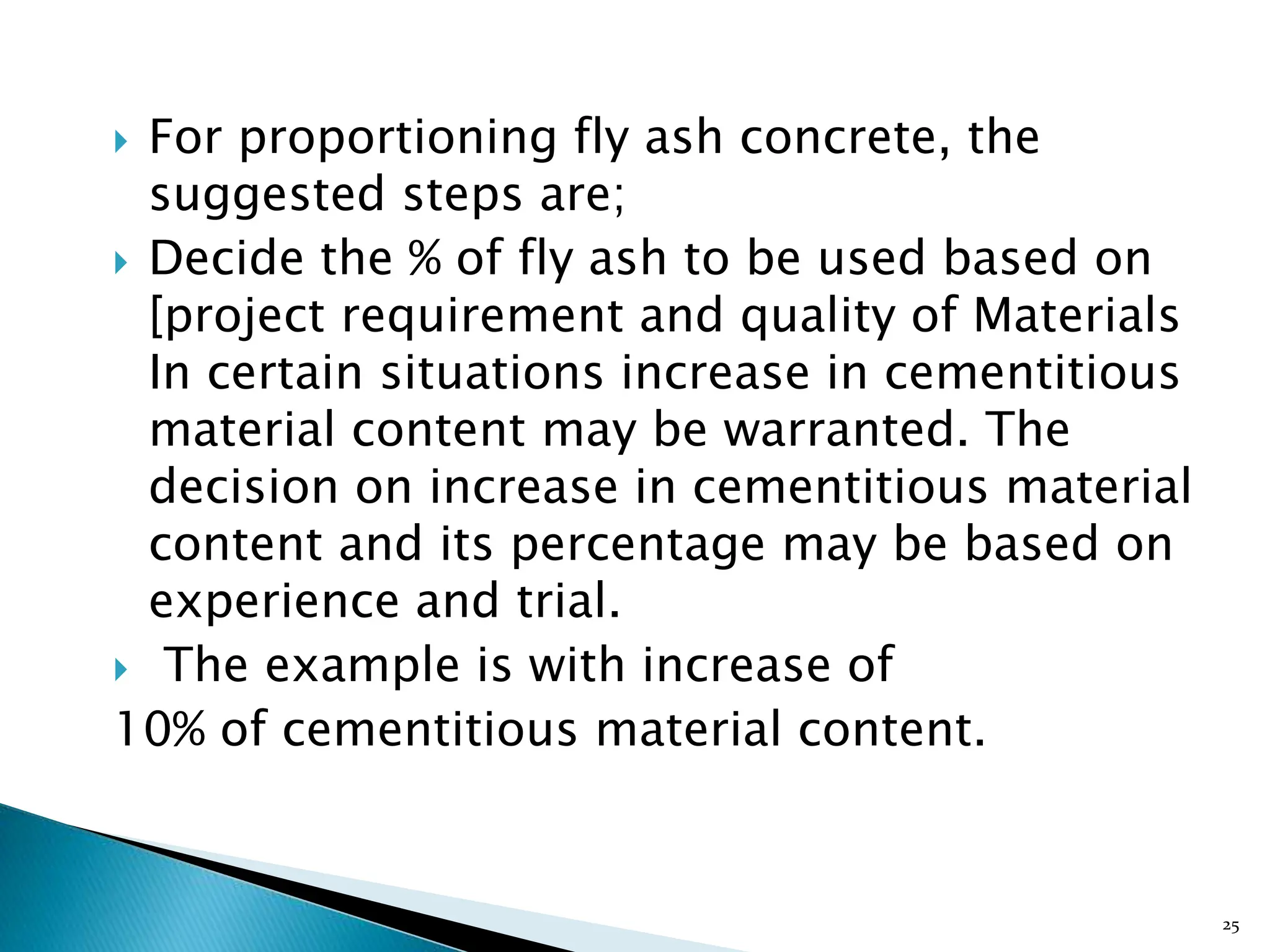
 For proportioning fly ash concrete, the
suggested steps are;
 Decide the % of fly ash to be used based on
[project requirement and quality of Materials
In certain situations increase in cementitious
material content may be warranted. The
decision on increase in cementitious material
content and its percentage may be based on
experience and trial.
 The example is with increase of
10% of cementitious material content.
25
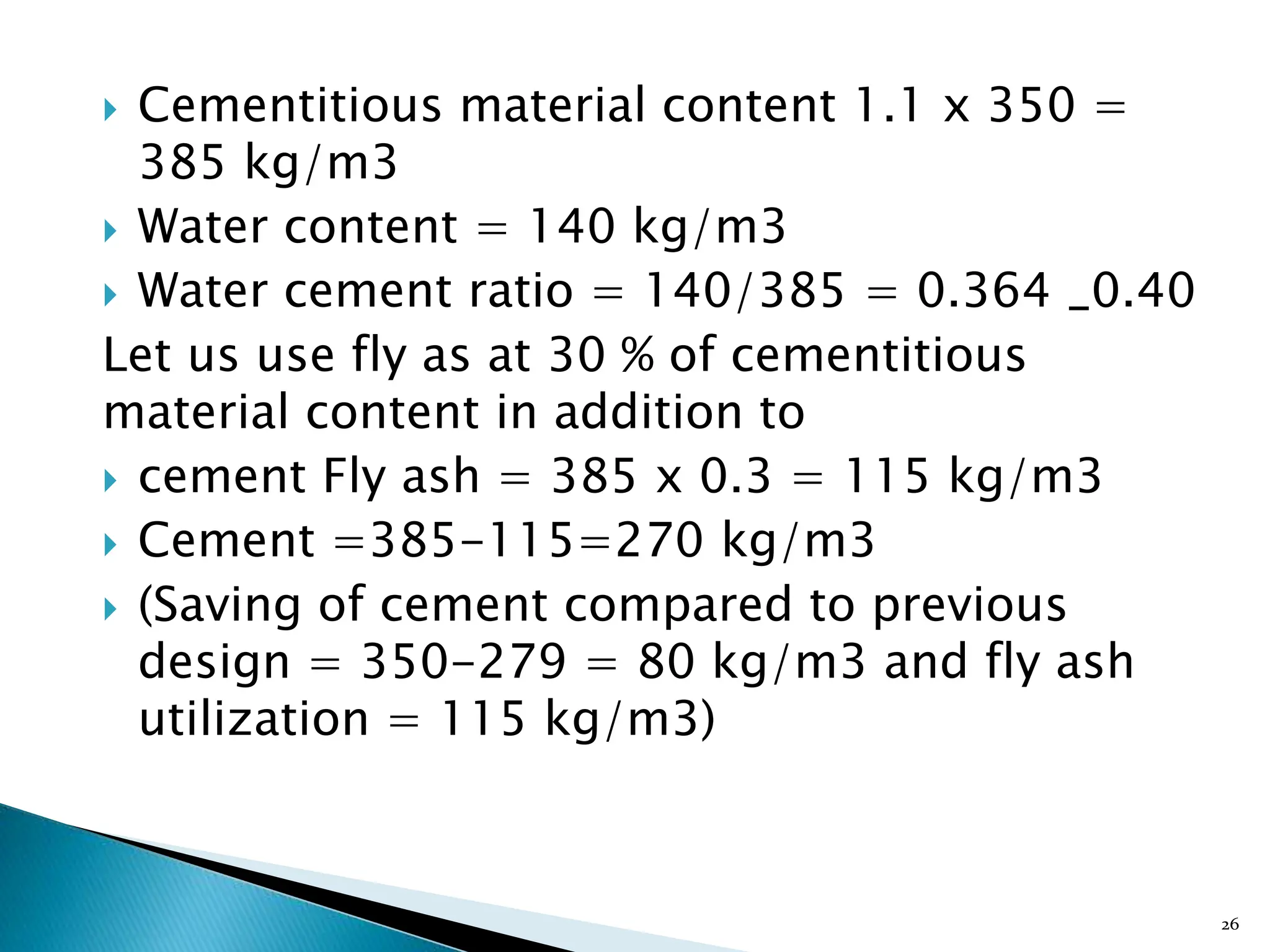
 Cementitious material content 1.1 x 350 =
385 kg/m3
 Water content = 140 kg/m3
 Water cement ratio = 140/385 = 0.364 _0.40
Let us use fly as at 30 % of cementitious
material content in addition to
 cement Fly ash = 385 x 0.3 = 115 kg/m3
 Cement =385-115=270 kg/m3
 (Saving of cement compared to previous
design = 350-279 = 80 kg/m3 and fly ash
utilization = 115 kg/m3)
26
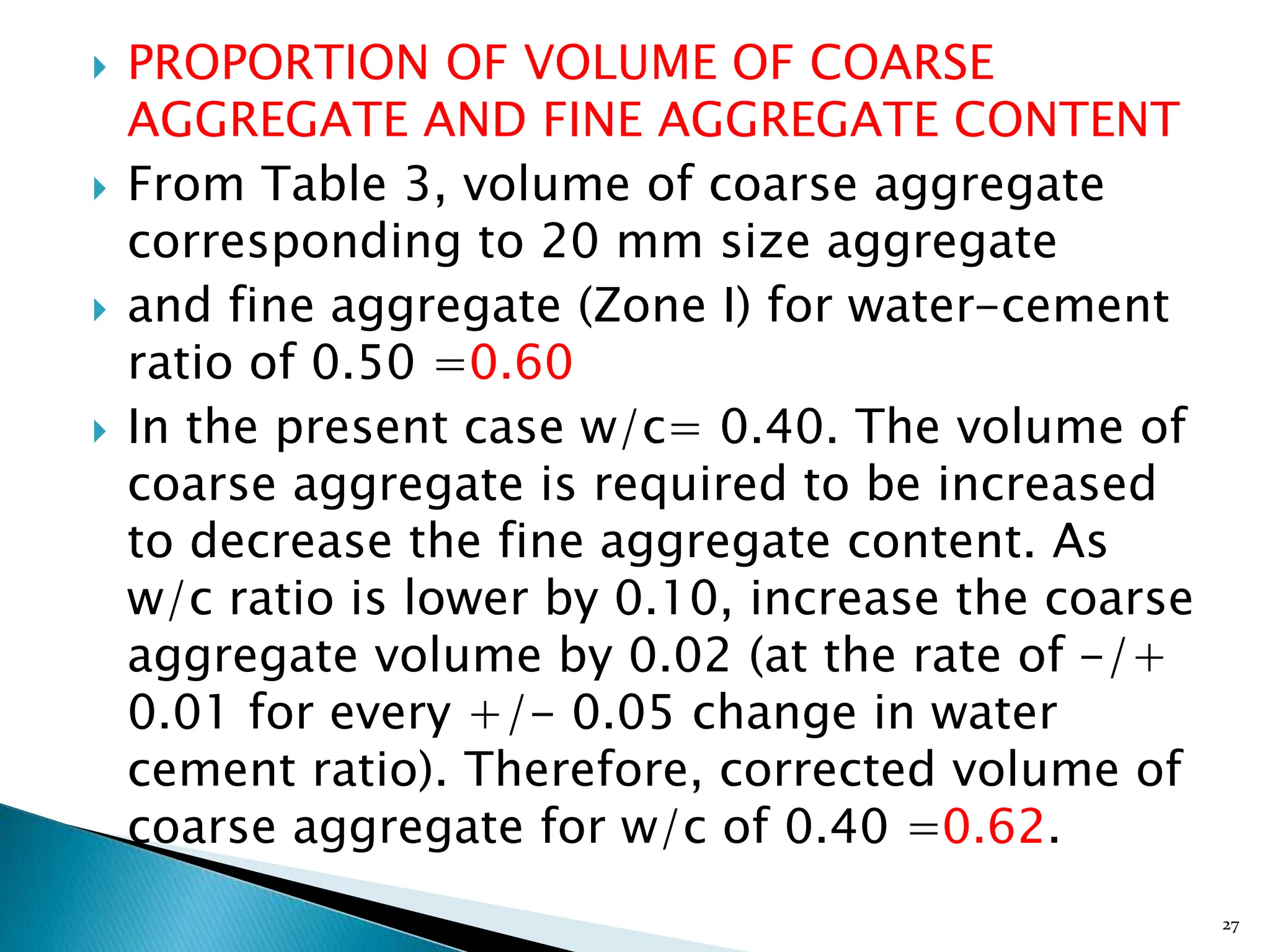
 PROPORTION OF VOLUME OF COARSE
AGGREGATE AND FINE AGGREGATE CONTENT
 From Table 3, volume of coarse aggregate
corresponding to 20 mm size aggregate
 and fine aggregate (Zone I) for water-cement
ratio of 0.50 =0.60
 In the present case w/c= 0.40. The volume of
coarse aggregate is required to be increased
to decrease the fine aggregate content. As
w/c ratio is lower by 0.10, increase the coarse
aggregate volume by 0.02 (at the rate of -/+
0.01 for every +/- 0.05 change in water
cement ratio). Therefore, corrected volume of
coarse aggregate for w/c of 0.40 =0.62.
27
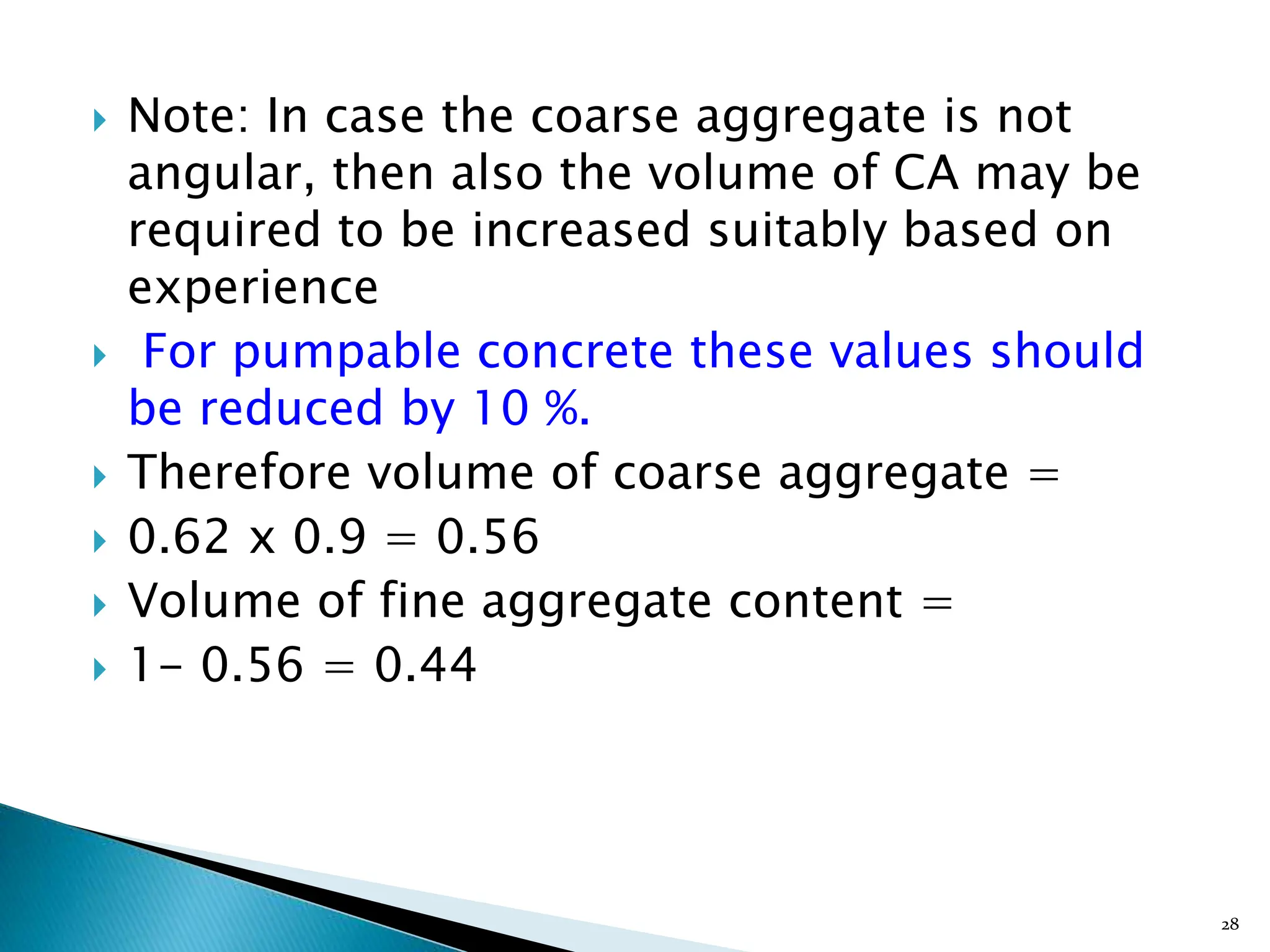
 Note: In case the coarse aggregate is not
angular, then also the volume of CA may be
required to be increased suitably based on
experience
 For pumpable concrete these values should
be reduced by 10 %.
 Therefore volume of coarse aggregate =
 0.62 x 0.9 = 0.56
 Volume of fine aggregate content =
 1- 0.56 = 0.44
28
MIX CALCULATIONS
 The mix calculations per unit volume of
concrete shall be as follows
 Volume of concrete = 1 m3
 Volume of air content = 0.01m3
 Volume of cement =
[270/3.15] x [1/1000] = 0.086 m3
 Volume of fly ash = [115/2.2] x [1/1000] =
0.052 m3
 Volume of water = [140/1] x [1/1000] =
0.140 m3
29
 Volume of chemical admixture = [7.7/1.145]
x [1/1000] = 0.007 m3
 ( SP 2% by mass of cementitious material)
 Volume of all in aggregates (e)
= 1 – (0.086 + 0.052 + 0.140 + 0.007) =
0.715 m3
 Volume of coarse aggregates = e x Volume
of CA x specific gravity of CA
 = 0.715 x 0.56 x 2.74 x 1000 = 1097 kg
 Volume of fine aggregates = e x Volume of
FA x specific gravity of FA
= 0.715 x 0.44 x 2.74 x 1000 = 862 kg
30
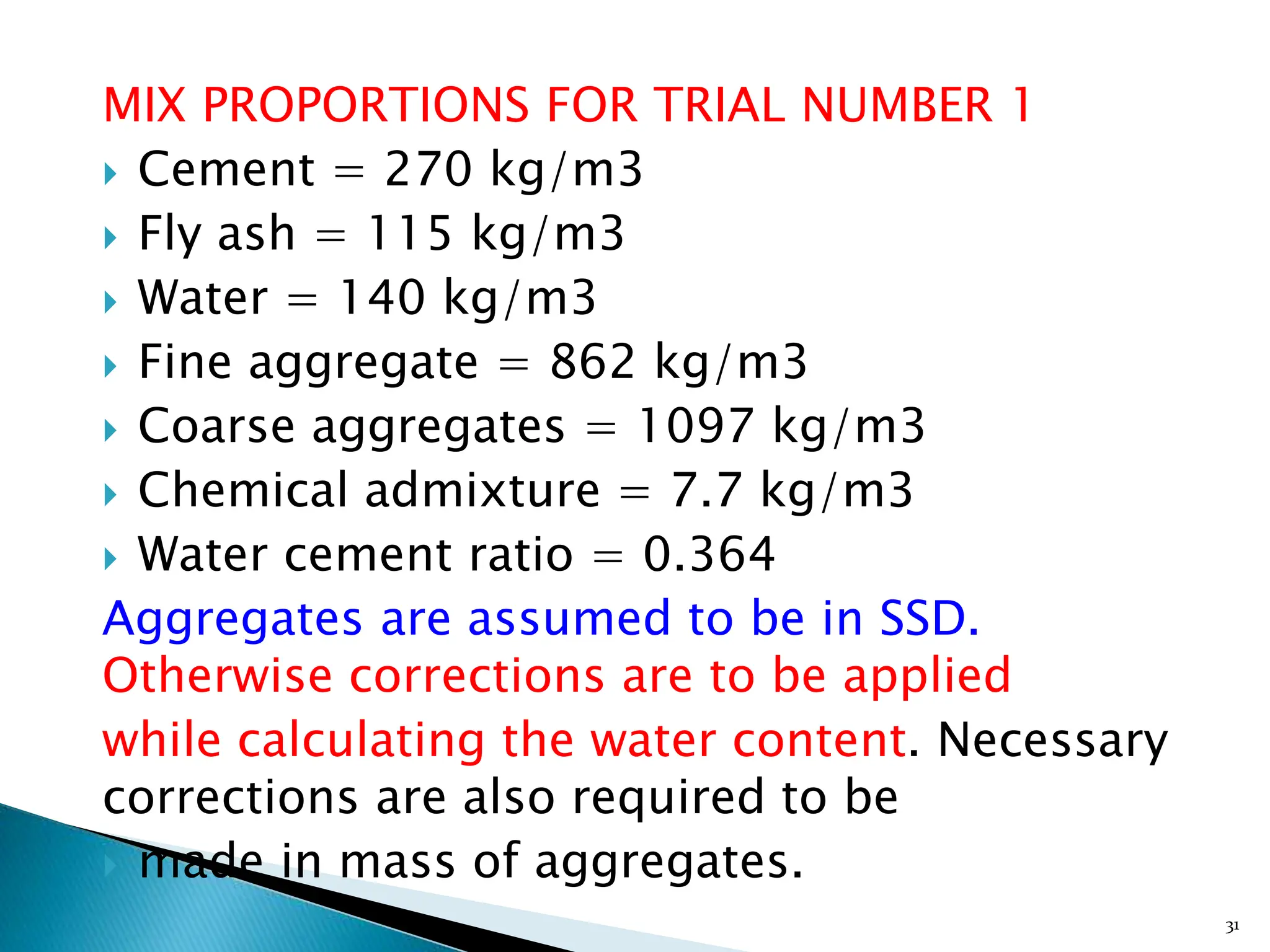
MIX PROPORTIONS FOR TRIAL NUMBER 1
 Cement = 270 kg/m3
 Fly ash = 115 kg/m3
 Water = 140 kg/m3
 Fine aggregate = 862 kg/m3
 Coarse aggregates = 1097 kg/m3
 Chemical admixture = 7.7 kg/m3
 Water cement ratio = 0.364
Aggregates are assumed to be in SSD.
Otherwise corrections are to be applied
while calculating the water content. Necessary
corrections are also required to be
 made in mass of aggregates.
31
 The DoE Design of normal concrete mixes has replaced
the traditional British mix design method of Road Note
No. 4.
 This method was first published in 1975 and revised in
1988.
 The method uses the relationship between water-
cement ratio and compressive strength of concrete
depending on the type of cement and the type of
aggregate used.
 This method can also be used for concrete containing
fly ash.
32
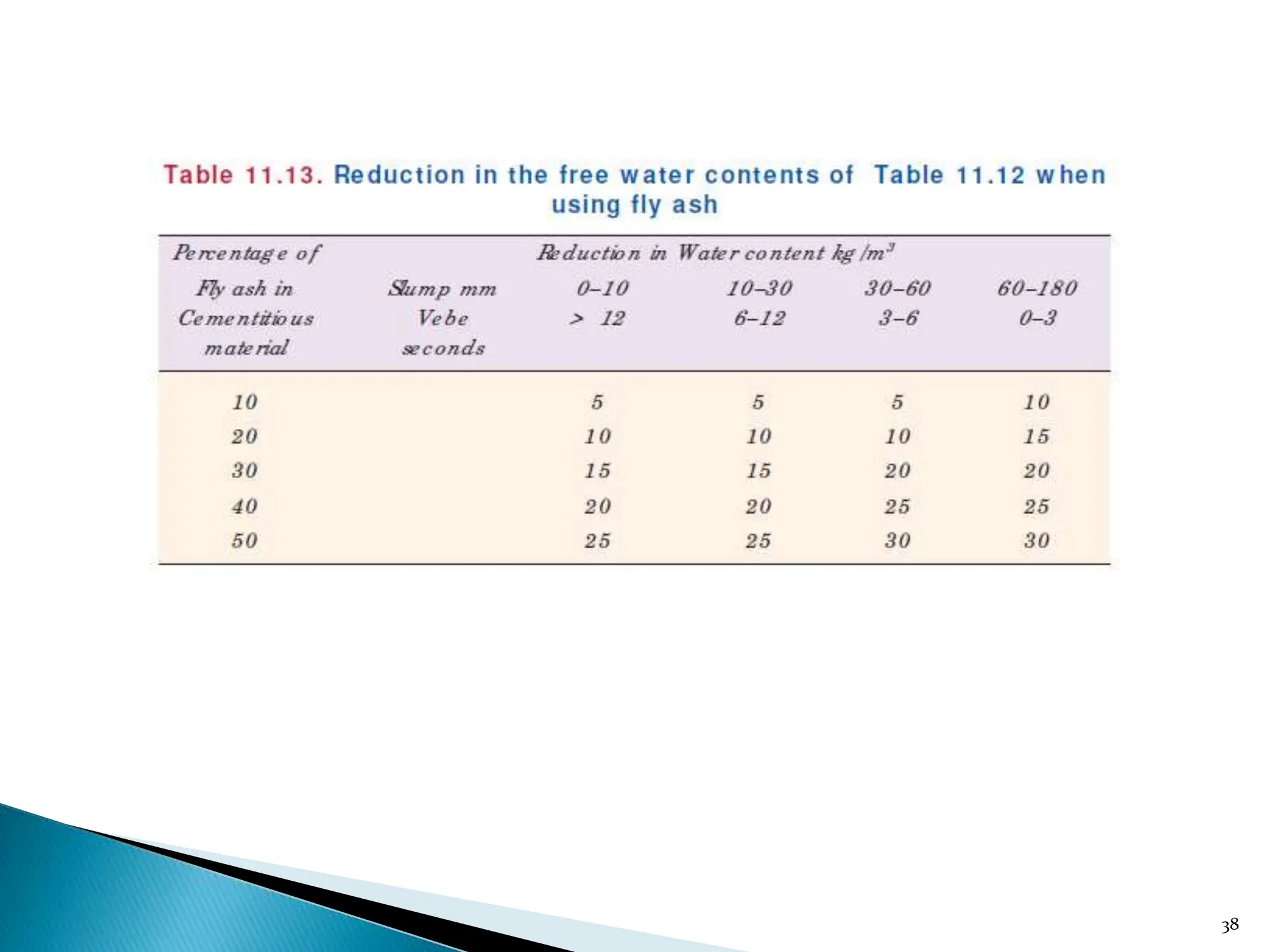
 The water contents required to give various levels of
workability, i.e: very low, low, medium and high
(expressed in terms of slump or Vee-Bee time) are
determined for the two types of aggregates, viz.,
crushed (angular) and uncrushed (gravel).
 The method gives mix proportions in terms of
quantities of materials per unit volume of concrete.
 DoE method is standard method of mix design in UK.
 This method is suitable for mix design of normal
concrete mixes having 28 days cube compressive
strength upto 75 MPa for non air entrained concrete.
33
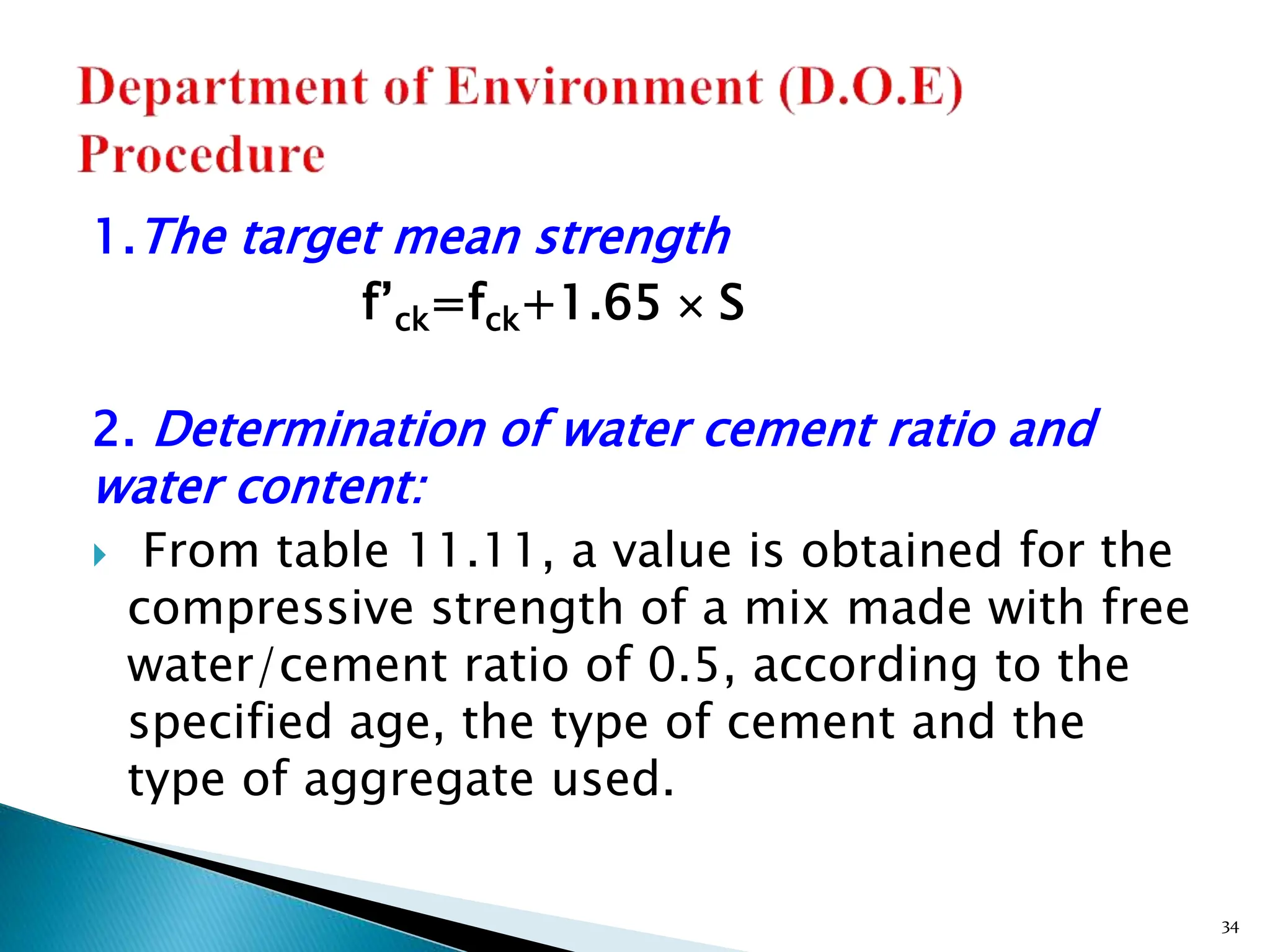
1.The target mean strength
f’ck=fck+1.65  S
2. Determination of water cement ratio and
water content:
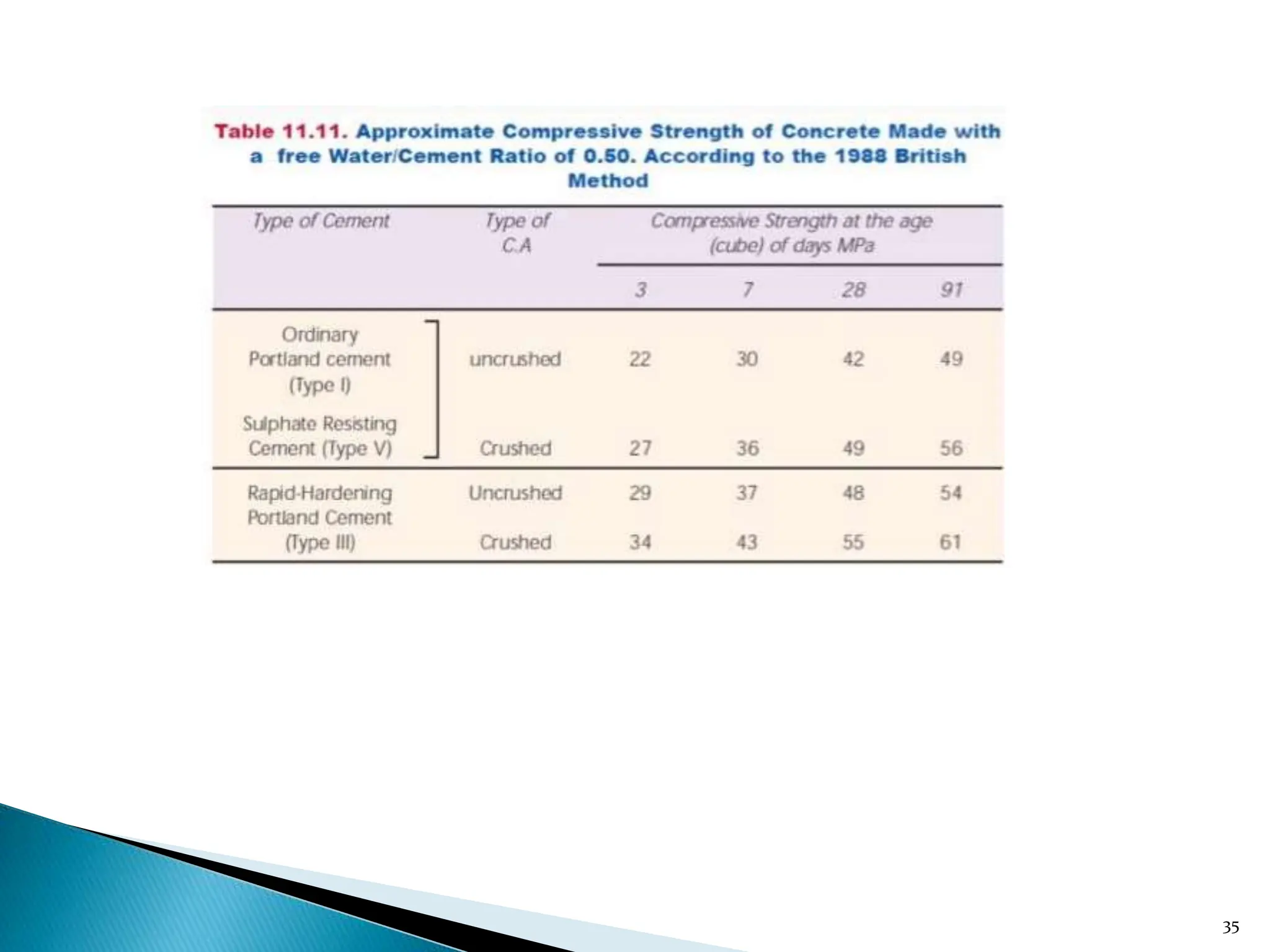
 From table 11.11, a value is obtained for the
compressive strength of a mix made with free
water/cement ratio of 0.5, according to the
specified age, the type of cement and the
type of aggregate used.
34
35
36
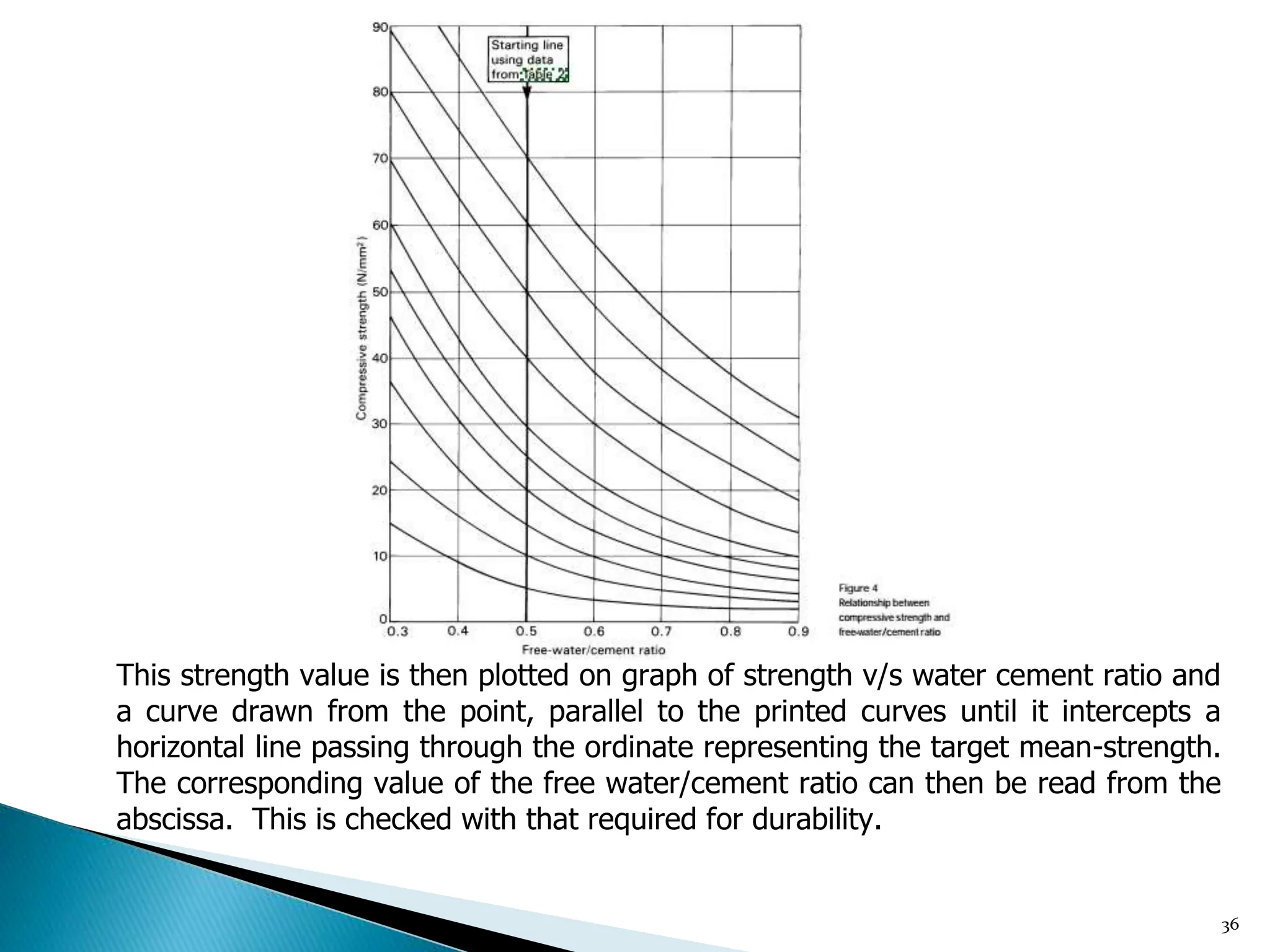
This strength value is then plotted on graph of strength v/s water cement ratio and
a curve drawn from the point, parallel to the printed curves until it intercepts a
horizontal line passing through the ordinate representing the target mean-strength.
The corresponding value of the free water/cement ratio can then be read from the
abscissa. This is checked with that required for durability.
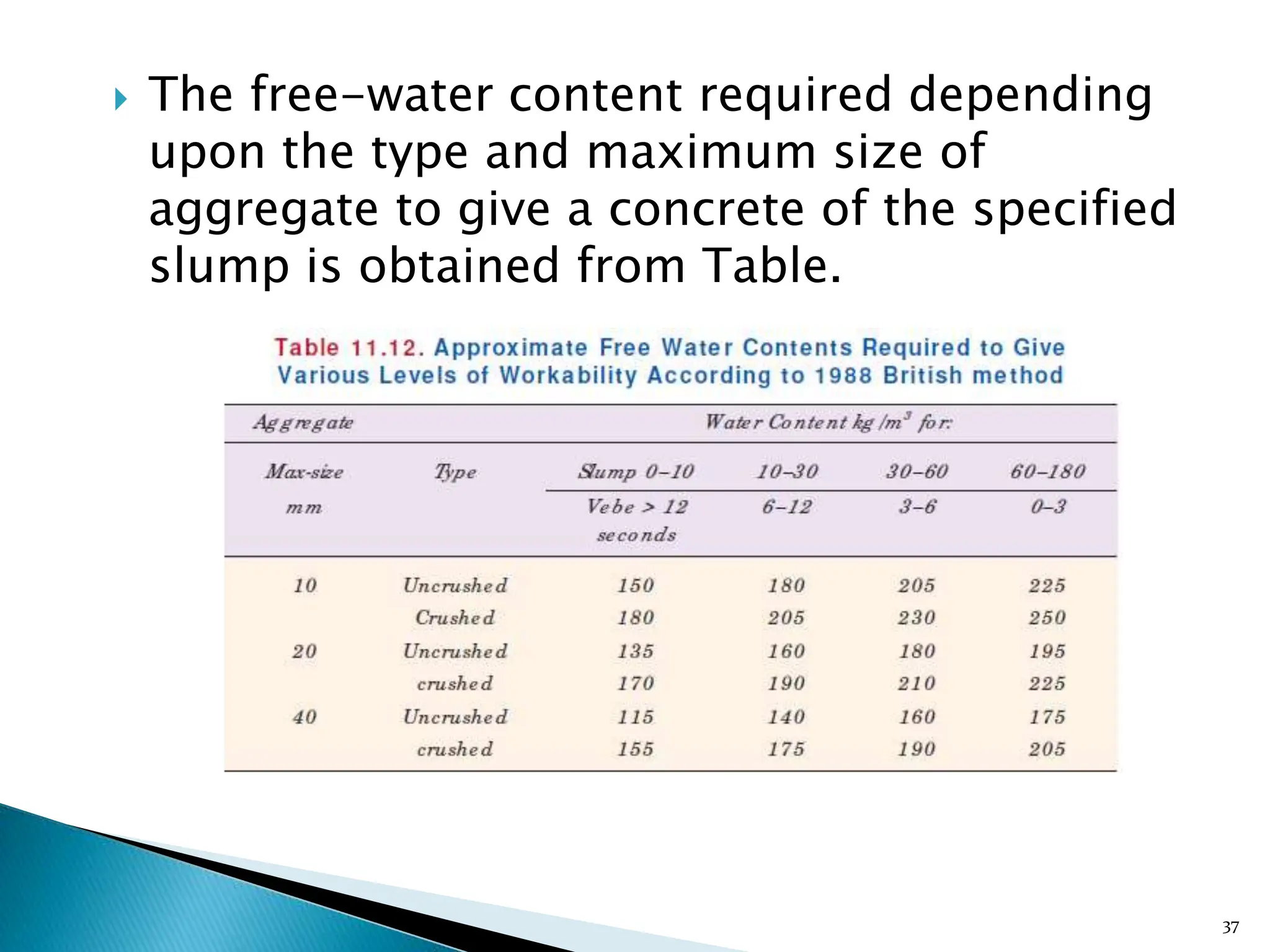
 The free-water content required depending
upon the type and maximum size of
aggregate to give a concrete of the specified
slump is obtained from Table.
37
38
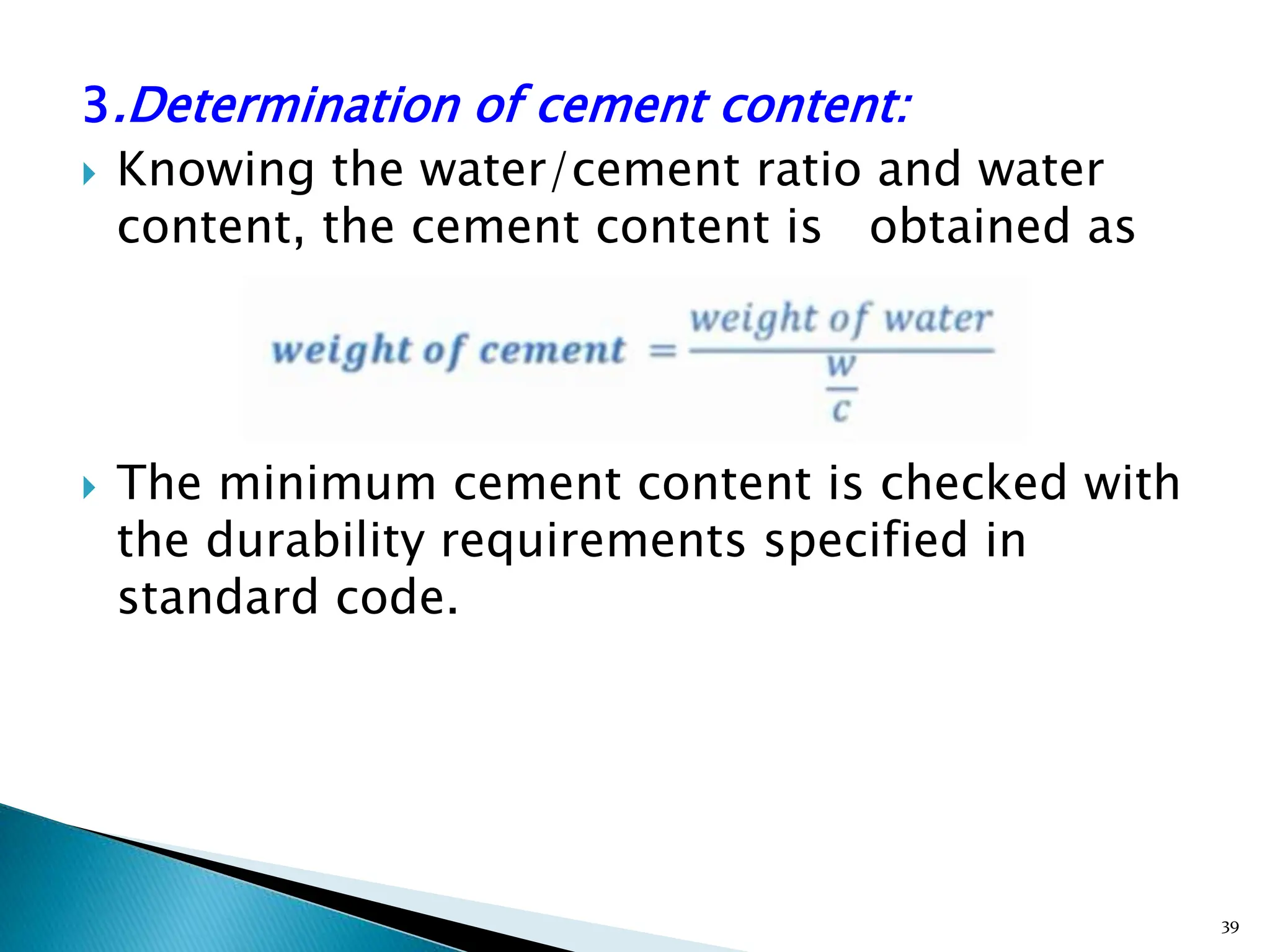
3.Determination of cement content:
 Knowing the water/cement ratio and water
content, the cement content is obtained as
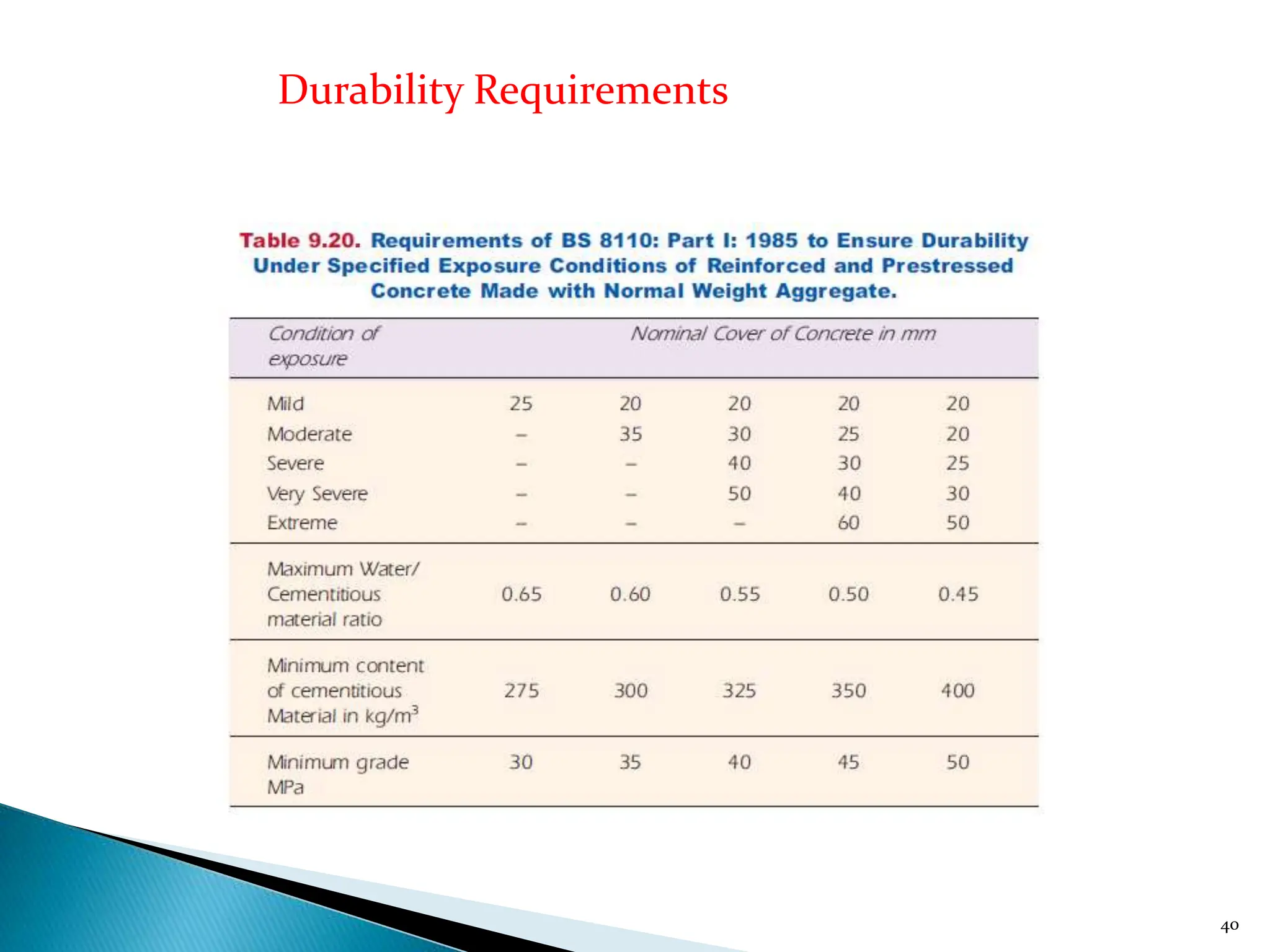
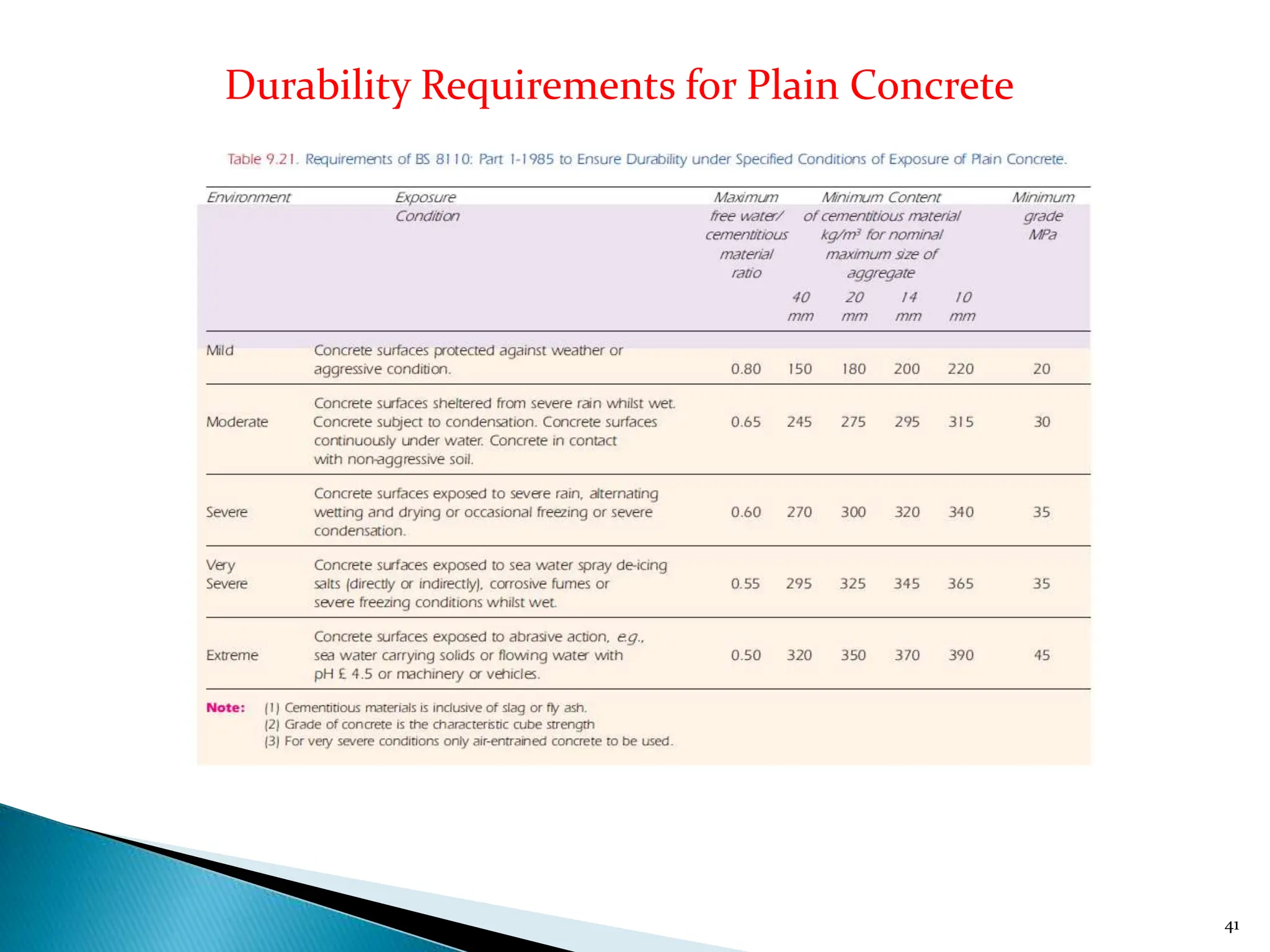
 The minimum cement content is checked with
the durability requirements specified in
standard code.
39
40
Durability Requirements
41
Durability Requirements for Plain Concrete
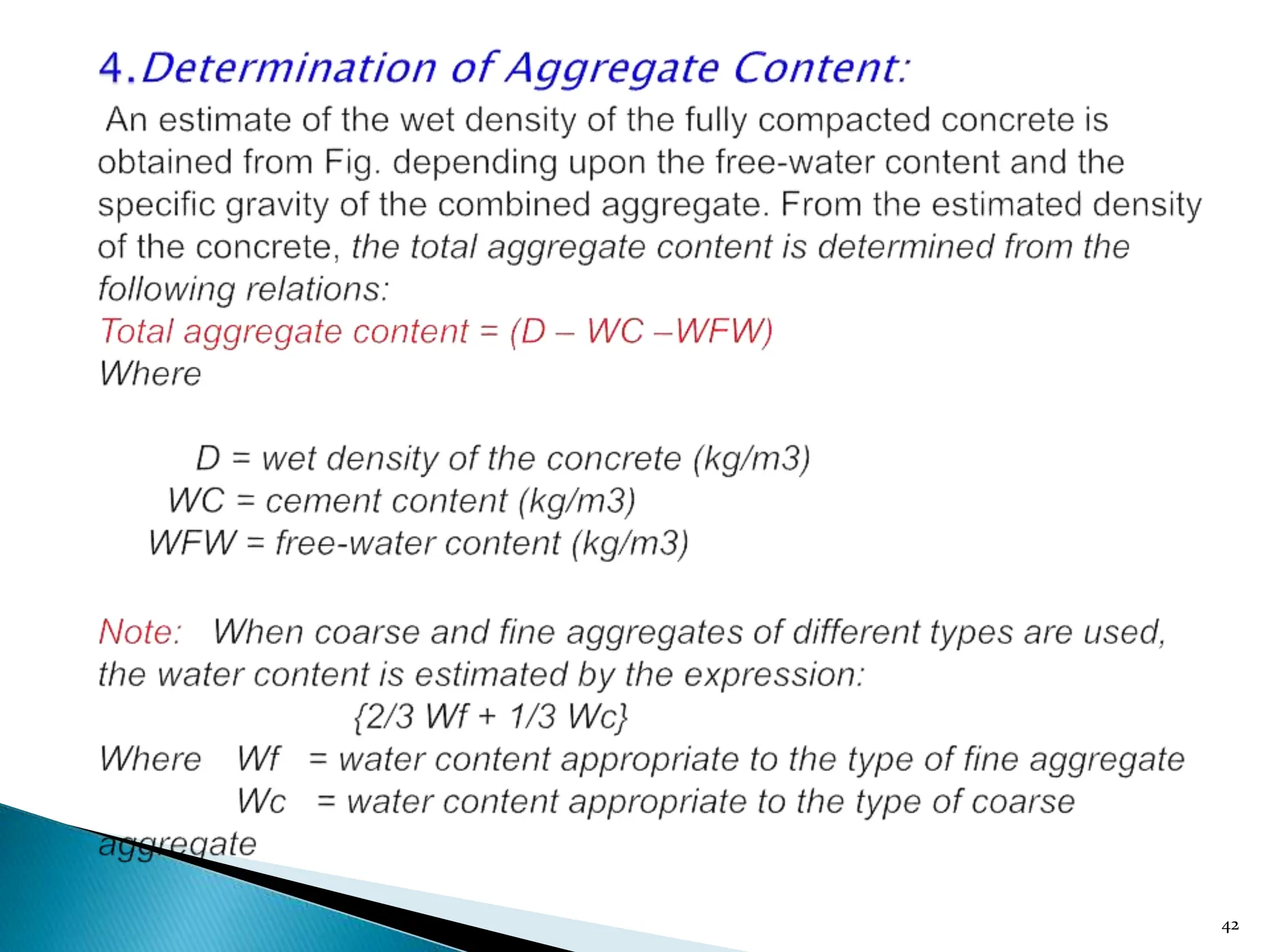
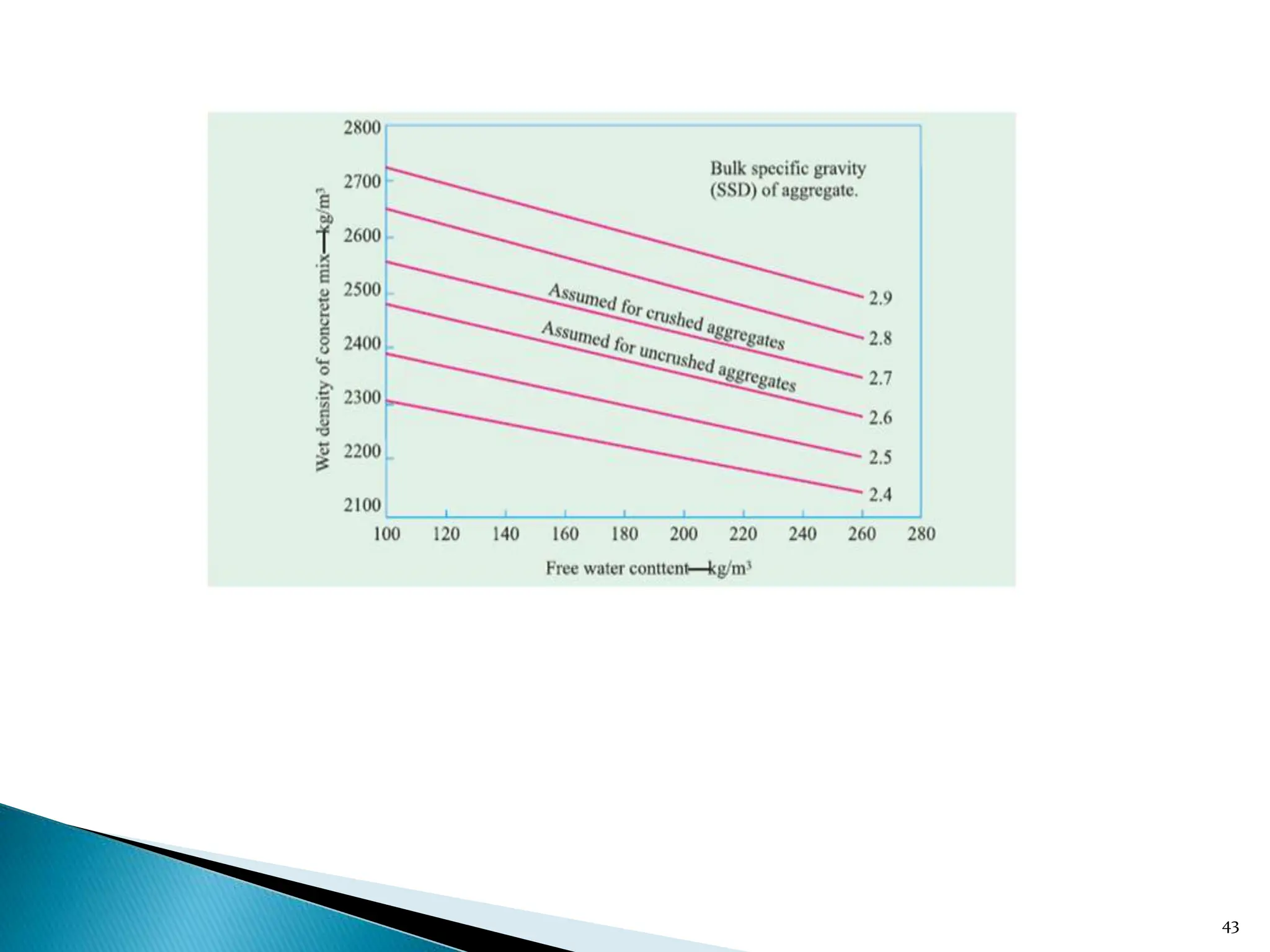
42
43
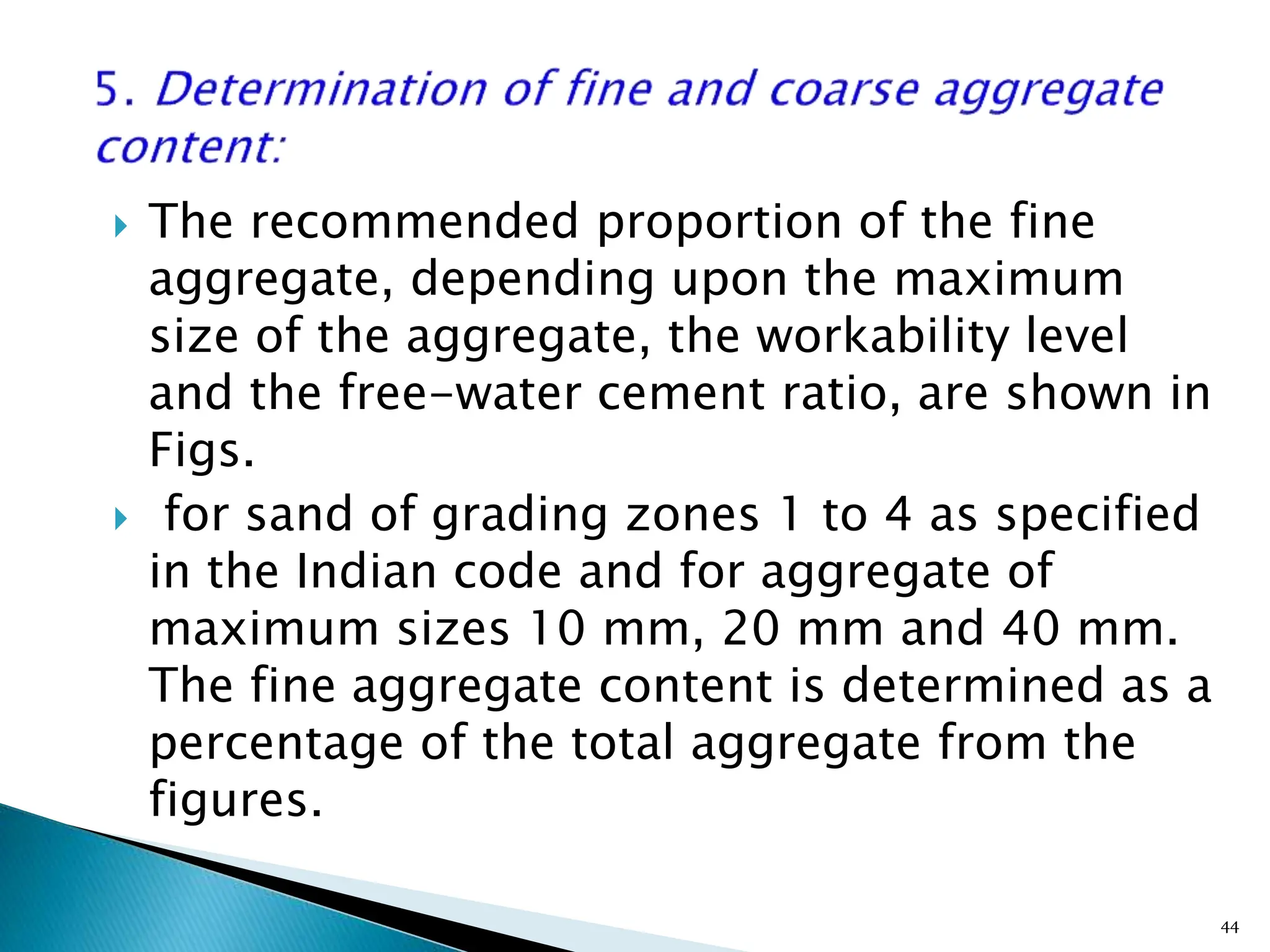
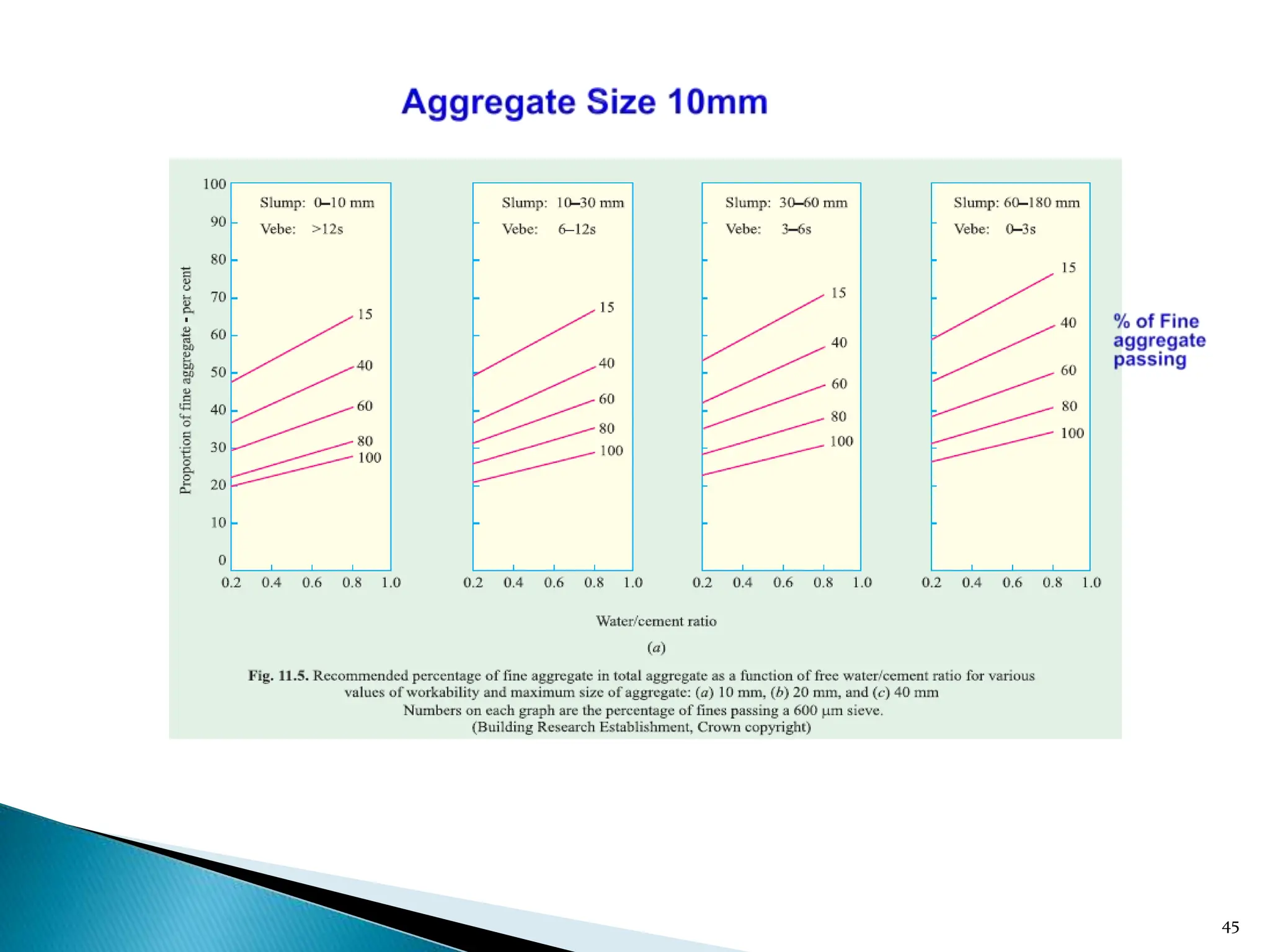
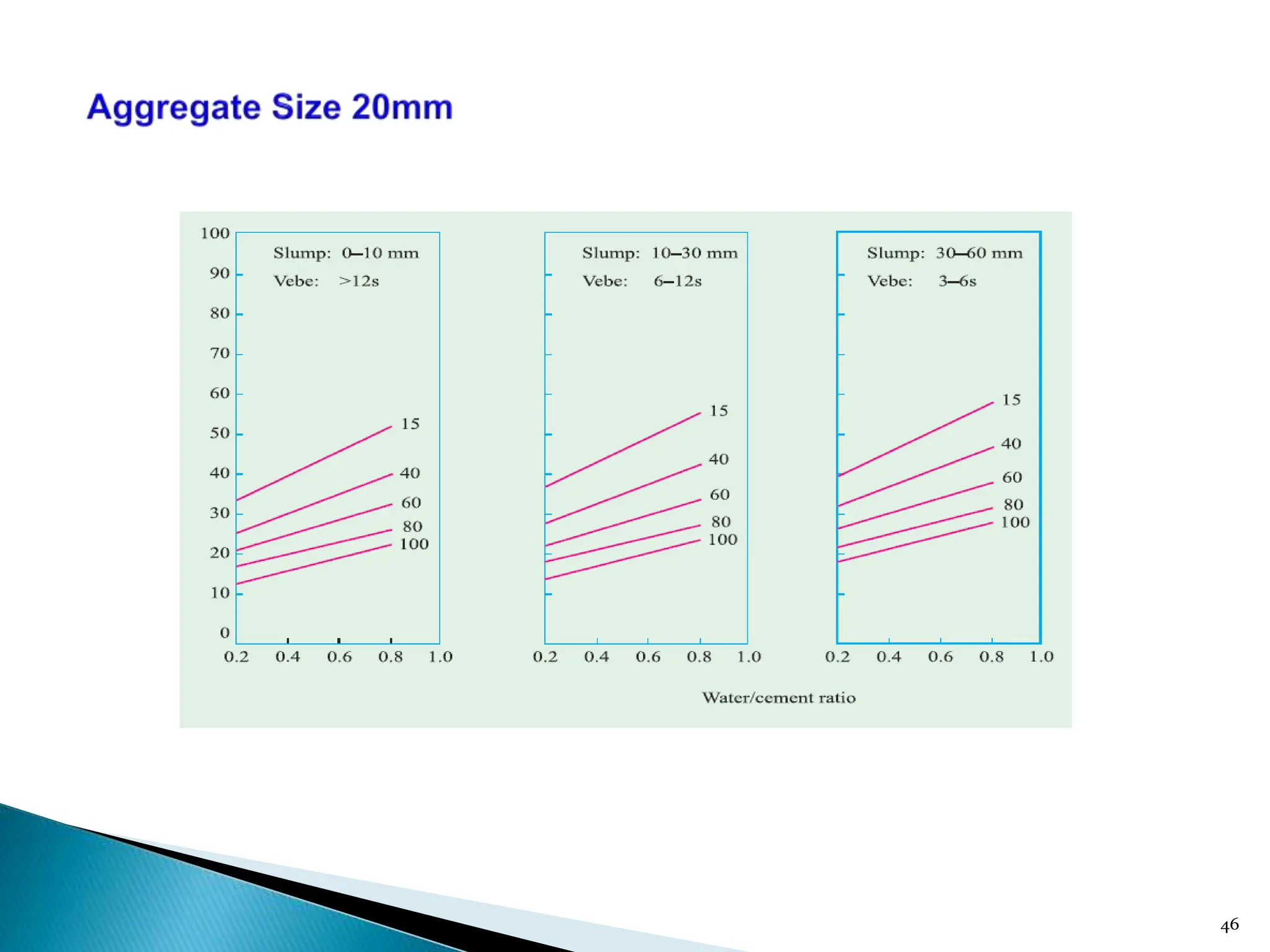
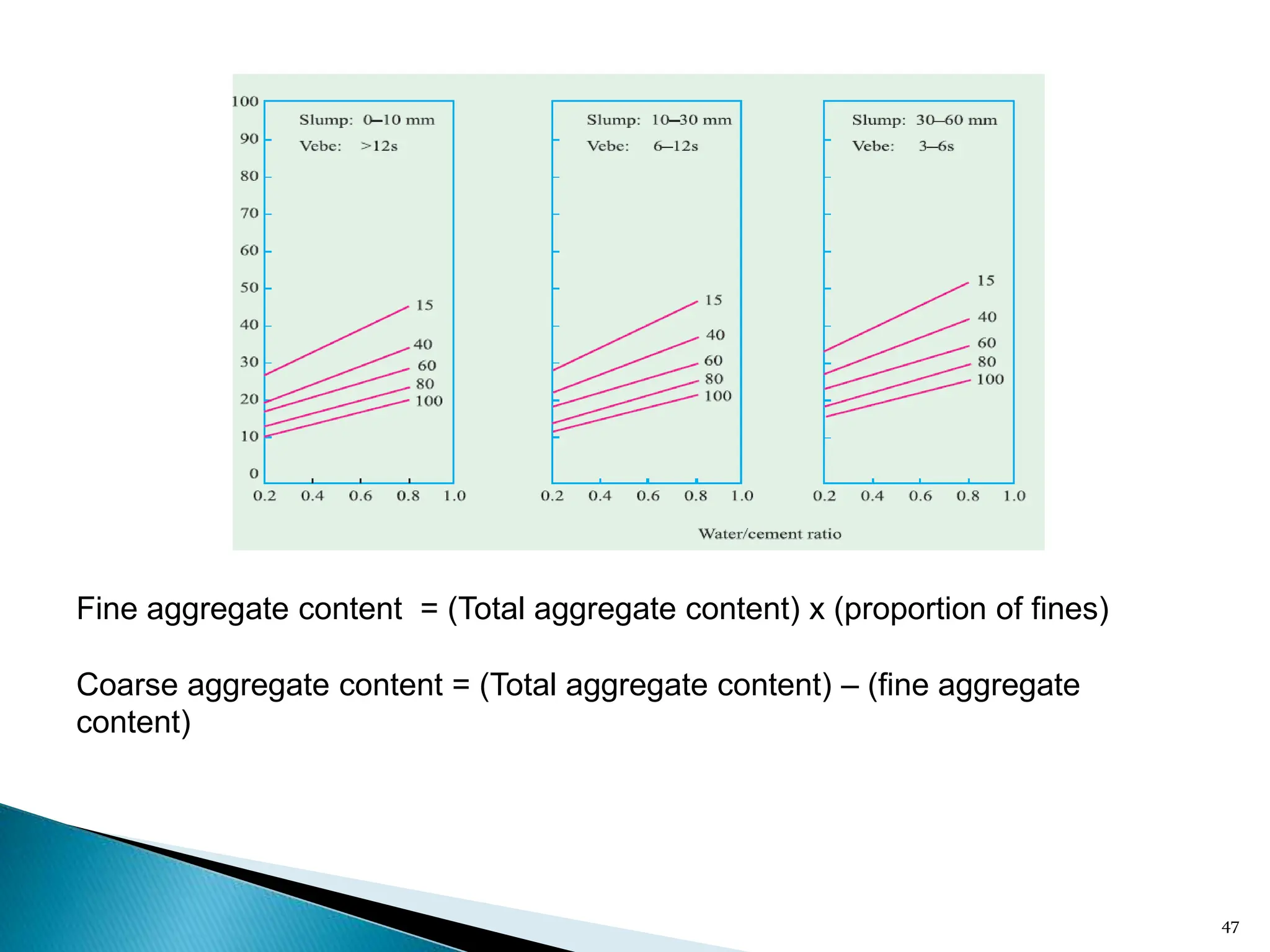
 The recommended proportion of the fine
aggregate, depending upon the maximum
size of the aggregate, the workability level
and the free-water cement ratio, are shown in
Figs.
 for sand of grading zones 1 to 4 as specified
in the Indian code and for aggregate of
maximum sizes 10 mm, 20 mm and 40 mm.
The fine aggregate content is determined as a
percentage of the total aggregate from the
figures.
44
45
46
47
Fine aggregate content = (Total aggregate content) x (proportion of fines)
Coarse aggregate content = (Total aggregate content) – (fine aggregate
content)

a presentation on Concrete Mix Design1.ppt

  • 1.
     The processof selecting suitable ingredients of concrete and determining their relative amounts with the objective of producing a concrete of the required, strength, durability, and workability as economically as possible, is termed the concrete mix design.  Concrete mix of inadequate workability may result in a high labour cost to obtain a degree of compaction with available equipment. 1
  • 2.
     From technicalpoint of view the rich mixes may lead to high shrinkage and cracking in the structural concrete, and to evolution of high heat of hydration in mass concrete which may cause cracking. 2
  • 3.
    REQUIREMENTS OF CONCRETEMix design The basis of selection and proportioning of mix ingredients are:  The minimum compressive strength required from structural consideration.  The adequate workability necessary for full compaction with the compacting equipment available.  Maximum water-cement ratio and/or maximum cement content to give adequate durability for the particular site conditions.  Maximum cement content to avoid shrinkage cracking due to temperature cycle in mass concrete. 3
  • 4.
    Types of mixes Nominal Mixes : For concrete prescribed the proportions of cement, fine and coarse aggregates. These mixes of fixed cement aggregate ratio which ensures adequate strength are termed nominal mixes  Standard Mixes : IS 456-2000 has designated the concrete mixes into a number of grades as M10, M15, M20, M25, M30, M35 and M40. In this designation the letter M refers to the mix and the number to the specified 28 day cube strength of mix in N/mm2.  Design Mixes : In these mixes the performance of the concrete is specified by the designer but the mix proportions are determined by the producer of concrete, except that the minimum cement content can be laid down. 4
  • 5.
     Compressive strength:It is one of the most important properties of concrete and influences many other describable properties of the hardened concrete. The mean compressive strength required at a specific age, usually 28 days, determines the nominal water-cement ratio of the mix 5
  • 6.
     Durability :The durability of concrete is its resistance to the aggressive environmental conditions. High strength concrete is generally more durable than low strength concrete. In the situations when the high strength is not necessary but the conditions of exposure are such that high durability is vital, the durability requirement will determine the water- cement ratio to be used. 6
  • 7.
     Maximum nominalsize of aggregate : In general, larger the maximum size of aggregate, smaller is the cement requirement for a particular water-cement ratio, because the workability of concrete increases with increase in maximum size of the aggregate.  Grading and type of aggregate : The grading of aggregate influences the mix proportions for a specified workability and water- cement ratio. Coarser the grading leaner will be mix which can be used. Very lean mix is not desirable since it does not contain enough finer material to make the concrete cohesive 7
  • 8.
     Water-Slump Relationship Characteristic strength and target strength  s/a ratio 8
  • 9.
    9 Mean strength isrelated to the quality and proportioning of the constituents of concrete. Standard deviation is a measure of the variation in the quality of concrete. The concrete strength is determined by the quality of the raw material that we have used, that is cement, fine aggregate, coarse aggregate and each of these materials has its own variation.
  • 10.
    Causes of variationin concrete quality  The quality of constituent of materials  Proportioning, which is weighing of constituent  Mixing. For example, the time the method, the mixer, if we mix a certain concrete mix, let us say for one minute. Another concrete mix for one and half minutes, it is likely that the extent of mixing the extent of homogeneity, which is achieved is different and that will affect the strength of concrete. 10
  • 11.
     How manylayers do we fill the concrete in? Whether, we vibrate each layer, whether we vibrate the entire specimen, the method of vibration and so on.  All this effects the strength of concrete as determined from that particular specimen,  curing of specimens.  Usually specifications require that the concrete is stored under water, what is the temperature of that water? specification give you certain ranges? Now, within that range what is the actual value and so on.  The testing of the specimen that is the rate of loading specimen condition specimen is tested. 11
  • 12.
  • 13.
     Target strengthfor mix proportioning : IS 10262 : 2019 f’ck = fck + 1.65 s Where, f’ck = Target average compressive strength at 28 days fck = Characteristic compressive strength at 28 days s= Standard deviation (Table 1 IS 456) 13
  • 14.
  • 15.
    Various Methods ofMix Design  Arbitrary Proportions  Maximum Density Method  Fineness Modulus Method  Surface Area Method  Indian Standard Method  ACI Committee Method  Road Note no. 4 Method  DOE Method  Shacklock’s method 15
  • 16.
    Information Required forConcrete Mix Design:  Grade designation.  Type of cement.  Maximum nominal size of aggregate.  Minimum and maximum cement content.  Maximum water-cement ratio.  Workability.  Exposure conditions.  Method of placing.  Degree of supervision.  Type and properties of aggregate. 16
  • 17.
    Out of theabove methods first four are not very widely used these days but the procedures of mix design recommended by American Concrete Institute, Indian Standard method, DOE method and Road Note No. 4 are widely adopted. Shacklock’s method is mainly used for design of high strength mixes. 17
  • 18.
     Problem Illustrative exampleson concrete mix proportioning [M40 pumpable concrete with fly ash] Design stipulations for proportioning  Grade designation : M40  Type of cement : OPC 43 grade confirming to IS 8112  Type of mineral admixture : Fly ash confirming to IS 3812 (Part-1)  Maximum nominal size of aggregates : 20 mm  Minimum cement content : 320 kg/m3 18
  • 19.
     Maximum watercement ratio : 0.45  Workability : 100 mm (slump)  Exposure condition : Severe (for reinforced concrete)  Method of concrete placing : Pumping  Degree of supervision : Good  Type of aggregate : Crushed angular aggregate 19
  • 20.
     Maximum cementcontent : 450 kg/m3  Chemical admixture type : Superplsticiser TEST DATA FOR MATERIALS  Cement used : OPC 43 grade confirming to IS 8112  Specific gravity of cement : 3.15  Fly ash used : Fly ash confirming to IS 3812 (Part-1)  Specific gravity of fly ash : 2.2  Chemical admixture : Superplasticiser conforming to IS 9103  Specific gravity of Coarse aggregate : 2.74 Fine aggregate : 2.74 20
  • 21.
     Water absorption Coarse aggregate : 0.5 percent  Fine aggregate : 1.0 percent  Free (surface) moisture  Coarse aggregate : Nil (absorbed moisture also nil)  Fine aggregate : Nil  Sieve analysis  Coarse aggregate : Conforming to Table 2 of IS: 383  Fine aggregate : Conforming to Zone I of IS: 383 21
  • 22.
     TARGET STRENGTHFOR MIX PROPORTIONING f‟ ck = fck + 1.65 s  Where  f‟ ck = Target average compressive strength at 28 days,  fck = Characteristic compressive strength at 28 days,  s= Standard deviation  From Table 1 standard deviation, s = 5 N/mm2 Therefore target strength = 40 + 1.65 x 5 = 48.25 N/mm2 22
  • 23.
     SELECTION OFWATER CEMENT RATIO 0.4 < 0.5, hence ok  From Table-2, maximum water content = 186 liters (for 25mm – 50mm slump range and for 20 mm aggregates)  Estimated water content for 100 mm slump = 186 + 6/100 x186 = 197 liters  As superplsticiser is used, the water content can be reduced up to 20 percent and above Based on trials with SP water content  reduction of 29 percent has been achieved. Hence the water content arrived = 19 x  0.71 =140 liters 23
  • 24.
    CALCULATION OF CEMENTCONTENT  Water cement ratio = 0.40  Cement content = 140/0.40 = 350 kg/m3  From Table 5 of IS: 456, minimum cement content for severe exposure condition  = 320 kg/m3  350 kg/m3 > 320 kg/m3, hence OK 24
  • 25.
     For proportioningfly ash concrete, the suggested steps are;  Decide the % of fly ash to be used based on [project requirement and quality of Materials In certain situations increase in cementitious material content may be warranted. The decision on increase in cementitious material content and its percentage may be based on experience and trial.  The example is with increase of 10% of cementitious material content. 25
  • 26.
     Cementitious materialcontent 1.1 x 350 = 385 kg/m3  Water content = 140 kg/m3  Water cement ratio = 140/385 = 0.364 _0.40 Let us use fly as at 30 % of cementitious material content in addition to  cement Fly ash = 385 x 0.3 = 115 kg/m3  Cement =385-115=270 kg/m3  (Saving of cement compared to previous design = 350-279 = 80 kg/m3 and fly ash utilization = 115 kg/m3) 26
  • 27.
     PROPORTION OFVOLUME OF COARSE AGGREGATE AND FINE AGGREGATE CONTENT  From Table 3, volume of coarse aggregate corresponding to 20 mm size aggregate  and fine aggregate (Zone I) for water-cement ratio of 0.50 =0.60  In the present case w/c= 0.40. The volume of coarse aggregate is required to be increased to decrease the fine aggregate content. As w/c ratio is lower by 0.10, increase the coarse aggregate volume by 0.02 (at the rate of -/+ 0.01 for every +/- 0.05 change in water cement ratio). Therefore, corrected volume of coarse aggregate for w/c of 0.40 =0.62. 27
  • 28.
     Note: Incase the coarse aggregate is not angular, then also the volume of CA may be required to be increased suitably based on experience  For pumpable concrete these values should be reduced by 10 %.  Therefore volume of coarse aggregate =  0.62 x 0.9 = 0.56  Volume of fine aggregate content =  1- 0.56 = 0.44 28
  • 29.
    MIX CALCULATIONS  Themix calculations per unit volume of concrete shall be as follows  Volume of concrete = 1 m3  Volume of air content = 0.01m3  Volume of cement = [270/3.15] x [1/1000] = 0.086 m3  Volume of fly ash = [115/2.2] x [1/1000] = 0.052 m3  Volume of water = [140/1] x [1/1000] = 0.140 m3 29
  • 30.
     Volume ofchemical admixture = [7.7/1.145] x [1/1000] = 0.007 m3  ( SP 2% by mass of cementitious material)  Volume of all in aggregates (e) = 1 – (0.086 + 0.052 + 0.140 + 0.007) = 0.715 m3  Volume of coarse aggregates = e x Volume of CA x specific gravity of CA  = 0.715 x 0.56 x 2.74 x 1000 = 1097 kg  Volume of fine aggregates = e x Volume of FA x specific gravity of FA = 0.715 x 0.44 x 2.74 x 1000 = 862 kg 30
  • 31.
    MIX PROPORTIONS FORTRIAL NUMBER 1  Cement = 270 kg/m3  Fly ash = 115 kg/m3  Water = 140 kg/m3  Fine aggregate = 862 kg/m3  Coarse aggregates = 1097 kg/m3  Chemical admixture = 7.7 kg/m3  Water cement ratio = 0.364 Aggregates are assumed to be in SSD. Otherwise corrections are to be applied while calculating the water content. Necessary corrections are also required to be  made in mass of aggregates. 31
  • 32.
     The DoEDesign of normal concrete mixes has replaced the traditional British mix design method of Road Note No. 4.  This method was first published in 1975 and revised in 1988.  The method uses the relationship between water- cement ratio and compressive strength of concrete depending on the type of cement and the type of aggregate used.  This method can also be used for concrete containing fly ash. 32
  • 33.
     The watercontents required to give various levels of workability, i.e: very low, low, medium and high (expressed in terms of slump or Vee-Bee time) are determined for the two types of aggregates, viz., crushed (angular) and uncrushed (gravel).  The method gives mix proportions in terms of quantities of materials per unit volume of concrete.  DoE method is standard method of mix design in UK.  This method is suitable for mix design of normal concrete mixes having 28 days cube compressive strength upto 75 MPa for non air entrained concrete. 33
  • 34.
    1.The target meanstrength f’ck=fck+1.65  S 2. Determination of water cement ratio and water content:  From table 11.11, a value is obtained for the compressive strength of a mix made with free water/cement ratio of 0.5, according to the specified age, the type of cement and the type of aggregate used. 34
  • 35.
  • 36.
    36 This strength valueis then plotted on graph of strength v/s water cement ratio and a curve drawn from the point, parallel to the printed curves until it intercepts a horizontal line passing through the ordinate representing the target mean-strength. The corresponding value of the free water/cement ratio can then be read from the abscissa. This is checked with that required for durability.
  • 37.
     The free-watercontent required depending upon the type and maximum size of aggregate to give a concrete of the specified slump is obtained from Table. 37
  • 38.
  • 39.
    3.Determination of cementcontent:  Knowing the water/cement ratio and water content, the cement content is obtained as  The minimum cement content is checked with the durability requirements specified in standard code. 39
  • 40.
  • 41.
  • 42.
  • 43.
  • 44.
     The recommendedproportion of the fine aggregate, depending upon the maximum size of the aggregate, the workability level and the free-water cement ratio, are shown in Figs.  for sand of grading zones 1 to 4 as specified in the Indian code and for aggregate of maximum sizes 10 mm, 20 mm and 40 mm. The fine aggregate content is determined as a percentage of the total aggregate from the figures. 44
  • 45.
  • 46.
  • 47.
    47 Fine aggregate content= (Total aggregate content) x (proportion of fines) Coarse aggregate content = (Total aggregate content) – (fine aggregate content)