Tectonic Plates
● Plate tectonics a scientific theory describing the large-scale motion
of seven large plates and the movements of a larger number of
smaller plates of Earth’s lithosphere.
● Tectonic processes began on Earth between 3.3 to 3.5 billion years
ago.
● As the mantle acts as high density viscous material, it helps crust
plates to move around.
● Where the plates meet, their relative motion determines the type of
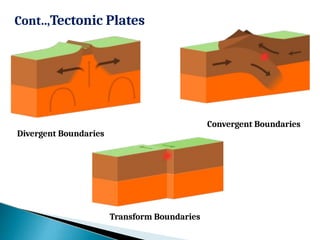
boundary: convergent, divergent, or transform.
● The relative movement of the plates typically ranges from zero to 100
mm annually.
● The location where two plates meet is called a plate boundary
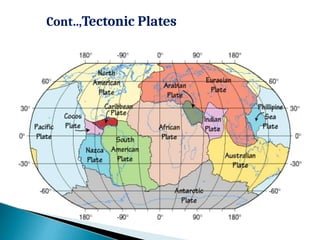
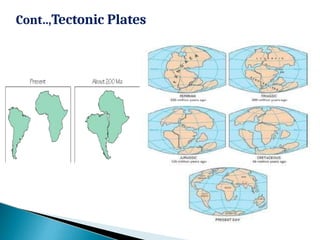
Cont..,Tectonic Plates
Convergent Boundaries
Divergent Boundaries
Transform Boundaries
Types of Plate Boundaries
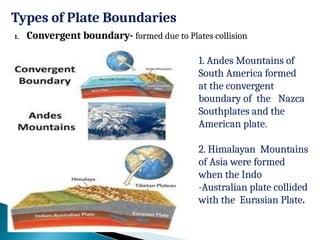
1. Convergent boundary- formed due to Plates collision
1. Andes Mountains of
South America formed
at the convergent
boundary of the Nazca
Southplates and the
American plate.
2. Himalayan Mountains
of Asia were formed
when the Indo
-Australian plate collided
with the Eurasian Plate.
Types of Plate Boundaries
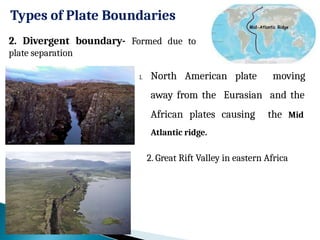
1. North American plate moving
away from the Eurasian and the
African plates causing the Mid
Atlantic ridge.
2. Divergent boundary- Formed due to
plate separation
2. Great Rift Valley in eastern Africa
Types of Plate Boundaries
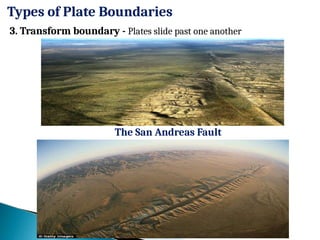
3. Transform boundary - Plates slide past one another
The San Andreas Fault
Thank you

Plate tectonics

  • 2.
    Tectonic Plates ● Platetectonics a scientific theory describing the large-scale motion of seven large plates and the movements of a larger number of smaller plates of Earth’s lithosphere. ● Tectonic processes began on Earth between 3.3 to 3.5 billion years ago. ● As the mantle acts as high density viscous material, it helps crust plates to move around. ● Where the plates meet, their relative motion determines the type of boundary: convergent, divergent, or transform. ● The relative movement of the plates typically ranges from zero to 100 mm annually. ● The location where two plates meet is called a plate boundary
  • 3.
  • 4.
  • 5.
  • 6.
    Types of PlateBoundaries 1. Convergent boundary- formed due to Plates collision 1. Andes Mountains of South America formed at the convergent boundary of the Nazca Southplates and the American plate. 2. Himalayan Mountains of Asia were formed when the Indo -Australian plate collided with the Eurasian Plate.
  • 7.
    Types of PlateBoundaries 1. North American plate moving away from the Eurasian and the African plates causing the Mid Atlantic ridge. 2. Divergent boundary- Formed due to plate separation 2. Great Rift Valley in eastern Africa
  • 8.
    Types of PlateBoundaries 3. Transform boundary - Plates slide past one another The San Andreas Fault
  • 9.