Concrete Mix Design
DOE Method
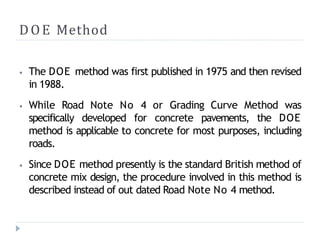
⦁ The DOE method was first published in 1975 and then revised
in 1988.
⦁ While Road Note No 4 or Grading Curve Method was
specifically developed for concrete pavements, the DOE
method is applicable to concrete for most purposes, including
roads.
⦁ Since DOE method presently is the standard British method of
concrete mix design, the procedure involved in this method is
described instead of out dated Road Note No 4 method.
Step 01: Data to be collected
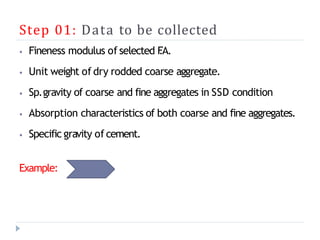
⦁ Fineness modulus of selected F
.A.
⦁ Unit weight of dry rodded coarse aggregate.
⦁ Sp.gravity of coarse and fine aggregates in SSD condition
⦁ Absorption characteristics of both coarse and fine aggregates.
⦁ Specific gravity of cement.
Example:
Step 01: Data to be collected
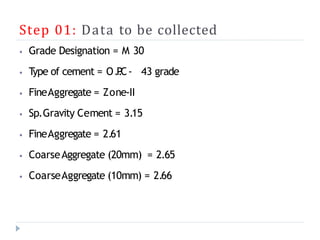
⦁ Grade Designation = M 30
⦁ T
ype of cement = O.P
.C- 43 grade
⦁ FineAggregate = Zone-II
⦁ Sp.Gravity Cement = 3.15
⦁ FineAggregate = 2.61
⦁ CoarseAggregate (20mm) = 2.65
⦁ CoarseAggregate (10mm) = 2.66
Step 02: Target Mean Strength
⦁ Find the target mean strength from the specified characteristic
strength
Target mean strength = specified characteristic strength +
Standard deviation x risk factor
⦁ (risk factor is on the assumption that 5 percent of results are
allowed to fall less than the specified characteristic strength).
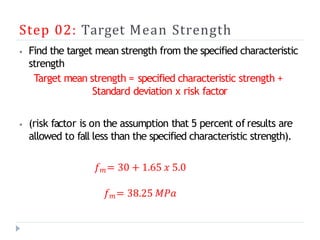
𝑓𝑚= 30 + 1.65 𝑥 5.0
𝑓𝑚= 38.25 𝑀𝑃𝑎
Step 03: Water/cement ratio
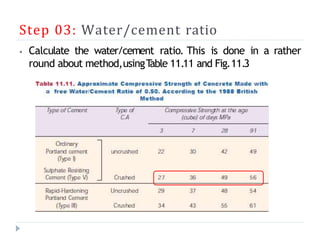
⦁ Calculate the water/cement ratio. This is done in a rather
round about method,usingT
able 11.11 and Fig.11.3
Step 03: Water/cement ratio
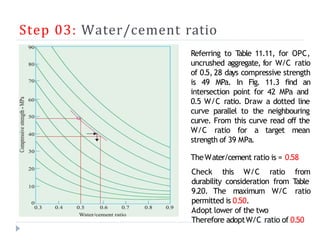
Referring to T
able 11.11, for OPC,
uncrushed aggregate, for W/C ratio
of 0.5, 28 days compressive strength
is 49 MPa. In Fig. 11.3 find an
intersection point for 42 MPa and
0.5 W/C ratio. Draw a dotted line
curve parallel to the neighbouring
curve. From this curve read off the
W/C ratio for a target mean
strength of 39 MPa.
TheWater/cement ratio is = 0.58
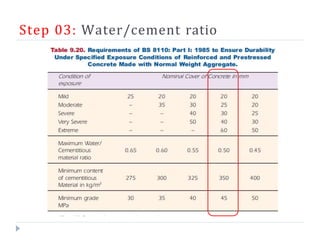
Check this W/C ratio from
durability consideration from T
able
9.20. The maximum W/C ratio
permitted is 0.50.
Adopt lower of the two
Therefore adoptW/C ratio of 0.50
Step 03: Water/cement ratio
Step 04: Calculation of Water Content
2 1
2 1
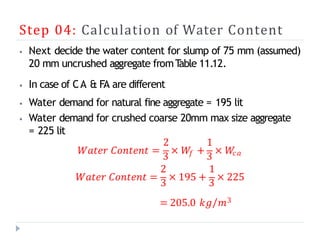
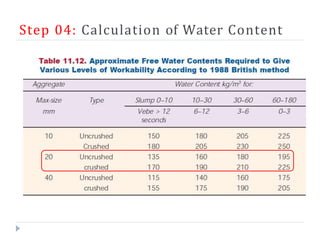
⦁ Next decide the water content for slump of 75 mm (assumed)
20 mm uncrushed aggregate fromT
able 11.12.
⦁ In case of CA & FA are different
⦁ Water demand for natural fine aggregate = 195 lit
⦁ Water demand for crushed coarse 20mm max size aggregate
= 225 lit
𝑊𝑎𝑡𝑒𝑟 𝐶𝑜𝑛𝑡𝑒𝑛𝑡 =
3
× 𝑊𝑓 +
3
× 𝑊
𝑐𝑎
𝑊𝑎𝑡𝑒𝑟 𝐶𝑜𝑛𝑡𝑒𝑛𝑡 =
3
× 195 +
3
× 225
= 205.0 𝑘𝑔/𝑚3
Step 04: Calculation of Water Content
Step 05: Cement Content
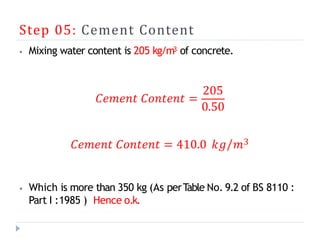
⦁ Mixing water content is 205 kg/m3 of concrete.
𝐶𝑒𝑚𝑒𝑛𝑡 𝐶𝑜𝑛𝑡𝑒𝑛𝑡 =
205
0.50
𝐶𝑒𝑚𝑒𝑛𝑡 𝐶𝑜𝑛𝑡𝑒𝑛𝑡 = 410.0 𝑘𝑔/𝑚3
⦁ Which is more than 350 kg (As perT
able No. 9.2 of BS 8110 :
Part I :1985 ) Hence o.k.
Step 06: Weight of Total Aggregate
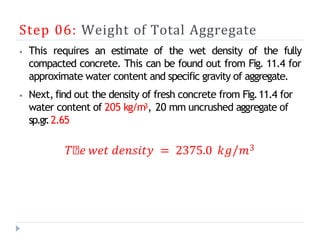
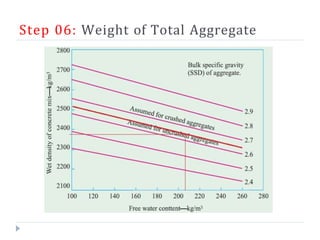
⦁ This requires an estimate of the wet density of the fully
compacted concrete. This can be found out from Fig. 11.4 for
approximate water content and specific gravity of aggregate.
⦁ Next, find out the density of fresh concrete from Fig.11.4 for
water content of 205 kg/m3, 20 mm uncrushed aggregate of
sp.gr
.2.65
𝑇𝑕𝑒 𝑤𝑒𝑡 𝑑𝑒𝑛𝑠𝑖𝑡𝑦 = 2375.0 𝑘𝑔/𝑚3
Step 06: Weight of Total Aggregate
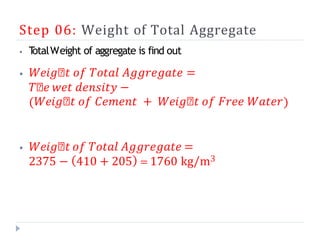
⦁ T
otalWeight of aggregate is find out
⦁ 𝑊𝑒𝑖𝑔𝑕𝑡 𝑜𝑓 𝑇𝑜𝑡𝑎𝑙 𝐴𝑔𝑔𝑟𝑒𝑔𝑎𝑡𝑒 =
𝑇𝑕𝑒 𝑤𝑒𝑡 𝑑𝑒𝑛𝑠𝑖𝑡𝑦 −
𝑊𝑒𝑖𝑔𝑕𝑡 𝑜𝑓 𝐶𝑒𝑚𝑒𝑛𝑡 + 𝑊𝑒𝑖𝑔𝑕𝑡 𝑜𝑓 𝐹𝑟𝑒𝑒 𝑊𝑎𝑡𝑒𝑟
⦁ 𝑊𝑒𝑖𝑔𝑕𝑡 𝑜𝑓 𝑇𝑜𝑡𝑎𝑙 𝐴𝑔𝑔𝑟𝑒𝑔𝑎𝑡𝑒 =
2375 − 410 + 205 = 1760 kg/m3
Step 07: Weight of Fine Aggregate
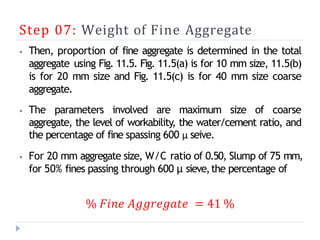
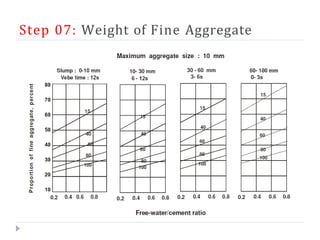
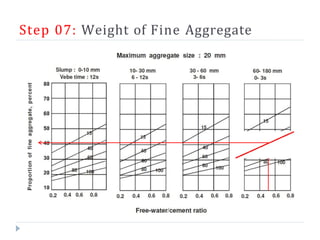
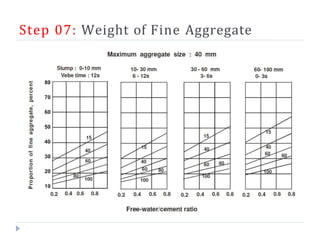
⦁ Then, proportion of fine aggregate is determined in the total
aggregate using Fig. 11.5. Fig. 11.5(a) is for 10 mm size, 11.5(b)
is for 20 mm size and Fig. 11.5(c) is for 40 mm size coarse
aggregate.
⦁ The parameters involved are maximum size of coarse
aggregate, the level of workability, the water/cement ratio, and
the percentage of fine spassing 600 μ seive.
⦁ For 20 mm aggregate size, W/C ratio of 0.50, Slump of 75 mm,
for 50% fines passing through 600 μ sieve,the percentage of
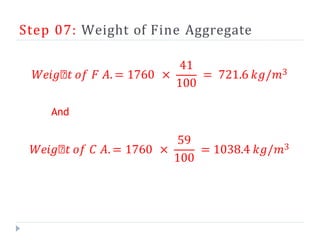
% 𝐹𝑖𝑛𝑒 𝐴𝑔𝑔𝑟𝑒𝑔𝑎𝑡𝑒 = 41 %
Step 07: Weight of Fine Aggregate
𝑊𝑒𝑖𝑔𝑕𝑡 𝑜𝑓 𝐹 𝐴. = 1760 ×
41
100
= 721.6 𝑘𝑔/𝑚3
And
𝑊𝑒𝑖𝑔𝑕𝑡 𝑜𝑓 𝐶 𝐴. = 1760 ×
59
100
= 1038.4 𝑘𝑔/𝑚3
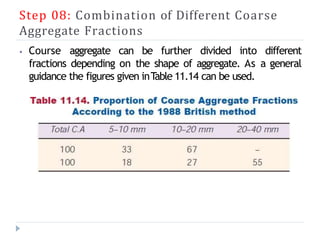
Step 08: Combination of Different Coarse
Aggregate Fractions
⦁ Course aggregate can be further divided into different
fractions depending on the shape of aggregate. As a general
guidance the figures given inT
able 11.14 can be used.
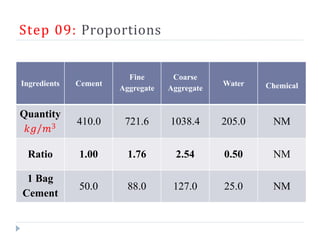
Step 09: Proportions
Ingredients Cement
Fine
Aggregate
Coarse
Aggregate
Water Chemical
Quantity
𝑘𝑔/𝑚3
410.0 721.6 1038.4 205.0 NM
Ratio 1.00 1.76 2.54 0.50 NM
1 Bag
Cement
50.0 88.0 127.0 25.0 NM
Step 10: Adjustment for Field Condition
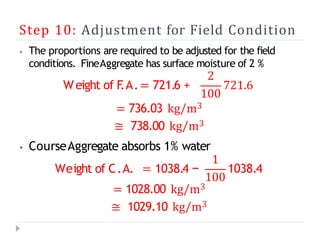
⦁ The proportions are required to be adjusted for the field
conditions. FineAggregate has surface moisture of 2 %
Weight of F
.A.= 721.6 +
2
100
721.6
= 736.03 kg/m3
≅ 738.00 kg/m3
⦁ CourseAggregate absorbs 1% water
Weight of C.A. = 1038.4 −
1
100
1038.4
= 1028.00 kg/m3
≅ 1029.10 kg/m3
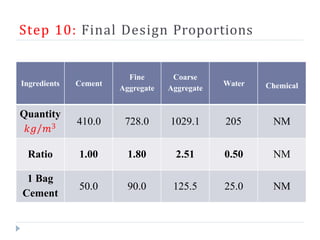
Step 10: Final Design Proportions
Ingredients Cement
Fine
Aggregate
Coarse
Aggregate
Water Chemical
Quantity
𝑘𝑔/𝑚3
410.0 728.0 1029.1 205 NM
Ratio 1.00 1.80 2.51 0.50 NM
1 Bag
Cement
50.0 90.0 125.5 25.0 NM

Concrete Mix Design.pptx

  • 1.
  • 2.
    DOE Method ⦁ TheDOE method was first published in 1975 and then revised in 1988. ⦁ While Road Note No 4 or Grading Curve Method was specifically developed for concrete pavements, the DOE method is applicable to concrete for most purposes, including roads. ⦁ Since DOE method presently is the standard British method of concrete mix design, the procedure involved in this method is described instead of out dated Road Note No 4 method.
  • 3.
    Step 01: Datato be collected ⦁ Fineness modulus of selected F .A. ⦁ Unit weight of dry rodded coarse aggregate. ⦁ Sp.gravity of coarse and fine aggregates in SSD condition ⦁ Absorption characteristics of both coarse and fine aggregates. ⦁ Specific gravity of cement. Example:
  • 4.
    Step 01: Datato be collected ⦁ Grade Designation = M 30 ⦁ T ype of cement = O.P .C- 43 grade ⦁ FineAggregate = Zone-II ⦁ Sp.Gravity Cement = 3.15 ⦁ FineAggregate = 2.61 ⦁ CoarseAggregate (20mm) = 2.65 ⦁ CoarseAggregate (10mm) = 2.66
  • 5.
    Step 02: TargetMean Strength ⦁ Find the target mean strength from the specified characteristic strength Target mean strength = specified characteristic strength + Standard deviation x risk factor ⦁ (risk factor is on the assumption that 5 percent of results are allowed to fall less than the specified characteristic strength). 𝑓𝑚= 30 + 1.65 𝑥 5.0 𝑓𝑚= 38.25 𝑀𝑃𝑎
  • 6.
    Step 03: Water/cementratio ⦁ Calculate the water/cement ratio. This is done in a rather round about method,usingT able 11.11 and Fig.11.3
  • 7.
    Step 03: Water/cementratio Referring to T able 11.11, for OPC, uncrushed aggregate, for W/C ratio of 0.5, 28 days compressive strength is 49 MPa. In Fig. 11.3 find an intersection point for 42 MPa and 0.5 W/C ratio. Draw a dotted line curve parallel to the neighbouring curve. From this curve read off the W/C ratio for a target mean strength of 39 MPa. TheWater/cement ratio is = 0.58 Check this W/C ratio from durability consideration from T able 9.20. The maximum W/C ratio permitted is 0.50. Adopt lower of the two Therefore adoptW/C ratio of 0.50
  • 8.
  • 9.
    Step 04: Calculationof Water Content 2 1 2 1 ⦁ Next decide the water content for slump of 75 mm (assumed) 20 mm uncrushed aggregate fromT able 11.12. ⦁ In case of CA & FA are different ⦁ Water demand for natural fine aggregate = 195 lit ⦁ Water demand for crushed coarse 20mm max size aggregate = 225 lit 𝑊𝑎𝑡𝑒𝑟 𝐶𝑜𝑛𝑡𝑒𝑛𝑡 = 3 × 𝑊𝑓 + 3 × 𝑊 𝑐𝑎 𝑊𝑎𝑡𝑒𝑟 𝐶𝑜𝑛𝑡𝑒𝑛𝑡 = 3 × 195 + 3 × 225 = 205.0 𝑘𝑔/𝑚3
  • 10.
    Step 04: Calculationof Water Content
  • 11.
    Step 05: CementContent ⦁ Mixing water content is 205 kg/m3 of concrete. 𝐶𝑒𝑚𝑒𝑛𝑡 𝐶𝑜𝑛𝑡𝑒𝑛𝑡 = 205 0.50 𝐶𝑒𝑚𝑒𝑛𝑡 𝐶𝑜𝑛𝑡𝑒𝑛𝑡 = 410.0 𝑘𝑔/𝑚3 ⦁ Which is more than 350 kg (As perT able No. 9.2 of BS 8110 : Part I :1985 ) Hence o.k.
  • 12.
    Step 06: Weightof Total Aggregate ⦁ This requires an estimate of the wet density of the fully compacted concrete. This can be found out from Fig. 11.4 for approximate water content and specific gravity of aggregate. ⦁ Next, find out the density of fresh concrete from Fig.11.4 for water content of 205 kg/m3, 20 mm uncrushed aggregate of sp.gr .2.65 𝑇𝑕𝑒 𝑤𝑒𝑡 𝑑𝑒𝑛𝑠𝑖𝑡𝑦 = 2375.0 𝑘𝑔/𝑚3
  • 13.
    Step 06: Weightof Total Aggregate
  • 14.
    Step 06: Weightof Total Aggregate ⦁ T otalWeight of aggregate is find out ⦁ 𝑊𝑒𝑖𝑔𝑕𝑡 𝑜𝑓 𝑇𝑜𝑡𝑎𝑙 𝐴𝑔𝑔𝑟𝑒𝑔𝑎𝑡𝑒 = 𝑇𝑕𝑒 𝑤𝑒𝑡 𝑑𝑒𝑛𝑠𝑖𝑡𝑦 − 𝑊𝑒𝑖𝑔𝑕𝑡 𝑜𝑓 𝐶𝑒𝑚𝑒𝑛𝑡 + 𝑊𝑒𝑖𝑔𝑕𝑡 𝑜𝑓 𝐹𝑟𝑒𝑒 𝑊𝑎𝑡𝑒𝑟 ⦁ 𝑊𝑒𝑖𝑔𝑕𝑡 𝑜𝑓 𝑇𝑜𝑡𝑎𝑙 𝐴𝑔𝑔𝑟𝑒𝑔𝑎𝑡𝑒 = 2375 − 410 + 205 = 1760 kg/m3
  • 15.
    Step 07: Weightof Fine Aggregate ⦁ Then, proportion of fine aggregate is determined in the total aggregate using Fig. 11.5. Fig. 11.5(a) is for 10 mm size, 11.5(b) is for 20 mm size and Fig. 11.5(c) is for 40 mm size coarse aggregate. ⦁ The parameters involved are maximum size of coarse aggregate, the level of workability, the water/cement ratio, and the percentage of fine spassing 600 μ seive. ⦁ For 20 mm aggregate size, W/C ratio of 0.50, Slump of 75 mm, for 50% fines passing through 600 μ sieve,the percentage of % 𝐹𝑖𝑛𝑒 𝐴𝑔𝑔𝑟𝑒𝑔𝑎𝑡𝑒 = 41 %
  • 16.
    Step 07: Weightof Fine Aggregate
  • 17.
    Step 07: Weightof Fine Aggregate
  • 18.
    Step 07: Weightof Fine Aggregate
  • 19.
    Step 07: Weightof Fine Aggregate 𝑊𝑒𝑖𝑔𝑕𝑡 𝑜𝑓 𝐹 𝐴. = 1760 × 41 100 = 721.6 𝑘𝑔/𝑚3 And 𝑊𝑒𝑖𝑔𝑕𝑡 𝑜𝑓 𝐶 𝐴. = 1760 × 59 100 = 1038.4 𝑘𝑔/𝑚3
  • 20.
    Step 08: Combinationof Different Coarse Aggregate Fractions ⦁ Course aggregate can be further divided into different fractions depending on the shape of aggregate. As a general guidance the figures given inT able 11.14 can be used.
  • 21.
    Step 09: Proportions IngredientsCement Fine Aggregate Coarse Aggregate Water Chemical Quantity 𝑘𝑔/𝑚3 410.0 721.6 1038.4 205.0 NM Ratio 1.00 1.76 2.54 0.50 NM 1 Bag Cement 50.0 88.0 127.0 25.0 NM
  • 22.
    Step 10: Adjustmentfor Field Condition ⦁ The proportions are required to be adjusted for the field conditions. FineAggregate has surface moisture of 2 % Weight of F .A.= 721.6 + 2 100 721.6 = 736.03 kg/m3 ≅ 738.00 kg/m3 ⦁ CourseAggregate absorbs 1% water Weight of C.A. = 1038.4 − 1 100 1038.4 = 1028.00 kg/m3 ≅ 1029.10 kg/m3
  • 23.
    Step 10: FinalDesign Proportions Ingredients Cement Fine Aggregate Coarse Aggregate Water Chemical Quantity 𝑘𝑔/𝑚3 410.0 728.0 1029.1 205 NM Ratio 1.00 1.80 2.51 0.50 NM 1 Bag Cement 50.0 90.0 125.5 25.0 NM