Concrete Mix Design
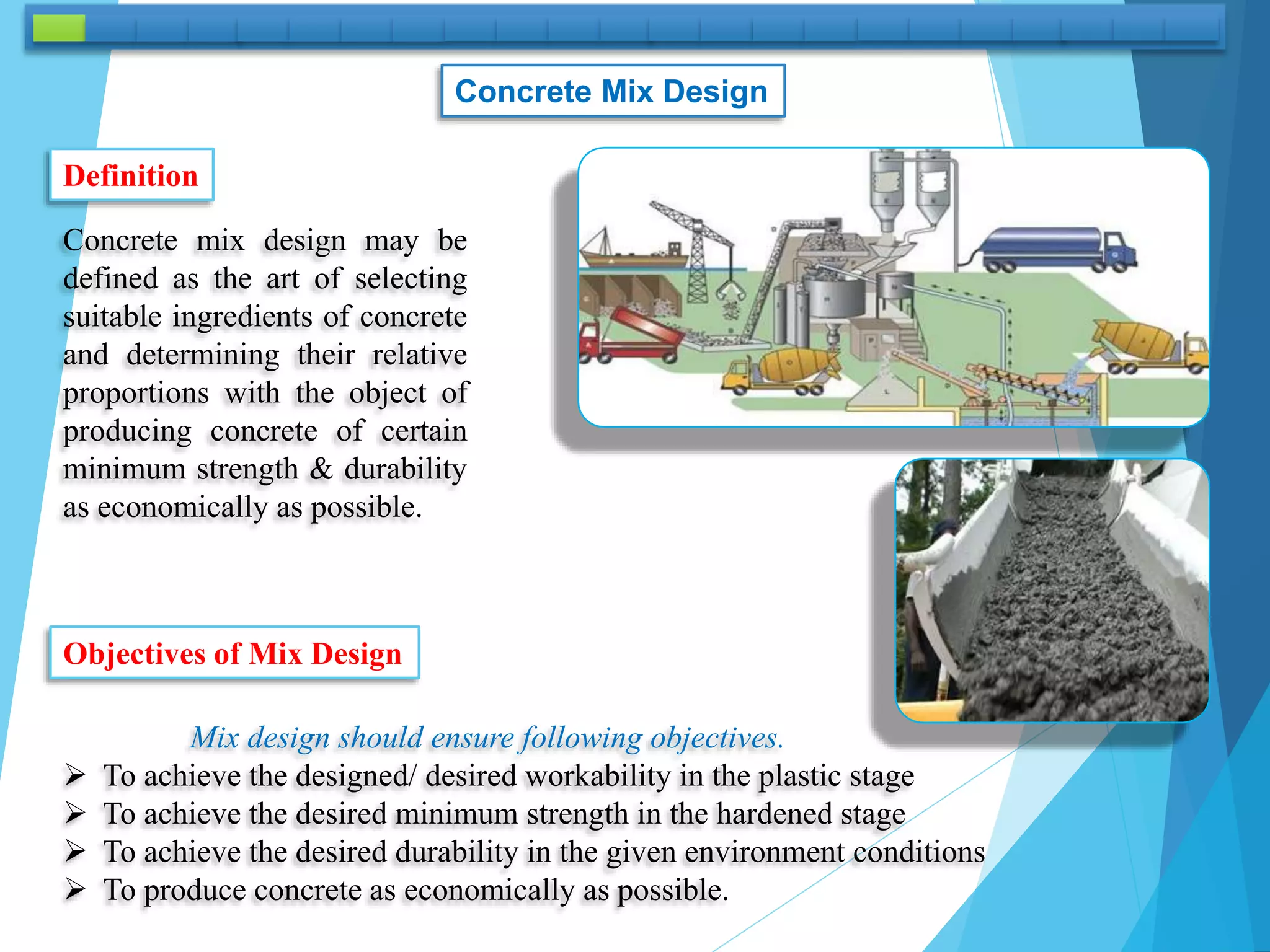
Concrete mix design may be
defined as the art of selecting
suitable ingredients of concrete
and determining their relative
proportions with the object of
producing concrete of certain
minimum strength & durability
as economically as possible.
Objectives of Mix Design
Definition
Mix design should ensure following objectives.
 To achieve the designed/ desired workability in the plastic stage
 To achieve the desired minimum strength in the hardened stage
 To achieve the desired durability in the given environment conditions
 To produce concrete as economically as possible.
Basic Considerations
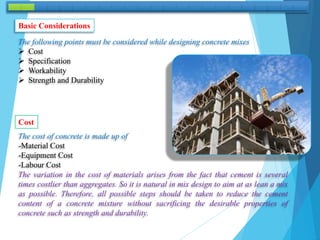
The following points must be considered while designing concrete mixes
 Cost
 Specification
 Workability
 Strength and Durability
The cost of concrete is made up of
-Material Cost
-Equipment Cost
-Labour Cost
The variation in the cost of materials arises from the fact that cement is several
times costlier than aggregates. So it is natural in mix design to aim at as lean a mix
as possible. Therefore, all possible steps should be taken to reduce the cement
content of a concrete mixture without sacrificing the desirable properties of
concrete such as strength and durability.
Cost
The following points may be kept in mind while designing concrete mixes
 Minimum Compressive Strength required
 Minimum water/ cement ratio
 Maximum cement content to avoid shrinkage cracks
 Maximum aggregate / cement ratio
 Maximum density of concrete in case of gravity dams
Specifications
The following points related to workability
shall be kept in mind while designing concrete mixes.
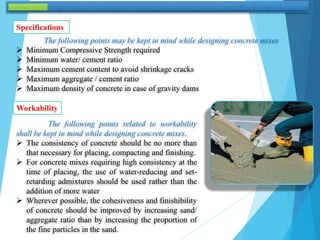
 The consistency of concrete should be no more than
that necessary for placing, compacting and finishing.
 For concrete mixes requiring high consistency at the
time of placing, the use of water-reducing and set-
retarding admixtures should be used rather than the
addition of more water
 Wherever possible, the cohesiveness and finishibility
of concrete should be improved by increasing sand/
aggregate ratio than by increasing the proportion of
the fine particles in the sand.
Workability
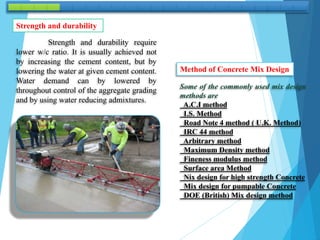
Strength and durability require
lower w/c ratio. It is usually achieved not
by increasing the cement content, but by
lowering the water at given cement content.
Water demand can by lowered by
throughout control of the aggregate grading
and by using water reducing admixtures.
Strength and durability
Method of Concrete Mix Design
Some of the commonly used mix design
methods are
A.C.I method
I.S. Method
Road Note 4 method ( U.K. Method)
IRC 44 method
Arbitrary method
Maximum Density method
Fineness modulus method
Surface area Method
Nix design for high strength Concrete
Mix design for pumpable Concrete
DOE (British) Mix design method
CONCRETE MIX DESIGN
Weight & Absolute Volume Method
( ACI Method )
 Is the process of selecting suitable ingredients of concrete & determining their
relative quantities with the purpose of producing an economical concrete which
has certain minimum properties [ notably Workability, Strength & Durability].
Mix design
The following three qualities are required of properly proportioned concrete mixers:-
1) Acceptable workability of freshly mixed concrete.
2) Durability, strength & uniform appearance of hardened concrete.
3) Economy.
 Several mix design methods have been developed over the years, ranging from an arbitrary
volume method. [e.g. (1:2:4) cement, Sand, Gravel].to the weight & absolute – volume
method.
 The weight method provides relatively simple techniques for estimating mix proportions using
an assumed or known unit weight of concrete.
 The absolute volume methods uses the specific gravity of each ingredient to calculate the unit
volume each will occupy in unit volume of concrete.
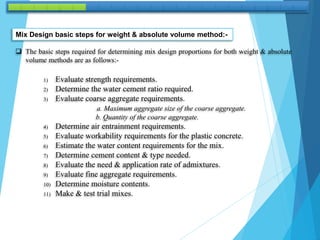
Mix Design basic steps for weight & absolute volume method:-
 The basic steps required for determining mix design proportions for both weight & absolute
volume methods are as follows:-
1) Evaluate strength requirements.
2) Determine the water cement ratio required.
3) Evaluate coarse aggregate requirements.
a. Maximum aggregate size of the coarse aggregate.
b. Quantity of the coarse aggregate.
4) Determine air entrainment requirements.
5) Evaluate workability requirements for the plastic concrete.
6) Estimate the water content requirements for the mix.
7) Determine cement content & type needed.
8) Evaluate the need & application rate of admixtures.
9) Evaluate fine aggregate requirements.
10) Determine moisture contents.
11) Make & test trial mixes.
1 – STRENGTH REQUIREMENTS:-
 In order to compute the strength requirements for concrete mix design, three quantities
must be known:-
1) The specified compressive strength [fc
/)].
Cylinder at 28 days [ (fc
/) = 0.80 (fcu ) ] Cube at 28 days.
Cube at 28 days [ (fcu ) = 1.25 (fc
/) ] Cylinder at 28 days.
2) The variability or standard deviation (S), of concrete.
3) The allowable risk of making concrete with an unacceptable strength.
 The standard deviation in the strength is determined for a plant by making batches of
concrete, testing the strength for many samples and computing the standard deviation.
 The allowable risk has been established by the [(ACI)], One of the risk rules has been
established, states that there should be less than [(10%)] chance that the strength of a
concrete mix is less than the specified strength.
1. Standard deviation (S) is a measure of the dispersion or spread of the results.
2. The arithmetic mean [(X‾)] is simply the average of test results of all specimens tested.
fcŕ= fc
/ + 1.34 (S) ……………… (1)
Where:-
fcŕ = Required average compressive strength (MPa) .
fc
/ = Specified compressive strength (MPa)
S = Standard deviation (MPa)
 For mixes with a large standard deviation in strength, there is another risk criterion that requires.
fcŕ = fc
/ + 2.33 (S) – (3.45) ……… (2)
 The larger of equations [(1) & (2)], will govern.
 The standard deviation should be determined from at least (30) strength results.
 If (S) is computed from [(15) to (30)] samples, then
fcŕ= fc
/ + 1.34 (S¯) …………..…… (3)
0r
fcŕ = fc
/ + 2.33 (S¯) – (3.45) ……… (4)
 Where (S¯) is the product of
(S) multiplied by the following
modification factors(f). i.e,
S¯ = S . f
 If fewer than (15) test are available, the following adjustments are made to the specified strength
instead of using equations [(1), ( 2 ) ,( 3 ) and (4)] as shown below:
Specified compressive strength
fc
/ ( MPa )
Required average compressive strength
fcŕ ( MPa )
< 20.7
20.7 to 34.5
> 34.5
fc
/ + 6.9
fc
/ + 8.3
fc
/ + 9.7
Example:
The design engineer specifies a concrete strength of [(31.0) MPa], Determine the
required average compressive strength for:-
(A) - A new plant where (S) is unknown.
(B) - A plant where [(S=3.6) MPa], for (17) test results.
(C) - A plant with extensive history of producing concrete with [(S=2.4) MPa].
(D) - A plant with extensive history of producing concrete with [(S=3.8) MPa].
(A) – for fc‾ = 31 MPa , as (S) is unknown.
fcŕ = fc‾ + 8.3
= 31.0 + 8.3 = 39.3 MPa
Specified
compressive strength
fc
/ ( MPa )
Required average
compressive strength
fcŕ ( MPa )
< 20.7
20.7 to 34.5
> 34.5
fc
/ + 6.9
fc
/ + 8.3
fc
/ + 9.7
(B) - As (S) is based on ( 17 ) test results , between ( 15 – 30 ) so modified (S) to be used .
find ( f ) by inter potation.
f = {(1.16) – [(1.16 –1.08) / (20 –15)] × (17 –15)} f =1.13
i.e.
S¯ = f * S = 1.13×3.6 = 4.1 MPa
Now determine (fcŕ) basing on equ. ( 1 ) & ( 2 ) .
fcŕ= fc‾ + 1.34 (S)
fcŕ= 31.0 + [ (1.34)×(4.1) ] = 36.5 MPa
Or
fcŕ = fc‾ + 2.33 (S) – (3.45)
= {31.0 + [(2.33) × (4.1)] – (3.45)} = 37.1 MPa [govern]
Use fcŕ = 37.1 MPa
Number of tests (n) Modification Factor (f)
15
20
25
30 or more
1.16
1.08
1.05
1.00
(C) - As (S) is based on more results , than (30 ) results
(fcŕ) to be calculated directly from equ. ( 1 ) & ( 2 ) .
fcŕ= fc‾ + 1.34 (S)
= {31.0 + [ (1.34)×(2.4) ] } = 34.2 Mpa [govern]
Or
fcŕ = fc‾ + 2.33 (S) – (3.45)
= {31.0 + [(2.33) × (2.4)] – (3.45)} = 33.1 MPa
Use fcŕ = 34.2 MPa
(D) Same as C
fcŕ= fc‾ + 1.34 (S)
= 31.0 + [ (1.34)×(3.8) ] = 36.1 MPa
or
fcŕ = fc‾ + 2.33 (S) – (3.45)
= {31.0 + [(2.33) × (3.8)] – (3.45)} = 36.4 MPa [govern]
Use fcŕ = 36.4 MPa
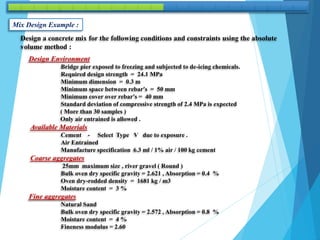
Mix Design Example :
Design a concrete mix for the following conditions and constraints using the absolute
volume method :
Design Environment
Bridge pier exposed to freezing and subjected to de-icing chemicals.
Required design strength = 24.1 MPa
Minimum dimension = 0.3 m
Minimum space between rebar's = 50 mm
Minimum cover over rebar's = 40 mm
Standard deviation of compressive strength of 2.4 MPa is expected
( More than 30 samples )
Only air entrained is allowed .
Available Materials
Cement - Select Type V due to exposure .
Air Entrained
Manufacture specification 6.3 ml / 1% air / 100 kg cement
Coarse aggregates
25mm maximum size , river gravel ( Round )
Bulk oven dry specific gravity = 2.621 , Absorption = 0.4 %
Oven dry-rodded density = 1681 kg / m3
Moisture content = 3 %
Fine aggregates
Natural Sand
Bulk oven dry specific gravity = 2.572 , Absorption = 0.8 %
Moisture content = 4 %
Fineness modulus = 2.60
Solution :
1- STRENGTH REQUIREMENTS :-
S = 2.4 MPa ( enough samples so that no correction is needed )
fcŕ= fc‾ + 1.34 (S) = 24.1 + [ (1.34)×(2.4) ] = 27.3 MPa [govern] Or
fcŕ = fc‾ + 2.33 (S) – (3.45) = {24.1 + [(2.33) × (2.4)] – (3.45)} = 26.2 MPa fcŕ = 27.3 MPa
2 - WATER – CEMENT RATIO:-
For fcŕ = 27.3 (MPa)
TABLE ( 1 ) Typical Relationship between Water-Cement Ratio and Compressive Strength of Concrete
Average compressive strength
at 28 Days f'cr ( MPa )
Water – Cement Ratio , by Weight
Non-air-entrained concrete Air –entrained concrete
41.4 0.41 -
34.5 0.48 0.40
27.6 0.57 0.48
20.7 0.68 0.59
13.8 0.82 0.74
Enter table No. ( 1 ) , & by interpolation [ (W/C) = 0.48 ].
Δ fc‾ = 27.6 – 20.7 = 6.9 (MPa)
Δ (W/C) = 0.59 – 0.48 = 0.11
For ( 27.6 -27.3 ) = 0 .3 Δ (W/C) = {( 0.3 × 0.11 ) / 6.9 } = 0.0047
(W/C) = 0.48 + 0.0047 = 0.48
0
[ ( W/C ) = 0.45 ] The smaller value of table ( 1 & 3 ) governs
 For exposure condition ( exposed to freezing & thawing subjected the de-icing chemicals ) .
Enter table No.( 3 ) , Max. Permissible [ ( W/C ) = 0.45 ].
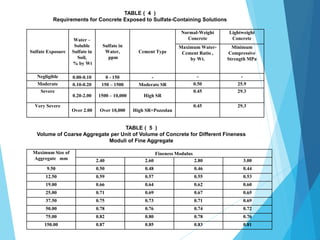
TABLE ( 3 )
Maximum Water-Cement Ratio for Various Exposure Conditions
Exposure Condition
Maximum Water-Cement Ratio
for Normal-Weight Concrete
by Weight
Concrete protected from exposure to freezing and thawing or
application of de-icer chemicals
Select water-cement ratio on
basis of strength ,workability
and finishing needs
Concrete intended to be watertight , exposed to :
a. Fresh water 0.50
b. Brackish water or Seawater 0.45
Concrete exposed to freezing and thawing in a moist condition (
air-entrained concrete)
a. Curbs , gutters , guardrails, or this sections 0.45
b. Other elements 0.50
c. In presence of de-icing chemicals 0.45
For corrosion protection for reinforced concrete exposed to
de-icing salts, brackish water, seawater, or spray from these
sources
0.40
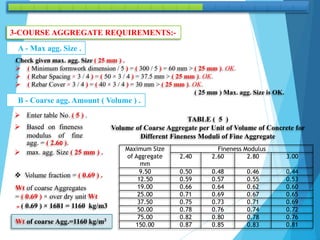
3-COURSE AGGREGATE REQUIREMENTS:-
A - Max agg. Size .
Check given max. agg. Size ( 25 mm ) .
 ( Minimum formwork dimension / 5 ) = ( 300 / 5 ) = 60 mm > ( 25 mm ). OK.
 ( Rebar Spacing × 3 / 4 ) = ( 50 × 3 / 4 ) = 37.5 mm > ( 25 mm ). OK.
 ( Rebar Cover × 3 / 4 ) = ( 40 × 3 / 4 ) = 30 mm > ( 25 mm ). OK.
( 25 mm ) Max. agg. Size is OK.
B - Coarse agg. Amount ( Volume ) .
TABLE ( 5 )
Volume of Coarse Aggregate per Unit of Volume of Concrete for
Different Fineness Moduli of Fine Aggregate
Maximum Size
of Aggregate
mm
Fineness Modulus
2.40 2.60 2.80 3.00
9.50 0.50 0.48 0.46 0.44
12.50 0.59 0.57 0.55 0.53
19.00 0.66 0.64 0.62 0.60
25.00 0.71 0.69 0.67 0.65
37.50 0.75 0.73 0.71 0.69
50.00 0.78 0.76 0.74 0.72
75.00 0.82 0.80 0.78 0.76
150.00 0.87 0.85 0.83 0.81
 Enter table No. ( 5 ) .
 Based on fineness
modulus of fine
agg. = ( 2.60 ).
 max. agg. Size ( 25 mm ) .
 Volume fraction = ( 0.69 ) .
Wt of coarse Aggregates
= ( 0.69 ) × over dry unit Wt
= ( 0.69 ) × 1681 = 1160 kg/m3
Wt of coarse Agg.=1160 kg/m3
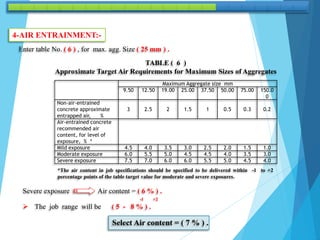
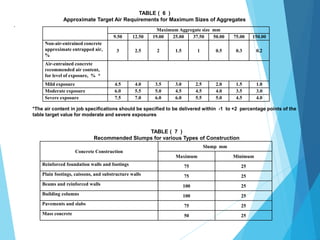
4-AIR ENTRAINMENT:-
Enter table No. ( 6 ) , for max. agg. Size ( 25 mm ) .
TABLE ( 6 )
Approximate Target Air Requirements for Maximum Sizes of Aggregates
Maximum Aggregate size mm
9.50 12.50 19.00 25.00 37.50 50.00 75.00 150.0
0
Non-air-entrained
concrete approximate
entrapped air, %
3 2.5 2 1.5 1 0.5 0.3 0.2
Air-entrained concrete
recommended air
content, for level of
exposure, % *
Mild exposure 4.5 4.0 3.5 3.0 2.5 2.0 1.5 1.0
Moderate exposure 6.0 5.5 5.0 4.5 4.5 4.0 3.5 3.0
Severe exposure 7.5 7.0 6.0 6.0 5.5 5.0 4.5 4.0
*The air content in job specifications should be specified to be delivered within -1 to +2
percentage points of the table target value for moderate and severe exposures.
Severe exposure Air content = ( 6 % ) .
-1 +2
 The job range will be ( 5 - 8 % ) .
Select Air content = ( 7 % ) .
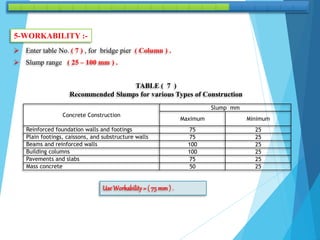
5-WORKABILITY :-
 Enter table No. ( 7 ) , for bridge pier ( Column ) .
 Slump range ( 25 – 100 mm ) .
Use Workability= ( 75 mm) .
TABLE ( 7 )
Recommended Slumps for various Types of Construction
Concrete Construction
Slump mm
Maximum Minimum
Reinforced foundation walls and footings 75 25
Plain footings, caissons, and substructure walls 75 25
Beams and reinforced walls 100 25
Building columns 100 25
Pavements and slabs 75 25
Mass concrete 50 25
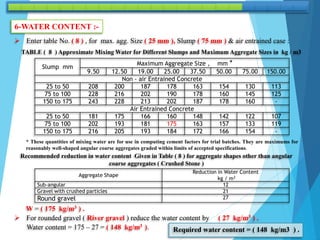
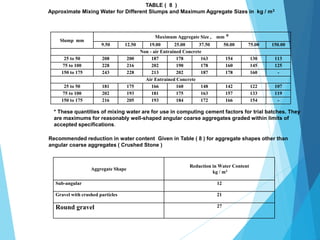
6-WATER CONTENT :-
 Enter table No. ( 8 ) , for max. agg. Size ( 25 mm ), Slump ( 75 mm ) & air entrained case :
TABLE ( 8 ) Approximate Mixing Water for Different Slumps and Maximum Aggregate Sizes in kg / m3
Slump mm
Maximum Aggregate Size , mm *
9.50 12.50 19.00 25.00 37.50 50.00 75.00 150.00
Non - air Entrained Concrete
25 to 50 208 200 187 178 163 154 130 113
75 to 100 228 216 202 190 178 160 145 125
150 to 175 243 228 213 202 187 178 160 -
Air Entrained Concrete
25 to 50 181 175 166 160 148 142 122 107
75 to 100 202 193 181 175 163 157 133 119
150 to 175 216 205 193 184 172 166 154 -
W = ( 175 kg/m3 ) .
* These quantities of mixing water are for use in computing cement factors for trial batches. They are maximums for
reasonably well-shaped angular coarse aggregates graded within limits of accepted specifications.
Recommended reduction in water content Given in Table ( 8 ) for aggregate shapes other than angular
coarse aggregates ( Crushed Stone )
Aggregate Shape
Reduction in Water Content
kg / m3
Sub-angular 12
Gravel with crushed particles 21
Round gravel 27
 For rounded gravel ( River gravel ) reduce the water content by ( 27 kg/m3 ) .
Water content = 175 – 27 = ( 148 kg/m3 ). Required water content = ( 148 kg/m3 ) .
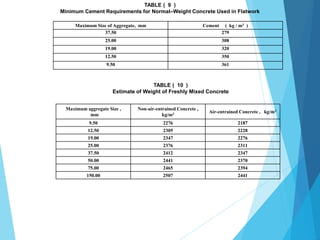
7-CEMENT CONTENT REQUIREMENTS:-
 For [(W/C) = 0.45 ] & water content = ( 148 kg/m3 )
 [ Cement Content = ( 148 / 0.45 )] = ( 329 kg/m3 )
Having minimum cement content requirement for freeze & thawing & de-icing chemicals
= ( 334 kg/m3 )
Cement Content = ( 334 kg/m3 )
8-ADMIXTURE :-
 For Air content = ( 7 % ) , Cement Content = ( 334 kg/m3 ) .
 Admixture required = { 6.3 × 7 × ( 334 /100 )} = ( 147 ml /m3 ) .
Admixture Required = ( 147 ml /m3 ) .
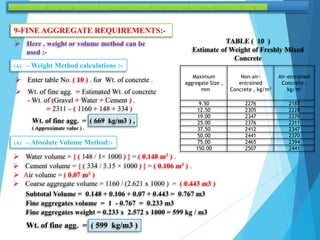
9-FINE AGGREGATE REQUIREMENTS:-
 Here , weight or volume method can be
used :-
(A) – Weight Method calculations :-
 Enter table No. ( 10 ) . for Wt. of concrete .
TABLE ( 10 )
Estimate of Weight of Freshly Mixed
Concrete
Maximum
aggregate Size ,
mm
Non-air-
entrained
Concrete , kg/m3
Air-entrained
Concrete ,
kg/m3
9.50 2276 2187
12.50 2305 2228
19.00 2347 2276
25.00 2376 2311
37.50 2412 2347
50.00 2441 2370
75.00 2465 2394
150.00 2507 2441
 Wt. of fine agg. = Estimated Wt. of concrete
- Wt. of (Gravel + Water + Cement ) .
= 2311 – ( 1160 + 148 + 334 )
Wt. of fine agg. = ( 669 kg/m3 ) ,
( Approximate value ) .
(A) – Absolute Volume Method:-
 Water volume = { ( 148 / 1× 1000 ) } = ( 0.148 m3 ) .
 Cement volume = { ( 334 / 3.15 × 1000 ) } = ( 0.106 m3 ) .
 Air volume = ( 0.07 m3 )
 Coarse aggregate volume = 1160 / (2.621 x 1000 ) = ( 0.443 m3 )
Subtotal Volume = 0.148 + 0.106 + 0.07 + 0.443 = 0.767 m3
Fine aggregates volume = 1 - 0.767 = 0.233 m3
Fine aggregates weight = 0.233 x 2.572 x 1000 = 599 kg / m3
Wt. of fine agg. = ( 599 kg/m3 )
10-MOISTURE CORRECTIONS:-
 Mix design should be based on (S.S.D.) [ Saturation Surface Dry ], condition for fine &
coarse aggregate .
 The final step in the mix design process is to adjust the weight of water & aggregates to
acount for the existing moisture content of the aggregates. If moisture content of the
aggregates is more than the (S.S.D.) moisture content , the weight of mixing water is reduced
by an amount equal to the free weight of the moisture on the aggregate.
 Similarly, if the moisture content is below, (S.S.D.) moisture content, the mixing water must
be increased.
Coarse aggregates : Need 1160 kg / m3 in SSD condition , so increase by 3 % for excess
moisture
Moist coarse aggregates = 1160 x 1.03 = 1195 kg / m3
Fine aggregates : Need 599 kg / m3 in SSD condition , so increase by 4 % for excess
moisture
Moist fine aggregates = 599 x 1.04 = 623 kg / m3
Water : Reduce for free water on aggregates
= 148 – 1160 ( 0.03 – 0.004 ) - 599 ( 0.04 – 0.008 ) = 99 kg / m3
Summary : Water 99 kg
Cement 334 kg
Fine aggregates 623 kg
Coarse aggregates 1195 kg
Admixture 147 ml
Concrete mix W (Water): C ( Cement) : F ( Fine agg.) : C ( Coarse agg.) : Ad (Admixture )
99 : 334 : 623 : 1195 : 147ml
0.2964 : 1 : 1.8653 : 3.5778 : 147 ml
11 - TRIAL MIXES:-
 To be done on site, to check the mix design.
 Trial batch using three (Cubes) [ (150 ) × (150 ) × (150 ) mm ] ,
or cylinder [( 150 ) × ( 300 ) mm ] , cured for [ (28) days ] and tested for compression strength.
 Finally mix design ratio should be based on the weight of the mix ingredients & the site
engineer can convert it to volumes.
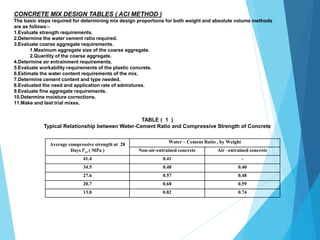
CONCRETE MIX DESIGN TABLES ( ACI METHOD )
The basic steps required for determining mix design proportions for both weight and absolute volume methods
are as follows:-
1.Evaluate strength requirements.
2.Determine the water cement ratio required.
3.Evaluate coarse aggregate requirements.
1.Maximum aggregate size of the coarse aggregate.
2.Quantity of the coarse aggregate.
4.Determine air entrainment requirements.
5.Evaluate workability requirements of the plastic concrete.
6.Estimate the water content requirements of the mix.
7.Determine cement content and type needed.
8.Evaluated the need and application rate of admixtures.
9.Evaluate fine aggregate requirements.
10.Determine moisture corrections.
11.Make and test trial mixes.
Average compressive strength at 28
Days f'cr ( MPa )
Water – Cement Ratio , by Weight
Non-air-entrained concrete Air –entrained concrete
41.4 0.41 -
34.5 0.48 0.40
27.6 0.57 0.48
20.7 0.68 0.59
13.8 0.82 0.74
TABLE ( 1 )
Typical Relationship between Water-Cement Ratio and Compressive Strength of Concrete
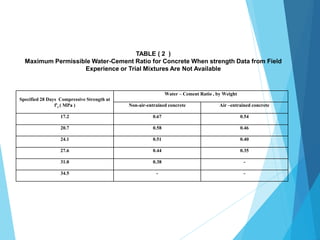
Specified 28 Days Compressive Strength at
f'c ( MPa )
Water – Cement Ratio , by Weight
Non-air-entrained concrete Air –entrained concrete
17.2 0.67 0.54
20.7 0.58 0.46
24.1 0.51 0.40
27.6 0.44 0.35
31.0 0.38 -
34.5 - -
TABLE ( 2 )
Maximum Permissible Water-Cement Ratio for Concrete When strength Data from Field
Experience or Trial Mixtures Are Not Available
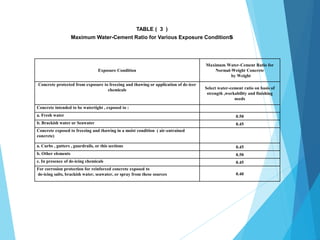
Exposure Condition
Maximum Water-Cement Ratio for
Normal-Weight Concrete
by Weight
Concrete protected from exposure to freezing and thawing or application of de-icer
chemicals Select water-cement ratio on basis of
strength ,workability and finishing
needs
Concrete intended to be watertight , exposed to :
a. Fresh water 0.50
b. Brackish water or Seawater 0.45
Concrete exposed to freezing and thawing in a moist condition ( air-entrained
concrete)
a. Curbs , gutters , guardrails, or this sections 0.45
b. Other elements 0.50
c. In presence of de-icing chemicals 0.45
For corrosion protection for reinforced concrete exposed to
de-icing salts, brackish water, seawater, or spray from these sources 0.40
TABLE ( 3 )
Maximum Water-Cement Ratio for Various Exposure Conditions
Sulfate Exposure
Water –
Soluble
Sulfate in
Soil,
% by Wt
Sulfate in
Water,
ppm
Cement Type
Normal-Weight
Concrete
Lightweight
Concrete
Maximum Water-
Cement Ratio ,
by Wt.
Minimum
Compressive
Strength MPa
Negligible 0.00-0.10 0 - 150 - - -
Moderate 0.10-0.20 150 – 1500 Moderate SR 0.50 25.9
Severe
0.20-2.00 1500 – 10,000 High SR
0.45 29.3
Very Severe
Over 2.00 Over 10,000 High SR+Pozzolan
0.45 29.3
TABLE ( 4 )
Requirements for Concrete Exposed to Sulfate-Containing Solutions
Maximum Size of
Aggregate mm
Fineness Modulus
2.40 2.60 2.80 3.00
9.50 0.50 0.48 0.46 0.44
12.50 0.59 0.57 0.55 0.53
19.00 0.66 0.64 0.62 0.60
25.00 0.71 0.69 0.67 0.65
37.50 0.75 0.73 0.71 0.69
50.00 0.78 0.76 0.74 0.72
75.00 0.82 0.80 0.78 0.76
150.00 0.87 0.85 0.83 0.81
TABLE ( 5 )
Volume of Coarse Aggregate per Unit of Volume of Concrete for Different Fineness
Moduli of Fine Aggregate
Maximum Aggregate size mm
9.50 12.50 19.00 25.00 37.50 50.00 75.00 150.00
Non-air-entrained concrete
approximate entrapped air,
%
3 2.5 2 1.5 1 0.5 0.3 0.2
Air-entrained concrete
recommended air content,
for level of exposure, % *
Mild exposure 4.5 4.0 3.5 3.0 2.5 2.0 1.5 1.0
Moderate exposure 6.0 5.5 5.0 4.5 4.5 4.0 3.5 3.0
Severe exposure 7.5 7.0 6.0 6.0 5.5 5.0 4.5 4.0
TABLE ( 6 )
Approximate Target Air Requirements for Maximum Sizes of Aggregates
.
*The air content in job specifications should be specified to be delivered within -1 to +2 percentage points of the
table target value for moderate and severe exposures
Concrete Construction
Slump mm
Maximum Minimum
Reinforced foundation walls and footings 75 25
Plain footings, caissons, and substructure walls 75 25
Beams and reinforced walls 100 25
Building columns 100 25
Pavements and slabs 75 25
Mass concrete 50 25
TABLE ( 7 )
Recommended Slumps for various Types of Construction
Slump mm
Maximum Aggregate Size , mm *
9.50 12.50 19.00 25.00 37.50 50.00 75.00 150.00
Non - air Entrained Concrete
25 to 50 208 200 187 178 163 154 130 113
75 to 100 228 216 202 190 178 160 145 125
150 to 175 243 228 213 202 187 178 160 -
Air Entrained Concrete
25 to 50 181 175 166 160 148 142 122 107
75 to 100 202 193 181 175 163 157 133 119
150 to 175 216 205 193 184 172 166 154 -
TABLE ( 8 )
Approximate Mixing Water for Different Slumps and Maximum Aggregate Sizes in kg / m3
Aggregate Shape
Reduction in Water Content
kg / m3
Sub-angular 12
Gravel with crushed particles 21
Round gravel 27
Recommended reduction in water content Given in Table ( 8 ) for aggregate shapes other than
angular coarse aggregates ( Crushed Stone )
* These quantities of mixing water are for use in computing cement factors for trial batches. They
are maximums for reasonably well-shaped angular coarse aggregates graded within limits of
accepted specifications.
Maximum Size of Aggregate, mm Cement ( kg / m3 )
37.50 279
25.00 308
19.00 320
12.50 350
9.50 361
TABLE ( 9 )
Minimum Cement Requirements for Normal–Weight Concrete Used in Flatwork
Maximum aggregate Size ,
mm
Non-air-entrained Concrete ,
kg/m3 Air-entrained Concrete , kg/m3
9.50 2276 2187
12.50 2305 2228
19.00 2347 2276
25.00 2376 2311
37.50 2412 2347
50.00 2441 2370
75.00 2465 2394
150.00 2507 2441
TABLE ( 10 )
Estimate of Weight of Freshly Mixed Concrete
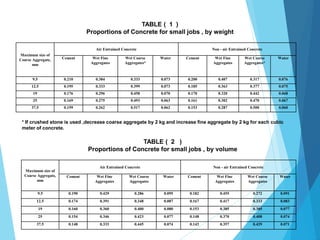
Maximum size of
Coarse Aggregate,
mm
Air Entrained Concrete Non - air Entrained Concrete
Cement Wet Fine
Aggregates
Wet Coarse
Aggregates*
Water Cement Wet Fine
Aggregates
Wet Coarse
Aggregates*
Water
9.5 0.210 0.384 0.333 0.073 0.200 0.407 0.317 0.076
12.5 0.195 0.333 0.399 0.073 0.185 0.363 0.377 0.075
19 0.176 0.296 0.458 0.070 0.170 0.320 0.442 0.068
25 0.169 0.275 0.493 0.063 0.161 0.302 0.470 0.067
37.5 0.159 0.262 0.517 0.062 0.153 0.287 0.500 0.060
TABLE ( 1 )
Proportions of Concrete for small jobs , by weight
Maximum size of
Coarse Aggregate,
mm
Air Entrained Concrete Non - air Entrained Concrete
Cement Wet Fine
Aggregates
Wet Coarse
Aggregates
Water Cement Wet Fine
Aggregates
Wet Coarse
Aggregates
Water
9.5 0.190 0.429 0.286 0.095 0.182 0.455 0.272 0.091
12.5 0.174 0.391 0.348 0.087 0.167 0.417 0.333 0.083
19 0.160 0.360 0.400 0.080 0.153 0.385 0.385 0.077
25 0.154 0.346 0.423 0.077 0.148 0.370 0.408 0.074
37.5 0.148 0.333 0.445 0.074 0.143 0.357 0.429 0.071
TABLE ( 2 )
Proportions of Concrete for small jobs , by volume
* If crushed stone is used ,decrease coarse aggregate by 2 kg and increase fine aggregate by 2 kg for each cubic
meter of concrete.

Concrete Mix Design.pptx

  • 1.
    Concrete Mix Design Concretemix design may be defined as the art of selecting suitable ingredients of concrete and determining their relative proportions with the object of producing concrete of certain minimum strength & durability as economically as possible. Objectives of Mix Design Definition Mix design should ensure following objectives.  To achieve the designed/ desired workability in the plastic stage  To achieve the desired minimum strength in the hardened stage  To achieve the desired durability in the given environment conditions  To produce concrete as economically as possible.
  • 2.
    Basic Considerations The followingpoints must be considered while designing concrete mixes  Cost  Specification  Workability  Strength and Durability The cost of concrete is made up of -Material Cost -Equipment Cost -Labour Cost The variation in the cost of materials arises from the fact that cement is several times costlier than aggregates. So it is natural in mix design to aim at as lean a mix as possible. Therefore, all possible steps should be taken to reduce the cement content of a concrete mixture without sacrificing the desirable properties of concrete such as strength and durability. Cost
  • 3.
    The following pointsmay be kept in mind while designing concrete mixes  Minimum Compressive Strength required  Minimum water/ cement ratio  Maximum cement content to avoid shrinkage cracks  Maximum aggregate / cement ratio  Maximum density of concrete in case of gravity dams Specifications The following points related to workability shall be kept in mind while designing concrete mixes.  The consistency of concrete should be no more than that necessary for placing, compacting and finishing.  For concrete mixes requiring high consistency at the time of placing, the use of water-reducing and set- retarding admixtures should be used rather than the addition of more water  Wherever possible, the cohesiveness and finishibility of concrete should be improved by increasing sand/ aggregate ratio than by increasing the proportion of the fine particles in the sand. Workability
  • 4.
    Strength and durabilityrequire lower w/c ratio. It is usually achieved not by increasing the cement content, but by lowering the water at given cement content. Water demand can by lowered by throughout control of the aggregate grading and by using water reducing admixtures. Strength and durability Method of Concrete Mix Design Some of the commonly used mix design methods are A.C.I method I.S. Method Road Note 4 method ( U.K. Method) IRC 44 method Arbitrary method Maximum Density method Fineness modulus method Surface area Method Nix design for high strength Concrete Mix design for pumpable Concrete DOE (British) Mix design method
  • 5.
    CONCRETE MIX DESIGN Weight& Absolute Volume Method ( ACI Method )  Is the process of selecting suitable ingredients of concrete & determining their relative quantities with the purpose of producing an economical concrete which has certain minimum properties [ notably Workability, Strength & Durability]. Mix design The following three qualities are required of properly proportioned concrete mixers:- 1) Acceptable workability of freshly mixed concrete. 2) Durability, strength & uniform appearance of hardened concrete. 3) Economy.  Several mix design methods have been developed over the years, ranging from an arbitrary volume method. [e.g. (1:2:4) cement, Sand, Gravel].to the weight & absolute – volume method.  The weight method provides relatively simple techniques for estimating mix proportions using an assumed or known unit weight of concrete.  The absolute volume methods uses the specific gravity of each ingredient to calculate the unit volume each will occupy in unit volume of concrete.
  • 6.
    Mix Design basicsteps for weight & absolute volume method:-  The basic steps required for determining mix design proportions for both weight & absolute volume methods are as follows:- 1) Evaluate strength requirements. 2) Determine the water cement ratio required. 3) Evaluate coarse aggregate requirements. a. Maximum aggregate size of the coarse aggregate. b. Quantity of the coarse aggregate. 4) Determine air entrainment requirements. 5) Evaluate workability requirements for the plastic concrete. 6) Estimate the water content requirements for the mix. 7) Determine cement content & type needed. 8) Evaluate the need & application rate of admixtures. 9) Evaluate fine aggregate requirements. 10) Determine moisture contents. 11) Make & test trial mixes.
  • 7.
    1 – STRENGTHREQUIREMENTS:-  In order to compute the strength requirements for concrete mix design, three quantities must be known:- 1) The specified compressive strength [fc /)]. Cylinder at 28 days [ (fc /) = 0.80 (fcu ) ] Cube at 28 days. Cube at 28 days [ (fcu ) = 1.25 (fc /) ] Cylinder at 28 days. 2) The variability or standard deviation (S), of concrete. 3) The allowable risk of making concrete with an unacceptable strength.  The standard deviation in the strength is determined for a plant by making batches of concrete, testing the strength for many samples and computing the standard deviation.  The allowable risk has been established by the [(ACI)], One of the risk rules has been established, states that there should be less than [(10%)] chance that the strength of a concrete mix is less than the specified strength. 1. Standard deviation (S) is a measure of the dispersion or spread of the results. 2. The arithmetic mean [(X‾)] is simply the average of test results of all specimens tested.
  • 8.
    fcŕ= fc / +1.34 (S) ……………… (1) Where:- fcŕ = Required average compressive strength (MPa) . fc / = Specified compressive strength (MPa) S = Standard deviation (MPa)  For mixes with a large standard deviation in strength, there is another risk criterion that requires. fcŕ = fc / + 2.33 (S) – (3.45) ……… (2)  The larger of equations [(1) & (2)], will govern.  The standard deviation should be determined from at least (30) strength results.  If (S) is computed from [(15) to (30)] samples, then fcŕ= fc / + 1.34 (S¯) …………..…… (3) 0r fcŕ = fc / + 2.33 (S¯) – (3.45) ……… (4)  Where (S¯) is the product of (S) multiplied by the following modification factors(f). i.e, S¯ = S . f
  • 9.
     If fewerthan (15) test are available, the following adjustments are made to the specified strength instead of using equations [(1), ( 2 ) ,( 3 ) and (4)] as shown below: Specified compressive strength fc / ( MPa ) Required average compressive strength fcŕ ( MPa ) < 20.7 20.7 to 34.5 > 34.5 fc / + 6.9 fc / + 8.3 fc / + 9.7 Example: The design engineer specifies a concrete strength of [(31.0) MPa], Determine the required average compressive strength for:- (A) - A new plant where (S) is unknown. (B) - A plant where [(S=3.6) MPa], for (17) test results. (C) - A plant with extensive history of producing concrete with [(S=2.4) MPa]. (D) - A plant with extensive history of producing concrete with [(S=3.8) MPa].
  • 10.
    (A) – forfc‾ = 31 MPa , as (S) is unknown. fcŕ = fc‾ + 8.3 = 31.0 + 8.3 = 39.3 MPa Specified compressive strength fc / ( MPa ) Required average compressive strength fcŕ ( MPa ) < 20.7 20.7 to 34.5 > 34.5 fc / + 6.9 fc / + 8.3 fc / + 9.7 (B) - As (S) is based on ( 17 ) test results , between ( 15 – 30 ) so modified (S) to be used . find ( f ) by inter potation. f = {(1.16) – [(1.16 –1.08) / (20 –15)] × (17 –15)} f =1.13 i.e. S¯ = f * S = 1.13×3.6 = 4.1 MPa Now determine (fcŕ) basing on equ. ( 1 ) & ( 2 ) . fcŕ= fc‾ + 1.34 (S) fcŕ= 31.0 + [ (1.34)×(4.1) ] = 36.5 MPa Or fcŕ = fc‾ + 2.33 (S) – (3.45) = {31.0 + [(2.33) × (4.1)] – (3.45)} = 37.1 MPa [govern] Use fcŕ = 37.1 MPa Number of tests (n) Modification Factor (f) 15 20 25 30 or more 1.16 1.08 1.05 1.00
  • 11.
    (C) - As(S) is based on more results , than (30 ) results (fcŕ) to be calculated directly from equ. ( 1 ) & ( 2 ) . fcŕ= fc‾ + 1.34 (S) = {31.0 + [ (1.34)×(2.4) ] } = 34.2 Mpa [govern] Or fcŕ = fc‾ + 2.33 (S) – (3.45) = {31.0 + [(2.33) × (2.4)] – (3.45)} = 33.1 MPa Use fcŕ = 34.2 MPa (D) Same as C fcŕ= fc‾ + 1.34 (S) = 31.0 + [ (1.34)×(3.8) ] = 36.1 MPa or fcŕ = fc‾ + 2.33 (S) – (3.45) = {31.0 + [(2.33) × (3.8)] – (3.45)} = 36.4 MPa [govern] Use fcŕ = 36.4 MPa
  • 12.
    Mix Design Example: Design a concrete mix for the following conditions and constraints using the absolute volume method : Design Environment Bridge pier exposed to freezing and subjected to de-icing chemicals. Required design strength = 24.1 MPa Minimum dimension = 0.3 m Minimum space between rebar's = 50 mm Minimum cover over rebar's = 40 mm Standard deviation of compressive strength of 2.4 MPa is expected ( More than 30 samples ) Only air entrained is allowed . Available Materials Cement - Select Type V due to exposure . Air Entrained Manufacture specification 6.3 ml / 1% air / 100 kg cement Coarse aggregates 25mm maximum size , river gravel ( Round ) Bulk oven dry specific gravity = 2.621 , Absorption = 0.4 % Oven dry-rodded density = 1681 kg / m3 Moisture content = 3 % Fine aggregates Natural Sand Bulk oven dry specific gravity = 2.572 , Absorption = 0.8 % Moisture content = 4 % Fineness modulus = 2.60
  • 13.
    Solution : 1- STRENGTHREQUIREMENTS :- S = 2.4 MPa ( enough samples so that no correction is needed ) fcŕ= fc‾ + 1.34 (S) = 24.1 + [ (1.34)×(2.4) ] = 27.3 MPa [govern] Or fcŕ = fc‾ + 2.33 (S) – (3.45) = {24.1 + [(2.33) × (2.4)] – (3.45)} = 26.2 MPa fcŕ = 27.3 MPa 2 - WATER – CEMENT RATIO:- For fcŕ = 27.3 (MPa) TABLE ( 1 ) Typical Relationship between Water-Cement Ratio and Compressive Strength of Concrete Average compressive strength at 28 Days f'cr ( MPa ) Water – Cement Ratio , by Weight Non-air-entrained concrete Air –entrained concrete 41.4 0.41 - 34.5 0.48 0.40 27.6 0.57 0.48 20.7 0.68 0.59 13.8 0.82 0.74 Enter table No. ( 1 ) , & by interpolation [ (W/C) = 0.48 ]. Δ fc‾ = 27.6 – 20.7 = 6.9 (MPa) Δ (W/C) = 0.59 – 0.48 = 0.11 For ( 27.6 -27.3 ) = 0 .3 Δ (W/C) = {( 0.3 × 0.11 ) / 6.9 } = 0.0047 (W/C) = 0.48 + 0.0047 = 0.48 0
  • 14.
    [ ( W/C) = 0.45 ] The smaller value of table ( 1 & 3 ) governs  For exposure condition ( exposed to freezing & thawing subjected the de-icing chemicals ) . Enter table No.( 3 ) , Max. Permissible [ ( W/C ) = 0.45 ]. TABLE ( 3 ) Maximum Water-Cement Ratio for Various Exposure Conditions Exposure Condition Maximum Water-Cement Ratio for Normal-Weight Concrete by Weight Concrete protected from exposure to freezing and thawing or application of de-icer chemicals Select water-cement ratio on basis of strength ,workability and finishing needs Concrete intended to be watertight , exposed to : a. Fresh water 0.50 b. Brackish water or Seawater 0.45 Concrete exposed to freezing and thawing in a moist condition ( air-entrained concrete) a. Curbs , gutters , guardrails, or this sections 0.45 b. Other elements 0.50 c. In presence of de-icing chemicals 0.45 For corrosion protection for reinforced concrete exposed to de-icing salts, brackish water, seawater, or spray from these sources 0.40
  • 15.
    3-COURSE AGGREGATE REQUIREMENTS:- A- Max agg. Size . Check given max. agg. Size ( 25 mm ) .  ( Minimum formwork dimension / 5 ) = ( 300 / 5 ) = 60 mm > ( 25 mm ). OK.  ( Rebar Spacing × 3 / 4 ) = ( 50 × 3 / 4 ) = 37.5 mm > ( 25 mm ). OK.  ( Rebar Cover × 3 / 4 ) = ( 40 × 3 / 4 ) = 30 mm > ( 25 mm ). OK. ( 25 mm ) Max. agg. Size is OK. B - Coarse agg. Amount ( Volume ) . TABLE ( 5 ) Volume of Coarse Aggregate per Unit of Volume of Concrete for Different Fineness Moduli of Fine Aggregate Maximum Size of Aggregate mm Fineness Modulus 2.40 2.60 2.80 3.00 9.50 0.50 0.48 0.46 0.44 12.50 0.59 0.57 0.55 0.53 19.00 0.66 0.64 0.62 0.60 25.00 0.71 0.69 0.67 0.65 37.50 0.75 0.73 0.71 0.69 50.00 0.78 0.76 0.74 0.72 75.00 0.82 0.80 0.78 0.76 150.00 0.87 0.85 0.83 0.81  Enter table No. ( 5 ) .  Based on fineness modulus of fine agg. = ( 2.60 ).  max. agg. Size ( 25 mm ) .  Volume fraction = ( 0.69 ) . Wt of coarse Aggregates = ( 0.69 ) × over dry unit Wt = ( 0.69 ) × 1681 = 1160 kg/m3 Wt of coarse Agg.=1160 kg/m3
  • 16.
    4-AIR ENTRAINMENT:- Enter tableNo. ( 6 ) , for max. agg. Size ( 25 mm ) . TABLE ( 6 ) Approximate Target Air Requirements for Maximum Sizes of Aggregates Maximum Aggregate size mm 9.50 12.50 19.00 25.00 37.50 50.00 75.00 150.0 0 Non-air-entrained concrete approximate entrapped air, % 3 2.5 2 1.5 1 0.5 0.3 0.2 Air-entrained concrete recommended air content, for level of exposure, % * Mild exposure 4.5 4.0 3.5 3.0 2.5 2.0 1.5 1.0 Moderate exposure 6.0 5.5 5.0 4.5 4.5 4.0 3.5 3.0 Severe exposure 7.5 7.0 6.0 6.0 5.5 5.0 4.5 4.0 *The air content in job specifications should be specified to be delivered within -1 to +2 percentage points of the table target value for moderate and severe exposures. Severe exposure Air content = ( 6 % ) . -1 +2  The job range will be ( 5 - 8 % ) . Select Air content = ( 7 % ) .
  • 17.
    5-WORKABILITY :-  Entertable No. ( 7 ) , for bridge pier ( Column ) .  Slump range ( 25 – 100 mm ) . Use Workability= ( 75 mm) . TABLE ( 7 ) Recommended Slumps for various Types of Construction Concrete Construction Slump mm Maximum Minimum Reinforced foundation walls and footings 75 25 Plain footings, caissons, and substructure walls 75 25 Beams and reinforced walls 100 25 Building columns 100 25 Pavements and slabs 75 25 Mass concrete 50 25
  • 18.
    6-WATER CONTENT :- Enter table No. ( 8 ) , for max. agg. Size ( 25 mm ), Slump ( 75 mm ) & air entrained case : TABLE ( 8 ) Approximate Mixing Water for Different Slumps and Maximum Aggregate Sizes in kg / m3 Slump mm Maximum Aggregate Size , mm * 9.50 12.50 19.00 25.00 37.50 50.00 75.00 150.00 Non - air Entrained Concrete 25 to 50 208 200 187 178 163 154 130 113 75 to 100 228 216 202 190 178 160 145 125 150 to 175 243 228 213 202 187 178 160 - Air Entrained Concrete 25 to 50 181 175 166 160 148 142 122 107 75 to 100 202 193 181 175 163 157 133 119 150 to 175 216 205 193 184 172 166 154 - W = ( 175 kg/m3 ) . * These quantities of mixing water are for use in computing cement factors for trial batches. They are maximums for reasonably well-shaped angular coarse aggregates graded within limits of accepted specifications. Recommended reduction in water content Given in Table ( 8 ) for aggregate shapes other than angular coarse aggregates ( Crushed Stone ) Aggregate Shape Reduction in Water Content kg / m3 Sub-angular 12 Gravel with crushed particles 21 Round gravel 27  For rounded gravel ( River gravel ) reduce the water content by ( 27 kg/m3 ) . Water content = 175 – 27 = ( 148 kg/m3 ). Required water content = ( 148 kg/m3 ) .
  • 19.
    7-CEMENT CONTENT REQUIREMENTS:- For [(W/C) = 0.45 ] & water content = ( 148 kg/m3 )  [ Cement Content = ( 148 / 0.45 )] = ( 329 kg/m3 ) Having minimum cement content requirement for freeze & thawing & de-icing chemicals = ( 334 kg/m3 ) Cement Content = ( 334 kg/m3 ) 8-ADMIXTURE :-  For Air content = ( 7 % ) , Cement Content = ( 334 kg/m3 ) .  Admixture required = { 6.3 × 7 × ( 334 /100 )} = ( 147 ml /m3 ) . Admixture Required = ( 147 ml /m3 ) .
  • 20.
    9-FINE AGGREGATE REQUIREMENTS:- Here , weight or volume method can be used :- (A) – Weight Method calculations :-  Enter table No. ( 10 ) . for Wt. of concrete . TABLE ( 10 ) Estimate of Weight of Freshly Mixed Concrete Maximum aggregate Size , mm Non-air- entrained Concrete , kg/m3 Air-entrained Concrete , kg/m3 9.50 2276 2187 12.50 2305 2228 19.00 2347 2276 25.00 2376 2311 37.50 2412 2347 50.00 2441 2370 75.00 2465 2394 150.00 2507 2441  Wt. of fine agg. = Estimated Wt. of concrete - Wt. of (Gravel + Water + Cement ) . = 2311 – ( 1160 + 148 + 334 ) Wt. of fine agg. = ( 669 kg/m3 ) , ( Approximate value ) . (A) – Absolute Volume Method:-  Water volume = { ( 148 / 1× 1000 ) } = ( 0.148 m3 ) .  Cement volume = { ( 334 / 3.15 × 1000 ) } = ( 0.106 m3 ) .  Air volume = ( 0.07 m3 )  Coarse aggregate volume = 1160 / (2.621 x 1000 ) = ( 0.443 m3 ) Subtotal Volume = 0.148 + 0.106 + 0.07 + 0.443 = 0.767 m3 Fine aggregates volume = 1 - 0.767 = 0.233 m3 Fine aggregates weight = 0.233 x 2.572 x 1000 = 599 kg / m3 Wt. of fine agg. = ( 599 kg/m3 )
  • 21.
    10-MOISTURE CORRECTIONS:-  Mixdesign should be based on (S.S.D.) [ Saturation Surface Dry ], condition for fine & coarse aggregate .  The final step in the mix design process is to adjust the weight of water & aggregates to acount for the existing moisture content of the aggregates. If moisture content of the aggregates is more than the (S.S.D.) moisture content , the weight of mixing water is reduced by an amount equal to the free weight of the moisture on the aggregate.  Similarly, if the moisture content is below, (S.S.D.) moisture content, the mixing water must be increased. Coarse aggregates : Need 1160 kg / m3 in SSD condition , so increase by 3 % for excess moisture Moist coarse aggregates = 1160 x 1.03 = 1195 kg / m3 Fine aggregates : Need 599 kg / m3 in SSD condition , so increase by 4 % for excess moisture Moist fine aggregates = 599 x 1.04 = 623 kg / m3 Water : Reduce for free water on aggregates = 148 – 1160 ( 0.03 – 0.004 ) - 599 ( 0.04 – 0.008 ) = 99 kg / m3
  • 22.
    Summary : Water99 kg Cement 334 kg Fine aggregates 623 kg Coarse aggregates 1195 kg Admixture 147 ml Concrete mix W (Water): C ( Cement) : F ( Fine agg.) : C ( Coarse agg.) : Ad (Admixture ) 99 : 334 : 623 : 1195 : 147ml 0.2964 : 1 : 1.8653 : 3.5778 : 147 ml 11 - TRIAL MIXES:-  To be done on site, to check the mix design.  Trial batch using three (Cubes) [ (150 ) × (150 ) × (150 ) mm ] , or cylinder [( 150 ) × ( 300 ) mm ] , cured for [ (28) days ] and tested for compression strength.  Finally mix design ratio should be based on the weight of the mix ingredients & the site engineer can convert it to volumes.
  • 25.
    CONCRETE MIX DESIGNTABLES ( ACI METHOD ) The basic steps required for determining mix design proportions for both weight and absolute volume methods are as follows:- 1.Evaluate strength requirements. 2.Determine the water cement ratio required. 3.Evaluate coarse aggregate requirements. 1.Maximum aggregate size of the coarse aggregate. 2.Quantity of the coarse aggregate. 4.Determine air entrainment requirements. 5.Evaluate workability requirements of the plastic concrete. 6.Estimate the water content requirements of the mix. 7.Determine cement content and type needed. 8.Evaluated the need and application rate of admixtures. 9.Evaluate fine aggregate requirements. 10.Determine moisture corrections. 11.Make and test trial mixes. Average compressive strength at 28 Days f'cr ( MPa ) Water – Cement Ratio , by Weight Non-air-entrained concrete Air –entrained concrete 41.4 0.41 - 34.5 0.48 0.40 27.6 0.57 0.48 20.7 0.68 0.59 13.8 0.82 0.74 TABLE ( 1 ) Typical Relationship between Water-Cement Ratio and Compressive Strength of Concrete
  • 26.
    Specified 28 DaysCompressive Strength at f'c ( MPa ) Water – Cement Ratio , by Weight Non-air-entrained concrete Air –entrained concrete 17.2 0.67 0.54 20.7 0.58 0.46 24.1 0.51 0.40 27.6 0.44 0.35 31.0 0.38 - 34.5 - - TABLE ( 2 ) Maximum Permissible Water-Cement Ratio for Concrete When strength Data from Field Experience or Trial Mixtures Are Not Available
  • 27.
    Exposure Condition Maximum Water-CementRatio for Normal-Weight Concrete by Weight Concrete protected from exposure to freezing and thawing or application of de-icer chemicals Select water-cement ratio on basis of strength ,workability and finishing needs Concrete intended to be watertight , exposed to : a. Fresh water 0.50 b. Brackish water or Seawater 0.45 Concrete exposed to freezing and thawing in a moist condition ( air-entrained concrete) a. Curbs , gutters , guardrails, or this sections 0.45 b. Other elements 0.50 c. In presence of de-icing chemicals 0.45 For corrosion protection for reinforced concrete exposed to de-icing salts, brackish water, seawater, or spray from these sources 0.40 TABLE ( 3 ) Maximum Water-Cement Ratio for Various Exposure Conditions
  • 28.
    Sulfate Exposure Water – Soluble Sulfatein Soil, % by Wt Sulfate in Water, ppm Cement Type Normal-Weight Concrete Lightweight Concrete Maximum Water- Cement Ratio , by Wt. Minimum Compressive Strength MPa Negligible 0.00-0.10 0 - 150 - - - Moderate 0.10-0.20 150 – 1500 Moderate SR 0.50 25.9 Severe 0.20-2.00 1500 – 10,000 High SR 0.45 29.3 Very Severe Over 2.00 Over 10,000 High SR+Pozzolan 0.45 29.3 TABLE ( 4 ) Requirements for Concrete Exposed to Sulfate-Containing Solutions Maximum Size of Aggregate mm Fineness Modulus 2.40 2.60 2.80 3.00 9.50 0.50 0.48 0.46 0.44 12.50 0.59 0.57 0.55 0.53 19.00 0.66 0.64 0.62 0.60 25.00 0.71 0.69 0.67 0.65 37.50 0.75 0.73 0.71 0.69 50.00 0.78 0.76 0.74 0.72 75.00 0.82 0.80 0.78 0.76 150.00 0.87 0.85 0.83 0.81 TABLE ( 5 ) Volume of Coarse Aggregate per Unit of Volume of Concrete for Different Fineness Moduli of Fine Aggregate
  • 29.
    Maximum Aggregate sizemm 9.50 12.50 19.00 25.00 37.50 50.00 75.00 150.00 Non-air-entrained concrete approximate entrapped air, % 3 2.5 2 1.5 1 0.5 0.3 0.2 Air-entrained concrete recommended air content, for level of exposure, % * Mild exposure 4.5 4.0 3.5 3.0 2.5 2.0 1.5 1.0 Moderate exposure 6.0 5.5 5.0 4.5 4.5 4.0 3.5 3.0 Severe exposure 7.5 7.0 6.0 6.0 5.5 5.0 4.5 4.0 TABLE ( 6 ) Approximate Target Air Requirements for Maximum Sizes of Aggregates . *The air content in job specifications should be specified to be delivered within -1 to +2 percentage points of the table target value for moderate and severe exposures Concrete Construction Slump mm Maximum Minimum Reinforced foundation walls and footings 75 25 Plain footings, caissons, and substructure walls 75 25 Beams and reinforced walls 100 25 Building columns 100 25 Pavements and slabs 75 25 Mass concrete 50 25 TABLE ( 7 ) Recommended Slumps for various Types of Construction
  • 30.
    Slump mm Maximum AggregateSize , mm * 9.50 12.50 19.00 25.00 37.50 50.00 75.00 150.00 Non - air Entrained Concrete 25 to 50 208 200 187 178 163 154 130 113 75 to 100 228 216 202 190 178 160 145 125 150 to 175 243 228 213 202 187 178 160 - Air Entrained Concrete 25 to 50 181 175 166 160 148 142 122 107 75 to 100 202 193 181 175 163 157 133 119 150 to 175 216 205 193 184 172 166 154 - TABLE ( 8 ) Approximate Mixing Water for Different Slumps and Maximum Aggregate Sizes in kg / m3 Aggregate Shape Reduction in Water Content kg / m3 Sub-angular 12 Gravel with crushed particles 21 Round gravel 27 Recommended reduction in water content Given in Table ( 8 ) for aggregate shapes other than angular coarse aggregates ( Crushed Stone ) * These quantities of mixing water are for use in computing cement factors for trial batches. They are maximums for reasonably well-shaped angular coarse aggregates graded within limits of accepted specifications.
  • 31.
    Maximum Size ofAggregate, mm Cement ( kg / m3 ) 37.50 279 25.00 308 19.00 320 12.50 350 9.50 361 TABLE ( 9 ) Minimum Cement Requirements for Normal–Weight Concrete Used in Flatwork Maximum aggregate Size , mm Non-air-entrained Concrete , kg/m3 Air-entrained Concrete , kg/m3 9.50 2276 2187 12.50 2305 2228 19.00 2347 2276 25.00 2376 2311 37.50 2412 2347 50.00 2441 2370 75.00 2465 2394 150.00 2507 2441 TABLE ( 10 ) Estimate of Weight of Freshly Mixed Concrete
  • 32.
    Maximum size of CoarseAggregate, mm Air Entrained Concrete Non - air Entrained Concrete Cement Wet Fine Aggregates Wet Coarse Aggregates* Water Cement Wet Fine Aggregates Wet Coarse Aggregates* Water 9.5 0.210 0.384 0.333 0.073 0.200 0.407 0.317 0.076 12.5 0.195 0.333 0.399 0.073 0.185 0.363 0.377 0.075 19 0.176 0.296 0.458 0.070 0.170 0.320 0.442 0.068 25 0.169 0.275 0.493 0.063 0.161 0.302 0.470 0.067 37.5 0.159 0.262 0.517 0.062 0.153 0.287 0.500 0.060 TABLE ( 1 ) Proportions of Concrete for small jobs , by weight Maximum size of Coarse Aggregate, mm Air Entrained Concrete Non - air Entrained Concrete Cement Wet Fine Aggregates Wet Coarse Aggregates Water Cement Wet Fine Aggregates Wet Coarse Aggregates Water 9.5 0.190 0.429 0.286 0.095 0.182 0.455 0.272 0.091 12.5 0.174 0.391 0.348 0.087 0.167 0.417 0.333 0.083 19 0.160 0.360 0.400 0.080 0.153 0.385 0.385 0.077 25 0.154 0.346 0.423 0.077 0.148 0.370 0.408 0.074 37.5 0.148 0.333 0.445 0.074 0.143 0.357 0.429 0.071 TABLE ( 2 ) Proportions of Concrete for small jobs , by volume * If crushed stone is used ,decrease coarse aggregate by 2 kg and increase fine aggregate by 2 kg for each cubic meter of concrete.