UNIVERSITY OF AGRICULTURAL SCIENCES, DHARWAD
COLLEGE OF AGRICULTUE,VIJAYAPURA
Topic : miRNAs and their use in Plant Breeding
Presented By
Surya Charan
PGS22AGR9086
Jr Msc(agri) GPB
Submitted To
Dr. M D Patil
Scientist
ARS,Dharwad
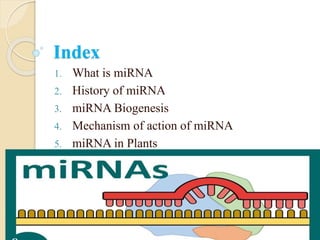
Index
1. What is miRNA
2. History of miRNA
3. miRNA Biogenesis
4. Mechanism of action of miRNA
5. miRNA in Plants
What is miRNA?
A microRNA is a small non coding RNA molecule
found in plants, animals and some viruses , that
functions in RNA silencing and post transcriptional
regulation of gene expression.
miRNAs function via base-pairing with
complementary sequences within mRNA molecules.
miRNAs are hair pin-like structure found only in
Eukaryotes
Single stranded and small in size(19 to 25
nucleotides).It folds back on itself.
Play important regulatory roles in by targeting
mRNAs for cleavage or translation expression.
One miRNA can bind to more than one mRNA
(Vice versa)
Aberrant level of mRNA is controlled by miRNA.
History of miRNA
miRNA was first discovered in 1993 during a study
of the lin-4 gene in the study of C.elegans by Ambros
and coworkers.
 Also in 2000, let-7 RNA was regulated lin-41
mRNA(L4) to adult.
Researchers realized several small regulating RNA
were present in C.elegans, Drosophila and human
cells. Hence named miRNA.
miRNA Biogenesis
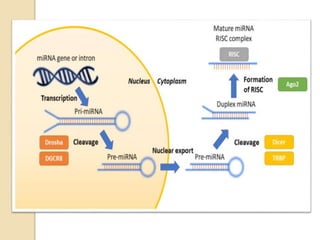
miRNA is transcribed as long pre-miRNA, which
undergoes cleavage and processing to form mature
miRNA.
miRNA is transcribed by RNA polymerase II and III.
Many miRNA genes lie in the introns of other genes.
The pre-miRNA is much longer and comprises the 5’ cap
and 3’ poly(A) tail.
The pre-miRNA undergoes nuclear and cytoplasmic
processing.
 In the nucleus, pre-miRNA is processed by the enzyme
Drosha.
It has an RNase III domain to form a microprocessor
complex.
In the cytoplasm, pre-miRNA is processed by another
enzyme called Dicer. It is also an RNase III enzyme.
It forms a miRNA duplex of 22 nucleotides.
Either of the strands has the capability to act as a
miRNA.
In the RISC complex, only one strand is incorporated
that targets the mRNA.
Mechanism of Action
miRNA like siRNA is involved in gene silencing
through RNA interference. It is involved in post-
transcriptional gene silencing (PTGS).
The mature miRNA is associated with other proteins to
form the RNA-Induced Silencing Complex (RISC). It is
also referred to as miRISC.
The processing of pre-miRNA by Dicer also causes
unwinding of the duplex and only one miRNA strand is
associated with the RISC complex. The other strand is
generally degraded.
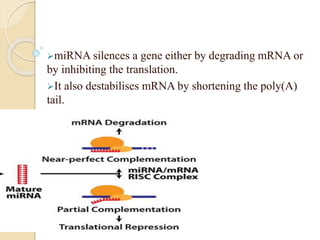
miRNA silences a gene either by degrading mRNA or
by inhibiting the translation.
It also destabilises mRNA by shortening the poly(A)
tail.
miRNAs in Plants
miRNAs are considered to be key regulators of many
developmental, homeostatic, and immune processes in
plants.
Their roles in plant development include shoot apical
meristem development, leaf growth, flower formation,
seed production, or root expansion.
In addition, they play a complex role in responses to
various abiotic stresses comprising heat stress, low-
temperature stress, drought stress, light stress, or
gamma radiation exposure.
miR156 is highly expressed in the embryo and early
seedling stage and declines with increasing plant
stage.
High levels of miR156 early in plant development
suppress flowering and are necessary for expression
of the juvenile phase.
mi160 is a major regulator of root growth and
graviotropism.
miR172 regulate tassel formation.
miRNA.pptx

miRNA.pptx

  • 1.
    UNIVERSITY OF AGRICULTURALSCIENCES, DHARWAD COLLEGE OF AGRICULTUE,VIJAYAPURA Topic : miRNAs and their use in Plant Breeding Presented By Surya Charan PGS22AGR9086 Jr Msc(agri) GPB Submitted To Dr. M D Patil Scientist ARS,Dharwad
  • 2.
    Index 1. What ismiRNA 2. History of miRNA 3. miRNA Biogenesis 4. Mechanism of action of miRNA 5. miRNA in Plants
  • 3.
    What is miRNA? AmicroRNA is a small non coding RNA molecule found in plants, animals and some viruses , that functions in RNA silencing and post transcriptional regulation of gene expression. miRNAs function via base-pairing with complementary sequences within mRNA molecules. miRNAs are hair pin-like structure found only in Eukaryotes
  • 4.
    Single stranded andsmall in size(19 to 25 nucleotides).It folds back on itself. Play important regulatory roles in by targeting mRNAs for cleavage or translation expression. One miRNA can bind to more than one mRNA (Vice versa) Aberrant level of mRNA is controlled by miRNA.
  • 5.
    History of miRNA miRNAwas first discovered in 1993 during a study of the lin-4 gene in the study of C.elegans by Ambros and coworkers.  Also in 2000, let-7 RNA was regulated lin-41 mRNA(L4) to adult. Researchers realized several small regulating RNA were present in C.elegans, Drosophila and human cells. Hence named miRNA.
  • 6.
    miRNA Biogenesis miRNA istranscribed as long pre-miRNA, which undergoes cleavage and processing to form mature miRNA. miRNA is transcribed by RNA polymerase II and III. Many miRNA genes lie in the introns of other genes. The pre-miRNA is much longer and comprises the 5’ cap and 3’ poly(A) tail. The pre-miRNA undergoes nuclear and cytoplasmic processing.
  • 8.
     In thenucleus, pre-miRNA is processed by the enzyme Drosha. It has an RNase III domain to form a microprocessor complex. In the cytoplasm, pre-miRNA is processed by another enzyme called Dicer. It is also an RNase III enzyme. It forms a miRNA duplex of 22 nucleotides. Either of the strands has the capability to act as a miRNA. In the RISC complex, only one strand is incorporated that targets the mRNA.
  • 9.
    Mechanism of Action miRNAlike siRNA is involved in gene silencing through RNA interference. It is involved in post- transcriptional gene silencing (PTGS). The mature miRNA is associated with other proteins to form the RNA-Induced Silencing Complex (RISC). It is also referred to as miRISC. The processing of pre-miRNA by Dicer also causes unwinding of the duplex and only one miRNA strand is associated with the RISC complex. The other strand is generally degraded.
  • 10.
    miRNA silences agene either by degrading mRNA or by inhibiting the translation. It also destabilises mRNA by shortening the poly(A) tail.
  • 11.
    miRNAs in Plants miRNAsare considered to be key regulators of many developmental, homeostatic, and immune processes in plants. Their roles in plant development include shoot apical meristem development, leaf growth, flower formation, seed production, or root expansion. In addition, they play a complex role in responses to various abiotic stresses comprising heat stress, low- temperature stress, drought stress, light stress, or gamma radiation exposure.
  • 12.
    miR156 is highlyexpressed in the embryo and early seedling stage and declines with increasing plant stage. High levels of miR156 early in plant development suppress flowering and are necessary for expression of the juvenile phase. mi160 is a major regulator of root growth and graviotropism. miR172 regulate tassel formation.