Click to edit Master title style
1
miRNA
BIOCHEMISTRY
PRESENTED BY-AANCHAL MANCHANDA
MSc.Zoology
Click to edit Master title style
2
What is miRNA?
2
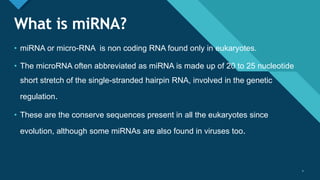
• miRNA or micro-RNA is non coding RNA found only in eukaryotes.
• The microRNA often abbreviated as miRNA is made up of 20 to 25 nucleotide
short stretch of the single-stranded hairpin RNA, involved in the genetic
regulation.
• These are the conserve sequences present in all the eukaryotes since
evolution, although some miRNAs are also found in viruses too.
Click to edit Master title style
3
Who discovered it and how?
3
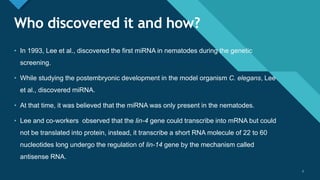
• In 1993, Lee et al., discovered the first miRNA in nematodes during the genetic
screening.
• While studying the postembryonic development in the model organism C. elegans, Lee
et al., discovered miRNA.
• At that time, it was believed that the miRNA was only present in the nematodes.
• Lee and co-workers observed that the lin-4 gene could transcribe into mRNA but could
not be translated into protein, instead, it transcribe a short RNA molecule of 22 to 60
nucleotides long undergo the regulation of lin-14 gene by the mechanism called
antisense RNA.
Click to edit Master title style
4 4
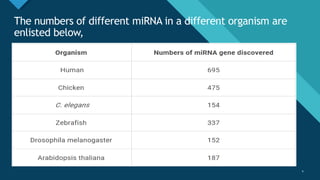
The numbers of different miRNA in a different organism are
enlisted below,
Click to edit Master title style
5
Types of miRNA:
5
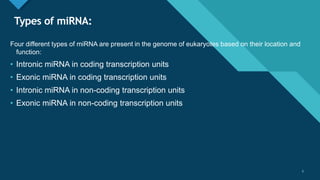
Four different types of miRNA are present in the genome of eukaryotes based on their location and
function:
• Intronic miRNA in coding transcription units
• Exonic miRNA in coding transcription units
• Intronic miRNA in non-coding transcription units
• Exonic miRNA in non-coding transcription units
Click to edit Master title style
6
The function of miRNA:
6
• The miRNA functions as translational repression by degrading the protein-coding mRNA thus
regulates the gene expression.
• The miRNA often called a smaller RNA are further involved in the regulation of numerous
metabolic pathways such as lipid metabolism, immune system, cell proliferation and apoptosis,
neuronal patterning and hematopoietic cells differentiation, also in plants, it is involved in leaf
and flower development.
• Using state of the art sequencing methods, computational tools and bioinformatics algorithms,
thousands of different miRNA and their function in gene regulation are now known to us.
• the miRNA is involved in a variety of biological regulatory function in animals and other
eukaryotes
.
Click to edit Master title style
7
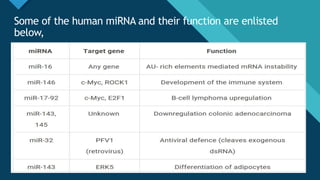
Some of the human miRNA and their function are enlisted
below,
7
Click to edit Master title style
8
Processing of miRNA:
8
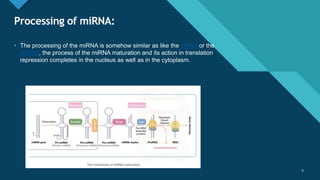
• The processing of the miRNA is somehow similar as like the siRNA or the
shRNA, the process of the miRNA maturation and its action in translation
repression completes in the nucleus as well as in the cytoplasm.
Click to edit Master title style
9
Processing in the nucleus:
9
• The pre-miRNA transcript is first formed in the nucleus by the transcription.
• A large number of miRNAs are transcribed using the RNA polymerase II, though some are transcribed by the
RNA polymerase III too.
• The RNA pol II or RNA pol III mediated transcribed product is known as the pri-miRNA or primary-miRNA
which is several kb in length having a hairpin-like stem-loop like structure.
• The Drosha in conjugation with the DGCR8 or Pash forms a large microprocessor complex which cleaves
the Pol II transcribed pri-miRNA hairpin at the junction of loop and stem.
• The precursor miRNA hairpin is formed by this large microprocessor complex.
• Two different RNase III enzymes involved in the process of maturation of miRNA, first, the Drosha binds to
pri-miRNA(primary miRNA) and creates the precursor miRNA.
• The Drosha cleaves the dsRNA hairpin duplex and generates the 5’ phosphate and 2 nucleotide overhang at
the 3’ OH end (as like the siRNA).
Click to edit Master title style
1010
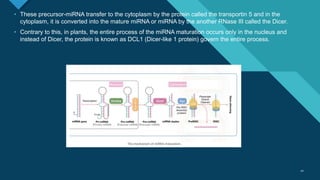
• These precursor-miRNA transfer to the cytoplasm by the protein called the transportin 5 and in the
cytoplasm, it is converted into the mature miRNA or miRNA by the another RNase III called the Dicer.
• Contrary to this, in plants, the entire process of the miRNA maturation occurs only in the nucleus and
instead of Dicer, the protein is known as DCL1 (Dicer-like 1 protein) govern the entire process.
Click to edit Master title style
11
Processing in the cytoplasm:
11
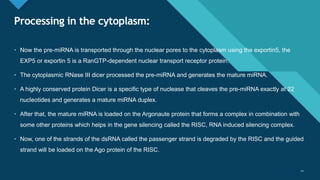
• Now the pre-miRNA is transported through the nuclear pores to the cytoplasm using the exportin5, the
EXP5 or exportin 5 is a RanGTP-dependent nuclear transport receptor protein.
• The cytoplasmic RNase III dicer processed the pre-miRNA and generates the mature miRNA.
• A highly conserved protein Dicer is a specific type of nuclease that cleaves the pre-miRNA exactly at 22
nucleotides and generates a mature miRNA duplex.
• After that, the mature miRNA is loaded on the Argonaute protein that forms a complex in combination with
some other proteins which helps in the gene silencing called the RISC, RNA induced silencing complex.
• Now, one of the strands of the dsRNA called the passenger strand is degraded by the RISC and the guided
strand will be loaded on the Ago protein of the RISC.
Click to edit Master title style
12
RISC:
12
• The RISC is a ribonucleoprotein complex having the miRNA guided strand, Dicer, argonaute protein and
other proteins create the primary complex often known as the miRISC. Besides these major proteins several
other proteins in the RISC are:
• TRBP, PACT, TNRC6B (RNA recognition motif-containing protein), FMRP (fragile X mental retardation
protein), tudor staphylococcal nuclease domain-containing protein and putative DNA helicase MOV10.
• The argonaute protein is one of the main functional parts of the RNA induced silencing complex having three
different domains:
• PAZ
• PIWI
• MID
• The PAZ domain binds to the 3’ end of the miRNA guided strand while the PIWI domain interacts with the 5’
end of the miRNA which structurally alike to the ribonuclease-H, although functionally not.
Click to edit Master title style
1313
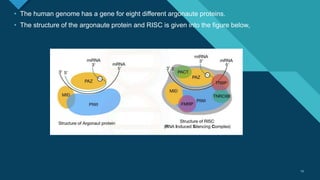
• The human genome has a gene for eight different argonaute proteins.
• The structure of the argonaute protein and RISC is given into the figure below,
Click to edit Master title style
14
Applications of miRNA:
14
• Gain and loss of function assays and studies.
• Identification of specific miRNA and target-gene relationship studies.
• Gene expression and gene silencing assay.
• Cancer and viral infection studies.
• Other therapeutic techniques such as diagnosis, prognosis and
monitoring of cancer development.
• Also used in the study of cell metabolism, cell proliferation and
apoptosis etc.
Click to edit Master title style
15
RESOURCE:
15
• https://geneticeducation.co.in/microrna-mirna-and-gene-regulation/

miRNA-Biochemistry

  • 1.
    Click to editMaster title style 1 miRNA BIOCHEMISTRY PRESENTED BY-AANCHAL MANCHANDA MSc.Zoology
  • 2.
    Click to editMaster title style 2 What is miRNA? 2 • miRNA or micro-RNA is non coding RNA found only in eukaryotes. • The microRNA often abbreviated as miRNA is made up of 20 to 25 nucleotide short stretch of the single-stranded hairpin RNA, involved in the genetic regulation. • These are the conserve sequences present in all the eukaryotes since evolution, although some miRNAs are also found in viruses too.
  • 3.
    Click to editMaster title style 3 Who discovered it and how? 3 • In 1993, Lee et al., discovered the first miRNA in nematodes during the genetic screening. • While studying the postembryonic development in the model organism C. elegans, Lee et al., discovered miRNA. • At that time, it was believed that the miRNA was only present in the nematodes. • Lee and co-workers observed that the lin-4 gene could transcribe into mRNA but could not be translated into protein, instead, it transcribe a short RNA molecule of 22 to 60 nucleotides long undergo the regulation of lin-14 gene by the mechanism called antisense RNA.
  • 4.
    Click to editMaster title style 4 4 The numbers of different miRNA in a different organism are enlisted below,
  • 5.
    Click to editMaster title style 5 Types of miRNA: 5 Four different types of miRNA are present in the genome of eukaryotes based on their location and function: • Intronic miRNA in coding transcription units • Exonic miRNA in coding transcription units • Intronic miRNA in non-coding transcription units • Exonic miRNA in non-coding transcription units
  • 6.
    Click to editMaster title style 6 The function of miRNA: 6 • The miRNA functions as translational repression by degrading the protein-coding mRNA thus regulates the gene expression. • The miRNA often called a smaller RNA are further involved in the regulation of numerous metabolic pathways such as lipid metabolism, immune system, cell proliferation and apoptosis, neuronal patterning and hematopoietic cells differentiation, also in plants, it is involved in leaf and flower development. • Using state of the art sequencing methods, computational tools and bioinformatics algorithms, thousands of different miRNA and their function in gene regulation are now known to us. • the miRNA is involved in a variety of biological regulatory function in animals and other eukaryotes .
  • 7.
    Click to editMaster title style 7 Some of the human miRNA and their function are enlisted below, 7
  • 8.
    Click to editMaster title style 8 Processing of miRNA: 8 • The processing of the miRNA is somehow similar as like the siRNA or the shRNA, the process of the miRNA maturation and its action in translation repression completes in the nucleus as well as in the cytoplasm.
  • 9.
    Click to editMaster title style 9 Processing in the nucleus: 9 • The pre-miRNA transcript is first formed in the nucleus by the transcription. • A large number of miRNAs are transcribed using the RNA polymerase II, though some are transcribed by the RNA polymerase III too. • The RNA pol II or RNA pol III mediated transcribed product is known as the pri-miRNA or primary-miRNA which is several kb in length having a hairpin-like stem-loop like structure. • The Drosha in conjugation with the DGCR8 or Pash forms a large microprocessor complex which cleaves the Pol II transcribed pri-miRNA hairpin at the junction of loop and stem. • The precursor miRNA hairpin is formed by this large microprocessor complex. • Two different RNase III enzymes involved in the process of maturation of miRNA, first, the Drosha binds to pri-miRNA(primary miRNA) and creates the precursor miRNA. • The Drosha cleaves the dsRNA hairpin duplex and generates the 5’ phosphate and 2 nucleotide overhang at the 3’ OH end (as like the siRNA).
  • 10.
    Click to editMaster title style 1010 • These precursor-miRNA transfer to the cytoplasm by the protein called the transportin 5 and in the cytoplasm, it is converted into the mature miRNA or miRNA by the another RNase III called the Dicer. • Contrary to this, in plants, the entire process of the miRNA maturation occurs only in the nucleus and instead of Dicer, the protein is known as DCL1 (Dicer-like 1 protein) govern the entire process.
  • 11.
    Click to editMaster title style 11 Processing in the cytoplasm: 11 • Now the pre-miRNA is transported through the nuclear pores to the cytoplasm using the exportin5, the EXP5 or exportin 5 is a RanGTP-dependent nuclear transport receptor protein. • The cytoplasmic RNase III dicer processed the pre-miRNA and generates the mature miRNA. • A highly conserved protein Dicer is a specific type of nuclease that cleaves the pre-miRNA exactly at 22 nucleotides and generates a mature miRNA duplex. • After that, the mature miRNA is loaded on the Argonaute protein that forms a complex in combination with some other proteins which helps in the gene silencing called the RISC, RNA induced silencing complex. • Now, one of the strands of the dsRNA called the passenger strand is degraded by the RISC and the guided strand will be loaded on the Ago protein of the RISC.
  • 12.
    Click to editMaster title style 12 RISC: 12 • The RISC is a ribonucleoprotein complex having the miRNA guided strand, Dicer, argonaute protein and other proteins create the primary complex often known as the miRISC. Besides these major proteins several other proteins in the RISC are: • TRBP, PACT, TNRC6B (RNA recognition motif-containing protein), FMRP (fragile X mental retardation protein), tudor staphylococcal nuclease domain-containing protein and putative DNA helicase MOV10. • The argonaute protein is one of the main functional parts of the RNA induced silencing complex having three different domains: • PAZ • PIWI • MID • The PAZ domain binds to the 3’ end of the miRNA guided strand while the PIWI domain interacts with the 5’ end of the miRNA which structurally alike to the ribonuclease-H, although functionally not.
  • 13.
    Click to editMaster title style 1313 • The human genome has a gene for eight different argonaute proteins. • The structure of the argonaute protein and RISC is given into the figure below,
  • 14.
    Click to editMaster title style 14 Applications of miRNA: 14 • Gain and loss of function assays and studies. • Identification of specific miRNA and target-gene relationship studies. • Gene expression and gene silencing assay. • Cancer and viral infection studies. • Other therapeutic techniques such as diagnosis, prognosis and monitoring of cancer development. • Also used in the study of cell metabolism, cell proliferation and apoptosis etc.
  • 15.
    Click to editMaster title style 15 RESOURCE: 15 • https://geneticeducation.co.in/microrna-mirna-and-gene-regulation/