PLANT PATHOGEN
INTERACTION
POOJA DOGRA
ROLL. NO - 1468
M.Sc. Agriculture Biotech.
Date – 07-01- 2015
Objective
• Introduction
• Pathogen
• Plant defence
• Elictors
• Induced defence
• Systemic defence
• Pathogen related protein
• secondary compounds
• Communal resistance
INTRODUCTION
 The contact between plant and pathogenic
microorganism lead to a particular chain of
events in the plant organism.
Communication requires a mobile ‘systemic
signal’.
 Interaction lead to two type of response:
compatible response
incompatible response
Brian C. Freeman and Gwyn A. Beattie. 2008
Pathogen
An agent that causes infection or disease,
especially microorganism, such
as a bacterium or protozoan,or a virus.
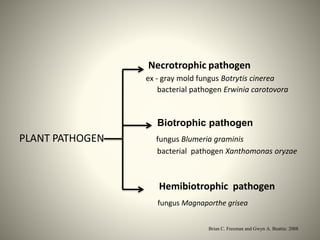
Necrotrophic pathogen
ex - gray mold fungus Botrytis cinerea
bacterial pathogen Erwinia carotovora
Biotrophic pathogen
PLANT PATHOGEN fungus Blumeria graminis
bacterial pathogen Xanthomonas oryzae
Hemibiotrophic pathogen
fungus Magnaporthe grisea
Brian C. Freeman and Gwyn A. Beattie. 2008
Examples
• Late Blight of Potato
Caused by the fungus Phytophthora
infestans
• Ergot of Rye
Caused by the fungus Claviceps
purpurea
• The pathogen produces a
structure called a sclerotium that
grows in place of the rye kernel.
Plant defense
constitutive
• Cell walls
• Waxy epidermal cuticle
• Bark
• Thorns, Spine
Inducible
• Toxic chemicals
• Pathogen degrading enzymes
• Deliberate cell suicide
• Systemic resistance
Elicitors of defense responses
• Any substance that has the capability of activating
defense responses in plants
• Include components of the cell surface as well as
excreted metabolites
Elicitors
General Race specific
a) Oligosaccharide elicitors a)avr gene products
b) Protein/peptide elicitors
(Meenakshi Thakur and Baldev Singh Sohal 2012)
(Teiz and ziger)
Induced defence
Induced defence
Programmed cell death
(PCD)
Induced structural barriers
phytoalexins
Pathogenesis related
proteins (PR-proteins)
Post transcriptional gene
silencing (PTGS)
Heil, M., and R.M. Bostock. 2002
Hypersensitive response
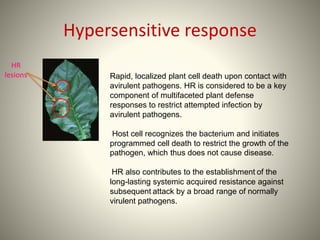
HR
lesions Rapid, localized plant cell death upon contact with
avirulent pathogens. HR is considered to be a key
component of multifaceted plant defense
responses to restrict attempted infection by
avirulent pathogens.
Host cell recognizes the bacterium and initiates
programmed cell death to restrict the growth of the
pathogen, which thus does not cause disease.
HR also contributes to the establishment of the
long-lasting systemic acquired resistance against
subsequent attack by a broad range of normally
virulent pathogens.
• HR Includes:
– oxidative bust (production of reactive oxygen
species)
– Disruption of cell membranes
– opening of ion channels
– Cross linking of phenolics with cell wall
component
– Production of anti-microbial phytoalexins and PR
protein
– apoptosis (programmed cell death)
Systemic Acquired Resistance (SAR)
SAR is a mechanism of induced defense that
confers long-lasting protection against a broad
spectrum of microorganisms.
Enhance resistance against subsequent attack
by a wide array of pathogen.
The vasculature provide the excellent channel
for transport of systemic signals.
SAR induces the chromatin modification.
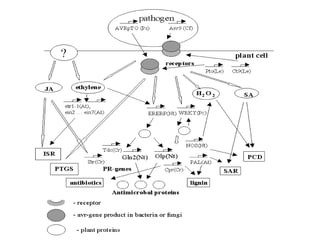
• Pathogen recognition triggersa number of rapid cellular
responses, including ionic changes, and phosphorylation
cascades, which precede the accumulationof reactive oxygen
species, nitric oxide, and salicylic acid (SA) and the
transcriptional activation of defence-related genes.
• SA also has a keyrole in establishing local and systemic
resistance to many virulent biotrophic pathogens.
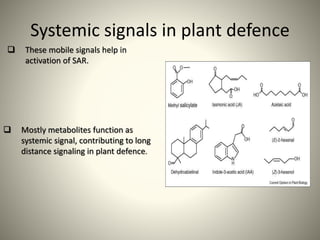
Systemic signals in plant defence
 These mobile signals help in
activation of SAR.
 Mostly metabolites function as
systemic signal, contributing to long
distance signaling in plant defence.
Pathogenesis-Related Proteins
(PR-proteins)
• Pathogenesis related proteins, called PR-
proteins- A group of plant coded proteins
• Are structurally diverse group toxic to invading
pathogens.
• Produced under stress
• They are widely distributed in plants in
trace amounts but are produced in high
concentration following pathogen attack
Significance of PR-proteins
• They show strong antifungal and other antimicrobial
activity.
• These are associated with strengthening of the host
cell wall and its out growths and papillae.
• Some of the PR-proteins, for example, B-1, 3-
glucanase and chitinase, diffuse towards and affect
(break down) the chitin-supported structure of the
cell walls of several plant pathogenic fungi, whereas
lysozymes degrade the glucosmine and muramic acid
components of bacterial cell walls.
Secondary Compounds
• Secondary metabolites are not directly involved in
growth or reproduction but they are often involved
with plant defense. These compounds usually belong
to one of three large chemical classes: terpenoids,
phenolics, and alkaloids.
• Secondary compounds have negative impacts on
herbivores and pathogens
• Tannins are water-soluble flavonoid polymers
produced by plants and stored in vacuoles.
Tannins are toxic to insects because they bind to
salivary proteins and digestive enzymes including
trypsin and chymotrypsin resulting in protein
inactivation.
• lignin provides an excellent physical barrier
against pathogen attack.
• Furanocoumarins are phenolic compounds
produced by a wide variety of plants in response
to pathogen.
Communal resistance
Plant can communicate with their neighboring plant
through the production of
volatile singles- Methyle jasmonate
Methyle salicylate
there by activation of defense gene in
neighboring plant.
Ex: Methyle jasmonate from Big sagebrush
(Artemisia tridentate) induce production of
protease inhibitor in adjacent tomato plant.
(Stout & Duffey, 1996)
Conclusion
• As plant being sessile in plant suffers from various abiotic and
biotic insults. In which biotic stress is produce through the
living organisms. Plants have several strategy to surpass these
conditions. They make their defense strategy by first line of
defense e.g. Cell walls Waxy epidermal cuticle, Thorns, Spine.
and second line of defense by producing chemical toxins,
secondary metabolite, and by SAR,PR.
• To produce biotic stress tolerance crop researcher are mainly
focusing on PR proteins. By understanding the mechanism of
PR we can produce high yielding crop varities.
References
• Brian C. Freeman and Gwyn A. Beattie. 2008. An Overview of Plant
Defenses against Pathogens and Herbivores
• Heil, M., and R.M. Bostock. 2002. Induced systemic resistance (ISR) against
pathogens in the context of induced plant defenses.
• Role of Elicitors in Inducing Resistance in Plants against Pathogen
Infection: A Review Meenakshi Thakur and Baldev Singh Sohal 2012
• Teiz and ziger
• Biotechnology – u.satyanaryna
Thank you

Plant Pathogen Interaction

  • 1.
    PLANT PATHOGEN INTERACTION POOJA DOGRA ROLL.NO - 1468 M.Sc. Agriculture Biotech. Date – 07-01- 2015
  • 2.
    Objective • Introduction • Pathogen •Plant defence • Elictors • Induced defence • Systemic defence • Pathogen related protein • secondary compounds • Communal resistance
  • 3.
    INTRODUCTION  The contactbetween plant and pathogenic microorganism lead to a particular chain of events in the plant organism. Communication requires a mobile ‘systemic signal’.  Interaction lead to two type of response: compatible response incompatible response Brian C. Freeman and Gwyn A. Beattie. 2008
  • 4.
    Pathogen An agent thatcauses infection or disease, especially microorganism, such as a bacterium or protozoan,or a virus.
  • 5.
    Necrotrophic pathogen ex -gray mold fungus Botrytis cinerea bacterial pathogen Erwinia carotovora Biotrophic pathogen PLANT PATHOGEN fungus Blumeria graminis bacterial pathogen Xanthomonas oryzae Hemibiotrophic pathogen fungus Magnaporthe grisea Brian C. Freeman and Gwyn A. Beattie. 2008
  • 6.
    Examples • Late Blightof Potato Caused by the fungus Phytophthora infestans • Ergot of Rye Caused by the fungus Claviceps purpurea • The pathogen produces a structure called a sclerotium that grows in place of the rye kernel.
  • 7.
    Plant defense constitutive • Cellwalls • Waxy epidermal cuticle • Bark • Thorns, Spine Inducible • Toxic chemicals • Pathogen degrading enzymes • Deliberate cell suicide • Systemic resistance
  • 8.
    Elicitors of defenseresponses • Any substance that has the capability of activating defense responses in plants • Include components of the cell surface as well as excreted metabolites Elicitors General Race specific a) Oligosaccharide elicitors a)avr gene products b) Protein/peptide elicitors (Meenakshi Thakur and Baldev Singh Sohal 2012)
  • 10.
  • 11.
    Induced defence Induced defence Programmedcell death (PCD) Induced structural barriers phytoalexins Pathogenesis related proteins (PR-proteins) Post transcriptional gene silencing (PTGS) Heil, M., and R.M. Bostock. 2002
  • 12.
    Hypersensitive response HR lesions Rapid,localized plant cell death upon contact with avirulent pathogens. HR is considered to be a key component of multifaceted plant defense responses to restrict attempted infection by avirulent pathogens. Host cell recognizes the bacterium and initiates programmed cell death to restrict the growth of the pathogen, which thus does not cause disease. HR also contributes to the establishment of the long-lasting systemic acquired resistance against subsequent attack by a broad range of normally virulent pathogens.
  • 13.
    • HR Includes: –oxidative bust (production of reactive oxygen species) – Disruption of cell membranes – opening of ion channels – Cross linking of phenolics with cell wall component – Production of anti-microbial phytoalexins and PR protein – apoptosis (programmed cell death)
  • 14.
    Systemic Acquired Resistance(SAR) SAR is a mechanism of induced defense that confers long-lasting protection against a broad spectrum of microorganisms. Enhance resistance against subsequent attack by a wide array of pathogen. The vasculature provide the excellent channel for transport of systemic signals. SAR induces the chromatin modification.
  • 15.
    • Pathogen recognitiontriggersa number of rapid cellular responses, including ionic changes, and phosphorylation cascades, which precede the accumulationof reactive oxygen species, nitric oxide, and salicylic acid (SA) and the transcriptional activation of defence-related genes. • SA also has a keyrole in establishing local and systemic resistance to many virulent biotrophic pathogens.
  • 17.
    Systemic signals inplant defence  These mobile signals help in activation of SAR.  Mostly metabolites function as systemic signal, contributing to long distance signaling in plant defence.
  • 18.
    Pathogenesis-Related Proteins (PR-proteins) • Pathogenesisrelated proteins, called PR- proteins- A group of plant coded proteins • Are structurally diverse group toxic to invading pathogens. • Produced under stress • They are widely distributed in plants in trace amounts but are produced in high concentration following pathogen attack
  • 19.
    Significance of PR-proteins •They show strong antifungal and other antimicrobial activity. • These are associated with strengthening of the host cell wall and its out growths and papillae. • Some of the PR-proteins, for example, B-1, 3- glucanase and chitinase, diffuse towards and affect (break down) the chitin-supported structure of the cell walls of several plant pathogenic fungi, whereas lysozymes degrade the glucosmine and muramic acid components of bacterial cell walls.
  • 21.
    Secondary Compounds • Secondarymetabolites are not directly involved in growth or reproduction but they are often involved with plant defense. These compounds usually belong to one of three large chemical classes: terpenoids, phenolics, and alkaloids. • Secondary compounds have negative impacts on herbivores and pathogens
  • 22.
    • Tannins arewater-soluble flavonoid polymers produced by plants and stored in vacuoles. Tannins are toxic to insects because they bind to salivary proteins and digestive enzymes including trypsin and chymotrypsin resulting in protein inactivation. • lignin provides an excellent physical barrier against pathogen attack. • Furanocoumarins are phenolic compounds produced by a wide variety of plants in response to pathogen.
  • 23.
    Communal resistance Plant cancommunicate with their neighboring plant through the production of volatile singles- Methyle jasmonate Methyle salicylate there by activation of defense gene in neighboring plant. Ex: Methyle jasmonate from Big sagebrush (Artemisia tridentate) induce production of protease inhibitor in adjacent tomato plant. (Stout & Duffey, 1996)
  • 24.
    Conclusion • As plantbeing sessile in plant suffers from various abiotic and biotic insults. In which biotic stress is produce through the living organisms. Plants have several strategy to surpass these conditions. They make their defense strategy by first line of defense e.g. Cell walls Waxy epidermal cuticle, Thorns, Spine. and second line of defense by producing chemical toxins, secondary metabolite, and by SAR,PR. • To produce biotic stress tolerance crop researcher are mainly focusing on PR proteins. By understanding the mechanism of PR we can produce high yielding crop varities.
  • 25.
    References • Brian C.Freeman and Gwyn A. Beattie. 2008. An Overview of Plant Defenses against Pathogens and Herbivores • Heil, M., and R.M. Bostock. 2002. Induced systemic resistance (ISR) against pathogens in the context of induced plant defenses. • Role of Elicitors in Inducing Resistance in Plants against Pathogen Infection: A Review Meenakshi Thakur and Baldev Singh Sohal 2012 • Teiz and ziger • Biotechnology – u.satyanaryna
  • 26.