
miRNA and siRNA
and their application in crop improvement
Submitted to:
Dr. Arna Das
Assistant Professor,
Department of Genetics and Plant Breeding,
BACA, Anand.
Submitted by:
1. E. Vijaykumar
2. Vikram Suvatar
3. Sumit Parmar
4. Vivek Chauhan
5. Swapnil Baraskar
Department of Genetics and Plant Breeding
BACA, Anand
Contents:
■ Introduction
■ History
■ Biosynthesis of miRNA
■ Gene silencing by miRNA
■ Biosynthesis of siRNA
■ Gene silencing by siRNA
■ Fate of the cleaved mRNA
■ Difference between miRNA and siRNA
■ Applications
Introduction:
■ A microRNA (abbreviated miRNA) is a small non-coding RNA molecule (containing about
22 nucleotides) found in plants, animals and some viruses, that functions in RNA
silencing and post-transcriptional regulation of gene expression
■ Mature miRNA molecules are partially complementary to mRNA molecules due to which
they can downregulate gene expression
■ It is reported that typical mammalian cell contains about 50,000 different miRNAs
■ Small interfering RNA (siRNA), sometimes known as short interfering
RNA or silencing RNA, is a class of double-stranded RNA non-coding RNA molecules,
20-25 base pairs in length, interfering with the expression of specific genes with
complementary nucleotide sequences with mRNA and then degrades it.
■ siRNAs consist of two RNA strands, an antisense (or guide) strand and a sense (or
passenger) strand, which form a duplex 19 to 25 bp in length
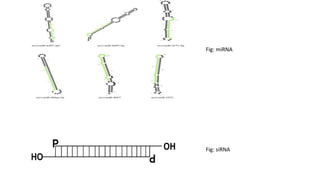
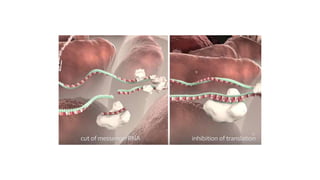
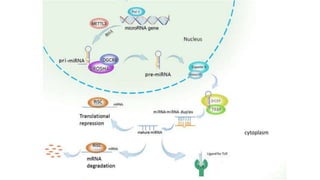
Fig: miRNA
Fig: siRNA
History:
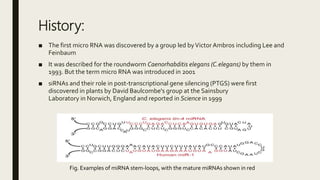
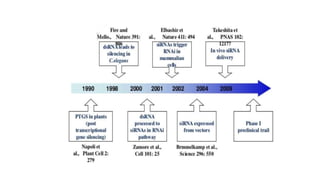
■ The first micro RNA was discovered by a group led byVictorAmbros including Lee and
Feinbaum
■ It was described for the roundworm Caenorhabditis elegans (C.elegans) by them in
1993. But the term micro RNA was introduced in 2001
■ siRNAs and their role in post-transcriptional gene silencing (PTGS) were first
discovered in plants by David Baulcombe's group at the Sainsbury
Laboratory in Norwich, England and reported in Science in 1999
Fig. Examples of miRNA stem-loops, with the mature miRNAs shown in red
Micro RNA
(miRNA)
Biosynthesis of miRNA:
■ Biosynthesis of miRNA involves various steps as following:
a) Synthesis of long ssRNA molecule from template DNA using key enzyme RNA
Polymerase II.
b) Characteristic feature of this ssRNA molecule is its complementarity in the
nucleotides of the strands
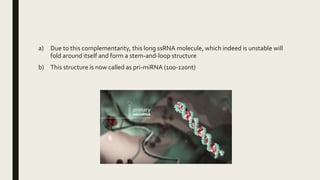
a) Due to this complementarity, this long ssRNA molecule, which indeed is unstable will
fold around itself and form a stem-and-loop structure
b) This structure is now called as pri-miRNA (100-120nt)
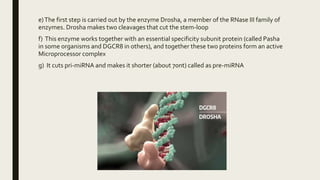
e)The first step is carried out by the enzyme Drosha, a member of the RNase III family of
enzymes. Drosha makes two cleavages that cut the stem-loop
f) This enzyme works together with an essential specificity subunit protein (called Pasha
in some organisms and DGCR8 in others), and together these two proteins form an active
Microprocessor complex
g) It cuts pri-miRNA and makes it shorter (about 70nt) called as pre-miRNA
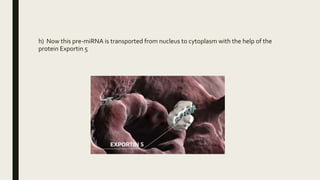
h) Now this pre-miRNA is transported from nucleus to cytoplasm with the help of the
protein Exportin 5
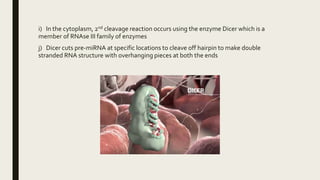
i) In the cytoplasm, 2nd cleavage reaction occurs using the enzyme Dicer which is a
member of RNAse III family of enzymes
j) Dicer cuts pre-miRNA at specific locations to cleave off hairpin to make double
stranded RNA structure with overhanging pieces at both the ends
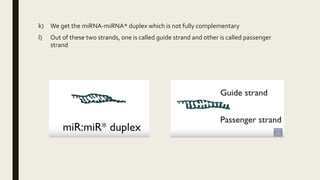
k) We get the miRNA-miRNA* duplex which is not fully complementary
l) Out of these two strands, one is called guide strand and other is called passenger
strand
Gene silencing by micro RNA:
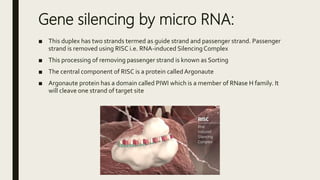
■ This duplex has two strands termed as guide strand and passenger strand. Passenger
strand is removed using RISC i.e. RNA-induced SilencingComplex
■ This processing of removing passenger strand is known as Sorting
■ The central component of RISC is a protein calledArgonaute
■ Argonaute protein has a domain called PIWI which is a member of RNase H family. It
will cleave one strand of target site
■ RISC finds the complementary sequence of miRNA on the target mRNA and when it is
found, RISC binds to it.This binding process is known as nucleation
■ It can work in in two ways, either by cutting the strand or by blocking translation by
inhibiting the binding of ribosomal subunits to the mRNA
■ If the miRNA complementarity with mRNA is quite high, then strand cleavage will
occur and gene expression will be inhibited
■ If the miRNA complementarity with mRNA is low, then it will block translation via
inhibiting the ribosomal subunit binding to mRNA
Small interfering RNA
(siRNA)
Biosynthesis of siRNA:
■ In contrast to miRNA, which are synthesized in the cell using dsRNA formed
endogenously, siRNA can be synthesized by using dsRNA obtained exogenously or
endogenously
■ Endogenous: By transcription of both strands of DNA to form dsRNA
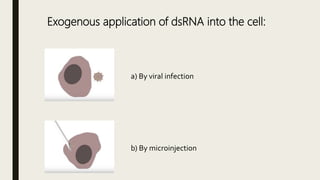
■ Exogenous: By the means of microinjecting dsRNA into the cell or by viral infections
to the cell
Exogenous application of dsRNA into the cell:
a) By viral infection
b) By microinjection
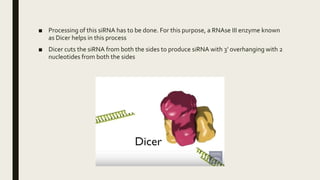
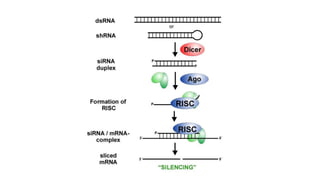
■ Processing of this siRNA has to be done. For this purpose, a RNAse III enzyme known
as Dicer helps in this process
■ Dicer cuts the siRNA from both the sides to produce siRNA with 3’ overhanging with 2
nucleotides from both the sides
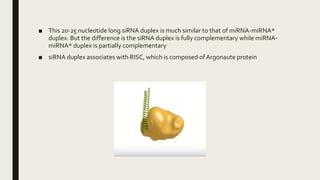
■ This 20-25 nucleotide long siRNA duplex is much similar to that of miRNA-miRNA*
duplex. But the difference is the siRNA duplex is fully complementary while miRNA-
miRNA* duplex is partially complementary
■ siRNA duplex associates with RISC, which is composed of Argonaute protein
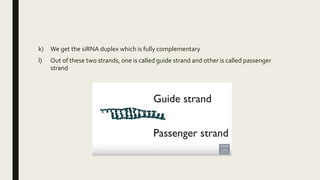
k) We get the siRNA duplex which is fully complementary
l) Out of these two strands, one is called guide strand and other is called passenger
strand
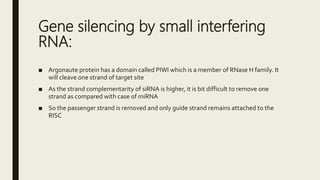
Gene silencing by small interfering
RNA:
■ Argonaute protein has a domain called PIWI which is a member of RNase H family. It
will cleave one strand of target site
■ As the strand complementarity of siRNA is higher, it is bit difficult to remove one
strand as compared with case of miRNA
■ So the passenger strand is removed and only guide strand remains attached to the
RISC
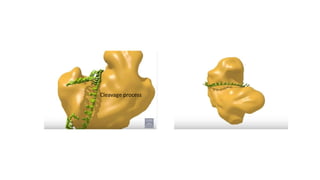
Cleavage process
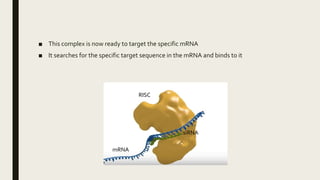
■ This complex is now ready to target the specific mRNA
■ It searches for the specific target sequence in the mRNA and binds to it
mRNA
siRNA
RISC
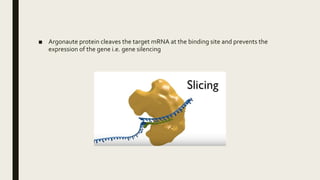
■ Argonaute protein cleaves the target mRNA at the binding site and prevents the
expression of the gene i.e. gene silencing
Fate of the cleaved mRNA:
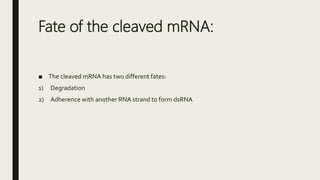
■ The cleaved mRNA has two different fates:
1) Degradation
2) Adherence with another RNA strand to form dsRNA
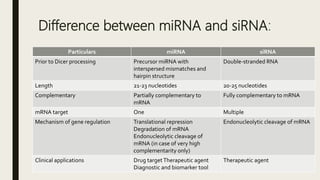
Difference between miRNA and siRNA:
Particulars miRNA siRNA
Prior to Dicer processing Precursor miRNA with
interspersed mismatches and
hairpin structure
Double-stranded RNA
Length 21-23 nucleotides 20-25 nucleotides
Complementary Partially complementary to
mRNA
Fully complementary to mRNA
mRNA target One Multiple
Mechanism of gene regulation Translational repression
Degradation of mRNA
Endonucleolytic cleavage of
mRNA (in case of very high
complementarity only)
Endonucleolytic cleavage of mRNA
Clinical applications Drug targetTherapeutic agent
Diagnostic and biomarker tool
Therapeutic agent
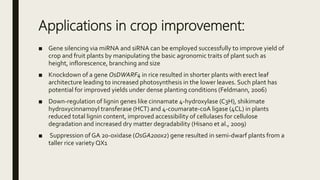
Applications in crop improvement:
■ Gene silencing via miRNA and siRNA can be employed successfully to improve yield of
crop and fruit plants by manipulating the basic agronomic traits of plant such as
height, inflorescence, branching and size
■ Knockdown of a gene OsDWARF4 in rice resulted in shorter plants with erect leaf
architecture leading to increased photosynthesis in the lower leaves. Such plant has
potential for improved yields under dense planting conditions (Feldmann, 2006)
■ Down-regulation of lignin genes like cinnamate 4-hydroxylase (C3H), shikimate
hydroxycinnamoyl transferase (HCT) and 4-coumarate-coA ligase (4CL) in plants
reduced total lignin content, improved accessibility of cellulases for cellulose
degradation and increased dry matter degradability (Hisano et al., 2009)
■ Suppression of GA 20-oxidase (OsGA20ox2) gene resulted in semi-dwarf plants from a
taller rice variety QX1
■ DET1 gene was specifically degraded in transgenic tomatoes with suppressed DET1,
accompanied by an increase in the level of flavonoid and carotenoid
■ Similarly, it has been utilized to increase the carotenoid content of rapeseed (Brassica
napus) by down-regulating the expression of lycopene epsilon cyclase (ε-CYC) gene
■ Xiong et al. (2005) introduced dsRNA targeting a single unit of 1-aminocyclopropane-
1-carboxylate (ACC) oxidase, a gene of ethylene biosynthesis pathway in tomato and
suppressed the expression of its gene.The rate of ethylene production was
significantly inhibited in the ripened fruits of transgenic plants leading to prolonged
shelf life
■ Resistance to Potato SpindleTuberViroid (PSTVd) infection was achieved in transgenic
tomato plants producing dsRNA against PSTVd sequences (Nora et al., 2009)
■ In Arabidopsis, miR393 was reported to repress auxin signaling by negatively
regulating the F-box auxin receptors like TIR1, thereby restricting the infection by
bacteria Pseudomonas syringae (Navarro et al., 2006)
■ Suppression of a rice gene OsSSI2led to enhanced resistance to blast
fungus Magnaporthe grisea and leaf blight bacterium Xanthomonas oryzae (Jiang et al.,
2009)
miRNA and siRNA (RNAi)

miRNA and siRNA (RNAi)

  • 1.
    miRNA and siRNA andtheir application in crop improvement Submitted to: Dr. Arna Das Assistant Professor, Department of Genetics and Plant Breeding, BACA, Anand. Submitted by: 1. E. Vijaykumar 2. Vikram Suvatar 3. Sumit Parmar 4. Vivek Chauhan 5. Swapnil Baraskar Department of Genetics and Plant Breeding BACA, Anand
  • 2.
    Contents: ■ Introduction ■ History ■Biosynthesis of miRNA ■ Gene silencing by miRNA ■ Biosynthesis of siRNA ■ Gene silencing by siRNA ■ Fate of the cleaved mRNA ■ Difference between miRNA and siRNA ■ Applications
  • 3.
    Introduction: ■ A microRNA(abbreviated miRNA) is a small non-coding RNA molecule (containing about 22 nucleotides) found in plants, animals and some viruses, that functions in RNA silencing and post-transcriptional regulation of gene expression ■ Mature miRNA molecules are partially complementary to mRNA molecules due to which they can downregulate gene expression ■ It is reported that typical mammalian cell contains about 50,000 different miRNAs
  • 4.
    ■ Small interferingRNA (siRNA), sometimes known as short interfering RNA or silencing RNA, is a class of double-stranded RNA non-coding RNA molecules, 20-25 base pairs in length, interfering with the expression of specific genes with complementary nucleotide sequences with mRNA and then degrades it. ■ siRNAs consist of two RNA strands, an antisense (or guide) strand and a sense (or passenger) strand, which form a duplex 19 to 25 bp in length
  • 5.
  • 6.
    History: ■ The firstmicro RNA was discovered by a group led byVictorAmbros including Lee and Feinbaum ■ It was described for the roundworm Caenorhabditis elegans (C.elegans) by them in 1993. But the term micro RNA was introduced in 2001 ■ siRNAs and their role in post-transcriptional gene silencing (PTGS) were first discovered in plants by David Baulcombe's group at the Sainsbury Laboratory in Norwich, England and reported in Science in 1999 Fig. Examples of miRNA stem-loops, with the mature miRNAs shown in red
  • 8.
  • 9.
    Biosynthesis of miRNA: ■Biosynthesis of miRNA involves various steps as following: a) Synthesis of long ssRNA molecule from template DNA using key enzyme RNA Polymerase II. b) Characteristic feature of this ssRNA molecule is its complementarity in the nucleotides of the strands
  • 10.
    a) Due tothis complementarity, this long ssRNA molecule, which indeed is unstable will fold around itself and form a stem-and-loop structure b) This structure is now called as pri-miRNA (100-120nt)
  • 11.
    e)The first stepis carried out by the enzyme Drosha, a member of the RNase III family of enzymes. Drosha makes two cleavages that cut the stem-loop f) This enzyme works together with an essential specificity subunit protein (called Pasha in some organisms and DGCR8 in others), and together these two proteins form an active Microprocessor complex g) It cuts pri-miRNA and makes it shorter (about 70nt) called as pre-miRNA
  • 12.
    h) Now thispre-miRNA is transported from nucleus to cytoplasm with the help of the protein Exportin 5
  • 13.
    i) In thecytoplasm, 2nd cleavage reaction occurs using the enzyme Dicer which is a member of RNAse III family of enzymes j) Dicer cuts pre-miRNA at specific locations to cleave off hairpin to make double stranded RNA structure with overhanging pieces at both the ends
  • 14.
    k) We getthe miRNA-miRNA* duplex which is not fully complementary l) Out of these two strands, one is called guide strand and other is called passenger strand
  • 15.
    Gene silencing bymicro RNA: ■ This duplex has two strands termed as guide strand and passenger strand. Passenger strand is removed using RISC i.e. RNA-induced SilencingComplex ■ This processing of removing passenger strand is known as Sorting ■ The central component of RISC is a protein calledArgonaute ■ Argonaute protein has a domain called PIWI which is a member of RNase H family. It will cleave one strand of target site
  • 16.
    ■ RISC findsthe complementary sequence of miRNA on the target mRNA and when it is found, RISC binds to it.This binding process is known as nucleation ■ It can work in in two ways, either by cutting the strand or by blocking translation by inhibiting the binding of ribosomal subunits to the mRNA ■ If the miRNA complementarity with mRNA is quite high, then strand cleavage will occur and gene expression will be inhibited ■ If the miRNA complementarity with mRNA is low, then it will block translation via inhibiting the ribosomal subunit binding to mRNA
  • 19.
  • 20.
    Biosynthesis of siRNA: ■In contrast to miRNA, which are synthesized in the cell using dsRNA formed endogenously, siRNA can be synthesized by using dsRNA obtained exogenously or endogenously ■ Endogenous: By transcription of both strands of DNA to form dsRNA ■ Exogenous: By the means of microinjecting dsRNA into the cell or by viral infections to the cell
  • 21.
    Exogenous application ofdsRNA into the cell: a) By viral infection b) By microinjection
  • 22.
    ■ Processing ofthis siRNA has to be done. For this purpose, a RNAse III enzyme known as Dicer helps in this process ■ Dicer cuts the siRNA from both the sides to produce siRNA with 3’ overhanging with 2 nucleotides from both the sides
  • 23.
    ■ This 20-25nucleotide long siRNA duplex is much similar to that of miRNA-miRNA* duplex. But the difference is the siRNA duplex is fully complementary while miRNA- miRNA* duplex is partially complementary ■ siRNA duplex associates with RISC, which is composed of Argonaute protein
  • 24.
    k) We getthe siRNA duplex which is fully complementary l) Out of these two strands, one is called guide strand and other is called passenger strand
  • 25.
    Gene silencing bysmall interfering RNA: ■ Argonaute protein has a domain called PIWI which is a member of RNase H family. It will cleave one strand of target site ■ As the strand complementarity of siRNA is higher, it is bit difficult to remove one strand as compared with case of miRNA ■ So the passenger strand is removed and only guide strand remains attached to the RISC
  • 26.
  • 27.
    ■ This complexis now ready to target the specific mRNA ■ It searches for the specific target sequence in the mRNA and binds to it mRNA siRNA RISC
  • 28.
    ■ Argonaute proteincleaves the target mRNA at the binding site and prevents the expression of the gene i.e. gene silencing
  • 30.
    Fate of thecleaved mRNA: ■ The cleaved mRNA has two different fates: 1) Degradation 2) Adherence with another RNA strand to form dsRNA
  • 31.
    Difference between miRNAand siRNA: Particulars miRNA siRNA Prior to Dicer processing Precursor miRNA with interspersed mismatches and hairpin structure Double-stranded RNA Length 21-23 nucleotides 20-25 nucleotides Complementary Partially complementary to mRNA Fully complementary to mRNA mRNA target One Multiple Mechanism of gene regulation Translational repression Degradation of mRNA Endonucleolytic cleavage of mRNA (in case of very high complementarity only) Endonucleolytic cleavage of mRNA Clinical applications Drug targetTherapeutic agent Diagnostic and biomarker tool Therapeutic agent
  • 32.
    Applications in cropimprovement: ■ Gene silencing via miRNA and siRNA can be employed successfully to improve yield of crop and fruit plants by manipulating the basic agronomic traits of plant such as height, inflorescence, branching and size ■ Knockdown of a gene OsDWARF4 in rice resulted in shorter plants with erect leaf architecture leading to increased photosynthesis in the lower leaves. Such plant has potential for improved yields under dense planting conditions (Feldmann, 2006) ■ Down-regulation of lignin genes like cinnamate 4-hydroxylase (C3H), shikimate hydroxycinnamoyl transferase (HCT) and 4-coumarate-coA ligase (4CL) in plants reduced total lignin content, improved accessibility of cellulases for cellulose degradation and increased dry matter degradability (Hisano et al., 2009) ■ Suppression of GA 20-oxidase (OsGA20ox2) gene resulted in semi-dwarf plants from a taller rice variety QX1
  • 33.
    ■ DET1 genewas specifically degraded in transgenic tomatoes with suppressed DET1, accompanied by an increase in the level of flavonoid and carotenoid ■ Similarly, it has been utilized to increase the carotenoid content of rapeseed (Brassica napus) by down-regulating the expression of lycopene epsilon cyclase (ε-CYC) gene ■ Xiong et al. (2005) introduced dsRNA targeting a single unit of 1-aminocyclopropane- 1-carboxylate (ACC) oxidase, a gene of ethylene biosynthesis pathway in tomato and suppressed the expression of its gene.The rate of ethylene production was significantly inhibited in the ripened fruits of transgenic plants leading to prolonged shelf life ■ Resistance to Potato SpindleTuberViroid (PSTVd) infection was achieved in transgenic tomato plants producing dsRNA against PSTVd sequences (Nora et al., 2009) ■ In Arabidopsis, miR393 was reported to repress auxin signaling by negatively regulating the F-box auxin receptors like TIR1, thereby restricting the infection by bacteria Pseudomonas syringae (Navarro et al., 2006) ■ Suppression of a rice gene OsSSI2led to enhanced resistance to blast fungus Magnaporthe grisea and leaf blight bacterium Xanthomonas oryzae (Jiang et al., 2009)