
small nuclear RNA
-Presentation by-
Rushil Mandlik
I M.Sc.(Ag) Biotechnology
(2017600317)
Tamilnadu Agricultural University,Coimbatore.
 Small nuclear ribonucleic acid (snRNA), also commonly referred to as U-RNA, is
a class of small RNA molecules that are found within the nucleus
of eukaryotic cells.
 Intronless ,Non-polyadenylated, non-coding transcripts that function in the
nucleoplasm.
 snRNA are always associated with a set of specific proteins, and the complexes
are referred to as small nuclear ribonucleoproteins (snRNP often pronounced
"snurps")
 Each snRNP particle is composed of a snRNA component and several snRNP-
specific proteins
 The snRNAs can be divided into two classes on the basis of common sequence
features and protein cofactors.
Introduction
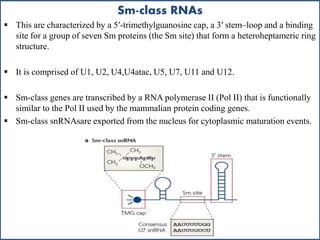
Sm-class RNAs
 This are characterized by a 5′-trimethylguanosine cap, a 3′ stem–loop and a binding
site for a group of seven Sm proteins (the Sm site) that form a heteroheptameric ring
structure.
 It is comprised of U1, U2, U4,U4atac, U5, U7, U11 and U12.
 Sm-class genes are transcribed by a RNA polymerase II (Pol II) that is functionally
similar to the Pol II used by the mammalian protein coding genes.
 Sm-class snRNAsare exported from the nucleus for cytoplasmic maturation events.
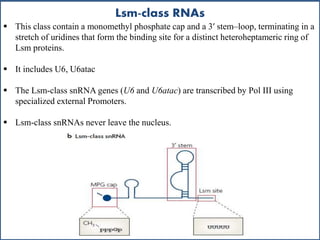
Lsm-class RNAs
 This class contain a monomethyl phosphate cap and a 3′ stem–loop, terminating in a
stretch of uridines that form the binding site for a distinct heteroheptameric ring of
Lsm proteins.
 It includes U6, U6atac
 The Lsm-class snRNA genes (U6 and U6atac) are transcribed by Pol III using
specialized external Promoters.
 Lsm-class snRNAs never leave the nucleus.
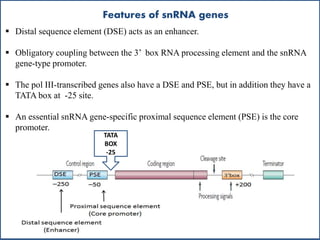
Features of snRNA genes
TATA
BOX
-25
 Distal sequence element (DSE) acts as an enhancer.
 Obligatory coupling between the 3’ box RNA processing element and the snRNA
gene-type promoter.
 The pol III-transcribed genes also have a DSE and PSE, but in addition they have a
TATA box at -25 site.
 An essential snRNA gene-specific proximal sequence element (PSE) is the core
promoter.
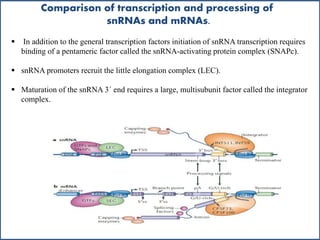
 In addition to the general transcription factors initiation of snRNA transcription requires
binding of a pentameric factor called the snRNA-activating protein complex (SNAPc).
 snRNA promoters recruit the little elongation complex (LEC).
 Maturation of the snRNA 3ʹ end requires a large, multisubunit factor called the integrator
complex.
Comparison of transcription and processing of
snRNAs and mRNAs.
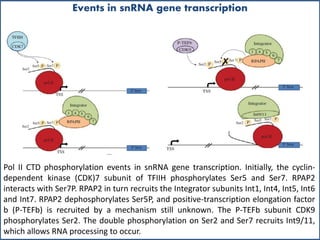
Events in snRNA gene transcription
Pol II CTD phosphorylation events in snRNA gene transcription. Initially, the cyclin-
dependent kinase (CDK)7 subunit of TFIIH phosphorylates Ser5 and Ser7. RPAP2
interacts with Ser7P. RPAP2 in turn recruits the Integrator subunits Int1, Int4, Int5, Int6
and Int7. RPAP2 dephosphorylates Ser5P, and positive-transcription elongation factor
b (P-TEFb) is recruited by a mechanism still unknown. The P-TEFb subunit CDK9
phosphorylates Ser2. The double phosphorylation on Ser2 and Ser7 recruits Int9/11,
which allows RNA processing to occur.
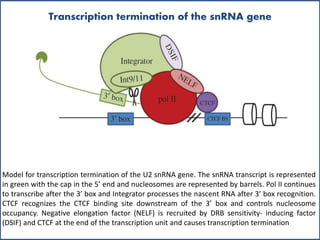
Transcription termination of the snRNA gene
Model for transcription termination of the U2 snRNA gene. The snRNA transcript is represented
in green with the cap in the 5’ end and nucleosomes are represented by barrels. Pol II continues
to transcribe after the 3’ box and Integrator processes the nascent RNA after 3’ box recognition.
CTCF recognizes the CTCF binding site downstream of the 3’ box and controls nucleosome
occupancy. Negative elongation factor (NELF) is recruited by DRB sensitivity- inducing factor
(DSIF) and CTCF at the end of the transcription unit and causes transcription termination
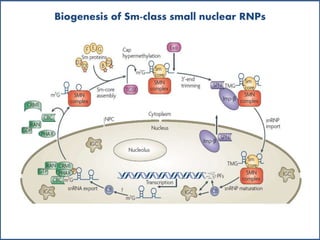
Biogenesis of Sm-class small nuclear RNPs
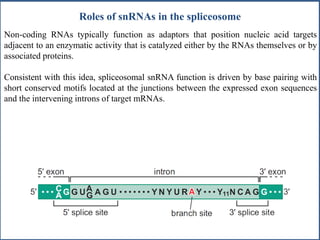
Roles of snRNAs in the spliceosome
Non-coding RNAs typically function as adaptors that position nucleic acid targets
adjacent to an enzymatic activity that is catalyzed either by the RNAs themselves or by
associated proteins.
Consistent with this idea, spliceosomal snRNA function is driven by base pairing with
short conserved motifs located at the junctions between the expressed exon sequences
and the intervening introns of target mRNAs.
Figure The splicing reaction.
 The transesterification reactions are mediated by a huge molecular
“machine” called the spliceosome.
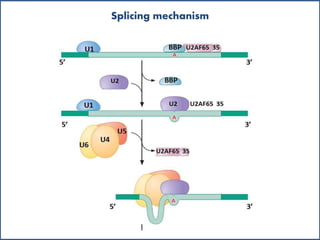
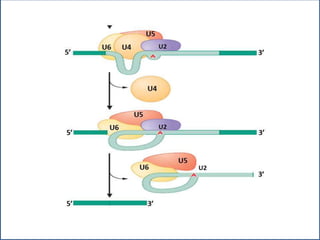
 The spliceosome is the large complex made up of the snRNPs U1, U2, U4,
U5, and U6.
 The snRNPs have three roles in splicing:
i. They recognize the 5’ splice site and the branch site.
ii. They bring those sites together as required.
iii. They catalyze (or help to catalyze) the RNA cleavage and joining
reactions
 Non-snRNPs are involved in splicing:
i. U2AF (U2 auxiliary factor)
ii. Branchpoint-binding protein (BBP)
 U11 and U12 components of the alternative spliceosome have the same
roles in the splicing reaction as U1 and U2 of the major form, but they
recognize distinct sequences. U4 and U6 have equivalent counterparts in
both spliceosome forms.
Spliceosome mediated Rna splicing
Splicing mechanism
Human spliceosomal diseases
 Mutations in the minor spliceosomal small nuclear RNA (snRNA) U4atac
were recently shown to result in microcephalic osteodysplastic primordial
dwarfism (MOPD) type I178, a rare genetic defect that causes severe
growth retardation and infant death.
 Chronic lymphocytic leukaemia and myelodysplasia have also been
associated with splicing defects.
Mutations in U2 snRNP, such as splicing factor 3B subunit 1 (SF3B1)
and U2 auxiliary factor 35 (U2AF35).
Mutations result in defective snRNP assembly, deregulated alternative
splicing or accumulation of unspliced mRNA, and thus may alter the
expression of multiple genes. Mis-regulation of splicing factor levels has often
been found to be associated with various neoplasias.
Therefore, targeting spliceosome function may provide a new route
for cancer therapy.
Histone gene maturation
 Features distinguishing histone mRNA’s them from all other mRNAs are
their lack of introns and poly(A) tails.
 Their 3’ ends are formed by an endonucleolytic cleavage of longer
premRNAs that is mechanistically different from the cleavage
polyadenylation reaction generating all other mRNA 3’ends.
 The U7 small nuclear ribonucleoprotein (snRNP) is an essential factor for
the maturation of animal replication dependent histone messenger RNAs
(mRNAs).
 In contrast to spliceosomal snRNPs, which contain a ring-shaped assembly
of seven so-called Sm proteins, in the U7 snRNP the Sm proteins D1 and
D2 are replaced by U7-specific Sm-like proteins, Lsm10 and Lsm11. This
polypeptide composition and the unusual structure of Lsm11, which plays a
role in histone RNA processing.
 The histone RNA cleavage site is flanked by evolutionarily conserved
sequences that interact with trans-acting processing factors.
 Upstream of the cleavage site is a highly conserved 26 nt sequence
encompassing a hairpin structure.
 This RNA hairpin is recognized by the hairpin binding protein (HBP) or
stem-loop binding protein (SLBP).
 HBP acts by stabilizing the binding of the U7 snRNP to the second
conserved sequence element, the purine-rich histone downstream element
(HDE).
 Moreover, a 100-kDa zinc finger protein was identified that interacts with
the HBP/RNA hairpin complex but not with the individual components of
this Complex
 The second conserved sequence in the histone 3’ UTR, the purine-rich
HDE, lies several nucleotides downstream of the cleavage site and
interacts by base-pairing with the U7 small nuclear (sn)RNA component
of the U7 snRNP.
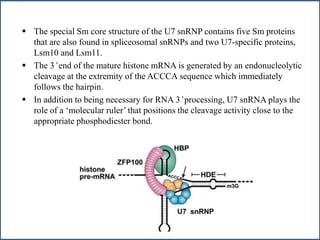
 The special Sm core structure of the U7 snRNP contains five Sm proteins
that are also found in spliceosomal snRNPs and two U7-specific proteins,
Lsm10 and Lsm11.
 The 3’end of the mature histone mRNA is generated by an endonucleolytic
cleavage at the extremity of the ACCCA sequence which immediately
follows the hairpin.
 In addition to being necessary for RNA 3’processing, U7 snRNA plays the
role of a ‘molecular ruler’ that positions the cleavage activity close to the
appropriate phosphodiester bond.
References
• Guiro, J., & Murphy, S. (2017). Regulation of expression of human RNA
polymerase II-transcribed snRNA genes. Open Biology, 7(6), 170073.
• Matera, A. G., Terns, R. M., & Terns, M. P. (2007). Non-coding RNAs:
lessons from the small nuclear and small nucleolar RNAs. Nature reviews
Molecular cell biology, 8(3), 209-220.
• Schümperli, D., & Pillai, R. S. (2004). The special Sm core structure of the
U7 snRNP: far-reaching significance of a small nuclear
ribonucleoprotein. Cellular and molecular life sciences, 61(19), 2560-2570.
• Chen, J., & Wagner, E. J. (2010). snRNA 3′ end formation: the dawn of the
Integrator complex.
Thank you…

Small nuclear rna

  • 1.
    small nuclear RNA -Presentationby- Rushil Mandlik I M.Sc.(Ag) Biotechnology (2017600317) Tamilnadu Agricultural University,Coimbatore.
  • 2.
     Small nuclearribonucleic acid (snRNA), also commonly referred to as U-RNA, is a class of small RNA molecules that are found within the nucleus of eukaryotic cells.  Intronless ,Non-polyadenylated, non-coding transcripts that function in the nucleoplasm.  snRNA are always associated with a set of specific proteins, and the complexes are referred to as small nuclear ribonucleoproteins (snRNP often pronounced "snurps")  Each snRNP particle is composed of a snRNA component and several snRNP- specific proteins  The snRNAs can be divided into two classes on the basis of common sequence features and protein cofactors. Introduction
  • 3.
    Sm-class RNAs  Thisare characterized by a 5′-trimethylguanosine cap, a 3′ stem–loop and a binding site for a group of seven Sm proteins (the Sm site) that form a heteroheptameric ring structure.  It is comprised of U1, U2, U4,U4atac, U5, U7, U11 and U12.  Sm-class genes are transcribed by a RNA polymerase II (Pol II) that is functionally similar to the Pol II used by the mammalian protein coding genes.  Sm-class snRNAsare exported from the nucleus for cytoplasmic maturation events.
  • 4.
    Lsm-class RNAs  Thisclass contain a monomethyl phosphate cap and a 3′ stem–loop, terminating in a stretch of uridines that form the binding site for a distinct heteroheptameric ring of Lsm proteins.  It includes U6, U6atac  The Lsm-class snRNA genes (U6 and U6atac) are transcribed by Pol III using specialized external Promoters.  Lsm-class snRNAs never leave the nucleus.
  • 5.
    Features of snRNAgenes TATA BOX -25  Distal sequence element (DSE) acts as an enhancer.  Obligatory coupling between the 3’ box RNA processing element and the snRNA gene-type promoter.  The pol III-transcribed genes also have a DSE and PSE, but in addition they have a TATA box at -25 site.  An essential snRNA gene-specific proximal sequence element (PSE) is the core promoter.
  • 6.
     In additionto the general transcription factors initiation of snRNA transcription requires binding of a pentameric factor called the snRNA-activating protein complex (SNAPc).  snRNA promoters recruit the little elongation complex (LEC).  Maturation of the snRNA 3ʹ end requires a large, multisubunit factor called the integrator complex. Comparison of transcription and processing of snRNAs and mRNAs.
  • 7.
    Events in snRNAgene transcription Pol II CTD phosphorylation events in snRNA gene transcription. Initially, the cyclin- dependent kinase (CDK)7 subunit of TFIIH phosphorylates Ser5 and Ser7. RPAP2 interacts with Ser7P. RPAP2 in turn recruits the Integrator subunits Int1, Int4, Int5, Int6 and Int7. RPAP2 dephosphorylates Ser5P, and positive-transcription elongation factor b (P-TEFb) is recruited by a mechanism still unknown. The P-TEFb subunit CDK9 phosphorylates Ser2. The double phosphorylation on Ser2 and Ser7 recruits Int9/11, which allows RNA processing to occur.
  • 8.
    Transcription termination ofthe snRNA gene Model for transcription termination of the U2 snRNA gene. The snRNA transcript is represented in green with the cap in the 5’ end and nucleosomes are represented by barrels. Pol II continues to transcribe after the 3’ box and Integrator processes the nascent RNA after 3’ box recognition. CTCF recognizes the CTCF binding site downstream of the 3’ box and controls nucleosome occupancy. Negative elongation factor (NELF) is recruited by DRB sensitivity- inducing factor (DSIF) and CTCF at the end of the transcription unit and causes transcription termination
  • 9.
    Biogenesis of Sm-classsmall nuclear RNPs
  • 10.
    Roles of snRNAsin the spliceosome Non-coding RNAs typically function as adaptors that position nucleic acid targets adjacent to an enzymatic activity that is catalyzed either by the RNAs themselves or by associated proteins. Consistent with this idea, spliceosomal snRNA function is driven by base pairing with short conserved motifs located at the junctions between the expressed exon sequences and the intervening introns of target mRNAs.
  • 11.
  • 12.
     The transesterificationreactions are mediated by a huge molecular “machine” called the spliceosome.  The spliceosome is the large complex made up of the snRNPs U1, U2, U4, U5, and U6.  The snRNPs have three roles in splicing: i. They recognize the 5’ splice site and the branch site. ii. They bring those sites together as required. iii. They catalyze (or help to catalyze) the RNA cleavage and joining reactions  Non-snRNPs are involved in splicing: i. U2AF (U2 auxiliary factor) ii. Branchpoint-binding protein (BBP)  U11 and U12 components of the alternative spliceosome have the same roles in the splicing reaction as U1 and U2 of the major form, but they recognize distinct sequences. U4 and U6 have equivalent counterparts in both spliceosome forms. Spliceosome mediated Rna splicing
  • 13.
  • 15.
    Human spliceosomal diseases Mutations in the minor spliceosomal small nuclear RNA (snRNA) U4atac were recently shown to result in microcephalic osteodysplastic primordial dwarfism (MOPD) type I178, a rare genetic defect that causes severe growth retardation and infant death.  Chronic lymphocytic leukaemia and myelodysplasia have also been associated with splicing defects. Mutations in U2 snRNP, such as splicing factor 3B subunit 1 (SF3B1) and U2 auxiliary factor 35 (U2AF35). Mutations result in defective snRNP assembly, deregulated alternative splicing or accumulation of unspliced mRNA, and thus may alter the expression of multiple genes. Mis-regulation of splicing factor levels has often been found to be associated with various neoplasias. Therefore, targeting spliceosome function may provide a new route for cancer therapy.
  • 16.
    Histone gene maturation Features distinguishing histone mRNA’s them from all other mRNAs are their lack of introns and poly(A) tails.  Their 3’ ends are formed by an endonucleolytic cleavage of longer premRNAs that is mechanistically different from the cleavage polyadenylation reaction generating all other mRNA 3’ends.  The U7 small nuclear ribonucleoprotein (snRNP) is an essential factor for the maturation of animal replication dependent histone messenger RNAs (mRNAs).  In contrast to spliceosomal snRNPs, which contain a ring-shaped assembly of seven so-called Sm proteins, in the U7 snRNP the Sm proteins D1 and D2 are replaced by U7-specific Sm-like proteins, Lsm10 and Lsm11. This polypeptide composition and the unusual structure of Lsm11, which plays a role in histone RNA processing.
  • 17.
     The histoneRNA cleavage site is flanked by evolutionarily conserved sequences that interact with trans-acting processing factors.  Upstream of the cleavage site is a highly conserved 26 nt sequence encompassing a hairpin structure.  This RNA hairpin is recognized by the hairpin binding protein (HBP) or stem-loop binding protein (SLBP).  HBP acts by stabilizing the binding of the U7 snRNP to the second conserved sequence element, the purine-rich histone downstream element (HDE).  Moreover, a 100-kDa zinc finger protein was identified that interacts with the HBP/RNA hairpin complex but not with the individual components of this Complex  The second conserved sequence in the histone 3’ UTR, the purine-rich HDE, lies several nucleotides downstream of the cleavage site and interacts by base-pairing with the U7 small nuclear (sn)RNA component of the U7 snRNP.
  • 18.
     The specialSm core structure of the U7 snRNP contains five Sm proteins that are also found in spliceosomal snRNPs and two U7-specific proteins, Lsm10 and Lsm11.  The 3’end of the mature histone mRNA is generated by an endonucleolytic cleavage at the extremity of the ACCCA sequence which immediately follows the hairpin.  In addition to being necessary for RNA 3’processing, U7 snRNA plays the role of a ‘molecular ruler’ that positions the cleavage activity close to the appropriate phosphodiester bond.
  • 19.
    References • Guiro, J.,& Murphy, S. (2017). Regulation of expression of human RNA polymerase II-transcribed snRNA genes. Open Biology, 7(6), 170073. • Matera, A. G., Terns, R. M., & Terns, M. P. (2007). Non-coding RNAs: lessons from the small nuclear and small nucleolar RNAs. Nature reviews Molecular cell biology, 8(3), 209-220. • Schümperli, D., & Pillai, R. S. (2004). The special Sm core structure of the U7 snRNP: far-reaching significance of a small nuclear ribonucleoprotein. Cellular and molecular life sciences, 61(19), 2560-2570. • Chen, J., & Wagner, E. J. (2010). snRNA 3′ end formation: the dawn of the Integrator complex.
  • 20.