welcome
Presented by
Mukesh Kumar (Ph.D Scholar)
Department of Plant Pathology
Dr. Rajendra Prasad Central Agricultural University Pusa,
Samastipur, 848185 (Bihar) India
Credit Seminar
on
“Systemic Acquired Resistance”
 Ist recognized as a significant phenomenon in 1933 by Chester.
 Infection of plants with necrotizing pathogens (causing HR) often results in
enhanced resistance to subsequent infections by a variety of fungal, bacterial
and viral pathogens.
 This physiological immunity was termed Systemic Acquired Resistance
(SAR).
SAR confers a broad spectrum type of resistance
SAR is effective against some but not all pathogens:
Tobacco: Phytophthora parasitica, Cercospora nicotianae, Peronospora tabacina
tobacco mosaic virus, tobacco necrosis virus,
Pseudomonas syringae pv. tabaci, Erwinia carotovora
Not effective against: Botrytis cinerea or Alternaria alternata
Arabidopsis: Phytophthora parasitica
turnip crinkle virus
Pseudomonas syringae pv. tomato DC3000
INTRODUCTION
SAR (Systemic Acquired Resistance)
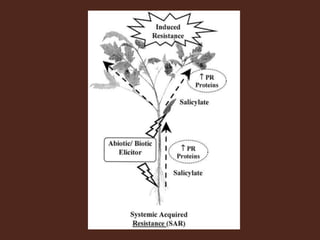
• Systemic acquired resistance (SAR) is a mechanism of induced
defense that confers long-lasting protection against a broad spectrum
of microorganisms. SAR requires the signal molecule salicylic acid
(SA) and is associated with accumulation of pathogenesis-related
proteins, which are thought to contribute to resistance .
or
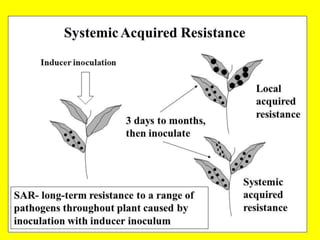
• Resistance triggered in the plant during its life time is Acquired
Resistance. It can be local (LAR) confined to few cells or tissues, or
systemic (SAR) having been moved through out the plant.
• Systemic acquired resistance (SAR) refers to a distinct signal
transduction pathway that plays an important role in the ability of
plants to defend themselves against pathogens
 Frank Ross (1961) showed that tobacco plants challenged
with tobacco mosaic virus (TMV) subsequently developed
increased resistance to secondary infection in distal tissues.
 This spread of resistance throughout the plant’s tissues was
termed systemic acquired resistance (SAR).
 SAR is characterized by the increased expression of a large
number of pathogenesis-related genes (PR genes), in both
local and systemic tissues.
 PR proteins were first described in the 1970s by Van Loon,
who observed accumulation of various novel proteins after
infection of tobacco with TMV.
History
 White 1979 observed that PR protein accumulation and resistance to TMV
could be induced by treatment of tobacco with salicylic acid (SA), aspirin
(acetyl SA), or benzoic acid.
 Malamy et al., 1990 Evidence that SA is a signal for the induction of
SAR.
 Malamy et al. 1990: showed that the endogenous SA concentration rises in
both local and systemic tissues after infection of tobacco with TMV and
this rise correlates with PR gene induction.
 Metraux et al. 1990: found that cucumber plants infected with either
Colletotrichum lagenarium or tobacco necrosis virus (TNV) have
considerably elevated levels of SA in the phloem sap.
 A requirement for SA as an endogenous signal for SAR was proven by
Gaffney et al. 1993 using a bacterial gene, nahG, encoding salicylate
hydroxylase, which removes SA by conversion to catechol
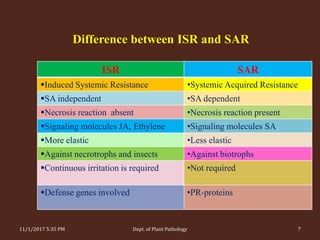
ISR SAR
Induced Systemic Resistance •Systemic Acquired Resistance
SA independent •SA dependent
Necrosis reaction absent •Necrosis reaction present
Signaling molecules JA, Ethylene •Signaling molecules SA
More elastic •Less elastic
Against necrotrophs and insects •Against biotrophs
Continuous irritation is required •Not required
Defense genes involved •PR-proteins
Difference between ISR and SAR
11/1/2017 5:35 PM 7Dept. of Plant Pathology
Characteristics of SAR
1. Resistance is expressed against broad spectrum of organism
2. Time needed for establishment of SAR depend on both the plant
and type of inducing factor.
3. It need for a necrotic lesions produced by the pathogen as an
inducing agent.
4. Systemic expression of PRP genes.
5. Involvement of salicylic acid as apart of signaling process.
Systemic Acquire Resistance (SAR)
• Secondary response
• Systemic
• Broad-range resistance
• Leads to Pathogenesis-Related (PR) gene
expression
• Signals: SA,
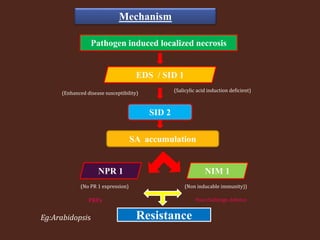
Mechanism
Pathogen induced localized necrosis
EDS / SID 1
SID 2
NPR 1
SA accumulation
NIM 1
Resistance
(Enhanced disease susceptibility)
(Salicylic acid induction deficient)
(No PR 1 expression) (Non inducable immunity))
PRPs Post challenge defence
Eg:Arabidopsis
NPR1
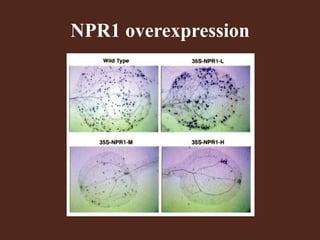
 The Arabidopsis NPR1 gene is a positive regulator of inducible plant disease
resistance.
 Expression of NPR1 is induced by pathogen infection or treatment with defense-
inducing compounds such as salicylic acid (SA).
 Transgenic plants overexpressing NPR1 exhibit enhanced resistance to a broad
spectrum of microbial pathogens.
 Whereas plants under expressing the gene are more susceptible to pathogen
infection.
 These results suggest that regulation of NPR1 gene expression is important for the
activation of plant defense responses.
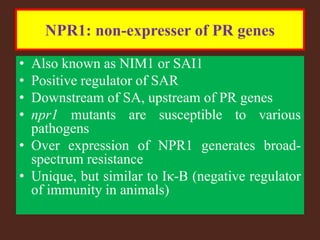
NPR1: non-expresser of PR genes
• Also known as NIM1 or SAI1
• Positive regulator of SAR
• Downstream of SA, upstream of PR genes
• npr1 mutants are susceptible to various
pathogens
• Over expression of NPR1 generates broad-
spectrum resistance
• Unique, but similar to Iκ-B (negative regulator
of immunity in animals)
NPR1 overexpression
Salicylic Acid (SA)-mediated SAR
Salicylic acid is part of signaling pathway involved in
transmission of the defense response throughout the plant to
produce SAR
 SA reported as the endogenously as well as exogenously
signal of SAR (Metraux et al., 1990, Sticher, 1997)
 SA plat role in elicitation of Pathogenesis-Related
proteins
 Analogs: INA or BTH
Salicylic Acid Biosynthesis
Genetic studies in Arabidopsis have shown that SA is synthesized mainly
through the pathway involving ICS1
Biochemically, SA can also be synthesized from phenylalanine ammonia lyase
(PAL) but this pathway seems to play a minor role in SAR-associated SA
synthesis.
 The chorismate pathway has similarities to the bacterial SA-biosynthesis
pathway:
1. ICS1 converts chorismate to isochorismate
2. SA is generated from isochorismate catalyzed by isochorismate pyruvate
lyase (IPL) .
Mutants affecting SA synthesis
• Elevated SA accumulation
– dnd1 (defense, no death 1): increased SA, but
reduced HR, DND1 gene encodes cyclic-
nucleotide-gated ion channel
– mpk4: constitutive SA accumulation
– edr1 (enhanced disease resistance 1): defective
MAPKKK
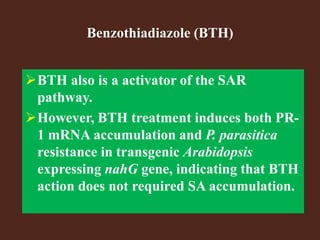
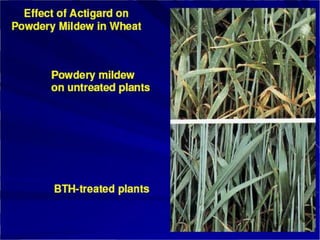
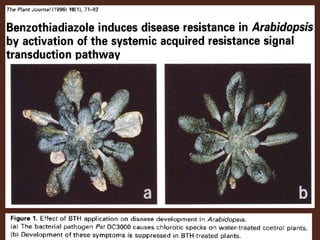
Benzothiadiazole (BTH)
BTH also is a activator of the SAR
pathway.
However, BTH treatment induces both PR-
1 mRNA accumulation and P. parasitica
resistance in transgenic Arabidopsis
expressing nahG gene, indicating that BTH
action does not required SA accumulation.
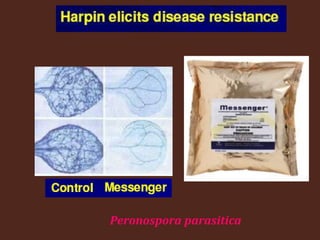
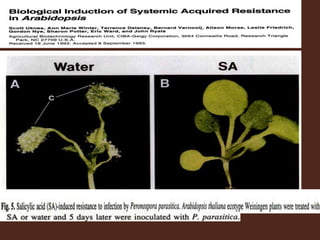
Peronospora parasitica
Involvement of H2O2 in SAR
 Elevated level of cellular reactive oxygen species
(i.e., H2O2) was observed in plants with SAR.
 Chen and Klessig (1993) isolated a SA-binding
protein (SABP) from the cDNA library of tobacco
leaves.
 The deduced cDNA sequence indicates that SABP
is a catalase.
 They proposed that SA activates the elevated levels
of cellular H2O2 by inhibiting the catalase activity.
 Cellular H2O2 functions as a secondary messenger
in SAR signal transduction.
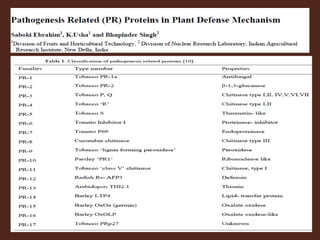
Production of pathogenesis related protein
• PR protein are plant protein that are induced in
pathological and related situation.
• These proteins are accumulated 7-10 days after infection
and indicate the attainment of SAR.
• It is accumulated in the intercellular spaces(first line of
defence) and vacuole (second line of defence by lytic
enzyme).
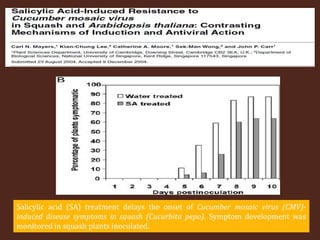
Salicylic acid (SA) treatment delays the onset of Cucumber mosaic virus (CMV)-
induced disease symptoms in squash (Cucurbita pepo). Symptom development was
monitored in squash plants inoculated.
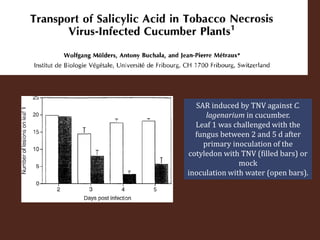
SAR induced by TNV against C.
lagenarium in cucumber.
Leaf 1 was challenged with the
fungus between 2 and 5 d after
primary inoculation of the
cotyledon with TNV (filled bars) or
mock
inoculation with water (open bars).
31
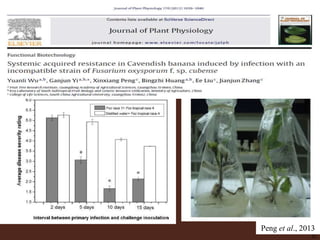
Peng et al., 2013
The positives aspects of SAR….
 Broad spectrum , thus effective against viral, bacterial and fungal
pathogen.
 Its ability to immunize susceptible plants implies that genetic
potential for resistance is in all types of plants.
 The significant practical aspects of SAR is the discovery of chemical
inducers of plant defense.
 Dichloro isonicotinic acid (DCINA) provides systemic protection , as
provided by biotic agents.
New generation fungicides act as a plant defense system , rather than
killing pathogen.
ICGA-245 704, a benzothiadiazole compound (plant activator)
switches SAR in host plant.
Conclusion
Systemic acquired resistance is a general and rather elegant
response developed by plants against various invaders.
Better understanding of the SAR signaling pathway will certainly
lead to new environmentally friendly methods of crop protection.
Systemic acquired resistance (SAR) is a highly desirable form of
resistance that protects against a broad-spectrum of related or
unrelated pathogens.
SAR involves the generation of multiple signals at the site of
primary infection, which arms distal portions against subsequent
secondary infections.
Systemic acquired Resistance

Systemic acquired Resistance

  • 1.
  • 2.
    Presented by Mukesh Kumar(Ph.D Scholar) Department of Plant Pathology Dr. Rajendra Prasad Central Agricultural University Pusa, Samastipur, 848185 (Bihar) India Credit Seminar on “Systemic Acquired Resistance”
  • 3.
     Ist recognizedas a significant phenomenon in 1933 by Chester.  Infection of plants with necrotizing pathogens (causing HR) often results in enhanced resistance to subsequent infections by a variety of fungal, bacterial and viral pathogens.  This physiological immunity was termed Systemic Acquired Resistance (SAR). SAR confers a broad spectrum type of resistance SAR is effective against some but not all pathogens: Tobacco: Phytophthora parasitica, Cercospora nicotianae, Peronospora tabacina tobacco mosaic virus, tobacco necrosis virus, Pseudomonas syringae pv. tabaci, Erwinia carotovora Not effective against: Botrytis cinerea or Alternaria alternata Arabidopsis: Phytophthora parasitica turnip crinkle virus Pseudomonas syringae pv. tomato DC3000 INTRODUCTION
  • 4.
    SAR (Systemic AcquiredResistance) • Systemic acquired resistance (SAR) is a mechanism of induced defense that confers long-lasting protection against a broad spectrum of microorganisms. SAR requires the signal molecule salicylic acid (SA) and is associated with accumulation of pathogenesis-related proteins, which are thought to contribute to resistance . or • Resistance triggered in the plant during its life time is Acquired Resistance. It can be local (LAR) confined to few cells or tissues, or systemic (SAR) having been moved through out the plant. • Systemic acquired resistance (SAR) refers to a distinct signal transduction pathway that plays an important role in the ability of plants to defend themselves against pathogens
  • 5.
     Frank Ross(1961) showed that tobacco plants challenged with tobacco mosaic virus (TMV) subsequently developed increased resistance to secondary infection in distal tissues.  This spread of resistance throughout the plant’s tissues was termed systemic acquired resistance (SAR).  SAR is characterized by the increased expression of a large number of pathogenesis-related genes (PR genes), in both local and systemic tissues.  PR proteins were first described in the 1970s by Van Loon, who observed accumulation of various novel proteins after infection of tobacco with TMV. History
  • 6.
     White 1979observed that PR protein accumulation and resistance to TMV could be induced by treatment of tobacco with salicylic acid (SA), aspirin (acetyl SA), or benzoic acid.  Malamy et al., 1990 Evidence that SA is a signal for the induction of SAR.  Malamy et al. 1990: showed that the endogenous SA concentration rises in both local and systemic tissues after infection of tobacco with TMV and this rise correlates with PR gene induction.  Metraux et al. 1990: found that cucumber plants infected with either Colletotrichum lagenarium or tobacco necrosis virus (TNV) have considerably elevated levels of SA in the phloem sap.  A requirement for SA as an endogenous signal for SAR was proven by Gaffney et al. 1993 using a bacterial gene, nahG, encoding salicylate hydroxylase, which removes SA by conversion to catechol
  • 7.
    ISR SAR Induced SystemicResistance •Systemic Acquired Resistance SA independent •SA dependent Necrosis reaction absent •Necrosis reaction present Signaling molecules JA, Ethylene •Signaling molecules SA More elastic •Less elastic Against necrotrophs and insects •Against biotrophs Continuous irritation is required •Not required Defense genes involved •PR-proteins Difference between ISR and SAR 11/1/2017 5:35 PM 7Dept. of Plant Pathology
  • 9.
    Characteristics of SAR 1.Resistance is expressed against broad spectrum of organism 2. Time needed for establishment of SAR depend on both the plant and type of inducing factor. 3. It need for a necrotic lesions produced by the pathogen as an inducing agent. 4. Systemic expression of PRP genes. 5. Involvement of salicylic acid as apart of signaling process.
  • 10.
    Systemic Acquire Resistance(SAR) • Secondary response • Systemic • Broad-range resistance • Leads to Pathogenesis-Related (PR) gene expression • Signals: SA,
  • 12.
    Mechanism Pathogen induced localizednecrosis EDS / SID 1 SID 2 NPR 1 SA accumulation NIM 1 Resistance (Enhanced disease susceptibility) (Salicylic acid induction deficient) (No PR 1 expression) (Non inducable immunity)) PRPs Post challenge defence Eg:Arabidopsis
  • 13.
    NPR1  The ArabidopsisNPR1 gene is a positive regulator of inducible plant disease resistance.  Expression of NPR1 is induced by pathogen infection or treatment with defense- inducing compounds such as salicylic acid (SA).  Transgenic plants overexpressing NPR1 exhibit enhanced resistance to a broad spectrum of microbial pathogens.  Whereas plants under expressing the gene are more susceptible to pathogen infection.  These results suggest that regulation of NPR1 gene expression is important for the activation of plant defense responses.
  • 14.
    NPR1: non-expresser ofPR genes • Also known as NIM1 or SAI1 • Positive regulator of SAR • Downstream of SA, upstream of PR genes • npr1 mutants are susceptible to various pathogens • Over expression of NPR1 generates broad- spectrum resistance • Unique, but similar to Iκ-B (negative regulator of immunity in animals)
  • 15.
  • 17.
    Salicylic Acid (SA)-mediatedSAR Salicylic acid is part of signaling pathway involved in transmission of the defense response throughout the plant to produce SAR  SA reported as the endogenously as well as exogenously signal of SAR (Metraux et al., 1990, Sticher, 1997)  SA plat role in elicitation of Pathogenesis-Related proteins  Analogs: INA or BTH
  • 18.
    Salicylic Acid Biosynthesis Geneticstudies in Arabidopsis have shown that SA is synthesized mainly through the pathway involving ICS1 Biochemically, SA can also be synthesized from phenylalanine ammonia lyase (PAL) but this pathway seems to play a minor role in SAR-associated SA synthesis.  The chorismate pathway has similarities to the bacterial SA-biosynthesis pathway: 1. ICS1 converts chorismate to isochorismate 2. SA is generated from isochorismate catalyzed by isochorismate pyruvate lyase (IPL) .
  • 20.
    Mutants affecting SAsynthesis • Elevated SA accumulation – dnd1 (defense, no death 1): increased SA, but reduced HR, DND1 gene encodes cyclic- nucleotide-gated ion channel – mpk4: constitutive SA accumulation – edr1 (enhanced disease resistance 1): defective MAPKKK
  • 22.
    Benzothiadiazole (BTH) BTH alsois a activator of the SAR pathway. However, BTH treatment induces both PR- 1 mRNA accumulation and P. parasitica resistance in transgenic Arabidopsis expressing nahG gene, indicating that BTH action does not required SA accumulation.
  • 25.
  • 26.
    Involvement of H2O2in SAR  Elevated level of cellular reactive oxygen species (i.e., H2O2) was observed in plants with SAR.  Chen and Klessig (1993) isolated a SA-binding protein (SABP) from the cDNA library of tobacco leaves.  The deduced cDNA sequence indicates that SABP is a catalase.  They proposed that SA activates the elevated levels of cellular H2O2 by inhibiting the catalase activity.  Cellular H2O2 functions as a secondary messenger in SAR signal transduction.
  • 27.
    Production of pathogenesisrelated protein • PR protein are plant protein that are induced in pathological and related situation. • These proteins are accumulated 7-10 days after infection and indicate the attainment of SAR. • It is accumulated in the intercellular spaces(first line of defence) and vacuole (second line of defence by lytic enzyme).
  • 29.
    Salicylic acid (SA)treatment delays the onset of Cucumber mosaic virus (CMV)- induced disease symptoms in squash (Cucurbita pepo). Symptom development was monitored in squash plants inoculated.
  • 30.
    SAR induced byTNV against C. lagenarium in cucumber. Leaf 1 was challenged with the fungus between 2 and 5 d after primary inoculation of the cotyledon with TNV (filled bars) or mock inoculation with water (open bars).
  • 31.
  • 33.
    The positives aspectsof SAR….  Broad spectrum , thus effective against viral, bacterial and fungal pathogen.  Its ability to immunize susceptible plants implies that genetic potential for resistance is in all types of plants.  The significant practical aspects of SAR is the discovery of chemical inducers of plant defense.  Dichloro isonicotinic acid (DCINA) provides systemic protection , as provided by biotic agents. New generation fungicides act as a plant defense system , rather than killing pathogen. ICGA-245 704, a benzothiadiazole compound (plant activator) switches SAR in host plant.
  • 34.
    Conclusion Systemic acquired resistanceis a general and rather elegant response developed by plants against various invaders. Better understanding of the SAR signaling pathway will certainly lead to new environmentally friendly methods of crop protection. Systemic acquired resistance (SAR) is a highly desirable form of resistance that protects against a broad-spectrum of related or unrelated pathogens. SAR involves the generation of multiple signals at the site of primary infection, which arms distal portions against subsequent secondary infections.