www.MINEPORTAL.in
ONLINE TEST SERIES FOR
• DGMS COAL/METAL FIRST/SECOND CLASS EXAM
• GATE MINING EXAM
• OVERMAN EXAM TEST
• MINING INSPECTOR EXAMS
• COAL INDIA MTs & OTHER PSUs EXAMS
FREE STUDY MATERIAL & VIDEO LECTURES
MINING JOBS NOTIFICATIONS
www.mineportal.in Call/Whatsapp-8804777500 www.fb.com/mineportal.in
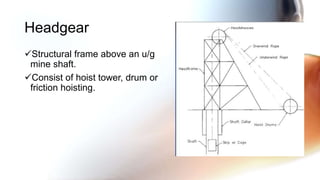
HEADGEAR
Structural frame above an u/g
mine shaft.
Consist of hoist tower, drum or
friction hoisting.
Headgear
Based on mode of main entry
• Vertical(most commonly used)
• Inclined(may be a single A framed type or two frame type)
Classifications:
Based on material used
• Timber(not in use)
• Steel
• Concrete
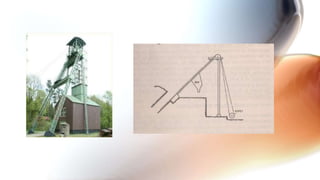
Steal head gear, Narwapahar
Concrete head gear,
Jaduguda
• EASE IN MODIFICATION
• SHOP FABRICATION SAVES TIME
• DEALS WITH UNFAVOURABLE GROUND CONDITION
STEEL HEADGEAR
ADVANTAGES OF STEEL HEADGEAR
• SLIGHTLY CHEAPER AND NO PAINTING REQUIRED
• CLEAR APPROACH TO SHAFT
• RIGID STRUCTURE CONTROLS VIBRATIONS
CONCRETE HEADGEAR
ADVANTAGES
• CONSTRUCTION HAMPERS OTHER OPERATIONS
• DIFFICULT TO MODIFY
• REPAIRING IS DIFFICULT
DISADVANTAGES
Depending on mounting of mine hoists
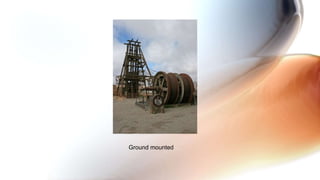
• Ground mounted hoists
• Tower type head frames with ground mounted friction hoists
• Hoist towers with one or two friction hoists ( mounted on them)
• Tower mounted friction hoist and ground mounted drum hoist
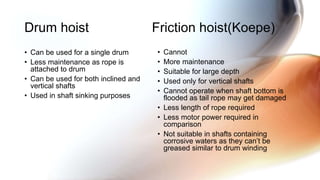
• Cannot
• More maintenance
• Suitable for large depth
• Used only for vertical shafts
• Cannot operate when shaft bottom is
flooded as tail rope may get damaged
• Less length of rope required
• Less motor power required in
comparison
• Not suitable in shafts containing
corrosive waters as they can’t be
greased similar to drum winding
• Can be used for a single drum
• Less maintenance as rope is
attached to drum
• Can be used for both inclined and
vertical shafts
• Used in shaft sinking purposes
Drum hoist Friction hoist(Koepe)
Ground mounted
• It is determined by distance between shaft collar and centre of
headgear pulley at highest level. It mainly depend upon many factors
such as banking level, maximum over wined allowed up to catch
plate, pit-top layout, number of deck on cage etc. It varies in range of
20-60 meters depending on above factors
Height of Headgear
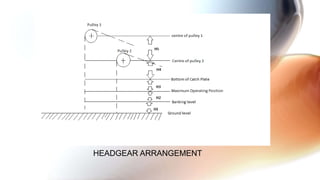
HEADGEAR ARRANGEMENT
Total height of headgear H = h1+h2+h3+h4+h5
h1=height of banking level above shaft collar (h1=0, if banking level is at shaft collar)
h2=maximum height of top conveyance when discharging above banking level
h3=over wind allowance up to bumper beam / catch plate
h4= vertical distance between bumper beam and centre of pulley
h5=vertical distance between centres of two pulley in case of two tier arrangement (h5=0,
when either one is used or two pulleys are parallel )
Factors affecting design
Design of headgear
• Height of headgear
• Geological disturbances on shaft mouth
-Steel headgear is preferred over concrete headgear in geologically disturbed areas
• Geometry of headgear
-Circular shape gives optimum hoisting due to high factor of safety
• Depth of shaft
-It impacts duty cycle which directly affects production
• Minimum structure dead load
-It depends on various factors like structure weight, pulley weight , guide vanes and tensions
developed in ropes, internal steel structure supported by headgear etc
• Sufficient rigidity to limit vibrations to their permissible values
Vibrations are caused by
- Translational vibration of ropes
- Longitudinal vibrations of ropes
• Strength to withstand stress developed in various parts of headgear under
adverse loading conditions
• Construction and maintenance cost
-Steel headgear is more economic in maintenance than any other type of
headgear
• Durability of frame
-It depends upon material used and overall production for long time
• Structural and functional requirement to suit the shaft
• Length of rope (underlay/overlay) between hoist and head sheave
• Determines maximum allowable distance between hoist and shaft
• Should not exceed 60m so as to avoid large sags and harmful rope
whip
• Guide rollers should be installed near opening of hoistroom if Rope
plane exceeds 60m
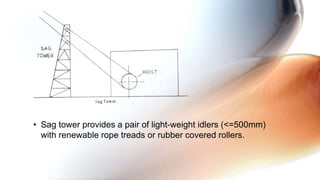
• If it exceeds 75m installation of a sag tower between hoistroom and
head frame, preferably at 1/3rd distance of rope length away from
drum should be installed
Rope Lead - Introduction
• Sag tower provides a pair of light-weight idlers (<=500mm)
with renewable rope treads or rubber covered rollers.
lR is Rope lead or Rope plane, given by
lR = sqrt[ (h-ho)2 + (l-Rs)2 ]
h = calculated value of head frame height
l = horizontal distance between axis of drum shaft and
center of shaft section
ho = height of axis of drum shaft above shaft collar level
Rs = radius of head sheaves
Rope slope, given by
tan = (h-ho)/(l-Rs)
Calculation of Rope plane and rope slope
When head sheaves are arranged in same vertical plane on separate
platforms, length of Rope planes are given by
lR1 = sqrt[ (h-ho)2 + (l-Rs)2 ]
lR2 = sqrt[ (h-∆h-ho)2 + (l-ls)2 ]
∆h = difference in elevation of head sheaves’ centers,
ls = horizontal distance between head sheaves’ centers
• Determined by relative positions of mine hoist and head
sheaves
• Should not exceed a definite permissible value for satisfactory
rope coiling and longer rope life
• Friction sheave – one or no fleet angle
• Drum Hoist – outer and inner fleet angles
• Max Permissible fleet angle is 1º30´ for friction sheaves and
smooth faced drums & 2º for grooved drums
Rope fleet angle
Hoist Ropes
Desired
Qualities
Strength
Resistance
to bending
fatigue
Resistance
to abrasion
Resistance
to
distortion/cr-
ushing
Resistance
to rotation
Resistance
to
corrosion
Reverse
Strength
Constructio-
nal stretch
 Winding Ropes
 6x7 Lang Lay, F.C.
 6x19 Seale Regular or Lang Lay, F.C.
 6x21 Filler Wire Regular or Lang Lay, F.C.
 6x25 Filler Wire Regular or Lang Lay, F.C.
 6x27 Flattened Strand Lang Lay, F.C.
 6x30 Flattened Strand Lang Lay, F.C.
 Locked coil hoist Rope
 Guide Rope
 Half Locked Coil Guide Rope
Ropes Used for Different Purposes
• Drum Diameter >= 100 x Rope diameter
• Required torque = Load Torque + Rope Torque + Frictional Torque +
Travelling Torque + Rotating Torque
• And all the above components are directly proportional to Drum
Radius.
• This implies that lesser the rope radius, lesser will be the drum
radius which in turn corresponds to lower torque requirement and
hence lower power requirement.
Why rope diameter should be less?
Amit Tiwari 11108EN001
P. Rahul Bharadwaj 11108EN002
Anirudh Singh 11108EN003
Deepu Jha 11108EN004
Alok Rai 11108EN005
Ravi Raj Dwivedi 11108EN006
Ravi Agrawal 11108EN007
Shwetab Suman 11108EN008
Dushyant Saraswat 11108EN009
Prasoon Garg 11108EN010
Atish Kumar 11108EN011
Prepared by Group 1

Head gear

  • 1.
    www.MINEPORTAL.in ONLINE TEST SERIESFOR • DGMS COAL/METAL FIRST/SECOND CLASS EXAM • GATE MINING EXAM • OVERMAN EXAM TEST • MINING INSPECTOR EXAMS • COAL INDIA MTs & OTHER PSUs EXAMS FREE STUDY MATERIAL & VIDEO LECTURES MINING JOBS NOTIFICATIONS www.mineportal.in Call/Whatsapp-8804777500 www.fb.com/mineportal.in
  • 2.
  • 3.
    Structural frame abovean u/g mine shaft. Consist of hoist tower, drum or friction hoisting. Headgear
  • 4.
    Based on modeof main entry • Vertical(most commonly used) • Inclined(may be a single A framed type or two frame type) Classifications:
  • 6.
    Based on materialused • Timber(not in use) • Steel • Concrete Steal head gear, Narwapahar Concrete head gear, Jaduguda
  • 7.
    • EASE INMODIFICATION • SHOP FABRICATION SAVES TIME • DEALS WITH UNFAVOURABLE GROUND CONDITION STEEL HEADGEAR ADVANTAGES OF STEEL HEADGEAR
  • 8.
    • SLIGHTLY CHEAPERAND NO PAINTING REQUIRED • CLEAR APPROACH TO SHAFT • RIGID STRUCTURE CONTROLS VIBRATIONS CONCRETE HEADGEAR ADVANTAGES
  • 9.
    • CONSTRUCTION HAMPERSOTHER OPERATIONS • DIFFICULT TO MODIFY • REPAIRING IS DIFFICULT DISADVANTAGES
  • 10.
    Depending on mountingof mine hoists • Ground mounted hoists • Tower type head frames with ground mounted friction hoists • Hoist towers with one or two friction hoists ( mounted on them) • Tower mounted friction hoist and ground mounted drum hoist
  • 11.
    • Cannot • Moremaintenance • Suitable for large depth • Used only for vertical shafts • Cannot operate when shaft bottom is flooded as tail rope may get damaged • Less length of rope required • Less motor power required in comparison • Not suitable in shafts containing corrosive waters as they can’t be greased similar to drum winding • Can be used for a single drum • Less maintenance as rope is attached to drum • Can be used for both inclined and vertical shafts • Used in shaft sinking purposes Drum hoist Friction hoist(Koepe)
  • 12.
  • 13.
    • It isdetermined by distance between shaft collar and centre of headgear pulley at highest level. It mainly depend upon many factors such as banking level, maximum over wined allowed up to catch plate, pit-top layout, number of deck on cage etc. It varies in range of 20-60 meters depending on above factors Height of Headgear
  • 14.
  • 15.
    Total height ofheadgear H = h1+h2+h3+h4+h5 h1=height of banking level above shaft collar (h1=0, if banking level is at shaft collar) h2=maximum height of top conveyance when discharging above banking level h3=over wind allowance up to bumper beam / catch plate h4= vertical distance between bumper beam and centre of pulley h5=vertical distance between centres of two pulley in case of two tier arrangement (h5=0, when either one is used or two pulleys are parallel )
  • 16.
  • 17.
    • Height ofheadgear • Geological disturbances on shaft mouth -Steel headgear is preferred over concrete headgear in geologically disturbed areas • Geometry of headgear -Circular shape gives optimum hoisting due to high factor of safety • Depth of shaft -It impacts duty cycle which directly affects production • Minimum structure dead load -It depends on various factors like structure weight, pulley weight , guide vanes and tensions developed in ropes, internal steel structure supported by headgear etc • Sufficient rigidity to limit vibrations to their permissible values Vibrations are caused by - Translational vibration of ropes - Longitudinal vibrations of ropes
  • 18.
    • Strength towithstand stress developed in various parts of headgear under adverse loading conditions • Construction and maintenance cost -Steel headgear is more economic in maintenance than any other type of headgear • Durability of frame -It depends upon material used and overall production for long time • Structural and functional requirement to suit the shaft
  • 19.
    • Length ofrope (underlay/overlay) between hoist and head sheave • Determines maximum allowable distance between hoist and shaft • Should not exceed 60m so as to avoid large sags and harmful rope whip • Guide rollers should be installed near opening of hoistroom if Rope plane exceeds 60m • If it exceeds 75m installation of a sag tower between hoistroom and head frame, preferably at 1/3rd distance of rope length away from drum should be installed Rope Lead - Introduction
  • 20.
    • Sag towerprovides a pair of light-weight idlers (<=500mm) with renewable rope treads or rubber covered rollers.
  • 21.
    lR is Ropelead or Rope plane, given by lR = sqrt[ (h-ho)2 + (l-Rs)2 ] h = calculated value of head frame height l = horizontal distance between axis of drum shaft and center of shaft section ho = height of axis of drum shaft above shaft collar level Rs = radius of head sheaves Rope slope, given by tan = (h-ho)/(l-Rs) Calculation of Rope plane and rope slope
  • 22.
    When head sheavesare arranged in same vertical plane on separate platforms, length of Rope planes are given by lR1 = sqrt[ (h-ho)2 + (l-Rs)2 ] lR2 = sqrt[ (h-∆h-ho)2 + (l-ls)2 ] ∆h = difference in elevation of head sheaves’ centers, ls = horizontal distance between head sheaves’ centers
  • 23.
    • Determined byrelative positions of mine hoist and head sheaves • Should not exceed a definite permissible value for satisfactory rope coiling and longer rope life • Friction sheave – one or no fleet angle • Drum Hoist – outer and inner fleet angles • Max Permissible fleet angle is 1º30´ for friction sheaves and smooth faced drums & 2º for grooved drums Rope fleet angle
  • 24.
  • 25.
  • 26.
     Winding Ropes 6x7 Lang Lay, F.C.  6x19 Seale Regular or Lang Lay, F.C.  6x21 Filler Wire Regular or Lang Lay, F.C.  6x25 Filler Wire Regular or Lang Lay, F.C.  6x27 Flattened Strand Lang Lay, F.C.  6x30 Flattened Strand Lang Lay, F.C.  Locked coil hoist Rope  Guide Rope  Half Locked Coil Guide Rope Ropes Used for Different Purposes
  • 27.
    • Drum Diameter>= 100 x Rope diameter • Required torque = Load Torque + Rope Torque + Frictional Torque + Travelling Torque + Rotating Torque • And all the above components are directly proportional to Drum Radius. • This implies that lesser the rope radius, lesser will be the drum radius which in turn corresponds to lower torque requirement and hence lower power requirement. Why rope diameter should be less?
  • 28.
    Amit Tiwari 11108EN001 P.Rahul Bharadwaj 11108EN002 Anirudh Singh 11108EN003 Deepu Jha 11108EN004 Alok Rai 11108EN005 Ravi Raj Dwivedi 11108EN006 Ravi Agrawal 11108EN007 Shwetab Suman 11108EN008 Dushyant Saraswat 11108EN009 Prasoon Garg 11108EN010 Atish Kumar 11108EN011 Prepared by Group 1