MINI TEACHING
DR. C. BEULAH JAYARANI
M.Sc., M.A, M.Ed, M.Phil (Edn), M.Phil (ZOO), NET, Ph.D (Edn)
ASST. PROFESSOR,
LOYOLA COLLEGE OF EDUCATION, CHENNAI - 34
UNIT - III
B.Ed. - TNTEU
WHAT IS MINI TEACHING….?
A mini lesson is a
short lesson with
a narrow focus
that provides
instruction in a
skill or concept
that students will
then relate to a
larger lesson that
will follow
Minilessons are
brief – each one
will take
approximately
fifteen to twenty
minutes to deliver
during whole
group time
20-05-2021 Dr. C. BEULAH JAYARANI 2
BASIC COMPONENTS ARE…
1. Connection
2. Teaching
3. Active engagement
4. Link
20-05-2021 Dr. C. BEULAH JAYARANI 3
WHY MINI TEACHING…..?
Teaching training technique for learning teaching skills.
It employs real teaching situation for developing skills and helps to get deeper
knowledge regarding the art of teaching.
It’s a basic precursor to a bigger or broader topic.
It is a short lesson it can benefit the students in lessons to come.
It teaches a valuable lesson and sets the foundation for further discussion of writing
styles or reading concepts.
20-05-2021
Dr. C. BEULAH JAYARANI 4
PRACTISING A MINI-LESSON WITH
MULTIPLE TEACHING SKILLS
• NAME:
• SUBJECT:
• TOPIC:
• DATE:
• TIME:
20-05-2021 Dr. C. BEULAH JAYARANI 5
OBjECTIvES
1. Acquires
knowledge
2.
Understands
3. Applies
the
knowledge
4. Develops
skills in
drawing and
labelling /
5.
Appreciates/
20-05-2021 Dr. C. BEULAH JAYARANI 6
TEACHING LEARNING MATERIALS
FLASH
CARD
CHART
FLOW
CHART
PICTURES MODEL
WORKING
MODEL
REAL
SPECIMEN
MATCH
BOARD
20-05-2021 Dr. C. BEULAH JAYARANI 7
MODEL MINI- LESSON PLAN
•
• NAME OF THE STUDENT TEACHER :
• NAME OF THE TEACHER EDUCATOR :
• SUBJECT : BIO. SCIENCE- ZOOLOGY
• UNIT : HUMAN BODY ORGAN SYSTEM
• TOPIC : CIRCULATORY SYSTEM
• CLASS : IX
• DURATION : 20 MINUTES
• DATE :
20-05-2021 Dr. C. BEULAH JAYARANI 8
CONTENT OUTLINE
1. Circulatory system- A special system which includes heart, blood vessels and blood.
2. This system makes the blood to circulate around the body, because of the contraction and expansion of the heart.
3. Blood vascular system is divided into open blood vascular system and closed blood vascular system.
4. Open blood vascular system: In this, the blood is pumped by the heart into the blood vessels that open into blood spaces/cavities.
There is no capillary system- eg: arthropods; Cavities- haemocoel. The pressure of the blood is very low - eg: cockroach. In
closed blood vascular system, the blood circulates through the blood vessels and it creates blood pressure inside the blood vessels.
eg: human
5. Heart- hollow, muscular, conical in shape; covered with doubled walled membrane- pericardium. The space between the
pericardial membrane- pericardial spaces, filled with- pericardial fluid.
6. Pericardial fluid protects the heart from shock. Heart is placed inside the thoracic chamber, in between the lungs in the
mediastinum.
7. Human heart has 4 chambers: 2 upper thin- artria and 2 lower thick- ventricles. Right and left side of the heart is separated by
longitudinal wall- inter artrio-ventricular septum.
8. Valves in heart are divided into three. They are – Tricuspid valve (located between right atrium and right ventricle)
Bicuspid/mitral valve(located between left atrium and left ventricle) Semi lunar valve (present near the mouth of pulmonary
artery and aorta)
20-05-2021
Dr. C. BEULAH JAYARANI 9
TEACHING SKILLS ARE….
1. SKILL OF INTRODUCTION
2. SKILL OF EXPLANATION
3. SKILL OF QUESTIONING
4. SKILL OF STIMULUS VARIATION
5. SKILL OF NON-VERBAL CUES
6. SKILL OF REINFORCEMENT
7. SKILL OF CLOSURE
8. SKILL OF FLUENCY IN COMMUNICATION
Teaching skill as
‘a group of
teaching acts or
behaviors
intended to
facilitate pupils
learning directly
or indirectly’ -
Passi (1976)
20-05-2021 Dr. C. BEULAH JAYARANI
10
OBSERvATION
The complex teaching can be split into component skills, simple, well
defined and limited. These skills can be identified, practiced, evaluated,
controlled and acquired through training.
Teaching skill as a set of related teaching behaviors which is specified the
achievement of specified types of educational objectives’.
20-05-2021 Dr. C. BEULAH JAYARANI 11
FEEDBACK
The teaching skills developed through training are to be observed by the
peers/ teacher educators. Immediate feedback may be given to the
student-teachers individually using the feedback forms
- McIntyre et.al (1977)
20-05-2021 Dr. C. BEULAH JAYARANI 12
INTEGRATION OF TEACHING SKILLS FEEDBACK FORM
TEACHING SKILLS AVERAGE
(SCORE 1)
GOOD
(SCORE 2)
VERY GOOD
(SCORE 3)
TOTAL
INTRODUCING
EXPLAINING
QUESTIONING
STIMULUS VARIATION
NON-VERBAL CUES
REINFORCEMENT
CLOSURE
NAME OF THE STUDENT TEACHER: DURATION: 20
FLUENCY IN
COMMUNICATION
TOTAL
INTEGRATING SKILLS IN MINI TEACHING (Assessment by Peers/Teacher educators)
20-05-2021 Dr. C. BEULAH JAYARANI 13
OvERALL ASSESSMENT OF MINI-TEA CHING
AVERAGE ____ GOOD ____ VERY GOOD_____
Interpretation of scores
Average : 8
Good : 9-16
Very Good :17-24
Signature of the observer
20-05-2021 Dr. C. BEULAH JAYARANI 14
UNDERSTANDING MAjOR STEPS IN
TEACHING A MINI-LESSON
• Instructional Procedures and Activities: Provide a detailed
discussion of the mini lesson (15-20 min) using the following
headings:
• 1. Motivation
• 2. Presentation
• 3. Interaction
• 4. Reflection
• 5. Summing-up
20-05-2021 Dr. C. BEULAH JAYARANI 15
MOTIvATION /PREPARATORY STEP
Prepare the minds
to receive the
subject matter.
Identifies the
mental readiness
Checks entry
behavior
Testing previous
knowledge develops
interest in the
minds and helps to
maintain curiosity
20-05-2021 Dr. C. BEULAH JAYARANI 16
PRESENTATION
Key step - actual process of teaching take place
The aims of the lesson should be stated clearly and the heading should be written on the B/b.
Must provide situation to participate in the process of TL.
Must explain the content in understandable way
Use of simple language
Use of appropriate and specific examples with illustrations
To maintain interest - must ask questions from time to time
Use of instructional aids like charts, audiovisuals, specimen etc.,
20-05-2021
Dr. C. BEULAH JAYARANI
17
INTERACTION
Done by
speaking, sharing
opinion, listening
to others and
establishing a
mutual consent
Support the TL
process directly
Interacting
directly with the
object of learning
and
communicating
in groups
Provides the
ability of gaining
mastery over the
subject
20-05-2021 Dr. C. BEULAH JAYARANI 18
REFLECTION
20-05-2021 Dr. C. BEULAH JAYARANI 19
SUMMING-UP
Teachers
conclusion
Finding the
understanding
level
Reviewing the
lesson
Giving
assignments
20-05-2021 Dr. C. BEULAH JAYARANI 20
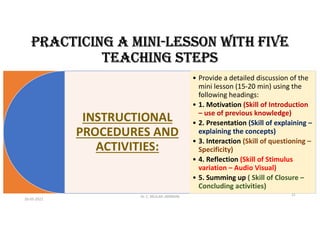
PRACTICING A MINI-LESSON WITH FIvE
TEACHING STEPS
INSTRUCTIONAL
PROCEDURES AND
ACTIVITIES:
• Provide a detailed discussion of the
mini lesson (15-20 min) using the
following headings:
• 1. Motivation (Skill of Introduction
– use of previous knowledge)
• 2. Presentation (Skill of explaining –
explaining the concepts)
• 3. Interaction (Skill of questioning –
Specificity)
• 4. Reflection (Skill of Stimulus
variation – Audio Visual)
• 5. Summing up ( Skill of Closure –
Concluding activities)
20-05-2021
Dr. C. BEULAH JAYARANI 21
INTRODUCTORY ACTIvITIES
• 1. Motivation: The teacher asks questions regarding circulatory system, heart, external and
internal structure of human heart and bring out the previous knowledge of the student about the
circulatory system
 How do you identify that a person is living?
 Which organ in our body is related to our fist of our hand size?
 Which organ pumps blood and circulates all through the body?
 Which system is concerned with circulation?
 What is the shape of the heart?
 Where is heart placed?
 Which sound is heard when you check the pulse of a person?
20-05-2021 Dr. C. BEULAH JAYARANI 22
2. Presentation
 The teacher announces the topic “Circulatory System” and writes it on the black board.
 The teacher describes that the circulatory system is also called as blood vascular system.
 The teacher explains that in open type, the blood is pumped by the heart into the blood vessels that opens into blood spaces
(cavities) and in whereas in closed type, the blood is circulating through the blood vessels and it creates blood pressure
inside the blood vessels.
 The teacher asks the students to observe the chart the human heart entire
 The teacher asks the student to identify that heart is hallow, muscular organ and conical shape. The heart is covered with
double-walled membrane called pericardium. The space between the pericardial membranes is called pericardial space,
which is filled with pericardial fluid. This fluid protects the heart from shock. The heart is placed inside the thoracic
chamber in between the two lungs in the mediastinum.
 The teacher describe that the human heart consists of 4 chambers. Two upper thin chamber – artria and two lower thick
chambers – ventricles.
 The teacher explains that heart consist of three different valves-Tricuspid valve: Located between the right atrium and
right ventricle, Bicuspid valve (Mitral valve): Lies in between left atrium and left ventricle and Semi lunar valves:
Present near the mouth of pulmonary artery and aorta.
 The teacher lists out the parts of L.S. Human heart
20-05-2021 Dr. C. BEULAH JAYARANI 23
3. Interaction
 Circulatory system is also called as ----------
 What is open blood vascular system and closed blood vascular system?
 Open blood vessels are seen in ------
 What is called haemocoel?
 Closed blood vessels are seen in -------
 Heart is a ---, --------- and ------------organ
 What is pericardium?
 Which protects the heart from shock?
 Where the inter artrio- ventricular septum present?
 Tricuspid valve is located between ---------
 Where bicuspid valve and semi lunar valve is located?
 Define Circulatory system
20-05-2021 Dr. C. BEULAH JAYARANI 24
4. Reflection
 The teacher asks the students to observe and identify the human heart entire drawing
 The teacher shows the chart illustrating external & internal parts of human heart and ask
pupils to identify the various parts of human heart
 The teacher asks the students to observe the specimen and locate the right atrium, left
atrium, right ventricle and left ventricle
 The teacher points out the pulse rate of human being by conducting a simple experiment.
20-05-2021 Dr. C. BEULAH JAYARANI 25
5. Summing up
• Circulatory system – blood vascular system – open and closed system – shape of
the heart – structure of heart – valves
 Prepare a working model of circulatory system
 Buy a sheep heart from butchers shop, cut it into longitudinal equal half and
observe the chambers.
 Draw the diagram of Human heart entire and label the parts
20-05-2021 Dr. C. BEULAH JAYARANI 26
INTEGRATION OF TEACHING STEPS FEEDBACK FORM
TEACHING STEPS AVERAGE
(SCORE 1)
GOOD
(SCORE 2)
VERY GOOD
(SCORE 3)
TOTAL
MOTIVATION
PRESENTATION
INTERACTION
REFLECTION
SUMMING UP
TOTAL
NAME OF THE STUDENT TEACHER: DURATION: 20
INTEGRATING STEPS IN MINI TEACHING (Assessment by Peers/Teacher educators)
Range of Scores: 5 - 15
20-05-2021
Dr. C. BEULAH JAYARANI 27
OvERALL ASSESSMENT OF TEACHING STEPS
AVERAGE ____ GOOD ____ VERY GOOD_____
Interpretation of scores
Average : 5
Good : 6-10
Very Good :11-15
Signature of the observer
20-05-2021 Dr. C. BEULAH JAYARANI 28
FUNCTIONS OF MINI-TEACHING
It’s a basic
precursor to a
bigger or
broader topic.
It is a short lesson
that can be taught
in just a 15 – 20
minutes, but it can
benefit the
students in lessons
to come.
Teaches a valuable
lesson and sets the
foundation for
further discussion
of writing styles or
reading concepts.
Teaching skills -
identified,
practiced,
evaluated,
controlled and
acquired through
training.
20-05-2021 Dr. C. BEULAH JAYARANI 29
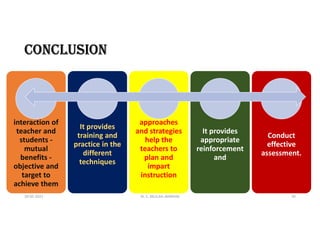
CONCLUSION
Teaching
means
interaction of
teacher and
students -
mutual
benefits -
objective and
target to
achieve them
It provides
training and
practice in the
different
techniques
The
approaches
and strategies
help the
teachers to
plan and
impart
instruction
It provides
appropriate
reinforcement
and
Conduct
effective
assessment.
20-05-2021 Dr. C. BEULAH JAYARANI 30
EvALUATION AND ASSESSMENT
• List how the pre-service teachers (peers) will demonstrate their
learning.
• How will you know the mini-lesson has been successful?
• What are the steps involved in mini-lesson plan?
• What are the skills and steps involved in mini-teaching? Explain
• Write a model mini-lesson for the topic “Excretory system”
20-05-2021 Dr. C. BEULAH JAYARANI 31
REFERENCE
TNTEU – Study Material
Ram Publications
Sri Krishna Publications
Kaviyamala Publications
Google Images
5/20/2021 Dr. C. Beulah Jayarani 32

Mini teaching

  • 1.
    MINI TEACHING DR. C.BEULAH JAYARANI M.Sc., M.A, M.Ed, M.Phil (Edn), M.Phil (ZOO), NET, Ph.D (Edn) ASST. PROFESSOR, LOYOLA COLLEGE OF EDUCATION, CHENNAI - 34 UNIT - III B.Ed. - TNTEU
  • 2.
    WHAT IS MINITEACHING….? A mini lesson is a short lesson with a narrow focus that provides instruction in a skill or concept that students will then relate to a larger lesson that will follow Minilessons are brief – each one will take approximately fifteen to twenty minutes to deliver during whole group time 20-05-2021 Dr. C. BEULAH JAYARANI 2
  • 3.
    BASIC COMPONENTS ARE… 1.Connection 2. Teaching 3. Active engagement 4. Link 20-05-2021 Dr. C. BEULAH JAYARANI 3
  • 4.
    WHY MINI TEACHING…..? Teachingtraining technique for learning teaching skills. It employs real teaching situation for developing skills and helps to get deeper knowledge regarding the art of teaching. It’s a basic precursor to a bigger or broader topic. It is a short lesson it can benefit the students in lessons to come. It teaches a valuable lesson and sets the foundation for further discussion of writing styles or reading concepts. 20-05-2021 Dr. C. BEULAH JAYARANI 4
  • 5.
    PRACTISING A MINI-LESSONWITH MULTIPLE TEACHING SKILLS • NAME: • SUBJECT: • TOPIC: • DATE: • TIME: 20-05-2021 Dr. C. BEULAH JAYARANI 5
  • 6.
    OBjECTIvES 1. Acquires knowledge 2. Understands 3. Applies the knowledge 4.Develops skills in drawing and labelling / 5. Appreciates/ 20-05-2021 Dr. C. BEULAH JAYARANI 6
  • 7.
    TEACHING LEARNING MATERIALS FLASH CARD CHART FLOW CHART PICTURESMODEL WORKING MODEL REAL SPECIMEN MATCH BOARD 20-05-2021 Dr. C. BEULAH JAYARANI 7
  • 8.
    MODEL MINI- LESSONPLAN • • NAME OF THE STUDENT TEACHER : • NAME OF THE TEACHER EDUCATOR : • SUBJECT : BIO. SCIENCE- ZOOLOGY • UNIT : HUMAN BODY ORGAN SYSTEM • TOPIC : CIRCULATORY SYSTEM • CLASS : IX • DURATION : 20 MINUTES • DATE : 20-05-2021 Dr. C. BEULAH JAYARANI 8
  • 9.
    CONTENT OUTLINE 1. Circulatorysystem- A special system which includes heart, blood vessels and blood. 2. This system makes the blood to circulate around the body, because of the contraction and expansion of the heart. 3. Blood vascular system is divided into open blood vascular system and closed blood vascular system. 4. Open blood vascular system: In this, the blood is pumped by the heart into the blood vessels that open into blood spaces/cavities. There is no capillary system- eg: arthropods; Cavities- haemocoel. The pressure of the blood is very low - eg: cockroach. In closed blood vascular system, the blood circulates through the blood vessels and it creates blood pressure inside the blood vessels. eg: human 5. Heart- hollow, muscular, conical in shape; covered with doubled walled membrane- pericardium. The space between the pericardial membrane- pericardial spaces, filled with- pericardial fluid. 6. Pericardial fluid protects the heart from shock. Heart is placed inside the thoracic chamber, in between the lungs in the mediastinum. 7. Human heart has 4 chambers: 2 upper thin- artria and 2 lower thick- ventricles. Right and left side of the heart is separated by longitudinal wall- inter artrio-ventricular septum. 8. Valves in heart are divided into three. They are – Tricuspid valve (located between right atrium and right ventricle) Bicuspid/mitral valve(located between left atrium and left ventricle) Semi lunar valve (present near the mouth of pulmonary artery and aorta) 20-05-2021 Dr. C. BEULAH JAYARANI 9
  • 10.
    TEACHING SKILLS ARE…. 1.SKILL OF INTRODUCTION 2. SKILL OF EXPLANATION 3. SKILL OF QUESTIONING 4. SKILL OF STIMULUS VARIATION 5. SKILL OF NON-VERBAL CUES 6. SKILL OF REINFORCEMENT 7. SKILL OF CLOSURE 8. SKILL OF FLUENCY IN COMMUNICATION Teaching skill as ‘a group of teaching acts or behaviors intended to facilitate pupils learning directly or indirectly’ - Passi (1976) 20-05-2021 Dr. C. BEULAH JAYARANI 10
  • 11.
    OBSERvATION The complex teachingcan be split into component skills, simple, well defined and limited. These skills can be identified, practiced, evaluated, controlled and acquired through training. Teaching skill as a set of related teaching behaviors which is specified the achievement of specified types of educational objectives’. 20-05-2021 Dr. C. BEULAH JAYARANI 11
  • 12.
    FEEDBACK The teaching skillsdeveloped through training are to be observed by the peers/ teacher educators. Immediate feedback may be given to the student-teachers individually using the feedback forms - McIntyre et.al (1977) 20-05-2021 Dr. C. BEULAH JAYARANI 12
  • 13.
    INTEGRATION OF TEACHINGSKILLS FEEDBACK FORM TEACHING SKILLS AVERAGE (SCORE 1) GOOD (SCORE 2) VERY GOOD (SCORE 3) TOTAL INTRODUCING EXPLAINING QUESTIONING STIMULUS VARIATION NON-VERBAL CUES REINFORCEMENT CLOSURE NAME OF THE STUDENT TEACHER: DURATION: 20 FLUENCY IN COMMUNICATION TOTAL INTEGRATING SKILLS IN MINI TEACHING (Assessment by Peers/Teacher educators) 20-05-2021 Dr. C. BEULAH JAYARANI 13
  • 14.
    OvERALL ASSESSMENT OFMINI-TEA CHING AVERAGE ____ GOOD ____ VERY GOOD_____ Interpretation of scores Average : 8 Good : 9-16 Very Good :17-24 Signature of the observer 20-05-2021 Dr. C. BEULAH JAYARANI 14
  • 15.
    UNDERSTANDING MAjOR STEPSIN TEACHING A MINI-LESSON • Instructional Procedures and Activities: Provide a detailed discussion of the mini lesson (15-20 min) using the following headings: • 1. Motivation • 2. Presentation • 3. Interaction • 4. Reflection • 5. Summing-up 20-05-2021 Dr. C. BEULAH JAYARANI 15
  • 16.
    MOTIvATION /PREPARATORY STEP Preparethe minds to receive the subject matter. Identifies the mental readiness Checks entry behavior Testing previous knowledge develops interest in the minds and helps to maintain curiosity 20-05-2021 Dr. C. BEULAH JAYARANI 16
  • 17.
    PRESENTATION Key step -actual process of teaching take place The aims of the lesson should be stated clearly and the heading should be written on the B/b. Must provide situation to participate in the process of TL. Must explain the content in understandable way Use of simple language Use of appropriate and specific examples with illustrations To maintain interest - must ask questions from time to time Use of instructional aids like charts, audiovisuals, specimen etc., 20-05-2021 Dr. C. BEULAH JAYARANI 17
  • 18.
    INTERACTION Done by speaking, sharing opinion,listening to others and establishing a mutual consent Support the TL process directly Interacting directly with the object of learning and communicating in groups Provides the ability of gaining mastery over the subject 20-05-2021 Dr. C. BEULAH JAYARANI 18
  • 19.
    REFLECTION 20-05-2021 Dr. C.BEULAH JAYARANI 19
  • 20.
  • 21.
    PRACTICING A MINI-LESSONWITH FIvE TEACHING STEPS INSTRUCTIONAL PROCEDURES AND ACTIVITIES: • Provide a detailed discussion of the mini lesson (15-20 min) using the following headings: • 1. Motivation (Skill of Introduction – use of previous knowledge) • 2. Presentation (Skill of explaining – explaining the concepts) • 3. Interaction (Skill of questioning – Specificity) • 4. Reflection (Skill of Stimulus variation – Audio Visual) • 5. Summing up ( Skill of Closure – Concluding activities) 20-05-2021 Dr. C. BEULAH JAYARANI 21
  • 22.
    INTRODUCTORY ACTIvITIES • 1.Motivation: The teacher asks questions regarding circulatory system, heart, external and internal structure of human heart and bring out the previous knowledge of the student about the circulatory system  How do you identify that a person is living?  Which organ in our body is related to our fist of our hand size?  Which organ pumps blood and circulates all through the body?  Which system is concerned with circulation?  What is the shape of the heart?  Where is heart placed?  Which sound is heard when you check the pulse of a person? 20-05-2021 Dr. C. BEULAH JAYARANI 22
  • 23.
    2. Presentation  Theteacher announces the topic “Circulatory System” and writes it on the black board.  The teacher describes that the circulatory system is also called as blood vascular system.  The teacher explains that in open type, the blood is pumped by the heart into the blood vessels that opens into blood spaces (cavities) and in whereas in closed type, the blood is circulating through the blood vessels and it creates blood pressure inside the blood vessels.  The teacher asks the students to observe the chart the human heart entire  The teacher asks the student to identify that heart is hallow, muscular organ and conical shape. The heart is covered with double-walled membrane called pericardium. The space between the pericardial membranes is called pericardial space, which is filled with pericardial fluid. This fluid protects the heart from shock. The heart is placed inside the thoracic chamber in between the two lungs in the mediastinum.  The teacher describe that the human heart consists of 4 chambers. Two upper thin chamber – artria and two lower thick chambers – ventricles.  The teacher explains that heart consist of three different valves-Tricuspid valve: Located between the right atrium and right ventricle, Bicuspid valve (Mitral valve): Lies in between left atrium and left ventricle and Semi lunar valves: Present near the mouth of pulmonary artery and aorta.  The teacher lists out the parts of L.S. Human heart 20-05-2021 Dr. C. BEULAH JAYARANI 23
  • 24.
    3. Interaction  Circulatorysystem is also called as ----------  What is open blood vascular system and closed blood vascular system?  Open blood vessels are seen in ------  What is called haemocoel?  Closed blood vessels are seen in -------  Heart is a ---, --------- and ------------organ  What is pericardium?  Which protects the heart from shock?  Where the inter artrio- ventricular septum present?  Tricuspid valve is located between ---------  Where bicuspid valve and semi lunar valve is located?  Define Circulatory system 20-05-2021 Dr. C. BEULAH JAYARANI 24
  • 25.
    4. Reflection  Theteacher asks the students to observe and identify the human heart entire drawing  The teacher shows the chart illustrating external & internal parts of human heart and ask pupils to identify the various parts of human heart  The teacher asks the students to observe the specimen and locate the right atrium, left atrium, right ventricle and left ventricle  The teacher points out the pulse rate of human being by conducting a simple experiment. 20-05-2021 Dr. C. BEULAH JAYARANI 25
  • 26.
    5. Summing up •Circulatory system – blood vascular system – open and closed system – shape of the heart – structure of heart – valves  Prepare a working model of circulatory system  Buy a sheep heart from butchers shop, cut it into longitudinal equal half and observe the chambers.  Draw the diagram of Human heart entire and label the parts 20-05-2021 Dr. C. BEULAH JAYARANI 26
  • 27.
    INTEGRATION OF TEACHINGSTEPS FEEDBACK FORM TEACHING STEPS AVERAGE (SCORE 1) GOOD (SCORE 2) VERY GOOD (SCORE 3) TOTAL MOTIVATION PRESENTATION INTERACTION REFLECTION SUMMING UP TOTAL NAME OF THE STUDENT TEACHER: DURATION: 20 INTEGRATING STEPS IN MINI TEACHING (Assessment by Peers/Teacher educators) Range of Scores: 5 - 15 20-05-2021 Dr. C. BEULAH JAYARANI 27
  • 28.
    OvERALL ASSESSMENT OFTEACHING STEPS AVERAGE ____ GOOD ____ VERY GOOD_____ Interpretation of scores Average : 5 Good : 6-10 Very Good :11-15 Signature of the observer 20-05-2021 Dr. C. BEULAH JAYARANI 28
  • 29.
    FUNCTIONS OF MINI-TEACHING It’sa basic precursor to a bigger or broader topic. It is a short lesson that can be taught in just a 15 – 20 minutes, but it can benefit the students in lessons to come. Teaches a valuable lesson and sets the foundation for further discussion of writing styles or reading concepts. Teaching skills - identified, practiced, evaluated, controlled and acquired through training. 20-05-2021 Dr. C. BEULAH JAYARANI 29
  • 30.
    CONCLUSION Teaching means interaction of teacher and students- mutual benefits - objective and target to achieve them It provides training and practice in the different techniques The approaches and strategies help the teachers to plan and impart instruction It provides appropriate reinforcement and Conduct effective assessment. 20-05-2021 Dr. C. BEULAH JAYARANI 30
  • 31.
    EvALUATION AND ASSESSMENT •List how the pre-service teachers (peers) will demonstrate their learning. • How will you know the mini-lesson has been successful? • What are the steps involved in mini-lesson plan? • What are the skills and steps involved in mini-teaching? Explain • Write a model mini-lesson for the topic “Excretory system” 20-05-2021 Dr. C. BEULAH JAYARANI 31
  • 32.
    REFERENCE TNTEU – StudyMaterial Ram Publications Sri Krishna Publications Kaviyamala Publications Google Images 5/20/2021 Dr. C. Beulah Jayarani 32