THREE LANGUAGE FORMULA
OVERVIEW :
--- REVIEW OF POLICY DOCUMENTS
--- AIM OF 3 LANGUAGE FORMULA
--- WHAT IS THE FORMULA ?
--- ISSUES IN IMPLEMENTATION
--- REASONS OF NON-IMPLEMENTATION
--- POSSIBLE SOLUTION
--- REFERENCES
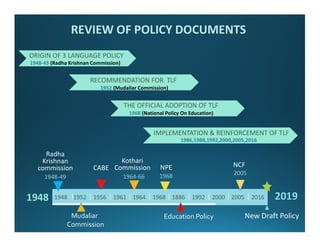
REVIEW OF POLICY DOCUMENTS
1948 1948 1952 1956 1961 1964 1968 1886 1992 2000 2005 2016
New Draft Policy
NCF
2005
NPE
1968
Kothari
Commission
1964-66
CABE
Radha
Krishnan
commission
1948-49
IMPLEMENTATION & REINFORCEMENT OF TLF
1986,1988,1992,2000,2005,2016
THE OFFICIAL ADOPTION OF TLF
1968 (National Policy On Education)
RECOMMENDATION FOR TLF
1952 (Mudaliar Commission)
ORIGIN OF 3 LANGUAGE POLICY
1948-49 (Radha Krishnan Commission)
2019
Mudaliar
Commission
Education Policy
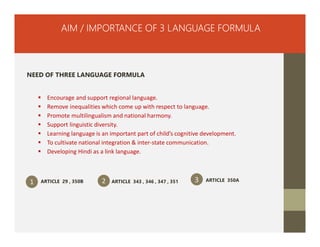
AIM / IMPORTANCE OF 3 LANGUAGE FORMULA
NEED OF THREE LANGUAGE FORMULA
 Encourage and support regional language.
 Remove inequalities which come up with respect to language.
 Promote multilingualism and national harmony.
 Support linguistic diversity.
 Learning language is an important part of child’s cognitive development.
 To cultivate national integration & inter-state communication.
 Developing Hindi as a link language.
ARTICLE 29 , 350B1 ARTICLE 343 , 346 , 347 , 3512
2
ARTICLE 350A3
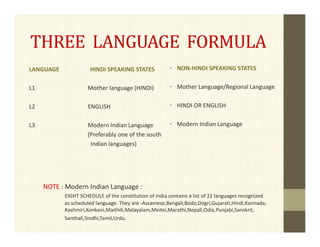
LANGUAGE HINDI SPEAKING STATES
L1 Mother language (HINDI)
L2 ENGLISH
L3 Modern Indian Language
(Preferably one of the south
Indian languages)
• NON-HINDI SPEAKING STATES
• Mother Language/Regional Language
• HINDI OR ENGLISH
• Modern Indian Language
NOTE : Modern Indian Language :
EIGHT SCHEDULE of the constitution of India contains a list of 22 languages recognized
as scheduled language. They are -Assamese,Bengali,Bodo,Dogri,Gujarati,Hindi,Kannada,
Kashmiri,Konkani,Maithili,Malayalam,Meitei,Marathi,Nepali,Odia,Punjabi,Sanskrit,
Santhali,Sindhi,Tamil,Urdu.
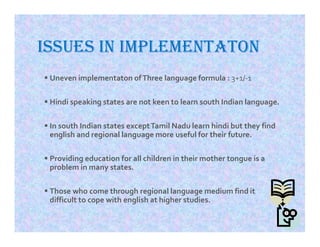
ISSUES IN IMPLEMENTATON
 Uneven implementaton ofThree language formula : 3+1/-1
 Hindi speaking states are not keen to learn south Indian language.
 In south Indian states exceptTamil Nadu learn hindi but they find
english and regional language more useful for their future.
 Providing education for all children in their mother tongue is a
problem in many states.
 Those who come through regional language medium find it
difficult to cope with english at higher studies.
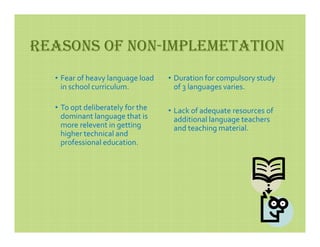
REASONS Of NON-IMPLEMETATION
• Fear of heavy language load
in school curriculum.
• To opt deliberately for the
dominant language that is
more relevent in getting
higher technical and
professional education.
• Duration for compulsory study
of 3 languages varies.
• Lack of adequate resources of
additional language teachers
and teaching material.
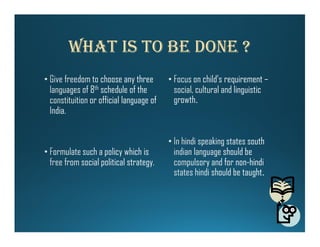
WhAT IS TO bE dONE ?
REFERENCES :
• Subhash “Three language formula in multiligual India : Problem and
Prospects”,Vol. 1 Issue 4 ,ISSN :2306-7063 , 2013.
• Leena Ratti “The three language formula : Challenges in its
implimentation in multilingual India”,Vol. 2.2,2015.
• K.Venkataramanam “What is the three-language formula?”,The
Hindu article ,8th june 2019.
• Government of India ministry of home affairs “Three language
formula”, 5th aug 2014.

THREE LANGUAGE FORMULA

  • 1.
    THREE LANGUAGE FORMULA OVERVIEW: --- REVIEW OF POLICY DOCUMENTS --- AIM OF 3 LANGUAGE FORMULA --- WHAT IS THE FORMULA ? --- ISSUES IN IMPLEMENTATION --- REASONS OF NON-IMPLEMENTATION --- POSSIBLE SOLUTION --- REFERENCES
  • 2.
    REVIEW OF POLICYDOCUMENTS 1948 1948 1952 1956 1961 1964 1968 1886 1992 2000 2005 2016 New Draft Policy NCF 2005 NPE 1968 Kothari Commission 1964-66 CABE Radha Krishnan commission 1948-49 IMPLEMENTATION & REINFORCEMENT OF TLF 1986,1988,1992,2000,2005,2016 THE OFFICIAL ADOPTION OF TLF 1968 (National Policy On Education) RECOMMENDATION FOR TLF 1952 (Mudaliar Commission) ORIGIN OF 3 LANGUAGE POLICY 1948-49 (Radha Krishnan Commission) 2019 Mudaliar Commission Education Policy
  • 3.
    AIM / IMPORTANCEOF 3 LANGUAGE FORMULA NEED OF THREE LANGUAGE FORMULA  Encourage and support regional language.  Remove inequalities which come up with respect to language.  Promote multilingualism and national harmony.  Support linguistic diversity.  Learning language is an important part of child’s cognitive development.  To cultivate national integration & inter-state communication.  Developing Hindi as a link language. ARTICLE 29 , 350B1 ARTICLE 343 , 346 , 347 , 3512 2 ARTICLE 350A3
  • 4.
    LANGUAGE HINDI SPEAKINGSTATES L1 Mother language (HINDI) L2 ENGLISH L3 Modern Indian Language (Preferably one of the south Indian languages) • NON-HINDI SPEAKING STATES • Mother Language/Regional Language • HINDI OR ENGLISH • Modern Indian Language NOTE : Modern Indian Language : EIGHT SCHEDULE of the constitution of India contains a list of 22 languages recognized as scheduled language. They are -Assamese,Bengali,Bodo,Dogri,Gujarati,Hindi,Kannada, Kashmiri,Konkani,Maithili,Malayalam,Meitei,Marathi,Nepali,Odia,Punjabi,Sanskrit, Santhali,Sindhi,Tamil,Urdu.
  • 5.
    ISSUES IN IMPLEMENTATON Uneven implementaton ofThree language formula : 3+1/-1  Hindi speaking states are not keen to learn south Indian language.  In south Indian states exceptTamil Nadu learn hindi but they find english and regional language more useful for their future.  Providing education for all children in their mother tongue is a problem in many states.  Those who come through regional language medium find it difficult to cope with english at higher studies.
  • 6.
    REASONS Of NON-IMPLEMETATION •Fear of heavy language load in school curriculum. • To opt deliberately for the dominant language that is more relevent in getting higher technical and professional education. • Duration for compulsory study of 3 languages varies. • Lack of adequate resources of additional language teachers and teaching material.
  • 7.
    WhAT IS TObE dONE ?
  • 8.
    REFERENCES : • Subhash“Three language formula in multiligual India : Problem and Prospects”,Vol. 1 Issue 4 ,ISSN :2306-7063 , 2013. • Leena Ratti “The three language formula : Challenges in its implimentation in multilingual India”,Vol. 2.2,2015. • K.Venkataramanam “What is the three-language formula?”,The Hindu article ,8th june 2019. • Government of India ministry of home affairs “Three language formula”, 5th aug 2014.