DAILY LESSON
LOG
School STA. MARIA INTEGRATED SCHOOL Grade Level 9
Teacher ROJEGARMIL C. LAGO Learning
Area
SCIENCE
Teaching Dates and Time Quarter FIRST
MONDAY TUESDAY WEDNESDAY THURSDAY FRIDAY
I. OBJECTIVES
A. Content Standard
 The learners demonstrate understanding of how the different structures of the respiratory and circulatory systems work together
to transport oxygen-rich blood and nutrients to the different parts of the body
 Prevention, detection, and treatment of diseases affecting the respiratory and circulatory systems
B. Performance Standard
 The learners should be able to conduct an information dissemination activity on effective ways of taking care of the
respiratory and circulatory systems based on the data gathered from the school or local health workers
C. Learning
Competency/Objectives
S9LT-Ia-b-26
 Identify the key parts
of the breathing
system
 Describe the function
of each parts of the
breathing systems
 Explain how
the lungs work
 Describe how the
movement of
diaphragm helps
the air to go in and
out of the lungs
 Describe blood
flows and gas
exchange with the
heart, circulatory
system and lungs
 Explain the
mechanism of
how the
respiratory and
circulatory
system work
together
 Identify the
component of the
circulatory system
 Explain the
different types of
circulation
 Identify the
composition of the
blood
 Name and compare
the different types of
blood vessels
II. CONTENT
Respiratory parts
and functions
Main Respiratory
organ - Lungs
Respiratory and
Circulatory
system
Circulatory
organs Type of
circulation
Blood and Blood vessels
III. LEARNING
RESOURCES
A. References
1. Teacher’s Guide
pages Pp. 2-3 Pp. 4-5 Pp. 6-7 Pp.8-10 Pp. 9-11
2. Learner’s Materials
pages Pp. 2-4 Pp. 5-7 Pp.8-9 Pp. 10-11 Pp. 12-13
3. Textbook pages
E- biology pp.241-242 E-biology pp. 245 248
4. Additional
Materials from
Learning
Resource
5. (LR)portal
B. Other Learning
Resource
https://
www.youtube.com/
watch?v=DCVIEMNPE1E
https://
www.youtube.com/
watch?v=_FLjj_Z7SkA
https://
www.youtube.com/
watch?v=_FLjj_Z7SkA
IV. PROCEDURES
A. Reviewing previous
lesson or
presenting the
new lesson
Recall the different
levels of organization in
the human body and
the mechanism involve
in it
Review the organs
of Respiratory
system
Recall how the lungs
work in the exchange
of gases in respiration
process
Review the blood flow
and gas exchange
within the respiratory
and circulatory system.
Recall the three
major organs of
circulatory system.
B. Establishing a purpose
for the lesson
Discuss the functions
of respiratory system
Explain how lungs work
and describe how the
movement of the
diaphragm help the air
go
in and out of the lungs
Discuss the blood flow
and gas exchange
within the circulatory
and respiratory system
Name and discuss the
components of
circulatory system
Describe and give the
functions of the
different components
of the blood.
C. Presenting
examples/Instances
of the new lesson
Present the chart or
model of the respiratory
organs and explain their
Show pictures of the
main respiratory organ-
Lungs
Using the learners
manual page 9 the
students will trace
Refer to figure 9 page 15
of learner’s module study
the different parts of
.
Show pictures of
blood composition.
Watch the video
functions the gas exchange
activity
circulatory system to
visualize each
component.
about blood types
D. Discussing new
concepts and
practicing new skills
# 1
Explain the procedure of
activity 1 and the
expected learning
outcome
The teacher will explain
and demonstrate how
to make the model of
human chest cavity
Discuss the procedure
and the materials
needed for the activity
Compare the three types
of blood circulation
Using microscope the
students will focus human
blood cells
E. Discussing new
concepts and
practicing new skills
#
2
The students will perform
the Activity 1 What a
bunch of grapes. (P.4
learners module)
The students
perform Activity 2
Bottled balloons
(pp.5-7 learners module)
The students will do
the activity 3 outside
the classroom. Page 8
learners module
Video showing the
animated flow of blood
to the different parts of
the body.
F. Developing mastery Let the students label the
parts and give the
functions of human
respiratory system.
The students will
demonstrate
breathing process
(Inhale and exhale)
and make comparison
of the movement of
diaphragm
muscles.
Discuss the answers
of the given
questions in activity 3
Fill in the missing parts,
description, and functions
to complete the entire
concept mapping of
circulatory system page
13 learners module
Let the students give the
functions of blood
components and compare
the blood vessels
G. Finding practical
application of
concepts and skills
in daily living
Call student to explain
what will happen if one
part of the
system fails to carry out
its function properly
Point out the
importance of living a
healthful life style.
Demonstrate ways of
taking care respiratory
system
Let the students discuss
the use and importance of
sphygmomanometer
and stethoscope.
Let the students infer
what would happen if
the blood stopped to
flow
H. Making
generalizations
and abstractions
about the lesson
Video showing about
human respiratory parts
and functions
(the students will watch
the video)
Let the students
discuss how the
movement of the
diaphragm cause the
air in and out of the
lung
Ask the students to
describe the blood
flow and gas
exchange with the
heart and lungs.
Ask the students to
enumerate the parts of
the blood and their
functions
Let the students answer
the question.
What are the blood
vessels and how are they
differ?
I. Evaluating learning The students will Evaluation of the Answer the given Evaluate the Let the students
answer Part B of
activity 1 p.5
constructed model of
the human chest
activity
questions on page
9.
students learning of
concepts of
circulatory system by
answering the
graphic
answer short quiz
organizer, page 13
of learner’s module.
J. Additional activities
for application or
remediation
Do the Enrichment
activity page 10 of
learners module
Invite the school nurse
to demonstrate how to
get blood pressure.
V. REMARKS
VI. REFLECTION
A. No. of learners who
earned 80% in
the evaluation
B. No. of learners who
require additional
activities for
remediation who
scored below 80%
C. Did the remedial
lessons work? No.
of learners who
have
caught up with
the lesson
D. No. of learners who
continue to require
remediation
E. Which of my teaching
strategies worked
well? Why did
these work?
F. What difficulties did I
encounter which my
principal or
supervisor
can help me solve?
G. What innovation or
localized materials
did I use/discover
which I wish to
share with
other teachers?
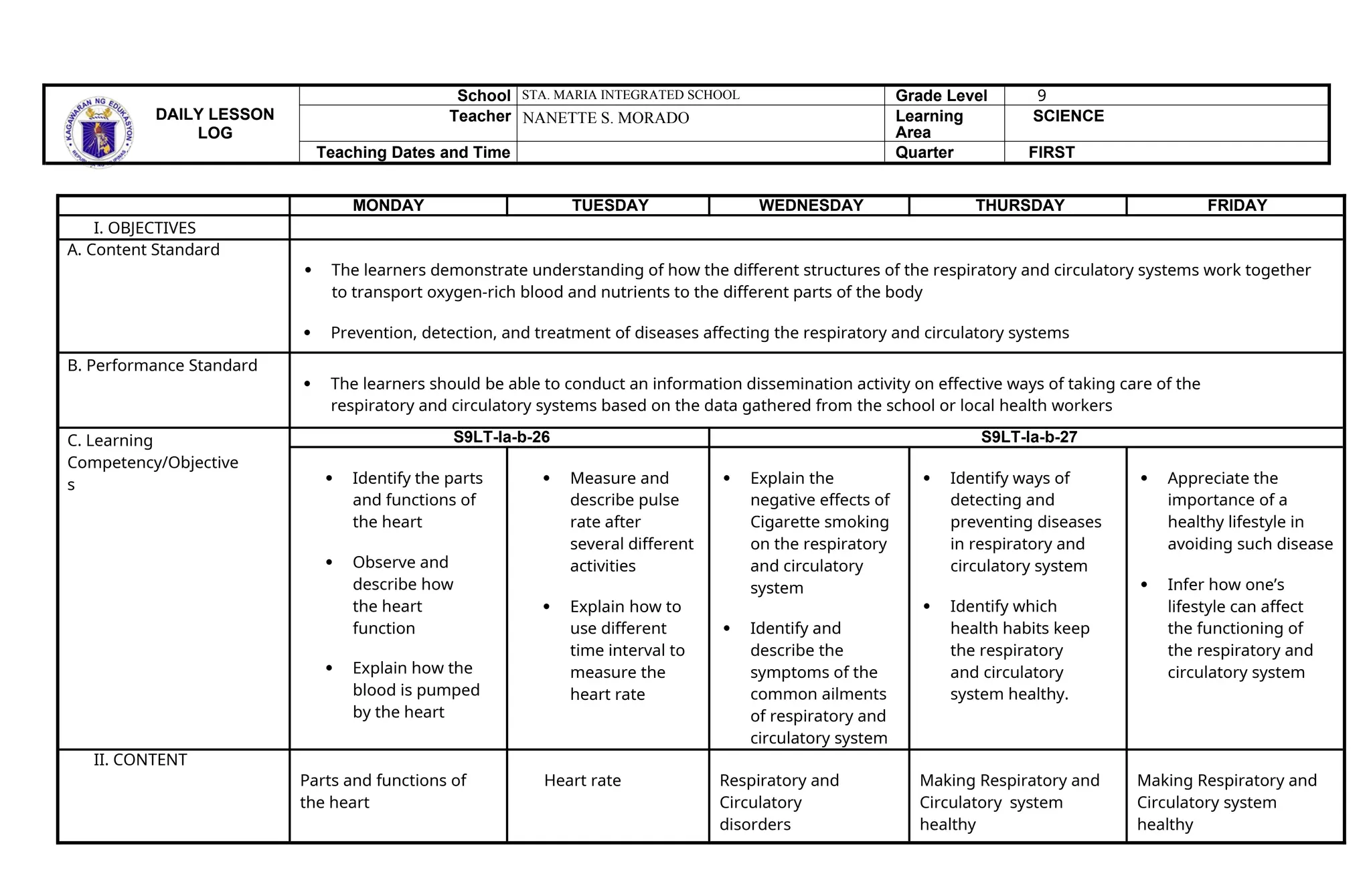
DAILY LESSON
LOG
School STA. MARIA INTEGRATED SCHOOL Grade Level 9
Teacher NANETTE S. MORADO Learning
Area
SCIENCE
Teaching Dates and Time Quarter FIRST
MONDAY TUESDAY WEDNESDAY THURSDAY FRIDAY
I. OBJECTIVES
A. Content Standard
 The learners demonstrate understanding of how the different structures of the respiratory and circulatory systems work together
to transport oxygen-rich blood and nutrients to the different parts of the body
 Prevention, detection, and treatment of diseases affecting the respiratory and circulatory systems
B. Performance Standard
 The learners should be able to conduct an information dissemination activity on effective ways of taking care of the
respiratory and circulatory systems based on the data gathered from the school or local health workers
C. Learning
Competency/Objective
s
S9LT-Ia-b-26 S9LT-Ia-b-27
 Identify the parts
and functions of
the heart
 Observe and
describe how
the heart
function
 Explain how the
blood is pumped
by the heart
 Measure and
describe pulse
rate after
several different
activities
 Explain how to
use different
time interval to
measure the
heart rate
 Explain the
negative effects of
Cigarette smoking
on the respiratory
and circulatory
system
 Identify and
describe the
symptoms of the
common ailments
of respiratory and
circulatory system
 Identify ways of
detecting and
preventing diseases
in respiratory and
circulatory system
 Identify which
health habits keep
the respiratory
and circulatory
system healthy.
 Appreciate the
importance of a
healthy lifestyle in
avoiding such disease
 Infer how one’s
lifestyle can affect
the functioning of
the respiratory and
circulatory system
II. CONTENT
Parts and functions of
the heart
Heart rate Respiratory and
Circulatory
disorders
Making Respiratory and
Circulatory system
healthy
Making Respiratory and
Circulatory system
healthy
III. LEARNING
RESOURCES
A. References
1. Teacher’s Guide pages
Pp. 9-10 Pp. 11- 12 Pp. 12 -13 Pp. 13 -14 Pp. 14-15
2. Learner’s
Materials pages Pp. 13-15 Pp. 17-18 Pp. 18-19 Pp.21- 22 Pp. 21-23
3. Textbook pages Phoenix Biology 167-
169
4. Additional Materials
from Learning
Resource (LR)portal
B. Other
Learning
Resource
https://
www.youtube.com/
watch?v=zrFQteTyTPc
https://
www.youtube.com
/watch?v=r-m27szUFjO
https://
www.youtube.com/
watch?v=fF7SNcw7kyQ
https://
www.youtube.com/
watch?v=0aNNYEUARAk
IV. PROCEDURES
A. Reviewing previous
lesson or presenting
the new lesson
Recall the organs
of circulatory
system
Let the students recall
the parts of Human
Heart
Recall blood circulation Review the common
Respiratory and
circulatory ailments
Ask the students to give
what are the different
ways on how to make
respiratory and
circulatory system
healthy
B. Establishing a
purpose for the lesson
Do you know how big
your heart is? Its just big
as your fist
Discuss Heartbeat
and demonstrate
how to measure
pulse beat.
Ask the students to
explain this quotation
“Smokers never grow
old but they just die
young “
Discuss way of
detecting and
preventing diseases.
and the healthy habits
to keep the respiratory
and circulatory system
healthy
Discuss the importance
of healthy lifestyle
C. Presenting
examples/Instances of
Bring out your books and
identify the detailed parts
the students to tell
where the sound of
Show the picture of
smokers body and
Cite some government
agencies that can help
show pictures of different
lifestyle and ask the
the new lesson of the human heart their heart is coming
from.
call students to
describe
and give information in
preventing diseases
students to give the
positive and negative
effect to one’s
life
D. Discussing new
concepts and
practicing new skills #
Let the students dissect
the chicken heart and
identify the parts of the
heart
In doing the activity,
remind the students to
choose only the
physical activities that
they can tolerate so as
to avoid injury or
strain.
Do Activity 7 Cigarette
Smoking Is Dangerous
to your Health
Watch video on effect
of smoking on the
human
respiratory and
circulatory
system
Watch the video
Harmful effects of
tobacco on the human
heart
The students will cut out
different examples of
unhealthy lifestyles from
old magazines or news
papers and create a
collage in your notebook.
E. Discussing
new concepts
practicing new
skill # 2
Do Activity
5 Pump it
The Students will do go
out from the classroom
to perform the Activity
6 The Rhythm of My
Heart
.page 11
Ask the students to
write some of the
common ailments of
Respiratory and
circulatory system
Perform the activity 8
Prevention is Better
that cure
F. Developing mastery Discuss how the
blood pump by the
heart
Discuss the answers
from the given
questions of Activity 6
page 12
After discussing the
ideas within the group,
stick and organize all
the responses which
falls under the
respiratory and
circulatory system
Let the students relate
their personal
experiences to the topic
to have more meaningful
discussion on prevention
Discuss the answers of
questions given on page
23 Learners module
G. Finding practical
application of
concepts and skills in
daily living
We believe that heart is
the center of emotions.
How can you control your
emotions ? so that you
will
influence others in
positive way.
Let the students
explain how nicotine in
cigarette tobacco
affects breathing rate
when it enters the
bloodstream.
Let the students
suggest the different
ways how to take care
of the circulatory
system
Appreciate the
importance of healthy
lifestyle avoiding such
diseases.
Negative lifestyle
weakens your system
while healthy lifestyle
leads to complete
wellness.
H. Making
generalizations and
abstractions about
Label the parts of the
heart
After exercise, the heart
rate increases and
eventually returns to
The students will
describe and give the
symptoms of the
Discuss the best way to
prevent diseases in the
respiratory and
Vices, stressful
environment, and
unhealthy eating habits
the lesson resting pulse. Therefore
shorter interval is
needed.
common ailments of
the circulatory system
circulatory systems to
have healthy lifestyle,
like balance diet,
regular exercise avoid
cigarette smoking.
can cause various
diseases specifically of
the respiratory and
circulatory systems.
I. Evaluating learning Short quiz ( formative test) Compare the
students resting
pulse with their
pulse after the given
activities.
Give 5 item
multiple choice
test
Answer the missing word
on page 22 of learner’s
module.
Summative Assessment 5
items multiple choice test
J. Additional activities
for application or
remediation
Visit other school clinic
or your family doctor
and interview them
about the common
ailments that affect the
respiratory and
circulatory system
V. REMARKS
VI. REFLECTION
A. No. of learners
who earned 80% in
the
evaluation
B. No. of learners who
require additional
activities for
remediation who
scored below 80%
C. Did the remedial
lessons work? No. of
learners who have
caught
up with the lesson
D. No. of learners who
continue to
require
remediation
E. Which of my teaching
strategies worked
well? Why did these
work?
F. What difficulties did I
encounter which my
principal or supervisor
can
help me solve?
G. What innovation or
localized materials did I
use/discover which I
wish to share with
other
teachers?
DAILY LESSON
LOG
School STA. MARIA INTEGRATED SCHOOL Grade Level 9
Teacher ROJEGARMIL C. LAGO Learning Area SCIENCE
Teaching Dates and Time August 12-16, 2024/ Quarter FIRST QUARTER
MONDAY TUESDAY WEDNESDAY THURSDAY FRIDAY
I. OBJECTIVES
A. Content Standard 1. How genetic information is organized in genes on chromosome;
2. Traits of organism are inherited through different patterns of inheritance.
B. Performance Standard
C. Learning
Competency/Objectives
S9LT-Id-28(describe the location of genes in chromosomes)
S9LT-Id-29 (explain the different patterns of Non Mendelian
Inheritance)
 Create a K-W-L
Chart to asses
prior knowledge
 Measure the
students’ prior
knowledge
regarding
inheritance and
variation
through pre –
assessment test
 Explain the
incomplete
dominance
pattern of
inheritance
 Illustrate by
means of Punnett
square a possible
combination of
offspring
involving
incomplete
 Analyze problem
regarding
codominanc
e
 Create a Punnett
square to show
the inheritance of
codominance
 Give the
phenotypic and
genotypic
percentage of
the offspring
 Describe Multiple
Alleles pattern
of inheritance
using ABO
blood type
 Infer the
unknown
phenotypes of
individuals on the
basis of the
known
phenotypes of
their family
members
 Identify traits
that falls on the
Non Mendelian
Pattern
of inheritance
 Describe how
sex
in
human
s is
determ
ined
 Draw a
Punnett
square to
explain how
sex genes
are inherited
II. CONTENT Unit 1: MODULE 2
Heredity: Inheritance
and Variation
Incomplete
Dominance
Codominance Multiple
Alleles
Sex Chromosome
and Sex
Determination
III. LEARNING
RESOURCES
A. References
1. Teacher’s Guide pages p. 1-2 p. 2-3 p. 3-4 p. 5-6 p. 7-8
2. Learner’s
Materials pages
p. 28-30 p. 30-32 p. 32-34 p. 34-36 p. 36-38
3. Textbook pages
4. Additional
materialsfrom
Learning Resource
(LR)portal
B. Other
Learning
Resource
https://www.youtube.com/watch?
v=9 O5JQqlngFY (Video)
https://www.youtube.com/
watch?v=k
MWxuF9YW38
IV. PROCEDURES
A. Reviewing previous
lesson or presenting
the new lesson
Mendelian Patterns
of Inheritance
Let them remember
again the ff. terms;
a. Recessive
b. Dominant
c. Phenotype
d. Genotype
e. Alleles
f. Punnett squares
“Incomplete dominance” “Codominance” Non Mendelian
Pattern of
Inheritance
B. Establishing a
purpose for the lesson
What are the exceptions
of Mendelian Pattern of
genetics?
Picture analysis
(Let the student react on
what they see on the
pictures) The Group that
will list as many reaction
as possible in 1 min. gets
a
reward card.
Picture analysis
(Let the student react on
what they see on the
pictures) The Group that
will list as many reaction
as possible in 1 min. gets
a
reward card.
What is your blood type?
Do you know your
parents blood type? Are
your blood types similar?
If not, does it mean that
your adopted?
Sex determination
diagram (Let the
student analyze the
picture and relate it
to meiosis and
inheritance) How
does sex genes
determined and
inherited?
C. Presenting
examples/Instances of
the new lesson
Since there is an
exception in Mendelian
pattern of inheritance,
how does other inherited
traits that falls beyond
the exception
of Mendel’s rule follows?
How does pink flower
arise when a red and
white flower was cross
pollinated?
Let us investigate!
Read the procedure and
explain the sample
problem found on LM p.
33
Watch Video for
better
understanding
https://www.youtube.com/watch?
v=9 O5JQqlngFY
https://www.youtube.com/
watch?v=k
MWxuF9YW38
(0:00 – 1:21
mins
only)
D. Discussing new
concepts and
practicing new skills #
Before we answer that
question let us answer
the Pre – Assessment on
Do the activity No. 1
“Phenotypes and
Genotypes in
Do the activity No.
2 “Mystery Bull”
Do the activity No. 3
“What’s your blood
type?” Discussion
Do the activity No. 4
“Boy or Girl?”
1 LM
p. 29
Incomplete
dominance”
follows right
after the given activity
E. Discussing new
concepts and
practicing new skills
# 2
(By group) Create a K-W-
L questions
Problem solving of
Incomplete
Dominance using
Punnett square
Problem solving of
Codominance
using Punnett
square
Identify the following
traits and classified it
into which
Non Mendelian Pattern
of Inheritance it
belongs
Presenting Punnett
square and
answering guide
questions
F. Developing mastery How is Mendelian
inheritance different
from Mendel’s
observation?
What is
Incomplete
dominance?
What is codominance? What is multiple alleles?
Summed up: What are
The Non Mendelian
Pattern of
Inheritance?
How does sex genes
determined and
inherited?
G. Finding practical
application of
concepts and skills
in daily living
Give examples of the
trait that does not
follow Mendelian
Principle
Is there any inherited
traits in human that
follows the incomplete
dominance pattern of
inheritance
Is there any inherited
traits in human that
follows the
Codominance pattern of
inheritance?
If you and your parents
happens to have
different blood types? Is
that mean that you are
not related to each
other? Why? Or why
not?
Is it right for the
husband to blame
his wife if she could
not bear a male
child? Which
chromosomes
determine a
person’s sex?
H. Making
generalizations and
abstractions about
the lesson
What happen with
those inherited traits
that does not conform
to predicted outcomes
based on Mendel’s
Law of inheritance?
How many phenotypes
are expressed in an
incomplete dominance
traits?
What is codominance?
How do they differ
from incomplete
dominance?
Why does human
blood types happens
to be the best example
to show multiple
alleles? Is there other
human traits that
follow multiple allele’s
pattern?
Who determine the
sex of their children?
Explain your answer.
I. Evaluating learning Not yet to be
determined (prior
knowledge based on the
result of pre –
assessment test)
Evaluation is based on
the result of the activity
Evaluation is based on
the result of the activity
See attachment on
DLL 1-5
Paper and pen test
Evaluation is based
on the result of the
Punnett square
J. Additional activities for
application or
remediation
Research for The NON
– Mendelian Patterns
of Genetics
Note: MDL
Activities on the LP will be
given to students to answer
at home.
Answer the problem
set (see the DLL
attachment
for the remediation
and enrichment)
Note: F2F
Answer the problem
set (see the DLL
attachment
for the remediation
and enrichment)
Note: MDL
Activities on the LP will
be given to students to
answer at home.
Note: F2F
Research on
the ff; Sex
linked genes
Sex limited
genes Sex
influenced
genes
Note: F2F
V. REMARKS
VI. REFLECTION
A. No. of learners who
earned 80% in
the evaluation
B. No. of learners who
require additional
activities for
remediation who
scored below 80%
C. Did the remedial
lessons work? No. of
learners who have
caught
up with the lesson
Prepared by:
D. No. of learners
who continue to
require
remediation
E. Which of my teaching
strategies worked
well? Why did these
work?
F. What difficulties did I
encounter which my
principal or supervisor
can
help me solve?
G. What innovation or
localized materials did I
use/discover which I
wish to share with
other
teachers?
DAILY LESSON
LOG
School BARCELONA NATIONAL HIGH SCHOOL Grade Level 9
Teacher JONAS CHRISTIAN S. ESTOR Learning Area SCIENCE
Teaching Dates and Time Quarter FIRST QUARTER
MONDAY TUESDAY WEDNESDAY THURSDAY FRIDAY
I. OBJECTIVES
A. Content Standard 1. How genetic information is organized in genes on chromosome;
2. Traits of organism are inherited through different patterns of inheritance.
B. Performance Standard
C. Learning
Competency/Objectives
S9LT-Id-28(describe the location of genes in chromosomes)
S9LT-Id-29 (explain the different patterns of Non Mendelian
Inheritance)
 Explain the
sex linked –
genes
inheritance of
traits
 Solve problems
related to
sex- linked
traits
II. CONTENT Sex-Linked Genes
III. LEARNING
RESOURCES
A. References
1. Teacher’s Guide pages p.8-9
2. Learner’s
Materials pages
p. 38-39
3. Textbook pages
4. Additional
materialsfrom Learning
Resource
(LR)portal
B. Other
Learning
Resource
IV. PROCEDURES
A. Reviewing previous
lesson or presenting
the new lesson
“Sex determination”
B. Establishing a purpose
for the lesson
What makes men
differs from women?
Let the student write
as many as
they can? Which
among these traits is
inherited?
C. Presenting
examples/Instances
of the new lesson
Among those traits
listed on the board,
encircle those that can
be found only in
male/female? (INTRO)
These traits are being
controlled by sex
chromosome, let us
investigate further.
-
D. Discussing new
concepts and practicing
new skills # 1
Do Activity 5 “
When Gender
Matters”
E. Discussing new concepts
and practicing new
skills # 2
F. Developing mastery What is sex linked
genes? How are these
genes inherited?
G. Finding practical
application of
concepts and skills in
daily living
Who are most likely to
be affected by sex
linked genes and why?
H. Making
generalizations and
abstractions about
the lesson
Sex linked are inherited
through the x
chromosome. What
could be the effect of
this disorder in male?
What
about in female?
I. Evaluating learning See rubrics for the result
of group discussion/
collaboration
J. Additional activities for
application
or
remediation
V. REMARKS .
VI. REFLECTION
A. No. of learners who
earned 80% in
the evaluation
B. No. of learners who
require additional
activities for remediation
who scored
below 80%
C. Did the remedial
lessons work? No. of
learners who have
caught up with the
lesson
D. No. of learners
who continue to
require
remediation
E. Which of my
teaching strategies
worked well?
Why did these work?
F. What difficulties did I
encounter which my
principal or supervisor
can help me solve?
G. What innovation or
localized materials did I
use/discover which I
wish to share with
other
teachers?
DAILY
LESSON LOG
School BARCELONA NATIONAL HIGH SCHOOL Grade Level 9
Teacher JONAS CHRISTIAN S. ESTOR Learning Area Science
Teaching Dates
and Time
Quarter First
MONDAY TUESDAY WEDNESDAY THURSDAY FRIDAY
I. OBJECTIVES
A. Content Standards
The learners demonstrate understanding how changes in the environment may affect species extinction.
B. Performance Standards Make a multimedia presentation of a timeline of extinction of representative microorganisms, plants and animals.
C. Learning Competencies/ Objectives
Write the LC code for each
S9LT - Ie - F – 30
Explain the importance
of biological diversity.
Measure
species distribution
using the
mathematical way of
expressing the
amount of biodiversity
and species
distribution in the
community.
Determine the area
distribution of a given
population using
mathematical formula
Infer the possible
effects of low and
high density
population.
Demonstrate using
simulation activity
that habitat
destruction can
contribute to species
extinction.
Relate species
extinction to the
failure of
populations of
organisms to adapt
to abrupt changes in
the environment.
Distinguish
environmental
changes that may
result in the loss of
the species.
Realize that the way
they interact with the
environment may
ensure or deters
survival of all living
things.
Cite other human
activities that leads
to extinction.
Assess students
acquired skills
through Summative
Assessment.
II. CONTENT
Biodiversity
and
Evolution
Biodiversity
and Evolution
Biodiversity and
Evolution Causes of
Species Extinction
Biodiversity
and Evolution
Causes of Species
Extinction
Biodiversity
and Evolution
Causes of Species
Extinction
III. LEARNING RESOURCES
A. References
1. Teacher’s Guide pages
37- 39
39 – 41
41-43 43 -50 43 – 50
2. Learner’s Materials pages 50-55 56 – 57
58-59 60 -69 60 – 69
3. Textbook pages Science and Technology
I General Science
289 -293
Science and
Technology I
General
Science 289 -
293
4. Additional Materials from Learning
Resources (LR) portal
B. Other Learning Resources http://
content.teachen
gineering.org/conten
t/
cub_/activities/cub_bi
o
/cub_bio_lesson01_ac
tivity1_pop_density_w
orksheet.pdf
IV. PROCEDURES
A. Reviewing previous lessons
or presenting the new lesson Picture Analysis
Tell something about
the picture.
How do organisms
interact with each
other?
Which community
is most stable?
Why are
populations that
are more diverse
usually more
stable?
Play a short
video clip.
“Endangered
Animals”
What does
the
video tells us?
Is the world a safe place for
all animals and plants to live?
Why or why not?
What does it mean for a
species to be endangered?
What other human
activities contribute
to the extinction of
species?
B. Establishing a purpose for
the lesson
Analogy:
Present two boxes of
candies, one with 5
candies of the same
kind and the other one
with 5 different
Unlocking of
word difficulty:
Limiting Factors
Carrying
Capacity
Post a Quotation.
Students
reflect and give
their insights.
Picture Analysis:
How would you describe
the picture?
Answer Summative
Assessment in L.M.
p 71
candies. Ask the
students which
box will they choose
and why?
What does the picture implies?
C. Presenting examples/ instances
of the new lesson
Unlock term Species,
Population and
Biodiversity. This will
lead students to the
idea of species
distribution and
diversity in a
community.
Video Analysis
“ Population Growth “
What is the
message implied in
the video?
Students
perform “Species
Charade Game”
A list of
endangered
species,
threatened
species, and
extinct species
are the choices to
be
picked for
the game.
Video
Analysis: “
Man “
What is the impact of
modernization to the lives
of people and the
environment?
D. Discussing new concepts
and practicing new skills #1
Perform Activity 1:
Index of Diversity in
L.M. p.54.
Perform Activity
“ Population Density “
(See attached
activity sheet.)
Perform Activity 3:
Endangered but
not Extinct….. Yet
L.M. pp. 58-59
Perform Activity 4:
L.M. p. 60
Predict what happens to
both islands.
E. Discussing new concepts
and practicing new skills #2
F. Developing mastery
(Leads to Formative Assessment )
Discuss the answer
to Guide Questions:
1. How do you
compare your tree I.D.
in a vacant lot from a
grass lawn? Explain
your answer.
2. If humans were
concerned about
biological diversity,
Discuss the answer
to the activity.
Based on the
result, what
inference can you
give?
How can a
Discuss the
answer to Guide
Questions 9 –
13.
What happens if
the living
conditions of the
organisms are
not ideal for
Due to explosive human
population growth the
demand to use and overuse
our natural resources is
inevitable.
What is its implication in
our biodiversity?
What activities do people
Discuss the answer to the
questions.
Identify the least
learned items and
discuss the concept
for further
understanding.
would it be best to
have a low or high I.D.
for a particular
environment?
Why?
population’s density
be used to learn
about the needs and
their survival?
When can we
say that species
engaged that leads to
extinction?
characteristics of
that population?
How are
limiting factors
becomes
endangered
? Becomes
threatened?
How do changes
in the
environment
affect species
extinction?
How do you think or feel
about these potentially
disastrous activities?
As an individual, how can
you help the cause of
preserving wildlife?
G. Finding practical applications
of concepts and skills in daily
living
What do you think will
happen if a population
of only one specie
continue to increase in
number?
Compare and
contrast life in a
rural and urban
area.
Flash pictures of
silver therapon
or ayungin and
biya. Ask if they
know and eat
those kind of fish.
(Let them note
that these are
commonly found
in Laguna de
Bay.)
Other
endangered
species like the
tamaraw in
Mindoro, mouse
deer in Palawan,
Philippine deer,
monkey-eating
eagle, and
dugong are in
danger of
becoming
Will you patronize snakeskin
belts, alligator boots,
accessories made of ivory and
other things that made from
endangered species? Why or
why not?
Make a multimedia
presentation of a
timeline of extinction
of representative
microorganisms,
plants, and animals.
(See Timeline
Rubrics on T.M. p.
51)
extinct.
H. Making generalizations and
abstractions about the lesson
1. How is
biological
diversity
important?
2. How will the
community of
different species be
able to withstand
environmental
changes?
How do you
determine the area
distribution of a
given population?
How does
population density
changes?
What are the
factors that can be
attributed to the
change?
Why do
species
becomes
endangered?
When can we
say that a
species’
population
becomes
endangered?
Threatened?
And Extinct?
How are the
species affected
of the changes in
their
environment?
Cite different environmental
changes that leads to
extinction.
Why should we
protect endangered
species?
I. Evaluating learning
Using the Exit Ticket
Infer what will
happen If
population density
increases?
Decreases?
As population of
people increases
it has great
impact on the
growth and
development of
the community.
How will it lead to
species
extinction?
Give a 5 item formative test.
Using the Exit Ticket
What is
the most
importan
t thing
we
discusse
d
today?
What
was the
most
confusin
g idea
presente
d today?
What is
the most
importa
nt thing
we
discuss
e d
today?
What
was the
most
confusin
g idea
presente
d today?
What
are the
three
big
ideas/co
n cepts
What
made
the
learning
easy for
you
What
are the
three
big
ideas/co
ncepts
What
made
the
learning
easy for
you
to be
learned
from
this
lesson?
today?
What
made
the
learning
difficult
for you
today?
to be
learned
from
this
lesson?
today?
What
made
the
learning
difficult
for you
today?
J. Additional activities for
application or remediation Do research on
why would an
engineer have to
know the
population density
in building edifices
or any
infrastructure?
Make a Poster on
Conservation of Wildlife.
V. REMARKS Due to numerous human
activities affecting the
environment and leading
to
extinction, a second day
discussion will be carried
out.
VI. REFLECTION
A. No. of learners who earned 80% in
the Evaluation
B. No. of learners who require
additional
activities for remediation who
scored below 80%
C. Did the remedial lesson works? No.
of learners who have caught up with
the lesson
D. No. of learners who continue
to require remediation
E. Which of my teaching
strategies worked well? Why did
these works?
F. What difficulties did I encounter
which my principal or supervisor can
help me solve?
G. What innovations or localized
materials did I use/discover which I
wish
to share with other teachers?
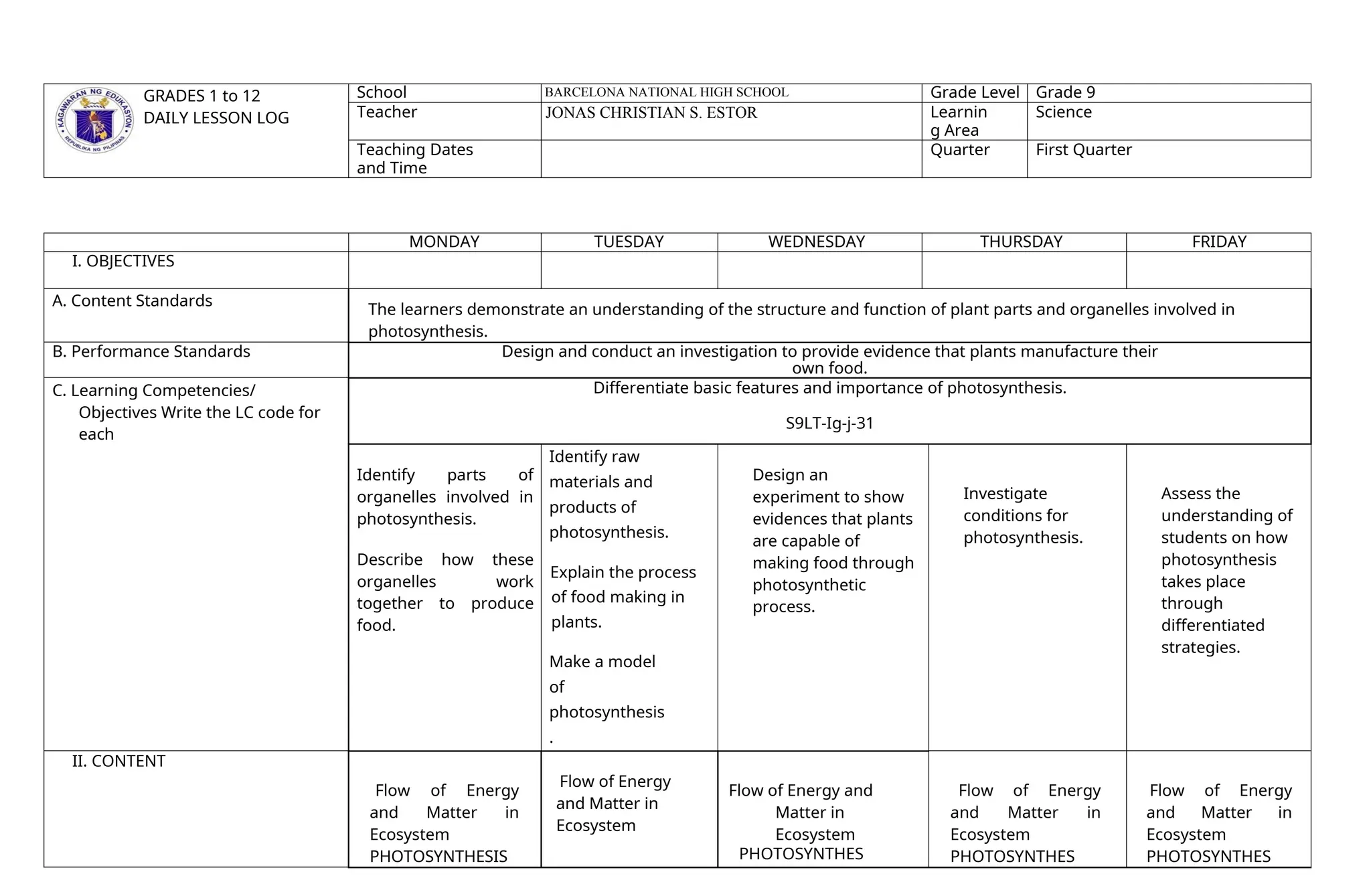
GRADES 1 to 12
DAILY LESSON LOG
School BARCELONA NATIONAL HIGH SCHOOL Grade Level Grade 9
Teacher JONAS CHRISTIAN S. ESTOR Learnin
g Area
Science
Teaching Dates
and Time
Quarter First Quarter
MONDAY TUESDAY WEDNESDAY THURSDAY FRIDAY
I. OBJECTIVES
A. Content Standards
The learners demonstrate an understanding of the structure and function of plant parts and organelles involved in
photosynthesis.
B. Performance Standards Design and conduct an investigation to provide evidence that plants manufacture their
own food.
C. Learning Competencies/
Objectives Write the LC code for
each
Differentiate basic features and importance of photosynthesis.
S9LT-Ig-j-31
Identify parts of
organelles involved in
photosynthesis.
Describe how these
organelles work
together to produce
food.
Identify raw
materials and
products of
photosynthesis.
Explain the process
of food making in
plants.
Make a model
of
photosynthesis
.
Design an
experiment to show
evidences that plants
are capable of
making food through
photosynthetic
process.
Investigate
conditions for
photosynthesis.
Assess the
understanding of
students on how
photosynthesis
takes place
through
differentiated
strategies.
II. CONTENT
Flow of Energy
and Matter in
Ecosystem
PHOTOSYNTHESIS
Flow of Energy
and Matter in
Ecosystem
Flow of Energy and
Matter in
Ecosystem
PHOTOSYNTHES
Flow of Energy
and Matter in
Ecosystem
PHOTOSYNTHES
Flow of Energy
and Matter in
Ecosystem
PHOTOSYNTHES
PHOTOSYNTHESIS
III. LEARNING RESOURCES
A. References
1. Teacher’s Guide pages 55-62 55-62 63-68 63-68 55-68
2. Learner’s Materials pages 72-77 77-78
79-85 77-78 72-85
3. Textbook pages Perfect Guide
Lower Secondary
Science Book B
Christopher N. Prescott
pp. 178
Perfect Guide
Lower Secondary
Science Book B
Christopher N. Prescott
pp. 176-177
4. Additional Materials from Learning
Resources (LR) portal
B. Other Learning
Resources
http://
dendro.cnre.vt.edu
/forestbiology/
photosynt hesis.swf
http://
dendro.cnre.vt.e
du/forestbiology/ph
oto synthesis.swf
NSF FOCUS Math
and Science
Partnership of
University of
California
IRVINE
http://www.skoool.ie/
skoo
ol/homeworkzone.asp?
id= 233
NSF FOCUS Math and
Science Partnership
of University of
California IRVINE
IV. PROCEDURES
A. Reviewing previous lessons
or presenting the new lesson
Perform the Pre-test in
L.M. p. 73-74 to
assess prior
knowledge.
What are the parts
of plants and
organelles essential
to food making
process?
What processes are
involved in food
making?
Write the word equation
of photosynthesis.
Cite evidence that
shows photosynthetic
process.
1. What are the raw
materials and
product of
photosynthesis?
2. What organelles
play an important
role in
photosynthesis?
3. How do you
describe
photosynthesis using
the word equation?
B. Establishing a purpose for
the lesson
Why do you think
Well, the sun comes Think-Pair-Share:
Unlocking of
Word Difficulty:
English Learners:
Students will use
plants are called great
food providers?
streaming out of
the sky making
everything grow
and keeping us
alive and our main
connection to the
sun are the
green leaves, only
Do plants really
capable of making
foods?
Enzymes,
Chloroplast,
Humidity,
Temperature
This will lead to factors
affecting
photosynthesis.
word triangles to
review the molecules
involved in the
process of
photosynthesis. (To
complete a word
triangle, students
draw
they can make food
with sunshine
energy. ( An excerpt
from Energy and Me
CD by Billy B, lyrics
for The Rock and Roll
of Photosynthesis)
What is implied in
the song?
one triangle for each
word and divide the
triangle into three
bands horizontally.
The new vocabulary is
placed in the middle
band, the definition of
the word is written on
the bottom band and
a diagram of the word
is written in the top
band).
Art Education:
Students will draw
a leaf diagram and
use this to illustrate
what goes in
(reactants), and
what comes out
(products) of
photosynthesis.
GATE:
Students will
sequence the
C. Presenting examples/ instances
of the new lesson
Show pictures of
different food
products locally
made from Khong
Guan since students
are very familiar with
it.
How do you think
these products are
made available for
us?
(Elicit answer that
will lead to the
concept of how are
these foods
manufactured.)
Picture Analysis.
Teacher asks
students what
materials are
involved in the
process of
photosynthesis.
Students think
about the question
for one minute, then
turn to a shoulder
partner and discuss
their thoughts to
the question.
Worked Example
with Answer
Analysis:
Devi covered a part of a
leaf with a black piece
of paper and left the
leaf in bright sunlight
for several days.
She then carried out
the iodine test for
starch.
What do you think
happens to the
leaf?
(The part of the leaf
covered by the black
paper cannot
photosynthesize and
would be unable to
manufacture sugar and
starch. Therefore, when
tested with iodine
solution, the area
There’s an old saying
that goes,” Para
maganda ang tubo ng
mga halaman kausapin
mo ito palagi.”
Is there any truth to
this saying?
What scientific
explanation lies
behind the saying?
would remain pale. The
rest of the leaf would
be positive to the iodine
test and produce a dark
blue
stain.)
process of
photosynthesis and
identify specific
reactions involved,
using a “flow map” (or
D. Discussing new concepts
and practicing new skills #1
Perform Activity 1:
What are the
Structures Involved In
the Food Making
Process in Plants? pp.
75-77
Perform
Activity:
Modelling
Photosynthesis
( See attached
Activity Sheet)
Perform Activity
3A.B,C,D: Evidence of
Photosynthesis in
L.M. pp. 79-82
Perform Activity 3C
and 3D of L.M. pp. 81-
83
other suitable maps
for sequencing
events).
E. Discussing new concepts
and practicing new skills #2
F. Developing mastery
(Leads to Formative Assessment )
Discuss the findings
in each Learning
Station.
1.What are the parts
of chloroplast and
internal structure of
leaf that are involved
in the process of
photosynthesis?
2. What are the raw
materials and
products of
photosynthesis?
3. How would you
describe the entire
process of food
making?
Discuss the answer
to guide questions
in the activity.
1.What reactants or
materials are
required for the
process of
photosynthesis?
2. What products
are formed in the
process?
3. What happens to
the light energy in
the thylakoid
membrane of the
chloroplasts?
4..How does the
energy from
sunlight
used to build sugars?
Process the Activity:
Observations and
data gathered would
lead to the discussion
of the different
evidences in
photosynthetic
process.
Discuss the answer to
the Guide Questions.
Key Concepts would be
Enzymes, Temperature,
Carbon Dioxide, and
Light
Computer
Aided Activity:
Students make
a multimedia
presentation
of
photosyntheti
c process.
G. Finding practical applications If one of the organelles
of concepts and skills in daily
living
or parts of a leaf will
not function, is there a
chance for
photosynthesis to take
place? Why or Why
not?
Students should
create an analogy
for the process of
photosynthesis and
compare each part
of
the process with
some
Imagine that you are a
farmer, what ways
would you suggest to
yield better crops?
Supposed there are 2
jars with burning candle
and one has potted
plant inside. Both jars
are placed near a
window in
strong sunlight.
other process in
everyday life. (Ex.
The process of
photosynthesis is
like baking bread).
Question:
Why does the burning
candle in jar without
potted plant stop
burning before the
candle with potted
plant?
H. Making generalizations and
abstractions about the lesson
1. What are the
organelles essential
to the process of
photosynthesis?
2. How are these
organelles work
together in the entire
process of food
making?
1. The overall
process of
photosynthesis uses
water and carbon
dioxide to produce
sugars that store
chemical energy.
2. Sunlight is
absorbed using
plant pigments
called chlorophyll,
and the process of
photosynthesis
takes place within
organelles called
chloroplasts.
3. Energy from
sunlight is
captured during
the light-
dependent
reactions and is
used to build
sugars during the
light–independent
reactions.
What evidences are
shown that
photosynthetic process
takes place?
What are the factors
or conditions that
affect
photosynthesis?
I. Evaluating learning
Imagine that you
are applying for a
job in
photosynthesis
company. Create a
“resume”,
explaining
your job qualifications
Explain the equation:
Carbon Dioxide
(CO2 ) +
Using the Exit Ticket
What is
the
most
What
was the
most
confusin
g
What was
the most
and describing how
you will efficiently get
the job done.
Descriptions must
include key vocabulary
such as stomata,
water, carbon dioxide,
light, energy,
chlorophyll and
chloroplast.
Water
Chlorophyll (H2O)
Sunlight
Glucose + Oxygen
C6H12O6 O2
importa
nt thing
we
discusse
d today?
idea
presente
d today?
What is
the most
importa
nt thing
we
discuss
e d
today?
confusin
g idea
presente
d today?
What
are the
three
big
ideas/co
ncepts
to be
learned
from
this
lesson?
What
made the
learning
easy for
you today?
What
made the
learning
difficult
for you
today?
What
are the
three
big
ideas/co
ncepts
to be
learned
from
this
lesson?
What
made the
learning
easy for
you today?
What
made the
learning
difficult
for you
today?
J. Additional activities for
application or remediation Perform activity 3E:
The Effect of the
Amount of Chlorophyll
in Photosynthesis L.M.
pp. 84-85.
V. REMARKS
VI. REFLECTION
A. No. of learners who earned 80%
in the Evaluation
B. No. of learners who require
additional activities for remediation
who scored
below 80%
C. Did the remedial lesson works? No.
of learners who have caught up with
the lesson
D. No. of learners who continue
to require remediation
E. Which of my teaching
strategies worked well? Why did
these works?
F. What difficulties did I encounter
which
my principal or supervisor can help
me solve?
G. What innovations or localized
materials did I use/discover which I
wish to share with other teachers?
FIRST-quarter-PART-1-daily lesson log science 9cx

FIRST-quarter-PART-1-daily lesson log science 9cx

  • 1.
    DAILY LESSON LOG School STA.MARIA INTEGRATED SCHOOL Grade Level 9 Teacher ROJEGARMIL C. LAGO Learning Area SCIENCE Teaching Dates and Time Quarter FIRST MONDAY TUESDAY WEDNESDAY THURSDAY FRIDAY I. OBJECTIVES A. Content Standard  The learners demonstrate understanding of how the different structures of the respiratory and circulatory systems work together to transport oxygen-rich blood and nutrients to the different parts of the body  Prevention, detection, and treatment of diseases affecting the respiratory and circulatory systems B. Performance Standard  The learners should be able to conduct an information dissemination activity on effective ways of taking care of the respiratory and circulatory systems based on the data gathered from the school or local health workers C. Learning Competency/Objectives S9LT-Ia-b-26  Identify the key parts of the breathing system  Describe the function of each parts of the breathing systems  Explain how the lungs work  Describe how the movement of diaphragm helps the air to go in and out of the lungs  Describe blood flows and gas exchange with the heart, circulatory system and lungs  Explain the mechanism of how the respiratory and circulatory system work together  Identify the component of the circulatory system  Explain the different types of circulation  Identify the composition of the blood  Name and compare the different types of blood vessels II. CONTENT Respiratory parts and functions Main Respiratory organ - Lungs Respiratory and Circulatory system Circulatory organs Type of circulation Blood and Blood vessels
  • 2.
    III. LEARNING RESOURCES A. References 1.Teacher’s Guide pages Pp. 2-3 Pp. 4-5 Pp. 6-7 Pp.8-10 Pp. 9-11 2. Learner’s Materials pages Pp. 2-4 Pp. 5-7 Pp.8-9 Pp. 10-11 Pp. 12-13 3. Textbook pages E- biology pp.241-242 E-biology pp. 245 248 4. Additional Materials from Learning Resource 5. (LR)portal B. Other Learning Resource https:// www.youtube.com/ watch?v=DCVIEMNPE1E https:// www.youtube.com/ watch?v=_FLjj_Z7SkA https:// www.youtube.com/ watch?v=_FLjj_Z7SkA IV. PROCEDURES A. Reviewing previous lesson or presenting the new lesson Recall the different levels of organization in the human body and the mechanism involve in it Review the organs of Respiratory system Recall how the lungs work in the exchange of gases in respiration process Review the blood flow and gas exchange within the respiratory and circulatory system. Recall the three major organs of circulatory system. B. Establishing a purpose for the lesson Discuss the functions of respiratory system Explain how lungs work and describe how the movement of the diaphragm help the air go in and out of the lungs Discuss the blood flow and gas exchange within the circulatory and respiratory system Name and discuss the components of circulatory system Describe and give the functions of the different components of the blood. C. Presenting examples/Instances of the new lesson Present the chart or model of the respiratory organs and explain their Show pictures of the main respiratory organ- Lungs Using the learners manual page 9 the students will trace Refer to figure 9 page 15 of learner’s module study the different parts of . Show pictures of blood composition. Watch the video
  • 3.
    functions the gasexchange activity circulatory system to visualize each component. about blood types
  • 4.
    D. Discussing new conceptsand practicing new skills # 1 Explain the procedure of activity 1 and the expected learning outcome The teacher will explain and demonstrate how to make the model of human chest cavity Discuss the procedure and the materials needed for the activity Compare the three types of blood circulation Using microscope the students will focus human blood cells E. Discussing new concepts and practicing new skills # 2 The students will perform the Activity 1 What a bunch of grapes. (P.4 learners module) The students perform Activity 2 Bottled balloons (pp.5-7 learners module) The students will do the activity 3 outside the classroom. Page 8 learners module Video showing the animated flow of blood to the different parts of the body. F. Developing mastery Let the students label the parts and give the functions of human respiratory system. The students will demonstrate breathing process (Inhale and exhale) and make comparison of the movement of diaphragm muscles. Discuss the answers of the given questions in activity 3 Fill in the missing parts, description, and functions to complete the entire concept mapping of circulatory system page 13 learners module Let the students give the functions of blood components and compare the blood vessels G. Finding practical application of concepts and skills in daily living Call student to explain what will happen if one part of the system fails to carry out its function properly Point out the importance of living a healthful life style. Demonstrate ways of taking care respiratory system Let the students discuss the use and importance of sphygmomanometer and stethoscope. Let the students infer what would happen if the blood stopped to flow H. Making generalizations and abstractions about the lesson Video showing about human respiratory parts and functions (the students will watch the video) Let the students discuss how the movement of the diaphragm cause the air in and out of the lung Ask the students to describe the blood flow and gas exchange with the heart and lungs. Ask the students to enumerate the parts of the blood and their functions Let the students answer the question. What are the blood vessels and how are they differ? I. Evaluating learning The students will Evaluation of the Answer the given Evaluate the Let the students
  • 5.
    answer Part Bof activity 1 p.5 constructed model of the human chest activity questions on page 9. students learning of concepts of circulatory system by answering the graphic answer short quiz
  • 6.
    organizer, page 13 oflearner’s module. J. Additional activities for application or remediation Do the Enrichment activity page 10 of learners module Invite the school nurse to demonstrate how to get blood pressure. V. REMARKS VI. REFLECTION A. No. of learners who earned 80% in the evaluation B. No. of learners who require additional activities for remediation who scored below 80% C. Did the remedial lessons work? No. of learners who have caught up with the lesson D. No. of learners who continue to require remediation E. Which of my teaching strategies worked well? Why did these work? F. What difficulties did I encounter which my principal or supervisor can help me solve? G. What innovation or localized materials
  • 7.
    did I use/discover whichI wish to share with other teachers?
  • 8.
    DAILY LESSON LOG School STA.MARIA INTEGRATED SCHOOL Grade Level 9 Teacher NANETTE S. MORADO Learning Area SCIENCE Teaching Dates and Time Quarter FIRST MONDAY TUESDAY WEDNESDAY THURSDAY FRIDAY I. OBJECTIVES A. Content Standard  The learners demonstrate understanding of how the different structures of the respiratory and circulatory systems work together to transport oxygen-rich blood and nutrients to the different parts of the body  Prevention, detection, and treatment of diseases affecting the respiratory and circulatory systems B. Performance Standard  The learners should be able to conduct an information dissemination activity on effective ways of taking care of the respiratory and circulatory systems based on the data gathered from the school or local health workers C. Learning Competency/Objective s S9LT-Ia-b-26 S9LT-Ia-b-27  Identify the parts and functions of the heart  Observe and describe how the heart function  Explain how the blood is pumped by the heart  Measure and describe pulse rate after several different activities  Explain how to use different time interval to measure the heart rate  Explain the negative effects of Cigarette smoking on the respiratory and circulatory system  Identify and describe the symptoms of the common ailments of respiratory and circulatory system  Identify ways of detecting and preventing diseases in respiratory and circulatory system  Identify which health habits keep the respiratory and circulatory system healthy.  Appreciate the importance of a healthy lifestyle in avoiding such disease  Infer how one’s lifestyle can affect the functioning of the respiratory and circulatory system II. CONTENT Parts and functions of the heart Heart rate Respiratory and Circulatory disorders Making Respiratory and Circulatory system healthy Making Respiratory and Circulatory system healthy
  • 9.
    III. LEARNING RESOURCES A. References 1.Teacher’s Guide pages Pp. 9-10 Pp. 11- 12 Pp. 12 -13 Pp. 13 -14 Pp. 14-15 2. Learner’s Materials pages Pp. 13-15 Pp. 17-18 Pp. 18-19 Pp.21- 22 Pp. 21-23 3. Textbook pages Phoenix Biology 167- 169 4. Additional Materials from Learning Resource (LR)portal B. Other Learning Resource https:// www.youtube.com/ watch?v=zrFQteTyTPc https:// www.youtube.com /watch?v=r-m27szUFjO https:// www.youtube.com/ watch?v=fF7SNcw7kyQ https:// www.youtube.com/ watch?v=0aNNYEUARAk IV. PROCEDURES A. Reviewing previous lesson or presenting the new lesson Recall the organs of circulatory system Let the students recall the parts of Human Heart Recall blood circulation Review the common Respiratory and circulatory ailments Ask the students to give what are the different ways on how to make respiratory and circulatory system healthy B. Establishing a purpose for the lesson Do you know how big your heart is? Its just big as your fist Discuss Heartbeat and demonstrate how to measure pulse beat. Ask the students to explain this quotation “Smokers never grow old but they just die young “ Discuss way of detecting and preventing diseases. and the healthy habits to keep the respiratory and circulatory system healthy Discuss the importance of healthy lifestyle C. Presenting examples/Instances of Bring out your books and identify the detailed parts the students to tell where the sound of Show the picture of smokers body and Cite some government agencies that can help show pictures of different lifestyle and ask the
  • 10.
    the new lessonof the human heart their heart is coming from. call students to describe and give information in preventing diseases students to give the positive and negative effect to one’s life
  • 11.
    D. Discussing new conceptsand practicing new skills # Let the students dissect the chicken heart and identify the parts of the heart In doing the activity, remind the students to choose only the physical activities that they can tolerate so as to avoid injury or strain. Do Activity 7 Cigarette Smoking Is Dangerous to your Health Watch video on effect of smoking on the human respiratory and circulatory system Watch the video Harmful effects of tobacco on the human heart The students will cut out different examples of unhealthy lifestyles from old magazines or news papers and create a collage in your notebook. E. Discussing new concepts practicing new skill # 2 Do Activity 5 Pump it The Students will do go out from the classroom to perform the Activity 6 The Rhythm of My Heart .page 11 Ask the students to write some of the common ailments of Respiratory and circulatory system Perform the activity 8 Prevention is Better that cure F. Developing mastery Discuss how the blood pump by the heart Discuss the answers from the given questions of Activity 6 page 12 After discussing the ideas within the group, stick and organize all the responses which falls under the respiratory and circulatory system Let the students relate their personal experiences to the topic to have more meaningful discussion on prevention Discuss the answers of questions given on page 23 Learners module G. Finding practical application of concepts and skills in daily living We believe that heart is the center of emotions. How can you control your emotions ? so that you will influence others in positive way. Let the students explain how nicotine in cigarette tobacco affects breathing rate when it enters the bloodstream. Let the students suggest the different ways how to take care of the circulatory system Appreciate the importance of healthy lifestyle avoiding such diseases. Negative lifestyle weakens your system while healthy lifestyle leads to complete wellness. H. Making generalizations and abstractions about Label the parts of the heart After exercise, the heart rate increases and eventually returns to The students will describe and give the symptoms of the Discuss the best way to prevent diseases in the respiratory and Vices, stressful environment, and unhealthy eating habits
  • 12.
    the lesson restingpulse. Therefore shorter interval is needed. common ailments of the circulatory system circulatory systems to have healthy lifestyle, like balance diet, regular exercise avoid cigarette smoking. can cause various diseases specifically of the respiratory and circulatory systems.
  • 13.
    I. Evaluating learningShort quiz ( formative test) Compare the students resting pulse with their pulse after the given activities. Give 5 item multiple choice test Answer the missing word on page 22 of learner’s module. Summative Assessment 5 items multiple choice test J. Additional activities for application or remediation Visit other school clinic or your family doctor and interview them about the common ailments that affect the respiratory and circulatory system V. REMARKS VI. REFLECTION A. No. of learners who earned 80% in the evaluation B. No. of learners who require additional activities for remediation who scored below 80% C. Did the remedial lessons work? No. of learners who have caught up with the lesson D. No. of learners who continue to require remediation E. Which of my teaching strategies worked well? Why did these work?
  • 14.
    F. What difficultiesdid I encounter which my principal or supervisor can help me solve? G. What innovation or localized materials did I use/discover which I wish to share with other teachers?
  • 15.
    DAILY LESSON LOG School STA.MARIA INTEGRATED SCHOOL Grade Level 9 Teacher ROJEGARMIL C. LAGO Learning Area SCIENCE Teaching Dates and Time August 12-16, 2024/ Quarter FIRST QUARTER MONDAY TUESDAY WEDNESDAY THURSDAY FRIDAY I. OBJECTIVES A. Content Standard 1. How genetic information is organized in genes on chromosome; 2. Traits of organism are inherited through different patterns of inheritance. B. Performance Standard C. Learning Competency/Objectives S9LT-Id-28(describe the location of genes in chromosomes) S9LT-Id-29 (explain the different patterns of Non Mendelian Inheritance)  Create a K-W-L Chart to asses prior knowledge  Measure the students’ prior knowledge regarding inheritance and variation through pre – assessment test  Explain the incomplete dominance pattern of inheritance  Illustrate by means of Punnett square a possible combination of offspring involving incomplete  Analyze problem regarding codominanc e  Create a Punnett square to show the inheritance of codominance  Give the phenotypic and genotypic percentage of the offspring  Describe Multiple Alleles pattern of inheritance using ABO blood type  Infer the unknown phenotypes of individuals on the basis of the known phenotypes of their family members  Identify traits that falls on the Non Mendelian Pattern of inheritance  Describe how sex in human s is determ ined  Draw a Punnett square to explain how sex genes are inherited II. CONTENT Unit 1: MODULE 2 Heredity: Inheritance and Variation Incomplete Dominance Codominance Multiple Alleles Sex Chromosome and Sex Determination III. LEARNING RESOURCES
  • 16.
    A. References 1. Teacher’sGuide pages p. 1-2 p. 2-3 p. 3-4 p. 5-6 p. 7-8 2. Learner’s Materials pages p. 28-30 p. 30-32 p. 32-34 p. 34-36 p. 36-38 3. Textbook pages
  • 17.
    4. Additional materialsfrom Learning Resource (LR)portal B.Other Learning Resource https://www.youtube.com/watch? v=9 O5JQqlngFY (Video) https://www.youtube.com/ watch?v=k MWxuF9YW38 IV. PROCEDURES A. Reviewing previous lesson or presenting the new lesson Mendelian Patterns of Inheritance Let them remember again the ff. terms; a. Recessive b. Dominant c. Phenotype d. Genotype e. Alleles f. Punnett squares “Incomplete dominance” “Codominance” Non Mendelian Pattern of Inheritance B. Establishing a purpose for the lesson What are the exceptions of Mendelian Pattern of genetics? Picture analysis (Let the student react on what they see on the pictures) The Group that will list as many reaction as possible in 1 min. gets a reward card. Picture analysis (Let the student react on what they see on the pictures) The Group that will list as many reaction as possible in 1 min. gets a reward card. What is your blood type? Do you know your parents blood type? Are your blood types similar? If not, does it mean that your adopted? Sex determination diagram (Let the student analyze the picture and relate it to meiosis and inheritance) How does sex genes determined and inherited? C. Presenting examples/Instances of the new lesson Since there is an exception in Mendelian pattern of inheritance, how does other inherited traits that falls beyond the exception of Mendel’s rule follows? How does pink flower arise when a red and white flower was cross pollinated? Let us investigate! Read the procedure and explain the sample problem found on LM p. 33 Watch Video for better understanding https://www.youtube.com/watch? v=9 O5JQqlngFY https://www.youtube.com/ watch?v=k MWxuF9YW38 (0:00 – 1:21 mins only) D. Discussing new concepts and practicing new skills # Before we answer that question let us answer the Pre – Assessment on Do the activity No. 1 “Phenotypes and Genotypes in Do the activity No. 2 “Mystery Bull” Do the activity No. 3 “What’s your blood type?” Discussion Do the activity No. 4 “Boy or Girl?”
  • 18.
    1 LM p. 29 Incomplete dominance” followsright after the given activity E. Discussing new concepts and practicing new skills # 2 (By group) Create a K-W- L questions Problem solving of Incomplete Dominance using Punnett square Problem solving of Codominance using Punnett square Identify the following traits and classified it into which Non Mendelian Pattern of Inheritance it belongs Presenting Punnett square and answering guide questions
  • 19.
    F. Developing masteryHow is Mendelian inheritance different from Mendel’s observation? What is Incomplete dominance? What is codominance? What is multiple alleles? Summed up: What are The Non Mendelian Pattern of Inheritance? How does sex genes determined and inherited? G. Finding practical application of concepts and skills in daily living Give examples of the trait that does not follow Mendelian Principle Is there any inherited traits in human that follows the incomplete dominance pattern of inheritance Is there any inherited traits in human that follows the Codominance pattern of inheritance? If you and your parents happens to have different blood types? Is that mean that you are not related to each other? Why? Or why not? Is it right for the husband to blame his wife if she could not bear a male child? Which chromosomes determine a person’s sex? H. Making generalizations and abstractions about the lesson What happen with those inherited traits that does not conform to predicted outcomes based on Mendel’s Law of inheritance? How many phenotypes are expressed in an incomplete dominance traits? What is codominance? How do they differ from incomplete dominance? Why does human blood types happens to be the best example to show multiple alleles? Is there other human traits that follow multiple allele’s pattern? Who determine the sex of their children? Explain your answer. I. Evaluating learning Not yet to be determined (prior knowledge based on the result of pre – assessment test) Evaluation is based on the result of the activity Evaluation is based on the result of the activity See attachment on DLL 1-5 Paper and pen test Evaluation is based on the result of the Punnett square J. Additional activities for application or remediation Research for The NON – Mendelian Patterns of Genetics Note: MDL Activities on the LP will be given to students to answer at home. Answer the problem set (see the DLL attachment for the remediation and enrichment) Note: F2F Answer the problem set (see the DLL attachment for the remediation and enrichment) Note: MDL Activities on the LP will be given to students to answer at home. Note: F2F Research on the ff; Sex linked genes Sex limited genes Sex influenced genes Note: F2F V. REMARKS
  • 20.
    VI. REFLECTION A. No.of learners who earned 80% in the evaluation B. No. of learners who require additional activities for remediation who scored below 80% C. Did the remedial lessons work? No. of learners who have caught up with the lesson Prepared by: D. No. of learners who continue to require remediation E. Which of my teaching strategies worked well? Why did these work? F. What difficulties did I encounter which my principal or supervisor can help me solve? G. What innovation or localized materials did I use/discover which I wish to share with other teachers?
  • 22.
    DAILY LESSON LOG School BARCELONANATIONAL HIGH SCHOOL Grade Level 9 Teacher JONAS CHRISTIAN S. ESTOR Learning Area SCIENCE Teaching Dates and Time Quarter FIRST QUARTER MONDAY TUESDAY WEDNESDAY THURSDAY FRIDAY I. OBJECTIVES A. Content Standard 1. How genetic information is organized in genes on chromosome; 2. Traits of organism are inherited through different patterns of inheritance. B. Performance Standard C. Learning Competency/Objectives S9LT-Id-28(describe the location of genes in chromosomes) S9LT-Id-29 (explain the different patterns of Non Mendelian Inheritance)  Explain the sex linked – genes inheritance of traits  Solve problems related to sex- linked traits II. CONTENT Sex-Linked Genes III. LEARNING RESOURCES A. References 1. Teacher’s Guide pages p.8-9 2. Learner’s Materials pages p. 38-39 3. Textbook pages 4. Additional materialsfrom Learning Resource (LR)portal B. Other Learning Resource IV. PROCEDURES
  • 23.
    A. Reviewing previous lessonor presenting the new lesson “Sex determination”
  • 24.
    B. Establishing apurpose for the lesson What makes men differs from women? Let the student write as many as they can? Which among these traits is inherited? C. Presenting examples/Instances of the new lesson Among those traits listed on the board, encircle those that can be found only in male/female? (INTRO) These traits are being controlled by sex chromosome, let us investigate further. - D. Discussing new concepts and practicing new skills # 1 Do Activity 5 “ When Gender Matters” E. Discussing new concepts and practicing new skills # 2 F. Developing mastery What is sex linked genes? How are these genes inherited? G. Finding practical application of concepts and skills in daily living Who are most likely to be affected by sex linked genes and why? H. Making generalizations and abstractions about the lesson Sex linked are inherited through the x chromosome. What could be the effect of this disorder in male? What about in female?
  • 25.
    I. Evaluating learningSee rubrics for the result of group discussion/ collaboration J. Additional activities for application or remediation
  • 26.
    V. REMARKS . VI.REFLECTION A. No. of learners who earned 80% in the evaluation B. No. of learners who require additional activities for remediation who scored below 80% C. Did the remedial lessons work? No. of learners who have caught up with the lesson D. No. of learners who continue to require remediation E. Which of my teaching strategies worked well? Why did these work? F. What difficulties did I encounter which my principal or supervisor can help me solve? G. What innovation or localized materials did I use/discover which I wish to share with other teachers?
  • 27.
    DAILY LESSON LOG School BARCELONANATIONAL HIGH SCHOOL Grade Level 9 Teacher JONAS CHRISTIAN S. ESTOR Learning Area Science Teaching Dates and Time Quarter First MONDAY TUESDAY WEDNESDAY THURSDAY FRIDAY I. OBJECTIVES A. Content Standards The learners demonstrate understanding how changes in the environment may affect species extinction. B. Performance Standards Make a multimedia presentation of a timeline of extinction of representative microorganisms, plants and animals. C. Learning Competencies/ Objectives Write the LC code for each S9LT - Ie - F – 30 Explain the importance of biological diversity. Measure species distribution using the mathematical way of expressing the amount of biodiversity and species distribution in the community. Determine the area distribution of a given population using mathematical formula Infer the possible effects of low and high density population. Demonstrate using simulation activity that habitat destruction can contribute to species extinction. Relate species extinction to the failure of populations of organisms to adapt to abrupt changes in the environment. Distinguish environmental changes that may result in the loss of the species. Realize that the way they interact with the environment may ensure or deters survival of all living things. Cite other human activities that leads to extinction. Assess students acquired skills through Summative Assessment. II. CONTENT Biodiversity and Evolution Biodiversity and Evolution Biodiversity and Evolution Causes of Species Extinction Biodiversity and Evolution Causes of Species Extinction Biodiversity and Evolution Causes of Species Extinction III. LEARNING RESOURCES A. References 1. Teacher’s Guide pages 37- 39 39 – 41 41-43 43 -50 43 – 50
  • 29.
    2. Learner’s Materialspages 50-55 56 – 57 58-59 60 -69 60 – 69 3. Textbook pages Science and Technology I General Science 289 -293 Science and Technology I General Science 289 - 293 4. Additional Materials from Learning Resources (LR) portal B. Other Learning Resources http:// content.teachen gineering.org/conten t/ cub_/activities/cub_bi o /cub_bio_lesson01_ac tivity1_pop_density_w orksheet.pdf IV. PROCEDURES A. Reviewing previous lessons or presenting the new lesson Picture Analysis Tell something about the picture. How do organisms interact with each other? Which community is most stable? Why are populations that are more diverse usually more stable? Play a short video clip. “Endangered Animals” What does the video tells us? Is the world a safe place for all animals and plants to live? Why or why not? What does it mean for a species to be endangered? What other human activities contribute to the extinction of species? B. Establishing a purpose for the lesson Analogy: Present two boxes of candies, one with 5 candies of the same kind and the other one with 5 different Unlocking of word difficulty: Limiting Factors Carrying Capacity Post a Quotation. Students reflect and give their insights. Picture Analysis: How would you describe the picture? Answer Summative Assessment in L.M. p 71
  • 30.
    candies. Ask the studentswhich box will they choose and why? What does the picture implies?
  • 31.
    C. Presenting examples/instances of the new lesson Unlock term Species, Population and Biodiversity. This will lead students to the idea of species distribution and diversity in a community. Video Analysis “ Population Growth “ What is the message implied in the video? Students perform “Species Charade Game” A list of endangered species, threatened species, and extinct species are the choices to be picked for the game. Video Analysis: “ Man “ What is the impact of modernization to the lives of people and the environment? D. Discussing new concepts and practicing new skills #1 Perform Activity 1: Index of Diversity in L.M. p.54. Perform Activity “ Population Density “ (See attached activity sheet.) Perform Activity 3: Endangered but not Extinct….. Yet L.M. pp. 58-59 Perform Activity 4: L.M. p. 60 Predict what happens to both islands. E. Discussing new concepts and practicing new skills #2 F. Developing mastery (Leads to Formative Assessment ) Discuss the answer to Guide Questions: 1. How do you compare your tree I.D. in a vacant lot from a grass lawn? Explain your answer. 2. If humans were concerned about biological diversity, Discuss the answer to the activity. Based on the result, what inference can you give? How can a Discuss the answer to Guide Questions 9 – 13. What happens if the living conditions of the organisms are not ideal for Due to explosive human population growth the demand to use and overuse our natural resources is inevitable. What is its implication in our biodiversity? What activities do people Discuss the answer to the questions. Identify the least learned items and discuss the concept for further understanding.
  • 32.
    would it bebest to have a low or high I.D. for a particular environment? Why? population’s density be used to learn about the needs and their survival? When can we say that species engaged that leads to extinction?
  • 33.
    characteristics of that population? Howare limiting factors becomes endangered ? Becomes threatened? How do changes in the environment affect species extinction? How do you think or feel about these potentially disastrous activities? As an individual, how can you help the cause of preserving wildlife? G. Finding practical applications of concepts and skills in daily living What do you think will happen if a population of only one specie continue to increase in number? Compare and contrast life in a rural and urban area. Flash pictures of silver therapon or ayungin and biya. Ask if they know and eat those kind of fish. (Let them note that these are commonly found in Laguna de Bay.) Other endangered species like the tamaraw in Mindoro, mouse deer in Palawan, Philippine deer, monkey-eating eagle, and dugong are in danger of becoming Will you patronize snakeskin belts, alligator boots, accessories made of ivory and other things that made from endangered species? Why or why not? Make a multimedia presentation of a timeline of extinction of representative microorganisms, plants, and animals. (See Timeline Rubrics on T.M. p. 51)
  • 34.
  • 35.
    H. Making generalizationsand abstractions about the lesson 1. How is biological diversity important? 2. How will the community of different species be able to withstand environmental changes? How do you determine the area distribution of a given population? How does population density changes? What are the factors that can be attributed to the change? Why do species becomes endangered? When can we say that a species’ population becomes endangered? Threatened? And Extinct? How are the species affected of the changes in their environment? Cite different environmental changes that leads to extinction. Why should we protect endangered species? I. Evaluating learning Using the Exit Ticket Infer what will happen If population density increases? Decreases? As population of people increases it has great impact on the growth and development of the community. How will it lead to species extinction? Give a 5 item formative test. Using the Exit Ticket What is the most importan t thing we discusse d today? What was the most confusin g idea presente d today? What is the most importa nt thing we discuss e d today? What was the most confusin g idea presente d today? What are the three big ideas/co n cepts What made the learning easy for you What are the three big ideas/co ncepts What made the learning easy for you
  • 36.
    to be learned from this lesson? today? What made the learning difficult for you today? tobe learned from this lesson? today? What made the learning difficult for you today?
  • 37.
    J. Additional activitiesfor application or remediation Do research on why would an engineer have to know the population density in building edifices or any infrastructure? Make a Poster on Conservation of Wildlife. V. REMARKS Due to numerous human activities affecting the environment and leading to extinction, a second day discussion will be carried out. VI. REFLECTION A. No. of learners who earned 80% in the Evaluation B. No. of learners who require additional activities for remediation who scored below 80% C. Did the remedial lesson works? No. of learners who have caught up with the lesson D. No. of learners who continue to require remediation E. Which of my teaching strategies worked well? Why did these works? F. What difficulties did I encounter which my principal or supervisor can help me solve? G. What innovations or localized materials did I use/discover which I
  • 38.
    wish to share withother teachers?
  • 39.
    GRADES 1 to12 DAILY LESSON LOG School BARCELONA NATIONAL HIGH SCHOOL Grade Level Grade 9 Teacher JONAS CHRISTIAN S. ESTOR Learnin g Area Science Teaching Dates and Time Quarter First Quarter MONDAY TUESDAY WEDNESDAY THURSDAY FRIDAY I. OBJECTIVES A. Content Standards The learners demonstrate an understanding of the structure and function of plant parts and organelles involved in photosynthesis. B. Performance Standards Design and conduct an investigation to provide evidence that plants manufacture their own food. C. Learning Competencies/ Objectives Write the LC code for each Differentiate basic features and importance of photosynthesis. S9LT-Ig-j-31 Identify parts of organelles involved in photosynthesis. Describe how these organelles work together to produce food. Identify raw materials and products of photosynthesis. Explain the process of food making in plants. Make a model of photosynthesis . Design an experiment to show evidences that plants are capable of making food through photosynthetic process. Investigate conditions for photosynthesis. Assess the understanding of students on how photosynthesis takes place through differentiated strategies. II. CONTENT Flow of Energy and Matter in Ecosystem PHOTOSYNTHESIS Flow of Energy and Matter in Ecosystem Flow of Energy and Matter in Ecosystem PHOTOSYNTHES Flow of Energy and Matter in Ecosystem PHOTOSYNTHES Flow of Energy and Matter in Ecosystem PHOTOSYNTHES
  • 40.
    PHOTOSYNTHESIS III. LEARNING RESOURCES A.References 1. Teacher’s Guide pages 55-62 55-62 63-68 63-68 55-68
  • 41.
    2. Learner’s Materialspages 72-77 77-78 79-85 77-78 72-85 3. Textbook pages Perfect Guide Lower Secondary Science Book B Christopher N. Prescott pp. 178 Perfect Guide Lower Secondary Science Book B Christopher N. Prescott pp. 176-177 4. Additional Materials from Learning Resources (LR) portal B. Other Learning Resources http:// dendro.cnre.vt.edu /forestbiology/ photosynt hesis.swf http:// dendro.cnre.vt.e du/forestbiology/ph oto synthesis.swf NSF FOCUS Math and Science Partnership of University of California IRVINE http://www.skoool.ie/ skoo ol/homeworkzone.asp? id= 233 NSF FOCUS Math and Science Partnership of University of California IRVINE IV. PROCEDURES A. Reviewing previous lessons or presenting the new lesson Perform the Pre-test in L.M. p. 73-74 to assess prior knowledge. What are the parts of plants and organelles essential to food making process? What processes are involved in food making? Write the word equation of photosynthesis. Cite evidence that shows photosynthetic process. 1. What are the raw materials and product of photosynthesis? 2. What organelles play an important role in photosynthesis? 3. How do you describe photosynthesis using the word equation? B. Establishing a purpose for the lesson Why do you think Well, the sun comes Think-Pair-Share: Unlocking of Word Difficulty: English Learners: Students will use
  • 42.
    plants are calledgreat food providers? streaming out of the sky making everything grow and keeping us alive and our main connection to the sun are the green leaves, only Do plants really capable of making foods? Enzymes, Chloroplast, Humidity, Temperature This will lead to factors affecting photosynthesis. word triangles to review the molecules involved in the process of photosynthesis. (To complete a word triangle, students draw
  • 43.
    they can makefood with sunshine energy. ( An excerpt from Energy and Me CD by Billy B, lyrics for The Rock and Roll of Photosynthesis) What is implied in the song? one triangle for each word and divide the triangle into three bands horizontally. The new vocabulary is placed in the middle band, the definition of the word is written on the bottom band and a diagram of the word is written in the top band). Art Education: Students will draw a leaf diagram and use this to illustrate what goes in (reactants), and what comes out (products) of photosynthesis. GATE: Students will sequence the C. Presenting examples/ instances of the new lesson Show pictures of different food products locally made from Khong Guan since students are very familiar with it. How do you think these products are made available for us? (Elicit answer that will lead to the concept of how are these foods manufactured.) Picture Analysis. Teacher asks students what materials are involved in the process of photosynthesis. Students think about the question for one minute, then turn to a shoulder partner and discuss their thoughts to the question. Worked Example with Answer Analysis: Devi covered a part of a leaf with a black piece of paper and left the leaf in bright sunlight for several days. She then carried out the iodine test for starch. What do you think happens to the leaf? (The part of the leaf covered by the black paper cannot photosynthesize and would be unable to manufacture sugar and starch. Therefore, when tested with iodine solution, the area There’s an old saying that goes,” Para maganda ang tubo ng mga halaman kausapin mo ito palagi.” Is there any truth to this saying? What scientific explanation lies behind the saying?
  • 44.
    would remain pale.The rest of the leaf would be positive to the iodine test and produce a dark blue stain.) process of photosynthesis and identify specific reactions involved, using a “flow map” (or
  • 45.
    D. Discussing newconcepts and practicing new skills #1 Perform Activity 1: What are the Structures Involved In the Food Making Process in Plants? pp. 75-77 Perform Activity: Modelling Photosynthesis ( See attached Activity Sheet) Perform Activity 3A.B,C,D: Evidence of Photosynthesis in L.M. pp. 79-82 Perform Activity 3C and 3D of L.M. pp. 81- 83 other suitable maps for sequencing events). E. Discussing new concepts and practicing new skills #2 F. Developing mastery (Leads to Formative Assessment ) Discuss the findings in each Learning Station. 1.What are the parts of chloroplast and internal structure of leaf that are involved in the process of photosynthesis? 2. What are the raw materials and products of photosynthesis? 3. How would you describe the entire process of food making? Discuss the answer to guide questions in the activity. 1.What reactants or materials are required for the process of photosynthesis? 2. What products are formed in the process? 3. What happens to the light energy in the thylakoid membrane of the chloroplasts? 4..How does the energy from sunlight used to build sugars? Process the Activity: Observations and data gathered would lead to the discussion of the different evidences in photosynthetic process. Discuss the answer to the Guide Questions. Key Concepts would be Enzymes, Temperature, Carbon Dioxide, and Light Computer Aided Activity: Students make a multimedia presentation of photosyntheti c process. G. Finding practical applications If one of the organelles
  • 46.
    of concepts andskills in daily living or parts of a leaf will not function, is there a chance for photosynthesis to take place? Why or Why not? Students should create an analogy for the process of photosynthesis and compare each part of the process with some Imagine that you are a farmer, what ways would you suggest to yield better crops? Supposed there are 2 jars with burning candle and one has potted plant inside. Both jars are placed near a window in strong sunlight.
  • 47.
    other process in everydaylife. (Ex. The process of photosynthesis is like baking bread). Question: Why does the burning candle in jar without potted plant stop burning before the candle with potted plant? H. Making generalizations and abstractions about the lesson 1. What are the organelles essential to the process of photosynthesis? 2. How are these organelles work together in the entire process of food making? 1. The overall process of photosynthesis uses water and carbon dioxide to produce sugars that store chemical energy. 2. Sunlight is absorbed using plant pigments called chlorophyll, and the process of photosynthesis takes place within organelles called chloroplasts. 3. Energy from sunlight is captured during the light- dependent reactions and is used to build sugars during the light–independent reactions. What evidences are shown that photosynthetic process takes place? What are the factors or conditions that affect photosynthesis?
  • 48.
    I. Evaluating learning Imaginethat you are applying for a job in photosynthesis company. Create a “resume”, explaining your job qualifications Explain the equation: Carbon Dioxide (CO2 ) + Using the Exit Ticket Using the Exit Ticket What is the most What was the most confusin g What was the most
  • 49.
    and describing how youwill efficiently get the job done. Descriptions must include key vocabulary such as stomata, water, carbon dioxide, light, energy, chlorophyll and chloroplast. Water Chlorophyll (H2O) Sunlight Glucose + Oxygen C6H12O6 O2 importa nt thing we discusse d today? idea presente d today? What is the most importa nt thing we discuss e d today? confusin g idea presente d today? What are the three big ideas/co ncepts to be learned from this lesson? What made the learning easy for you today? What made the learning difficult for you today? What are the three big ideas/co ncepts to be learned from this lesson? What made the learning easy for you today? What made the learning difficult for you today? J. Additional activities for application or remediation Perform activity 3E: The Effect of the Amount of Chlorophyll in Photosynthesis L.M. pp. 84-85. V. REMARKS VI. REFLECTION A. No. of learners who earned 80% in the Evaluation B. No. of learners who require additional activities for remediation who scored below 80%
  • 50.
    C. Did theremedial lesson works? No. of learners who have caught up with the lesson D. No. of learners who continue to require remediation
  • 51.
    E. Which ofmy teaching strategies worked well? Why did these works? F. What difficulties did I encounter which my principal or supervisor can help me solve? G. What innovations or localized materials did I use/discover which I wish to share with other teachers?