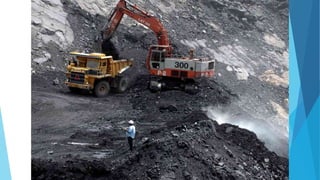
MINERAL RESOURCES
USE AND EXPLOITATION
MINERAL RESOURCES
 MINERALS are naturally occuring, inorganic,
crystalline compounds having a defnite
composition and characteristic physical
properties.
 They are finite, nonrenewable deposits and
include metals (e.g. iron, copper, and aluminum),
and non-metals (e.g. salt, gypsum, clay, sand,
phosphates).
MINERAL RESOURCES
 More than two-thousand minerals have been
identified and most of these contain inorganic
compounds formed by various combinations of the
eight elements (O, Si, Al, Fe, Ca, Na, K, and Mg)
that make up 98.5% of the Earth’s crust.
 Constitute the vital raw materials for many basic
industries and are a major resource for
development.
TYPES OF MINERAL RESOURCES
FUEL MINERALS
Coal: we are a good reservoirs for coal and nearby 400 tones
are mined annually.
Oil(petroleum):It is believed that petroleum has been
formed over a period of millions of years, through conversion
of remains of micro organisms living in sea, into hydrocarbon
by heat, pressure and catalytic action. The petroleum on
fractional distillation and further processing provides us nu-
merous products and by-products.
FUEL MINERALS
Natural gas:
The proven reserve for natural gas on April 1993 works
out to be approx. 700 billion cubic meter (BCM).
As regard to production vis a utilization aspect in
earlier years, more than half of gas coming out of the
wells remained unutilized.
However, in recent years, we have achieved a
utilization rate of 80 – 90% and it is unlikely that our gas
reserves might last for more than 20 years.
TYPES OF MINERAL RESOURCES
METALLIC MINERALS
 Hard substance and conduct
heat and electricity with a
characteristics of luster or
shine.
 They contains metals in their
chemical composition and are
potential source of the metal
that can be got through mining.
 Example: Gold, Silver, Tin,
Copper, Lead, Zinc, Iron, Nickel,
Chromium, and Aluminum.
NONMETALLIC MINERALS
 A non-metallic shine or lustre
in their appearance.
 Do not contain extractable
metals in their chemical
composition.
 No new product can be
generated if they are melted.
 Example: sand, gravel, gypsum,
halite, Uranium, dimension
stone.
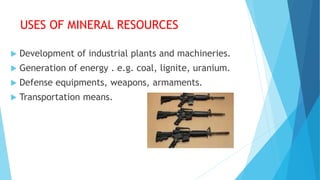
USES OF MINERAL RESOURCES
 Development of industrial plants and machineries.
 Generation of energy . e.g. coal, lignite, uranium.
 Defense equipments, weapons, armaments.
 Transportation means.
USES OF MINERAL RESOURCES
 Communication- telephone wires, cables,
electronic devices.
 Construction, housing, settlements.
 Medicinal system- particularly in Ayurvedic
System.
 Formation of alloys for various purposes (e.g.
phosphorite).
USES OF MINERAL RESOURCES
 Agriculture – as fertilizers, seed dressings and
fungicides (e.g. zineb containing zinc, Maneb-
containing manganese etc.).
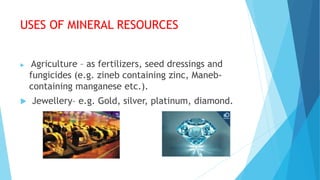
 Jewellery– e.g. Gold, silver, platinum, diamond.
INDIAN SCENARIO
 Manganese- Manganese is used in steel industries
and in making paints, glass, insecticides,
batteries, chemicals, bleaching powder, etc. India
stands second in the reserves of manganese in the
world.
 Iron ore- Iron ore is used in the manufacture of
steel and iron. Haematite, limonite, magnetite
and siderite are the varieties of iron ore.
INDIAN SCENARIO
 Mica- Mica is used in electrical and electronics
industries. It is also used in production of medicines,
paints, etc.
 Copper- Copper is a good conductor of electricity.
Copper is used for making alloys, electric wires and
utensils. It is also used in the manufacture of
medicines.
 Bauxite- India has large deposits of bauxite ore. It is
used in industries as rawmaterials which manufacture
ships, aeroplanes, automobiles, electric wires, etc.
OVEREXPLOITATION & CONSEQUENCES
Over-exploitation of mineral wealth have to be serious,
drastic and enormously damaging to the entire
biosphere. its consequences are as follows:
1. Rapid Depletion of High Grade Mineral Deposits
2. Wastage and Dissemination of Mineral Wealth
3. Pollution of Environment from Mining and Processing
Wastes
4. Pollution Caused by Heavy Energy Requirement of
Mining Industry:
MINING-A HAZARDOUS OCCUPATION
 This occupation involves several health risk dust produced
during mining operation are injurious to health and cause
lung diseases.
 Extraction of some toxic or radioactive minerals leads to
life threatening hazards.
 Dynamite explosion during mining is very risky as fumes
produced are extremely poisonous.
 Underground mining is more hazardous than surface
mining as there are more chances if accidents like roof
falls, flooding and inadequate ventilation etc.
ENVIORMENTAL PROBLEMS
Over exploitation of mineral resources resulted in many
environmental problems like:
 1. Conversion of productive land into mining and industrial
areas.
 2. Mining and extraction process are one of the sources of air,
water and land pollution.
 3. Mining involves huge consumption of energy resources like
coal, petroleum, natural gas etc. which are in-turn non
renewable sources of energy.
 4. Surface mining directly degrades the fertile soil surface thus
effect ecology and climate if that particular area.
CONSERVATION OF MINERAL RESOURCES
 Selection and adoption of suitable methodology of mining
which will have negligible effect on environment.
 Economic and optimum use of minerals. Low grade ores can be
better utilised by microbial leaching technique.
 Recovering all associated elements as co-products or by-
products.
 Use and reuse of scraps after suitable treatments.
 Replacing rare and costly minerals with those which are
abundant and cheaper.
 Restoration of mineral areas by revegetation.
BIBLIOGRAPHY
 http://www.yourarticlelibrary.com/essay/factors-affecting-
exploitation-of-mineral-resources-around-the-world/25483.
 http:/http://www.preservearticles.com/2012021323185/consequence
s-of-over-exploitation-of-mineral-resources.html.
 www.preservearticles.com/2012021323185/consequences-of-over-
exploitation-of-mineral-resources.html.
 http://www.yourarticlelibrary.com/environment/minerals/mineral-
resources-definition-types-use-and-exploitation.
 https://www.slideshare.net/AJINGHOSH/mineral-resources.
 http://www.environmentalpollution.in/minerals/mineral-resources-
types-impact-of-mineral-activities-on-environment-and-its-
conservation
Any questions……
Mineral resources

Mineral resources

  • 1.
  • 2.
    MINERAL RESOURCES  MINERALSare naturally occuring, inorganic, crystalline compounds having a defnite composition and characteristic physical properties.  They are finite, nonrenewable deposits and include metals (e.g. iron, copper, and aluminum), and non-metals (e.g. salt, gypsum, clay, sand, phosphates).
  • 3.
    MINERAL RESOURCES  Morethan two-thousand minerals have been identified and most of these contain inorganic compounds formed by various combinations of the eight elements (O, Si, Al, Fe, Ca, Na, K, and Mg) that make up 98.5% of the Earth’s crust.  Constitute the vital raw materials for many basic industries and are a major resource for development.
  • 4.
    TYPES OF MINERALRESOURCES FUEL MINERALS Coal: we are a good reservoirs for coal and nearby 400 tones are mined annually. Oil(petroleum):It is believed that petroleum has been formed over a period of millions of years, through conversion of remains of micro organisms living in sea, into hydrocarbon by heat, pressure and catalytic action. The petroleum on fractional distillation and further processing provides us nu- merous products and by-products.
  • 5.
    FUEL MINERALS Natural gas: Theproven reserve for natural gas on April 1993 works out to be approx. 700 billion cubic meter (BCM). As regard to production vis a utilization aspect in earlier years, more than half of gas coming out of the wells remained unutilized. However, in recent years, we have achieved a utilization rate of 80 – 90% and it is unlikely that our gas reserves might last for more than 20 years.
  • 6.
    TYPES OF MINERALRESOURCES METALLIC MINERALS  Hard substance and conduct heat and electricity with a characteristics of luster or shine.  They contains metals in their chemical composition and are potential source of the metal that can be got through mining.  Example: Gold, Silver, Tin, Copper, Lead, Zinc, Iron, Nickel, Chromium, and Aluminum. NONMETALLIC MINERALS  A non-metallic shine or lustre in their appearance.  Do not contain extractable metals in their chemical composition.  No new product can be generated if they are melted.  Example: sand, gravel, gypsum, halite, Uranium, dimension stone.
  • 7.
    USES OF MINERALRESOURCES  Development of industrial plants and machineries.  Generation of energy . e.g. coal, lignite, uranium.  Defense equipments, weapons, armaments.  Transportation means.
  • 8.
    USES OF MINERALRESOURCES  Communication- telephone wires, cables, electronic devices.  Construction, housing, settlements.  Medicinal system- particularly in Ayurvedic System.  Formation of alloys for various purposes (e.g. phosphorite).
  • 9.
    USES OF MINERALRESOURCES  Agriculture – as fertilizers, seed dressings and fungicides (e.g. zineb containing zinc, Maneb- containing manganese etc.).  Jewellery– e.g. Gold, silver, platinum, diamond.
  • 10.
    INDIAN SCENARIO  Manganese-Manganese is used in steel industries and in making paints, glass, insecticides, batteries, chemicals, bleaching powder, etc. India stands second in the reserves of manganese in the world.  Iron ore- Iron ore is used in the manufacture of steel and iron. Haematite, limonite, magnetite and siderite are the varieties of iron ore.
  • 11.
    INDIAN SCENARIO  Mica-Mica is used in electrical and electronics industries. It is also used in production of medicines, paints, etc.  Copper- Copper is a good conductor of electricity. Copper is used for making alloys, electric wires and utensils. It is also used in the manufacture of medicines.  Bauxite- India has large deposits of bauxite ore. It is used in industries as rawmaterials which manufacture ships, aeroplanes, automobiles, electric wires, etc.
  • 12.
    OVEREXPLOITATION & CONSEQUENCES Over-exploitationof mineral wealth have to be serious, drastic and enormously damaging to the entire biosphere. its consequences are as follows: 1. Rapid Depletion of High Grade Mineral Deposits 2. Wastage and Dissemination of Mineral Wealth 3. Pollution of Environment from Mining and Processing Wastes 4. Pollution Caused by Heavy Energy Requirement of Mining Industry:
  • 14.
    MINING-A HAZARDOUS OCCUPATION This occupation involves several health risk dust produced during mining operation are injurious to health and cause lung diseases.  Extraction of some toxic or radioactive minerals leads to life threatening hazards.  Dynamite explosion during mining is very risky as fumes produced are extremely poisonous.  Underground mining is more hazardous than surface mining as there are more chances if accidents like roof falls, flooding and inadequate ventilation etc.
  • 15.
    ENVIORMENTAL PROBLEMS Over exploitationof mineral resources resulted in many environmental problems like:  1. Conversion of productive land into mining and industrial areas.  2. Mining and extraction process are one of the sources of air, water and land pollution.  3. Mining involves huge consumption of energy resources like coal, petroleum, natural gas etc. which are in-turn non renewable sources of energy.  4. Surface mining directly degrades the fertile soil surface thus effect ecology and climate if that particular area.
  • 16.
    CONSERVATION OF MINERALRESOURCES  Selection and adoption of suitable methodology of mining which will have negligible effect on environment.  Economic and optimum use of minerals. Low grade ores can be better utilised by microbial leaching technique.  Recovering all associated elements as co-products or by- products.  Use and reuse of scraps after suitable treatments.  Replacing rare and costly minerals with those which are abundant and cheaper.  Restoration of mineral areas by revegetation.
  • 17.
    BIBLIOGRAPHY  http://www.yourarticlelibrary.com/essay/factors-affecting- exploitation-of-mineral-resources-around-the-world/25483.  http:/http://www.preservearticles.com/2012021323185/consequence s-of-over-exploitation-of-mineral-resources.html. www.preservearticles.com/2012021323185/consequences-of-over- exploitation-of-mineral-resources.html.  http://www.yourarticlelibrary.com/environment/minerals/mineral- resources-definition-types-use-and-exploitation.  https://www.slideshare.net/AJINGHOSH/mineral-resources.  http://www.environmentalpollution.in/minerals/mineral-resources- types-impact-of-mineral-activities-on-environment-and-its- conservation
  • 18.